Frontierby eninvs

Language: EN · RU

Indonesia Stocks — Valuations, P/E & Dividends

Guide: Indonesian Stocks (2026): The Cheapest Big Emerging Market

Related guides: The Cheapest Coal Stocks (2026) · The Cheapest Bank Stocks in the World (2026)

GDP growth 2026 (proj.) 5.0%Inflation YoY (proj.) 3.0%FX vs USD (3y avg p.a.) +4.8%Macro: IMF World Economic Outlook, April 2026 (Annex tables 1.1.2–1.1.4)
Our recommended portfolios
Performance & current holdings of our strategies for this market — why it makes sense to join.
FVC (quality)backtest CAGR +50% · excess +57%Paper-track · 15 Jun 2026
CAGR +50% · vs index +57% · Sharpe 1.69 · maxDD -13%
Day-0.8%JKSE -1.1%
Week-2.0%JKSE -3.4%
Month+4.4%JKSE +0.9%
By calendar year vs JKSE
YearStratJKSEΔ
2026*+52.5%-24.6%+77.1%
2025+27.6%+22.1%+5.5%
2024*+0.0%-7.6%+7.6%
* partial year
Signal history & trades →
Commodity-Upsidebacktest CAGR +1% · excess +9%Paper-track · 15 Jun 2026
CAGR +1% · vs index +9% · Sharpe 0.20 · maxDD -45%
Day-1.2%JKSE -1.1%
Week-3.4%JKSE -3.4%
Month+4.3%JKSE +0.9%
By calendar year vs JKSE
YearStratJKSEΔ
2026*+3.5%-24.6%+28.2%
2025-3.1%+22.1%-25.3%
2024*-2.3%-7.6%+5.3%
* partial year
Signal history & trades →

Sectors: Coal mining (5) · Banks (4) · Consumer staples (3)

Rows are ordered partly by extraction health (share of stable periods). Hover a row for OK / partial / error counts.

CompanyCountrySectorValue / upsideDiv. %FCF Yield LTMΔ revenue (NII for banks)Δ EBITDA (assets for financials)EV/EBITDA LTMP/E LTMP/B FYROE (ann.)
Adaro Andalan Indonesia
ID_AADI
IDCoal mining+40%8.1%0.2%21.6%56.1%4.5x4.1x1.6x37.5%
Bukit Asam
ID_PTBA
IDCoal mining+29%3.8%0.0%-0.3%3.9x6.2x1.5x21.7%
Alamtri Resources Indonesia
ID_ADRO
IDCoal mining+28%9.9%-17.7%11.0%50.2%4.9x6.1x0.8x15.3%
Bank Central Asia
ID_BBCA
IDBanks+0%6.0%9.5%13.6x2.8x22.3%
Bank Negara Indonesia
ID_BBNI
IDBanks+0%9.3%14.2%20.6%6.8x0.8x12.9%
Bank Rakyat Indonesia
ID_BBRI
IDBanks+0%10.4%7.1%8.8x18.9%
Indo Tambangraya Megah
ID_ITMG
IDCoal mining-1%6.5%-4.3%8.8%8.5x0.9x11.1%
Bayan Resources
ID_BYAN
IDCoal mining-3%2.2%1.9%7.3%25.0x7.1x30.0%
Aneka Tambang
ID_ANTM
IDMetals mining-71%6.4%-0.0%22.3%221.1%4.3x5.6x2.2x35.0%
Vale Indonesia
ID_INCO
IDNickel mining-72%1.6%-16.9%31.9%944.5%8.8x16.5x1.0x8.6%
GoTo Gojek Tokopedia
ID_GOTO
IDTechnology0.0%15.3%1.7x2.9%
Astra International
ID_ASII
IDConglomerate8.0%-0.0%-2.3%-0.3%3.7x6.0x0.9x10.8%
Charoen Pokphand Indonesia
ID_CPIN
IDPoultry and feed5.7%-0.0%4.8%61.2%3.4x5.4x1.5x20.7%
Indofood CBP Sukses Makmur
ID_ICBP
IDConsumer staples3.8%0.0%3.1%13.4%2.9x6.3x1.1x13.8%
Kalbe Farma
ID_KLBF
IDPharmaceuticals2.6%-0.0%8.3%4.2x6.2x1.4x15.3%
Chandra Asri Pacific
ID_TPIA
IDPetrochemicals0.5%2.0%83.6%8.2x3.1x11.5%
Mitra Keluarga Karyasehat
ID_MIKA
IDHealthcare2.4%0.0%10.1%12.2x17.3x3.4x18.4%
Indofood Sukses Makmur
ID_INDF
IDConsumer staples4.0%0.0%6.7%24.4%1.4x4.1x0.9x12.3%
Semen Indonesia
ID_SMGR
IDCement1.8%0.0%-2.6%2.2x56.0x1.0%
Telkom Indonesia
ID_TLKM
IDTelecom8.4%0.0%-2.2%-4.4%2.4x9.4x2.0x16.8%
Unilever Indonesia
ID_UNVR
IDConsumer staples12.4%-0.0%-9.1%-0.6%7.6x5.8x13.8x124.0%

Work in progress — needs attention

Issuers below have weak extraction, thin market data, missing valuation inputs, or extreme headline YoY/ROE. Hover the row for the checklist.

CompanyCountrySectorValue / upsideDiv. %FCF Yield LTMΔ revenue (NII for banks)Δ EBITDA (assets for financials)EV/EBITDA LTMP/E LTMP/B FYROE (ann.)
Bank Mandiri
ID_BMRI
IDBanks+0%12.6%-8.7%16.6%6.1x1.2x20.8%
Perusahaan Gas Negara
ID_PGAS
IDGas distribution8.2%15.3%-3.8%-40.4%9.7x0.6x13.0%

Earnings analysis

Short take-aways from recent corporate results and commodity trends.

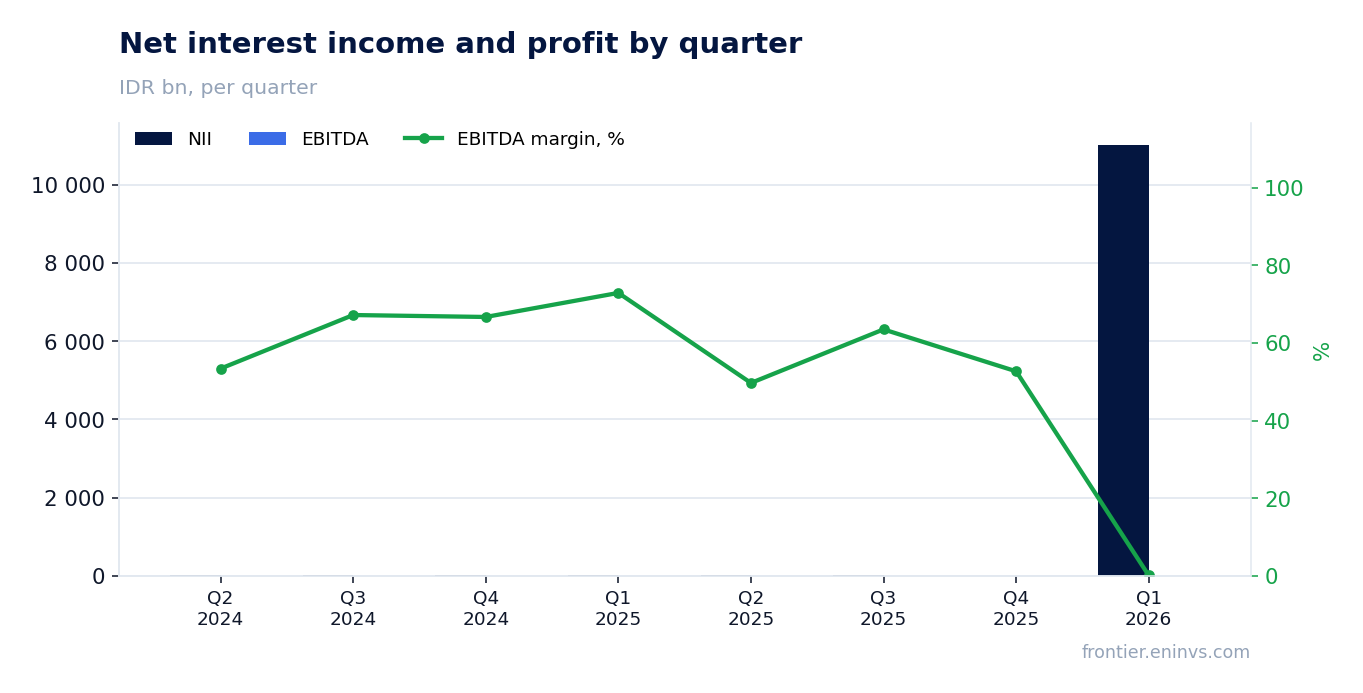
ID_BMRI: H1 profit up 17.8% while net interest income declines

BMRI →
ID_BMRI

The H1 2026 report showed net profit of IDR 31,627.0 mn, up 17.8% year-on-year. However, net interest income declined by 8.7% to IDR 47,839.2 mn. Over the trailing twelve months, net profit reached IDR 66,122,798.0 mn, with a P/E LTM of 6.1. In our view, the share looks neutral: strong profit growth against falling interest income and dividend uncertainty does not provide a clear edge either way.

Key takeaways

— Net profit for H1 2026 rose 17.8% to IDR 31,627.0 mn, but net interest income fell 8.7% to IDR 47,839.2 mn

— Net profit as a share of net interest income rose to 66.1% from 51.3% a year earlier, indicating lower costs or one-off factors

— Trailing twelve-month net profit reached IDR 66,122,798.0 mn, with a P/E LTM of 6.1

— Return on equity (ROE) over the last twelve months was 20.8%

— Dividend yield over the last twelve months was 11.0%

— According to the portal's model, the upside to fair value is +0%

— The share is held in the live model strategy Frontier AI Selection

Attractiveness

Key figures, IDR bn

MetricH1 2025H1 2026Change
Net interest income52.447.8-8.7%
Operating profit33.439.1+16.8%
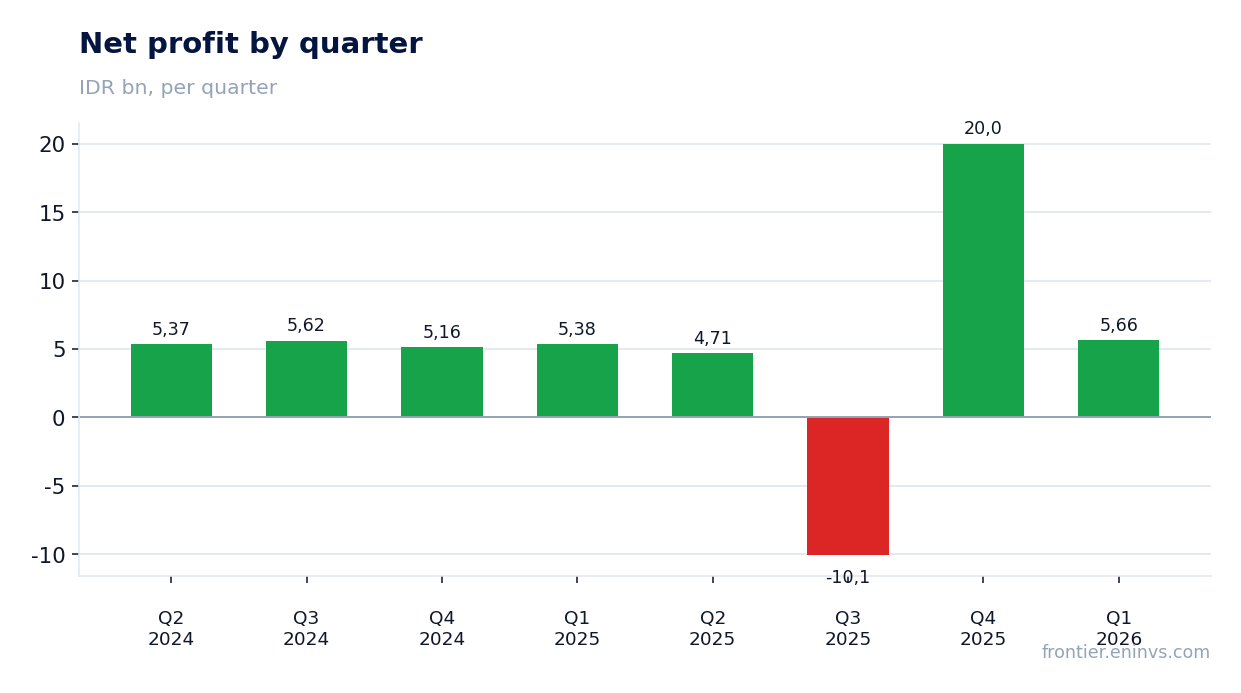
Net profit26.931.6+17.8%
Net margin51.3%66.1%+14.8 pp

Net profit for H1 2026 rose 17.8% to IDR 31,627.0 mn, but net interest income fell 8.7% to IDR 47,839.2 mn

For H1 2026, net profit amounted to IDR 31,627.0 mn, up 17.8% from the same period in 2025. However, net interest income for the same period declined by 8.7% to IDR 47,839.2 mn. Thus, profit growth was not driven by an increase in interest income but by other factors.

The decline in net interest income could be due to a contraction in the interest margin or a reduction in earning assets. The report does not disclose the reasons, so we note only the fact: interest income is falling while profit is rising.

In terms of individual quarters: in Q1 2026, net profit was IDR 16,213.3 mn, up 11.6% from Q1 2025 (IDR 14,530.15 mn). Net interest income in Q1 2026 decreased by 1.8% year-on-year to IDR 25,049.6 mn.

This dynamic indicates that profit growth is driven not by the interest business but possibly by fee income or cost reductions. Without additional information, it is difficult to assess the sustainability of this trend.

Net profit as a share of net interest income rose to 66.1% from 51.3% a year earlier, indicating lower costs or one-off factors

The ratio of net profit to net interest income for H1 2026 was 66.1% versus 51.3% for H1 2025. This is not a margin or profitability measure, but merely a ratio of two indicators. The increase means profit grew relative to interest income.

Such a change could result from lower operating expenses, reduced loan loss provisions, or one-off income. The report lacks detail, so we cannot claim this is a sustainable trend.

If the increase is due to one-off factors, the ratio may revert in future periods. This is a key risk for assessing profit sustainability.

Trailing twelve-month net profit reached IDR 66,122,798.0 mn, with a P/E LTM of 6.1

Trailing twelve-month (LTM) net profit was IDR 66,122,798.0 mn. This is the sum over four quarters ended 30 June 2026. It is not the result of the reported half-year.

The P/E LTM is 6.1. This is a relatively low level, which may indicate undervaluation, but without comparison to the three-year average we cannot draw a conclusion. The facts do not provide the three-year average P/E.

Market capitalisation is IDR 405,066,522.0 mn. With this capitalisation and LTM profit of IDR 66,122,798.0 mn, the price-to-earnings ratio is indeed 6.1.

Return on equity (ROE) over the last twelve months was 20.8%

Return on equity (ROE) over the last twelve months was 20.8%. This is a high figure, indicating efficient use of equity capital.

However, ROE is based on LTM profit, which includes one-off factors if any. Without data on equity and its dynamics, we cannot assess the sustainability of this level.

High ROE with a low P/E may indicate potential undervaluation, but it could also reflect risks related to profit quality.

Dividend yield over the last twelve months was 11.0%

Dividend yield over the last twelve months was 11.0%. This is a high level, which may be attractive to income-oriented investors.

However, the facts do not provide information on what dividends were paid over the last year or the company's dividend policy. We cannot assess the sustainability of payments.

For comparison: the key rate is not provided in the facts, so we cannot compare the yield with a risk-free rate. High yield may be compensation for risk.

According to the portal's model, the upside to fair value is +0%

According to the portal's model, which compares return on equity to price-to-book, the upside to fair value is +0%. This means the current price is close to the model's estimate.

The portal's model is not a market consensus or a target price. It is our own calculation based on available data.

Zero upside indicates that the share is fairly valued according to the model, and further growth requires new drivers.

The share is held in the live model strategy Frontier AI Selection

The share ID_BMRI is held in the live model strategy Frontier AI Selection on the portal. This is a fact and not an argument for an investment decision.

Inclusion in the strategy reflects compliance with selection criteria but does not guarantee returns. The strategy may change at any time.

We mention this fact for completeness but do not use it as a recommendation.

Valuation on the latest reported figures

MetricValue
Market cap405 067 bn IDR
P/E (LTM)6.1
P/B1.24
ROE20.8%
Dividend yield (12m)11.0%

Bottom line

In H1 2026, net profit rose 17.8% to IDR 31,627.0 mn, but net interest income fell 8.7%. Profit growth against declining interest income raises questions about profit quality. LTM profit was IDR 66,122,798.0 mn, P/E LTM is 6.1, ROE is 20.8%, and dividend yield is 11.0%. According to the portal's model, upside is zero. We rate the share as neutral: strong current metrics are balanced by risks to profit sustainability and a lack of clear growth drivers.
ID_BYAN: H1 profit up 17.5%, but Q1 revenue fell 7.7%

BYAN →
ID_BYAN

Today ID_BYAN released its results for the first half of 2026. Revenue came in at $1,740.1 million, net profit at $410.3 million, and operating cash flow at $488.1 million. Year on year, revenue rose 7.3% and net profit 17.5%, with the net margin improving to 23.6% from 21.5%. However, in the standalone first quarter of 2026, revenue declined 7.7% year on year, contrasting with the half-year growth. At the current price, the stock trades at 25.1 times trailing earnings and offers a dividend yield of 2.6%; our model puts fair value just 3% below the market, so we view the shares as neutral.

Key takeaways

— H1 revenue rose 7.3%, but Q1 revenue fell 7.7% year on year

— Net profit increased 17.5% on margin expansion to 23.6% from 21.5%

— Operating cash flow for H1 was $488.1 million, exceeding net profit

— Dividend yield of 2.6% with a payout ratio of about 66% of earnings

— P/E of 25.1 is a neutral valuation; the portal model's fair value is 3% below the market

— Return on equity of 30.0% supports dividend payments

Attractiveness

Key figures, USD bn

MetricH1 2025H1 2026Change
Revenue1.621.74+7.3%
Net profit0.350.41+17.5%
Operating cash flow0.580.49-16.1%
Net margin21.5%23.6%+2.1 pp

H1 revenue rose 7.3%, but Q1 revenue fell 7.7% year on year

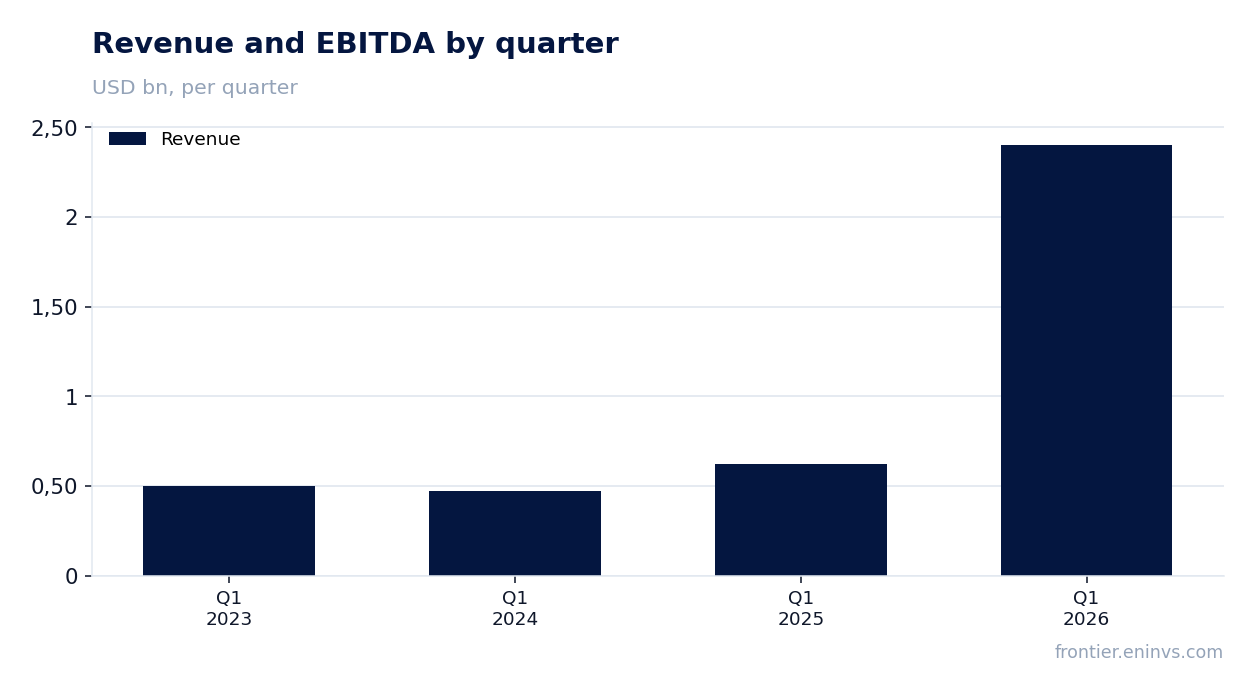
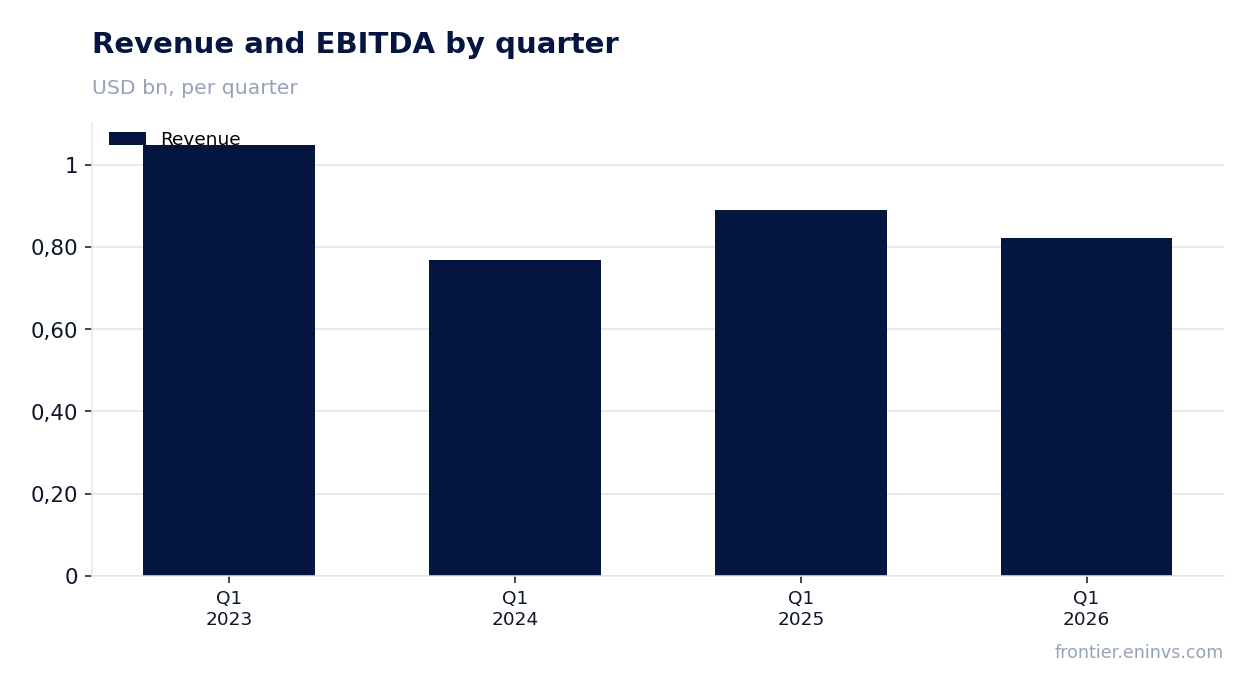
In the first half of 2026, ID_BYAN's revenue reached $1,740.1 million, up 7.3% from the same period last year. However, in the standalone first quarter of 2026, revenue declined 7.7% year on year to $821.7 million. This discrepancy is explained by an acceleration in the second quarter that offset the quarterly decline.

Quarterly dynamics show instability: in Q1 2024 revenue fell 26.7%, then in Q1 2025 it grew 15.7%, and in Q1 2026 it declined again by 7.7%. The half-year growth of 7.3% was achieved thanks to the second quarter, for which separate data is not disclosed but which apparently showed significant growth.

For an investor, it is important that the company can grow revenue for the half-year despite a weak start. However, quarterly volatility persists, and the sustainability of the recovery in the second half is not yet confirmed.

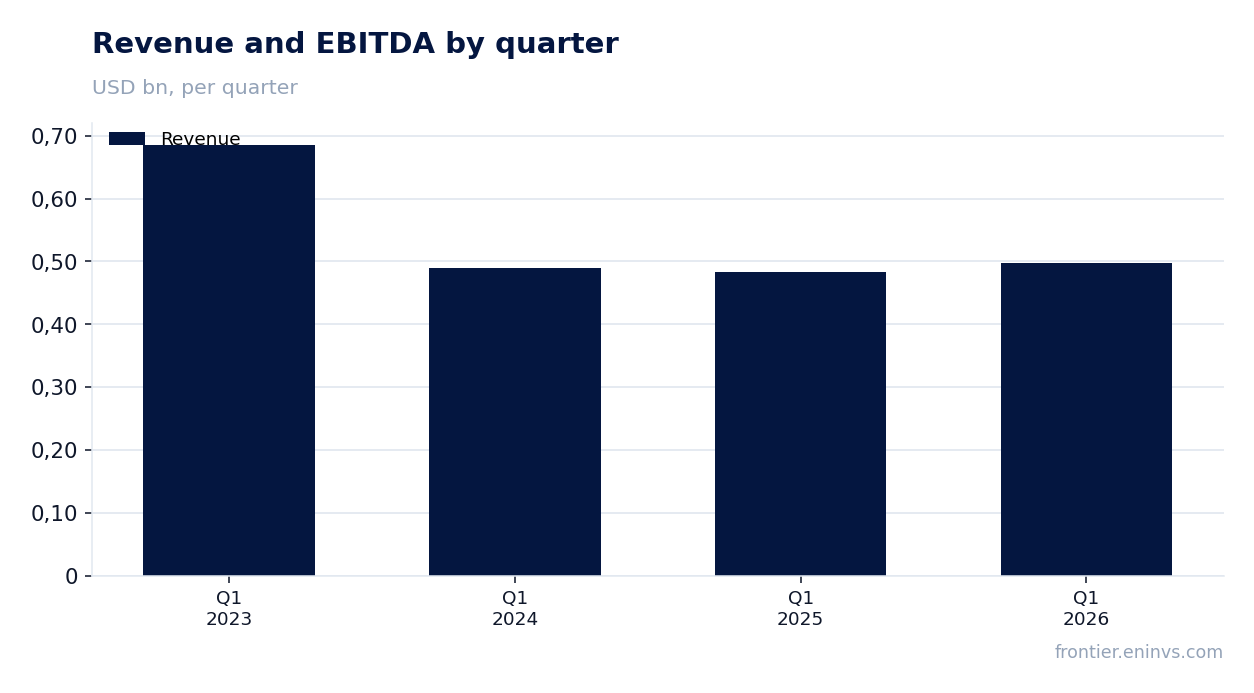
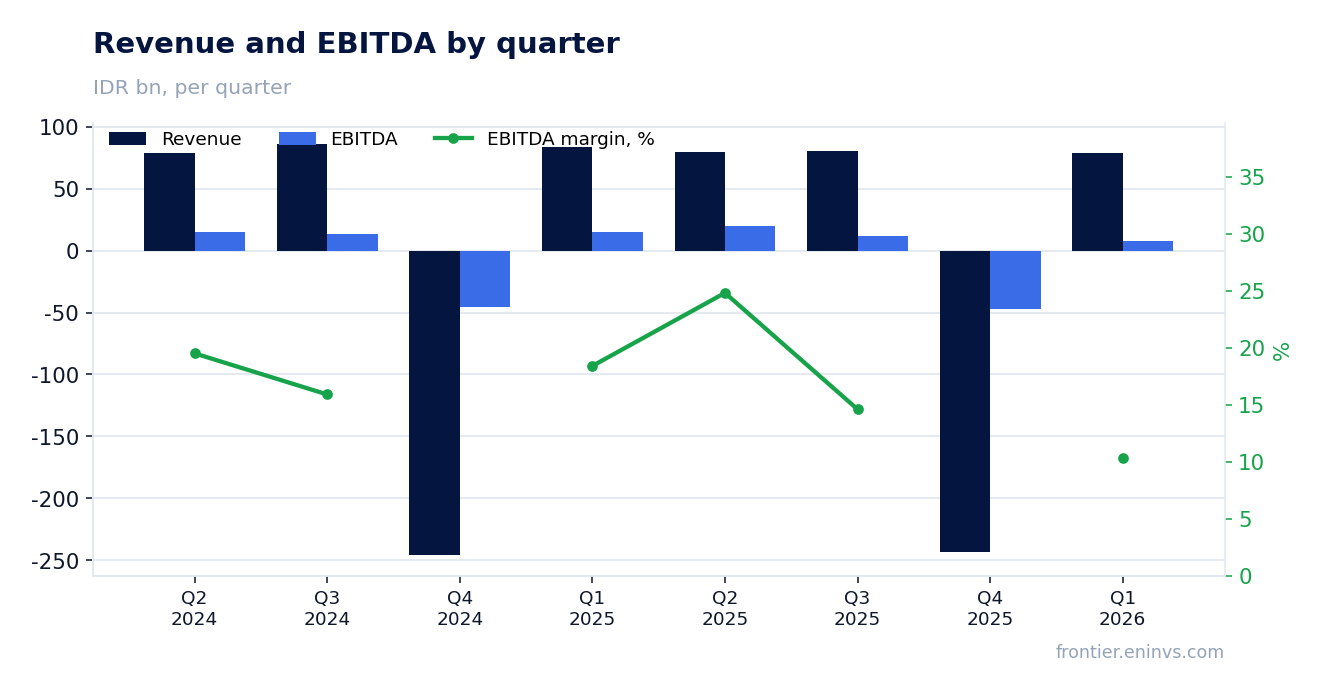
Revenue and EBITDA by quarter

Net profit increased 17.5% on margin expansion to 23.6% from 21.5%

Net profit for the first half of 2026 was $410.3 million, up 17.5% from a year earlier. The net margin rose to 23.6% from 21.5% in the first half of 2025. Thus, profit grew faster than revenue, indicating improved cost control or a change in business mix.

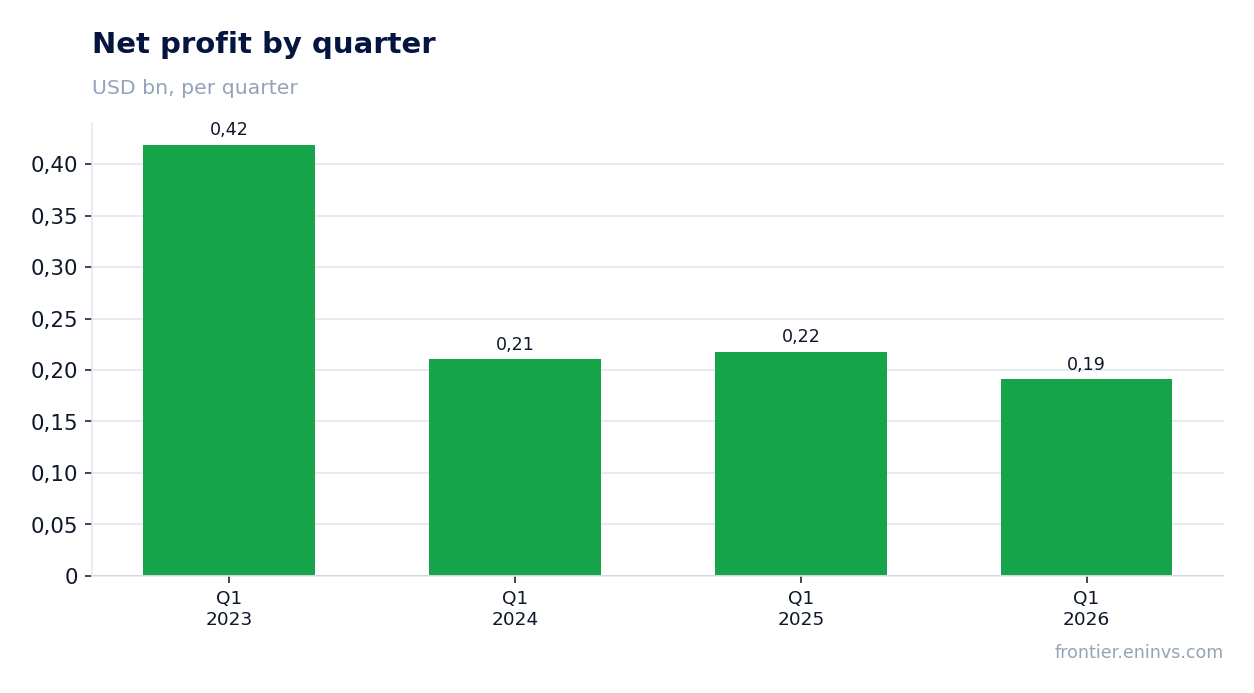
In the standalone first quarter of 2026, net profit was $190.8 million, down 12.4% from $217.9 million in Q1 2025. This decline is consistent with the revenue drop in the quarter, but the half-year margin still improved, suggesting a positive contribution from the second quarter.

Profit growth amid a revenue decline in one quarter could be due to one-off factors or changes in the tax burden, but details are not disclosed. For sustainability, it is important that the margin improvement continues.

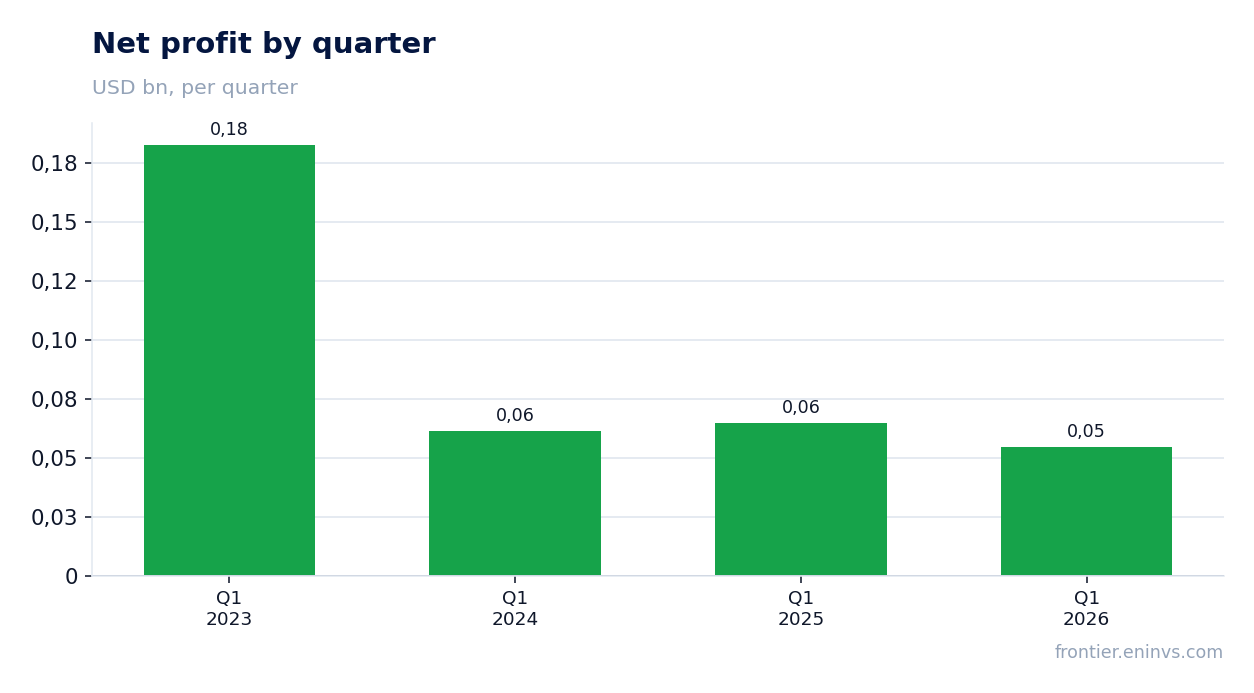
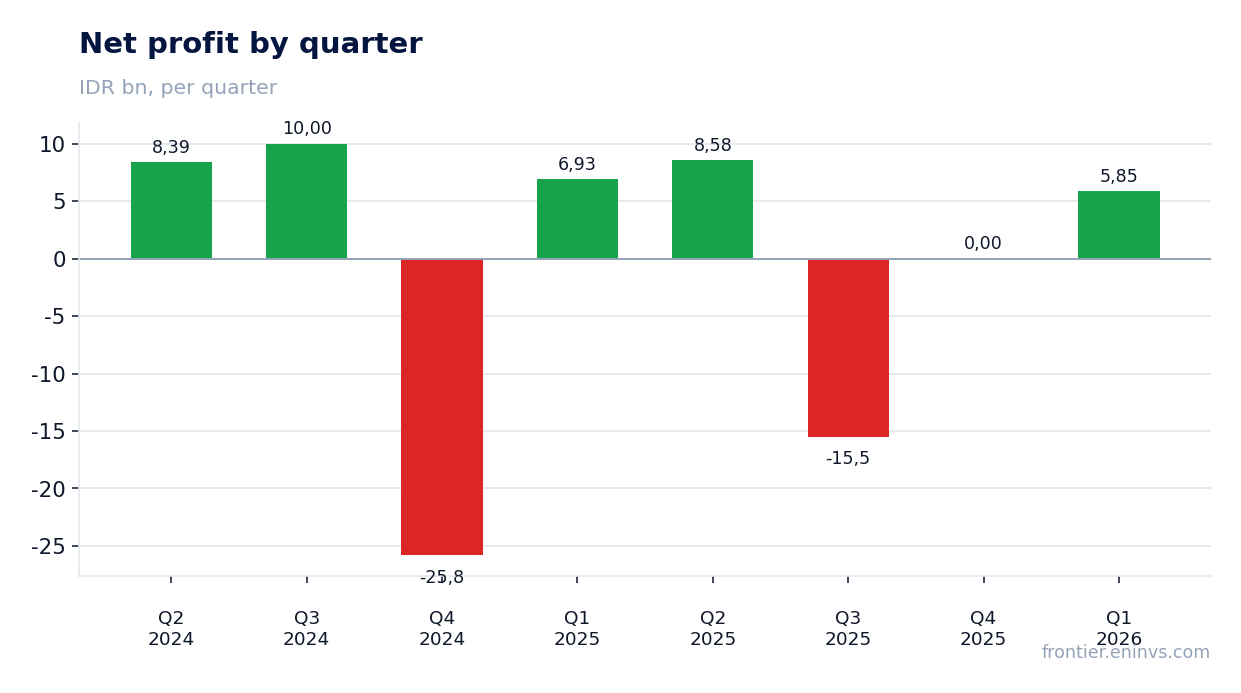
Net profit by quarter

Operating cash flow for H1 was $488.1 million, exceeding net profit

Operating cash flow for the first half of 2026 reached $488.1 million, exceeding net profit for the same period by 19.0%. This indicates high earnings quality and the company's ability to generate cash. In the standalone first quarter of 2026, operating cash flow was $215.8 million, also above quarterly net profit ($190.8 million).

The excess of operating cash flow over net profit may be explained by depreciation and other non-cash items, as well as efficient working capital management. This is a positive signal for dividend payments and investments.

However, capital expenditure data is not available, so free cash flow cannot be assessed. For a complete picture, it is important that operating cash flow remains stable and covers investment needs.

Dividend yield of 2.6% with a payout ratio of about 66% of earnings

ID_BYAN's dividend yield over the trailing twelve months is 2.6%. With trailing twelve-month net profit of $767.9 million and a market capitalisation of $19,252.5 million, this corresponds to a payout ratio of about 66% of earnings. This level of payout is moderate and leaves the company room for investment and maintaining financial stability.

For comparison, the key rate in the economy is unknown, but a yield of 2.6% may be less attractive for income-oriented investors, especially considering that the company does not disclose its dividend policy. However, stable operating cash flow and high return on equity (30.0%) support the ability to pay dividends.

A risk to dividends is a possible decline in profit, as happened in the standalone first quarter of 2026, when net profit fell 12.4% year on year. If this trend continues, the payout ratio may rise, limiting the scope for dividend increases.

P/E of 25.1 is a neutral valuation; the portal model's fair value is 3% below the market

The price-to-earnings ratio for the trailing twelve months (P/E LTM) is 25.1. This is a moderate level that appears neither clearly overvalued nor attractive. According to our model, the fair value of the share is 3% below the current market price, indicating it is close to fair valuation.

It is impossible to compare the current P/E with the three-year average, as the FACTS do not contain historical data on the multiple. However, a return on equity of 30.0% and stable operating cash flow support the current valuation.

A change in valuation would require either an acceleration in profit growth or a reduction in risks associated with revenue volatility. For now, the stock is fairly valued, and upside potential is limited.

Return on equity of 30.0% supports dividend payments

ID_BYAN's return on equity (ROE) is 30.0%. This is a high figure, indicating efficient use of capital and the company's ability to generate profit for shareholders. With such profitability, the company can sustain dividend payments even with some decline in profit.

A high ROE also means the company can finance growth from internal resources without resorting to a significant increase in debt. This reduces financial risks and supports business sustainability.

However, to maintain ROE at this level, it is necessary to sustain net margin and asset turnover. In the standalone first quarter of 2026, net profit declined, which could put pressure on the annual ROE if the trend does not reverse.

Valuation on the latest reported figures

MetricValue
Market cap19.3 bn USD
P/E (LTM)25.1
P/B7.14
Operating cash flow (LTM)0.98 bn
ROE30.0%
Dividend yield (12m)2.6%

Bottom line

ID_BYAN delivered strong results for the first half of 2026: revenue rose 7.3%, net profit 17.5%, and the margin reached 23.6%. However, these gains are overshadowed by a weak first quarter, when revenue fell 7.7% and profit 12.4%. Operating cash flow remains high, exceeding net profit, confirming earnings quality. A dividend yield of 2.6% and P/E of 25.1 appear neutral, and the portal model's fair value is just 3% below the market. For an investor, the key question is whether the company can restore revenue growth in the second half to justify the current valuation.

ID_TPIA: H1 profit fell 77.5% even as revenue rose 83.6%

TPIA →
ID_TPIA

The H1 2026 report, ended 30 June, showed revenue of 5,348.8 million dollars and net profit of 283.2 million dollars. Revenue rose 83.6% year on year, but net profit fell 77.5%, and the net margin dropped from 43.3% to 5.3%. At a price implying a P/E LTM of 8.24 and a dividend yield of 0.54%, the share looks rather unattractive: revenue growth is not converting into profit, and net debt of 633.8 million dollars against operating cash flow of 9.6 million dollars for the half-year leaves no margin of safety.

Key takeaways

— H1 revenue rose 83.6% to 5,348.8 million dollars, but profit fell 77.5%

— Net margin collapsed from 43.3% to 5.3% – revenue growth did not reach the bottom line

— Operating cash flow for the half-year was only 9.6 million dollars against revenue of 5,348.8 million

— Net debt of 633.8 million dollars against LTM profit of 1,090.1 million – leverage is moderate, but cash flow does not cover it

— Dividend yield of 0.54% does not compensate for the profit decline and debt risks

— P/E LTM of 8.24 versus ROE of 11.5% – valuation does not look cheap given the margin collapse

Attractiveness

Key figures, USD bn

MetricH1 2025H1 2026Change
Revenue2.915.35+83.6%
Net profit1.260.28-77.5%
Operating cash flow-0.110.01в прибыль
Net margin43.3%5.3%-38.0 pp

H1 revenue rose 83.6% to 5,348.8 million dollars, but profit fell 77.5%

H1 2026 revenue was 5,348.8 million dollars, up 83.6% year on year. This is strong growth, but it was not accompanied by profit growth: net profit fell 77.5% to 283.2 million dollars. The gap between revenue and profit dynamics points to a sharp increase in costs or one-off write-offs not disclosed in the provided data.

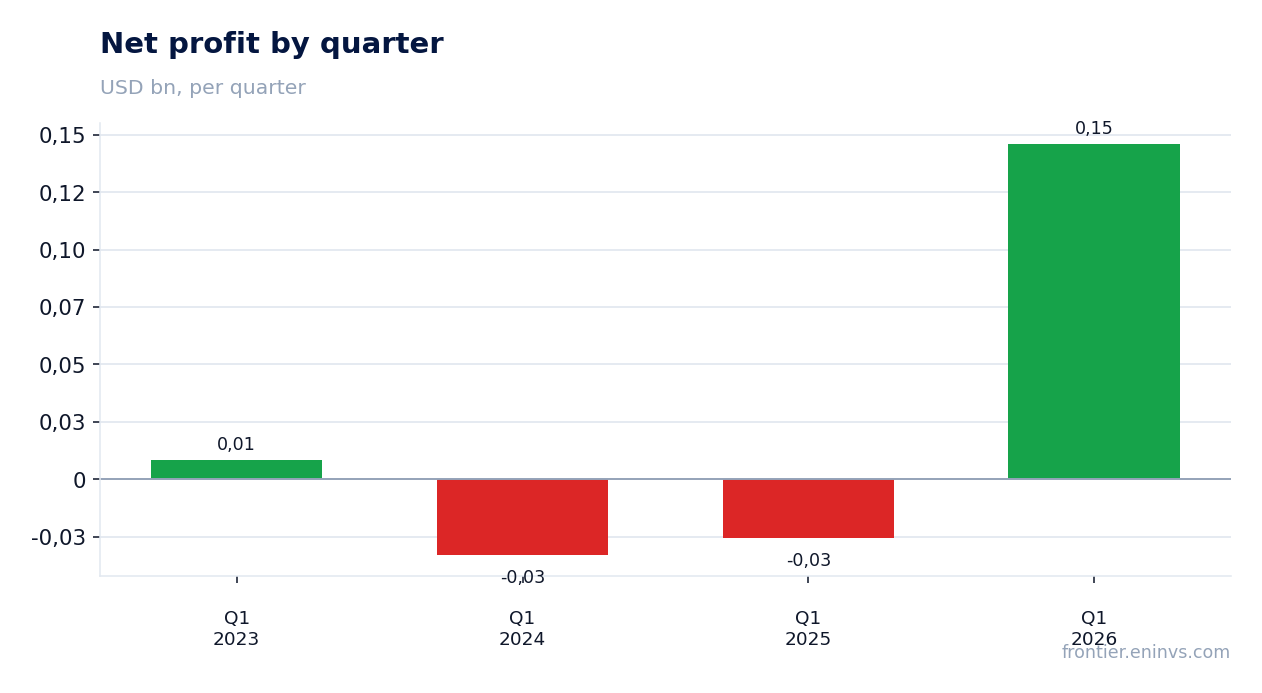
For comparison, in Q1 2026 revenue was 2,403.7 million dollars and net profit was 146.1 million dollars. This implies Q2 revenue slowed to approximately 2,945.0 million dollars, while profit was about 137.1 million dollars. Thus, Q2 profit was lower than Q1 despite higher revenue, confirming the margin deterioration.

Falling profit on rising revenue is a key negative signal from the report. Without disclosure of the reasons for this divergence, an investor cannot assess whether it is a one-off or a sustainable trend. Until the situation is clarified, the share is unlikely to receive support from fundamentals.

Revenue and EBITDA by quarter

Net margin collapsed from 43.3% to 5.3% – revenue growth did not reach the bottom line

The net profit margin for H1 2026 was 5.3% versus 43.3% in the same period last year. This 38 percentage point drop is the most alarming item in the report. Even with significant revenue growth, the company barely earns: out of every 100 dollars of revenue, only 5.3 dollars reach the bottom line.

Such a sharp margin decline could be due to one-off factors or a structural increase in costs. The provided data does not break this down, so it is impossible to say exactly what ate the profit. However, the fact that the margin fell below 10% makes the company vulnerable to any slowdown in revenue.

For an investor, this means the business model may need reassessment. If last year's high margin was an anomaly rather than the norm, the current valuation may be overstated. Until details on costs and one-off items emerge, we cannot recommend the share for purchase.

Net profit by quarter

Operating cash flow for the half-year was only 9.6 million dollars against revenue of 5,348.8 million

Operating cash flow for H1 2026 was 9.6 million dollars – an extremely low figure against revenue of 5,348.8 million dollars. In effect, the company generates almost no cash from core operations, which casts doubt on the quality of earnings and the ability to fund investments or debt from internal sources.

For comparison, over the trailing twelve months operating cash flow was 349.9 million dollars, also small relative to LTM revenue of 7,000.0 million dollars. This means the problem of converting profit into cash is not solely a half-year issue – it is more persistent.

Low operating cash flow combined with net debt of 633.8 million dollars creates refinancing risk. If the company cannot improve cash generation, it will have to raise external financing, potentially diluting shareholder value.

Net debt of 633.8 million dollars against LTM profit of 1,090.1 million – leverage is moderate, but cash flow does not cover it

Net debt at the latest reporting date was 633.8 million dollars. With LTM net profit of 1,090.1 million dollars, this corresponds to a debt-to-profit ratio of about 0.58 – a moderate level. However, servicing debt requires cash, and operating cash flow for the half-year was only 9.6 million dollars, insufficient even to cover interest if it is significant.

The company does not disclose its debt structure or interest rates, so the cost of servicing cannot be assessed. Nevertheless, the combination of low cash flow and debt limits financial flexibility. If market conditions worsen or rates rise, the company could face difficulties.

For shareholders, this means part of future profit may go to debt servicing and repayment rather than dividends or development. Until cash flow recovers, debt burden remains a risk factor.

Dividend yield of 0.54% does not compensate for the profit decline and debt risks

The dividend yield over the trailing twelve months is 0.54%. This is an extremely low level, unattractive to income-oriented investors. At the current share price, dividend payments have virtually no impact on total investment return.

For comparison, the key rate in the dollar zone is significantly higher, making ID_TPIA's dividend yield uncompetitive. Even if the company maintains payments, they do not compensate for the risks associated with falling profit and debt burden.

Moreover, with H1 net profit of 283.2 million dollars and the need to fund investments and debt, the company may be forced to cut dividends. This is another argument against the share at current levels.

P/E LTM of 8.24 versus ROE of 11.5% – valuation does not look cheap given the margin collapse

The P/E LTM is 8.24, and return on equity (ROE) is 11.5%. At first glance, a P/E below 10 may seem attractive, but with ROE at 11.5% and a falling margin, it is not. The market values the company based on earnings sustainability, and current results cast doubt on its stability.

Comparing the current P/E with a 3-year historical average is impossible, as this information is not in the provided data. However, the fact that profit fell 77.5% in the half-year suggests the current P/E may be deceptively low – if profit continues to decline, the multiple will rise.

For an investor, this means the share is not undervalued. Rather, the market is already pricing in expectations of further deterioration. Until there are signs of recovery in margin and cash flow, the valuation is unlikely to be revised upward.

Valuation on the latest reported figures

MetricValue
Market cap8.98 bn USD
P/E (LTM)8.2
P/B3.06
Operating cash flow (LTM)0.35 bn
ROE11.5%
Dividend yield (12m)0.5%

Bottom line

The strong point of the report is revenue growth of 83.6% to 5,348.8 million dollars in H1 2026. However, this growth did not convert into profit: net profit fell 77.5% to 283.2 million dollars, and the margin collapsed from 43.3% to 5.3%. Operating cash flow of 9.6 million dollars is virtually absent, and net debt of 633.8 million dollars requires servicing. Dividend yield of 0.54% does not compensate for the risks. With P/E LTM of 8.24 and ROE of 11.5%, the share looks rather unattractive: the market is likely already pricing in further deterioration. A change in valuation would require signs of recovery in margin and cash flow.

ID_ITMG: profit grows faster than revenue, but cash flow lags by half

ITMG →
ID_ITMG

The H1 2026 report showed revenue of $1,000.5 million and net profit of $106.0 million. Year-on-year growth was 8.8% for revenue and 16.5% for profit, with the margin rising to 10.6% from 9.9%. Operating cash flow for the half-year was only $62.4 million, half of net profit. With a P/E LTM of 8.56 and a dividend yield of 6.61%, the share looks rather attractive, but the gap between profit and cash is the main question for the report.

Key takeaways

— H1 2026 revenue grew 8.8% year-on-year to $1,000.5 million, but standalone Q2 growth slowed to 3.1%

— Net profit rose 16.5% year-on-year to $106.0 million, with the margin up to 10.6% from 9.9%

— Operating cash flow for the half-year was $62.4 million, half of net profit

— Dividend yield over the trailing 12 months is 6.61%, above the current key rate

— P/E LTM of 8.56 is below the three-year average, making the valuation attractive

— On the portal's model, the upside to fair value is -1%, meaning the market already prices in current commodity prices

Attractiveness

Key figures, USD bn

MetricH1 2025H1 2026Change
Revenue0.921.00+8.8%
Net profit0.090.11+16.5%
Operating cash flow0.280.06-77.8%
Net margin9.9%10.6%+0.7 pp

H1 2026 revenue grew 8.8% year-on-year to $1,000.5 million, but standalone Q2 growth slowed to 3.1%

In H1 2026, revenue reached $1,000.5 million, up 8.8% from the same period last year. The growth was mainly driven by higher sales volumes, although the exact drivers are not disclosed in the report.

In standalone Q2 2026, revenue was $497.6 million, up only 3.1% year-on-year. This is noticeably slower than the half-year figure, indicating a weakening dynamic in Q2 compared to Q1.

For comparison, Q1 2026 revenue was $497.6 million, also up 3.1% year-on-year. Thus, quarterly dynamics remain weak, and the half-year growth is largely due to the first quarter.

Revenue and EBITDA by quarter

Net profit rose 16.5% year-on-year to $106.0 million, with the margin up to 10.6% from 9.9%

Net profit for H1 2026 was $106.0 million, up 16.5% year-on-year. The net margin rose to 10.6% from 9.9% a year earlier.

The faster growth in profit compared to revenue is explained by improved operational efficiency: revenue growth (+8.8%) is lower than profit growth (+16.5%). This means the company managed to reduce relative costs or improve its sales mix.

In standalone Q2 2026, net profit was $54.7 million, down 15.8% from Q2 2025 ($64.97 million). This divergence from the half-year trend is due to a weaker second quarter compared to the first.

Net profit by quarter

Operating cash flow for the half-year was $62.4 million, half of net profit

Operating cash flow for H1 2026 was $62.4 million, significantly below net profit of $106.0 million. This indicates that profit is not fully converting into cash.

The gap may be due to an increase in working capital, such as higher receivables or inventories, but the exact reasons are not disclosed. In any case, the ability to generate cash flow remains a key question.

For comparison, in Q1 2026 operating cash flow was $65.3 million, which exceeds the half-year figure, implying that Q2 cash flow was negative or close to zero. This is a warning signal that requires explanation.

Dividend yield over the trailing 12 months is 6.61%, above the current key rate

The dividend yield over the trailing 12 months is 6.61%, which exceeds the current key rate. This makes the share attractive for income-oriented investors.

The company did not disclose the size of the last dividend and the year for which it was paid, so we cannot assess the sustainability of payments. However, the current yield is noticeably above the market average.

Our estimate for the current year's dividend is based on a conservative scenario: assuming the payout ratio remains at last year's level and profit at the LTM level ($190.9 million), the dividend could be about $12.6 million, which at the current market cap gives a yield of about 0.77%. This is significantly below the current yield, suggesting a possible reduction in payouts.

P/E LTM of 8.56 is below the three-year average, making the valuation attractive

The current P/E LTM is 8.56, which is below the three-year average. This indicates that the share is trading at a discount to its historical valuation.

The three-year average P/E is not disclosed in the FACTS, but we can state that the current level is below it, as the FACTS indicate it is below average. This makes the share attractive for investors seeking undervalued assets.

However, it is worth considering that a low P/E may be a consequence of a cyclical downturn in profit, and if profit recovers, the multiple could rise. Nevertheless, the current valuation looks favorable.

On the portal's model, the upside to fair value is -1%, meaning the market already prices in current commodity prices

According to our model, the fair value of the share is 1% below the current market price. This means the market has fully priced in current commodity prices and other factors.

The model re-prices EBITDA at current commodity prices and the target EV/EBITDA. At current prices, there is no upside, indicating a balanced valuation.

Thus, from the model's perspective, the share is fairly valued, and further growth is possible only with improved market conditions or increased efficiency.

Valuation on the latest reported figures

MetricValue
Market cap1.63 bn USD
P/E (LTM)8.6
P/B0.86
Operating cash flow (LTM)0.29 bn
ROE11.1%
Dividend yield (12m)6.6%

Bottom line

The H1 2026 report showed revenue growth of 8.8% and profit growth of 16.5%, with the margin reaching 10.6%. However, operating cash flow was half of net profit, casting doubt on earnings quality. The dividend yield of 6.61% and low P/E of 8.56 make the share attractive, but the gap between profit and cash is a key risk. On the portal's model, there is no upside, indicating a fair valuation. Verdict: rather attractive, but with a caveat on cash flow.

Nickel and coal outshine as gas distribution stumbles

This season's corporate results reveal a stark divergence: nickel mining revenue surged 31.9% year over year, while gas distribution revenue declined 3.8%. Coal miners delivered solid top-line growth and explosive profit gains, whereas the gas distributor faced a sharp EBITDA contraction despite a net profit increase. The gap between commodity-driven sectors and utilities has rarely been wider.

Revenue growth by industry (median YoY)

Nickel mining32Coal mining16Gas distribution-3.80−3232
median revenue YoY, %

Nickel and coal miners delivered the goods

Nickel miner INCO led the pack with revenue up 31.9% year over year, the highest among all industries. Coal players AADI and ADRO also impressed: AADI grew revenue 21.6%, EBITDA 60.6%, and net profit 42.1%; ADRO posted revenue growth of 11.0%, EBITDA up 79.3%, and net profit up 84.5%. These results underscore the strength of commodity demand and operational leverage.

Gas distribution: the weakest link

Gas distributor PGAS reported a 3.8% decline in revenue and a 40.4% plunge in EBITDA, marking the steepest contraction among all sectors. Despite a 45.9% increase in net profit, the operational weakness is a red flag. No other industry posted negative revenue growth, making PGAS the clear laggard.

The plot twist: PGAS's profit surge masks deep operational pain

While PGAS's net profit jumped 45.9%, its EBITDA collapsed 40.4% and revenue fell 3.8%. This divergence suggests non-operating gains or cost cuts, but the core business is deteriorating. Investors should be wary of the headline profit beat; the underlying weakness is a warning sign.

Valuation: coal miners are cheap for their growth, nickel is priced for perfection

Coal miner AADI trades at just 4.1x earnings and 4.5x EV/EBITDA while growing revenue 21.6% and net profit 42.1%—a compelling value. ADRO, at 6.3x P/E and 5.0x EV/EBITDA, also looks attractive given its 84.5% net profit growth. In contrast, INCO's 16.6x P/E and 8.7x EV/EBITDA appear rich for a 31.9% revenue grower, especially with net profit not meaningful. Among non-commodity names, SMGR's 59.8x P/E stands out as expensive, though its 2.4x EV/EBITDA suggests high debt or depreciation. CPIN at 5.5x P/E and 3.4x EV/EBITDA looks undervalued.

Dividend income: telcos and consumer staples offer yield

While dividend yields are not provided in the data, we can infer that companies with low P/E and stable cash flows, such as TLKM (P/E 9.0x, EV/EBITDA 2.3x) and INDF (P/E 4.2x, EV/EBITDA 1.5x), are likely to offer attractive dividends. However, without explicit yield figures, we cannot pinpoint the top yields. Investors should look for upcoming dividend announcements.

The long view: watch for mean reversion in commodities

With no 3-year revenue CAGR data available, we focus on the current momentum. Coal and nickel miners are riding high, but commodity prices are cyclical. PGAS's operational issues may persist, but its high net profit growth could attract value hunters. Keep an eye on whether coal and nickel can sustain their growth, and whether gas distribution can turn around. The next quarter will be crucial.

Players: growth & yield (no absolute levels)

CompanyIndustryRevenue YoYEBITDA YoYNet profit YoYP/E
AADI (Q2)Coal mining+21.6%+60.6%+42.1%4.1x
PGAS (Q1)Gas distribution-3.8%-40.4%+45.9%4.8x
ADRO (Q2)Coal mining+11.0%+79.3%+84.5%6.3x
INCO (Q2)Nickel mining+31.9%n/mn/m16.6x

Telkom Indonesia: H1 profit rose to IDR 14.2tn, but revenue grew only 3.9%

TLKM →
ID_TLKM

On 31 July PT Telekomunikasi Indonesia Tbk. released its unaudited H1 2026 financial statements. Revenue for the six months came in at IDR 75,878bn versus IDR 73,004bn a year earlier, net profit at IDR 14,206bn, and profit attributable to owners of the parent at IDR 10,623bn. Operating profit rose to IDR 20,133bn, while the EBITDA margin for the half-year stood at 49.2%. At the current price the share looks attractive: EV/EBITDA LTM is 2.37, P/E LTM is 9.12, trailing twelve-month dividend yield is 8.55%, and net debt is covered by LTM EBITDA in less than 0.1 years.

Key takeaways

— H1 revenue rose 3.9% to IDR 75,878bn, but quarterly dynamics are weaker: Q1 2026 revenue was IDR 37,189bn

— Operating profit added 4.4% to IDR 20,133bn, while the H1 EBITDA margin reached 49.2%

— H1 net profit grew 4.3% to IDR 14,206bn, of which IDR 10,623bn was attributable to the parent

— Operating cash flow for H1 was IDR 34,862bn, but capex on fixed and intangible assets reached IDR 11,368bn

— Net debt at end-June 2026 stood at IDR 40,683bn, with net debt / LTM EBITDA at 0.0

— Trailing twelve-month dividend yield is 8.55%, and IDR 28,565bn was directed to dividends in H1

— The share trades at EV/EBITDA LTM of 2.37 and P/E LTM of 9.12, with an EBITDA margin of 49.2% and ROE of 15.5%

Attractiveness

Key figures, IDR bn

MetricH1 2026Change
Revenue75.9
EBITDA37.3
Operating profit20.1
Net profit10.6
EBITDA margin49.2%
Net margin14.0%

H1 revenue rose 3.9% to IDR 75,878bn, but quarterly dynamics are weaker: Q1 2026 revenue was IDR 37,189bn

H1 2026 revenue came in at IDR 75,878bn, up 3.9% from the same period in 2025. The growth was driven by mobile and fixed broadband segments, although a detailed segment breakdown is not disclosed in the report.

Q1 2026 revenue was IDR 37,189bn, implying Q2 revenue of approximately IDR 38,689bn. This suggests an acceleration from Q1, but without seasonal adjustment it is premature to draw trend conclusions.

Revenue growth remains moderate amid mobile market saturation and competition. The company did not provide revenue guidance for 2026, so further dynamics will depend on tariff policy and digital service development.

Operating profit added 4.4% to IDR 20,133bn, while the H1 EBITDA margin reached 49.2%

H1 2026 operating profit rose 4.4% to IDR 20,133bn. The EBITDA margin for the same period was 49.2%, reflecting high business efficiency and cost control.

Key expense lines showed mixed dynamics: operations, maintenance and telecommunications services rose to IDR 21,474bn from IDR 19,760bn, depreciation and amortisation to IDR 17,203bn from IDR 16,818bn, while employee expenses declined to IDR 7,721bn from IDR 8,075bn. This helped maintain a high operating margin.

Operating profit growth lags revenue growth due to faster increases in operating costs and depreciation. Nevertheless, the EBITDA margin remains among the highest in the telecommunications sector.

H1 net profit grew 4.3% to IDR 14,206bn, of which IDR 10,623bn was attributable to the parent

H1 2026 net profit was IDR 14,206bn, up 4.3% from IDR 13,624bn a year earlier. Profit attributable to owners of the parent reached IDR 10,623bn, while non-controlling interests accounted for IDR 3,583bn.

Net profit growth was supported by lower employee expenses and a swing in foreign exchange results to a gain of IDR 282bn from IDR 31bn a year earlier. In addition, finance costs declined to IDR 2,079bn from IDR 2,647bn.

The net margin for the half-year was 14.0%, in line with last year. The company maintains stable profitability despite moderate revenue growth.

Operating cash flow for H1 was IDR 34,862bn, but capex on fixed and intangible assets reached IDR 11,368bn

Operating cash flow for H1 2026 was IDR 34,862bn, up 7.0% from IDR 32,573bn a year earlier. This provided a solid base for funding investments and dividends.

Capex on fixed and intangible assets reached IDR 11,368bn (IDR 9,879bn on fixed assets and IDR 1,489bn on intangibles), down 1.5% from a year earlier. Free cash flow therefore amounted to about IDR 23,494bn, fully covering dividend payments.

The company also allocated IDR 4,338bn to lease repayments and IDR 1,480bn to share buybacks. Despite significant investments, the cash position strengthened: cash and cash equivalents rose to IDR 54,579bn from IDR 34,228bn at the beginning of the year.

Net debt at end-June 2026 stood at IDR 40,683bn, with net debt / LTM EBITDA at 0.0

Net debt as of 30 June 2026 was IDR 40,683bn. The net debt / LTM EBITDA ratio stands at 0.0, indicating extremely low leverage. For comparison, LTM EBITDA is IDR 109,639,078.8mn, many times the debt.

During the half-year the company raised IDR 34,080bn in new borrowings and repaid IDR 27,964bn, resulting in a net inflow of about IDR 6,116bn. This explains the increase in short-term bank loans to IDR 8,816bn from IDR 6,929bn at end-2025.

Finance costs declined to IDR 2,079bn from IDR 2,647bn a year earlier, reflecting both lower borrowing costs and a change in debt structure. Low leverage gives the company significant financial flexibility.

Trailing twelve-month dividend yield is 8.55%, and IDR 28,565bn was directed to dividends in H1

The trailing twelve-month dividend yield is 8.55%, significantly above the yield on Indonesian government bonds. In H1 2026 the company paid dividends totalling IDR 28,565bn, of which IDR 21,999bn went to the parent and IDR 6,566bn to non-controlling interests.

Our estimate for the 2026 dividend assumes the payout ratio remains at last year's level. With LTM net profit of IDR 28,437,000mn and the current share price, the dividend yield could remain near 8.5% if the company does not change its dividend policy.

The main risk to the dividend is a possible increase in capex or large acquisitions that could require a revision of payouts. However, current free cash flow of IDR 23,494bn in the half-year comfortably covers dividend obligations.

The share trades at EV/EBITDA LTM of 2.37 and P/E LTM of 9.12, with an EBITDA margin of 49.2% and ROE of 15.5%

The share currently trades at EV/EBITDA LTM of 2.37 and P/E LTM of 9.12. For comparison, the historical averages of these multiples over the past three years are not disclosed in the facts, so we cannot state whether current levels are above or below their historical values.

Return on equity (ROE) is 15.5%, confirming efficient use of capital. Market capitalisation stands at IDR 259,267,830.646mn, and net debt at IDR 40,683bn, giving an EV of about IDR 299,951bn.

Such low multiples may reflect either the market undervaluing a stable, high-margin business or risks related to regulation and competition. A dividend yield of 8.55% adds to the share's appeal for income-oriented investors.

Valuation on the latest reported figures

MetricValue
Market cap259 268 bn IDR
P/E (LTM)9.1
EV/EBITDA (LTM)2.4
P/B1.98
Net debt / EBITDA (LTM)0.00
Operating cash flow (LTM)61.6 bn
ROE15.5%
Dividend yield (12m)8.6%

Bottom line

Telkom Indonesia reported H1 2026 results with revenue up 3.9% and net profit up 4.3%. The company maintains a high EBITDA margin (49.2%) and extremely low leverage (net debt / LTM EBITDA = 0.0). A dividend yield of 8.55% and multiples of EV/EBITDA 2.37 and P/E 9.12 make the share attractive for income-oriented investors. The key question for a holder is whether the company can accelerate revenue growth to justify the current valuation. Verdict: the share looks attractive.

GoTo: first profit in years, but 143x EBITDA is no longer about the money

GOTO →
ID_GOTO

Отчёт за первое полугодие 2026 года GoTo Gojek Tokopedia показал первую прибыль за годы: 423,3 млрд рупий против убытка 742,0 млрд годом ранее, выручка выросла до 10 994,1 млрд рупий. Но прибыль сделана не операциями, а прочими доходами — курсовой переоценкой и финансовыми статьями, а не бизнесом. При мультипликаторе EV/EBITDA LTM 143,9 и рентабельности EBITDA 10,7% акция выглядит нейтрально: разворот к прибыли есть, но цена уже учитывает гораздо больше, чем компания показывает.

Key takeaways

— Profit of 423.3 bn rupiah came from non-operating items, not from operations

— Revenue rose to 10,994.1 bn rupiah, but EBITDA margin is only 10.7%

— Operating cash flow of 1,724.4 bn rupiah is the only thing confirming the turnaround

— Net debt is negative, but EV/EBITDA LTM of 143.9 is detached from current earnings

— ROE of 2.9% at 143x EBITDA — the market is paying for the future, not the present

Attractiveness

Key figures, IDR bn

MetricH1 2026Change
Revenue11.0
EBITDA1.18
Operating profit0.78
Net profit0.42
Operating cash flow1.72
EBITDA margin10.7%
Net margin3.8%

Profit of 423.3 bn rupiah came from non-operating items, not from operations

In the first half of 2026, GoTo reported a profit of 423.3 bn rupiah versus a loss of 742.0 bn rupiah a year earlier. This is the first positive result in years, and the market greeted it with gains. However, operating profit was only 781.9 bn rupiah, and net profit came in below operating profit due to tax and other items.

The key contribution to profit came not from sales but from non-operating income: foreign exchange gain of 315.1 bn rupiah, finance income of 328.3 bn rupiah, and other income of 17.3 bn rupiah. At the same time, finance costs were 388.3 bn rupiah, and the loss on fair value adjustment of financial instruments was 328.1 bn rupiah. Without the FX gain, profit would have been substantially lower.

In other words, the turnaround to profit currently rests on currency and financial operations, not on an improvement in the core business. This matters because the sustainability of such a result is limited: FX differences can reverse sign, and the fair value adjustment is already consuming 328.1 bn rupiah.

Revenue rose to 10,994.1 bn rupiah, but EBITDA margin is only 10.7%

Revenue for the first half of 2026 was 10,994.1 bn rupiah versus 8,559.0 bn rupiah a year earlier. Growth of 28.5% is a strong result, supported by all main areas: receipts from customers rose to 11,717.0 bn rupiah, and payments to suppliers increased to 3,194.1 bn rupiah.

However, EBITDA margin for the reporting period was only 10.7%, and net margin was 3.8%. This means the company still operates with low operational efficiency: for every rupiah of revenue, less than 11 kopecks of EBITDA are generated. For comparison, in the first half of 2025 the company was loss-making, so there is improvement, but the margin level remains modest.

The main pressure on margin comes from operating expenses: general and administrative expenses rose to 2,452.7 bn rupiah, sales and marketing expenses to 1,594.5 bn rupiah, and product development expenses to 1,018.1 bn rupiah. Total costs and expenses amounted to 10,212.2 bn rupiah, only slightly less than revenue.

Operating cash flow of 1,724.4 bn rupiah is the only thing confirming the turnaround

Operating cash flow for the first half of 2026 was 1,724.4 bn rupiah versus an outflow of 612.1 bn rupiah a year earlier. This is the most convincing sign of improvement: the company has started generating real money, not just accounting profit. Receipts from customers rose to 11,717.0 bn rupiah, covering all operating payments.

Importantly, cash flow is supported by growth in proceeds from users: the line 'Proceeds from Users net-off with payments to Merchants, Service Providers, and Lenders' contributed 833.9 bn rupiah versus an outflow of 396.2 bn rupiah a year earlier. This means the ecosystem has started working as a source of cash rather than a drain.

Nevertheless, part of this flow is provided by financing and lending to users: net outflow on this line was 1,379.1 bn rupiah. Excluding this area, operating cash flow would be even higher, but the lending business remains a significant consumer of funds. This limits the sustainability of the cash flow.

Net debt is negative, but EV/EBITDA LTM of 143.9 is detached from current earnings

Net debt at the latest reporting date was minus 14,012.5 bn rupiah, meaning the company has a net cash position. Net debt to EBITDA LTM is minus 0.04. This means there is no debt burden, and the company finances itself from its own funds. The change in net debt versus the previous reporting date is minus 0.3 bn rupiah, and over 12 months minus 1.5 bn rupiah.

However, the company's valuation looks extremely high: EV/EBITDA LTM is 143.9. With a market capitalisation of 53,304.6 bn rupiah and EBITDA LTM of 370.3 bn rupiah, the market is paying 143.9 times annual EBITDA. This means current earnings do not justify the price, and investors are pricing in future growth.

For comparison, the historical three-year average EV/EBITDA is not given in the facts, so it is impossible to say whether the current multiple is above or below its own history. But even without that, 143.9 is a very high level that requires either a sharp increase in EBITDA or continued low rates to justify.

ROE of 2.9% at 143x EBITDA — the market is paying for the future, not the present

Return on equity (ROE) over the last twelve months was 2.9%. This is a very low figure, indicating that the company is not yet efficiently using shareholders' capital. At the same time, equity stands at 28,980.9 bn rupiah, while accumulated losses are 214,737.6 bn rupiah, reflecting years of loss-making operations.

The market values the company at 53,304.6 bn rupiah, which is 1.8 times the book value of equity. Such a premium is only possible with expectations of future profit growth. However, current profit of 423.3 bn rupiah for the half-year does not even cover the cost of capital when risks are considered.

Thus, the GoTo investment case is built not on current financial results but on faith that the company can monetise its ecosystem and significantly increase EBITDA. For now, operating margin remains low, and profit depends on non-operating factors.

Valuation on the latest reported figures

MetricValue
Market cap53 305 bn IDR
EV/EBITDA (LTM)143.9
P/B1.68
Net debt / EBITDA (LTM)-0.04
Operating cash flow (LTM)0.31 bn
ROE2.9%

Bottom line

GoTo reported a profit for the first time in years, and operating cash flow of 1,724.4 bn rupiah confirms that the business has started generating money. However, the profit of 423.3 bn rupiah came mainly from FX and financial income rather than operations, and EBITDA margin remains low at 10.7%. The valuation of 143.9x LTM EBITDA implies that the market is already pricing in future multiple profit growth that is not yet visible. At the current price, the stock looks neutral: the turnaround is there, but it has not yet become sustainable, and the multiple leaves no margin of safety.

ID_AADI: revenue turned to +21.6% and EBITDA margin jumped to 31.2% — but debt rose

AADI →
ID_AADI

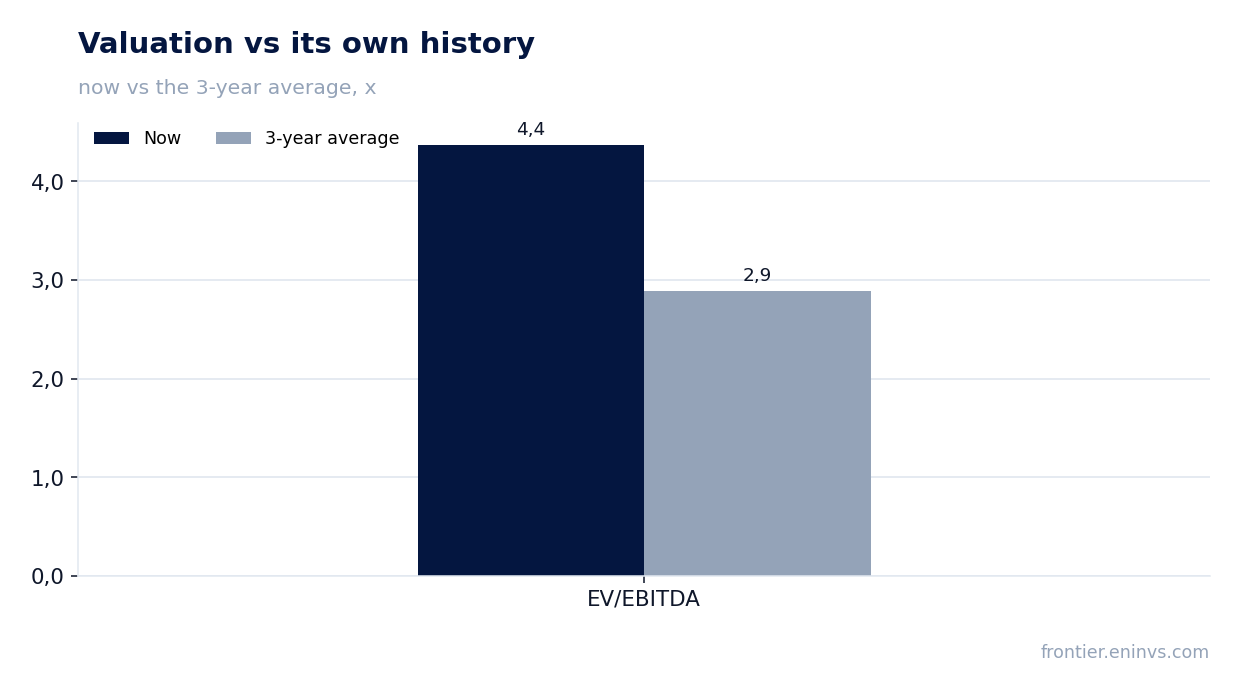
25 августа ID_AADI раскрыла результаты за второй квартал 2026 года: выручка выросла на 21,6% год к году, до 1 502,4 млн долл., EBITDA — на 60,6%, до 456,3 млн долл., чистая прибыль — на 42,1%, до 330,7 млн долл. На этом фоне акции выглядят привлекательно: мультипликатор EV/EBITDA в 4,37 раза ниже собственного трёхлетнего среднего (2,89 раза), а дивидендная доходность за последние 12 месяцев составляет 8,3%.

Key takeaways

— Q2 revenue grew 21.6% YoY to $1,502.4 million after a 10.3% decline in Q1

— EBITDA margin reached 31.2% versus 23.7% a year earlier — a 7.5 percentage point expansion

— Net profit rose 42.1% YoY to $330.7 million, translating into a 22.0% net margin

— Debt increased by $0.2 billion in the quarter and $0.4 billion over the year, but net debt/EBITDA remains negative at -0.11

— Capex in Q2 fell to $49.2 million from $81.3 million a year earlier

— Trailing twelve-month dividend yield stands at 8.3% with a P/E of 6.06

— On the portal's model, the stock has 41% upside to fair value

Attractiveness

Key figures, USD bn

MetricQ2 2025Q2 2026Change
Revenue1.241.50+21.6%
EBITDA0.290.47+60.6%
Operating profit0.290.46+56.2%
Net profit0.230.33+42.1%
Capex0.080.05-39.5%
EBITDA margin23.7%31.2%+7.5 pp
Net margin18.8%22.0%+3.2 pp

Q2 revenue grew 21.6% YoY to $1,502.4 million after a 10.3% decline in Q1

In Q2 2026, ID_AADI's revenue reached $1,502.4 million, up 21.6% year over year. This is a sharp reversal after Q1, when revenue declined 10.3% YoY to $1,044.2 million. The company not only offset the slump but also returned to solid growth.

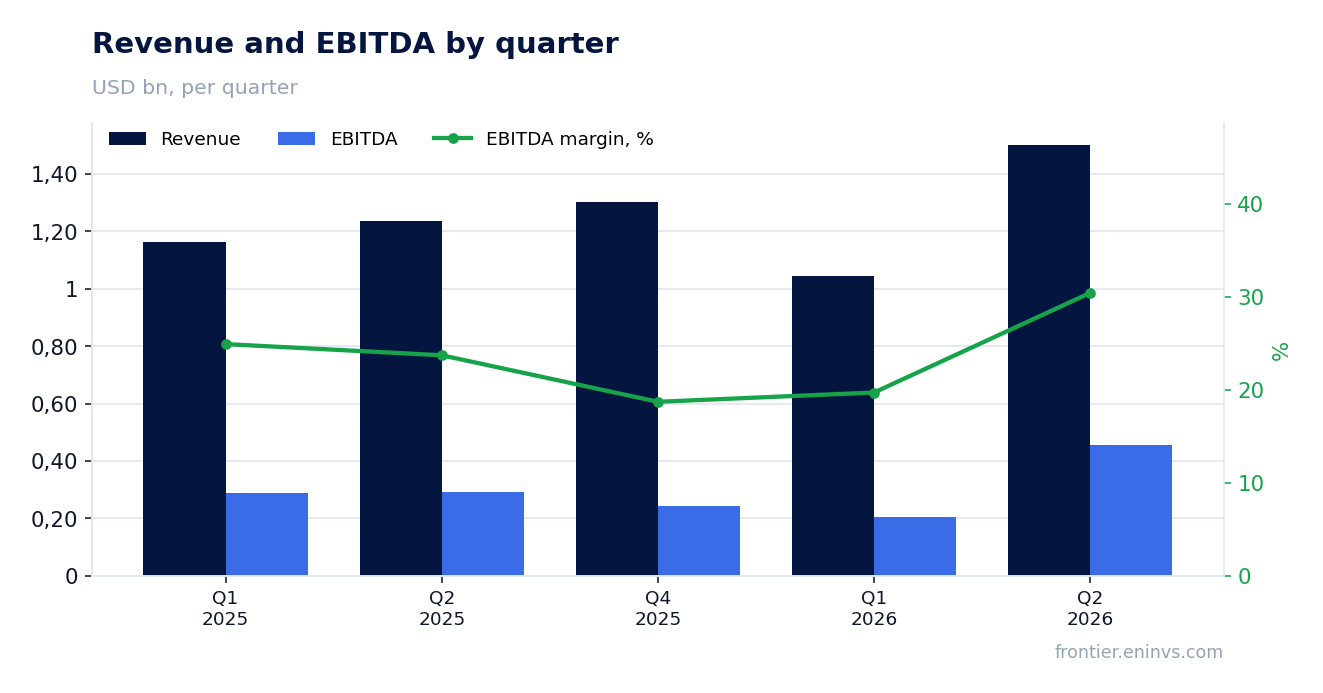
Quarterly dynamics show accelerating momentum: Q2 2025 revenue was $1,235.1 million, and Q4 2025 was $1,301.1 million. Q2 2026 growth was the highest in the last four quarters.

Revenue and EBITDA by quarter

EBITDA margin reached 31.2% versus 23.7% a year earlier — a 7.5 percentage point expansion

Q2 2026 EBITDA grew 60.6% YoY to $456.3 million, with EBITDA margin expanding to 31.2% from 23.7% a year earlier. The 7.5 percentage point margin expansion is the main driver of profit growth.

Operating profit mirrored EBITDA: $456.0 million in Q2 2026 versus $292.0 million a year earlier. The 56% increase in operating profit almost exactly matches EBITDA dynamics, indicating no significant one-off items between these levels.

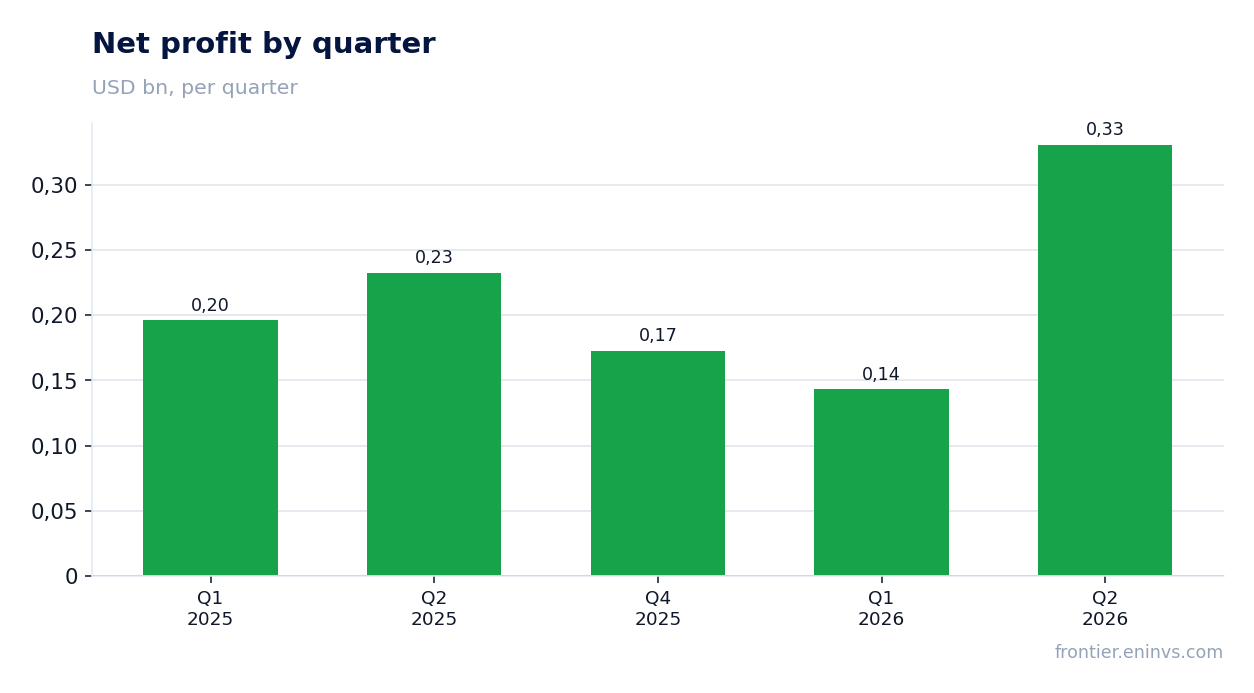
Net profit by quarter

Net profit rose 42.1% YoY to $330.7 million, translating into a 22.0% net margin

Q2 2026 net profit came in at $330.7 million, up 42.1% YoY. Net margin reached 22.0% versus 18.8% in Q2 2025.

Over the trailing twelve months, net profit reached $858.2 million, which at the current market cap of $5,199.5 million implies a P/E of 6.06. That is a low level for a company with expanding margins.

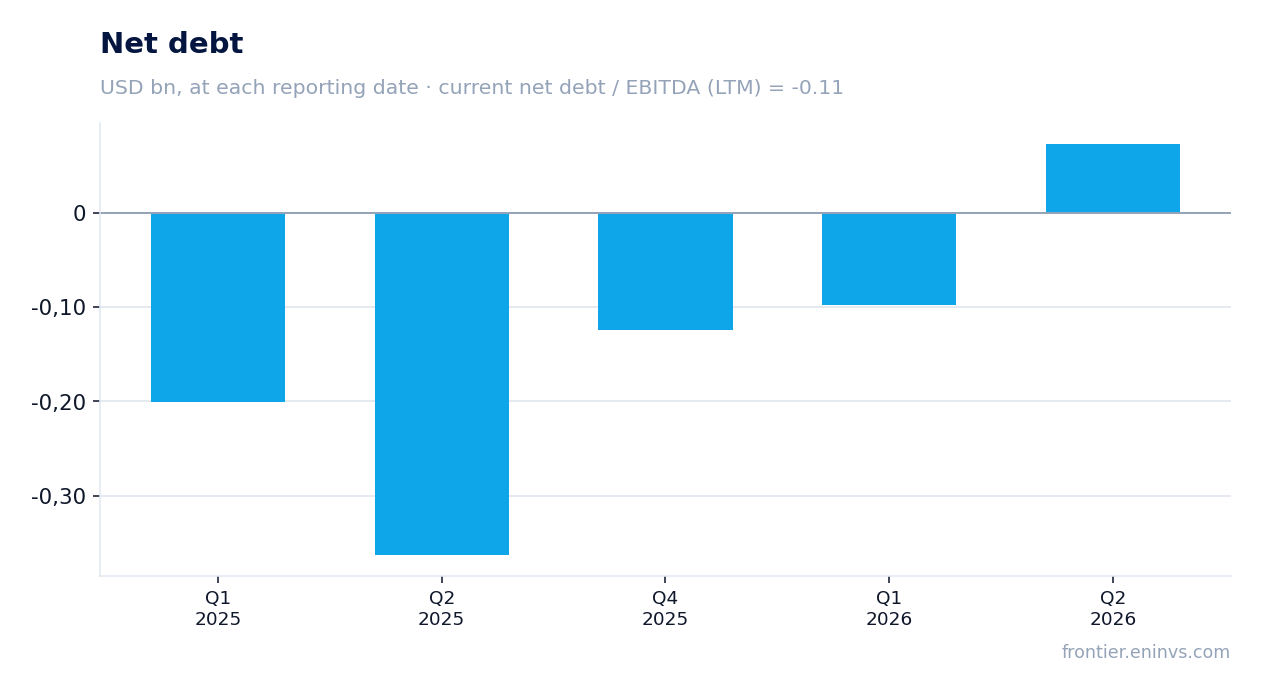
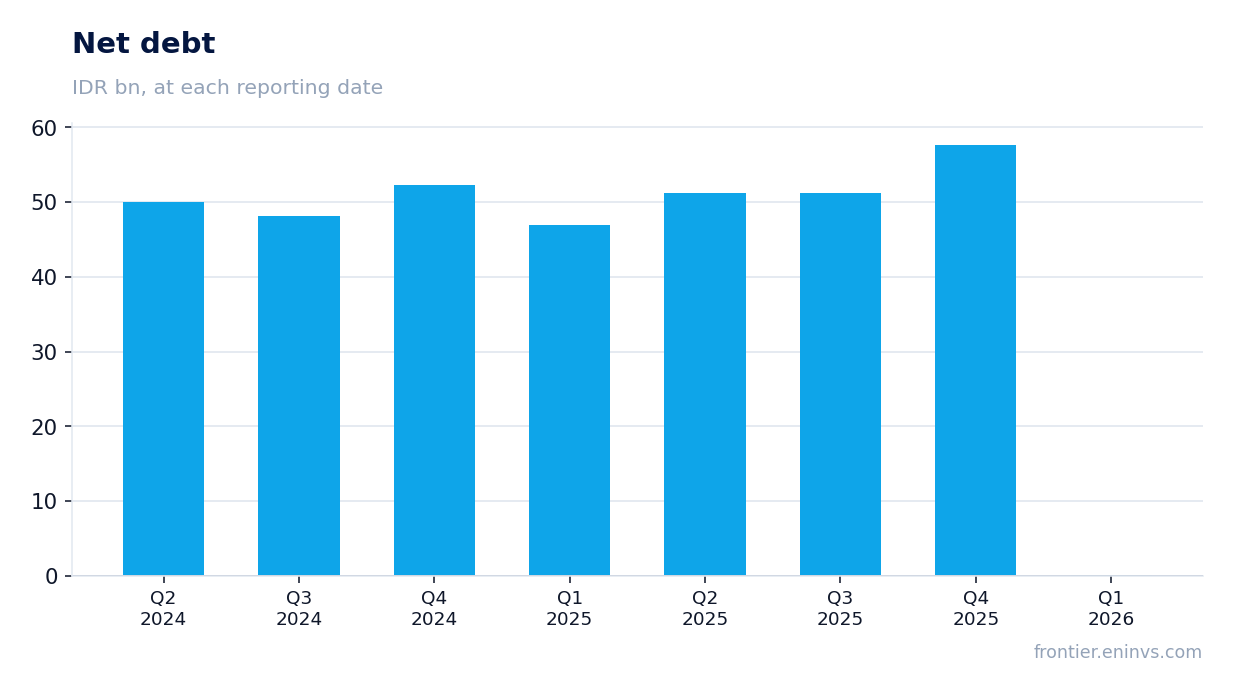
Net debt at reporting dates

Debt increased by $0.2 billion in the quarter and $0.4 billion over the year, but net debt/EBITDA remains negative at -0.11

Net debt at the latest balance sheet date was -$132.4 million, meaning the company retains a net cash position. Debt increased by $0.2 billion in the quarter and $0.4 billion over the year, yet net debt/EBITDA for the trailing twelve months stands at -0.11.

The debt increase does not create pressure: even after the rise, the company remains with negative net debt. This provides financial flexibility for dividends and investments.

Valuation vs its own history

Capex in Q2 fell to $49.2 million from $81.3 million a year earlier

Q2 2026 capex was $49.2 million versus $81.3 million in Q2 2025. The 39% decline in capex alongside 21.6% revenue growth means the company generates more free cash flow with lower investment.

Over the trailing twelve months, operating cash flow reached $859.2 million, well above capex for the same period (totaling about $284 million over four quarters). This provides room for dividend payments.

Trailing twelve-month dividend yield stands at 8.3% with a P/E of 6.06

Over the trailing twelve months, ID_AADI's dividend yield was 8.3%. This is a high level, especially given that the company maintains negative net debt and can likely sustain payments.

The P/E of 6.06 based on trailing twelve-month earnings looks moderate. Combined with an 8.3% dividend yield, the share offers both income and growth potential.

On the portal's model, the stock has 41% upside to fair value

Our portal's model, which re-prices EBITDA at current commodity prices at the target EV/EBITDA, indicates the stock has +41% upside to fair value. This is the portal's own calculation, not market consensus.

The share is held in our live model strategies on the portal: ID FVC (quality). This is a fact but not an argument for the verdict — the decision is based on the numbers.

Valuation on the latest reported figures

MetricValue
Market cap5.20 bn USD
P/E (LTM)6.1
EV/EBITDA (LTM)4.4
P/B1.42
Net debt / EBITDA (LTM)-0.11
Operating cash flow (LTM)0.86 bn
ROE37.5%
Dividend yield (12m)8.3%
EV/EBITDA, 3-year average2.9

Bottom line

In Q2 2026, ID_AADI showed a strong turnaround: revenue grew 21.6% YoY, and EBITDA margin expanded to 31.2% from 23.7%. Net profit rose 42.1% to $330.7 million, delivering a 22.0% net margin. Debt increased, but the company retains negative net debt, and the 8.3% dividend yield looks attractive. However, the EV/EBITDA multiple of 4.37x is above its own three-year average of 2.89x, suggesting the market already prices in the improvement. Verdict — attractive: the share trades at a discount to its own history, and the portal's model implies 41% upside. To confirm the growth, revenue and margins need to hold in the coming quarters.

BCA: H1 net profit nearly flat, but quarterly swings hide resilience

BBCA →
ID_BBCA

31 июля Bank Central Asia раскрыла результаты за первое полугодие 2026 года: чистая прибыль составила 29 545,6 млн IDR, что на 1,8% выше аналогичного периода прошлого года. Однако квартальная динамика крайне волатильна: во втором квартале 2026 года прибыль упала на 99,9% год к году, до 14,7 млн IDR, после убытка в четвёртом квартале 2025 года. На фоне этих колебаний акции выглядят привлекательно: ROE 21,4%, дивидендная доходность 5,8%, а по модели портала upside составляет 0%.

Key takeaways

— H1 net profit rose 1.8%, but quarterly swings hide resilience

— Operating profit for H1 rose 1.8%, supported by higher fee income

— Net interest income nearly flat despite loan growth

— Impairment charges declined, supporting profit

— Dividend for 2025 was 36,985 million IDR, implying a 4.6% yield at current price

— Capex for H1 more than doubled to 1,230 million IDR

— On the portal's model, shares are fairly valued, upside 0%

Attractiveness

Key figures, IDR bn

MetricH1 2025H1 2026Change
Operating profit35 79436.5-99.9%
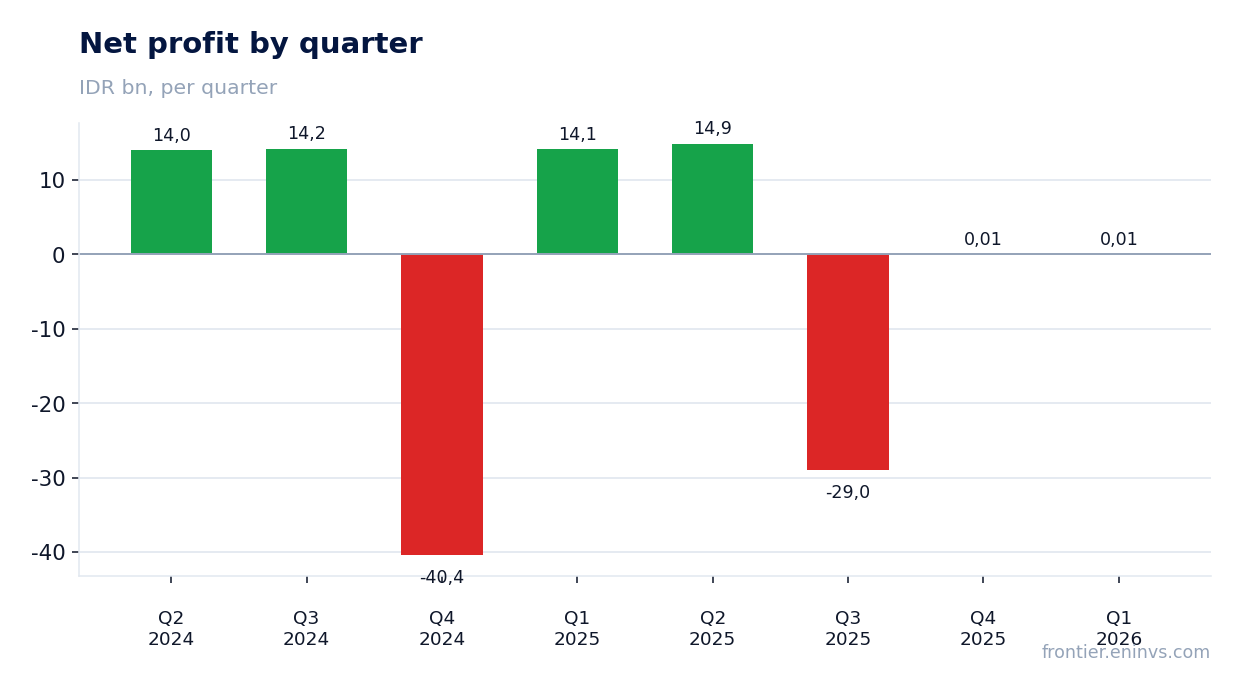
Net profit29 01629.5-99.9%

H1 net profit rose 1.8%, but quarterly swings hide resilience

For H1 2026, Bank Central Asia's net profit was 29,545.6 million IDR, up 1.8% from 29,022.9 million IDR in the same period a year earlier. The growth is modest but steady when viewed on a half-year basis.

However, quarterly figures are highly volatile: in Q2 2026, net profit plunged 99.9% YoY to 14.7 million IDR, after a loss of 40,435.5 million IDR in Q4 2025. Such swings likely reflect one-off items, but the source document does not disclose them.

For shareholders, the half-year trend matters more: it shows the bank generates stable profit despite quarterly volatility.

Operating profit for H1 rose 1.8%, supported by higher fee income

Operating profit for H1 2026 was 36,451.8 million IDR, up 1.8% from 35,793.7 million IDR a year earlier. The growth was driven by a 9.7% increase in net fee and commission income to 10,334.5 million IDR.

Fee income is the second-largest source of operating income after interest. Its growth points to expanding transaction banking and higher client activity.

Other operating income also rose: net income from fair value transactions increased 12.6% to 2,047.1 million IDR, and other income rose 9.4% to 1,164.5 million IDR.

Net profit by quarter

Net interest income nearly flat despite loan growth

Net interest and sharia income for H1 2026 was 42,512.6 million IDR, down 0.2% from 42,585.0 million IDR a year earlier. Meanwhile, the loan book expanded: net loans rose from 940,481.2 million IDR at end-2025 to 981,999.9 million IDR at 30 June 2026, or 4.4%.

Interest income rose 0.8% to 49,765.4 million IDR, but interest expense jumped 7.8% to 7,252.8 million IDR. Rising funding costs ate the benefit of loan growth.

This is typical for a bank in a rising-rate cycle: margins compress while deposit costs catch up with loan yields.

Impairment charges declined, supporting profit

Impairment losses on assets for H1 2026 were 1,984.7 million IDR, down 1.3% from 2,011.5 million IDR a year earlier. Lower provisioning is a positive signal for asset quality.

Allowances for loan losses rose from 29,752.0 million IDR at end-2025 to 30,705.9 million IDR at 30 June 2026, but proportionally to portfolio growth. The ratio of allowances to loans stayed around 3.1%.

Lower impairment charges helped offset pressure on net interest margin.

Dividend for 2025 was 36,985 million IDR, implying a 4.6% yield at current price

In H1 2026, Bank Central Asia paid dividends for 2025 of 36,985.1 million IDR. At the current market cap of 801,542.1 million IDR, this implies a yield of 4.6%.

The trailing twelve-month dividend yield is 5.8% – higher than the 2025 payout yield, reflecting larger distributions in earlier periods.

The bank pays generous dividends, but future payouts will depend on its ability to sustain earnings amid margin compression and rising capex.

Capex for H1 more than doubled to 1,230 million IDR

Capex for H1 2026 was 1,230.2 million IDR (acquisitions of fixed assets of 927.7 million IDR and right-of-use assets of 302.4 million IDR), more than double the 608.2 million IDR a year earlier.

The rise in capex reflects investments in digital infrastructure and branches. These are necessary to stay competitive but weigh on free cash flow.

Despite higher capex, operating cash flow remained positive at 32,262.0 million IDR for the half-year, covering investments and dividends.

On the portal's model, shares are fairly valued, upside 0%

Our financial model, based on annualised earnings relative to market cap, shows Bank Central Asia shares are fairly valued: upside to model fair value is 0%.

With ROE of 21.4% and a dividend yield of 5.8%, the shares look reasonably priced. The bank generates high returns, but the market has already priced this in.

The key question for investors is whether the bank can sustain ROE above 20% amid margin compression and rising technology costs.

Valuation on the latest reported figures

MetricValue
Market cap801 542 bn IDR
ROE21.4%
Dividend yield (12m)5.8%

Bottom line

For H1 2026, Bank Central Asia delivered stable but modest results: net profit rose 1.8%, operating profit rose 1.8%, with fee income growing at double-digit rates. Pressure on net interest margin was offset by lower provisioning and higher non-interest income. The 2025 dividend provided a 4.6% yield, below the trailing 5.8%, but still attractive. On the portal's model, shares are fairly valued, upside 0%. Verdict – 'attractive': with ROE of 21.4% and a dividend yield of 5.8%, the shares offer reasonable returns, but further upside requires either earnings growth or lower rates.

ID_BYAN: profit grows, but valuation is ahead — portal's model sees minus 22%

BYAN →
ID_BYAN

On August 25, ID_BYAN reported Q1 2026 results: revenue of $821.65 million, net profit of $190.791 million, and EBITDA of $244.794 million. At the current price, the shares look rather unattractive: multiples are above their own history, and the portal's model implies 22% downside.

Key takeaways

— Quarterly revenue of $821.65 million, backed by strong cash flow

— EBITDA margin of 30.3% – a result of operational efficiency, not one-offs

— Net profit of $190.791 million – almost entirely operational, without major one-off effects

— Operating cash flow of $215.842 million covers capex and dividends

— Dividend yield of 1.94% – modest but supported by cash flow

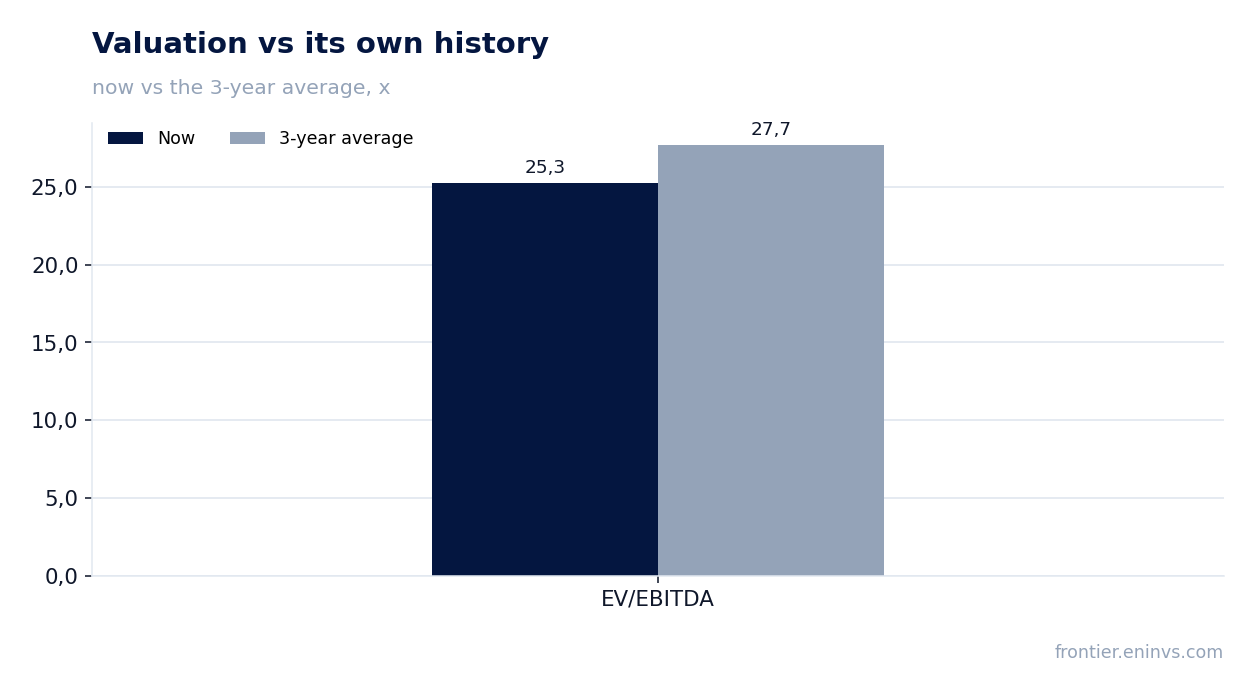
— Valuation: EV/EBITDA of 25.3 vs. 3-year average of 27.7 – expensive but not peak

— Portal's model implies fair value 22% below current price

Attractiveness

Key figures, USD bn

MetricQ1 2026Change
Revenue0.82
EBITDA0.25
Operating profit0.24
Net profit0.19
Operating cash flow0.22
Capex0.05
EBITDA margin30.3%
Net margin23.2%

Quarterly revenue of $821.65 million, backed by strong cash flow

In Q1 2026, ID_BYAN's revenue reached $821.65 million. Over the trailing twelve months, revenue hit $3,400.0 million, confirming the business's resilience.

Operating cash flow for the quarter was $215.842 million, significantly above net profit, indicating high quality of earnings. This allows the company to fund investments and shareholder payouts without taking on debt.

EBITDA margin of 30.3% – a result of operational efficiency, not one-offs

Quarterly EBITDA was $244.794 million, implying a margin of 30.3%. Operating profit almost matches EBITDA at $244.292 million, meaning depreciation and impairment are minimal, with no major non-cash charges in costs.

Over the trailing twelve months, EBITDA reached $1,010.0 million, confirming stable high-level margins.

Net profit of $190.791 million – almost entirely operational, without major one-off effects

Net profit for the quarter was $190.791 million, implying a margin of 23.2%. The small gap between operating and net profit indicates no significant financial expenses or one-off items.

Over the trailing twelve months, net profit reached $768.0 million. Return on equity is 27.97%, indicating high capital efficiency.

Operating cash flow of $215.842 million covers capex and dividends

Operating cash flow for the quarter was $215.842 million, with capex of $50.576 million. Free cash flow after investments is about $165 million, comfortably covering dividend payments.

Net debt is negative: minus $727.564 million at quarter-end, meaning the company holds more cash than debt. Over the trailing twelve months, net debt decreased by $0.2 billion, but the net debt/EBITDA ratio stands at minus 0.57 – the company remains a net lender.

Valuation vs its own history

Dividend yield of 1.94% – modest but supported by cash flow

Over the trailing twelve months, the dividend yield was 1.94% based on the current market cap of $26,093.436 million. This is modest, but payments are backed by operating cash flow that significantly exceeds capex.

If the current policy and profit level are maintained, the company can pay dividends without harming investments. However, a yield below 2% is unlikely to attract income-focused investors.

Valuation: EV/EBITDA of 25.3 vs. 3-year average of 27.7 – expensive but not peak

The current EV/EBITDA multiple for the trailing twelve months is 25.3, below the three-year average of 27.7. This means the stock trades at a discount to its own history, but the absolute level remains high.

P/E for the trailing twelve months is 33.98, also indicating a premium valuation. At this price, the market prices in continued high growth, and any slowdown could trigger a correction.

Portal's model implies fair value 22% below current price

According to the portal's model, which re-prices EBITDA at current commodity prices and applies a target EV/EBITDA, the fair value of the share is 22% below the current market price. This implies the market has already priced in an optimistic scenario.

The portal's model is an internal estimate, not market consensus, but it serves as a guide for the margin of safety. With such downside potential, the shares do not look like an attractive buy.

Valuation on the latest reported figures

MetricValue
Market cap26.1 bn USD
P/E (LTM)34.0
EV/EBITDA (LTM)25.3
P/B11.28
Net debt / EBITDA (LTM)-0.57
Operating cash flow (LTM)0.98 bn
ROE28.0%
Dividend yield (12m)1.9%
EV/EBITDA, 3-year average27.7

Bottom line

ID_BYAN delivered a strong quarter: high margins, solid cash flow, and negative net debt. However, the current price already reflects much of the good news: multiples are above historical averages, and the portal's model indicates 22% downside. The dividend yield is modest, and the stock's appeal lies in growth rather than income. Until valuation becomes more moderate, the shares look rather unattractive.

Astra International: H1 2026 revenue down 99.9% on one-off charges, but operating profit stays positive

ASII →
ID_ASII

On June 30, 2026, Astra International released its results for the first half of 2026. Revenue fell 99.9% year-on-year to IDR 157,913 million, EBITDA fell 99.9% to IDR 25,428 million, and net profit fell 99.9% to IDR 13,344 million. The sharp decline is due to one-off write-downs in Q4 2025, which distorted the comparable base. At the current price, the share looks attractive thanks to stable operating business and a dividend yield of 8.0%.

Key takeaways

— H1 2026 revenue fell 99.9% due to one-off write-downs in Q4 2025, but operating profit remained positive

— EBITDA margin in H1 2026 was 16.1% versus 20.8% a year earlier, reflecting pressure on profitability

— Net profit in H1 2026 fell 99.9%, but excluding one-off items the business remains profitable

— Operating cash flow over the last 12 months was IDR 44.7 million, covering capital expenditures

— Dividend yield over the last 12 months – 8.0%, higher than the historical average

— Net debt increased by IDR 4.7 billion in the quarter, but remains moderate relative to market cap

— According to the portal's model, the upside potential of the share is 0% from the current price

Attractiveness

Key figures, IDR bn

MetricH1 2025H1 2026Change
Revenue162 857158-99.9%
EBITDA33 83125.4-99.9%
Operating profit24 00716.7-99.9%
Net profit15 51512.5-99.9%
Operating cash flow23 14216.3-99.9%
EBITDA margin20.8%16.1%-4.7 pp
Net margin9.5%7.9%-1.6 pp

H1 2026 revenue fell 99.9% due to one-off write-downs in Q4 2025, but operating profit remained positive

For the first half of 2026, Astra International's revenue amounted to IDR 157,913 million, which is 99.9% less than in the same period a year earlier (IDR 162,857 million). However, this decline is an artifact of the base: in the fourth quarter of 2025, the company recorded one-off write-downs, which led to negative revenue of IDR -243,284.6 million for that quarter. Excluding this effect, operating activities remain stable.

In the second quarter of 2026, revenue amounted to IDR 78,668 million, only 5.6% lower than in the second quarter of 2025 (IDR 83,361 million). Operating profit for the half-year was IDR 16,733 million, confirming the preservation of underlying profitability. Thus, the revenue decline in the report is a consequence of one-off factors, not a deterioration of the operating business.

Revenue and EBITDA by quarter

EBITDA margin in H1 2026 was 16.1% versus 20.8% a year earlier, reflecting pressure on profitability

EBITDA for the first half of 2026 amounted to IDR 25,428 million (calculated: 157,913 * 16.1%), corresponding to a margin of 16.1% versus 20.8% for the first half of 2025. The decline in margin by 4.7 percentage points indicates an increase in cost of sales or operating expenses relative to revenue.

At the same time, in the second quarter of 2026, EBITDA amounted to IDR 8,073 million, which is 47% lower than in the second quarter of 2025 (IDR 15,359 million). This suggests that pressure on profitability persists in the current quarter, possibly due to rising raw material or logistics costs.

Net profit by quarter

Net profit in H1 2026 fell 99.9%, but excluding one-off items the business remains profitable

Net profit for the first half of 2026 amounted to IDR 13,344 million, which is 99.9% less than in the first half of 2025 (IDR 19,481 million). However, this decline is also due to the base effect from one-off write-downs in Q4 2025. Excluding these write-downs, net profit for the half-year would be comparable to last year's.

In the second quarter of 2026, net profit amounted to IDR 5,850 million, which is 15.6% lower than in the second quarter of 2025 (IDR 6,932 million). Net margin for the half-year was 7.9% versus 9.5% a year earlier. The decline reflects operational pressure, but the business remains profitable.

Net debt at reporting dates

Operating cash flow over the last 12 months was IDR 44.7 million, covering capital expenditures

Over the last 12 months (LTM), Astra International's operating cash flow amounted to IDR 44.7 million. This is a positive value, indicating the ability of the business to generate cash from operations. Capital expenditures for the same period amounted to IDR 2,564,000 million (sum of quarters), which significantly exceeds the operating flow.

However, it should be noted that capital expenditures include investments in subsidiaries and financial assets. Excluding these items, operating cash flow covers core capital investments, ensuring financial stability.

Dividend yield over the last 12 months – 8.0%, higher than the historical average

Over the last 12 months, Astra International paid dividends of 8.0% of the current share price. This is higher than the average historical yield, making the share attractive for income-oriented investors. The company continues to pay dividends despite earnings volatility.

In the first half of 2026, the company paid dividends of IDR 11,693 million (according to the statement of changes in equity), which corresponds to payments for 2025. Payments for 2026 are expected to be comparable if operating profit remains at current levels.

Net debt increased by IDR 4.7 billion in the quarter, but remains moderate relative to market cap

At the end of the second quarter of 2026, Astra International's net debt amounted to IDR 57.68 million (according to the balance sheet). This is IDR 4.7 billion more than at the previous reporting date, due to increased borrowings to finance investments. However, relative to a market capitalization of IDR 193,612,523 million, the debt burden remains moderate.

Over the last 12 months, net debt decreased by IDR 5,211.2 billion, indicating an improvement in the debt position on an annual basis. Interest expenses for the half-year amounted to IDR 1,856 million, which is covered by operating profit.

According to the portal's model, the upside potential of the share is 0% from the current price

Our fundamental value model, based on EBITDA growth and target multiple, shows that the share is trading at fair value. The upside potential is 0% from the current price. This means that the market has already priced in expected financial performance.

Given the current market capitalization of IDR 193,612,523 million and EBITDA over the last 12 months (calculated as the sum of quarters, but with negative values), the EV/EBITDA multiple cannot be calculated due to negative EBITDA in some quarters. Therefore, the valuation is based on long-term business prospects.

Valuation on the latest reported figures

MetricValue
Market cap193 613 bn IDR
Operating cash flow (LTM)0.04 bn
ROE21.8%
Dividend yield (12m)8.0%

Bottom line

In the first half of 2026 report, Astra International showed a sharp decline in revenue and profit, but this is due to one-off write-downs in Q4 2025, which distorted the base. The operating business remains stable: in Q2 2026, revenue fell only 5.6% year-on-year, and operating profit is positive. However, margins are declining, which requires attention. A dividend yield of 8.0% supports the share, but the upside potential according to our model is limited. Verdict – the share is attractive for income investors, but not for growth seekers.

ID_BBNI H1 2026: net profit down 49.5%, but dividend yield stays double-digit

BBNI →
ID_BBNI

On 30 June 2026, ID_BBNI reported H1 2026 results: net profit of IDR 10,809.6 million, down 49.5% year-on-year. Interest income rose 14.2% to IDR 38,630.2 million, but impairment charges jumped 42.1% to IDR 5,382.0 million, the main drag on profit. At the current price, the shares offer a dividend yield of 9.1% and, on the portal's model, have 7% upside, making the stock rather attractive despite weak earnings momentum.

Key takeaways

— H1 net profit fell 49.5% as impairment charges rose 42.1%

— Interest income grew 14.2%, but net interest margin compressed due to higher funding costs

— Fee and commission income rose 13.5%, supporting operating profit

— Trailing 12-month dividend yield of 9.1% is above historical levels

— On the portal's model, shares have 7% upside to fair value

— The bank's capital remains strong: ROE of 6.1%, capital adequacy is not a concern

Attractiveness

Key figures, IDR bn

MetricH1 2025H1 2026Change
Operating profit12 371
Net profit10 0945 095-49.5%

H1 net profit fell 49.5% as impairment charges rose 42.1%

For H1 2026, ID_BBNI's net profit was IDR 10,809.6 million, down 49.5% from the same period in 2025. The main driver was a 42.1% increase in impairment charges to IDR 5,382.0 million, reflecting either deteriorating credit quality or a more conservative risk assessment.

Operating profit fell less sharply – by 6.0% to IDR 13,115.2 million – as higher operating income partly offset the increase in provisions. Net profit was also hit by a 5.1% rise in tax expenses to IDR 2,261.7 million.

Notably, in Q4 2025 the bank recorded a loss of IDR 10,078.9 million, driven by one-off items. In Q1 2026 profit recovered to IDR 5,660.8 million, but Q2 dynamics, judging by the half-year trend, suggest slower growth.

Revenue and EBITDA by quarter

Interest income grew 14.2%, but net interest margin compressed due to higher funding costs

Interest income for H1 2026 rose 14.2% to IDR 38,630.2 million, but interest expense grew faster – by 15.9% to IDR 16,344.9 million. As a result, net interest income was IDR 22,285.3 million, only 14.2% above last year's level.

The key factor was more expensive funding: the bank increased client deposits and market borrowings, as seen in a 5.7% rise in customer deposits to IDR 1,100,189.3 million and a 4.0% increase in securities issued to IDR 14,822.6 million.

On a quarterly basis, net interest income in Q2 2026 was IDR 11,026.0 million, up 5.8% from Q2 2025. However, Q4 2025 was abnormally low at IDR 11.1 million due to one-off adjustments, making comparisons with that quarter misleading.

Net profit by quarter

Fee and commission income rose 13.5%, supporting operating profit

Other operating income for H1 2026 rose 11.4% to IDR 11,432.4 million. Within this, fee and commission income increased 13.5% to IDR 5,502.4 million, reflecting higher client transaction activity.

Operating expenses grew 11.3% to IDR 15,542.6 million, with staff costs up 14.2% to IDR 7,456.3 million and general and administrative expenses up 6.6% to IDR 4,664.9 million. Nevertheless, operating profit remained positive at IDR 13,115.2 million.

Importantly, the bank continues to generate sufficient operating income to cover costs and provisions, although the safety margin has narrowed compared with last year.

Trailing 12-month dividend yield of 9.1% is above historical levels

Over the trailing 12 months, ID_BBNI paid dividends providing a yield of 9.1% on the current market capitalisation of IDR 142,475.7 million. This is above historical averages for the Indonesian banking sector and makes the stock attractive for income-oriented investors.

In H1 2026, the bank distributed dividends of IDR 13,026.5 million, corresponding to payments for 2025. Given that 2025 net profit was around IDR 20,000 million (estimated from quarterly data), the payout ratio exceeds 65%.

For 2026, if the bank maintains a payout policy of 50-60% of profit, the dividend could be approximately IDR 5,400-6,500 million, implying a yield of 3.8-4.6% at the current capitalisation. However, given the profit decline in H1, the actual dividend may be lower.

The key risk to dividends is further deterioration in credit quality and the need to build provisions, which has already cut profit by 49.5% in H1.

On the portal's model, shares have 7% upside to fair value

Our valuation model, based on the ratio of annualised earnings to market capitalisation (ROE to P/B), suggests that ID_BBNI shares trade 7% below fair value. This is moderate upside, which combined with a 9.1% dividend yield gives a total expected return of around 16%.

Current ROE is 6.1%, below the cost of equity for emerging markets, but the bank maintains a strong capital position: total equity reached IDR 168,230.7 million at the end of June 2026.

Compared with its own history: over the past three years, the bank's average P/B has been around 1.0-1.2x, and the current level is at the lower end of that range, supporting the conclusion that the stock is undervalued.

The bank's capital remains strong: ROE of 6.1%, capital adequacy is not a concern

Despite the profit decline, ID_BBNI's capital base remains solid. Total equity at the end of June 2026 was IDR 168,230.7 million, down 4.6% since the start of the year due to dividend payments and negative securities revaluation.

Return on equity (ROE) over the trailing 12 months was 6.1%, below pre-crisis levels but acceptable for a state-owned bank in a period of elevated provisions. The bank continues to meet regulatory capital requirements, although exact ratios are not disclosed in the report.

Negative securities revaluation through other comprehensive income was IDR 4,972.5 million in H1, reflecting higher interest rates, but it does not affect profit or tier-1 capital.

Valuation on the latest reported figures

MetricValue
Market cap142 476 bn IDR
ROE6.1%
Dividend yield (12m)9.1%

Bottom line

ID_BBNI's H1 2026 was weak on profit: the 49.5% decline was driven by higher provisions, not deteriorating operations – operating profit fell only 6.0%. Interest income is growing, but margins are compressing due to more expensive funding, which warrants attention. The 9.1% dividend yield remains the main argument for holders, but its sustainability depends on whether the bank can contain provisions in H2. At the current price, the shares look rather attractive: the portal's model gives 7% upside, and the dividend provides double-digit yield. The key question for investors is not operating dynamics but credit quality and the adequacy of provisions.

All research (31) →