GDP growth 2026 (proj.)1.0%Inflation YoY (proj.)6.0%FX vs USD (3y avg p.a.)-5.0%Macro: IMF World Economic Outlook, April 2026 (Annex tables 1.1.2–1.1.4)
Our recommended portfolios
Performance & current holdings of our strategies for this market — why it makes sense to join.
Three-year models: revenue and margin from four independent sources, dividends from the company's policy, exit at today's multiple without re-rating. 'Model error' is the median EBITDA miss (profit for banks) in the backtest, with the number of measurements.
Build a moderately diversified income portfolio from our coverage — with quality and liquidity gates and per-issuer-group limits. Profiles: insurer, corporate treasury, qualified individual.
ММК 6,2% · ФосАгро 5,3% · Московский кредитный банк 5,0%
Смешанные фонды — выходят ли из акций
β к IMOEX = оценка доли акций; снижение β за 3 мес против года = сокращение акций (риск-офф).
TRURТ-Капитал – Стратегия вечного — β к индексу 0,43 (3 мес 0,25)сокращают акции, топ-10 акций 16%
AKUPАльфа-Капитал Умный портфель — β к индексу 0,53 (3 мес 0,72)наращивают акции, топ-10 акций 31%
SBPSПервая – Фонд Моя цель 2035 — β к индексу 0,54 (3 мес 0,70)наращивают акции, топ-10 акций 54%
Изменения в составе за месяц(к раскрытию 31.07.2026)
SBMXПервая - Фонд Топ Российских акций + Корпоративный Центр Икс 2,5%− МКПАО Озон↑ Лукойл +1,3 п.п.↑ Татнефть +0,8 п.п.↑ Сбербанк России +0,7 п.п.↑ ГМК Норильский никель +0,5 п.п.
SCFTТехнологии будущего + ГМК Норильский никель 3,9%+ Татнефть 3,8%− Корпоративный Центр Икс− НОВАТЭК
СЧА и стоимость пая — investfunds.ru (ежедневно). «Приток» — оценка нетто-привлечения (изменение СЧА за вычетом доходности пая). Доходность — по биржевой цене (MOEX). β — бета Дименсона к IMOEX за ~год (с поправкой на несинхронность котировок). «Динамика акций» — β за 3 мес против β за год: падение = фонд сокращает долю акций (уходит в кэш/облигации), рост = наращивает. Структура активов раскрывается УК ежемесячно.
Earnings analysis
Short take-aways from recent corporate results and commodity trends.
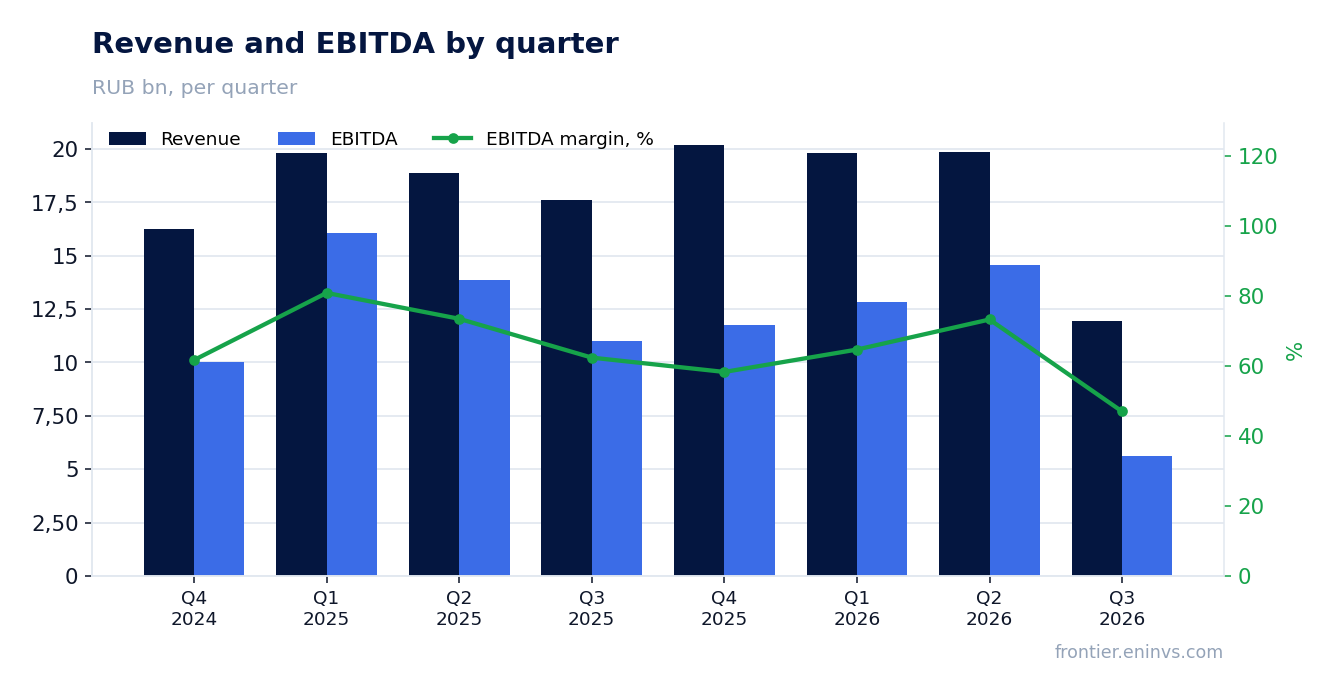
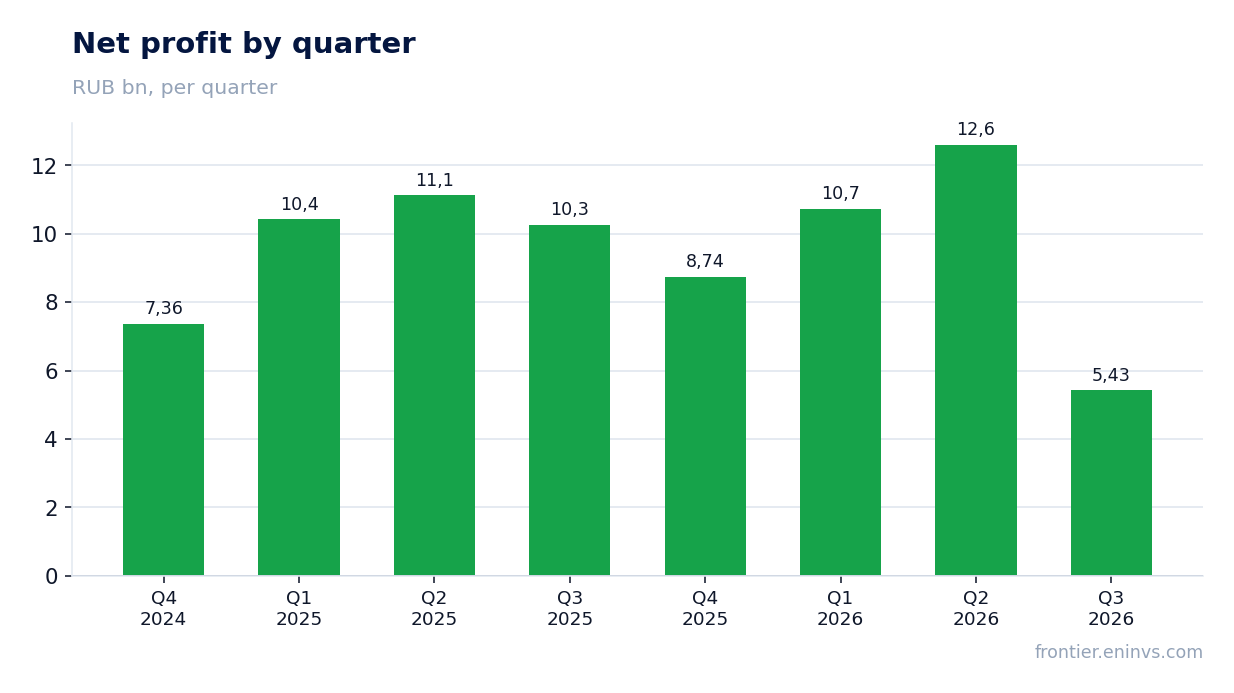
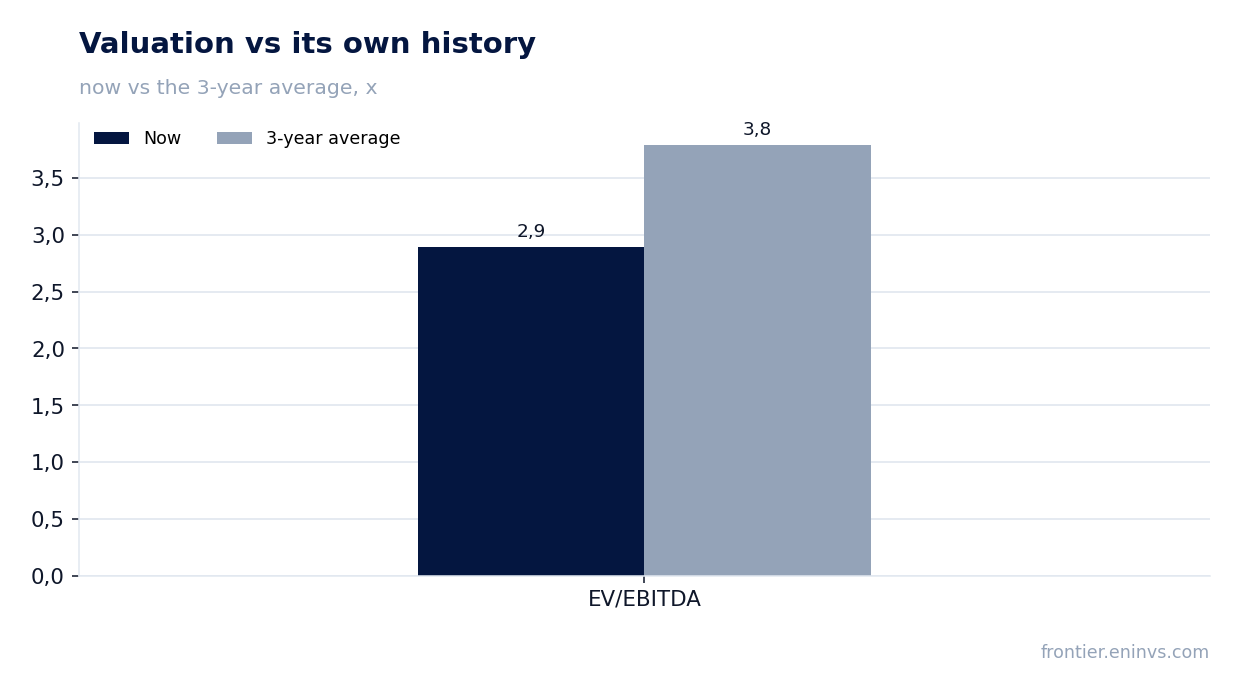
On 25 November NMTP reported results for the third quarter of 2026. Revenue fell 32.3% year on year to RUB 11,944 mn, EBITDA – by 49.0% to RUB 5,613 mn, net profit – by 47.2% to RUB 5,426 mn. The EBITDA margin compressed to 47.0% from 62.4%, but the company remains in a net cash position of RUB 5,379 mn and pays generous dividends. At the current price the stock looks rather attractive: EV/EBITDA of 2.9 is below its own three-year average of 3.8, and the dividend yield of 16.3% is well above the 10.5% we consider fair for the name.
Key takeaways
— Revenue collapsed 32.3% year on year in Q3 after a 5.3% rise in Q2 – the transshipment portfolio failed to hold last year's level
— EBITDA fell twice as fast as revenue – the margin dropped to 47.0% from 62.4%, and each tonne of cargo now brings noticeably less operating profit
— Net profit fell 47.2% but remained above operating profit – items below the operating line supported it in the reported quarter
— The company sits on net cash of RUB 5,379 mn with negative net debt and EV/EBITDA of 2.9 – the market values it below its own three-year average of 3.8
— Dividends remain the main argument: RUB 1.1448 per share paid over the last 12 months with a 16.3% yield, and we estimate RUB 1.05 per share for the current year
— Operating cash flow for the quarter was RUB 2,592 mn – it covers capital expenditure but leaves no cushion for higher payouts
— On our fair-value model the stock trades 23% above its estimated fair value – upside is exhausted, and it is worth holding for dividends, not for re-rating
Attractiveness
Key figures, RUB bn
Metric
Q3 2025
Q3 2026
Change
Revenue
17.6
11.9
-32.3%
EBITDA
11.0
5.61
-49.0%
Operating profit
9.39
4.00
-57.4%
Net profit
10.3
5.43
-47.2%
Operating cash flow
7.43
2.59
-65.1%
Capex
5.21
—
—
EBITDA margin
62.4%
47.0%
-15.4 pp
Net margin
58.2%
45.4%
-12.8 pp
Revenue collapsed 32.3% year on year in Q3 after a 5.3% rise in Q2 – the transshipment portfolio failed to hold last year's level
In the third quarter of 2026 NMTP's revenue amounted to RUB 11,944 mn, 32.3% below the same quarter a year earlier. This is a sharp deceleration after 5.3% growth in the second quarter: the top-line dynamic reversed from a slight plus to a deep minus.
A revenue decline of this magnitude means that cargo turnover and tariffs did not offset the lost volumes. The company did not disclose a line-by-line breakdown in the facts, so it is impossible to name the segment that fell most. One thing is clear: the quarter was a failure compared with last year's level, when revenue was RUB 17,632 mn.
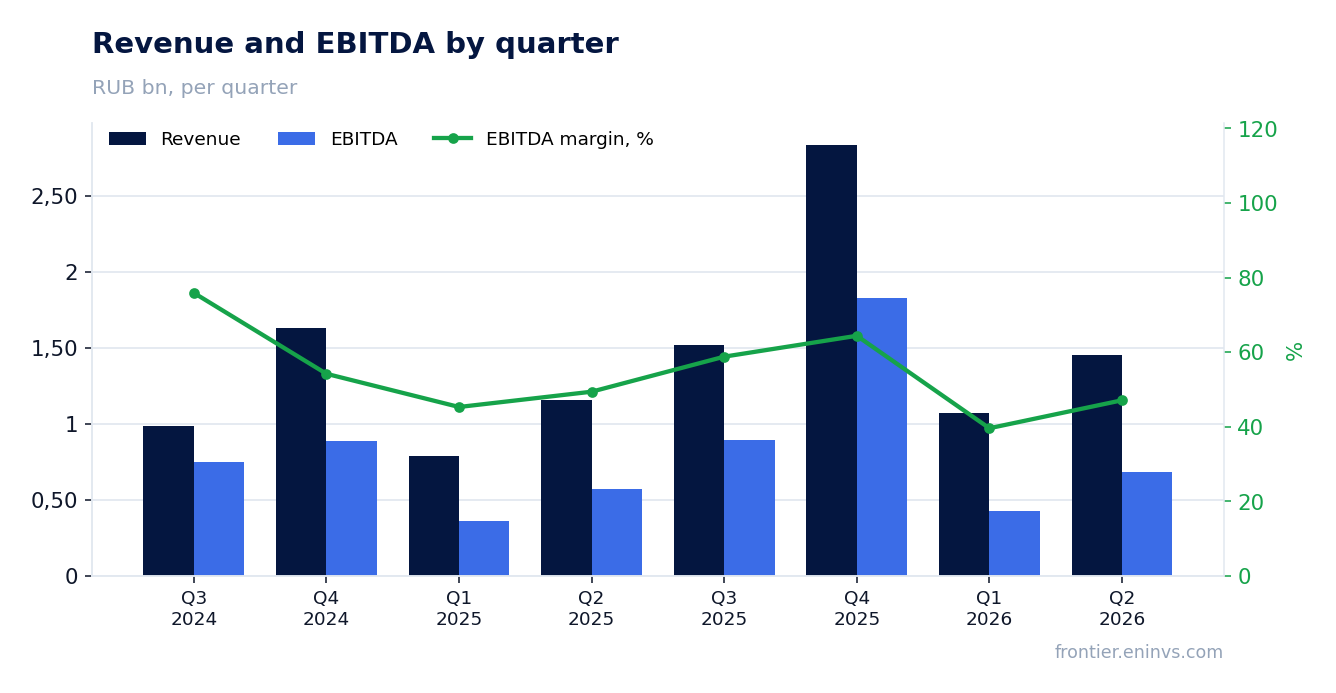
Revenue and EBITDA by quarter
EBITDA fell twice as fast as revenue – the margin dropped to 47.0% from 62.4%, and each tonne of cargo now brings noticeably less operating profit
EBITDA in the third quarter was RUB 5,613 mn, down 49.0% year on year – faster than revenue, which fell 32.3%. Operating profit declined to RUB 4,002 mn, and that fall was deeper than the top line's.
The EBITDA margin compressed to 47.0% from 62.4% a year earlier, the net margin – to 45.4% from 58.2%. This gap suggests that fixed costs did not adjust quickly enough to the smaller transshipment volume. Each rouble of revenue now brings almost half as much operating profit as a year ago.
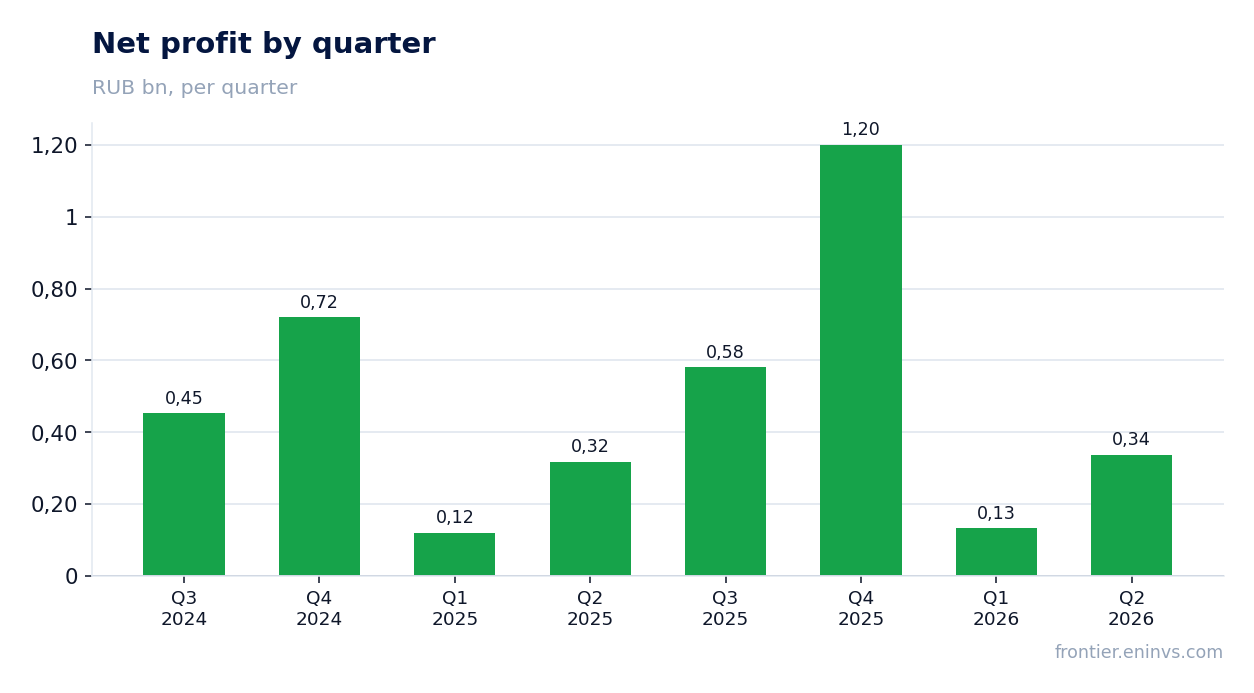
Net profit by quarter
Net profit fell 47.2% but remained above operating profit – items below the operating line supported it in the reported quarter
Net profit for the third quarter was RUB 5,426 mn against RUB 10,268 mn a year earlier, a decline of 47.2%. At the same time profit exceeded operating profit, which was RUB 4,002 mn. The difference of RUB 1,424 mn came from items below the operating line – likely interest on the cash position and other income, but the exact composition is not disclosed in the facts.
For the investor it matters that net profit remains positive and exceeds operating profit. This means that even in a weak quarter the company generates profit sufficient to support the dividend base. However, the sustainability of this support depends on how one-off or recurring the income below the operating line is.
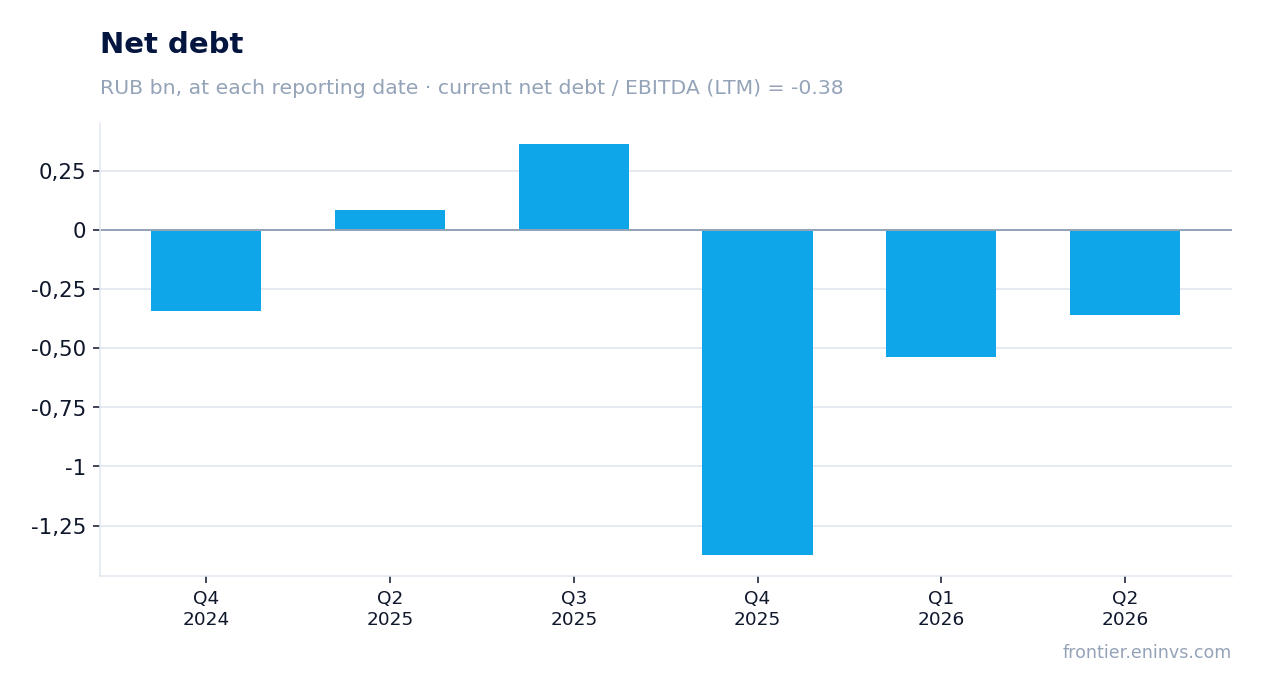
Net debt at reporting dates
The company sits on net cash of RUB 5,379 mn with negative net debt and EV/EBITDA of 2.9 – the market values it below its own three-year average of 3.8
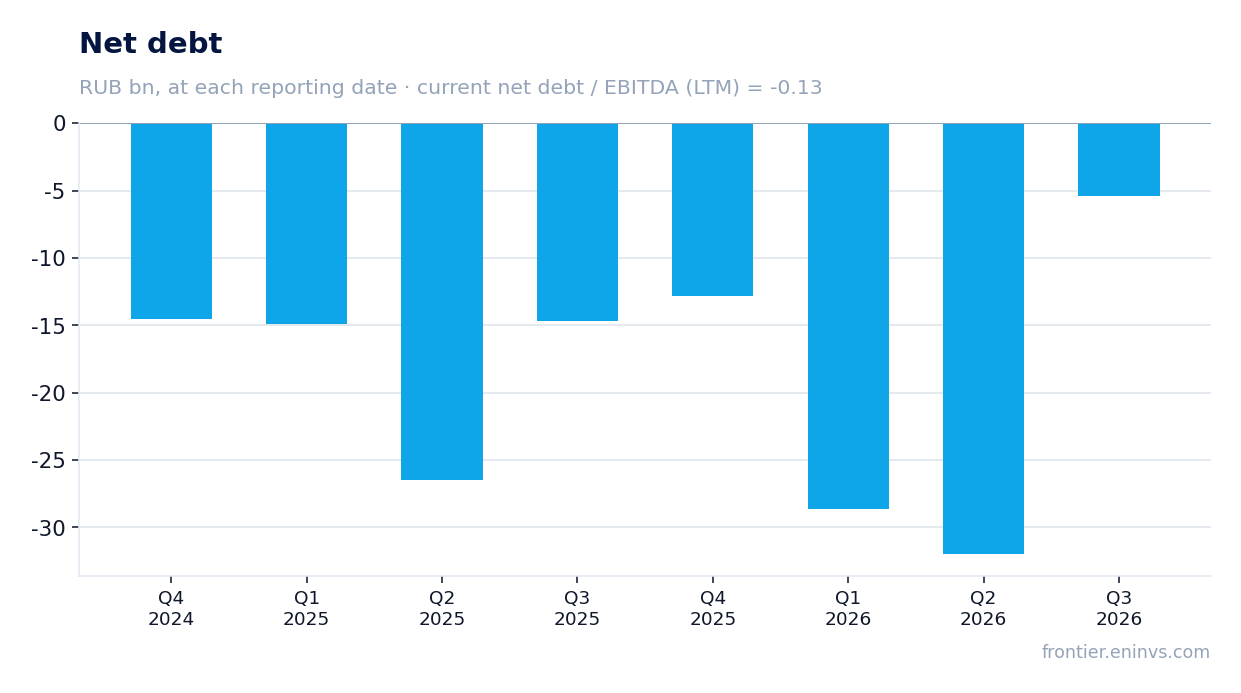
Net debt as of 30 September 2026 was minus RUB 5,379 mn, meaning the company has a net cash position. The ratio of net debt to EBITDA over the last twelve months is minus 0.13. This is a level, not a direction: it cannot be compared with past values, but the net cash position itself removes debt pressure.
The EV/EBITDA multiple over the last twelve months is 2.9, 24% below its own three-year average of 3.8. The stock trades cheaper than usual on this multiple. P/E over the last twelve months is 3.6 – a low level reflecting both the weakness of profit and general undervaluation.
On our fair-value model, which compares EBITDA growth with the target multiple, the stock trades 23% above its estimated fair value. This is our own calculation, not a market consensus. It suggests that the current price already prices in a recovery, and one should not count on re-rating upwards.
Valuation vs its own history
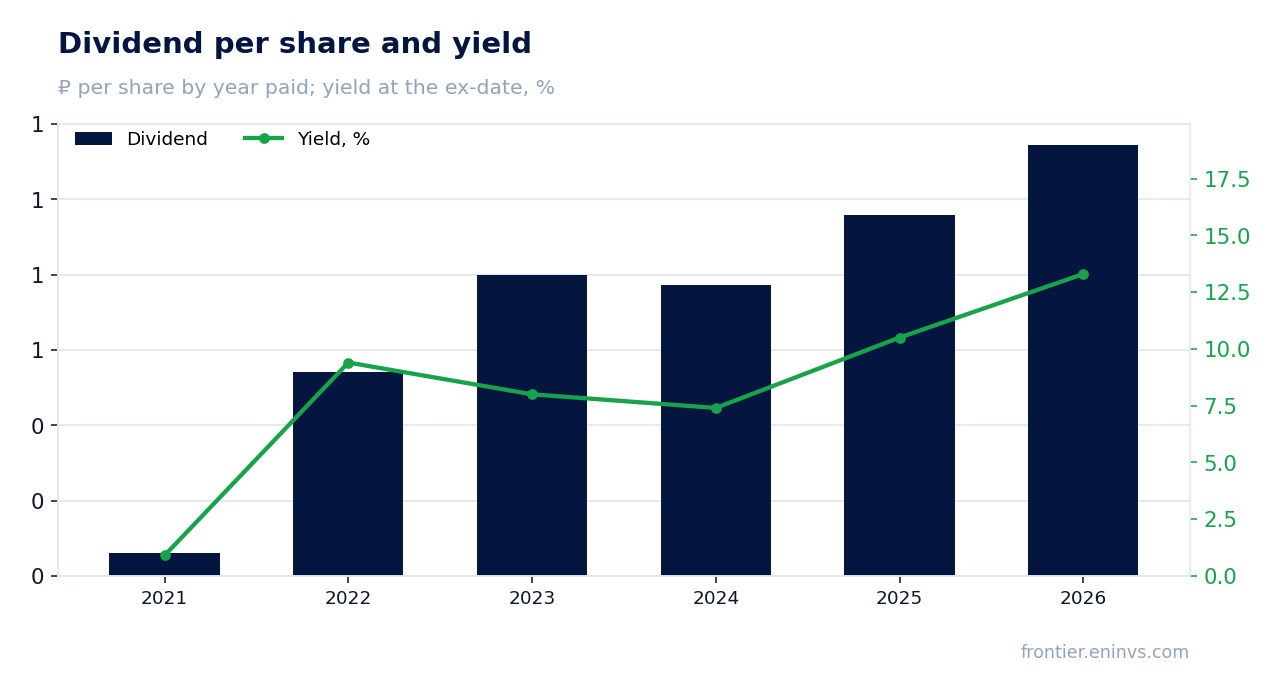
Dividends remain the main argument: RUB 1.1448 per share paid over the last 12 months with a 16.3% yield, and we estimate RUB 1.05 per share for the current year
Over the last twelve months NMTP paid RUB 1.1448 per share, which at the current price gives a yield of 16.3%. In calendar 2026, RUB 1.14 per share has already been paid, and no further payouts are planned for this year. This is a generous stream: the yield is more than double the key rate of 14.0%.
Our estimate of the payout for the current financial year, to be paid next year, is RUB 1.05 per share, corresponding to 15.0% on the current price. This is our calculation: we take net profit over the last twelve months, multiply by the share of profit paid out last year (0.54), and divide by the number of shares. The board decides, and the actual payout may differ.
The yield history shows that the current level is not anomalous: in 2025 the yield at the ex-date was 10.5%, in 2026 – 13.3%. We consider a yield of 10.5% fair for this name. The current yield of 16.3% is above both the fair and historical levels, which compensates for the weakness of profit.
A further fall in revenue and profit, as well as rising capital expenditure, could reduce the payout. Capital expenditure is not disclosed for the third quarter, but in the second quarter it was RUB 7,689 mn – a significant burden. If profit continues to decline, the dividend base will narrow, and the board may revise the payout ratio.
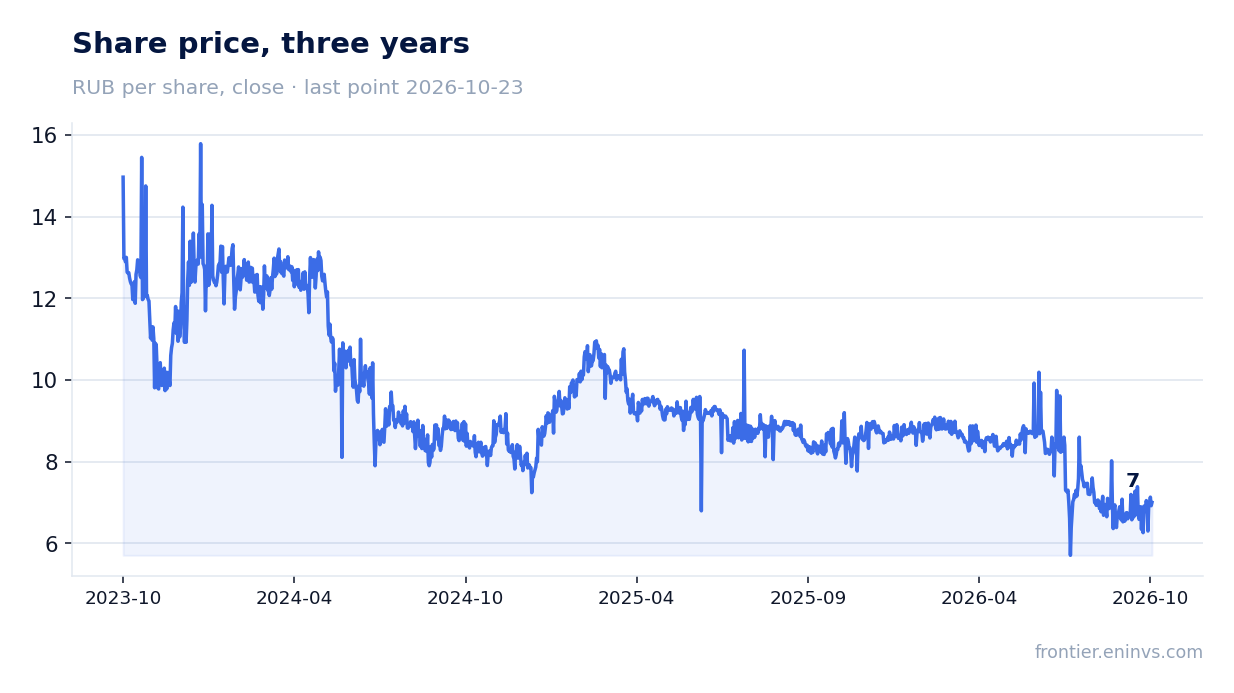
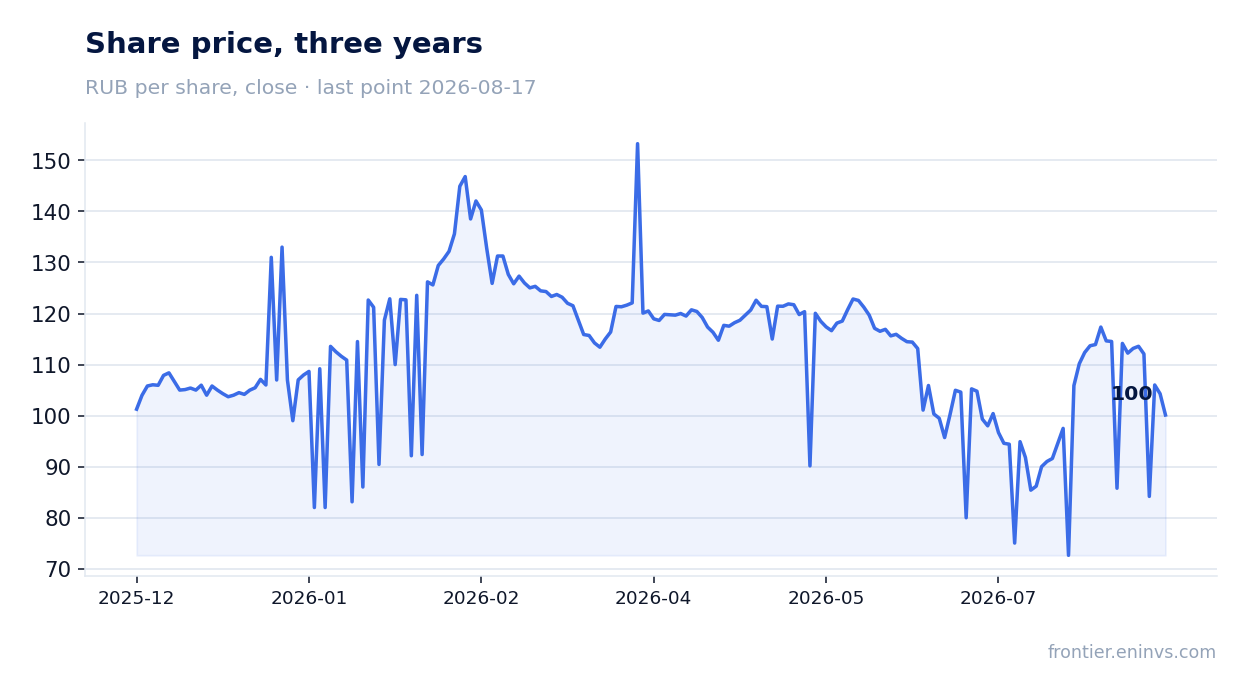
Share price, three years
Operating cash flow for the quarter was RUB 2,592 mn – it covers capital expenditure but leaves no cushion for higher payouts
Operating cash flow in the third quarter was RUB 2,592 mn against RUB 7,435 mn a year earlier. The more than twofold decline reflects lower revenue and profit. Over the last twelve months the flow was RUB 31,990 mn – a solid base, but the quarterly dynamic shows that the margin of safety is shrinking.
Capital expenditure is not disclosed for the reported quarter, but in the second quarter it was RUB 7,689 mn, and in the first – RUB 5,419 mn. With quarterly flow of RUB 2,592 mn, the company does not cover such investment from current flow and is spending its accumulated cash. The net cash position of RUB 5,379 mn still allows this, but the cushion is not endless.
For dividends this means that payouts are financed not only by flow but also by cash balances. If operating flow does not recover and capital expenditure remains high, the dividend may be cut. For now the company pays more than it earns in the quarter – a warning signal for the sustainability of payouts.
Dividend per share and yield at the ex-date
On our fair-value model the stock trades 23% above its estimated fair value – upside is exhausted, and it is worth holding for dividends, not for re-rating
Our fair-value model, which compares EBITDA growth with the target multiple, shows that the stock trades 23% above its estimated fair value. This is our own calculation, not a market consensus. It suggests that the current price already prices in a recovery of profit, and one should not count on re-rating upwards.
At the same time, the EV/EBITDA multiple of 2.9 is 24% below its own three-year average of 3.8. This indicates that the stock is cheaper than usual on this multiple. The discrepancy with the model is explained by the fact that the model takes into account not only the current multiple but also the EBITDA dynamic, which was weak in the third quarter.
For the investor this means that the main return will come from dividends, not from share price growth. A yield of 16.3% against the fair 10.5% is a weighty argument in favour of holding the stock. But if profit continues to fall, the dividend base will narrow, and then the current price will not look so low.
Valuation on the latest reported figures
Metric
Value
Market cap
135 bn ₽
P/E (LTM)
3.6
EV/EBITDA (LTM)
2.9
P/B
0.79
Net debt / EBITDA (LTM)
-0.13
Operating cash flow (LTM)
32.0 bn
ROE
3.6%
Dividend yield (12m)
16.2%
EV/EBITDA, 3-year average
3.8
Dividend per share, ₽, and yield at the ex-date
Year paid
Dividend
Yield
2021
0.06
0.9%
2022
0.54
9.4%
2023
0.80
8.0%
2024
0.77
7.4%
2025
0.96
10.5%
2026
1.14
13.3%
Our estimate, current year
1.05
15.0% on the current price
Bottom line
The strong side of the report remains financial stability: a net cash position of RUB 5,379 mn and an EV/EBITDA multiple of 2.9 below its own three-year average of 3.8. However, revenue fell 32.3%, EBITDA – by 49.0%, and the margin compressed to 47.0% from 62.4%. The dividend yield of 16.3% against the fair 10.5% is the main argument in favour of the stock, but operating flow of RUB 2,592 mn does not cover capital expenditure. On our fair-value model the stock trades 23% above its estimated fair value, so it is worth holding for dividends, not for share price growth.
This season's defining split is not between oil and tech but between companies riding volume and price upside and those still digesting the 2024-2025 cost shock. Mining and electricity delivered the widest spread: the mining median rose 30.1% year over year while metallurgy fell 10.8%, a 41-point gap. Construction and chemicals also contracted, with medians of -4.5% and -4.7%. The market is rewarding volume and pricing power and punishing anything tied to domestic capex or export tariffs.
Revenue growth by industry (median YoY)
median revenue YoY, %
Gold and power grids delivered the cleanest upside
The mining median of +30.1% is not a single-name fluke. Seligdar posted revenue +46.5%, EBITDA +145.6% and net profit +257.3%, while Yuzhuralzoloto grew revenue +90.5% and EBITDA +197.2%. Even Nornickel, the diversified giant, lifted revenue +12.6% and net profit +108.4%. In electricity, IDGC South was the standout with revenue +150.0%, EBITDA +233.6% and net profit +425.4%, and Rushydro added revenue +18.9% with net profit +90.1%.
The breadth matters as much as the headline. Six of the seven IDGC subsidiaries reported double-digit revenue growth, and Rosseti Moscow Region grew revenue +22.2% with net profit +46.5%. This is a sector where regulated tariffs and volume recovery are finally flowing through to the bottom line.
Steel and construction are the season's warning sign
Metallurgy's -10.8% median is ugly across the board. Severstal saw revenue -10.1%, EBITDA -27.9% and net profit -61.2%; NLMK reported revenue -11.6% and net profit -54.3%; TMK was the worst with revenue -36.9% and EBITDA -78.0%. Construction is no better: Samolet's revenue fell 31.3% and EBITDA 39.9%, while PIK declined 11.6% in revenue with net profit down 54.1%. These are not one-off misses; they are a capex and demand cycle turning down.
The plot twist: Lukoil's profit surge is the outlier nobody priced
Oil and gas as a sector grew just 3.5% in revenue, but Lukoil accelerated from an unspecified prior period to revenue +8.0%, EBITDA +93.3% and net profit +387.3%. That is a genuine surprise in a sector where Gazprom's net profit fell 9.8% and Rosneft's dropped 18.4%. The divergence suggests Lukoil's downstream and trading mix is doing heavy lifting while peers are squeezed by export economics.
Cheap for growth: Sberbank and Sovcombank screen as value traps or bargains
Sberbank trades at 3.5x earnings while growing revenue 22.5% and net profit 18.6%. Sovcombank is even cheaper at 2.9x P/E with revenue +70.4% and net profit +158.2%. Both look mispriced if growth holds. At the other extreme, Ozon trades at 35.9x earnings with revenue +47.8% but EBITDA -181.0% and net profit -222.6% — priced for perfection in a business still burning cash. Diasoft at 23.0x P/E with revenue -2.8% and net profit -77.3% is expensive for the wrong reason.
Income: FGC UES and Inter RAO offer yield with growth
FGC UES looks like the income play of the season: P/E 0.5x, EV/EBITDA 1.7x, with revenue +16.3%, EBITDA +28.5% and net profit +50.2%. Inter RAO at P/E 1.7x and EV/EBITDA 0.3x is even cheaper on cash flow, though its net profit fell 17.2%. For a value investor, these are the names where the market is paying you to wait.
The long view belongs to ArenaData and Positive: three-year revenue CAGRs of +52.0% and +30.9% respectively, yet both trade at single-digit EV/EBITDA multiples (5.3x and 6.2x). If the IT cycle holds, these are the compounders hiding in plain sight. Watch the next two quarters for whether the growth deceleration in some IT names (Head Hunter at 0.0% revenue) spreads — that is the key risk to the value case.
The published operating data point to uneven momentum. In Transport and logistics, Aeroflot carried 4.8 mln passengers in September 2026, down 4.2% y/y. In Finance, MOEX total volume reached 205.2 trln RUB in September 2026, up 18.3% y/y, while Europlan new business (incl. VAT) was 49.1 bln RUB in H1 2026, up 13.1% y/y. In Retail, X5 net retail revenue was 1270 bln RUB in Q2 2026, up 9.4% y/y, and Magnit LFL sales rose 6.4% y/y in H1 2026.
Operating momentum, latest reported period (YoY)
%
In Metals and mining, steel output rose: Severstal produced 2.8 mln t in Q2 2026 (+11.8% y/y), MMK 2.7 mln t (+7.3% y/y), NLMK 6.8 mln t in H1 2026 (n/a). Rusal produced 2.0 mln t of aluminium in H1 2026 (n/a). In Mining, Norilsk Nickel produced 85 ths t of nickel in H1 2026 (n/a), Polyus gold output was 1286.9 koz in H1 2026 (-1.8% y/y), and Uzhuralzoloto gold output was 12 t in FY 2025 (+13.2% y/y).
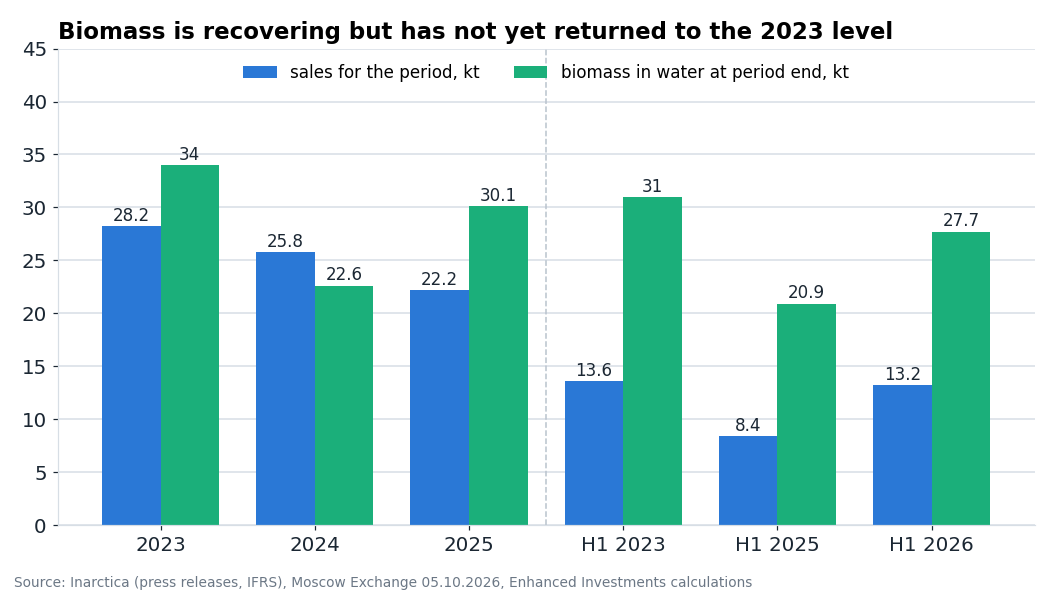
In IT, Ozon GMV reached 1311 bln RUB in Q2 2026 (+36.8% y/y), Whoosh trips were 56.5 mln in H1 2026 (+0.0% y/y), Delimobil sold minutes were 560 mln in Q2 2026 (n/a), and Astra shipments (excl. VAT) were 7.3 bln RUB in H1 2026 (n/a). Elsewhere, Inarctica biomass in water was 27.7 ths t in H1 2026 (+32.5% y/y), Etalon contract value was 23.2 bln RUB in Q2 2026 (n/a), Novatek gas production was 43.7 bln m3 in H1 2026 (n/a), and PhosAgro agrochemicals totaled 12.2 mln t in FY 2025 (+3.4% y/y).
In upcoming reporting, attention should focus on whether the positive y/y dynamics in Finance, Retail, IT (Ozon) and Metals translate into margins and cash flow, and on the negative or flat signals: Aeroflot passengers (-4.2% y/y), Polyus gold (-1.8% y/y) and Whoosh trips (+0.0% y/y). For companies with n/a comparisons, the key is disclosure of absolute volumes and their consistency with prior periods.
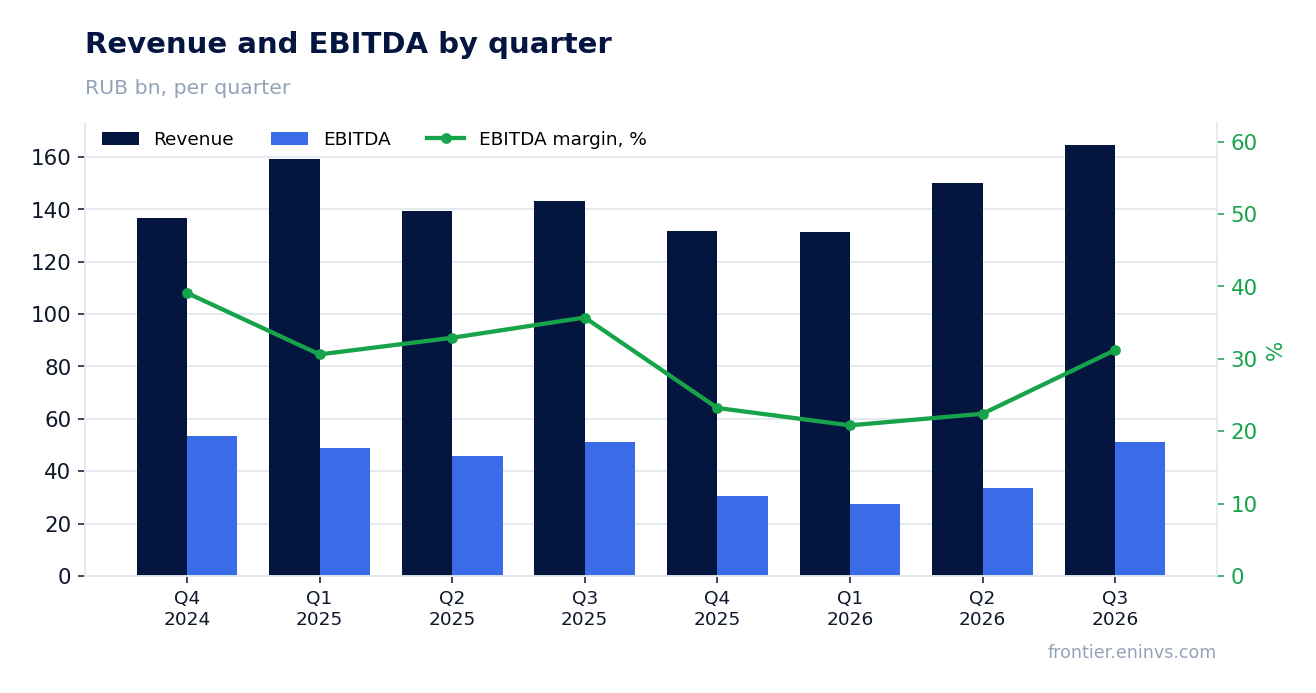
Phosagro reported results for the third quarter of 2026. Revenue rose 15.0% year on year to RUB 164.7 bn, EBITDA added only 0.5% to RUB 51.3 bn, and net profit fell 37.2% to RUB 12.6 bn. Revenue growth accelerated versus the second quarter (+7.7%), but the EBITDA margin declined to 31.2% from 35.7% a year earlier, and leverage at 2.64 EBITDA together with a valuation above its own history make the share unattractive at the current price.
Key takeaways
— Revenue rose 15.0% year on year in the third quarter, an acceleration from +7.7% in the second quarter
— EBITDA added only 0.5% because the margin fell to 31.2% from 35.7%
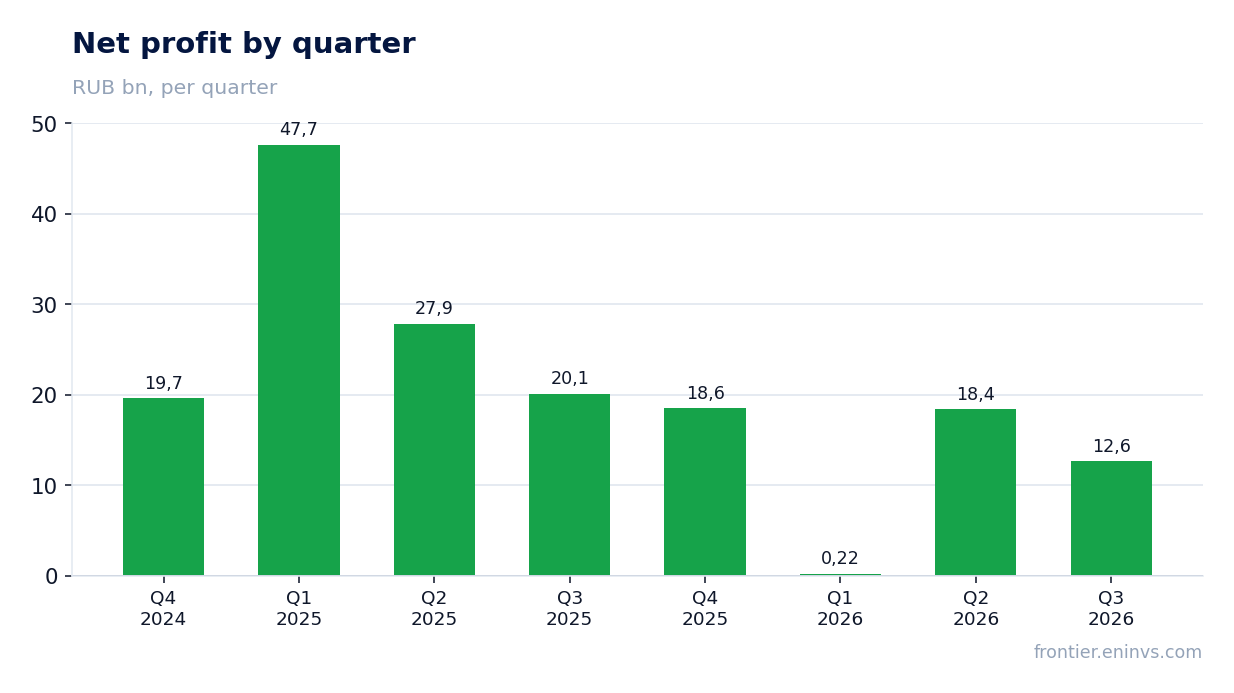
— Net profit fell 37.2% to RUB 12.6 bn with a margin of 7.7% versus 14.1% a year earlier
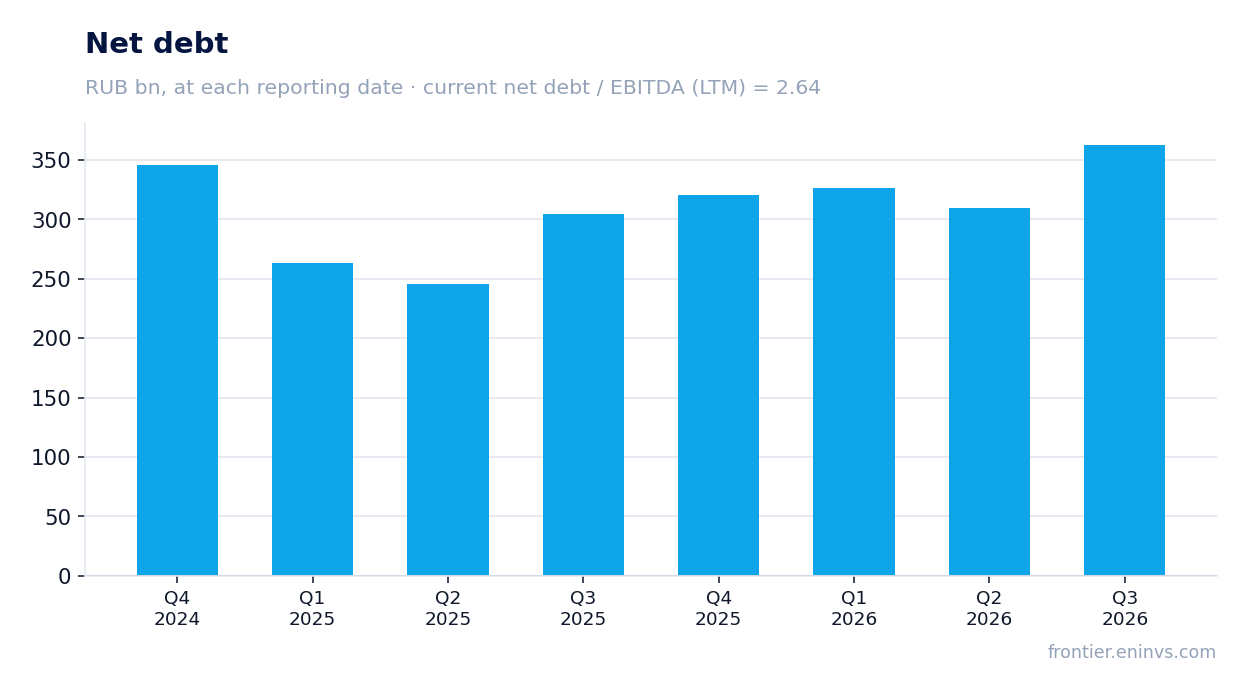
— Net debt rose to RUB 362.7 bn at the end of September from RUB 309.2 bn at the end of June
— The dividend for 2025 was RUB 474 per share, while our estimate for the current year is RUB 207.88 per share
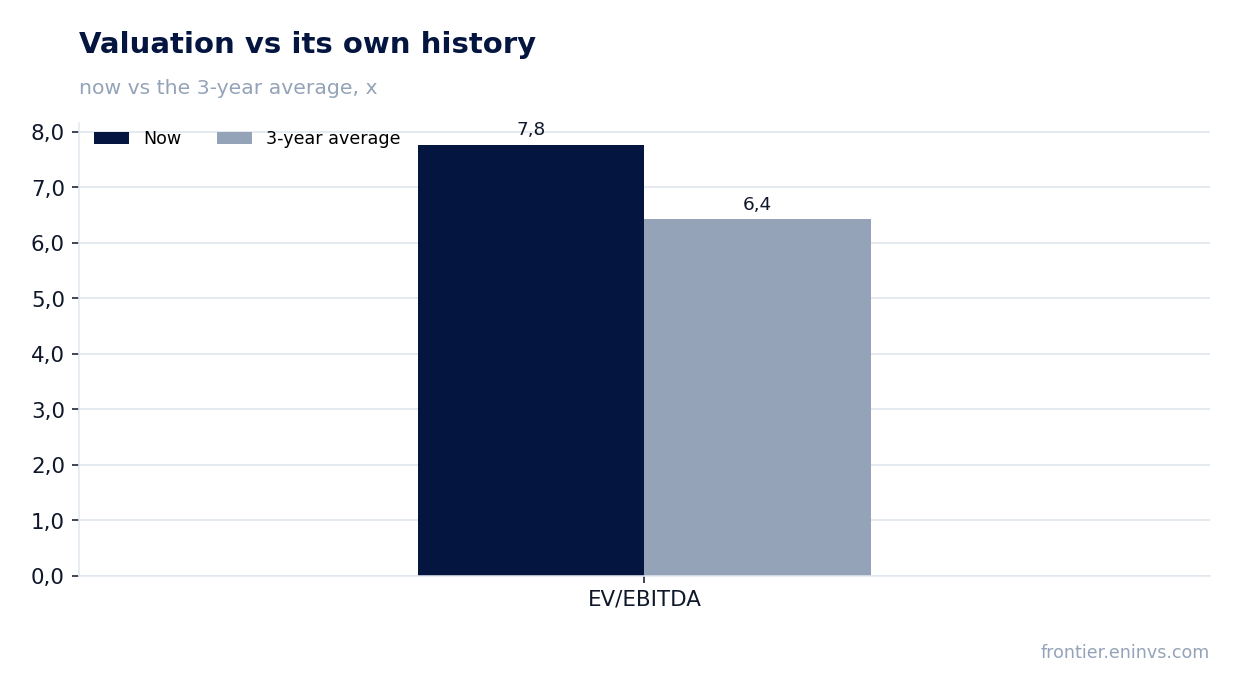
— EV/EBITDA LTM of 7.8 is 21% above its own three-year average of 6.4
Attractiveness
Key figures, RUB bn
Metric
Q3 2025
Q3 2026
Change
Revenue
143
165
+15.0%
EBITDA
51.1
51.3
+0.5%
Operating profit
40.5
39.2
-3.2%
Net profit
20.1
12.6
-37.2%
Operating cash flow
40.5
39.2
-3.2%
Capex
15.7
21.1
+34.5%
EBITDA margin
35.7%
31.2%
-4.5 pp
Net margin
14.1%
7.7%
-6.4 pp
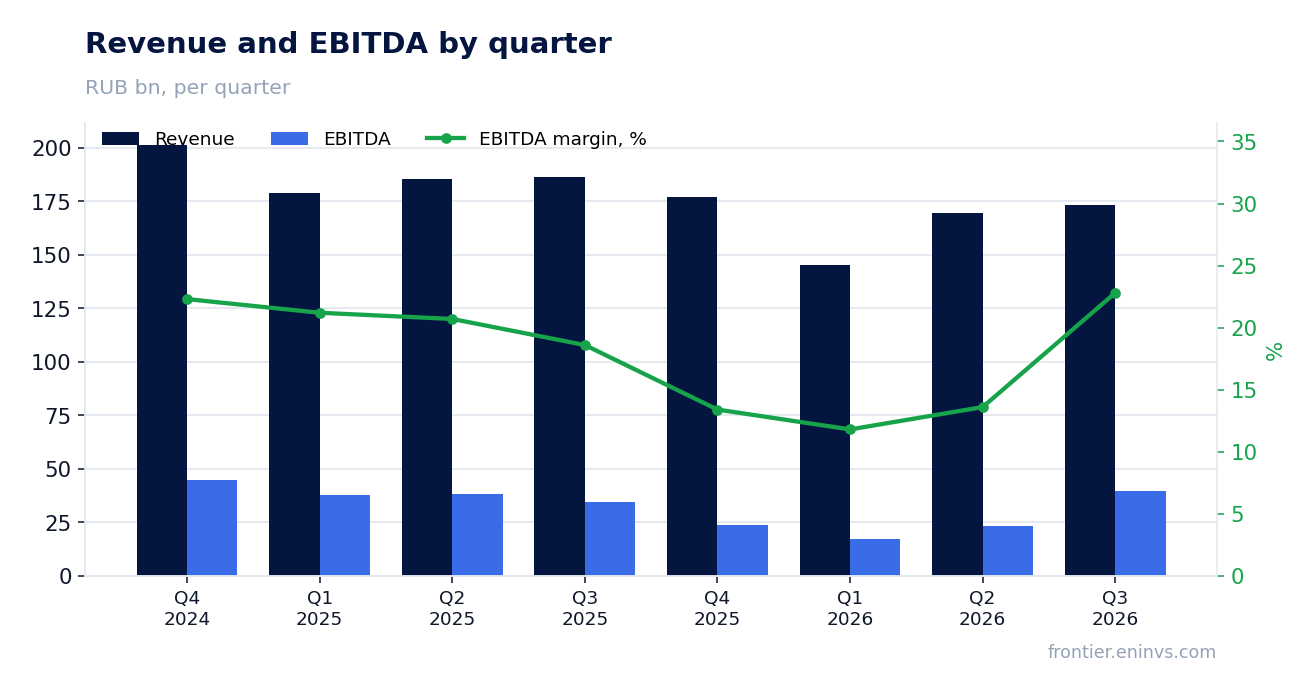
Revenue rose 15.0% year on year in the third quarter, an acceleration from +7.7% in the second quarter
Revenue for the third quarter of 2026 was RUB 164.7 bn, 15.0% more than a year earlier. In the second quarter growth was more modest at 7.7%, so the pace accelerated. This is the best quarterly revenue result since the fourth quarter of 2024.
The acceleration rests on recovery from a weak base: in the first quarter of 2026 revenue fell 17.5% year on year, in the second it grew 7.7%. The third consecutive quarter shows improvement, but the absolute level of revenue is still below the peaks of 2024–2025.
For profit this growth does not yet convert: EBITDA added only 0.5%, and net profit fell. Revenue is growing faster than costs, but not fast enough to hold the margin.
Revenue and EBITDA by quarter
EBITDA added only 0.5% because the margin fell to 31.2% from 35.7%
EBITDA for the third quarter was RUB 51.3 bn, only 0.5% more than a year earlier. With revenue growth of 15.0%, this means the EBITDA margin declined to 31.2% from 35.7% in the third quarter of 2025.
Operating profit was RUB 39.2 bn. The gap between revenue growth and stagnant EBITDA points to cost of sales or selling expenses rising faster than revenue. The facts contain no breakdown by cost line, so the specific cause cannot be named.
A margin of 31.2% is still a high level for the company, but a decline of 4.5 percentage points year on year eats into the effect of sales growth. This is exactly why profit falls while revenue rises.
Net profit by quarter
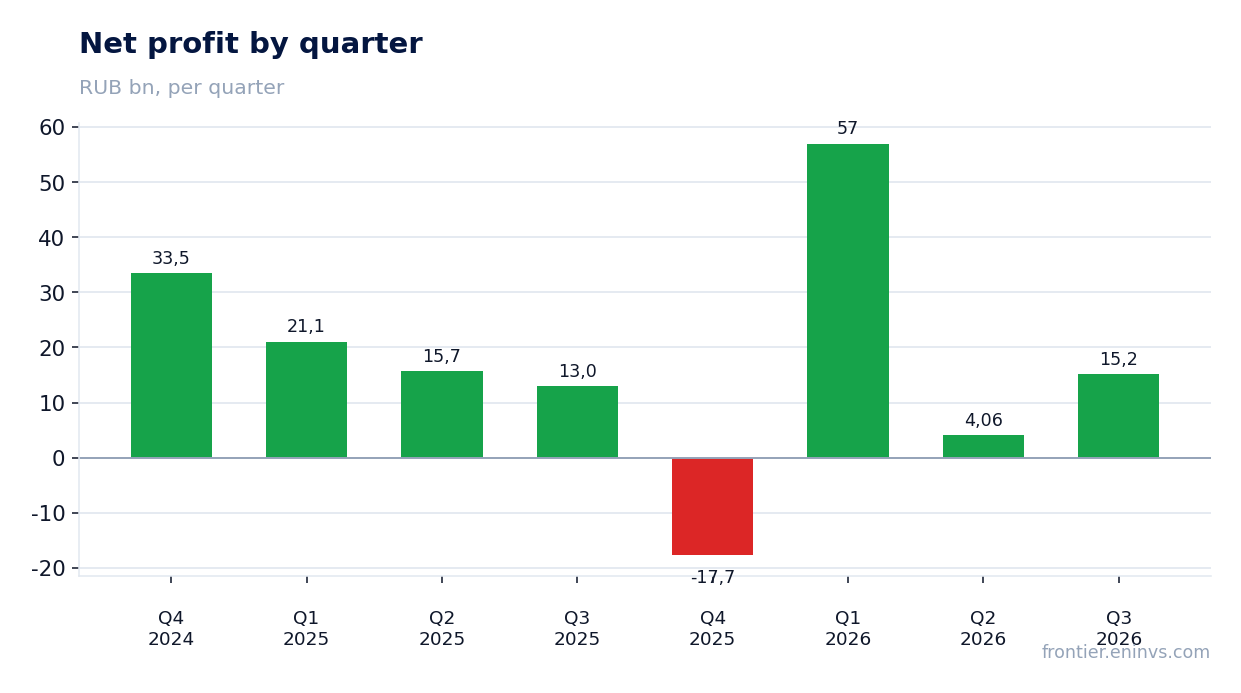
Net profit fell 37.2% to RUB 12.6 bn with a margin of 7.7% versus 14.1% a year earlier
Net profit for the third quarter of 2026 was RUB 12.6 bn, 37.2% less than a year earlier. The net margin fell to 7.7% from 14.1% in the third quarter of 2025.
The profit decline is deeper than the EBITDA decline, which points to rising expenses below the operating line — likely interest. Debt has grown, and servicing it costs more. The facts contain no interest expense figure, so the exact cause cannot be named.
Over the last twelve months net profit was RUB 49.9 bn. This is noticeably below the level of previous years, and this base determines the company's dividend capacity.
Net debt at reporting dates
Net debt rose to RUB 362.7 bn at the end of September from RUB 309.2 bn at the end of June
Net debt at 30 September 2026 was RUB 362.7 bn versus RUB 309.2 bn at 30 June 2026 — an increase of RUB 53.5 bn over the quarter. A year earlier, at 30 September 2025, debt was RUB 304.2 bn, so over 12 months it rose by RUB 58.5 bn.
The ratio of net debt to EBITDA LTM is 2.64. This is a level that limits freedom of manoeuvre: with falling EBITDA, leverage becomes more sensitive to further deterioration in results.
Operating cash flow for the third quarter was RUB 39.2 bn, capital expenditures — RUB 21.1 bn. Free cash flow is positive, but it is not enough to cover interest expenses and dividends while servicing debt.
Valuation vs its own history
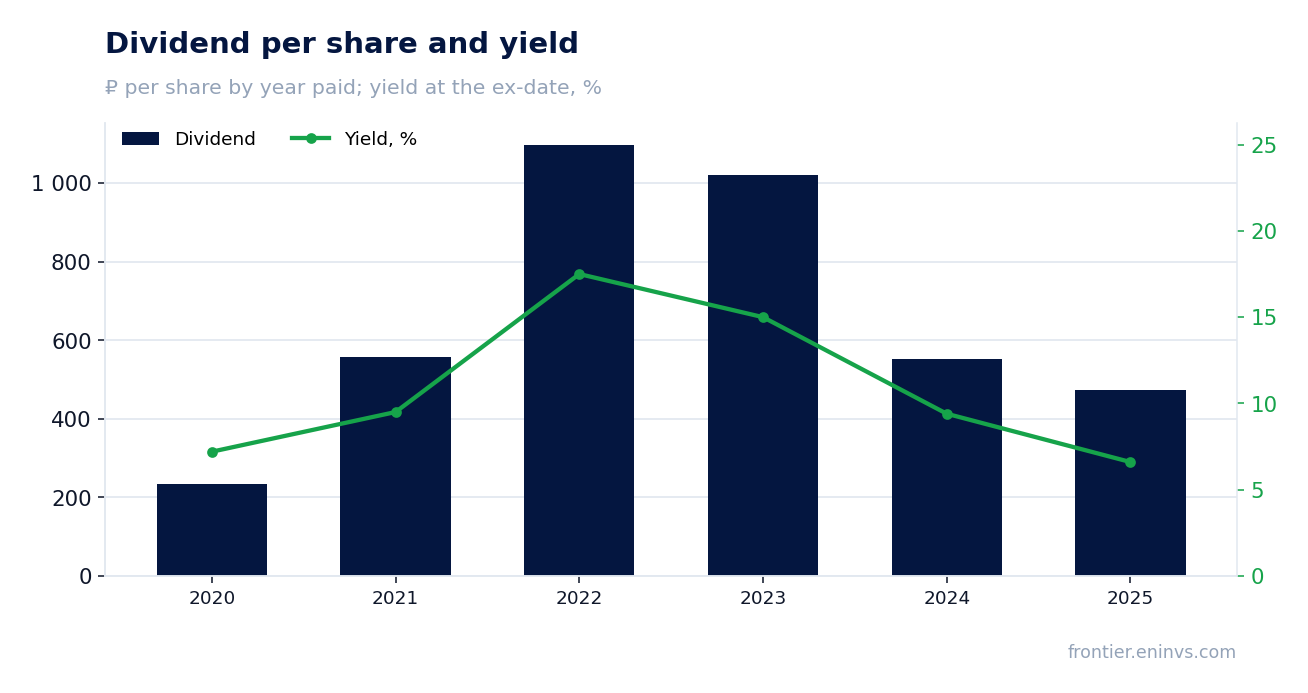
The dividend for 2025 was RUB 474 per share, while our estimate for the current year is RUB 207.88 per share
No dividends were paid over the last 12 months. The last payment was RUB 474 per share for 2025, which at the ex-date price of RUB 7,182 gave a yield of 6.6%. The payment history shows a decline: RUB 1,098 per share in 2022, RUB 1,020 in 2023, RUB 552 in 2024.
Our estimate for the dividend for the current financial year is RUB 207.88 per share, which gives about 3.6% on the current price. This is our forecast, not a board decision: the calculation is based on net profit over the last 12 months and a payout ratio of 0.54 of profit, as last year.
A yield of 3.6% is noticeably below the key rate of 14.0% and below the yield we consider fair for this name — 10.5%. The dividend history of recent years shows payments declining with profit, and at the current profit base the dividend is unlikely to return to the levels of 2022–2023.
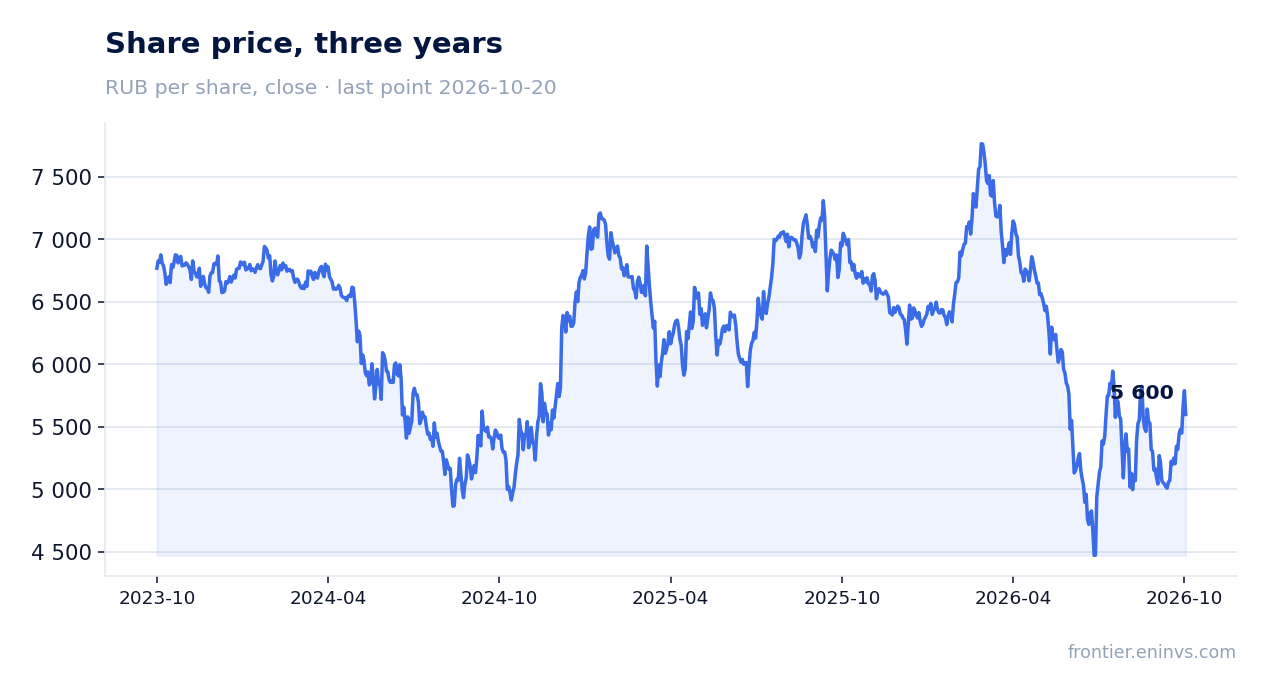
Share price, three years
EV/EBITDA LTM of 7.8 is 21% above its own three-year average of 6.4
On the EV/EBITDA LTM multiple of 7.8, the share trades 21% above its three-year average of 6.4. This means the market values the company more expensively than usual over the last three years, despite falling profit.
P/E LTM is 15.0. With net profit over the last 12 months of RUB 49.9 bn and a market capitalisation of RUB 747.2 bn, this does not look cheap for a company with a falling margin.
On the portal's model, which reprices EBITDA at current commodity prices at the target EV/EBITDA, the upside of the share to fair value is estimated at minus 32%. This is our own estimate, not a market consensus.
Valuation on the latest reported figures
Metric
Value
Market cap
747 bn ₽
P/E (LTM)
15.0
EV/EBITDA (LTM)
7.8
P/B
3.12
Net debt / EBITDA (LTM)
2.64
Operating cash flow (LTM)
97.4 bn
ROE
6.1%
EV/EBITDA, 3-year average
6.4
Dividend per share, ₽, and yield at the ex-date
Year paid
Dividend
Yield
2020
234.00
7.2%
2021
558.00
9.5%
2022
1098.00
17.5%
2023
1020.00
15.0%
2024
552.00
9.4%
2025
474.00
6.6%
Our estimate, current year
207.88
3.6% on the current price
Dividend per share and yield at the ex-date
Bottom line
The strong side of the report is the acceleration of revenue to 15.0% year on year, the best quarterly result since the end of 2024. But growth does not convert into profit: EBITDA added only 0.5%, net profit fell 37.2%, and the margin compressed. Debt rose to RUB 362.7 bn, the dividend forecast is modest, and the valuation is above its own history. The verdict is unattractive: the share offers neither growing profit, nor a high dividend yield, nor a discount to history.
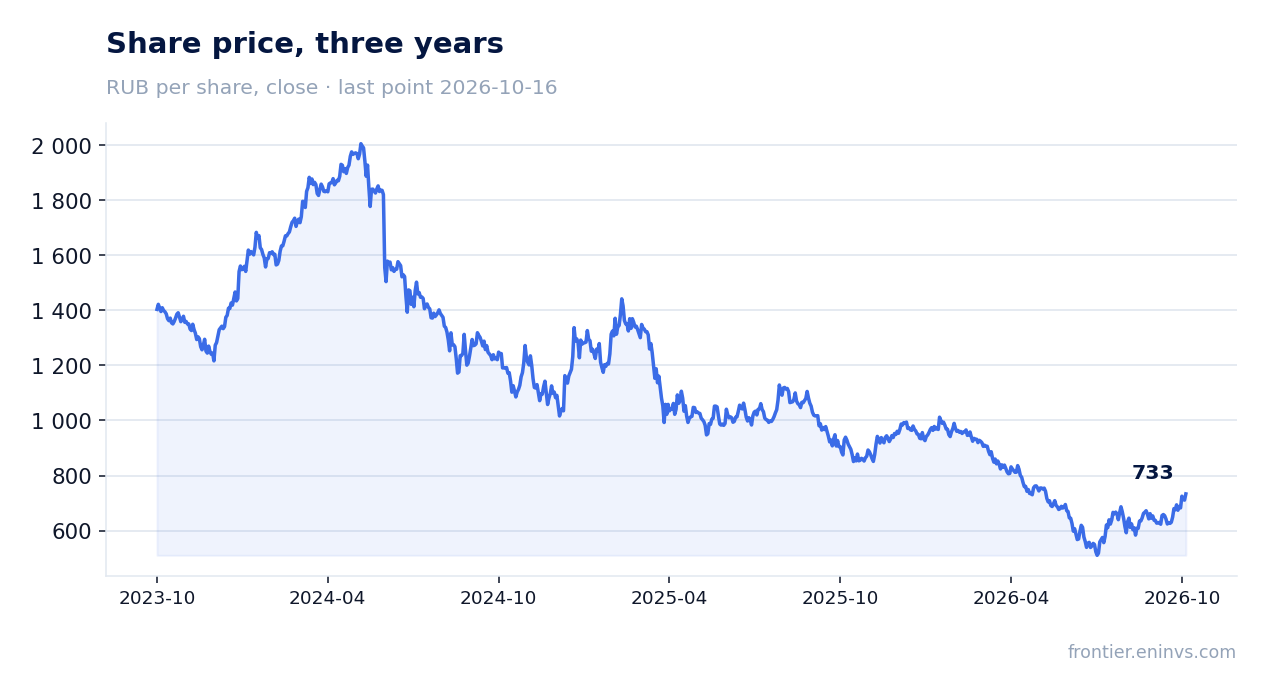
On 20 October Severstal published its results for the nine months and the third quarter of 2026. Quarterly revenue was RUB 173.5 bn (–7.0% year on year), EBITDA RUB 39.6 bn (+14.1%), net profit RUB 15.2 bn (+16.8%), and the EBITDA margin rose to 22.8% from 18.6% a year earlier. Yet the share trades above its own history: EV/EBITDA LTM 6.3 against a three-year average of 4.6, and the portal's model puts the upside to fair value at –39%. The verdict is neutral: the margin and cash flow are strong, but valuation and the absence of a dividend outweigh them.
Key takeaways
— Revenue fell 7.0%, but the decline is shallower than in the second quarter (–8.6%)
— EBITDA added 14.1% on falling revenue – the margin rose to 22.8% from 18.6%
— Quarterly net profit of RUB 15.2 bn rests on FX differences, not only on operating results
— Operating cash flow of RUB 64.5 bn for the quarter – cash arrived ahead of profit
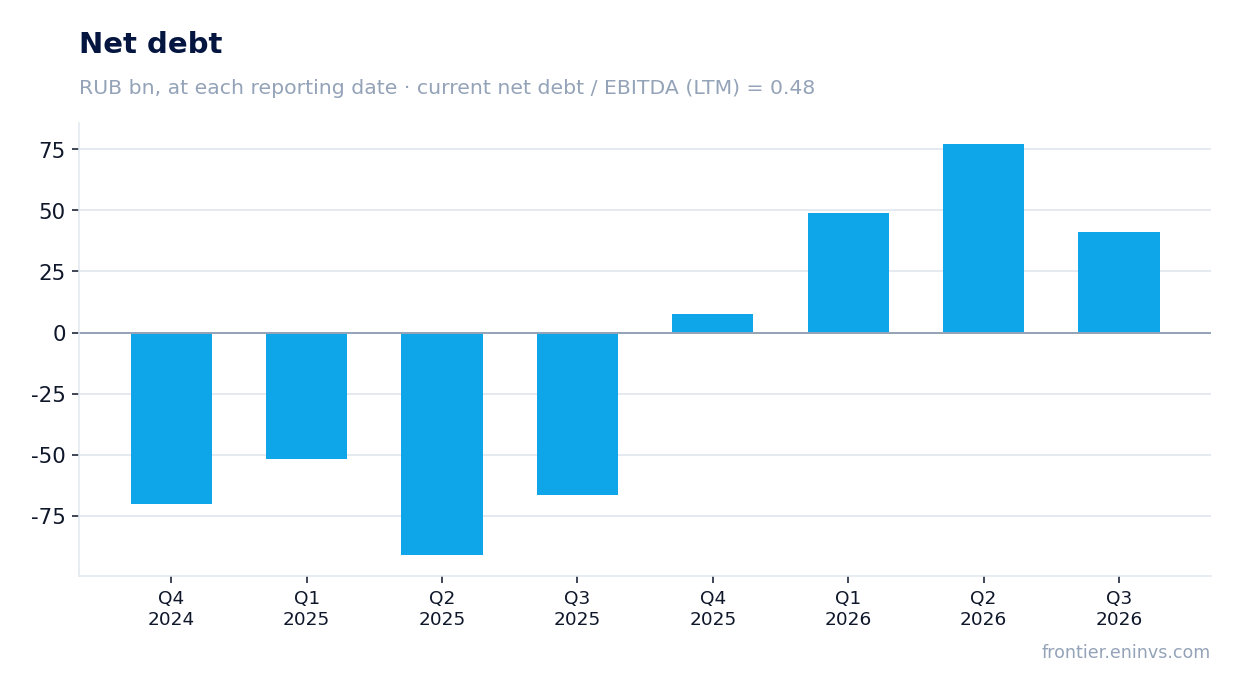
— Net debt fell to RUB 41.3 bn from RUB 77.3 bn at end-June, leverage at 0.48 EBITDA
— No dividends were paid over the last 12 months, and none is pencilled in for this year
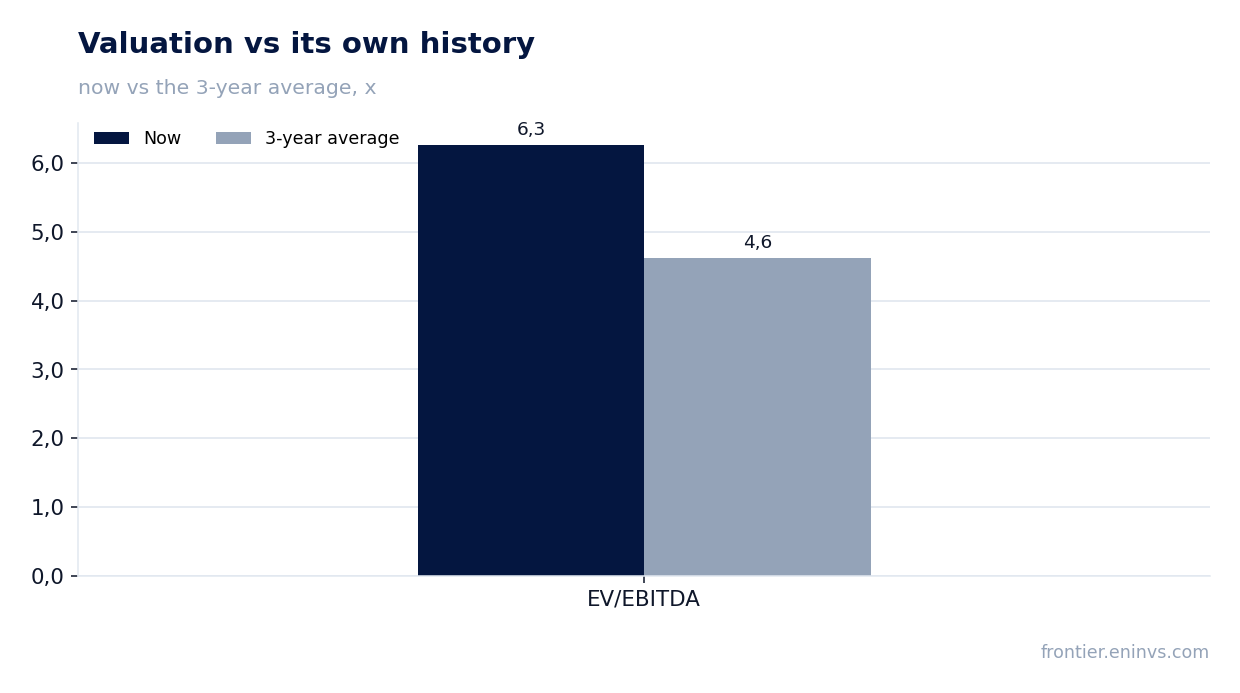
— EV/EBITDA of 6.3 is above its own three-year average of 4.6 – the share is dearer than its history
Attractiveness
Key figures, RUB bn
Metric
Q3 2025
Q3 2026
Change
Revenue
187
174
-7.0%
EBITDA
34.7
39.6
+14.1%
Operating profit
23.3
27.3
+17.5%
Net profit
13.0
15.2
+16.8%
Operating cash flow
42.4
64.5
+52.1%
Capex
4.22
—
—
EBITDA margin
18.6%
22.8%
+4.2 pp
Net margin
7.0%
8.7%
+1.7 pp
Revenue fell 7.0%, but the decline is shallower than in the second quarter (–8.6%)
Third-quarter revenue was RUB 173.5 bn against RUB 186.5 bn a year earlier. The 7.0% decline was smaller than the 8.6% in the second quarter – the pace of contraction slowed rather than accelerated. This is the first improvement in quarterly dynamics after four consecutive quarters of deepening decline.
By product, metal products brought RUB 152.5 bn for the quarter against RUB 159.6 bn a year earlier, transport and warehousing services RUB 10.9 bn against RUB 9.7 bn, and other RUB 10.1 bn against RUB 9.8 bn. The decline is concentrated in the core steel segment, while service lines grew.
In the report management attributes weak demand to the high key rate: end consumers of steel products are not restoring purchases in 2026. While that factor persists, revenue will stay under pressure, and the better quarterly pace is stabilisation rather than a reversal.
Revenue and EBITDA by quarter
EBITDA added 14.1% on falling revenue – the margin rose to 22.8% from 18.6%
Quarterly EBITDA was RUB 39.6 bn against RUB 34.7 bn a year earlier, up 14.1%. The EBITDA margin rose to 22.8% from 18.6%, a gain of 4.2 percentage points. Operating profit increased to RUB 27.3 bn from RUB 23.3 bn.
That gap between revenue and EBITDA means cost of sales shrank faster than sales. Other taxes and levies within cost of sales fell to RUB 4.3 bn for the quarter from RUB 4.9 bn a year earlier, while depreciation of production assets rose to RUB 12.3 bn from RUB 11.4 bn – the savings came through cash cost lines, not accounting adjustments.
By segment, Severstal Resources EBITDA was RUB 9.2 bn against RUB 14.1 bn a year earlier, while Severstal Russian Steel was RUB 31.8 bn against RUB 19.4 bn. The mining division weakened and the steel division doubled its result – the margin was pulled by the processing stage, not by raw materials.
Net profit by quarter
Quarterly net profit of RUB 15.2 bn rests on FX differences, not only on operating results
Third-quarter net profit was RUB 15.2 bn against RUB 13.0 bn a year earlier, up 16.8%. The net margin rose to 8.7% from 7.0%. Yet profit before tax and financial items for the nine months was RUB 38.9 bn against RUB 73.5 bn a year earlier – the operating base over three quarters is markedly weaker than last year's.
The gap is explained by FX differences. For the quarter the net FX loss was RUB 3.7 bn against RUB 5.7 bn a year earlier, so currency revaluation weighed less on profit. For the nine months the FX loss was RUB 9.2 bn against RUB 10.1 bn. That is not operating income, and the sign may flip next quarter.
For the nine months net profit was RUB 19.3 bn against RUB 49.7 bn a year earlier. Quarterly profit growth against a weak nine-month result is a recovery from the collapse at the start of the year, not a durable trend.
Net debt at reporting dates
Operating cash flow of RUB 64.5 bn for the quarter – cash arrived ahead of profit
Quarterly operating cash flow was RUB 64.5 bn – more than four times net profit. For the nine months it came to RUB 46.8 bn after interest and tax, against RUB 89.9 bn a year earlier. The quarterly surge partly reflects working-capital release: over nine months trade payables rose by RUB 20.6 bn while inventories added RUB 8.7 bn.
Capital expenditure for the nine months was RUB 72.3 bn against RUB 122.2 bn a year earlier, so the investment programme has been almost halved. Free cash flow for the nine months was negative at minus RUB 27.6 bn, but in the third quarter it turned positive at RUB 42.6 bn.
The combination of a strong quarterly flow and a trimmed construction programme produced the cash that was missing in the first half. Unrecognised capital commitments at 30 September were RUB 41.7 bn against RUB 72.5 bn at end-2025, so pressure on investment is easing.
Valuation vs its own history
Net debt fell to RUB 41.3 bn from RUB 77.3 bn at end-June, leverage at 0.48 EBITDA
Net debt at 30 September was RUB 41.3 bn against RUB 77.3 bn at 30 June – a reduction of RUB 36.0 bn over the quarter. The ratio of net debt to trailing twelve-month EBITDA is 0.48, so leverage is moderate. A year earlier, at 30 September 2025, net debt was negative at minus RUB 66.6 bn, so over twelve months it rose by RUB 107.9 bn.
The debt portfolio is being restructured: in March the BO-06 and BO-07 exchange bonds were repaid for RUB 15.4 bn, and in July two-year 002Р-01 bonds were issued for RUB 25 bn with a floating rate and a 110 basis point spread to the key rate. Short-term debt fell to RUB 41.2 bn from RUB 56.3 bn at end-2025, while long-term debt rose to RUB 29.9 bn from RUB 3.8 bn.
Interest paid over nine months was RUB 15.3 bn against RUB 24.0 bn a year earlier. With the key rate at 14.0% and a floating coupon, the new issue means debt servicing will follow the rate: a cut eases the interest burden, a rise does not.
Share price, three years
No dividends were paid over the last 12 months, and none is pencilled in for this year
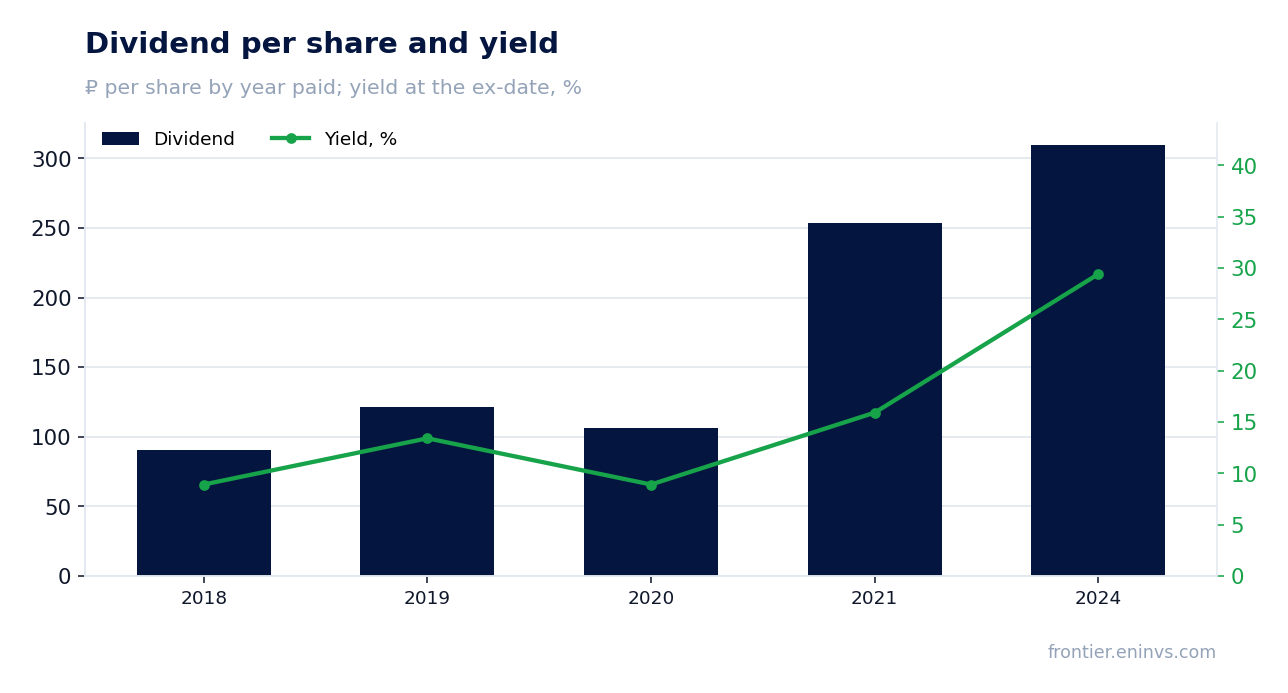
Over the last 12 months Severstal paid no dividends – RUB 0.0 per share – and no further payout is pencilled in for the current calendar year. The last payment in the history is for 2024: RUB 309.93 per share at a 29.4% yield to the ex-date price. The yield history is uneven: 8.9% in 2018, 13.4% in 2019, 8.9% in 2020, 15.9% in 2021.
Our estimate of a fair yield for this name is 15.0%, corresponding to a payout ratio of 0.72 of profit. With the key rate at 14.0%, that yield offers only a small premium to the risk-free alternative, and only if profit recovers. The base is weak: trailing twelve-month net profit is RUB 58.5 bn, but nine-month 2026 profit is only RUB 19.3 bn.
The payout could be reduced by anything that hits profit: a further fall in revenue, a weak rouble through FX differences, higher interest costs on the floating coupon. While the company directs cash to debt reduction and investment, the dividend is a question for next year, not this one.
Dividend per share and yield at the ex-date
EV/EBITDA of 6.3 is above its own three-year average of 4.6 – the share is dearer than its history
On the trailing twelve-month EV/EBITDA the share trades at 6.3 against a three-year average of 4.6 – 35% above its own history. The trailing P/E is 10.4 and ROE is 3.7%. The market is paying for a margin recovery more than it is worth by historical standards.
On the portal's model, where EBITDA is re-priced at current commodity prices at the target EV/EBITDA, the upside of the share to fair value is negative at –39%. This is our own estimate, not a market consensus, and it rests on current commodity prices.
Only a durable EBITDA recovery can justify the premium to history. A quarterly margin of 22.8% is a step in that direction, but revenue is still falling and nine-month profit is a third of last year's. Until both conditions are met, the valuation looks stretched.
Valuation on the latest reported figures
Metric
Value
Market cap
608 bn ₽
P/E (LTM)
10.4
EV/EBITDA (LTM)
6.3
P/B
1.22
Net debt / EBITDA (LTM)
0.48
Operating cash flow (LTM)
81.2 bn
ROE
3.7%
EV/EBITDA, 3-year average
4.6
Dividend per share, ₽, and yield at the ex-date
Year paid
Dividend
Yield
2018
90.33
8.9%
2019
121.70
13.4%
2020
106.39
8.9%
2021
253.42
15.9%
2024
309.93
29.4%
Bottom line
What came out strong in the report was the margin and the cash: EBITDA added 14.1%, the margin rose to 22.8%, quarterly operating cash flow was RUB 64.5 bn, and net debt fell to RUB 41.3 bn at 0.48 EBITDA. But part of the quarterly profit came from smaller FX losses rather than from operations, and nine-month net profit is a third of last year's. No dividends were paid over the last 12 months, and none is pencilled in for this year. The key question for a holder is whether a durable margin recovery justifies a multiple of 6.3 against its own 4.6 average; with no answer yet, the verdict is neutral.
Rolf bonds yield 21-22% to maturity with the key rate at 14%. The issuer itself, ROLF JSC, earns money and services its own debt with a margin of safety. The premium of 7-8 percentage points is the price for the holding company sitting above it, which bought the business on credit in 2024. Rolf guarantees that loan, which is serviced with Rolf's cash and the owner's loans. We consider the short issues maturing in January and May 2027 an acceptable risk for investors who deliberately take high-yield bond risk. The long 1R09 to 2028 depends on how the group refinances the acquisition loan, and there the yield looks fair rather than generous.
The issuer page with financials by period and all bond issues: Rolf. Below are Enhanced Investments estimates based on the IFRS statements of Rolf Group (PromAgroLogistika JSC) and the standalone IFRS of ROLF JSC for 2025 and 1H2026, releases by ACRA, NCR and Expert RA, and Moscow Exchange and Federal Tax Service data. Where a figure is our estimate, it is marked.
Key points:
In August 2024 the PAL holding company bought Rolf from the state for RUB 34.8bn. The money came from a bank, and Rolf became a guarantor of that loan (RUB 30.1bn at the end of 2025). The ultimate owner is Umar Kremlev, president of the International Boxing Association (IBA).
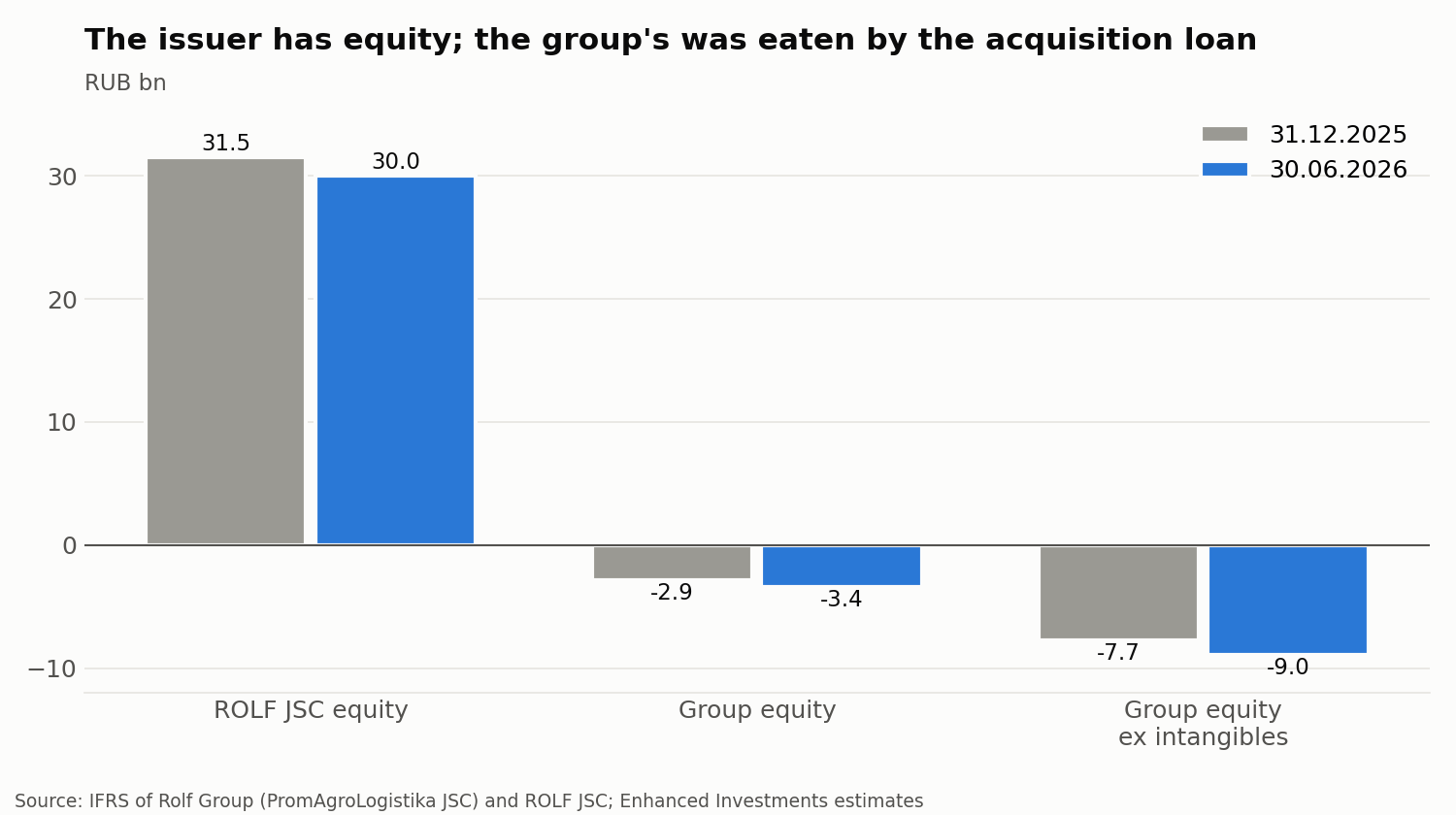
The issuer's own numbers are good: net debt to EBITDA of 1.4x, net profit of RUB 1.0bn for the half-year, equity of RUB 30bn. But including the guarantee, Rolf's leverage is close to the group's.
The whole group including the acquisition loan looks different. Net debt to EBITDA is 3.8x, equity is minus RUB 3.4bn, the half-year loss is RUB 1.7bn. The auditor's review report points to a material uncertainty about the group's ability to continue as a going concern.
Rolf pays dividends to the holding even when its own cash flow is negative. The owner covers the gap with interest-free loans, which reached RUB 9bn by 30 June.
The group sells new cars at a negative margin. The money comes from loans, insurance, service and used cars.
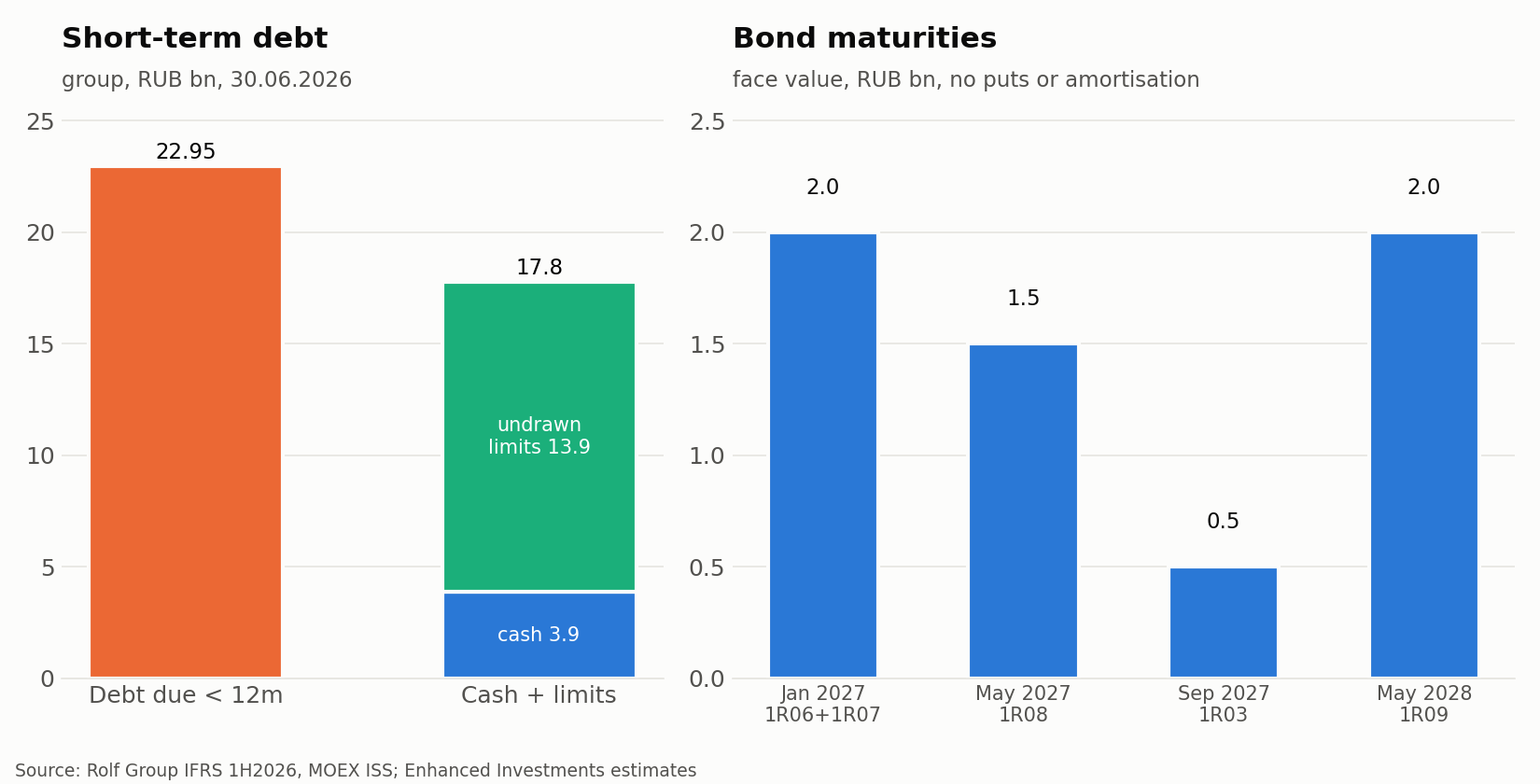
Bonds are only RUB 6bn out of the group's RUB 51bn of debt. The next maturity is RUB 2bn in January 2027, against RUB 13.9bn of undrawn bank limits.
Ratings are A-(RU) from ACRA and BBB+.ru from NCR. Expert RA cut its rating by three notches in a year and withdrew it in September 2026.
The bonds are issued by the operating company, while the loan used to buy it sits above it
Fact. Rolf is the largest car dealer in Moscow and St Petersburg; in 2026 it opened branches in Krasnodar and Kazan. In 2023 the shares were confiscated from founder Sergey Petrov in favour of the state. In August 2024 the Federal Property Management Agency sold Rolf to Avtomobilnye Tekhnologii JSC, 99% owned by PromAgroLogistika JSC (PAL). According to IFRS, the ultimate beneficiary of the group is Umar Kremlev, president of the International Boxing Association (IBA) and a prominent public figure. PAL has no board of directors, and Rolf itself has no independent directors.
The buyer paid RUB 34.8bn in cash. PAL's charter capital is RUB 10 thousand, so the purchase was made almost entirely with debt. The floating-rate loan from a Russian bank is secured by all the property and assets of the acquired companies. According to ACRA, the loan amortises until 2029, and a single bank accounts for more than 80% of the group's bank debt.
For a bondholder this is the key feature of the whole story. The bonds are issued by ROLF JSC, whose own debt is moderate. But the holding has nothing other than Rolf to service its loan with, and Rolf is legally liable for it. The Russian accounting (RAS) statements of ROLF JSC for 2025, in the note on collateral, disclose a guarantee issued for RUB 30.09bn (RUB 34.94bn at the end of 2024; less than RUB 1mn at the end of 2023). The amount matches the group's floating-rate term loan to the rouble, i.e. the acquisition loan. So the bank can claim the outstanding balance of this loan directly from Rolf. We did not find this guarantee in Rolf's standalone IFRS, and the company's investor materials show leverage without it. Rolf's bonds should therefore be assessed on group metrics, not the issuer's.
This is a standard structure for debt-funded acquisitions. The bank wants a direct claim on the company that holds the cash and assets, so the acquired company guarantees the buyer's debt. In Western markets bondholders are usually protected by the terms of the issue: a right to sell the bonds at 101% of par on a change of control, and limits on new debt, guarantees and dividends. In a number of European countries corporate law also restricts a company from guaranteeing debt taken to buy its own shares. In Russia there is no direct prohibition, such a guarantee is approved by the sole shareholder, and retail bond issues usually carry no such restrictions.
Current holders were not misled retroactively. The deal closed on 31.08.2024, and the earliest outstanding issue, 1R03, was placed on 24.09.2024, the rest later. Our complaint is about disclosure. The RUB 30bn guarantee is visible only in an image table in the RAS statements, while the company's communication emphasises an "operating perimeter" with leverage of 1.3x.
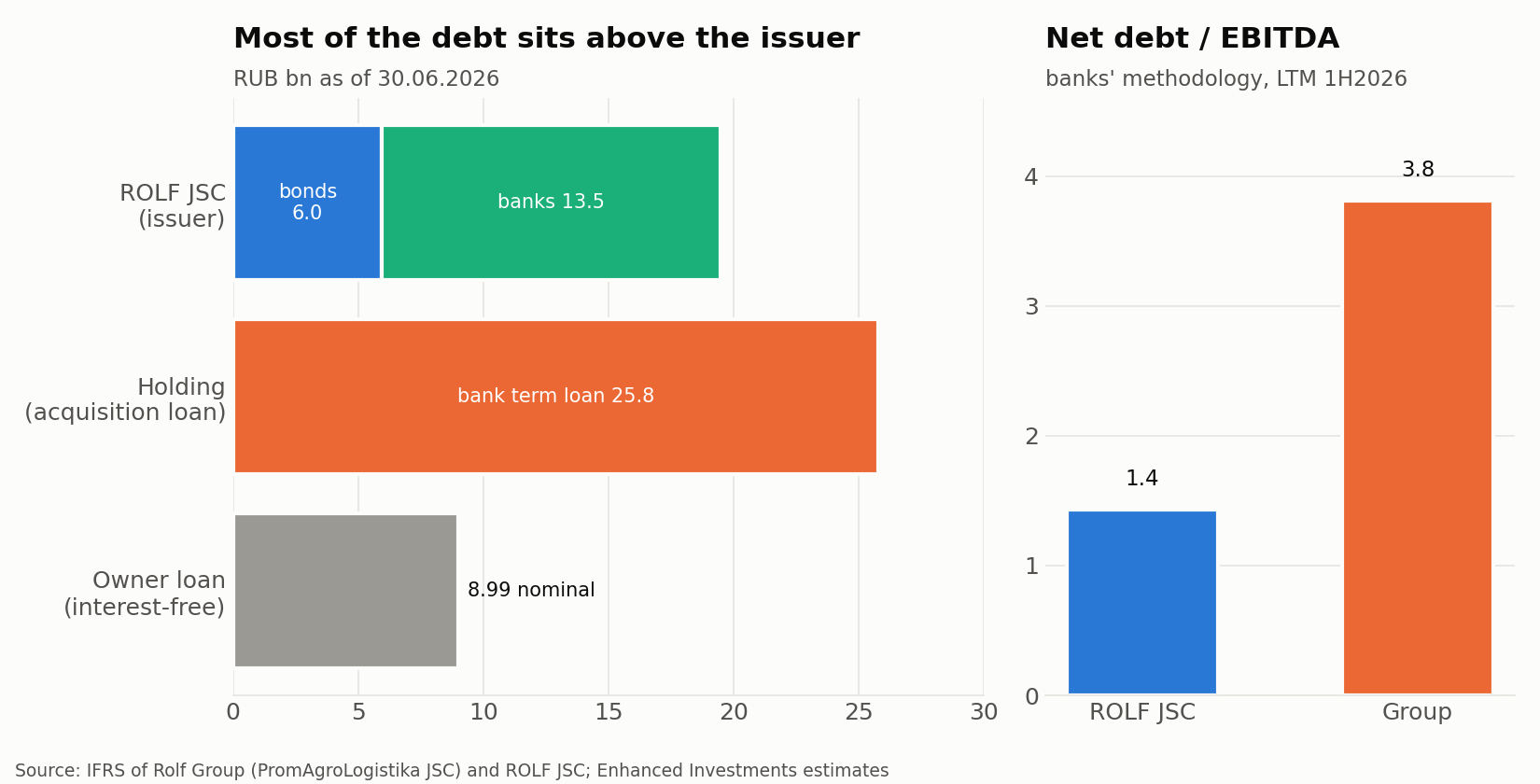
Debt as of 30.06.2026. The issuer has RUB 19.5bn (bonds and bank lines), the holding has a RUB 25.8bn acquisition term loan, plus the owner's interest-free loan. Right: net debt to adjusted EBITDA under the loan agreements' methodology, from the IFRS of the issuer and the group. Rolf guarantees the holding's loan.
The scheme in plain terms: the holding borrowed, Rolf guaranteed and pays
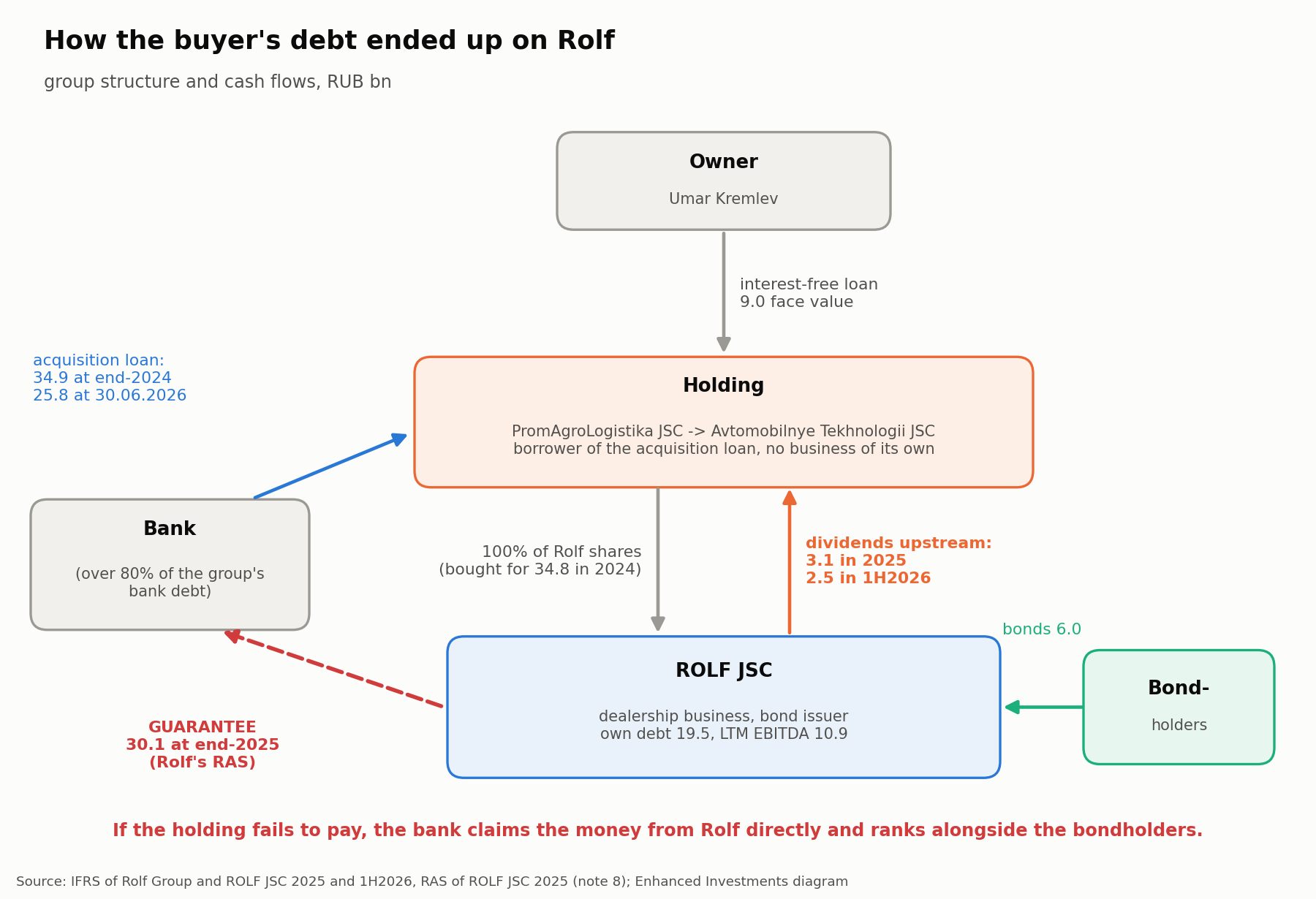
Group structure and cash flows. The red dashed arrow is the guarantee, i.e. Rolf's legal obligation to pay the bank if the holding does not.
How it works, step by step:
Step 1. A debt-funded purchase. A holding company with no business of its own takes a bank loan and buys 100% of Rolf's shares from the state for RUB 34.8bn.
Step 2. The guarantee. The bank wants the loan backed by whoever has the cash. Rolf provides a guarantee: if the holding does not pay, the bank is entitled to claim the debt from Rolf. Under RAS the guarantee stood at RUB 30.1bn at the end of 2025.
Step 3. Debt service. The holding pays the bank out of Rolf's dividends (RUB 3.1bn paid in 2025 and RUB 2.5bn in 1H2026) and the owner's interest-free loans (RUB 9.0bn of face value).
Step 4. If something goes wrong. The holding stops paying, and the bank comes to Rolf as a debtor. A claim of RUB 26-30bn joins the queue of unsecured creditors next to RUB 6bn of bonds, and both will have to be paid from the same dealership business.
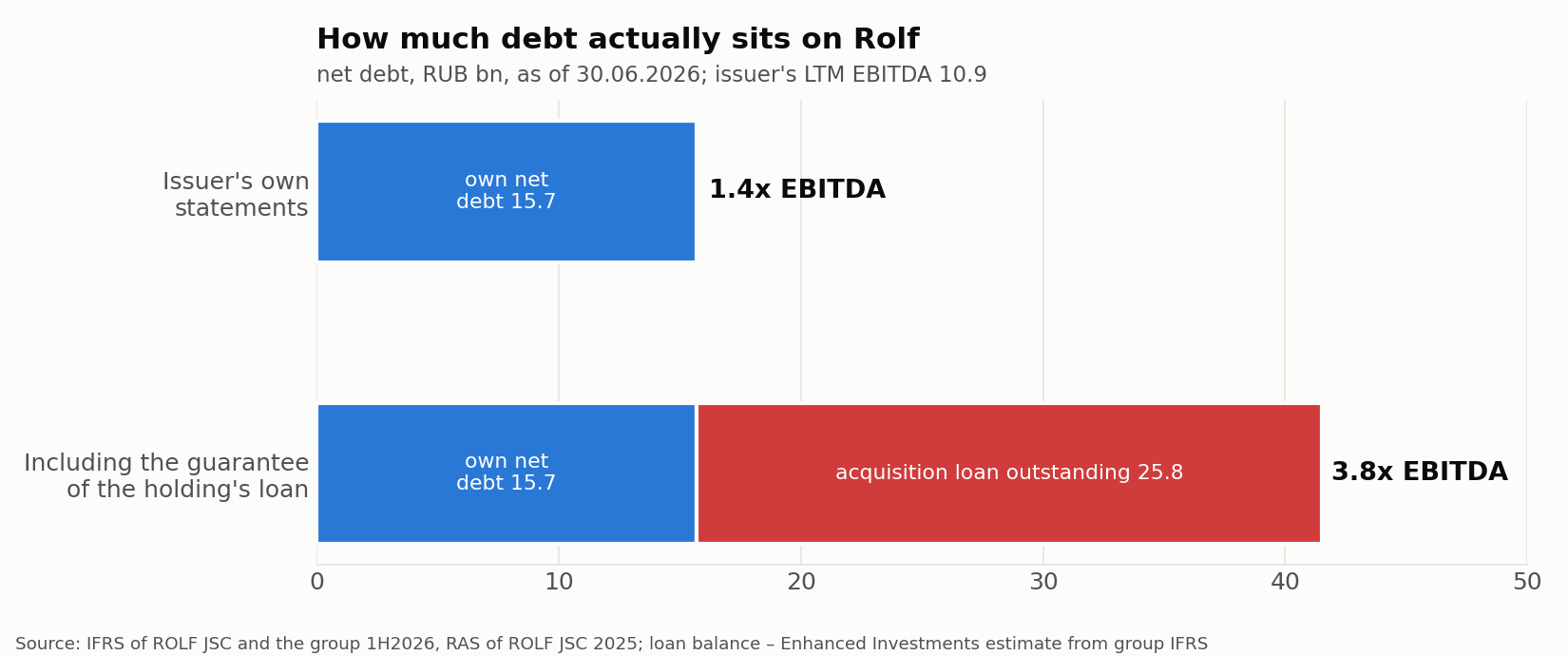
Rolf's net debt without and with the guarantee, as a multiple of the issuer's LTM EBITDA. The acquisition loan balance as of 30.06.2026 is an authors' estimate based on group IFRS.
Authors' estimate. In the issuer's statements net debt is RUB 15.7bn, or 1.4x annual EBITDA. Adding the outstanding acquisition loan that Rolf guarantees gives RUB 41.5bn and 3.8x EBITDA, the same as the group under the banks' methodology. So for a Rolf bondholder the right starting point is the group's numbers, not the issuer's.
Rolf services its own debt with room to spare, but that excludes the guarantee
Fact, IFRS of ROLF JSC for 1H2026. Revenue was RUB 144.3bn versus RUB 70.0bn a year earlier (part of the growth came from merging subsidiaries in August 2025). Operating profit was RUB 3.24bn versus RUB 0.76bn, finance costs RUB 2.04bn versus RUB 2.67bn. Net profit was RUB 1.01bn versus a loss of RUB 0.95bn.
The issuer's debt as of 30 June was RUB 19.5bn: RUB 13.5bn of bank lines and RUB 6.0bn of bonds. Net of RUB 3.8bn of cash, net debt is RUB 15.7bn. Adjusted 12-month EBITDA excluding the lease effect was RUB 10.9bn, a ratio of 1.43x. The issuer's equity is RUB 30.0bn, most of it from revalued dealership buildings and land.
Authors' estimate and assumption. Over the 12 months to 30 June the issuer's operating profit was about RUB 9.9bn against finance costs of about RUB 4.0bn, a coverage of about 2.5x. If Rolf stood on its own, with these numbers its credit quality would, in our view, be noticeably higher than its current ratings. But it does not stand on its own: including the guarantee of the acquisition loan (about RUB 26bn outstanding as of 30 June 2026, our estimate from group IFRS), Rolf's leverage is close to the group's, about 3.8x.
The group with the acquisition loan does not yet cover its interest, and the auditor warns of going-concern risk
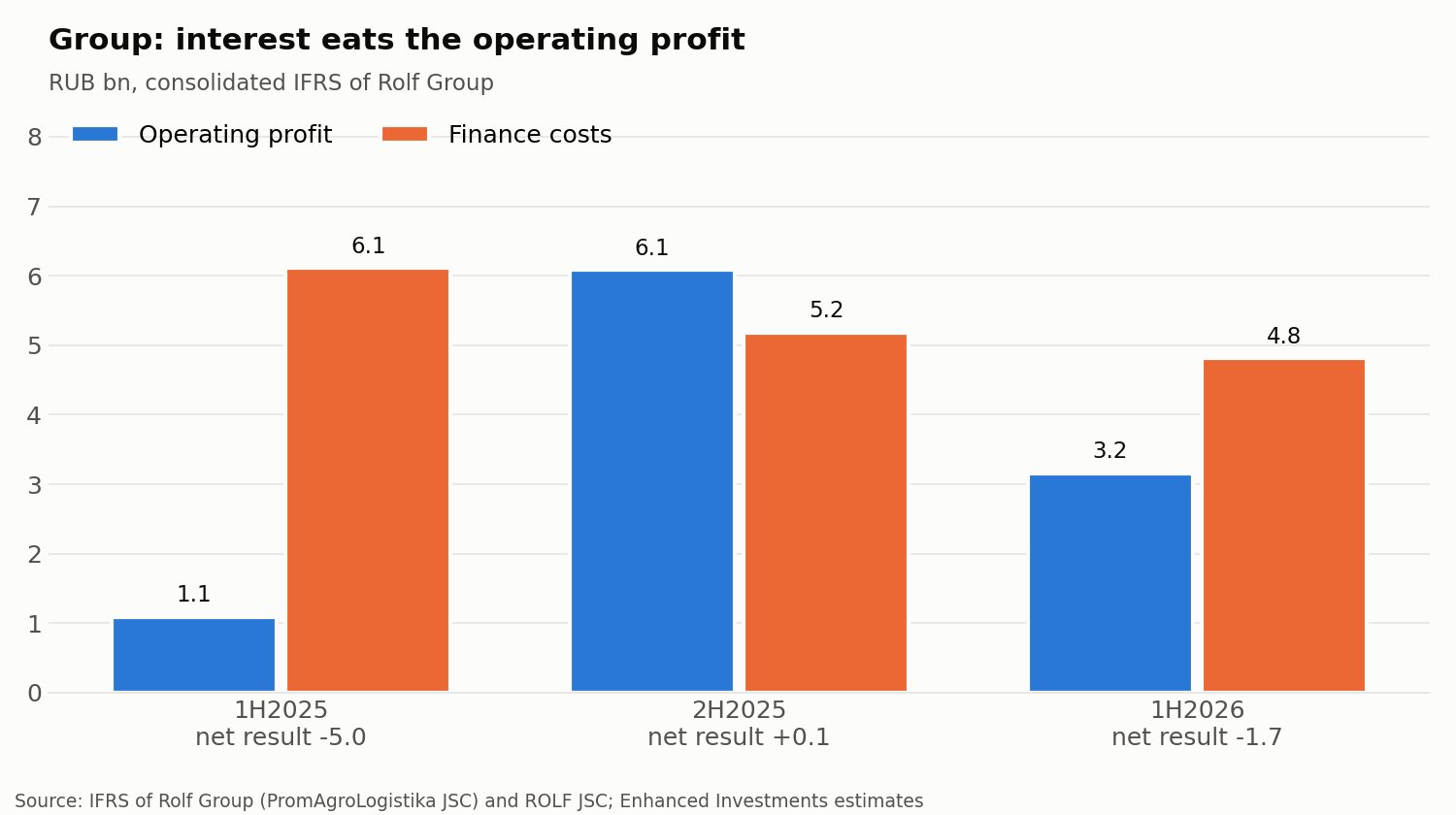
Fact, IFRS of Rolf Group (PromAgroLogistika JSC). 2025: revenue RUB 244.1bn, operating profit RUB 7.17bn, finance costs RUB 11.29bn, net loss RUB 4.95bn. 1H2026: revenue RUB 144.3bn (+61%), operating profit RUB 3.16bn, finance costs RUB 4.81bn, loss RUB 1.74bn versus RUB 5.01bn a year earlier.
Group operating profit and finance costs by half-year, IFRS. In 2H2025 the group broke even; in 1H2026 it was back to a loss, but three times smaller than a year earlier.
Authors' estimate. Over the 12 months to 30 June 2026 the group's operating profit was RUB 9.25bn and finance costs RUB 9.99bn, a coverage of 0.93x. EBITDA (RUB 11.4bn) against interest paid (RUB 9.6bn) gives coverage of 1.19x. Operating cash flow after interest for the same 12 months was negative at minus RUB 1.8bn, mainly because inventories grew by RUB 6.4bn in the first half.
The group's auditor, Unicon JSC, in its review of the 1H2026 statements drew attention to a material uncertainty about the group's ability to continue as a going concern. The reasons are listed in the statements themselves: negative net assets, a loss, negative operating cash flow, and operating profit not covering finance costs. Management responds that the loss shrank by 35%, interest falls along with debt and the key rate, and creditors have provided written waivers of sanctions and early repayment. According to the company, financial covenants are met; the waivers concern non-financial terms.
The group's negative equity is a direct consequence of the debt-funded purchase. There was almost no negative goodwill on the acquisition (RUB 1.4mn), and all losses in later years fell on equity that started at zero.
Equity of the issuer and the group. Excluding intangible assets (RUB 5.5bn, mostly software and trademarks), group equity as of 30.06.2026 is minus RUB 9.0bn. Authors' estimate based on IFRS.
Rolf's cash goes up the chain, and the owner tops it up with interest-free loans
Fact. ROLF JSC paid its sole shareholder RUB 3.11bn in dividends in 2025 and RUB 2.47bn in 1H2026. In the same half-year the issuer's operating cash flow was negative (minus RUB 0.68bn), and its borrowings grew by RUB 4.4bn. The half-year dividend was 2.5 times the half-year IFRS profit.
The beneficiary, for his part, provided the group with an interest-free loan: RUB 4.7bn of face value at the end of 2025 and RUB 8.99bn as of 30 June 2026, plus RUB 0.5bn of financial aid. The loan is carried at a fair value of RUB 3.5bn, with the RUB 3.0bn difference booked as a capital contribution. The group's acquisition term loan shrank from about RUB 30bn to RUB 26bn over the half-year.
Authors' assumption. The scheme looks like this: the acquisition loan is repaid partly with Rolf's dividends and partly with the owner's money. For the bonds this is rather positive as long as the owner keeps putting money in. It is direct evidence of support, not just words. The owner is a public figure, and abandoning one of the country's largest dealers, bought from the state, would be costly for his reputation. As long as he funds the group with cash, we consider a scenario in which the owner walks away unlikely. But this is our assumption, not an obligation: legally the owner is not liable for the group's debts. But the dependence works both ways. If the owner stops topping up, the holding will have to take more from Rolf, and the operating company will start borrowing to pay dividends. This direction of cash flow is what to track in every subsequent report.
The statements show no loans from Rolf to the owner or related companies: as of 30 June 2026 the balance of loans with related parties is zero. Cash goes up through dividends, and risk comes down through the guarantee. One caveat: other related-party transactions in 1H2026 amounted to RUB 0.26bn of administrative expenses, and their nature is not disclosed.
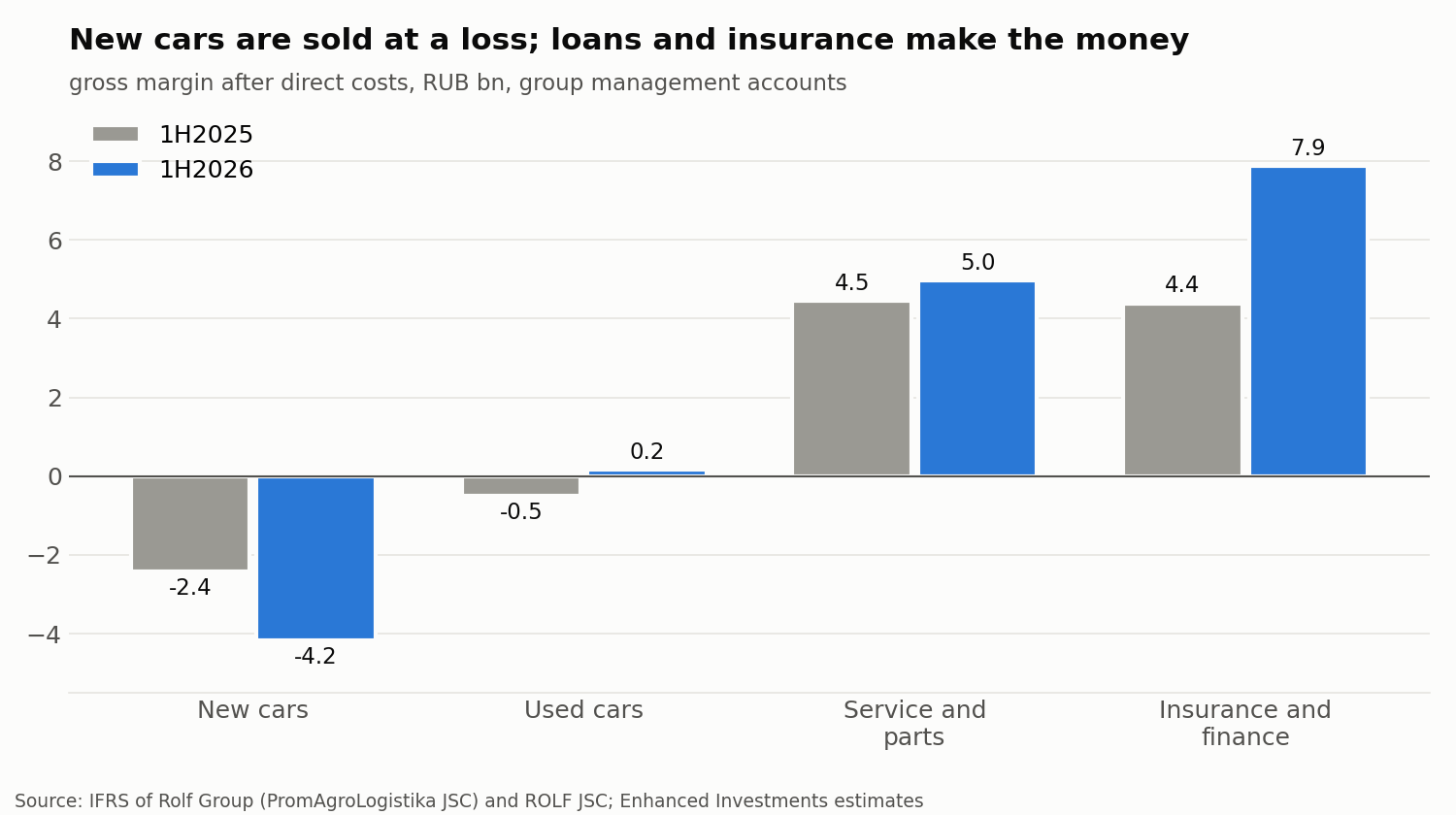
New cars are sold at a loss; loans, insurance and service make the money
Fact, group management accounts (segment note). In 1H2026 the new car segment after direct costs produced minus RUB 4.16bn of gross margin on revenue of RUB 64.3bn. A year earlier it was minus RUB 2.42bn. Used cars moved into a small positive (RUB 0.16bn), service and parts gave RUB 4.96bn, and insurance and finance brought RUB 7.87bn versus RUB 4.39bn a year earlier.
Gross margin of the group's segments after cost of sales and direct delivery, advertising and staff costs, management accounts. Under Russian accounting standards (RAS) the gross loss on new cars is smaller, RUB 0.23bn, because direct costs are not deducted there.
The model is clear: a new car is a reason to sell a loan, an insurance policy and later servicing. According to the company, more than 70% of sales are on credit. Hence the main operating risk. Group income depends on the volume of car loans and partner banks' commissions. If lending contracts or commissions are cut, there will be nothing to close the margin gap on new cars.
Inventories as of 30 June were RUB 29.4bn, of which RUB 23.3bn in cars. They grew by RUB 6.4bn since the start of the year, which is the main reason for the negative cash flow. Part of the purchases was financed by supplier deferrals: RUB 7.1bn versus RUB 5.0bn at the start of the year.
The market is recovering after the 2025 slump, but dealer margins remain thin
Fact. Sales of new passenger cars in Russia fell 15.6% in 2025, to 1.33mn units (Autostat). In 9M2026 the market grew 8%, to 968 thousand. Rolf sold 37.5 thousand new cars in 2025 (+14%), gaining share in a falling market. In 1H2026 it sold 19.6 thousand new and 26.5 thousand used cars.
Since 1 December 2025 the recycling fee has depended on engine power, and from 1 January 2026 the rates were indexed by another 10-25%. This supports prices but weighs on demand and favours locally assembled cars. Rolf works with Asian brands under non-exclusive agreements, without dependence on a single manufacturer.
Industry dealer margins hover around 1.5-2%, and according to the Russian Automobile Dealers Association almost 60% of dealers were loss-making in 2024. The key rate has been cut to 14%. For Rolf, with RUB 38bn of floating-rate debt, each percentage point of the rate costs roughly RUB 0.4bn of interest a year (authors' estimate). Rate cuts are the strongest argument for improving metrics in 2026-2027.
The company guides the market to EBITDA of RUB 11.4bn for 2026 (Interfax, SPIEF, June 2026, management forecast). Group adjusted EBITDA for the first half was RUB 4.3bn, so the guidance requires RUB 7.1bn in the second half. In 2H2025 it was RUB 7.1bn, so the forecast requires repeating last year's result with more expensive inventory. The target is achievable, but with no headroom.
Bonds are a small part of the debt. The key question is the rollover of bank lines
Fact. Group debt as of 30 June 2026 was RUB 50.7bn, including RUB 6.0bn of bonds, RUB 13.3bn of revolving lines and RUB 31.5bn of term loans, among them the acquisition loan and the owner's interest-free loan. RUB 23.0bn of it is due within 12 months. Cash is RUB 3.9bn, undrawn bank limits RUB 13.9bn, plus RUB 7.7bn of undrawn supply-finance limits.
Left: group debt due within a year against cash and undrawn bank limits, IFRS 1H2026. Right: bond maturities by date; all issues are repaid in a single payment, with no puts or amortisation.
Authors' estimate. Revolving lines finance the car inventory and are usually rolled over as long as the cars sell. So the main risk is not the RUB 2bn of bonds due in January 2027, but whether the main bank keeps rolling over the lines and tolerating non-financial covenant breaches. So far it grants waivers and keeps RUB 13.9bn of limits undrawn. Bond payments including coupons until September 2027 will total about RUB 4.9bn (authors' estimate), roughly a third of the undrawn limits.
As of 30 June 2026, RUB 5.3bn of buildings and land and RUB 7.6bn of inventories are pledged against RUB 12.0bn of loans. Over these assets the banks rank ahead of bondholders; the bonds are unsecured. In total, under RAS at the end of 2025 Rolf had pledged RUB 13.6bn of assets, without specifying whose obligations they secure. Under the guarantee, the holding's bank is a direct creditor of Rolf and as a general rule ranks alongside bondholders.
Ratings: A- from ACRA and BBB+ from NCR; Expert RA cut by three notches in a year and walked away
ACRA: A(RU) in August 2025, downgraded to A-(RU) on 04.08.2026, outlook stable. Standalone creditworthiness is assessed at bbb+, with one more notch added for beneficiary support. Downgrade triggers per the agency: debt to FFO above 5x, FFO to interest below 1x, FFO margin below 5% (currently 5.05%, i.e. at the threshold).
NCR: BBB+.ru assigned on 31.03.2026, outlook stable, also reflecting the beneficiary's role in repaying the acquisition loan.
Expert RA: ruA at the start of 2025, downgraded to ruBBB+ on 11.02.2025 and to ruBBB with a developing outlook on 06.02.2026. On 03.09.2026 the rating was withdrawn due to the expiry of the agreement and insufficient information to apply the methodology.
We read a withdrawal without a final review as a negative but not alarming signal: the two other agencies maintain their ratings. For some funds with rating constraints it narrows the pool of buyers.
Taxes and courts: no tax arrears, the story of the former owner closed by a verdict
Fact. According to Federal Tax Service open data as of 25.09.2026, ROLF JSC has no tax arrears, penalties or fines. We could not check the arbitration court records automatically. The group's statements contain the standard transfer-pricing risk disclaimer; no specific tax claims are disclosed.
On 17.08.2026 the Cheryomushkinsky court in Moscow sentenced Sergey Petrov in absentia to 9 years for siphoning about RUB 4bn out of the company (Interfax); the defence is appealing. We found no claims against the current group related to this case.
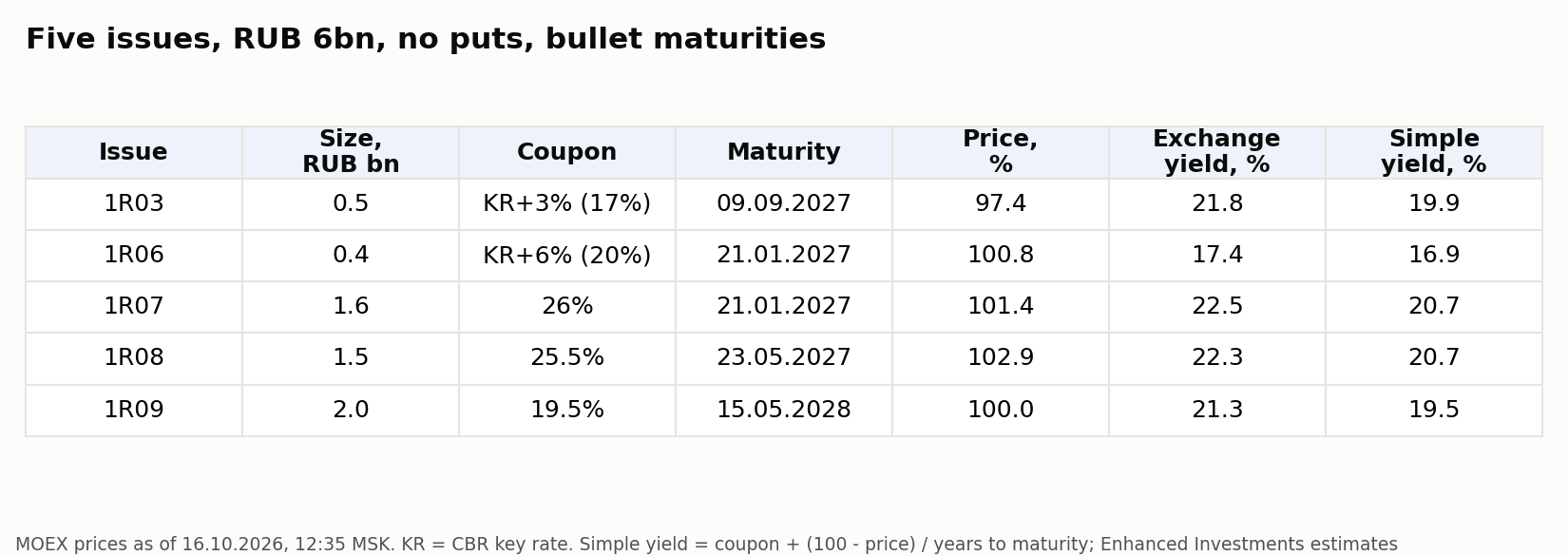
A 21-22% yield: the price of the deal structure, not of a weak business
Rolf's five outstanding issues. Simple yield is calculated the same way for fixed and floating coupons; it is what a holder actually receives without reinvestment.
Authors' estimate. The three liquid issues 1R07, 1R08 and 1R09 trade at yields to maturity of 21.3-22.5%, with simple yields of 19.5-20.7%. The 1R03 floater (key rate plus 3%) trades below par at 97.4%: the market demands a higher spread over the rate than the coupon provides. The small 1R06 (key rate plus 6%) trades rarely.
The market has already repriced the 25.5-26% fixed coupons of 1R07 and 1R08: prices are above par, and at maturity the holder loses the premium. For BBB+/A- paper, a 7-8 percentage point spread over the key rate is the upper end of the market, but the structure here is also worse than usual: negative group equity, an auditor's emphasis of matter, dividends upstream, the issuer's guarantee of the acquisition loan.
Main risks
The owner withdraws support. Without new interest-free loans the acquisition loan will be serviced only by Rolf's dividends, and the operating company will have to borrow to pay them.
The main bank's stance. One bank holds more than 80% of the group's bank debt, and Rolf guarantees its acquisition loan. If the bank refuses to roll over lines or demands early repayment for non-financial covenant breaches, a claim of RUB 26-30bn will land on Rolf directly.
Car lending. Profit comes from loan and insurance commissions. Tighter borrower terms or lower agency commissions hit the single large source of margin directly.
Inventories. RUB 23bn in cars with a negative margin on new vehicles. A new drop in demand means write-downs and further discounts.
Interest rate. RUB 38bn of floating-rate debt. If the easing cycle stops, the expected improvement in coverage will not happen.
Disclosure. The 1H2026 IFRS statements are published on e-disclosure, but as of 16.10.2026 they are not on the investor page of the company's website. In its communication the company emphasises an "operating perimeter" without the acquisition loan (net profit RUB 2.87bn and leverage of 1.3x for 2025), although the whole group will have to pay its debts. The RUB 30bn guarantee is visible only in the RAS statements.
What to take from this story into your own practice
Look at who sits above the issuer. The operating company's financials can be clean while the debt used to buy it sits one level up. In such deals (LBOs) the whole group's statements matter more than the issuer's.
Look for guarantees in the RAS statements. An operating company can be liable for the holding's loan even if its IFRS says nothing about it. Russian accounting statements contain a mandatory note on collateral for obligations. For Rolf it shows a RUB 30bn guarantee that appears neither in the issuer's IFRS nor in its investor materials.
Dividends with negative cash flow are a signal. When a company pays out more than its profit while increasing debt, creditors' money effectively goes to the shareholder.
Owner support shows up in the cash flow statement. Interest-free loans and capital contributions are a verifiable fact. Promises of support without cash flows are worth nothing.
Read the auditor's "Emphasis of matter" section. A going-concern note does not mean default, but it does mean the company lives on its creditors' consent.
A rating withdrawal after a series of downgrades is a reason to double-check. It does not mean the new rating would have been lower, but the market will never know it.
Compare yields the simple way. Coupon plus the difference between price and par per year to maturity shows what you actually keep. A bond with a 26% coupon priced at 103% yields about 21%, not 26%.
Bottom line: a profitable dealer with a heavy structure above it; short issues look more sensible than long ones
As a business, Rolf is a market leader that grew in a falling market in 2025, turned profitable at the issuer level and is reducing its interest burden along with the rate. The problem is the debt-funded purchase of the company. The loss, the group's negative equity and the auditor's emphasis of matter are consequences of this structure, not of failing sales. It rests on two supports: the bank rolls over lines and grants waivers, and the owner tops up with interest-free money. As long as both work, RUB 6bn of bonds against RUB 50bn of group debt are serviced without strain.
We would not put these bonds in the conservative part of a portfolio. The short 1R07 and 1R08 to May 2027, with a simple yield of about 20.7%, are an acceptable risk in the part of a portfolio set aside for high-yield paper. 1R09 to May 2028 at 19.5-21.3% carries the risk of refinancing the acquisition loan, and here the premium looks fair rather than generous.
What to watch next: the 2026 annual results (delivery on the RUB 11.4bn EBITDA guidance, inventory dynamics); the size of Rolf's upstream dividends; continued owner loans; continued bank waivers; ACRA and NCR rating actions; the key rate decision on 23 October; the repayment of RUB 2bn of 1R06 and 1R07 on 21 January 2027.
Sources and caveats
IFRS consolidated financial statements of PromAgroLogistika JSC (Rolf Group) for 2025 with the audit report of Unicon JSC, and condensed interim statements for 1H2026 with the review report dated 28.08.2026 – issuer disclosure.
IFRS financial statements of ROLF JSC for 2025 and 1H2026 – issuer disclosure.
RAS financial statements of ROLF JSC for 2025, note 8 "Collateral for obligations" – issuer disclosure.
ACRA press release of 04.08.2026; NCR press release of 31.03.2026; Expert RA releases of 11.02.2025, 06.02.2026 and 03.09.2026.
Prices, yields and terms of the issues as of 16.10.2026 – MOEX ISS. EBITDA guidance and share of sales on credit – Interfax, 16.06.2026; RAS results for 1H2026 – Interfax, 03.08.2026; Petrov's sentence – Interfax, 17.08.2026.
New car market – Autostat; recycling fee – Autonews; dealer margins – Russian Automobile Dealers Association via Autonews; tax arrears – Federal Tax Service open data as of 25.09.2026.
Samolet is paying on all its bonds, but it has no cash cushion, and the fate of the bonds depends on agreements with the banks. Samolet Group is one of Russia's largest homebuilders, with about RUB 68 bn of bonds outstanding. In 2026 the company passed two put offers and redeemed the BO-P20 issue, but twice transferred the money to the depository late. The holding company that issues the bonds had RUB 0.17 bn in its accounts at 30 June against RUB 250 bn of debt. It pays with money that moves up to it from the project subsidiaries and with new borrowing. There are enough arguments that the banks benefit from keeping the public debt serviced. There is no guarantee of this in any document.
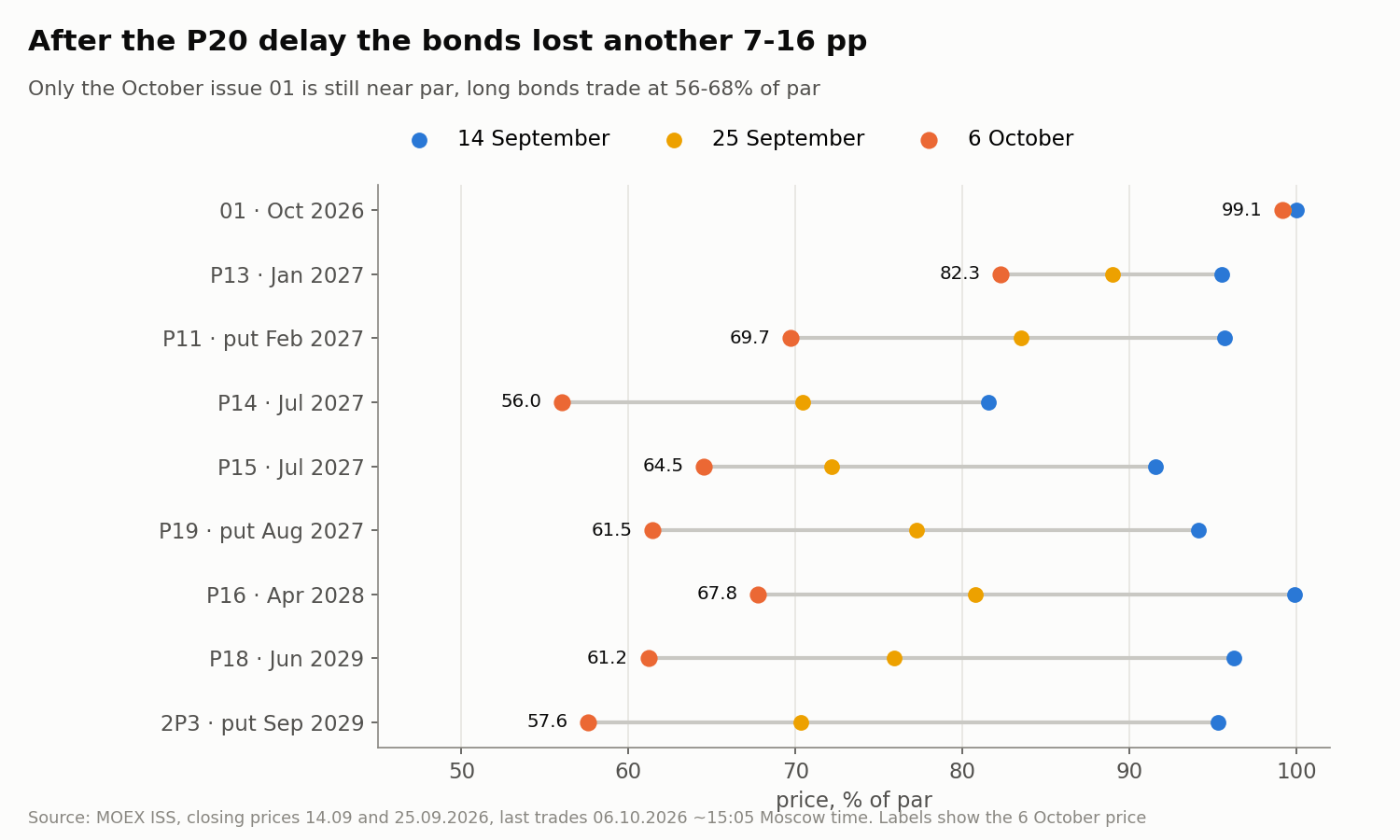
This is how the market prices it. The October issue 01 trades at par. The January BO-P13 is at 82.3% of par, the February BO-P11 put at 69.7%, and the long issues at 56-68%.
Pros. Scale and the banks' interest: Sber and VTB alone had lent the group RUB 360 bn at the end of 2025. Bonds are about 9% of the debt, and keeping them serviced is cheap for the lenders. All 2026 put offers and redemptions have been passed, escrow accounts hold RUB 339 bn, the group is completing the confiscated Kvartal Marino project as a contractor, and ACRA rates it A-(RU) with a stable outlook.
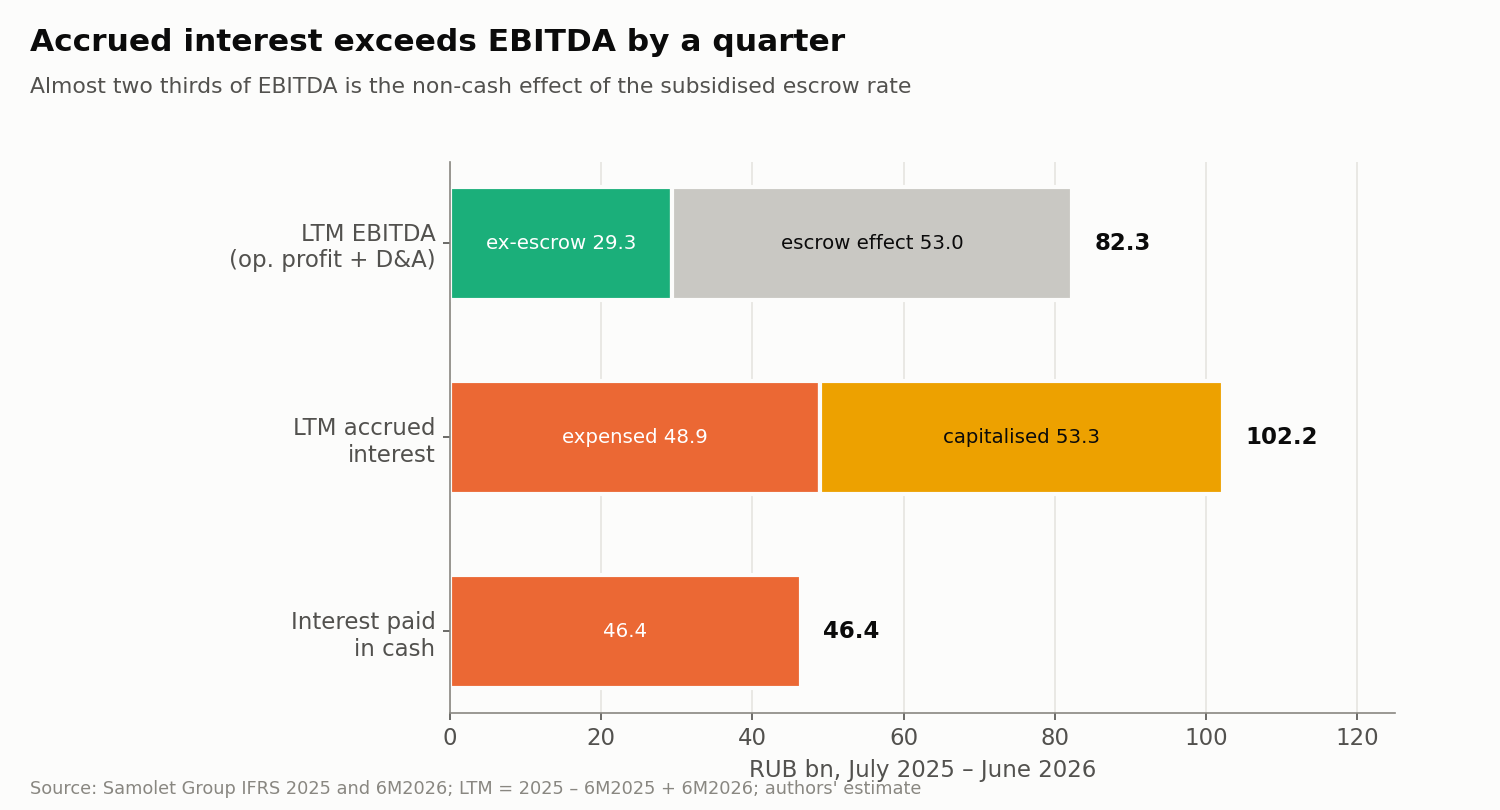
Cons. Accrued interest for the year (RUB 102 bn) exceeds EBITDA (RUB 82 bn), and two thirds of EBITDA is the non-cash escrow effect. Debt without escrow cover is RUB 217 bn, not RUB 113 bn as the company counts it. Excluding intangibles, the group's equity is negative. The issuer has almost no cash and has guaranteed subsidiaries' loans for RUB 1.44 trn.
Upcoming payments: 30 October – RUB 1.5 bn, 24 January – RUB 9.3 bn, 12 February – a put of up to RUB 6.4 bn. To the end of 2027, including coupons, about RUB 59 bn.
Authors' estimate. Prices on 6 October imply a 56-69% chance of being paid on time on BO-P13 and 33-51% on the BO-P11 put.
What is happening: sales have fallen, the company is negotiating with the banks
Samolet Group builds housing in Moscow, the Moscow Region, St Petersburg and other regions. According to ERZ data cited by ACRA, at the start of 2026 it had the largest volume of construction in progress among Russian developers. The shares have traded on the Moscow Exchange since 2020; market capitalisation on 6 October was about RUB 14 bn against RUB 773 bn of debt.
Fact. The group ended 1H2026 with revenue of RUB 117.4 bn (-31% year on year) and a net loss of RUB 22.3 bn. On the 28 August analyst call, CFO Nina Golubnichaya said sales had fallen about 15 pp more than the market and linked this to the February letter requesting state support. At the time the company asked for a RUB 50 bn subsidised loan. No direct support was granted; indirect measures were discussed. On 24 February the Ministry of Finance said that its review had found no preconditions for financial instability risks at the group.
In its 1H IFRS statements the company writes that it "is negotiating with its key lending banks to restructure the existing loan portfolio and reduce the current debt burden". On 17 September Kommersant wrote about possible forms of a deal with Sberbank. The company does not officially confirm that report and says the talks with the banks are constructive. The terms of any agreements have not been disclosed.
Key bond events over the past year:
24 December 2025 – ACRA downgraded the rating from A(RU) to A-(RU), outlook stable;
3 February 2026 – RUB 15.2 bn of the RUB 24.5 bn BO-P13 issue was redeemed at the put;
6 February – ACRA placed the rating under review after the request for state support; on 2 March it removed the review status;
5 May – technical default on coupons of three issues: the money reached the depository a few hours late, and the payments were made within the grace period;
7 August – RUB 3.1 bn of the RUB 5 bn BO-P15 issue was redeemed at the put;
10 August – the fund of the heirs of co-founder Mikhail Kenin sold 18% of the shares to a fund managed by Kazakhstan's Fonte Capital for RUB 4.2 bn;
28 August – 1H results: talks on restructuring the loans and a covenant breach on one RUB 3.0 bn loan;
14-16 September – the same fund sold almost its entire stake: first to 15%, then to 10% and to about 5% (disclosed on 29 September, buyers not named);
28 September – redemption of BO-P20 for RUB 2.5 bn: the coupon arrived in full, but only RUB 269 of the RUB 1,000 face value was paid on time, the rest on 29 September. The NSD recorded a technical default; the company attributed the delay to technical reasons.
After 28 September the issues maturing after January fell by another 7-16 pp. As of 6 October we found no rating actions following the BO-P20 redemption.
The new shareholder did not stay long. Fact. On 10 August the Horizont fund, representing the heirs of co-founder Mikhail Kenin, sold 18% of the shares for RUB 4.2 bn to a fund managed by Kazakhstan's Fonte Capital. As early as 14-16 September that fund sold almost its entire stake, down to about 5%: precisely in the days when the bonds started to fall. Who bought the shares has not been disclosed, and below 5% the fund may not report changes in its stake. Support from this shareholder cannot be counted on, and for the bonds this is rather a negative.
What supports Samolet bonds
The banks are better off if the group finishes the buildings. At the end of 2025 the largest lenders were Sberbank (RUB 274.2 bn, 30.6% of debt) and VTB (RUB 85.9 bn). Most of the debt is project loans for specific developments. Halting construction would hurt the banks themselves and tens of thousands of homebuyers, so the lenders have an interest in the company having enough money to complete its projects.
Bonds are a small part of the debt. About RUB 68 bn of bonds are outstanding at face value (RUB 74 bn on the balance sheet including accrued coupons) out of RUB 773 bn of group debt, around 9%. Keeping them serviced is cheaper for the lenders than dealing with the consequences of a default on public debt.
So far the company is making every payment. In 2026 it redeemed RUB 18.3 bn at put offers (BO-P13 and BO-P15) and the RUB 2.5 bn BO-P20 issue, and coupons were paid in full. There were delays, but they were short, and formally the technical default did not turn into a default.
Construction is mostly covered by homebuyers' money. Fact. Escrow accounts held RUB 338.8 bn at 30 June, 61% of project loans (RUB 556.7 bn). For the industry, according to the Bank of Russia for 2Q, coverage is 65%. On the covered part the bank charges a subsidised rate close to zero, and when the buildings are handed over the escrow money goes to repay the loans.
A large land bank. Land on the balance sheet is worth RUB 372.6 bn, of which RUB 243.0 bn is plots without building permits. This value includes capitalised interest, the land sells slowly (RUB 4.9 bn in six months), and most of it is pledged to banks. But it is a real asset against which maturities can be negotiated.
The state has let Samolet keep building a project confiscated from it. Kvartal Marino in New Moscow (855 thousand sq m) passed to the state following a Prosecutor General's Office lawsuit against Latvia's Rietumu Banka, a co-owner of the project, and the group wrote it off in its accounts. In spring 2026 Samolet resumed construction, now as a contractor, CFO Nina Golubnichaya said. For bondholders this is rather a positive. The group remains a guarantor of the project's RUB 13.2 bn loan and has obligations to about 1,600 buyers, and completing the project reduces these risks. Moreover, the decision to entrust the construction to the company suggests the authorities see no reason to remove it from large projects.
The rating and the state's position. ACRA rates the company A-(RU) with a stable outlook. In February the Ministry of Finance found no preconditions for financial instability at the company.
Related parties are buying the bonds. Fact. The face value of group bonds held by related parties rose from RUB 0.88 bn to RUB 3.3 bn over the half-year. Samolet's IFRS defines related parties as companies connected through key management personnel.
A lower key rate helps directly. Part of the project loans not covered by escrow carries a base rate linked to the market rate. The average portfolio rate is 11.8%, and a lower key rate will reduce interest payments.
The business does not earn its interest: EBITDA of RUB 82 bn against RUB 102 bn of accrued interest
For the 12 months to 30.06.2026. The escrow effect is non-cash revenue that IFRS recognises on account of the subsidised rate on project loans. EBITDA is calculated as operating profit plus depreciation and amortisation.
Authors' estimate. EBITDA for the 12 months to 30 June (operating profit plus D&A) was RUB 82.3 bn. The company's adjusted EBITDA is higher, at RUB 109.4 bn: the company adds back interest previously capitalised into cost of sales, impairments and compensation to buyers.
Under IFRS a developer recognises the escrow saving in revenue, that is, the difference between the market and subsidised rates on the project loan. This revenue brings in no actual cash. Over 12 months the effect was RUB 53.0 bn; without it EBITDA is RUB 29.3 bn.
Accrued interest for the same period was RUB 102.2 bn: RUB 48.9 bn went through expenses and RUB 53.3 bn was capitalised into the cost of buildings under construction and land. RUB 46.4 bn was paid in cash; the rest accumulates in the project loans and is repaid when escrow is released.
Authors' estimate. EBITDA covers accrued interest 0.81x, and 0.29x excluding the escrow effect. The company explains why the loss does not worry it: the gap between profit and cash in development is three years on average, and what matters is that future revenue from the apartments on the balance sheet covers the accumulated costs. For a group that survives these three years, the logic holds. For a lender it means that the debt is currently being serviced with new borrowing and asset sales.
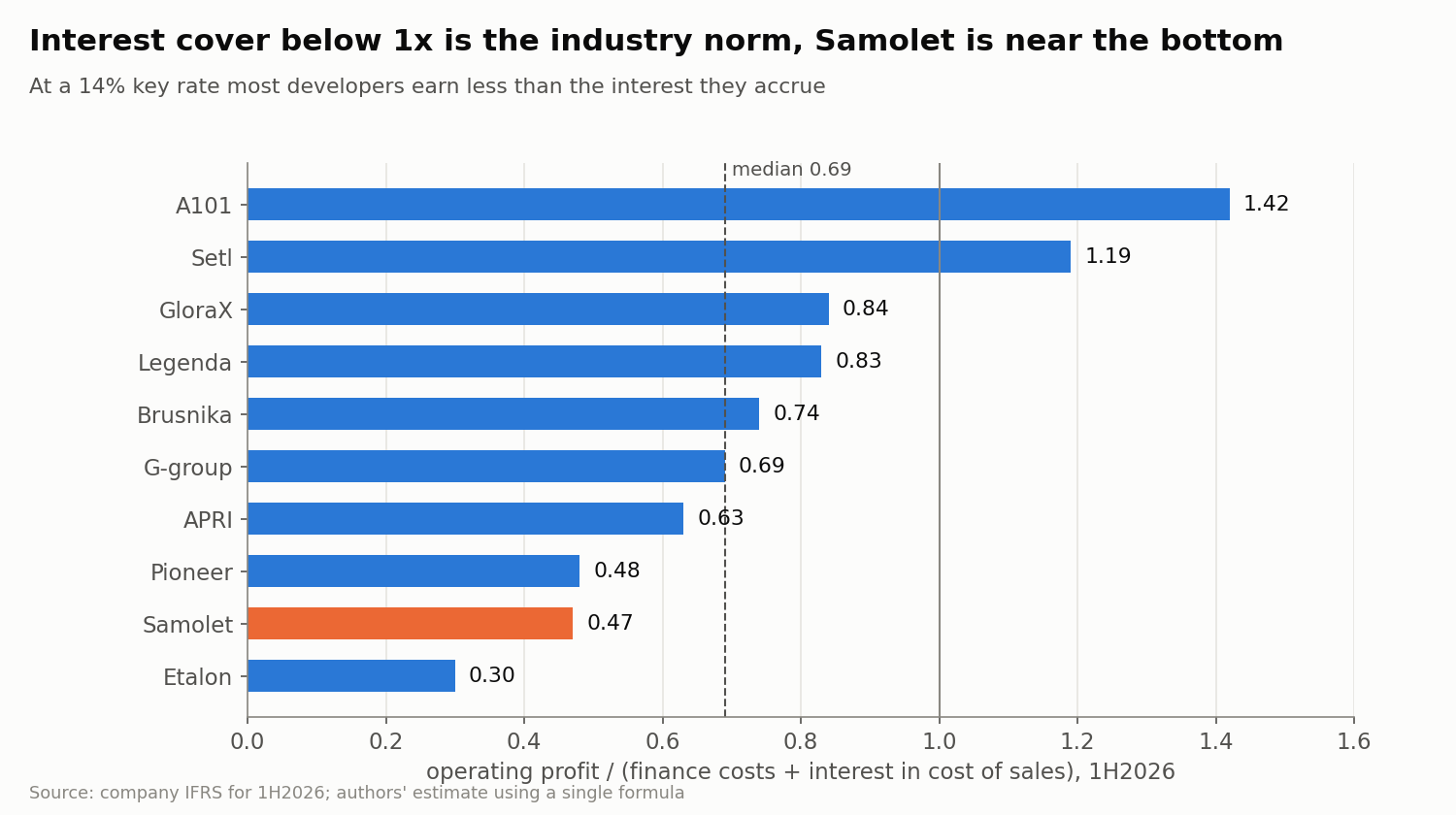
Interest cover of listed developers in 1H2026 using a single formula: operating profit to finance costs and interest in cost of sales.
Interest cover below 1x in 1H was the case for most listed developers, with a median of 0.69 across ten companies. Samolet, at 0.47, is near the bottom of the list. Only Setl and A101 are above 1x.
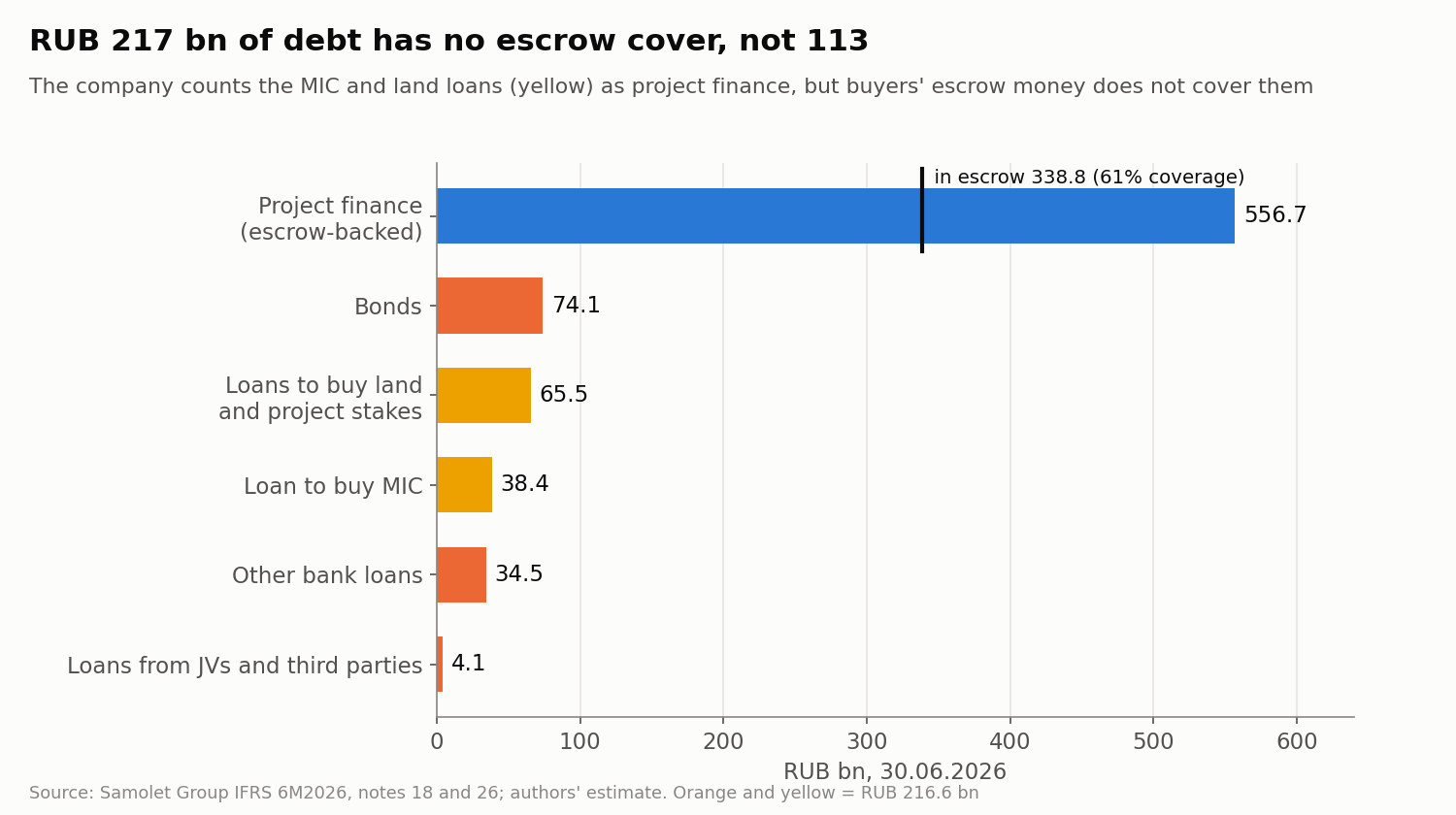
Debt without escrow cover is RUB 217 bn, not 113
Group debt at 30.06.2026 per IFRS note 18. Blue is project finance, partly covered by escrow. Orange and yellow is debt without escrow cover, RUB 216.6 bn in total.
The company splits its debt into two parts. It considers project finance (RUB 660.6 bn) to be backed by homebuyers' money and calls the rest corporate debt (RUB 112.7 bn), showing a ratio of 0.94x to EBITDA.
Within project finance there are two lines unrelated to escrow. The 2023 loan to buy the MIC group is RUB 38.4 bn, and loans to buy stakes in project companies and land are RUB 65.5 bn, of which RUB 45.6 bn is due within a year. The company classifies them as project finance in line with established market practice: MIC is essentially a land bank with project documentation. The logic is understandable, but escrow does not cover these loans, and they will have to be repaid from project margins or land sales.
Authors' estimate. Including these loans, debt without escrow cover is RUB 216.6 bn; net of RUB 9.9 bn of cash, RUB 206.8 bn, or 2.5x LTM EBITDA. Total net debt less escrow money is RUB 425 bn, or 5.2x EBITDA. Using its own methodology with adjusted EBITDA, the company gets 3.9x.
There are a lot of short-term obligations. Of RUB 325.3 bn of short-term loans, about RUB 113 bn is not covered by escrow: bonds (22.9), land loans (45.6), the MIC loan (12.3), bank loans (29.0) and other borrowings (3.3). Undrawn limits of RUB 519 bn are mostly project credit lines for specific developments and cannot be used to repay bonds. Long-term loans of RUB 396 bn are subject to covenants, and there is already one breach.
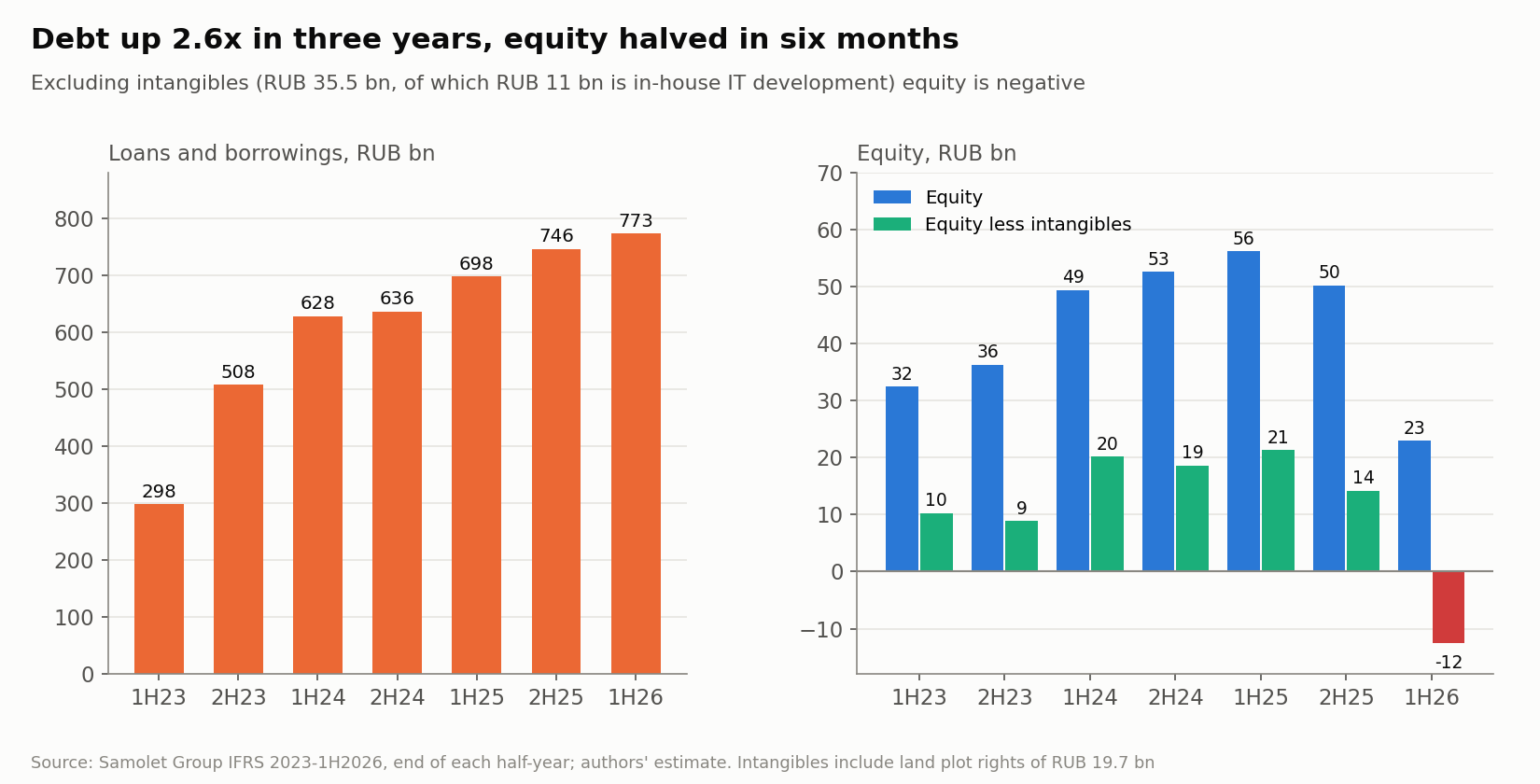
Excluding intangibles, the group's equity is negative
Group loans and borrowings and equity at the end of each half-year. Right: equity less intangible assets.
Fact. Over three years the group's loans and borrowings grew from RUB 298 bn to RUB 773 bn. Equity held at around RUB 50 bn in 2024-2025, and in 1H2026 fell to RUB 23.0 bn, or 2.2% of assets. Of this, RUB 8.3 bn belongs to the shareholders of the PJSC.
Authors' estimate. Assets include RUB 35.5 bn of intangibles: rights to land plots under the St Petersburg built-up area redevelopment programme (RUB 19.7 bn), in-house IT development (RUB 11.0 bn), licences and software (RUB 4.4 bn) and goodwill (RUB 0.4 bn). Without them equity is minus RUB 12.5 bn. If the land rights are kept as an asset close to a land bank, equity is RUB 7.2 bn. Another RUB 35.5 bn of assets are deferred tax assets, which will turn into cash only if the company returns to profit.
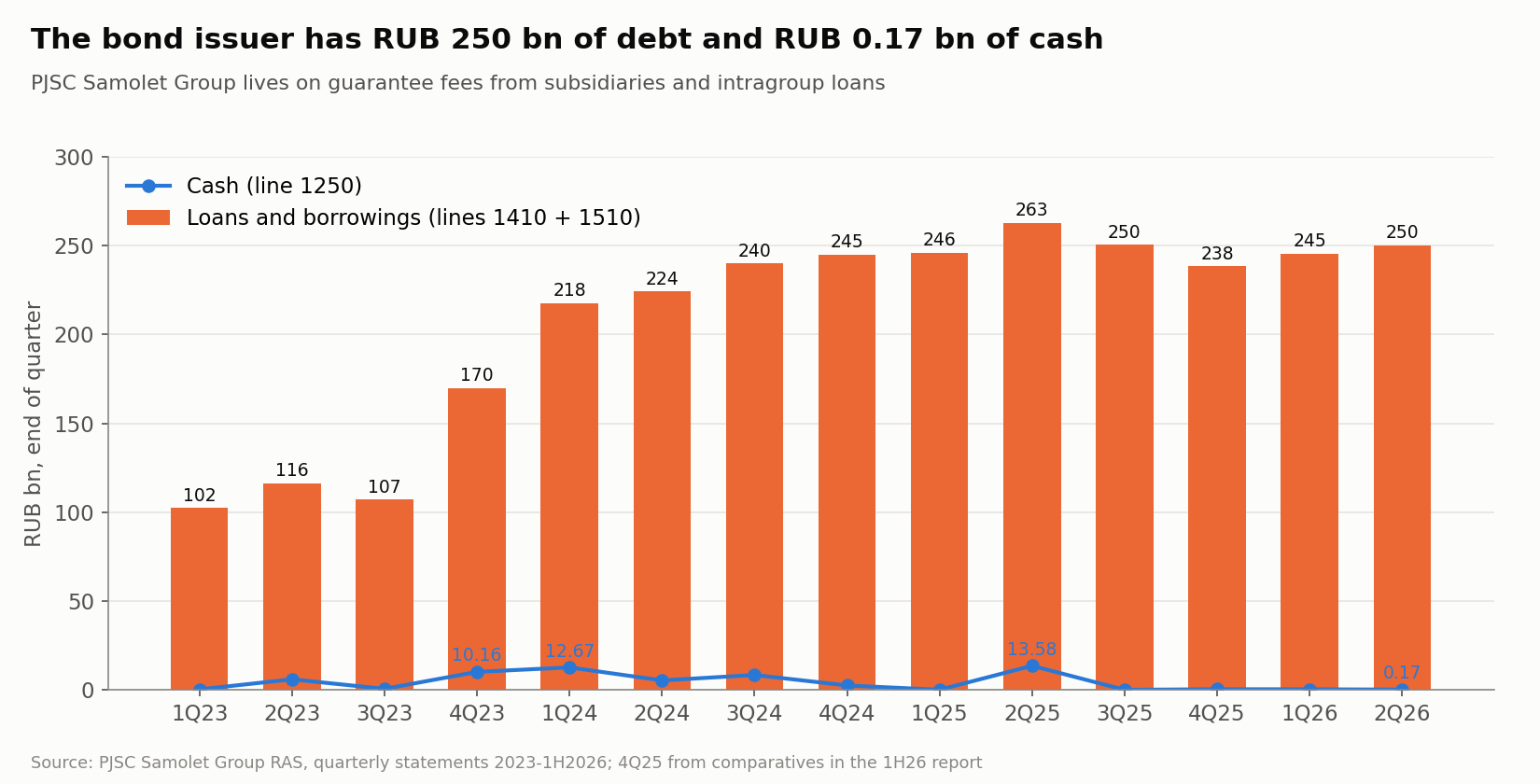
The bond issuer is a holding with RUB 1.44 trn of guarantees and almost no cash
Loans, borrowings and cash of PJSC Samolet Group under RAS at the end of each quarter. This is the company that owes on the bonds.
The bonds are issued by PJSC Samolet Group, so it is useful for a bondholder to look at its standalone RAS statements. Fact. At 30 June:
cash in accounts of RUB 0.17 bn;
loans and borrowings of RUB 250.1 bn: bonds, bank loans of RUB 79.1 bn, loans from its own subsidiaries and interest accrued on them;
equity of RUB 11.1 bn;
all revenue for the half-year (RUB 8.6 bn) is fees from subsidiaries for guarantees;
collateral issued for loans and guarantees totals RUB 1,443 bn.
Over three years the PJSC's debt grew from RUB 102 bn to RUB 250 bn. In half of the quarters, cash at period end was below the monthly coupon amount (about RUB 1 bn).
The PJSC has guaranteed its subsidiaries' loans, so if problems arise the banks will claim against both the project company and the holding. Unlike bondholders, the banks hold collateral: rights to land and buildings under construction worth RUB 268.5 bn, stakes in subsidiaries with net assets of RUB 49.9 bn and claims under loans of RUB 12.2 bn.
The PJSC does not pay interest on loans from its own subsidiaries but accumulates it: long-term payables on them grew from RUB 7.9 bn to RUB 15.0 bn in six months. The holding is saving cash on intragroup settlements in order to pay external creditors.
In its 2025 statements the PJSC corrected prior-year errors, and equity at the end of 2024 fell almost by half. Fact. In its 2023 statements the company did not fully reflect the impairment of investments in subsidiaries (RUB 6.25 bn), a loan to a subsidiary (RUB 0.35 bn) and receivables from subsidiaries (RUB 1.70 bn); in 2024 it wrongly recognised RUB 0.9 bn of income from participation and a deferred tax asset of RUB 0.31 bn. In the original statements the PJSC's equity at the end of 2024 was RUB 18.2 bn; in the restated ones, RUB 9.4 bn. The conclusion for a holder is simple: the issuer's RAS statements for past years showed an equity cushion that did not exist.
Loans to related parties are growing, and provisions on them have risen ninefold
Fact. At 30 June the group had lent RUB 13.5 bn to companies connected through key management personnel. The loans are unsecured, at 21.6% a year, for 1-5 years. In 1H, already in the middle of the cash problems, another RUB 0.54 bn was lent to them. The expected credit loss provision on these loans rose from RUB 151 mn to RUB 1.31 bn. Another RUB 3.5 bn has been lent to joint ventures (provision RUB 1.7 bn) and RUB 6.1 bn to project partners.
An outside investor cannot check on what terms this money was lent or whether it will come back. Interest income on such loans flatters the accounts until the borrowers stop paying. There are no direct signs of cash being siphoned off in the statements, but with RUB 0.17 bn in the issuer's accounts, RUB 23 bn of loans to related parties, JVs and partners is a large sum, and the rise in provisions shows that the company itself already considers part of it problematic.
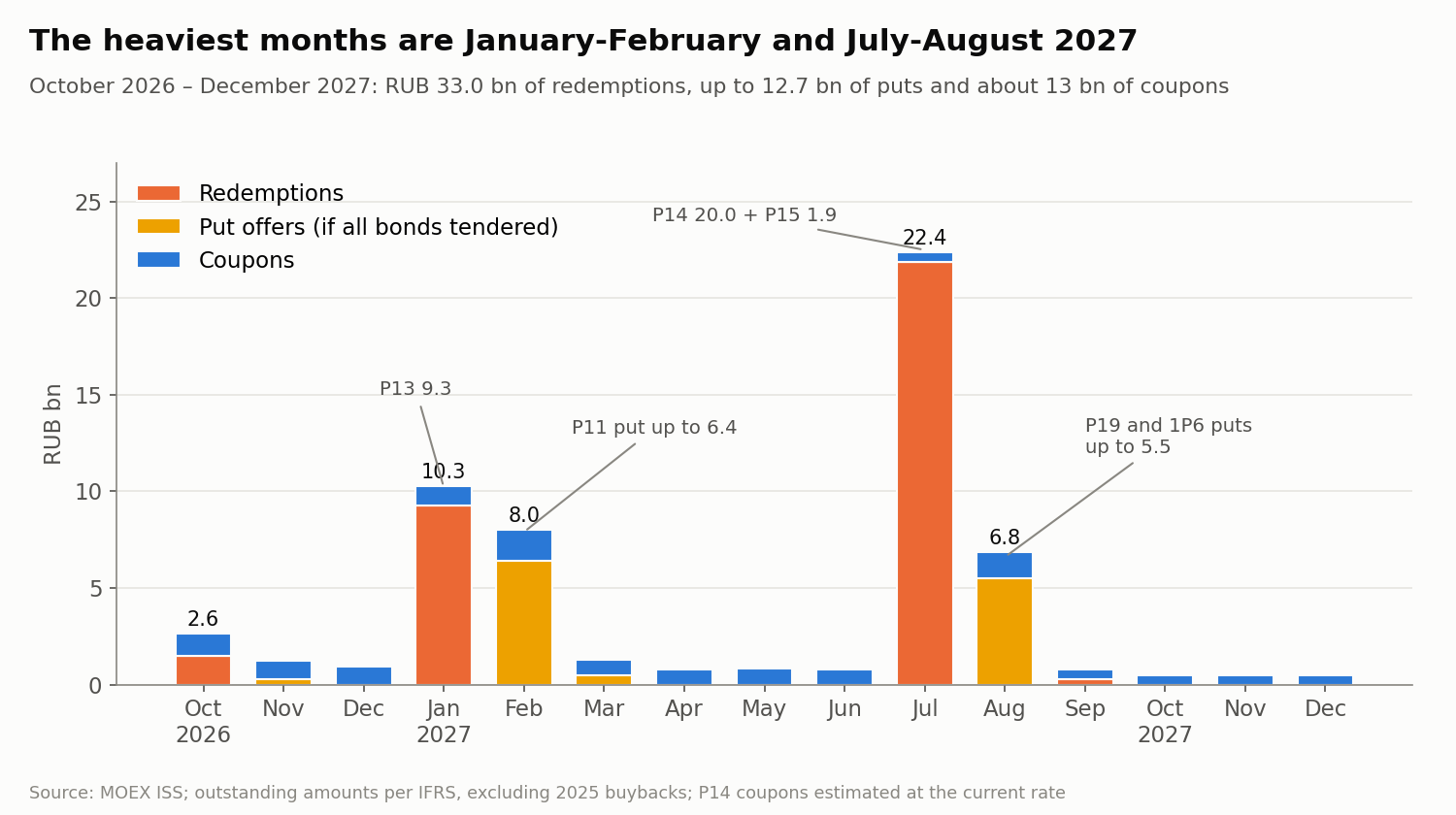
The heaviest months are January-February and July-August 2027
Payments on all traded issues. Amounts outstanding after partial redemptions at put offers are per IFRS. Put offers are shown as an upper bound, if all holders tender their bonds.
Upcoming payments:
30 October 2026 – redemption of issue 01, RUB 1.5 bn;
9 November – put offer on issue 1P5, up to RUB 0.3 bn;
24 January 2027 – redemption of BO-P13, RUB 9.3 bn (the remainder after the February 2026 put);
12 February – put offer on BO-P11, up to RUB 6.4 bn;
22 and 30 July – redemption of BO-P14 (RUB 20.0 bn) and the remainder of BO-P15 (RUB 1.9 bn);
2 and 9 August – put offers on BO-P19 and 1P6, up to RUB 5.5 bn.
Authors' estimate. From October 2026 to December 2027 holders are due RUB 33 bn of redemptions, up to RUB 12.7 bn at put offers and about RUB 13 bn of coupons, up to RUB 59 bn in total. That is more than the group's cash EBITDA for a year. Since June the company has placed only RUB 1.6 bn of new bonds (the discount issue 002P-05).
On the 28 August call, asked about the January-February redemptions, the CFO replied that there "is a plan, and there was one a year ago", that the 2026 put offers had gone smoothly and the redemptions would go the same way.
The industry: new-build sales under pressure from the key rate and the new family mortgage
The industry backdrop is unfavourable. The key rate is 14%, market mortgages are about 18.7% a year, and the next Bank of Russia meeting is on 23 October. On the call Samolet's CFO said market-rate mortgages would start working at a key rate of about 10%.
From 1 October the terms of the family mortgage changed: the rate depends on the number of children and the region. In Moscow, St Petersburg and their regions, a family with one child now borrows at 12% instead of 6%, and with two children at 10%. According to ERZ, about 70% of family mortgage buyers are families with one child, and the new-build market may shrink by 20%. For Samolet, whose sales are mainly in Moscow and the Moscow Region, this is a direct risk to guidance. As early as August the CFO said the 2026 sales forecast of 700-800 thousand sq m would be hard to meet.
From 1 January 2026 the moratorium on penalties for late delivery of buildings was lifted, another potential expense if construction slows.
Taxes and courts: the tax service has filed to bankrupt four project companies
According to open sources, the Federal Tax Service has filed bankruptcy petitions against four of the group's special-purpose developers:
LLC SZ Samolet-Poima – 6 August, Moscow Region Arbitration Court, case A41-81525/2026;
LLC SZ Paveletskaya – 11 September, claim of RUB 14.3 mn, case A40-298131/2026; according to the tax service as of 14 September, the company's accounts are blocked;
LLC SZ Samolet-Pyatnitskie Kvartaly – 11 September, case A40-297013/2026, hearing scheduled for 15 October.
No bankruptcy proceedings have been opened in any of the cases. We have not checked the outcome of the hearings in the first two cases. The amounts are small for the group, but tax claims against project companies usually mean that money for current payments is already short at the level of individual developments.
What bond prices imply
Closing prices on 14 and 25 September and last trades on 6 October. Labels show the 6 October price.
Moscow Exchange prices on 6 October (last trades around 15:05 Moscow time, cross-checked with Smart-Lab), with the 14 September close in brackets:
issue 01, maturing 30 October – 99.1% (100.0%);
BO-P13, maturing 24 January – 82.3% (95.5%), yield to maturity per the exchange 140% a year;
BO-P11, put on 12 February – 69.7% (95.7%), yield to put 240%;
BO-P14, maturing 22 July 2027 – 56.0% (81.6%);
BO-P16, maturing April 2028 – 67.8% (99.9%);
BO-P18, maturing June 2029 – 61.2% (96.2%), yield to maturity 65%.
Authors' estimate. The probability of timely payment implied by 6 October prices, taking into account accrued coupon and discounting at 14% a year:
BO-P13: with a recovery of 40% of face value in case of problems – 69%, at 50% – 64%, at 60% – 56%;
BO-P11 (put in February): 51%, 43% and 33%;
issue 01 (30 October): 97-98%.
The recovery levels are assumptions. What they turn out to be in practice depends on the terms of agreements with the banks, which do not yet exist. For comparison, at 25 September prices the same estimates were 67-77% for BO-P13 and 58-69% for BO-P11.
The market values the long issues at 56-68% of par as bonds likely to see changed terms or partial losses. If the company reaches an agreement with the banks and keeps paying, their yield will turn out to be very high. If not, losses for holders of the long issues will be larger than for the short ones.
What will show which scenario plays out
redemption of issue 01 on 30 October and the 1P5 put on 9 November: the money must reach the depository on time, without a repeat of the BO-P20 story;
official terms of the agreements with the banks: which loans, projects and PJSC guarantees are affected, and whether bond servicing is preserved;
sources of money for January-February: new non-project loans, sales of land or projects;
the Bank of Russia rate decision on 23 October and sales in October-November after the family mortgage change;
ACRA's reaction to the BO-P20 delay.
Bottom line: Samolet bonds are a bet on an agreement with the banks
Both sides have weighty arguments. For the bonds: the company's size, the banks' interest in completing construction, the small share of bonds in the debt, and the put offers passed in 2026. Against: a business that does not earn its interest at the current rate, thin equity, an issuer with no cash and RUB 1.44 trn of guarantees, two payment delays in six months, growing loans to related parties and a heavy redemption schedule in 2027.
The market considers the short issue 01 almost risk-free. For BO-P13 and the BO-P11 put, prices imply a significant probability of problems, and only the terms of the agreements with the banks can settle the argument between optimists and pessimists. Until they are published, Samolet bonds are suitable only for those prepared for high risk who understand that in a bad scenario an unsecured bondholder stands in line behind the banks with their collateral.
What to take from this story into your own practice
Look at the bond issuer, not just the group. The consolidated statements show RUB 773 bn of debt and RUB 9.9 bn of cash; the PJSC's statements show RUB 0.17 bn in its accounts and RUB 1.44 trn of guarantees.
Check what the company calls corporate debt. Moving land loans into project finance cut the figure in half.
Separate non-cash revenue from actual cash. For developers the escrow effect can be more than half of EBITDA.
Compare accrued interest, not just interest in the income statement. Samolet's capitalised interest for the year exceeds the interest that went through expenses.
Calculate equity without intangibles and deferred taxes. For a group with RUB 23 bn of equity, tangible equity turned out to be negative.
Read the notes on error corrections. The restatement of the PJSC's RAS statements cut equity at the end of 2024 almost by half.
Money arriving late at the depository is a signal even if the payment went through. Two delays in six months show the issuer has no liquidity cushion.
Loans to related parties when cash is short are a negative until proven otherwise. The rise in provisions on them shows that the company itself already considers part of the money problematic.
An extended Samolet card with financials and multiples is available on our portal Frontier.
Sources
IFRS statements of PJSC Samolet Group for 2023-2025 and 6 months of 2026; RAS accounts of the PJSC for 2023-1H2026 (e-disclosure).
Recording of the company's analyst call on 1H2026 results, 28.08.2026.
MOEX ISS and Smart-Lab: issue parameters, coupon and put schedules, prices.
[RIA Real Estate on the BO-P20 redemption, 29.09.2026](https://realty.ria.ru/20260929/samolet-2121042753.html); [Prime, 29.09.2026](https://1prime.ru/20260929/samolet-873778005.html); [Kommersant, 17.09.2026](https://www.kommersant.ru/doc/8956474); [Interfax on 1H2026 results](https://www.interfax.ru/business/1111802); [RIA Novosti on the Ministry of Finance position, 24.02.2026](https://realty.ria.ru/20260224/minfin-2076478593.html); [Kommersant on the Fonte Capital deal](https://www.kommersant.ru/doc/8876403); [RIA Real Estate on the sale of the Fonte stake, 29.09.2026](https://realty.ria.ru/20260929/samolet-2121047194.html); [ACRA, 24.12.2025](https://www.acra-ratings.ru/press-releases/6448/); [Vedomosti on the rating review, 06.02.2026](https://www.vedomosti.ru/investments/news/2026/02/06/1174492-akra-prisvoilo-status); [Rusbonds on the removal of the review, 02.03.2026](https://rusbonds.ru/news/20260302133400187919); [Kommersant on the 5 May technical default](https://www.kommersant.ru/doc/8636934); [Vitvet on the tax service petitions, 17.09.2026](https://vitvet.com/about/news/iski-o-bankrotstve-dochek-gk-samolet/); [RIA Real Estate on resumed construction at Kvartal Marino, 02.04.2026](https://realty.ria.ru/20260402/samolet-2084871143.html); [Dvizhenie.ru on Kvartal Marino](https://dvizhenie.ru/media/6135/samolet-vozobnovil-stroitelstvo-nacionalizirovannogo-zhk-kvartal-marino); [Ministry of Finance on the new family mortgage terms, 24.09.2026](https://minfin.gov.ru/ru/press-center/?id_4=40636).
Verdict. At RUB 80.9, Sovcomflot (MOEX: FLOT) shares are interesting as a speculative position for 9–12 months: from purchase to the payment of the 2026 dividend in summer 2027. Authors' estimate for the base case: a dividend of about RUB 10 (12–13% at the current price) and a fair price of RUB 86–97, for an expected total return of 20–30%. The idea rests on the closed Strait of Hormuz and record freight rates on Russian routes. If the strait reopens in the coming months, the price upside disappears and what remains is a dividend of about RUB 7–8 (9–10%). Buying makes sense up to ~RUB 85. Above RUB 90 the return rests on the dividend alone, and it is below the 14% key rate.
What the company is and why it is in focus
Sovcomflot is Russia's largest shipowner, 82.8% owned by the state. The fleet consists of crude and product tankers, LNG carriers and vessels serving Arctic and offshore projects (Sakhalin, Yamal, Arctic LNG 2). Revenue is in US dollars, IFRS reporting is in US dollars, dividends are paid in rubles. The free float is 15.5% and the market cap is RUB 189 bn ($2.2 bn).
Since January 2025 the company has been under blocking sanctions of the US, the EU and the UK. On 10 January 2025 the US added 69 group vessels to the SDN list, including 54 tankers. EBITDA fell from $1.57 bn in 2023 to $526 mn in 2025. For 2025 the company wrote off $550 mn as vessel impairment and posted a net loss of $648 mn.
In 2026 the picture reversed. Since March the Strait of Hormuz has been effectively closed to tankers because of the conflict around Iran. A temporary reopening in June broke down in July. Since 30 July the strait has been closed again; on 27 September one vessel passed through it against a norm of 85 a day. Global freight rates are at highs: the Aframax composite stood at $215k a day on 24 September versus about $67k in 1H2026. Sovcomflot's earnings are recovering together with the rates.
EBITDA by quarter. The bottom came in 1Q2025, right after the US sanctions. 2Q2026 – $320 mn, the level of late 2023. 3Q–4Q 2026 – authors' base case.
1H2026: profit is back, free cash is not
Fact (IFRS, 28.08.2026):
1H2026
1H2025
Change
Revenue, $ mn
1,026
618
+66%
Time-charter equivalent (TCE) revenue, $ mn
809
502
+61%
EBITDA, $ mn
547
263
+108%
Adjusted net profit, $ mn
266
19
x14
Adjusted net profit, RUB bn
20.1
1.6
x13
Net debt, $ mn (as of 30.06)
678
–14
The second quarter was markedly stronger than the first. 2Q EBITDA was $320 mn versus $227 mn in 1Q, adjusted profit $182 mn versus $84 mn (authors' calculation from cumulative figures). At SPIEF in June CEO Igor Tonkovidov expected the half-year to be "comparable to the first quarter". The actual result was better.
Growth rests on two things. The first is long-term contracts, which grew as the fleet was expanded for industrial projects. The second is the tanker market (management view). The company has not disclosed a segment breakdown since 2023, nor fleet size or idle vessels.
Cash is going into LNG carriers. Operating cash flow for 1H was $626 mn, investments $612 mn. Net debt rose from $359 mn to $678 mn in six months, partly due to non-cash financing of new vessels. That is 0.84x trailing 12-month EBITDA, so there is no leverage problem as such. But the dividend in 2027 will most likely be partly funded with borrowed money.
Peak cash flow in 2023 covered investments 2.6 times. In 1H2026 cash flow and investments are equal, and net debt nearly doubled.
Industry context: freight on Russian routes follows Hormuz
Shipping Russian oil now costs more than ever. According to Price Index Center (CCI) estimates, in the first week of September an Aframax voyage from Novorossiysk to West India cost $23.2 per barrel and to North China $25.7. That is an all-time high after seven consecutive weeks of growth. The reasons: drone attacks on tankers in the Black Sea, expensive insurance and a shortage of tonnage, part of which has moved to Middle Eastern routes.
Exports are growing and loadings are shifting to the Baltic. Russian seaborne crude exports have stayed above 4 mn bpd for five weeks (Bloomberg). Loadings from Novorossiysk fell by 42% in early September, while Baltic exports rose. The Urals discount at Primorsk narrowed to $22.6 per barrel, and in India and China discounts turned into premiums (Argus via Interfax). So demand for tankers carrying Russian oil is high, and buyers are willing to pay for them.
On the chart, a Baltic–India voyage repeats the news from Hormuz. March – $22–23 mn, during the temporary reopening of the strait in July – $7–8 mn, by the end of August – $13 mn.
Cost of an Aframax voyage Primorsk – India according to industry sources. The July dip came a month after the temporary reopening of the strait: this is what the downside scenario for 4Q looks like.
An important caveat: this is a market indicator, not the company's revenue. India does not accept cargoes on sanctioned vessels (management view, SPIEF 05.06), and Sovcomflot's main route is China. About half of its income comes from long-term fixed-rate contracts. So the company's earnings move in the same direction as freight, but with a smaller amplitude.
2026 forecast: EBITDA of about $1.1–1.2 bn
Base case (authors' estimate): 3Q EBITDA $290 mn, 4Q $330 mn, full year $1,167 mn.
3Q is slightly weaker than 2Q: the July dip in rates was half offset by a strong August and September. From the end of August a new LNG carrier, Konstantin Posyet, joined on a long-term contract with Arctic LNG 2.
4Q starts at record rates, and the LNG carrier works a full quarter.
Adjusted profit is calculated as EBITDA minus ~$140 mn per quarter: depreciation, interest and tax at the 1Q–2Q 2026 level.
Scenario
3Q / 4Q EBITDA, $ mn
EBITDA 2026F
Adj. profit 2026F
EV / EBITDA 2026F
Dividend at 50%, RUB
Yield
Weak: the strait reopens in 4Q
250 / 220
1,017
456
2.9x
7.6
9%
Base: the strait stays closed until year-end
290 / 330
1,167
606
2.5x
10.3
13%
Strong: record freight reaches the company
310 / 420
1,277
716
2.3x
12.3
15%
Conversion into rubles uses the average CBR rate for 3Q (RUB 82.0 per dollar) and RUB 87 in 4Q. The divisor is 2,375 mn issued shares, as in the company's EPS. For comparison, Financial One estimates 2026 EBITDA at about $950 mn and the dividend at RUB 7.5–7.8. That is closer to the weak scenario.
The 2026 dividend is the main argument, but not a guarantee
Under its policy the company pays at least 50% of adjusted profit in rubles (confirmed in the 1Q and 1H2026 reports). For 1H, RUB 4.24 per share has already accrued: 50% of adjusted EPS of RUB 8.48. The decision on the 2026 payout is expected in June 2027, with the record date in July.
The payout history is uneven. The company paid no dividends for 2021 and 2024, citing sanctions, capital expenditure and debt obligations in 2024. For 2025, despite the loss, it paid RUB 4.87 out of prior years' profit. The state, as an 83% shareholder, needs dividends, so a full cancellation is unlikely (authors' assumption). The formal minimum in the dividend regulation is 25% of IFRS net profit. At that level the base case gives about RUB 5.
Dividend by fiscal year. The 2026 forecast is 50% of adjusted profit in rubles, yield at a price of RUB 80.9.
A weak ruble helps, but for 2026 the effect is already small. Every +RUB 5 to the dollar rate in 4Q adds about RUB 0.2 to the dividend: half of the profit has already been earned at a rate of RUB 76. A weak ruble matters more for 2027: by the end of 2027 the authors expect RUB 95–100 per dollar.
Valuation: fair price of RUB 86–97
The valuation uses three methods, without comparison with other companies.
Own historical multiple. Since March 2024 the median EV / trailing 12-month EBITDA has been 2.86x (authors' calculation in US dollars, using data as of each report's publication date). – Exactly 2.86x on 2026F EBITDA gives RUB 97 in the base case, RUB 81 in the weak one and RUB 108 in the strong one. – Conservative EBITDA of $1.1 bn is the midpoint between the base 2026F and the 2023–2025 average. It gives RUB 91.
Book value. Equity is $4.8 bn, and the share trades at 0.46x book. The three-year median P/B is 0.50, which implies RUB 88.
Required dividend yield. A dividend of RUB 10.3 and a required 12% a year give RUB 86. 12% is the 14% key rate minus the expected rate cuts in 2027 (authors' assumption).
On trailing EBITDA (3.6x) the share looks more expensive than its median: the weak 3Q and 4Q 2025 are included. On the EBITDA expected for 2026 it is cheaper than the median. The gap between these two numbers is the bet on freight staying high.
Entry threshold (authors' estimate):
Purchase price
Upside to mid valuation (RUB 91)
+ dividend RUB 10.3
Total
RUB 76
+20%
+14%
+33%
RUB 81 (current)
+12%
+13%
+25%
RUB 85
+7%
+12%
+19%
RUB 90
+1%
+11%
+13% – below the key rate
Risks: the strait, sanctions and the size of the payout
Hormuz reopening. This is the main risk. In June rates on Russian routes halved within six weeks after the temporary US–Iran agreement. A repeat in 4Q means the weak scenario: a dividend of RUB 7–8 and a price around the current one.
The dividend may be below 50%. There is almost no free cash flow, and three more LNG carriers for Arctic LNG 2 still have to be completed. There is already a precedent of skipping the payout, in 2024.
Sanctions. SDN-listed tankers cannot serve India and depend on a limited circle of buyers. European countries detain tankers carrying Russian oil in their waters. In September foreign media reported a new US bill mentioning Sovcomflot. The primary source has not been verified.
Opacity. The company does not disclose fleet size, idle time, segments or the contract backlog. The last published backlog figure – $3.5 bn through the end of 2026 – dates from 2023. The contribution of spot freight to earnings has to be estimated indirectly.
The Black Sea. Attacks on tankers push rates up, but pose a direct risk to the company's vessels.
Taxes and courts. No major tax disputes were found in open sources. The last significant litigation – the London claim against the Skarga group – ended around 2018. Open Federal Tax Service data on the company were not separately checked for this review.
What to track
Metric
Base case
When
3Q EBITDA (from the 9M report)
$290 mn
late November 2026
Status of the Strait of Hormuz
closed until year-end
ongoing
Aframax voyage Primorsk – India
not below $12–13 mn
weekly
Net debt
up to $0.8 bn
9M report
Board recommendation on the 2026 dividend
50% of adj. profit, ~RUB 10
May – June 2027
For reference: what we wrote earlier and what has changed. The preview to the 1H report came out on 26 August ([Telegraph](https://telegra.ph/Sovcomflot-2Q2026-Preview-08-26)). At a price of RUB 74.1 the guide then was EV/EBITDA 2026F of about 2.4x and a dividend of RUB 7–8 (about 10%), with the conclusion "a speculative buy". Since then:
The report beat management's expectations. 2Q EBITDA was $320 mn versus $297 mn in Renaissance Capital's forecast. Adjusted profit was $182 mn versus $166 mn.
The price rose 9%, to RUB 80.9. The strong 1H is already priced in.
Hormuz closed again on 30 July, and by September rates on Russian routes hit all-time highs. So the dividend estimate was raised from RUB 7–8 to ~RUB 10.
Net debt nearly doubled – $678 mn versus $359 mn at the start of the year. The premise of "a dividend out of free cash flow" no longer holds.
Interfax: [SPIEF, 05.06.2026](https://www.interfax.ru/forumspb/1094116); [Urals prices for September](https://www.interfax.ru/business/1119753); [US sanctions on 69 vessels](https://interfax.com/newsroom/top-stories/109078/)
Neftegaz.ru: [freight from Novorossiysk, CCI data](https://neftegaz.ru/news/transport-and-storage/936001-frakht-vzletel-stoimost-perevozki-rossiyskoy-nefti-iz-novorossiyska-v-kitay-i-indiyu-bet-rekordy/); [Konstantin Posyet](https://neftegaz.ru/news/Suda-i-sudostroenie/935975-tanker-gazovoz-spg-konstantin-poset-dostavil-svoyu-pervuyu-partiyu-spg-i-vozvrashchaetsya-na-arktik-/)
[Optima, Aframax index on 24.09](https://www.optimashipbroking.com/market-report/dirty-tanker-index-summary-25-september-2026/); [Affinity Tanker Weekly, 18.09](https://www.hellenicshippingnews.com/wp-content/uploads/2026/09/Affinity-Tanker-Weekly-18.09.2026-HSN.pdf)
Inarctica is Russia's largest producer of farmed salmon and trout. In 2024 the company lost about a third of the fish in its pens to cold water and parasites. Sales and profit fell, and the share price dropped from RUB 900 in the SPO in November 2023 to RUB 314.5 today. In 2026 production is recovering. Below we look at whether the stock has upside at current fish prices.
At the current exchange rate the stock is roughly fairly valued; upside appears with a weak ruble or expensive fish on the world market. If the company sells 32 thousand tonnes in 2027 and fish prices stay where they are, the fair value of the stock is RUB 250-380, from -21% to +22% versus the current price. With the dollar at RUB 95-100, it rises to RUB 555-780.
2027 sales could rise to 30-34 thousand tonnes; the 2023 record was 28.2 thousand tonnes.
The company earns half as much per kilogram as it did in 2024.
Fish prices in Russia follow the exchange rate, while the premium to the world price fluctuates.
A strong El Niño could lift world salmon prices but would make feed more expensive.
The 6.4% dividend is below the 14% key rate and is currently paid with borrowed money.
The main risk is biological, and it has already materialised.
Inarctica covers the whole chain from smolt to chilled fish on the shelf
The company (called Russian Aquaculture until 2023) farms Atlantic salmon and sea trout in the Barents Sea off the coast of the Murmansk region and trout in the lakes of Karelia. It has 32 fish farming sites, five hatcheries in the Karelia, Kaluga, Nizhny Novgorod and Arkhangelsk regions, processing facilities and its own fleet. Some sites are always left fallow to reduce the risk of disease and parasites.
The cycle takes one and a half to two years. The smolt first grows in fresh water at a hatchery, in summer it is released into sea pens, and there the fish spends more than a year reaching market weight. It is then harvested, processed and shipped chilled to retail chains and restaurants across Russia. In 2025 revenue, salmon accounted for 66%, sea trout for 27%, lake trout for 2%, and the rest came from caviar and seaweed.
Imports account for a significant share of the market. According to the company, the Russian market for farmed salmon and sea trout was 138.5 thousand tonnes in 2025, and Inarctica, with sales of 22.2 thousand tonnes, holds about 16%. Most imports come from Turkey (trout) and Chile (salmon).
The long cycle has two consequences for the financial statements. Next year's sales are determined by biomass, that is, the live weight of fish in the pens. Under IFRS, fish in the water is revalued at market prices, so IFRS profit swings with prices. Operating performance is better tracked through adjusted EBITDA and profit before revaluation. As an agricultural producer, the company pays a zero rate of income tax, so almost all operating profit after interest goes to shareholders.
The company still imports part of its smolt from Norway, and already buys about 80% of its feed in Russia. In the Novgorod region it is building its own feed mill with a capacity of 70 thousand tonnes a year, which takes most of the 2026 capital expenditure. According to management, the period of high capex will end in late 2026, and the company plans to be fully self-sufficient in smolt and feed from 2028.
2027 sales could rise to 30-34 thousand tonnes
In 2023 the company sold a record 28.2 thousand tonnes. In 2024 part of the fish died, year-end biomass fell from 34 to 22.6 thousand tonnes, and in 2025 sales dropped to 22.2 thousand tonnes. In 2025 the company carried out record stocking, and biomass grew by 33% to 30.1 thousand tonnes. In the first half of 2026 this fed through to sales: 13.2 thousand tonnes versus 8.4 thousand tonnes a year earlier.
Biomass should be compared within the same season. It is at its lowest in summer: the large fish have already been harvested, and the juveniles have only just been released into the pens. Fish grow fastest from July to October, so biomass is noticeably higher by December. In 2025 it rose from 20.9 thousand tonnes at the end of June to 30.1 thousand tonnes at the end of December. At the end of June 2026 there were 27.7 thousand tonnes in the water, still below the 31 thousand tonnes of June 2023, but a third more than a year earlier.
If the second half repeats last year's growth, there will be 37-40 thousand tonnes in the water by the end of 2026. In that case the company could sell 30-34 thousand tonnes in 2027. Our base case assumes 32 thousand tonnes, with 28 thousand tonnes as the lower bound. The company's strategic target is 60 thousand tonnes a year, but the timing and cost of this programme have not been disclosed.
Sales and live weight of fish in the water. Left: annual data with biomass at the end of December; right: half-years with biomass at the end of June. Biomass should be compared within the same season.
Revenue grew by 38%, but the company earns half as much per kilogram as in 2024
In the first half of 2026 revenue grew by 38% to RUB 13.8 bn, and adjusted EBITDA also rose by 38% to RUB 3.4 bn, a 25% margin. Adjusted net profit doubled to RUB 1.6 bn. Under IFRS the company reported a loss of RUB 0.4 bn due to the revaluation of cheaper fish in the water.
Per kilogram of fish sold, the picture is worse. In 2024 the company earned RUB 1,223 of revenue and RUB 484 of EBITDA per kilogram; in the first half of 2026, RUB 1,048 and RUB 258. The company itself cites an average salmon price of RUB 1,008/kg, 12% below 2025. With volumes back, cost per kilogram fell from RUB 904 in the first half of 2025 to RUB 791, because fixed costs are spread over more tonnes. But that is still far from RUB 738 in 2024. For 2027 we assume RUB 860: inflation will continue, and it is too early to factor in the effect of the company's own feed mill.
Revenue and adjusted EBITDA per kilogram of fish sold. Cost is the difference between them. Calculated from company data.
Fish prices in Russia follow the exchange rate, while the premium to the world price fluctuates
Imports are paid for in foreign currency, so domestic prices follow the exchange rate. The rating agency [NKR](https://ratings.ru/ratings/press-releases/Inarctica-080726/) explicitly links the 2025 price decline to competition from imports amid a strong ruble. In kroner, Norwegian salmon has cost NOK 71-75 per kilogram throughout the past year, and its ruble price is driven almost entirely by the exchange rate. Since June the dollar has risen from RUB 74 to RUB 84, and salmon in rubles has become 13% more expensive, from RUB 576 to RUB 650/kg.
Inarctica sells fish above the Norwegian exchange price in rubles, but the premium varies. In 2023 revenue per kilogram exceeded the world price by a factor of 1.34, in 2025 by 1.75, and in the first half of 2026 by 1.82. The 2022-2026 average is 1.63. The current level is close to the maximum, so our base case uses 1.7. At a world price of RUB 650/kg this means RUB 1,105/kg for Inarctica.
Monthly price of Norwegian salmon in rubles. Since June it has risen by 13%, following the dollar exchange rate.How many times Inarctica's revenue per kilogram exceeds the Norwegian price in rubles. The premium has risen since 2023 but remains unstable.
A strong El Niño could lift world salmon prices but would make feed more expensive
El Niño is a warming of surface waters in the eastern Pacific that recurs every few years. According to a forecast by the US agency [NOAA](https://www.cpc.ncep.noaa.gov/products/analysis_monitoring/enso_advisory/ensodisc.shtml) dated 10 September 2026, there is a more than 90% probability that the current episode will be very strong. With a 75% probability, in October-December it will become stronger than any episode since 1950.
This matters for the salmon market because of Chile, the world's second-largest producer after Norway. Warm water off the Chilean coast leads to more frequent harmful algal blooms, which damage fish gills and reduce oxygen in the pens. In February-March 2016, after the previous strong El Niño, algae killed about 25 million fish in Chile, roughly 40 thousand tonnes. In the same year the average price of Norwegian salmon rose by 51.5%, although Norway's own problems also played a role. The bloom season falls in the southern summer, so any impact would come in early 2027. Even a very strong El Niño does not guarantee consequences in any particular region.
For Inarctica the effect cuts both ways. If world prices rise, imported fish in Russia will become more expensive, and the company will have room to raise prices. The flip side is feed. El Niño undermines the anchovy catch in Peru, which is used to make fishmeal and fish oil. According to [IFFO](https://www.iffo.com/amid-coastal-el-nino-fishmeal-and-fish-oil-output-remains-weak), in the first seven months of 2026 global fishmeal production fell by 49% and fish oil by 30%. These ingredients go into salmon feed, and the company's own feed mill does not protect it from their price.
Authors' estimate. Suppose the Norwegian price in kroner rises by 15% and half of the increase passes through to Inarctica's price. At 32 thousand tonnes, EBITDA would gain about RUB 2.6 bn. If the marine ingredients of feed become a third more expensive, costs would rise by about RUB 35/kg, minus RUB 1.1 bn. In total, about RUB 1.5 bn, or roughly RUB 85 per share at a 5x multiple. This is a scenario, not a forecast, and it is not included in our main estimate.
At the current exchange rate fair value is RUB 250-380; with the dollar at RUB 95-100 it is RUB 555-780
We calculate 2027 EBITDA simply: sales volume multiplied by the difference between price and cost per kilogram. Sales of 32 thousand tonnes, cost of RUB 860/kg. Net debt at the end of June was RUB 16.8 bn, or RUB 17.3 bn including leases. We value the company at two EV/EBITDA multiples: 5x, with a discount for biological risk and the 14% key rate, and 6.5x, closer to the company's history, which is the upper bound.
Premium of 1.6, the five-year average. Price RUB 1,040/kg, EBITDA RUB 5.8 bn, the stock is worth RUB 131-229.
Premium of 1.7, base case. Price RUB 1,105/kg, EBITDA RUB 7.8 bn, the stock is worth RUB 249-383, from -21% to +22% versus the current price.
Premium of 1.8, as in the first half. Price RUB 1,170/kg, EBITDA RUB 9.9 bn, the stock is worth RUB 368-537.
Dollar at RUB 95-100 by the end of 2027. This is the exchange rate we expect. At a premium of 1.7 the price would be about RUB 1,290/kg. We assume sales of 33 thousand tonnes and cost of RUB 890, because smolt and part of the feed are bought in foreign currency. EBITDA RUB 13.2 bn, the stock is worth RUB 555-780.
The current market capitalisation of RUB 27.6 bn at a 5x multiple corresponds to EBITDA of RUB 9 bn. At 32 thousand tonnes this requires a premium to the world price of about 1.76, almost the current level. The market already prices in the recovery of volumes and a sustained current premium, but not a weaker ruble. Sensitivity is high. Every 0.1 of premium changes EBITDA by RUB 2.1 bn, or about RUB 120 per share at 5x. With sales of 28 thousand tonnes instead of 32, the base-case valuation falls to RUB 193-311.
Fair value of the stock in four 2027 scenarios at two multiples. The red line is the current price of RUB 314.5.
The 6.4% dividend is below the key rate and is currently paid with borrowed money
Over the past 12 months the company has paid RUB 20 per share: RUB 10 in July and RUB 10 for the first half of 2026, for which the last day to buy was 1 October. At a price of RUB 314.5 this is a 6.4% annual yield versus a 14% key rate. Under its dividend policy, Inarctica pays if it has profit under Russian accounting standards (RAS) and net debt does not exceed 3.5x annual EBITDA. Debt is currently 2.5x EBITDA, so there is headroom.
The business is not yet earning the cash for these payouts. Free cash flow for the first half was negative at minus RUB 2.6 bn. The money goes into growing fish that will be sold later and into the feed mill. Net debt rose from RUB 13.8 bn to RUB 16.8 bn over six months, and in June the company placed RUB 3 bn of bonds. In the base case 2027 profit will be about RUB 3.7 bn, and with a payout ratio of 35-50% the dividend would be RUB 15-21, or 5-7% of the price. The stock is not worth buying for the dividend.
Dividends per share by record-date year. After the fish mortality, payouts fell fourfold; in 2026 they partially recovered.
The main risk is biological, and it has already materialised
Fish in the open sea depend on water temperature, disease and parasites. In 2024 this cost the company about a third of its biomass; in 2015 it lost 4.3 thousand tonnes. For protection the company has four wellboats for delousing fish (the fourth was bought in 2025), its farms are spread along the coast, and the fish is insured.
Credit quality is nonetheless high. In July 2026 NKR affirmed the A+.ru rating with a positive outlook. The second risk relates to the revaluation of fish in the water. It makes IFRS profit very volatile: when prices fall the company reports a loss even if it sells fish at a profit.
The stock is a third of the SPO price, but it is not cheap on current EBITDA
Market capitalisation is RUB 27.6 bn against equity of RUB 38.3 bn, or 0.72x book value. Including debt, the company is valued at RUB 45 bn, or 6.8x LTM adjusted EBITDA (RUB 6.6 bn). For a company with biological risk and debt, this is not cheap. The stock becomes cheap only if EBITDA rises to at least RUB 9-10 bn.
Monthly share price. In November 2023 shareholders sold shares in the SPO at RUB 900; the stock now trades at RUB 314.5.
Inarctica is a bet on a weak ruble and expensive fish, with biological risk
The production recovery is already in the price, as is the current high premium to the world price. Further upside for the stock depends on the price of fish in rubles. At the current RUB 84 per dollar the stock is roughly fairly valued. We expect the exchange rate at about RUB 90 by the end of 2026 and RUB 95-100 by the end of 2027, and in that scenario the upside is 75-150%. El Niño offers an additional chance if it hits Chilean salmon. If the ruble strengthens again to RUB 75-77, as in the first half, or the premium reverts to the average, the stock is more likely to fall.
What to track next:
year-end 2026 biomass, which determines 2027 sales;
the realised price for the second half and the ruble exchange rate;
algal blooms in Chile in January-March 2027 and fishmeal prices;
reports of fish mortality and the revaluation of biological assets;
free cash flow: without it, dividends rest on debt.
Financial statements, multiples and the company's dividend history are available on the Inarctica card on the Enhanced Investments portal.
Artificial intelligence was used in preparing this material. We have checked the information, but inaccuracies and errors are still possible. If you find one, please write to us at Enhanced Investments and we will promptly correct it.
Prepared by Enhanced Investments based on Inarctica's press releases and IFRS statements, the NKR press release of 8 July 2026, NOAA, IFFO, the Moscow Exchange and Trading Economics. Prices as of 5 October 2026. This is not an individual investment recommendation.
*Updated 5 October: we lowered our estimate of the next dividend to RUB 6-7 and of the annual payout to RUB 9-10, lowered the entry threshold to RUB 70, and added the risk of an overhang of shares from the incentive programme. For reference: on 5 October, the day the idea was published, the stock rose 5% to RUB 76.8, while the MOEX Russia Index gained 1.8%. Calculations in the text are based on the price of RUB 73.15 as of 2 October.*
VI.ru is the holding company of the online store VseInstrumenty.ru, Russia's largest online retailer of tools, equipment and construction and renovation goods. Three quarters of revenue comes from companies and entrepreneurs. The stock listed in July 2024 at RUB 200 and now trades at RUB 73.15. On 1 October the operating subsidiary decided to transfer RUB 3.55 bn to the holding company, and this sets the size of the next dividend.
The stock is attractive as a dividend play when bought at around RUB 70 or below. By our estimate, the next payout will be RUB 6-7 per share, or 8-9.5% of the current price. The company trades at six years of earnings, and net cash accounts for 18% of its market capitalisation. Fair value under three approaches is RUB 84-94. The dividend announcement itself will not lift the price for long: on the day the previous payout was announced the stock rose 2%, and on the record date it fell by more than the dividend.
Cash for the payout is already being transferred: RUB 3.55 bn from the subsidiary, or up to RUB 7.1 per share.
No debt and low capex, so the company can pay out almost all of its earnings.
Earnings are growing on efficiency and lower interest costs, not on sales.
Six times earnings and 2.6x EBITDA is cheap even after adjusting for a weak market.
The building materials market is shrinking, and retail customers are moving to marketplaces.
Cash for the payout is already being transferred: RUB 3.55 bn from the subsidiary
The listed VI.ru sells nothing itself: the entire business and its cash sit in VseInstrumenty.ru LLC. So before each dividend the subsidiary first pays the holding company, and the holding company then pays shareholders. [On 1 October](https://smart-lab.ru/blog/news/1358031.php) the subsidiary decided to pay RUB 3.549 bn out of earnings for 2025 and 1H2026. The money will arrive within 60 days.
In previous rounds the holding company passed almost everything it received on to shareholders. In June 2025 the subsidiary paid the holding company RUB 525 mn, and in September shareholders received RUB 1 per share, or RUB 500 mn. In December 2025 the holding company received RUB 1.06 bn and in March 2026 paid RUB 2 per share, or RUB 1 bn. Spread over 500 mn shares, RUB 3.55 bn gives RUB 7.1. The holding company will probably keep part of the amount for its own expenses, so we expect RUB 6-7.
[On 29 September](https://www.retail.ru/news/sovet-direktorov-vseinstrumenty-ru-odobril-vykup-aktsiy-obemom-do-500-mln-rubley-29-sentyabrya-2026-282700/) the board approved a share buyback of RUB 500 mn from November 2026 until the end of 2027. The subsidiary itself will carry out the buyback, and the shares will go to the employee incentive programme. The company's CFO separately said that the buyback does not cancel dividends. Therefore the buyback does not reduce the amount going to the holding company and does not affect the next payout. We expect the board meeting on the dividend in late October or November, and the record date before the end of the year.
Dividends per share and yield to the price on the eve of the record date. The last bar is our estimate, assuming part of the amount from the subsidiary stays in the holding company.
No debt and low capex, so the company can pay out almost all of its earnings
Under its [dividend policy](https://ir.vseinstrumenti.ru/dividendnaya-politika) the company pays at least 50% of IFRS net income as long as net debt does not exceed 3x EBITDA. In practice it pays more: for 2025 shareholders received RUB 6 per share, or 89% of net income. A payout of RUB 6-7 now would be 115-135% of 1H2026 net income.
Such a payout looks more like bringing forward part of the dividends for 2026 than a new norm. Under the budget package, from 2027 dividends will fall under the progressive personal income tax scale of 13-22%, so shareholders are better off receiving the money in 2026. In that case the payout in 1H2027 is likely to be smaller than usual. For the next 12 months we assume RUB 9-10 per share.
The company can afford this because the debt is gone. At the end of 2024 loans and bonds exceeded cash by RUB 12.7 bn. By the end of June 2026 cash exceeded debt by RUB 6.75 bn. Capex is small: RUB 0.4 bn for the half-year and RUB 1.1 bn for 2025. The company mostly leases its warehouses and pick-up points. Lease liabilities are RUB 20.8 bn; including them, net debt equals 0.74x annual EBITDA.
There is a caveat. Free cash flow in 2025, RUB 14.1 bn, was heavily inflated by a reduction in inventories from RUB 29.2 bn to RUB 24.4 bn. This cannot be repeated. By our estimate, normalised cash flow is close to annual net income, i.e. RUB 6 bn. On average this allows a payout of about RUB 12 per share per year, but no more without increasing debt. Over the next 12 months the payout will be lower because of the shift in timing. Management targets debt of zero to 1x annual EBITDA, so there is headroom for payouts.
Net financial debt excluding leases at quarter-end. Since the end of 2025 the company has had more cash than loans and bonds.
Earnings are growing on efficiency and lower interest costs, not on sales
In 2Q2026 net income was RUB 2.03 bn versus RUB 0.86 bn a year earlier. EBITDA before IFRS 16, i.e. after lease payments, grew 30% to RUB 3.52 bn. Revenue rose 9.7% to RUB 50.6 bn; for the half-year growth was 3.2%.
Earnings growth came mainly from cost savings and interest. Gross margin in 2Q2026 was 33.4% versus about 30% in 2024. Net finance costs for the half-year fell from RUB 3.3 bn to RUB 1.9 bn thanks to debt repayment. The company is shrinking its network: 1,076 pick-up points versus 1,181 a year earlier, and fewer warehouses. Management itself has called 2026 a year of efficiency rather than rapid growth.
Net income guidance for 2026 is RUB 4.5-6.5 bn. In 1H2026 the company earned RUB 2.58 bn, and its second half is seasonally stronger: in 2025 it brought RUB 3.18 bn versus RUB 0.19 bn in the first. 1H2026 net income includes RUB 0.58 bn of deferred tax; without it, net income is RUB 2 bn. Our estimate for the year is RUB 6 bn. The company's 2028 target (RUB 4.9-6.8 bn) has almost been reached already, so we do not assume rapid earnings growth from here.
EBITDA after lease payments and net income by quarter. In 2024 interest costs ate up earnings; since mid-2025 net income has been growing as debt declined.
Six times earnings and 2.6x EBITDA is cheap even after adjusting for a weak market
Market capitalisation is RUB 36.6 bn. Over the last 12 months (July 2025 to June 2026) the company earned RUB 5.76 bn, for a P/E of 6.4. EBITDA before IFRS 16 for the same period was RUB 11.5 bn; taking net cash into account, EV/EBITDA is 2.6. Including leases under IFRS 16 it is 2.7.
We estimate fair value in three ways:
Seven times 2026 earnings. With net income of RUB 6 bn this is RUB 84 per share.
A 13% dividend yield. With a payout of RUB 12 per year, i.e. all normalised earnings, this is RUB 92. We take a yield below the CBR key rate, anticipating rate cuts, but above the yield of large dividend stocks because of the small free float.
EV/EBITDA of 3.5x under IAS 17. This gives RUB 94.
The range is RUB 84-94, 15-29% above the current price. According to the company's IR, brokers set targets of RUB 95-124 after the half-year results.
Fair value per share under three approaches. The red line is the price of RUB 73.15 as of 2 October.
A dividend announcement does not lift the price for long
On 30 April the board recommended RUB 4 per share, 5.5% of the price. That day the stock rose 2% while the index gained 0.7%, and then it went sideways. On the record date, 22 June, it fell 9%: 5.7% was due to the dividend and the rest to the market, which fell 4% that day. After the 1 October disclosure the stock gained about 2%.
At the same time, dividends have noticeably supported the stock. Since the start of 2026 the price has barely changed, but together with RUB 6 of payouts shareholders earned 7%. The MOEX Russia Index lost 18% over the same period. We expect the next payout to follow the same pattern: a gain of a few percent before the record date, then a drop of roughly the size of the dividend. A rerating above RUB 80 will come not from the dividends themselves but from confirmation of net income of around RUB 6 bn per year.
VI.ru shareholder return including dividends paid and the MOEX Russia Index since the start of 2026, start of year = 100.
For dividends, the stock is worth buying at around RUB 70 or below
We expect RUB 9-10 of dividends over the next 12 months. At a price of RUB 73 that is 12-14% versus a key rate of 14%, i.e. a yield in line with the rate, not above it. When buying at around RUB 70 it will be 13-14%, and with the expected rate cuts a risk premium appears. Above that level the stock is worth holding for earnings growth and the fair value of RUB 84-94, not for the payouts.
12-month dividend yield at a payout of RUB 9 and RUB 10 per share depending on the purchase price. The red line is the key rate of 14%.
The building materials market is shrinking, and retail customers are moving to marketplaces
Market. According to [INFOLine data](https://www.retail.ru/news/rossiyskiy-rynok-tovarov-dlya-doma-i-remonta-nachal-vosstanavlivatsya-posle-pade-28-maya-2026-278244/), in 1Q2026 the home and renovation goods market contracted by 8%, and B2B by 10.5%. According to Rosstat, housing completions in January-August 2026 fell 14%, and individual housing construction 23.5%.
Retail customers. There are 3.48 mn active B2C customers versus 4.01 mn a year earlier, and B2C orders are down 3%. Marketplaces grew sales of renovation goods by 42% in 2025. The company's growth relies on large corporate customers.
Private labels. Their share of revenue fell from 14.1% to 10.7%, although the company targets more than 20% by 2030. This was one of the pillars of the margin.
Free float and liquidity. About 12% of shares are in free float, and the main shareholder owns 83.9%. Average turnover is about RUB 90 mn per day, so it is hard for a large investor to get in and out quickly.
Supply overhang. According to IFRS, at the end of 2025 about 13 mn shares, 2.6% of capital, remained locked up in the incentive programme launched for the IPO. The programme runs for roughly two years after the IPO, and a significant part of these shares may become available for sale in the coming months. The buyback starting in November may absorb part of this volume.
Share-based compensation. In 2025 it cost the company RUB 0.83 bn. The company excludes this expense from EBITDA; we keep it in our valuation.
What to watch
23 October – CBR key rate meeting;
by 30 October – 9M operating results: B2B growth and B2C dynamics;
late October or November – board decision on the dividend and the record date;
19 November – 9M IFRS results;
from 1 November – progress of the share buyback.
Financials, multiples and dividend history are available on the VI.ru card on the Enhanced Investments portal.
According to Moscow Exchange data, the bonds of the Obninsk vodka plant KLVZ Kristall yield 47-55% a year to maturity. We consider this yield inadequate compensation for the risk, and we would not buy these bonds at any of the current prices. The company is not in default, and coupons are being paid. But over six months too many warning signs have accumulated, and most of them are visible directly in the issuer's own reporting.
We have had objections to this group for a long time. In November 2023, before the IPO, we called the Kristall share offering a scam and advised staying away (channel post). The company was sold to investors at 117 times annual earnings, with stories of multiple-fold growth. Since the IPO price the share has fallen 80%. Now the same questions about the business and about the relationship with the owner have surfaced in the bonds, and our advice is the same: stay away.
Shares of PAO AGK since the first day of trading. The stock has not closed a single day above the placement price of RUB 9.5: it closed at RUB 8.1 on the first day and is now around 1.9.
The issuer card with financials by period and all issues: KLVZ Kristall. Below are Enhanced Investments' calculations based on the accounting statements (RAS) for 2025 and 1H2026, e-disclosure filings, NCR data and Moscow Exchange data. Where a figure is our estimate, it is marked as such.
The main points in seven theses:
In June there was a one-day technical default, and on 1 October NCR withdrew a rating that had been under review with a possible downgrade.
Profit from sales is not enough to cover interest, factoring and penalties. Net profit is held up by resales of trademarks.
Trademarks are sold to and bought from companies of the beneficiary and of the CEO, for hundreds of millions of roubles. This is the most negative point in the whole story.
If trademarks are removed from the balance sheet, the plant's own equity is negative.
Debt and payables rose from RUB 2.0bn to 4.6bn in three and a half years.
Excise debt to the budget has almost tripled in a year and now exceeds all of the company's bonds.
By September 2027 about RUB 1.6bn must be repaid or refinanced against RUB 46mn in the accounts.
A vodka plant with listed shares and four bond issues
Fact. OOO Kaluzhsky Likero-Vodochny Zavod Kristall produces vodka, tinctures, liqueurs, gin and soju in Obninsk. According to NCR, vodka accounts for about 70% of revenue. 99.9% of the plant is owned by PAO Alcohol Group Kristall (AGK), whose shares trade on the Moscow Exchange under the ticker KLVZ. The beneficiary is Pavel Pobedkin.
In February 2024 AGK held an IPO at RUB 9.5 per share and raised about RUB 1.15bn for 13.1% of the capital. On 5 October 2026 the share was worth RUB 1.85.
The bonds are issued by the plant itself. Four issues with a face value of RUB 843mn are outstanding, all available to non-qualified investors:
1P02 (RU000A10AZG2): RUB 350mn, coupon 28% monthly, amortisation of 25% from May 2027 to February 2028. Price 90.6%.
1P04 (RU000A10DSU2): RUB 250mn, coupon 23.5% quarterly, redeemed in parts in 2028. Price 73.3%.
1P05 (RU000A10FBR9): RUB 200mn, coupon 21%, placed in June 2026, redeemed in parts in 2028-2029. Price 68.4%.
Authors' estimate. The effective yield of 47-55% on the Moscow Exchange assumes that every coupon is reinvested at the same rate. The simple yield without reinvestment (the coupon plus the discount to par spread over the average time to maturity) is lower: 37.6% on 1P02, 38.3% on 1P04 and 34.9% on 1P05. This is still 2.5-2.7 times the key rate of 14%, and the market has had such a premium only since this summer. In May, 1P02 and 1P04 traded at 112% and 108% of par.
At the IPO the company was sold at 117 times earnings and stories of multiple-fold growth. The numbers did not confirm the stories
How it was sold. Before the IPO the owner, Pavel Pobedkin, spoke at conferences and in the investor community and promised rapid growth, including through the Korean vodka soju, which the plant had started to produce. By his account (Financial One, 15.02.2024), revenue was to grow 5 times over three years and EBITDA 10 times. The IPO proceeds were promised for expanding production, logistics and new products.
What it cost. AGK placed at the top of the range, RUB 9.5 per share, and raised RUB 1.15bn. Market capitalisation after the placement was RUB 8.75bn. The authors' estimate based on the plant's 2023 statements, the last full year before the IPO:
P/E of about 117: net profit of RUB 74.5mn;
market capitalisation to revenue of 2.4: revenue of RUB 3.7bn;
enterprise value with debt to profit from sales of about 41: profit from sales of RUB 238mn, debt of RUB 1.1bn.
For a vodka plant with a 2% net profit margin this is the price of a company taken on trust. Even then it was clear the offering was expensive. In November 2023 we wrote that the company discloses only RAS, the latest statements on its website were for 1H2022 with revenue of RUB 760mn and profit of about RUB 30mn, while it valued itself at RUB 6-9bn. We called the IPO a scam and advised against participating.
What the numbers showed. Revenue for the 12 months to mid-2026 is about RUB 5.0bn, up 35% on 2023 instead of the promised five-fold growth. Profit from sales rose in 2024, but net profit fell from 74 to RUB 66mn in the restated statements (the company originally showed 78mn): interest on debt consumed the growth. Over the last 12 months net profit is RUB 39mn, and in 1H2026 even profit from sales fell, by 9%. In two and a half years as a public company it has still not published IFRS (we reminded them of this in April 2025, post). By the balance sheet, the IPO money turned not into capacity but into trademarks, more on this below.
Conclusion. In our estimate, buyers in the IPO were sold a story that the numbers did not confirm, and they lost 80% of their investment. This is the standard market lesson: look at the reporting, not at the owner's speeches. If profit and disclosure do not match the promises, the promises are worth nothing. The bonds are issued by the same plant with the same owner, and there is no reason to expect a different attitude toward debt holders.
A one-day technical default, and three months later the rating was withdrawn instead of downgraded
Fact. On 22 June 2026 the company did not pay the coupons on 1P02 and 1P03 of RUB 8.8mn. The money reached holders the next day. In the disclosure the reason is given as a "technical error in sending payment documents", and the issuer stated that it had enough money. A curious detail: on 22 June the plant first published notices of payment, and on 23 June corrected the date in them and added the reason for the delay.
On 6 July NCR moved the BB-.ru rating to "under review with a possible downgrade". The agency wrote that it would monitor payment discipline and liquidity and might change the rating within three months. After three months, on 1 October, NCR withdrew the rating "due to expiry of the contract". The company did not renew the contract with the agency, and the market never saw the rating decision.
Why it matters. A BB- rating was low anyway, but without a rating the issues drop out of the view of many funds, and it becomes harder to place new issues for refinancing. Prices reacted in three waves: to the technical default, to the half-year report on 4 August, and to the rating withdrawal.
KLVZ bond prices since April 2026. 1P02 lost about 20 percentage points, 1P04 and 1P05 about 30. The sharpest fall came in August, after the half-year statements were released.
Profit from sales is not enough to cover interest, factoring and penalties
Fact. In 2025 profit from sales was RUB 651mn on revenue of RUB 4.78bn. Out of it the company must pay:
interest – RUB 398mn in the income statement and another RUB 62mn that the company attributed to the cost of workshops under construction;
factoring (selling customers' receivables to a bank at a discount) – RUB 275mn;
fees to banks for guarantees – RUB 44mn;
fines, penalties and forfeits under commercial contracts – RUB 345mn. To whom they were paid, the statements do not disclose.
In total RUB 1.12bn against RUB 651mn of profit from sales. In 1H2026 the picture is milder: RUB 376mn of costs against RUB 363mn of profit from sales, but there is still no cushion.
Where profit comes from, then. Net profit for 2025 is RUB 67mn, and for 1H2026 RUB 30mn. It is largely made by one-off income. In 1H2025 the company earned RUB 129mn from the sale of trademark rights against pre-tax profit of RUB 82mn. Without these deals the half-year would have been loss-making.
Authors' estimate. Counted the way banks do, net debt to EBITDA looks tolerable: about 2.7x at the end of 2025 (debt including leases of RUB 2.19bn, EBITDA as profit from sales plus depreciation of about RUB 0.79bn). But this metric does not see factoring and penalties, and for KLVZ it is exactly these that turn profit into zero.
Profit from sales (green) and what leaves it to service money and pay penalties. In 2025 the costs are almost twice the profit, in 1H2026 roughly equal.
Trademarks are sold to and bought from companies of the owner and the director
Fact. Related-party disclosure in the 2025 annual report:
in 2024 the plant sold trademarks to OOO Spika for RUB 893mn and bought trademarks and recipes from the same Spika for RUB 901mn. Spika is 100% owned by Pavel Pobedkin;
in 2025 the plant sold trademarks to OOO Krymsky Standart for RUB 330mn and bought from it for RUB 120mn. Krymsky Standart is 100% owned by Artem Chubukin, who was the plant's CEO until 26 August 2026. At the end of 2025 all RUB 330mn remained unpaid;
another RUB 205mn of trademarks were bought from the parent AGK.
Related parties' debts to the plant rose from RUB 46mn at the end of 2023 to RUB 540mn at the end of 2025. Of this, RUB 44mn is owed personally by the beneficiary. The company writes that everything will be repaid in cash during 2026.
Fact. In 1H2026 intangible assets on the balance sheet rose from RUB 0.95bn to 1.44bn. Another RUB 0.54bn of trademarks are recorded as assets held for sale. Yet only RUB 37mn in cash went on buying all non-current assets during the half-year. Authors' assumption: the trademarks were paid for by offsetting mutual debts, not with cash. Receivables over the same half-year fell by RUB 0.83bn.
Fact. The auditor OOO Rusaudit gave a qualified opinion on the 2025 statements: trademarks worth RUB 108mn show signs of impairment, but the company did not carry out a test, and the auditor could not assess what amount of loss is not reflected. The annual statements themselves were signed on 31 March 2026 and re-signed on 27 April "due to the introduction of material adjustments". Which figures exactly changed cannot be understood from the report.
This is the most negative signal in the whole story. Deals in which the plant sells and buys assets from the companies of its beneficiary and of its own CEO cannot be verified by an outside investor. Nobody from outside has confirmed the price of the trademarks, the plant had not received payment for the RUB 330mn sale by year-end, and the profit from these deals goes into the reporting and improves it. There is no direct evidence of cash extraction in the reporting. But the structure allows value to be moved between the plant and the owner's companies at any price, while the risk lies with creditors. For us this is enough not to lend the company money at any interest rate.
Why it matters for a bondholder. Trademarks make up about a third of the plant's assets, and their price is set by deals within one group of related persons. If under stress they have to be sold to outside buyers, what they would fetch cannot be predicted. What the balance sheet looks like without them is shown in the next section.
Trademark deals with related parties as disclosed in the annual report. In 2024 the plant sold and bought trademarks from the beneficiary's company for almost the same amount.
Without trademarks the plant's equity is negative
Authors' estimate. On the balance sheet the plant has RUB 1.89bn of equity at 30 June 2026. Against RUB 2.0bn of debt this looks solid. But of RUB 6.6bn of assets, almost RUB 2.0bn are intangible: trademarks and other intangibles of RUB 1.44bn, trademarks put up for sale of RUB 0.54bn, and another RUB 52mn of shares in its own parent AGK. If these are deducted, the plant's tangible equity is negative: minus RUB 152mn.
It was not always so. In 2022-2023 tangible equity was positive, RUB 0.25-0.36bn. In 2024, after the IPO, participants contributed RUB 0.66bn in cash to the plant's capital, and it rose to RUB 0.67bn. But in the same year trademarks bought from the beneficiary's company came onto the balance sheet, and by mid-2026 intangible assets together with trademarks for sale had risen from 0.8 to RUB 2.0bn. On the balance sheet, the money raised in the IPO turned into trademarks whose price was set by deals within the group.
At the end of 2025 the plant was also waiting for RUB 540mn from related parties. If these debts are not counted either, tangible equity at that date is minus RUB 284mn.
What this means. The plant's creditors are protected from losses mainly by trademarks. In ordinary life trademarks bring revenue, and that is normal. But in a bankruptcy, mid-tier vodka brands are usually sold for much less than book value, and bondholders stand in line behind banks with collateral. Some of the trademarks ("Bionika", "Vomsa") are already pledged against loans of RUB 412mn.
The plant's equity per balance sheet, trademarks and other intangibles, and tangible equity without them. Since 2024 trademarks have been growing faster than equity, and by mid-2026 tangible equity has gone negative.
The plant borrows from the budget and from suppliers
Fact. At 30 June 2026 the plant's excise debt is RUB 1.25bn against RUB 0.47bn a year earlier. This is more than all the bonds outstanding (RUB 0.84bn). Over the half-year the company accrued RUB 1.88bn of excise, so about four months of payments hang on the balance sheet. Debt to suppliers rose from RUB 0.36bn to 0.55bn.
What we checked. According to Federal Tax Service open data at 1 September 2026, the plant and AGK have no arrears, penalties or fines. There are no decisions suspending account operations as of 5 October 2026 (Federal Tax Service data via checko.ru). So the growth of excise debt is not a delay in payment to the tax authority, but the use of deferrals and payment deadlines.
Authors' estimate. Operating cash flow for 1H2026 is plus RUB 41mn against minus RUB 252mn a year earlier. The improvement is almost entirely explained by excise being paid later. If the deferral ends, the company will need money that is not in the accounts.
Excise debt, bonds outstanding and cash on accounts at 30 June 2025 and 2026. Cash on the accounts is 27 times smaller than excise debt.
Fact. Adding up loans, bonds, leases and payables, the plant's total debt rose from RUB 2.0bn at the end of 2022 to RUB 4.6bn in mid-2026. Loans and bonds tripled, from 0.7 to RUB 2.0bn, and payables almost doubled, from 1.25 to RUB 2.35bn. Revenue over the same time rose by about 35%.
The plant's debt at the end of each quarter: loans, borrowings and bonds, leases and payables. The peak came at the end of 2025, RUB 4.9bn.
Over 12 months RUB 1.6bn must be found against RUB 46mn in the accounts
Fact. According to the schedule from the half-year statements and Moscow Exchange data, from October 2026 to September 2027 the plant has to pay:
Sberbank – RUB 325mn, due 25 October 2026 and 18 August 2027;
Bank Rossiya – RUB 754.5mn under a credit line until 1 September 2027;
the parent AGK – a loan of RUB 120mn, whose contractual maturity expired in March 2026 but which was still outstanding at 30 June;
bondholders – RUB 196mn of coupons and RUB 196mn of amortisation on 1P02 and 1P03 in May and August 2027.
In total about RUB 1.6bn. Cash at 30 June is RUB 46mn. In addition, the plant has guaranteed third-party obligations of RUB 470mn.
How this is usually handled. The loans of Bank Rossiya and Sberbank are revolving lines, and they are renewed. At 30 June 2026 the plant was in compliance with covenants (in 2025 one covenant was breached, and the bank did not demand early repayment). So the base case is refinancing, not a break. But the whole structure rests on the willingness of two banks to renew the lines and on excise deferrals. Authors' assumption: after the technical default and the rating withdrawal, a new bond issue is unlikely to be placed for less than 25-30%.
The plant's obligations from October 2026 to September 2027 against cash on accounts. The largest part is the banks' revolving lines, and their fate decides the question for the bonds.
The vodka market is shrinking while excise is rising
Fact. According to Rosalkogoltabakkontrol (via TASS), vodka production in Russia in January-August 2026 fell 12.1%, to 39.6mn decalitres. For the first half the decline was about 4%, that is, it accelerated in summer. The excise rate on strong alcohol in 2026 is RUB 824 per litre of alcohol against RUB 740 in 2025.
What this means for KLVZ. So far the plant is growing against the market: revenue for 1H2026 is up 13% year on year. This is a strength. But in a shrinking market growth is usually bought with discounts to retail chains, and margins are under pressure. Profit from sales for the half-year fell 9% while revenue grew, and selling expenses rose 25%.
The owners took out money, and in court their right to a stake is being challenged
Dividends above profit. In 2024 the plant paid participants RUB 117mn of dividends against net profit of RUB 66mn and operating cash flow of minus RUB 429mn. A year later the company was looking for refinancing money at 28%.
Dispute over the stake. In April 2026 the plant disclosed that in the bankruptcy case of Nikolay Konovalov the financial manager is claiming RUB 110mn and RUB 37.9mn of interest from Pavel Pobedkin. The same case challenges the transaction under which Pobedkin bought a stake in the plant. The plant itself is a third party, and the company believes the outcome will not affect it.
Change of management. From 26 August 2026 Pobedkin himself became the plant's CEO in place of Chubukin, and from 10 September of AGK as well. We did not find a separate notice on e-disclosure about this; the fact is visible in the Unified State Register of Legal Entities.
Parent company. According to AGK's 2025 accounting statements (Federal Tax Service data), net loss was RUB 2.1bn on revenue of RUB 28mn. We found no reasons in the public domain.
Taxes and courts: no arrears or blocks, no enforcement proceedings
Federal Tax Service. There are no arrears or debts on penalties and fines at 01.09.2026 either at the plant or at AGK. There are no suspensions of account operations: at the plant as of 05.10.2026, at AGK as of 25.08.2026.
Arbitration. According to the arbitration case file, the plant has 57 cases as plaintiff for RUB 625mn and 16 cases as defendant for RUB 156mn, and no enforcement proceedings. We found no large claims against the plant that threaten liquidity, but we have not reviewed every case.
What could go better than it looks
Coupons have been paid on time since June, and 1P01 was redeemed on schedule in March 2026.
Revenue is growing faster than the market, and operating cash flow for the half-year turned positive.
Banks continue to lend: in 2026 the plant received new tranches from Bank Rossiya, and with VTB an additional agreement on bank guarantees for RUB 4.6bn was signed.
If the trademarks of RUB 0.54bn put up for sale are indeed sold for cash to outside buyers, this would cover a noticeable part of the near-term payments.
What to take from this story into your own practice
A high yield without default is already the price of risk, not a gift. When a bond with no serious delay trades at 50%, the market sees the same thing you do and prices in a noticeable probability of losses. First find out why, then look at the coupon.
Read the related-party section before everything else. Purchases and sales of assets from the companies of the owner, the director and their relatives are the most common sign that the interests of the owner and creditors diverge. If such deals run to hundreds of millions against profit in the tens, that is enough to walk away.
Deduct intangible assets from equity. Trademarks, licences and goodwill stand on the balance sheet at what was paid for them, often inside the group. Tangible equity shows what is left to creditors if the brands turn out to be of no use to anyone.
Count the full cost of money, not just interest. Factoring, bank guarantees and interest attributed to construction are not visible in the "interest payable" line. At KLVZ they almost double the burden.
Look at payables and debts to the budget. A company can show moderate debt while financing itself with deferrals from suppliers and the tax authority. There is no interest on such debt, but it can be demanded all at once.
A rating withdrawal during a review is a bad sign. If an agency put a rating under review for a downgrade and the company did not renew the contract, the market never learns what the new assessment would have been. Good news is usually not hidden by a company.
An auditor's qualification and re-signed statements are a reason to recheck everything. Each on its own may be a technical trifle. Together with the other signs it means the issuer's figures need additional verification.
Look at the numbers, not at the owner's words. Stories of multiple-fold growth and new products are worth nothing if the reporting does not confirm them. At the IPO, Kristall cost 117 years of earnings, and two years later profit was half as large.
The share story is the best forecast for the bonds. If at the IPO a company promised growth of several times, did not keep the promises and did not disclose IFRS, its bonds need a large discount. The owner and the attitude to investors are the same for shares and debt.
Bottom line: at a yield of about 50% the risk is still not paid for, we are not buying the bonds
KLVZ is a real plant with growing revenue, but its financial structure is fragile. Profit from sales is not enough for the cost of money, the difference is covered by trademark deals inside the group, without those trademarks equity is negative, and liquidity rests on excise deferrals and the renewal of bank lines. Over six months a technical default, a refusal of the rating in the middle of a review, an auditor's qualification and re-signed statements have been added. Each point on its own is explainable, but together they give a picture in which the bondholder is the last to learn about problems.
What to watch next: repayment to Sberbank on 25 October 2026; coupons on 1P02 and 1P03 on 20 October and monthly thereafter; the 9-month statements in November (excise debt, settlements with related parties, sale of trademarks); whether a new rating appears.
Sources and caveats
Accounting statements of OOO KLVZ Kristall for 2025 with the audit opinion of OOO Rusaudit (re-signed 27.04.2026) and the interim statements for 1H2026 with notes – issuer disclosure.
Issuer notices on e-disclosure: technical default and payment of 22-23.06.2026, court dispute of 20.04.2026, placement of 1P05 in June 2026, redemption of 1P01 on 10.03.2026.
NCR: press releases of 20.10.2025, 06.07.2026 and 01.10.2026.
Issue terms, amortisation schedules, prices and yields at 05.10.2026, KLVZ share price – MOEX ISS.
Arrears – Federal Tax Service open data at 01.09.2026; account blocks, Unified State Register of Legal Entities, arbitration, AGK statements – Federal Tax Service and arbitration case file data via checko.ru at 05.10.2026.
RAS balance sheets at the end of each quarter from 31.12.2022 to 30.06.2026 – the issuer's quarterly statements. Posts of the Enhanced Investments channel of 21.11.2023 and 14.04.2025. The owner's plans – Financial One, 15.02.2024; IPO results (RUB 9.5, RUB 1.15bn, capitalisation RUB 8.75bn) – company statement via retail.ru; share prices – MOEX ISS.
Vodka production – Rosalkogoltabakkontrol via TASS (January-August and 1H2026); excise rates – the Tax Code as amended in 2023.
Simple yield, EBITDA, net debt, tangible equity and 12-month obligations – the authors' estimate.
We made this review at the request of commenters.
Reviews of other issuers are in the Telegram channel Enhanced Investments, and issuer cards with financials by period are on the portal.
On 4 August, Basis reported its results for the second quarter of 2026. Revenue rose 25.7% year on year to RUB 1,451.4 mn, EBITDA by 19.8% to RUB 684.0 mn, and net profit by 6.2% to RUB 337.5 mn. Growth decelerated from the first quarter, when revenue was adding 35.8%, and margins are compressing: the EBITDA margin fell to 47.1% from 49.4%, the net margin to 23.3% from 27.5%. Yet the stock trades at EV/EBITDAC LTM of 7.6 with a dividend yield of 6.9%, and the portal's model implies 24% upside to fair value – a combination sufficient for a cautiously positive view, but not for an unqualified buy.
Key takeaways
— Revenue grew 25.7%, but that is a deceleration from 35.8% a quarter earlier
— Profit lagged revenue: the net margin fell to 23.3% from 27.5%
— Capitalised development of RUB 469.8 mn consumed the operating cash flow
— Leverage is negative: net debt of RUB -0.4 bn at -0.1x LTM EBITDA
— The dividend of RUB 7.2 per share over the last 12 months yields 6.9%
— Valuation at EV/EBITDAC of 7.6 and the portal's model leaves upside
Attractiveness
Key figures, RUB bn
Metric
Q2 2025
Q2 2026
Change
Revenue
1.15
1.45
+25.7%
EBITDA
0.57
0.68
+19.8%
Operating profit
0.28
0.32
+16.9%
Net profit
0.32
0.34
+6.2%
Operating cash flow
-0.01
0.29
to profit
Capex
0.32
0.47
+48.7%
EBITDA margin
49.4%
47.1%
-2.3 pp
Net margin
27.5%
23.3%
-4.2 pp
Revenue grew 25.7%, but that is a deceleration from 35.8% a quarter earlier
In the second quarter of 2026, Basis's revenue amounted to RUB 1,451.4 mn, up 25.7% year on year. This is a notable deceleration: growth was 35.8% in the first quarter and 73.8% in the fourth quarter of 2025. The slowdown comes against a high base from last year, when second-quarter 2025 revenue jumped 89.8%.
Licences and subscriptions are the main revenue contributor – RUB 1,271.4 mn for the quarter, or 87.6% of the total. Technical support brought in RUB 174.9 mn, other services RUB 5.0 mn. Flagship products (Basis Dynamix, Basis Workplace) generated RUB 1,044.8 mn, complementary products RUB 403.4 mn.
The company notes business seasonality: most orders close in the second half of the year, so quarterly results should not be extrapolated to the full year. Nevertheless, the current growth rate remains high for the enterprise software market, though it lags last year's dynamics.
Revenue and EBITDA by quarter
Profit lagged revenue: the net margin fell to 23.3% from 27.5%
Net profit in the second quarter of 2026 grew only 6.2% year on year, to RUB 337.5 mn, while revenue added 25.7%. As a result, the net margin fell to 23.3% from 27.5% a year earlier. EBITDA rose 19.8% to RUB 684.0 mn, but its margin also compressed – to 47.1% from 49.4%.
Several factors weighed on profit. Marketing and commercial expenses rose to RUB 206.7 mn from RUB 120.3 mn a year earlier, general and administrative costs to RUB 130.7 mn from RUB 110.7 mn. In addition, long-term incentive programme expenses of RUB 32.7 mn appeared, absent a year earlier, and expected credit loss expenses of RUB 19.4 mn versus a negligible gain a year earlier.
Operating profit rose 16.9% to RUB 323.5 mn, but its growth also lags revenue. Gross profit increased 40.4% to RUB 713.0 mn, yet commercial and administrative costs consumed part of that improvement.
Net profit by quarter
Capitalised development of RUB 469.8 mn consumed the operating cash flow
Operating cash flow in the second quarter of 2026 was RUB 289.2 mn, significantly below net profit of RUB 337.5 mn. The gap is primarily explained by capitalised development costs: RUB 341.4 mn of intangible assets were capitalised during the quarter, and total capital expenditures (capex) reached RUB 469.8 mn.
Free cash flow therefore remains under pressure: with operating cash flow of RUB 289.2 mn and capex of RUB 469.8 mn, the company spends more than it earns. For the first half of 2026, operating cash flow was negative – minus RUB 172.7 mn – and FCF was minus RUB 1,151.4 mn. This reflects an aggressive investment phase: the company is investing in new product development and test infrastructure.
Growth in capitalised development is not a cash loss but a deferral of costs to future periods. However, it means current profit is partly supported by capitalised costs that will be amortised and weigh on future results. The EV/EBITDAC multiple, which accounts for capitalisation, stands at 7.6 – a more conservative valuation than EV/EBITDA of 4.4.
Net debt at reporting dates
Leverage is negative: net debt of RUB -0.4 bn at -0.1x LTM EBITDA
As of 30 June 2026, Basis's net debt was RUB -0.4 bn, meaning the company has a net cash position. A year earlier, on 30 June 2025, net debt was RUB 0.1 bn, so over 12 months it decreased by RUB 0.4 bn. Compared with 31 March 2026, net debt changed from RUB -0.5 bn to RUB -0.4 bn (an increase of RUB 0.2 bn).
The net debt to EBITDA ratio for the last 12 months is -0.1. This is a very low level, reflecting no debt burden. The company has no loans, only lease liabilities of RUB 150.2 mn, which are fully covered by cash of RUB 529.3 mn.
Financial income for the quarter was RUB 21.3 mn, partly offsetting financial expenses of RUB 4.0 mn. Interest expenses relate mainly to leases. This balance sheet structure gives the company resilience but also means a significant portion of cash is not working in the core business.
The dividend of RUB 7.2 per share over the last 12 months yields 6.9%
Over the last 12 months, Basis paid dividends of RUB 7.2 per share, which at the current price gives a yield of 6.9%. This is below the central bank key rate of 14.0%. However, our fair yield estimate for this name is 7.0%, so the current yield is close to fair.
In the current calendar year, RUB 7.2 per share has already been paid, and no further payouts are planned. Our estimate for the current financial year's dividend (to be paid next year) is RUB 7.37 per share, corresponding to a 7.0% yield on the current price. This is our estimate, based on a conservative payout ratio of 0.54 of LTM profit; the board makes the final decision.
The historical yield at the ex-date in 2026 was 8.4% at a price of RUB 86.18. The current yield is lower, reflecting the share price increase. The dividend policy implies paying about half of profit, and if profit remains at the LTM level, the dividend could be around RUB 7.4 per share. The risk of a lower payout is linked to a profit decline due to rising capitalised development and amortisation.
Share price, three years
Valuation at EV/EBITDAC of 7.6 and the portal's model leaves upside
According to our data, EV/EBITDAC LTM is 7.6, above EV/EBITDA LTM of 4.4. The gap is explained by significant capitalised development, which inflates EBITDA. P/E LTM is 7.7, also indicating a low valuation. For comparison, our fair value model implies upside to fair value of +24%.
Return on equity (ROE) over the last 12 months was 22.2%, supporting the valuation. The dividend yield of 6.9% is close to our fair estimate of 7.0%. However, the stock trades at a discount to its own history? The FACTS do not contain historical multiples, so we cannot state whether the current valuation is above or below the three-year average.
The portal's model accounts for EBITDA growth and a target multiple, and its result is +24% upside to the current price. This is our own estimate, not a market consensus. The main risk is further deceleration in revenue growth and margin compression, which could lead to multiple de-rating.
Valuation on the latest reported figures
Metric
Value
Market cap
17.3 bn ₽
P/E (LTM)
7.7
EV/EBITDA (LTM)
4.4
EV/EBITDAC (EBITDA less capitalised development)
7.6
P/B
3.13
Net debt / EBITDA (LTM)
-0.10
Operating cash flow (LTM)
2.23 bn
ROE
22.2%
Dividend yield (12m)
6.9%
Bottom line
Bottom line: Basis delivered 25.7% revenue growth and 6.2% net profit growth in the second quarter of 2026, but momentum is decelerating and margins are compressing. Strengths include negative net debt, high return on equity, and a dividend yield of 6.9% close to fair. Weaknesses are profit lagging revenue, negative free cash flow due to capitalised development, and uncertainty over future dividends. Valuation at EV/EBITDAC of 7.6 and the portal's model (+24%) looks attractive but requires confirmation of sustainable growth. Verdict: 'rather attractive' – the stock is interesting for dividend-oriented holders, but not for aggressive growth.
P/E and EV/EBITDA use LTM from up to four quarter rows when they look comparable (incl. Q2/Q4); if the feed is only Q1 and Q3, we use latest FY profit/EBITDA instead of summing them. P/B is market cap ÷ latest FY equity. Hover multiples for the exact formula. Financial rows: year(period_end) ≥ max(2023, current calendar year − 2) (hide older).