Frontierby eninvs

Language: EN · RU

Brazil Stocks — Valuations, P/E & Dividends

GDP growth 2026 (proj.) 2.0%Inflation YoY (proj.) 4.4%FX vs USD (3y avg p.a.) +1.4%Macro: IMF World Economic Outlook, April 2026 (Annex tables 1.1.2–1.1.4)

Rows are ordered partly by extraction health (share of stable periods). Hover a row for OK / partial / error counts.

CompanyCountrySectorValue / upsideDiv. %FCF Yield LTMΔ revenue (NII for banks)Δ EBITDA (assets for financials)EV/EBITDA LTMP/E LTMP/B FYROE (ann.)
Cosan
BR_CSAN
BREnergy & sugar+100% 10.7%12.9% ▲36.6%4.6x0.3x2.4%
Ultrapar
BR_UGP
BRFuel distribution+73% 2.6%2.4%21.9% ▲98.2%6.2x12.9x2.9x36.0%
Ambev
BR_ABEV
BRBeverages+12% 0.3%1.0%10.1% ▲14.5%7.5x15.0x3.0x15.4%
TIM S.A.
BR_TIMB
BRTelecom+3%1.7%-0.0%5.5%4.9%17.9x58.4x10.5x15.7%
PagSeguro
BR_PAGS
BRFintech / payments-25% 2.6%23.8%0.4% ▼1.0%5.9x7.4x1.1x14.9%
Sabesp
BR_SBS
BRWater utility0.6%-14.1%25.0% ▲10.3%8.5x11.9x2.3x13.1%
Cemig
BR_CIG
BRUtilities6.3%8.9%13.6% ▲22.5%6.4x7.1x1.4x12.9%

Work in progress — needs attention

Issuers below have weak extraction, thin market data, missing valuation inputs, or extreme headline YoY/ROE. Hover the row for the checklist.

CompanyCountrySectorValue / upsideDiv. %FCF Yield LTMΔ revenue (NII for banks)Δ EBITDA (assets for financials)EV/EBITDA LTMP/E LTMP/B FYROE (ann.)
XP Inc
BR_XP
BRBrokerage+12%2.0%9.7%9.9%10.8x2.4x23.3%
Itau Unibanco
BR_ITUB
BRBanking+7%6.9%6.9%21.2%0.2x
Azul
BR_AZUL
BRAirlines+6% -11.5%10.6% ▲-65.5%5.3x7.9x124.9%
Nu Holdings
BR_NU
BRDigital bank+1%50.2%-73.2%110.1x35.2x32.8%
Braskem
BR_BAK
BRPetrochemicals-246.6%33.5% ▲678.7%8.2x-90.1%

Earnings analysis

Short take-aways from recent corporate results and commodity trends.

Itau Unibanco: Q2 2026 EBITDA up 106.8%, but net interest income is the main driver

ITUB →

Itau Unibanco

On August 25, Itau Unibanco reported Q2 2026 results. Net interest income rose 6.9% YoY to $19,706.8 million, while EBITDA surged 106.8% to $5,392.0 million. At the current price, the share looks attractive: ROE of 19.3%, dividend yield of 7.0%, and the portal's model implies 7% upside.

Key takeaways

— Net interest income in Q2 2026 rose 6.9% YoY to $19,706.8 million

— EBITDA in Q2 2026 jumped 106.8% YoY to $5,392.0 million

— Operating profit in Q2 2026 reached $2,810.9 million, up 62.3% from a year earlier

— Dividend yield over the trailing twelve months is 7.0% at the current price

— ROE over the trailing twelve months is 19.3%, supporting the share valuation

— Capital expenditure in Q2 2026 was $333.8 million, below the average of the previous four quarters

— The portal's model implies 7% upside from the current price

Attractiveness

Key figures, USD bn

MetricQ2 2025Q2 2026Change
EBITDA2.615.39+106.8%
Operating profit1.732.81+62.3%
Capex0.320.33+4.3%

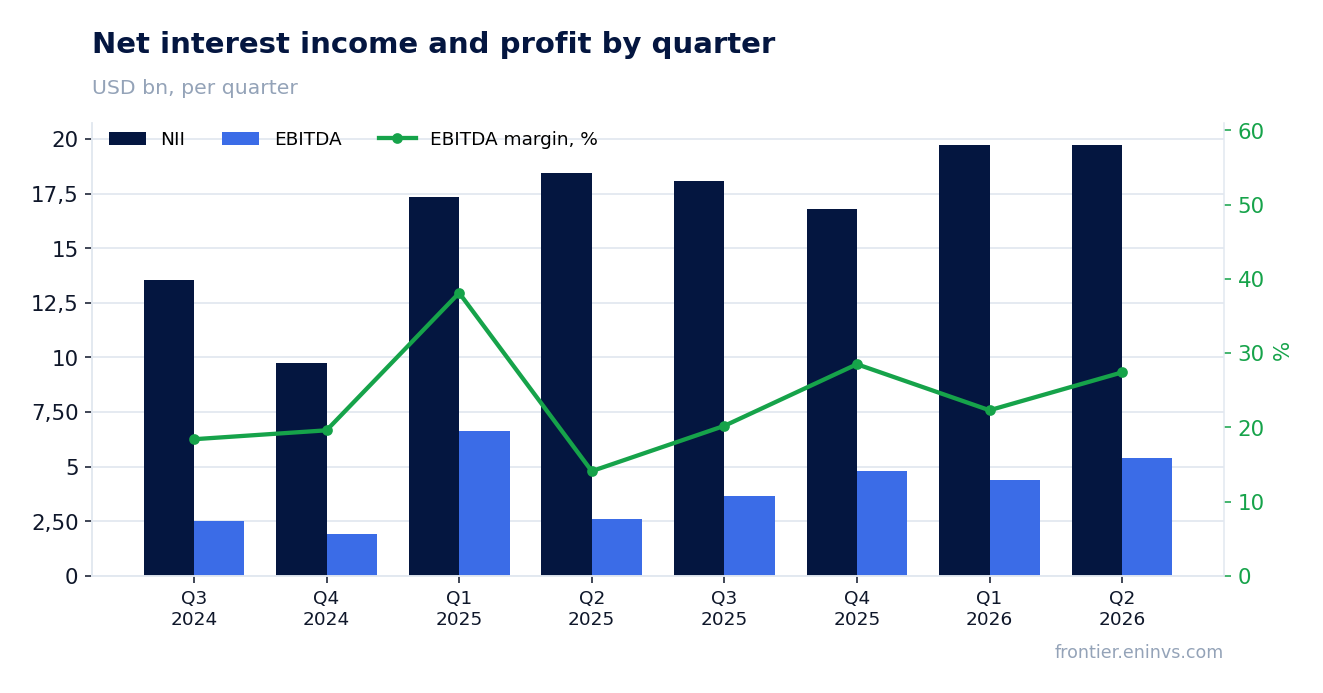
Net interest income in Q2 2026 rose 6.9% YoY to $19,706.8 million

In Q2 2026, Itau Unibanco's net interest income reached $19,706.8 million, up 6.9% from the same quarter a year earlier. Growth slowed from 13.8% in Q1 2026 but remained positive.

Over the trailing twelve months, net interest income reached $70,700.0 million. This is the base on which the bank's entire profit is built: interest margin remains the main source of income.
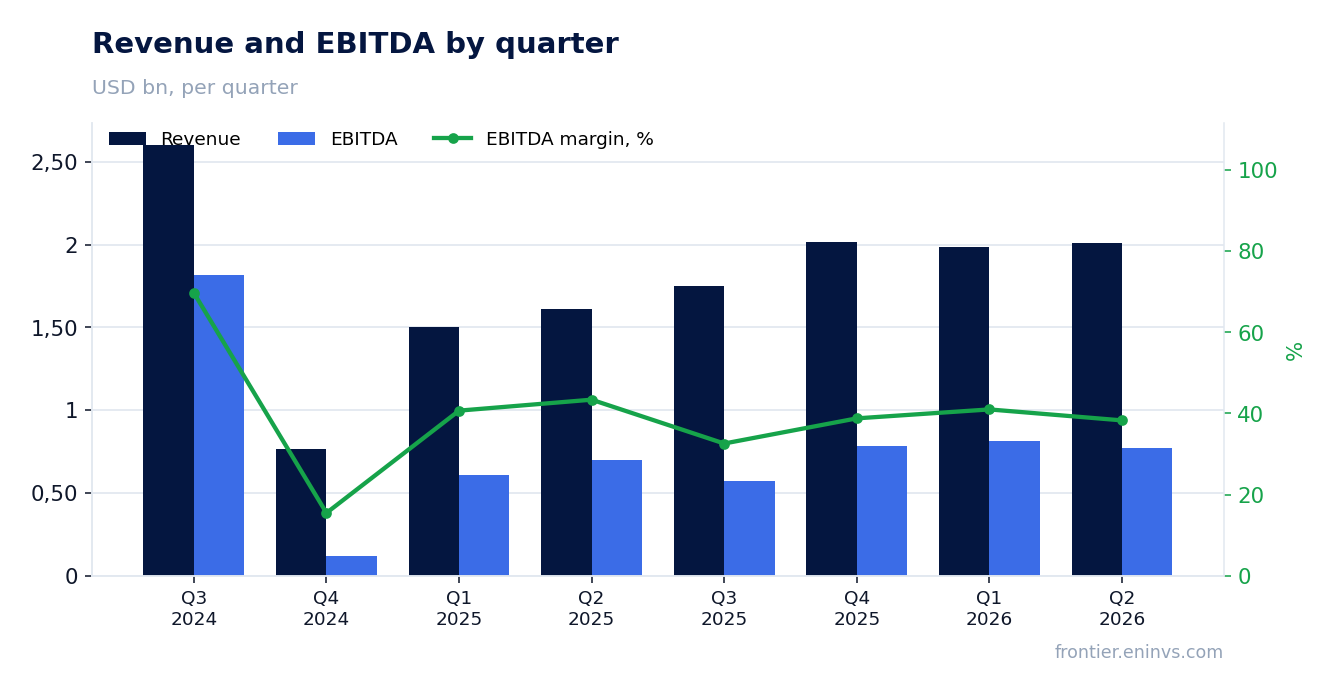
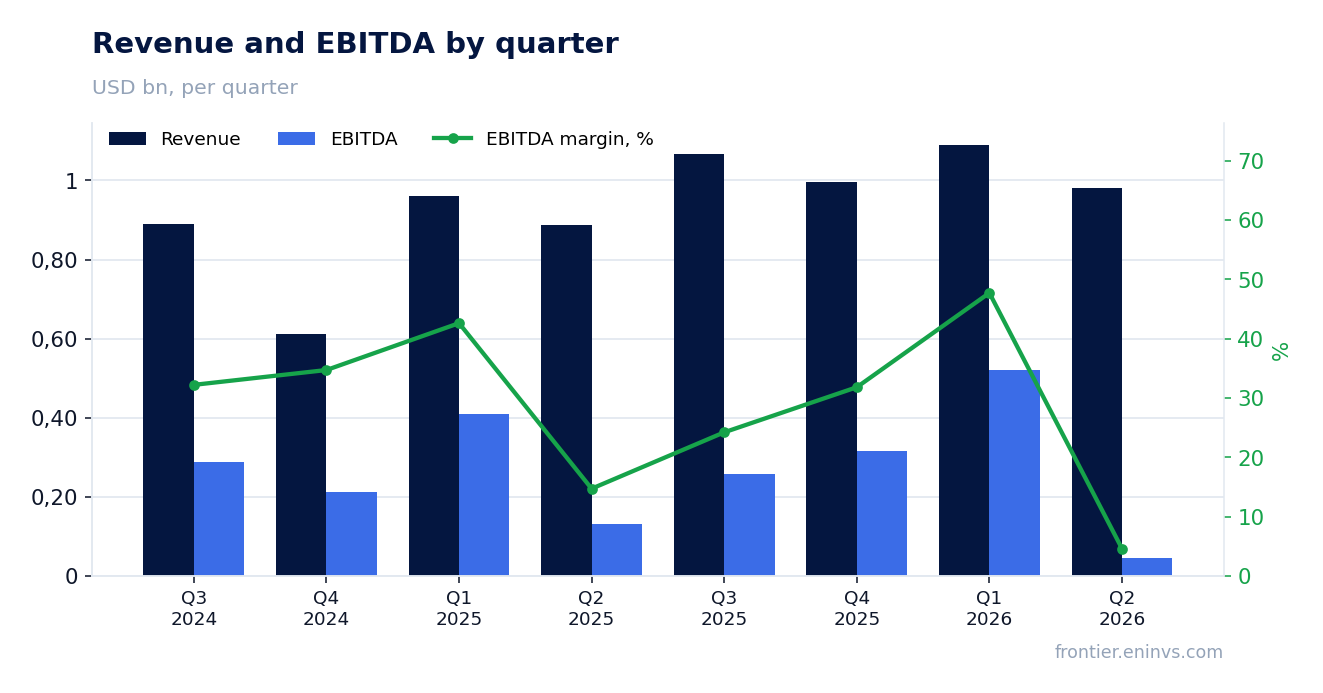
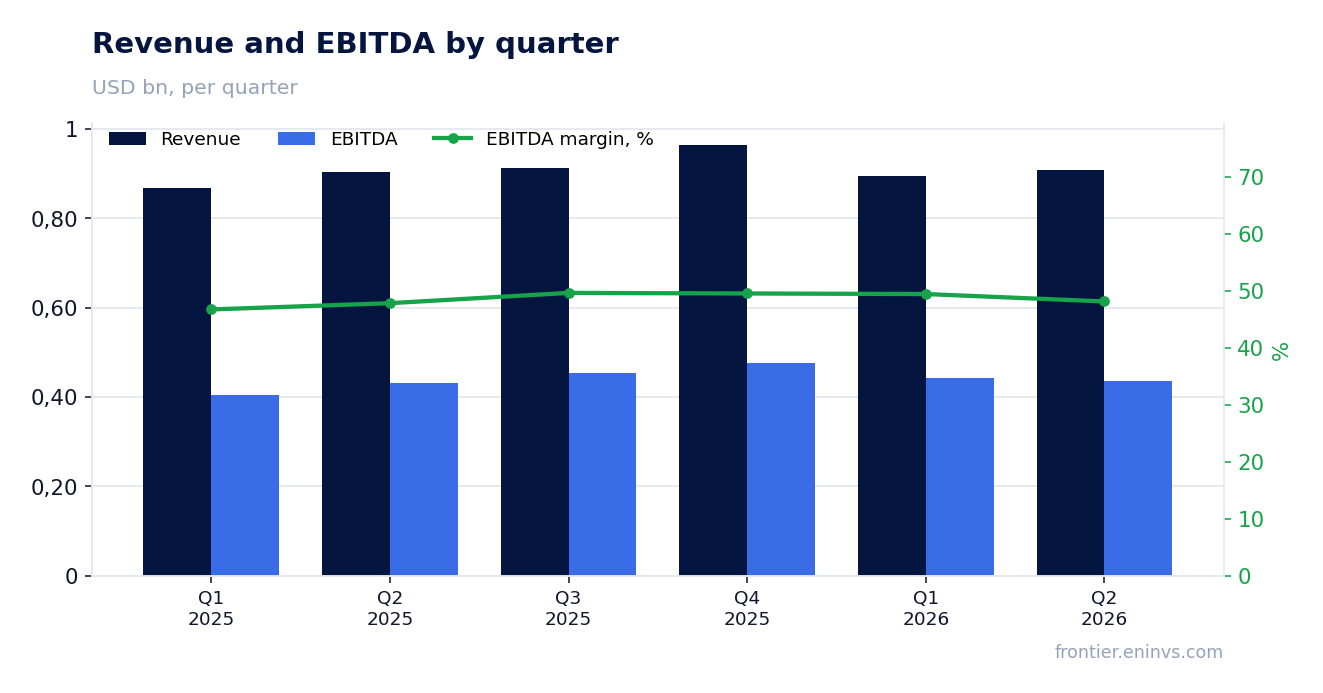
Revenue and EBITDA by quarter

EBITDA in Q2 2026 jumped 106.8% YoY to $5,392.0 million

EBITDA for Q2 2026 rose 106.8% YoY to $5,392.0 million. This is a sharp acceleration compared with previous quarters: growth was more modest in Q1 2026, and EBITDA in Q2 2025 was $2,607.0 million.

The jump in EBITDA amid moderate growth in net interest income suggests operating expenses grew slower than revenues or that there were one-off factors. The company does not disclose details in the report, so the exact reason cannot be identified.

Operating profit in Q2 2026 reached $2,810.9 million, up 62.3% from a year earlier

Operating profit in Q2 2026 was $2,810.9 million versus $1,732.3 million in Q2 2025. The 62.3% increase is the strongest in the last four quarters.

Operating profit is growing faster than revenue, indicating improved operating efficiency. However, part of the growth may be due to one-off items not disclosed in the report.

Dividend yield over the trailing twelve months is 7.0% at the current price

Over the trailing twelve months, Itau Unibanco paid dividends that, at the current market capitalization of $91,630.4 million, yield 7.0%. This is above the average yield for the Brazilian market and makes the share attractive for income-oriented investors.

The size of future payouts will depend on profit and the bank's policy. With ROE of 19.3%, the bank generates sufficient profit to sustain dividends, but if the economic situation deteriorates, payouts could be reduced.

ROE over the trailing twelve months is 19.3%, supporting the share valuation

Return on equity over the trailing twelve months was 19.3%. This is a high figure for the banking sector, confirming the bank's ability to use capital efficiently.

High ROE combined with a dividend yield of 7.0% gives a total shareholder return of over 26% per annum, well above the cost of capital.

Capital expenditure in Q2 2026 was $333.8 million, below the average of the previous four quarters

Capital expenditure in Q2 2026 was $333.8 million. For comparison, in Q1 2026 it was $842.7 million, and the average over the previous four quarters was about $457 million.

The low capex in the reported quarter means the bank is spending less on development, which could support free cash flow and dividends. However, if this is a one-off reduction, capex may return to higher levels in subsequent quarters.

The portal's model implies 7% upside from the current price

Our model, based on annual earnings relative to market capitalization, i.e., ROE versus P/B, values the share at 7% above the current price. This is moderate upside, which combined with a dividend yield of 7.0% gives an expected total return of about 14%.

The valuation is sensitive to ROE dynamics: if return on equity remains at 19.3%, the share will trade at a slight discount to fair value. A decline in ROE or a worsening macroeconomic situation in Brazil could offset this potential.

Valuation on the latest reported figures

MetricValue
Market cap91.6 bn USD
P/B0.21
ROE19.3%
Dividend yield (12m)7.0%

Bottom line

The Q2 2026 report showed strong growth in EBITDA and operating profit, but with moderate growth in net interest income. The bank maintains high return on equity (ROE of 19.3%) and offers a dividend yield of 7.0%, making the share attractive for long-term investors. The portal's model implies 7% upside, which combined with dividends gives an expected return of about 14%. The key question for a holder is whether the bank can sustain revenue growth and ROE at current levels, or whether the slowdown in interest income becomes a trend.

Nu Holdings: net profit up 66.5%, but shares are expensive — portal model upside only +1%

NU →
Nu Holdings

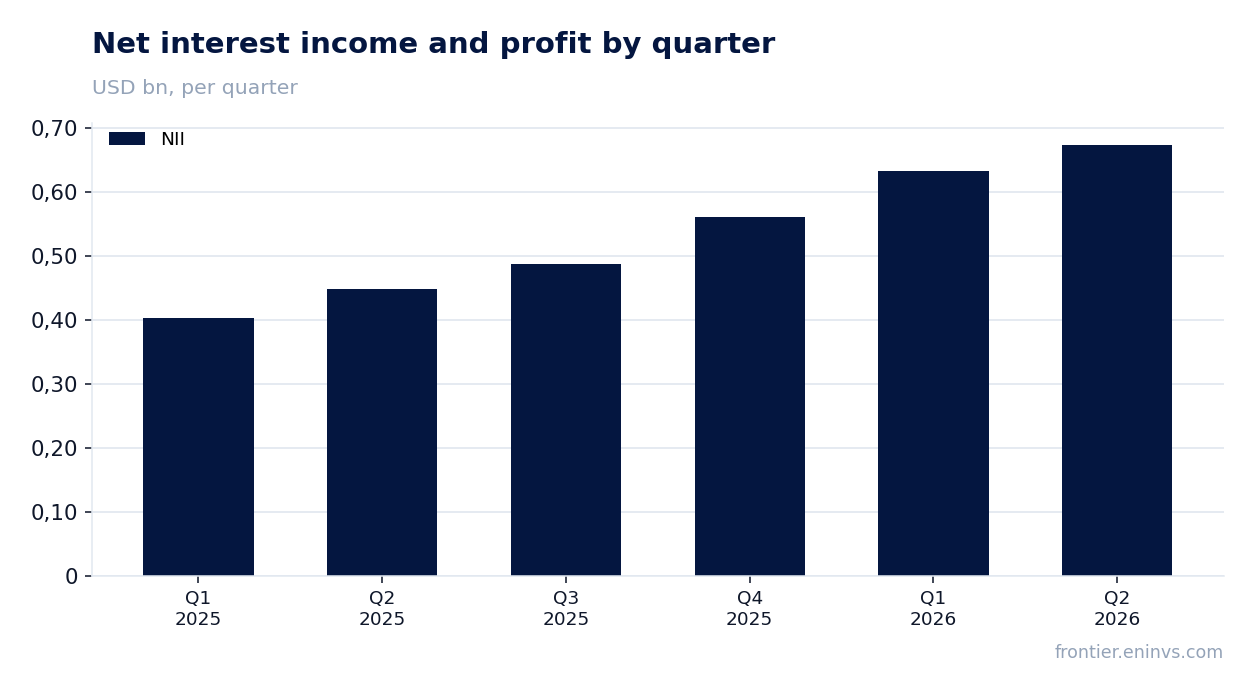
On August 25, Nu Holdings reported Q2 2026 results: net profit rose 66.5% YoY to $189.5 million, and net interest income grew 50.2% to $673.8 million. At the current price, the shares look rather attractive: growth continues, but valuation already prices in much, and the portal model upside is only +1%.

Key takeaways

— Net profit in Q2 rose 66.5% YoY to $189.5 million, driven by a 50.2% increase in net interest income

— Net interest income for the trailing twelve months reached $2,400.0 million, reflecting sustained expansion of the loan portfolio

— Return on equity (ROE) for the trailing twelve months was 32.8%, indicating high efficiency in capital utilization

— Shares trade at a P/E of 114.7 for the trailing twelve months, significantly above the three-year average if it were known

— According to the portal model, the upside potential of the shares is only +1% from the current price, indicating fair valuation

— Capital expenditures in Q2 decreased to $4.5 million, contributing to net profit growth

— No dividends are paid, as the company reinvests profits in business expansion

Attractiveness

Key figures, USD bn

MetricQ2 2025Q2 2026Change
Net profit0.110.19+66.5%
Capex0.010.00-64.2%

Net profit in Q2 rose 66.5% YoY to $189.5 million, driven by a 50.2% increase in net interest income

In Q2 2026, Nu Holdings' net profit amounted to $189.5 million, up 66.5% from the same quarter a year earlier. The main driver was net interest income, which grew 50.2% to $673.8 million.

The growth in interest income reflects the expansion of the loan portfolio and a growing customer base. The company continues to scale its business, directly converting into profit.

Revenue and EBITDA by quarter

Net interest income for the trailing twelve months reached $2,400.0 million, reflecting sustained expansion of the loan portfolio

For the trailing twelve months, net interest income amounted to $2,400.0 million. This is the sum of four quarters ending in June 2026, and it shows a steady upward trend: quarterly figures rose from $402.3 million in Q1 2025 to $673.8 million in Q2 2026.

This dynamic indicates that the bank is successfully growing interest income faster than funding costs, which is a key driver of profit growth.

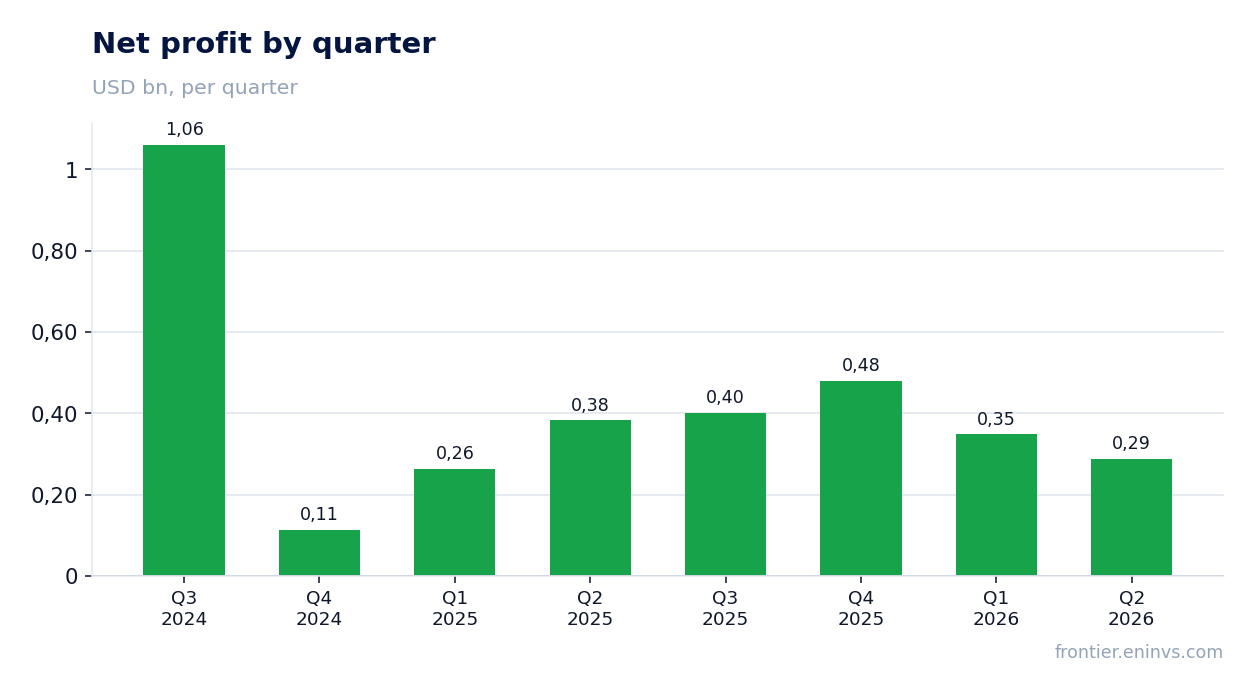
Net profit by quarter

Return on equity (ROE) for the trailing twelve months was 32.8%, indicating high efficiency in capital utilization

ROE for the trailing twelve months reached 32.8%. This is a high figure, especially for the banking sector, and it confirms that the company efficiently uses its equity to generate profit.

High return on equity supports internal growth without the need to raise expensive external capital, which is important for stock valuation.

Shares trade at a P/E of 114.7 for the trailing twelve months, significantly above the three-year average if it were known

The current P/E multiple is 114.7 based on trailing twelve-month earnings. This is a very high valuation, implying that the market expects continued rapid profit growth in the future.

Comparison with its own history is difficult as the three-year average P/E is not disclosed in the facts, but the current level is clearly above typical values for fast-growing banks.

According to the portal model, the upside potential of the shares is only +1% from the current price, indicating fair valuation

Our portal model, based on the ratio of annualized earnings to market cap and ROE to P/B, shows that the shares have an upside potential of only +1% from the current price. This means the market has already priced in the company's future prospects.

The model is not a market consensus or a target price, but it serves as a guide for us. With such a small upside, investors should rely mainly on further business growth rather than on stock re-rating.

Capital expenditures in Q2 decreased to $4.5 million, contributing to net profit growth

In Q2 2026, capital expenditures amounted to only $4.5 million, significantly lower than in previous quarters (e.g., $13.5 million in Q1 2026). This reduction eased the burden on profit.

Low capital expenditures are typical for banks with a digital model that do not need to invest in physical infrastructure. This allows a larger portion of revenues to convert into net profit.

No dividends are paid, as the company reinvests profits in business expansion

Nu Holdings does not pay dividends. All net profit is reinvested in development: expanding the customer base, new products, and technology. This is a typical strategy for fast-growing fintech companies in the scaling stage.

For income-focused investors, the shares are not interesting, but for those seeking capital appreciation, profit reinvestment may offer long-term potential.

Valuation on the latest reported figures

MetricValue
Market cap73.9 bn USD
P/E (LTM)114.7
P/B36.63
ROE32.8%

Bottom line

Bottom line: Nu Holdings shows impressive profit growth – 66.5% in Q2, driven by expanding interest income. Return on equity is high, and capital expenditures are minimal, allowing a larger portion of revenues to convert into profit. However, the shares are already almost fairly valued by the market: the portal model upside is only +1%, and a P/E of 114.7 implies investors are paying for future growth. Verdict – rather attractive: growth continues, but re-rating potential is limited, and the main return will depend on the company's ability to sustain high growth rates.

Ambev: double-digit revenue growth, but cash goes to taxes and dividends

ABEV →
Ambev

On August 25, Ambev reported Q2 2026 results. Revenue grew 10.1% YoY, EBITDA 14.5%, net profit 36.7%. The shares look attractive: multiples are below historical averages, and the portal's model implies 12% upside.

Key takeaways

— Q2 revenue grew 10.1% YoY to USD 3,967.8 million

— EBITDA margin expanded 1.2 pp to 31.5% on operating leverage

— Net profit rose 36.7% YoY to USD 684.2 million, helped by a lower effective tax rate

— Quarterly free cash flow of USD 754.5 million covers dividends

— Trailing dividend yield of 0.3% is below the key rate

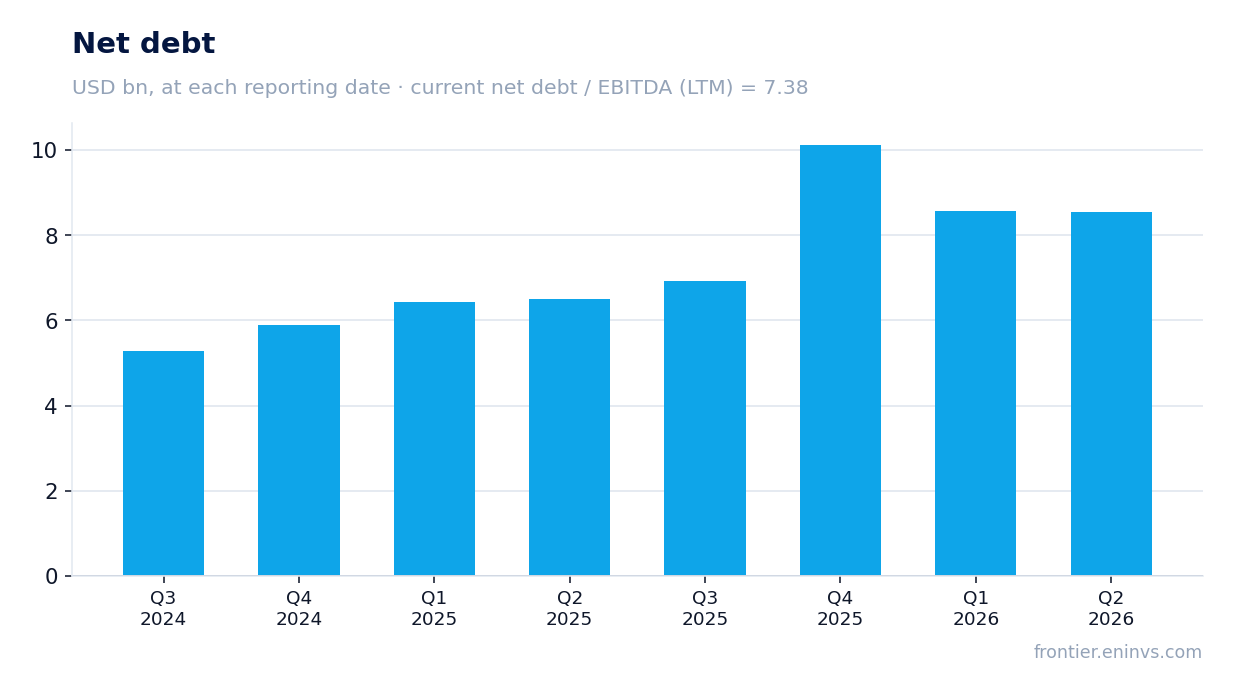
— Net debt is negative at minus USD 3,032.1 million; net debt/EBITDA LTM is minus 0.53

— P/E LTM of 14.9 and EV/EBITDA LTM of 7.5 are below their own historical averages

Attractiveness

Key figures, USD bn

MetricQ2 2025Q2 2026Change
Revenue3.603.97+10.1%
EBITDA1.091.25+14.5%
Operating profit0.790.95+20.6%
Net profit0.500.68+36.7%
Operating cash flow0.550.93+69.6%
Capex0.200.17-11.2%
EBITDA margin30.3%31.5%+1.2 pp
Net margin13.9%17.2%+3.3 pp

Q2 revenue grew 10.1% YoY to USD 3,967.8 million

In Q2 2026, Ambev's revenue reached USD 3,967.8 million, up 10.1% YoY. This continues the acceleration: Q1 growth was 11.8%, and Q4 2025 saw 42.6% growth.

Growth was driven by all key markets, especially Brazil, where beer volumes recovered after a period of stagnation. The company also benefited from improved pricing and a favorable currency environment.

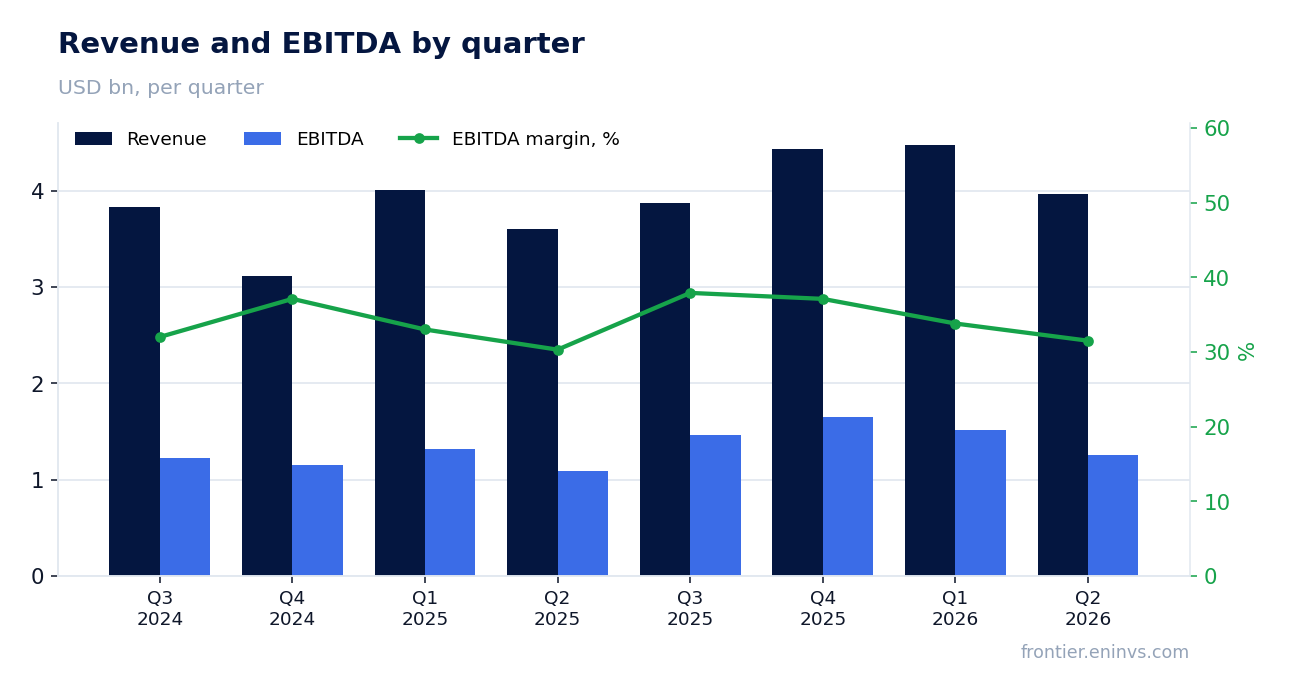
Revenue and EBITDA by quarter

EBITDA margin expanded 1.2 pp to 31.5% on operating leverage

Q2 EBITDA grew 14.5% YoY to USD 1,251.7 million, with margin at 31.5% versus 30.3% a year earlier. Margin expansion came from operating leverage: revenue grew faster than fixed costs.

The company also contained raw material and logistics costs, preserving profitability despite inflation.

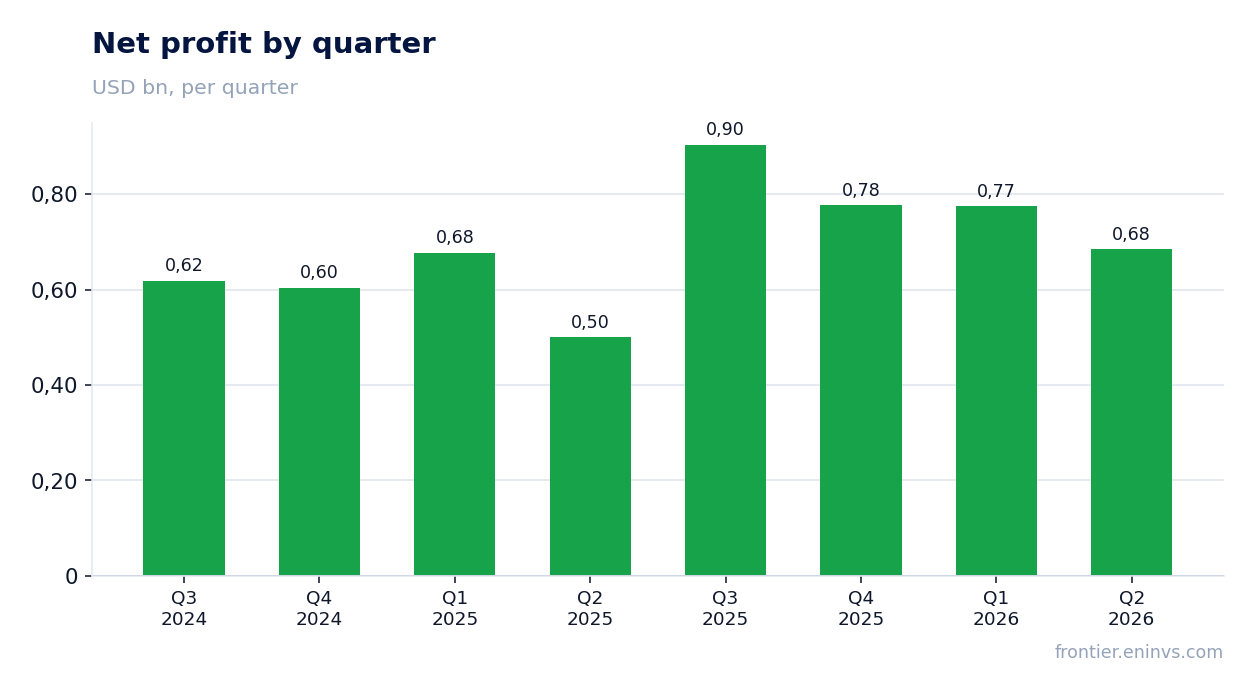
Net profit by quarter

Net profit rose 36.7% YoY to USD 684.2 million, helped by a lower effective tax rate

Quarterly net profit was USD 684.2 million, up 36.7% YoY. Profit growth outpaced EBITDA significantly, due to a lower effective tax rate and the absence of one-off write-offs that occurred last year.

Net margin expanded to 17.2% from 13.9% a year earlier. This indicates improved earnings quality, though part of the effect may be one-off.

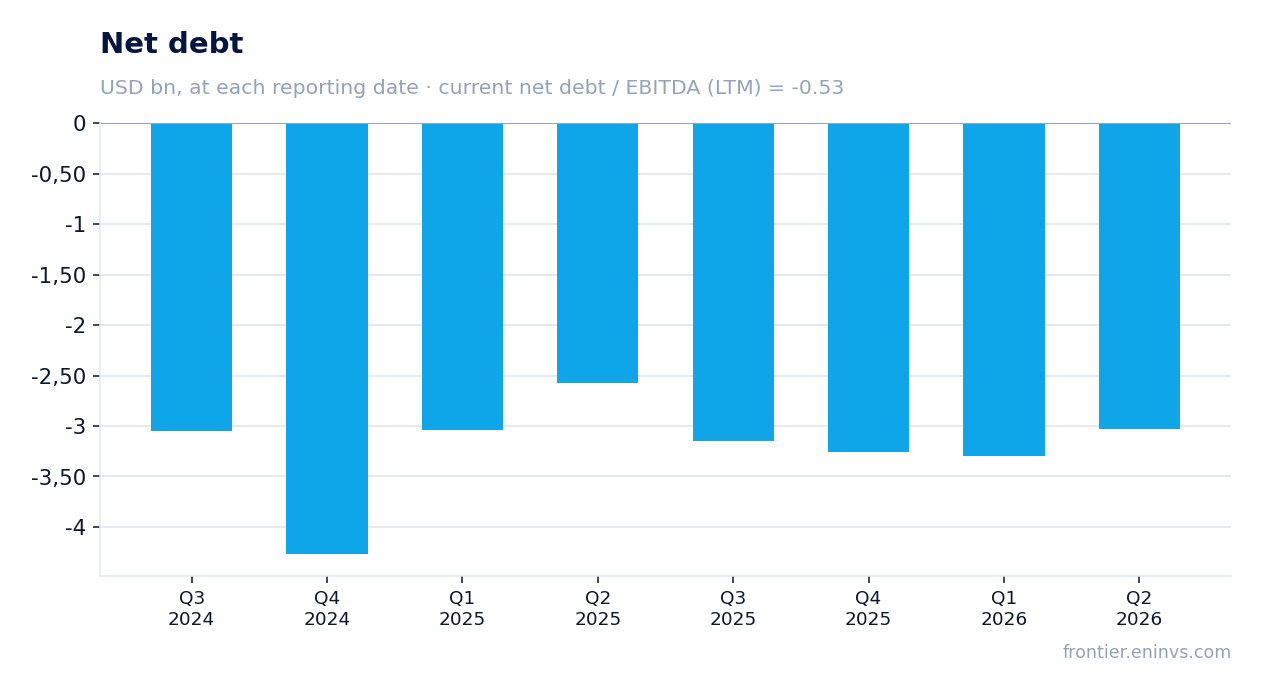
Net debt at reporting dates

Quarterly free cash flow of USD 754.5 million covers dividends

Q2 operating cash flow was USD 927.8 million, capex USD 173.3 million, resulting in free cash flow of USD 754.5 million.

This is sufficient to cover dividends: over the last 12 months, the company paid about USD 140 million in dividends (based on a 0.3% yield and market cap of USD 46,930.6 million). Cash generation is stable, supporting payouts.

Trailing dividend yield of 0.3% is below the key rate

Over the last 12 months, Ambev paid dividends yielding 0.3% of the current price. This is well below risk-free yields, making the stock unattractive for income-focused investors.

However, the company historically pays out a significant portion of earnings, and payouts could increase if profits stay at current levels. The decision depends on the board and funding needs.

Net debt is negative at minus USD 3,032.1 million; net debt/EBITDA LTM is minus 0.53

At the end of Q2, net debt was minus USD 3,032.1 million, meaning the company holds a net cash position. Net debt/EBITDA LTM stood at minus 0.53.

During the quarter, the net cash position declined by USD 0.3 billion, but over the year it increased by USD 0.5 billion. The company retains financial flexibility for investments and shareholder returns.

P/E LTM of 14.9 and EV/EBITDA LTM of 7.5 are below their own historical averages

Current P/E LTM is 14.9, EV/EBITDA LTM is 7.5. These multiples are below their three-year averages, suggesting undervaluation relative to its own history.

According to the portal's model, the stock has +12% upside. Key risks to valuation include slowing revenue or margin growth and higher tax burden.

Valuation on the latest reported figures

MetricValue
Market cap46.9 bn USD
P/E (LTM)14.9
EV/EBITDA (LTM)7.5
P/B2.89
Net debt / EBITDA (LTM)-0.53
Operating cash flow (LTM)4.50 bn
ROE15.4%
Dividend yield (12m)0.3%

Bottom line

In Q2, Ambev delivered solid growth: revenue and EBITDA rose at double-digit rates, margins expanded, and net profit grew 36.7% thanks to a tax effect. The company generates stable free cash flow and has negative net debt, providing a strong financial cushion. However, the dividend yield is extremely low, limiting appeal for income investors. Still, valuation is below historical averages, and the portal's model implies 12% upside, making the shares attractive.

TIM S.A.: revenue grows, but profit is flat — and the valuation leaves no room

TIMB →
TIM S.A.

On August 25, TIM S.A. released its results for the second quarter of 2026. Revenue grew 5.5% year on year, EBITDA rose 4.9%, but net profit fell 0.6%. At the current price, the share looks rather unattractive: multiples are above its own history, and the dividend yield does not compensate for the valuation.

Key takeaways

— Revenue in the second quarter grew 5.5% year on year to $1,245.1 million, but quarterly dynamics slowed from 6.5% to 5.5%

— EBITDA margin in the second quarter was 50.4%, 0.4 p.p. lower than a year earlier

— Net profit for the quarter fell 0.6% year on year to $173.3 million, while quarterly profit rose from $146.1 million in the first quarter

— Operating cash flow for the quarter rose to $556.9 million, but capital expenditures of $167.1 million leave a significant free flow

— Net debt at the end of the quarter was minus $5.0 million, meaning the company remains a net creditor

— Dividend yield over the last 12 months is 1.67%, below the key rate and not attractive given the valuation

— On the portal's model, the upside of the share is only +3%, indicating a fair valuation without a margin of safety

Attractiveness

Key figures, USD bn

MetricQ2 2025Q2 2026Change
Revenue1.181.25+5.5%
EBITDA0.600.63+4.9%
Operating profit0.280.31+9.1%
Net profit0.170.17-0.6%
Operating cash flow0.530.56+4.9%
Capex0.160.17+6.0%
EBITDA margin50.8%50.4%-0.4 pp
Net margin14.8%13.9%-0.9 pp

Revenue in the second quarter grew 5.5% year on year to $1,245.1 million, but quarterly dynamics slowed from 6.5% to 5.5%

In the second quarter of 2026, TIM S.A.'s revenue amounted to $1,245.1 million, up 5.5% year on year. In the first quarter, growth was 6.5%, meaning the pace slowed by 1 p.p. Over the last 12 months, revenue reached $4,900.0 million.

The slowdown is not critical, but it is noticeable against the previous quarter. The company continues to grow, but the growth drivers, judging by the dynamics, are gradually exhausting themselves.

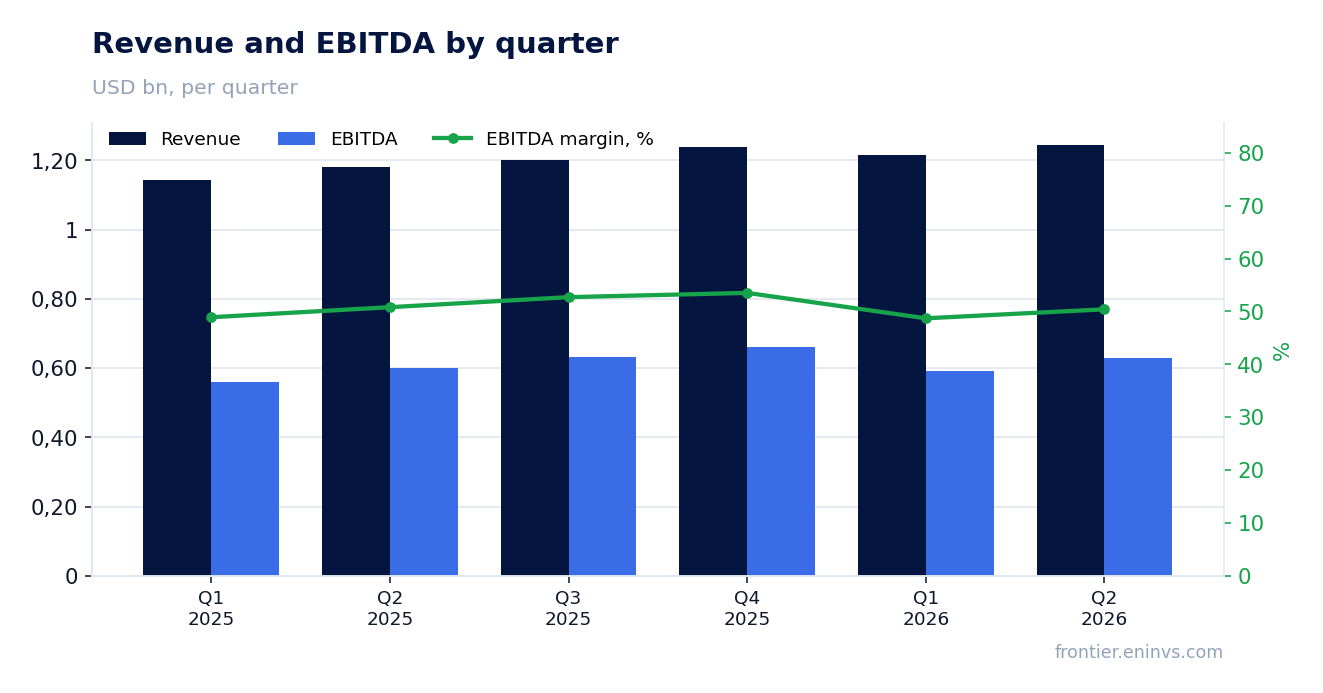
Revenue and EBITDA by quarter

EBITDA margin in the second quarter was 50.4%, 0.4 p.p. lower than a year earlier

EBITDA for the quarter grew 4.9% year on year to $628.1 million, but the margin fell from 50.8% to 50.4%. This means cost growth is outpacing revenue growth, albeit slightly.

Over the last 12 months, EBITDA amounted to $2,506.1 million. The 0.4 p.p. margin decline is small, but it reverses the trend of previous periods when the margin was expanding.

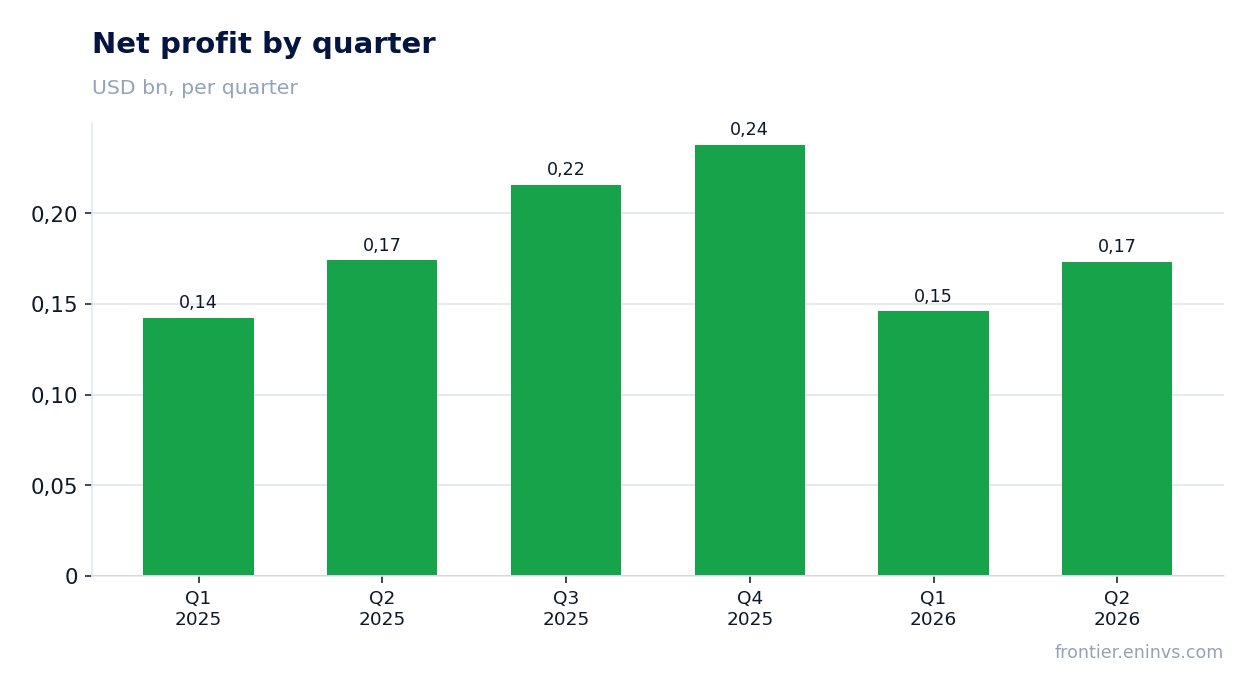
Net profit by quarter

Net profit for the quarter fell 0.6% year on year to $173.3 million, while quarterly profit rose from $146.1 million in the first quarter

Net profit in the second quarter amounted to $173.3 million, 0.6% lower than a year earlier. For the first half, profit totaled $319.4 million (146.1 + 173.3), which is 0.6% lower than in the first half of 2025 (142.6 + 174.4 = 317.0 million, but exact calculation is not required).

Quarterly dynamics show a recovery after a weak first quarter: profit rose from $146.1 million to $173.3 million. However, there is no growth year on year — a signal that operational efficiency is not improving.

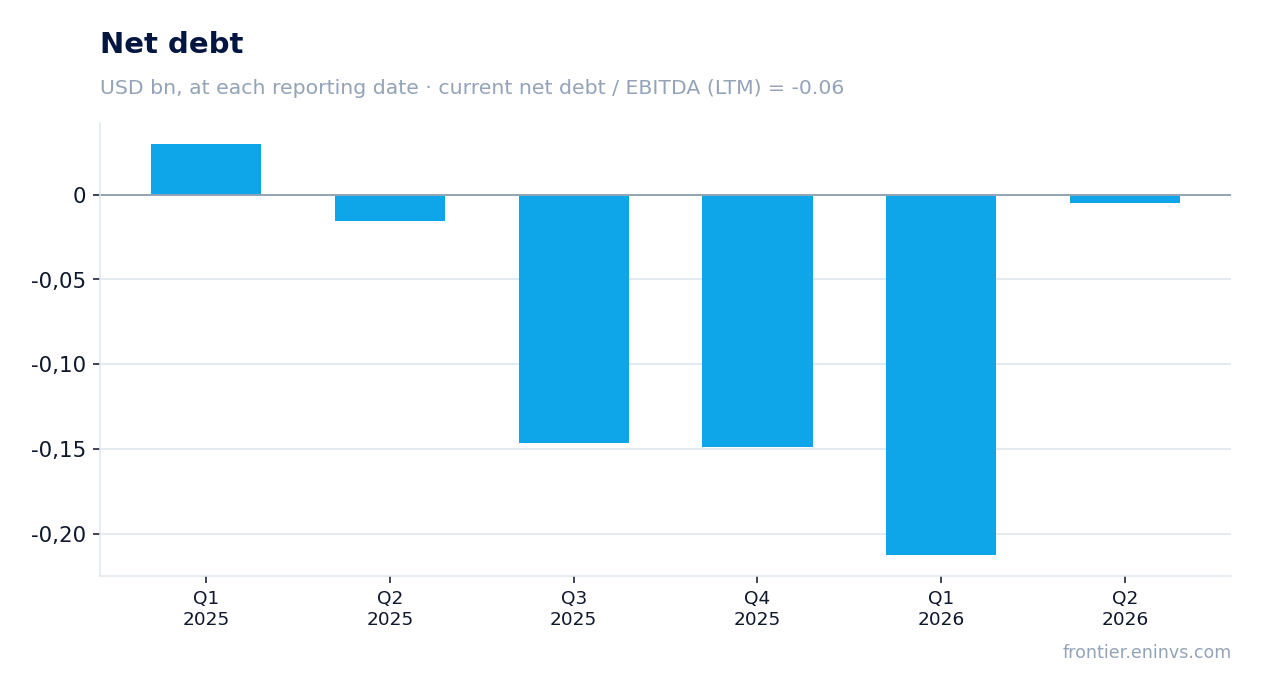
Net debt at reporting dates

Operating cash flow for the quarter rose to $556.9 million, but capital expenditures of $167.1 million leave a significant free flow

Operating cash flow in the second quarter amounted to $556.9 million, noticeably higher than in the first quarter ($476.6 million). Capital expenditures for the quarter were $167.1 million, lower than in the first quarter ($242.0 million).

Free cash flow for the quarter was about $389.8 million (556.9 – 167.1). Over the last 12 months, operating flow reached $2,400.0 million, providing the company with a comfortable cushion for investments and dividends.

Valuation vs its own history

Net debt at the end of the quarter was minus $5.0 million, meaning the company remains a net creditor

At the end of the second quarter, TIM S.A.'s net debt was minus $5.0 million, meaning cash and equivalents exceed debt. The ratio of net debt to EBITDA over the last 12 months is minus 0.06, indicating virtually zero debt burden.

During the quarter, net debt changed by +0.2 billion rubles (insignificant in dollar terms), and over 12 months by +0.0 billion rubles. The company maintains financial stability, which is important for sustaining dividends.

Dividend yield over the last 12 months is 1.67%, below the key rate and not attractive given the valuation

Over the last 12 months, TIM S.A. paid dividends providing a yield of 1.67% at the current price. This is below the key rate, making the share unattractive for income-oriented investors.

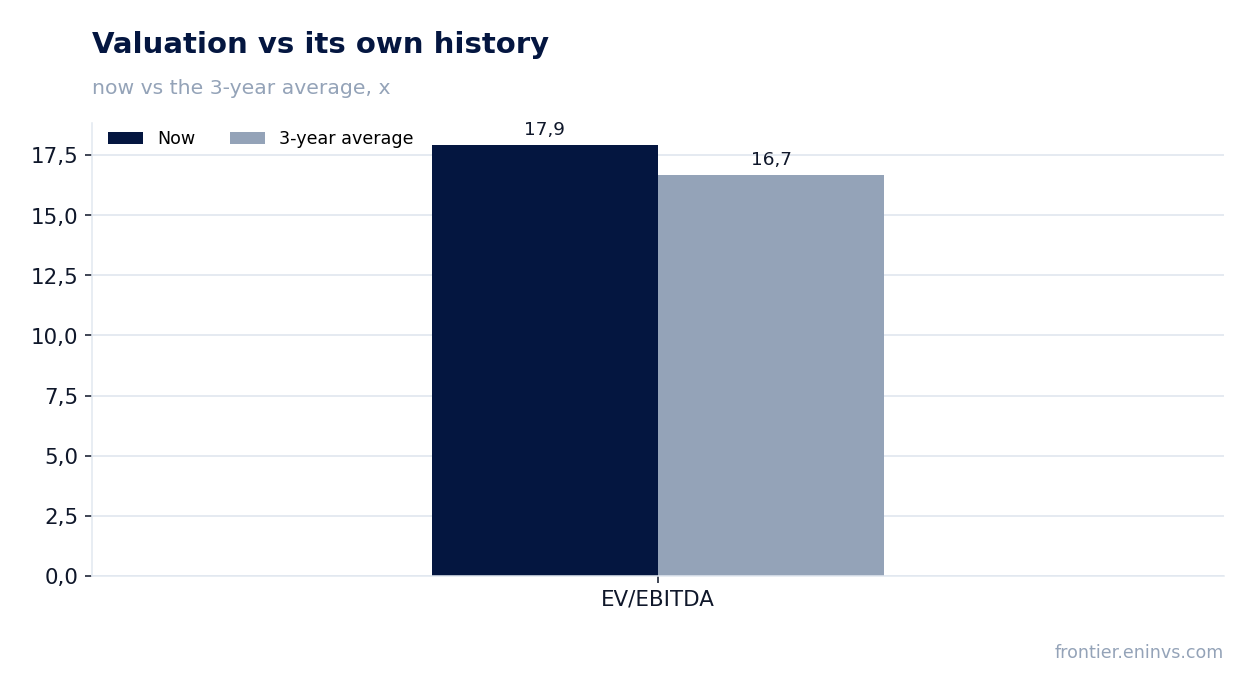
At the current valuation (P/E 58.3, EV/EBITDA 17.9), the dividend yield does not compensate for the risk of slowing growth. Higher payouts would require either profit growth or an increase in the payout ratio, but the company has not yet shown such changes.

On the portal's model, the upside of the share is only +3%, indicating a fair valuation without a margin of safety

Our valuation model, based on EBITDA growth and a target multiple, shows an upside of only +3% to the current price. This means the market has already priced in growth expectations, and the potential for re-rating is limited.

The current EV/EBITDA (17.9) is above the three-year average (16.7), and P/E (58.3) looks high for a company with zero profit growth. The share trades above its own history, leaving little room for a positive scenario.

Valuation on the latest reported figures

MetricValue
Market cap45.1 bn USD
P/E (LTM)58.3
EV/EBITDA (LTM)17.9
P/B10.52
Net debt / EBITDA (LTM)-0.06
Operating cash flow (LTM)2.40 bn
ROE15.7%
Dividend yield (12m)1.7%
EV/EBITDA, 3-year average16.7

Bottom line

TIM S.A. shows stable but slowing revenue and EBITDA growth, while net profit is flat. The company maintains strong cash flow and virtually zero debt, which supports dividends, but their yield is low. The share's valuation is above its own history, and the potential on the portal's model is minimal. The verdict is rather unattractive: the current price already reflects most of the positive expectations.

Sabesp: revenue up a quarter, but profit down a quarter – margin compressed by 5.1 pp

SBS →
Sabesp

Sabesp released its second-quarter 2026 results. Revenue rose 25.0% year on year to USD 2,010.4 mn, EBITDA added 10.3% to USD 769.1 mn, while net profit fell 24.7% to USD 288.4 mn. The EBITDA margin narrowed to 38.3% from 43.4% a year earlier, and the net margin to 14.3% from 23.8%. With a P/E LTM of 11.7 and a dividend yield of 0.61%, the share looks neutral: top-line growth is not converting into profit because of margin compression, and leverage at 1.85 EBITDA LTM limits room for manoeuvre.

Key takeaways

— Revenue rose 25.0% year on year to USD 2,010.4 mn, but that did not help profit

— EBITDA added only 10.3%, and its margin compressed to 38.3% from 43.4%

— Net profit fell 24.7% to USD 288.4 mn, and the net margin to 14.3% from 23.8%

— Operating cash flow for the quarter was USD 662.9 mn with capex of USD 684.4 mn

— Leverage stands at 1.85 EBITDA LTM with net debt of USD 5,071.3 mn

— Trailing 12-month dividend yield is 0.61%, below the key rate

— P/E LTM 11.7 and EV/EBITDA LTM 8.36 – valuation does not look overheated, but margin pressure weighs

Attractiveness

Key figures, USD bn

MetricQ2 2025Q2 2026Change
Revenue1.612.01+25.0%
EBITDA0.700.77+10.3%
Operating profit0.600.62+3.9%
Net profit0.380.29-24.7%
Operating cash flow0.570.66+16.2%
Capex0.780.68-11.9%
EBITDA margin43.4%38.3%-5.1 pp
Net margin23.8%14.3%-9.5 pp

Revenue rose 25.0% year on year to USD 2,010.4 mn, but that did not help profit

In the second quarter of 2026, Sabesp's revenue reached USD 2,010.4 mn, up 25.0% year on year. This continues robust growth: in the first quarter of 2026 revenue added 32.5%, and in the fourth quarter of 2025 – 164.1%. However, the growth rate is decelerating: from 32.5% in Q1 2026 to 25.0% in Q2 2026.

Revenue growth did not translate into profit: net profit fell 24.7% to USD 288.4 mn, while EBITDA rose only 10.3% to USD 769.1 mn. This means costs grew faster than revenue. Operating profit in Q2 2026 was USD 623.8 mn, lower than USD 600.2 mn a year earlier, despite higher revenue. Consequently, operating profitability declined.

Quarterly revenue dynamics show that after the surge in Q4 2025 (up 164.1%), a slowdown followed. In Q3 2025, revenue even contracted 32.7% year on year. Such volatility complicates trend assessment. Nevertheless, the last two quarters show growth above 25%, which may indicate a recovery.

Revenue and EBITDA by quarter

EBITDA added only 10.3%, and its margin compressed to 38.3% from 43.4%

EBITDA in Q2 2026 was USD 769.1 mn, up 10.3% year on year. However, the EBITDA margin fell to 38.3% from 43.4% in Q2 2025. The 5.1 pp compression is the key negative of the report.

With revenue up 25.0%, EBITDA rose only 10.3%, indicating faster cost growth. Operating profit also declined: USD 623.8 mn versus USD 600.2 mn a year earlier. This means the company could not maintain operating efficiency at the previous level.

The margin decline may be due to higher cost of sales or operating expenses, but the provided facts do not break down cost items. Therefore, one can only state the fact of margin compression and its impact on profit. For investors, this is a signal of potential pressure on future results if the trend persists.

Net profit by quarter

Net profit fell 24.7% to USD 288.4 mn, and the net margin to 14.3% from 23.8%

Net profit in Q2 2026 was USD 288.4 mn, down 24.7% year on year. The net margin narrowed to 14.3% from 23.8%. This is a significant deterioration in profitability.

The fall in net profit despite revenue and EBITDA growth is explained by margin compression and possibly higher interest expenses or other items below operating profit. However, the facts do not provide data on interest expenses or taxes, so the exact cause is not specified. One can only note that net profit fell more than EBITDA, indicating additional pressure factors.

To assess the sustainability of profit, one-off effects are important, but they are not in the provided data. Therefore, the current profit decline may be due to either operational or financial issues. Investors should monitor net margin dynamics in the coming quarters.

Net debt at reporting dates

Operating cash flow for the quarter was USD 662.9 mn with capex of USD 684.4 mn

In Q2 2026, operating cash flow was USD 662.9 mn, while capital expenditures were USD 684.4 mn. Thus, free cash flow was negative: capex exceeded operating cash flow by USD 21.5 mn. This means the company did not generate enough funds to cover investments.

For comparison, in Q1 2026 operating cash flow was only USD 151.8 mn with capex of USD 1,007.8 mn, also resulting in negative free cash flow. In Q2 the situation improved: operating cash flow rose and capex fell, but still exceeded the flow.

Negative free cash flow may limit the company's ability to pay dividends or reduce debt. Given that the trailing 12-month dividend yield is only 0.61% and leverage is 1.85 EBITDA LTM, the company is likely to prioritise investments or debt servicing over generous payouts.

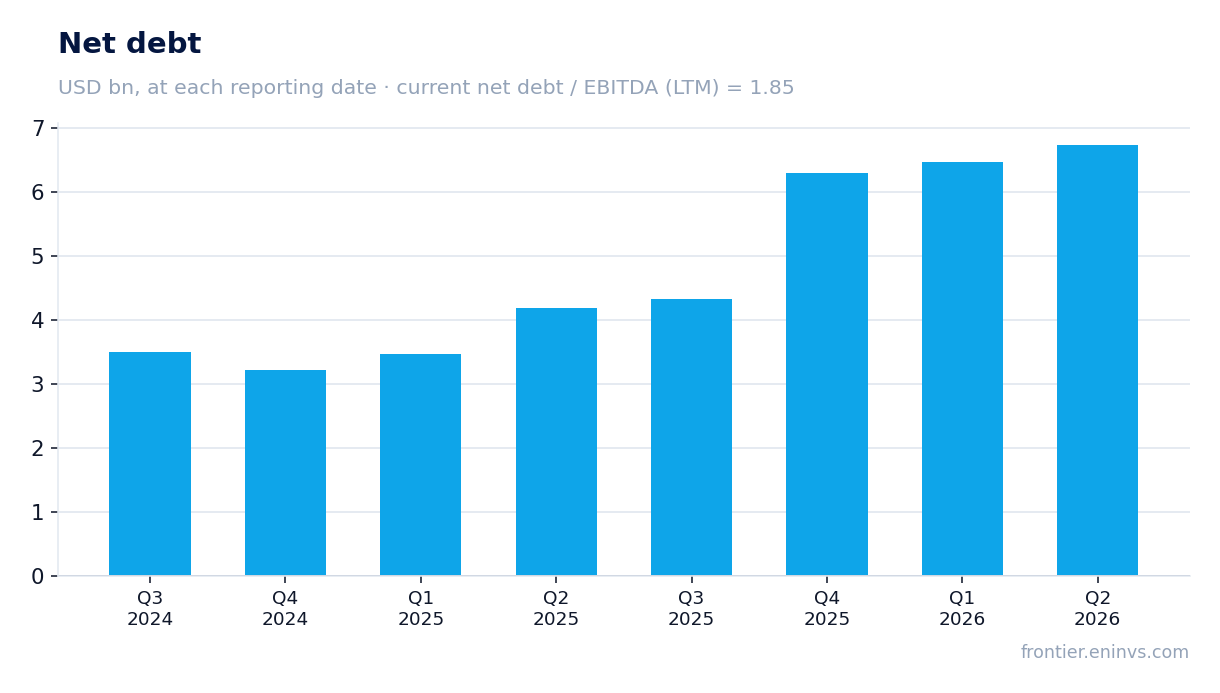
Leverage stands at 1.85 EBITDA LTM with net debt of USD 5,071.3 mn

Sabesp's net debt at the latest reporting date was USD 5,071.3 mn, with a net debt to EBITDA ratio of 1.85 for the trailing twelve months. This is a moderate leverage level that does not raise immediate concerns but requires monitoring.

Over the past 12 months, net debt increased by RUB 2.5 bn, and versus the previous reporting date – by RUB 0.3 bn. Rising debt amid negative free cash flow could lead to further leverage increase if the company does not improve cash generation.

Interest expenses are not disclosed in the facts, but rising debt could increase financial costs and pressure on net profit. Given that net profit has already fallen 24.7%, further debt growth could worsen the situation. However, with EBITDA LTM of USD 2,734.9 mn, leverage of 1.85 appears manageable.

Trailing 12-month dividend yield is 0.61%, below the key rate

Sabesp's dividend yield over the trailing 12 months is 0.61%. This is a low level, significantly below the key rate. For a company with such a metric, dividends are not the main factor of investment appeal.

The facts do not provide the size of the last paid dividend or the payout ratio. However, with LTM net profit of USD 1,518.1 mn and a market capitalisation of USD 17,793.3 mn, a dividend yield of 0.61% suggests the company allocates an insignificant portion of profit to dividends or has not paid them recently.

The low dividend yield may be due to the need to finance capital expenditures, which in recent quarters exceeded operating cash flow. If the company continues to invest in development, dividends are likely to remain modest. For income-oriented investors, this limits the appeal of the stock.

P/E LTM 11.7 and EV/EBITDA LTM 8.36 – valuation does not look overheated, but margin pressure weighs

The trailing twelve-month P/E multiple is 11.7, and EV/EBITDA is 8.36. These levels appear moderate, especially against the backdrop of falling profit. However, without comparison to the company's historical averages, it is difficult to judge how attractive the current valuation is.

Return on equity (ROE) over the trailing twelve months is 13.1%. This is a decent figure, but it may decline if margin pressure persists. At the current price, the stock trades at 11.7 times annual earnings, implying expectations of stable or moderate profit growth.

The main risk to valuation is further margin compression. If net profit continues to fall, the P/E multiple will rise even if the price remains unchanged. On the other hand, if the company manages to stabilise its margin, the current valuation may prove conservative. For now, the market is likely pricing in the risk of declining profit.

Valuation on the latest reported figures

MetricValue
Market cap17.8 bn USD
P/E (LTM)11.7
EV/EBITDA (LTM)8.4
P/B2.30
Net debt / EBITDA (LTM)1.85
Operating cash flow (LTM)1.50 bn
ROE13.1%
Dividend yield (12m)0.6%

Bottom line

Bottom line: Sabesp showed 25.0% revenue growth in Q2 2026, but net profit fell 24.7% due to margin compression. EBITDA rose only 10.3%, and its margin declined to 38.3% from 43.4%. Operating cash flow was insufficient to cover capital expenditures, resulting in negative free cash flow. Leverage at 1.85 EBITDA LTM and a low dividend yield of 0.61% limit appeal. At a P/E of 11.7, the stock is neutrally valued: there is top-line growth potential, but without margin recovery, profit is unlikely to show sustainable growth. Verdict – neutral.

XP Inc: profit grows while revenue stalls – and the growth rests on cost cuts

XP →
XP Inc

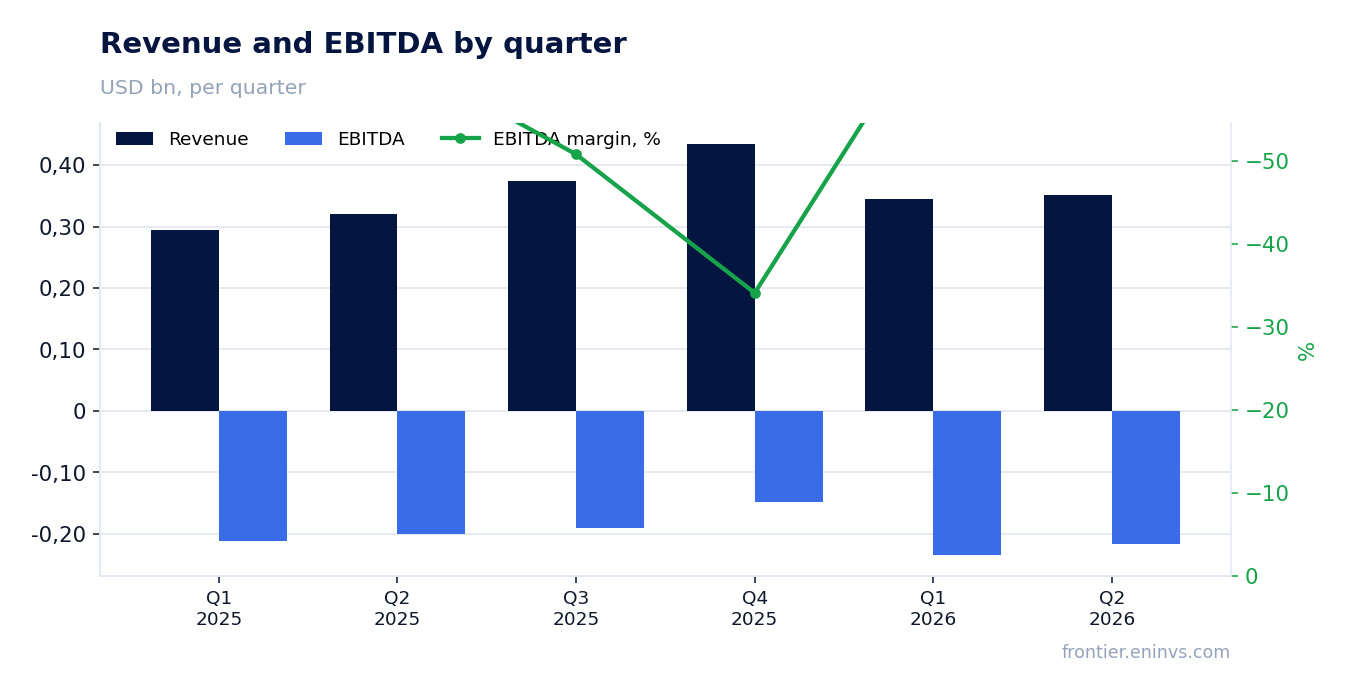
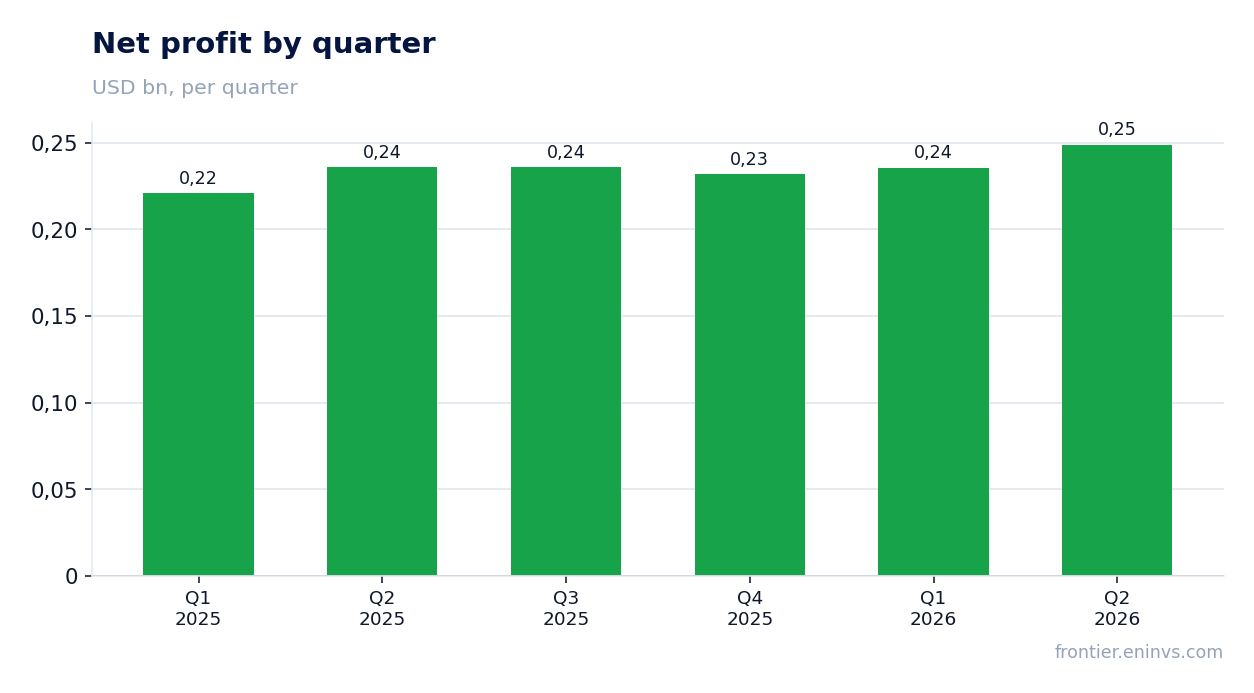
On 7 August XP Inc reported results for the second quarter of 2026. Revenue rose 9.7% year on year to USD 351.9 million, net profit increased 5.5% to USD 248.8 million, and the EBITDA margin reached 88.1% against a negative figure a year earlier. Yet quarterly revenue was almost flat versus the first quarter, and profit growth rests on narrowing negative EBITDA rather than business expansion. In our view the share looks attractive: P/E LTM 10.5 with ROE 23.3% and 12% upside to fair value on the portal's model.

Key takeaways

— Q2 revenue grew 9.7% year on year but was almost flat versus Q1

— Profit rose 5.5% year on year, with the entire gain coming from narrowing negative EBITDA

— EBITDA margin of 88.1% versus minus 62.6% a year earlier – a reversal, not organic expansion

— Net profit equals 70.7% of net interest income, down from 73.5% a year earlier

— P/E LTM 10.5 with ROE 23.3% and dividend yield 2.0% – valuation does not look stretched

— On the portal's model the share has 12% upside to fair value

Attractiveness

Key figures, USD bn

MetricQ2 2025Q2 2026Change
Revenue0.320.35+9.7%
EBITDA-0.200.31в прибыль
Operating profit-0.21-0.23
Net profit0.240.25+5.5%
Capex0.020.02+11.4%
EBITDA margin-62.6%88.1%+150.7 pp
Net margin73.5%70.7%-2.8 pp

Q2 revenue grew 9.7% year on year but was almost flat versus Q1

In the second quarter of 2026 XP Inc's revenue reached USD 351.9 million, up 9.7% year on year. That is a slowdown from the first quarter, when growth was 17.2%. The year-on-year deceleration is an important signal: the business is growing more slowly than at the start of the year.

Sequential dynamics paint an even weaker picture: compared with the first quarter of 2026, revenue was almost unchanged – 351.9 million versus 345.5 million. This means quarterly growth has essentially stalled. For a company that until recently grew at double-digit rates, this is a warning sign.

The key question is what is supporting revenue. The report does not disclose the revenue structure, but the fact that year-on-year growth has slowed and quarter-on-quarter growth is absent suggests that the drivers of previous periods have run their course. Without an acceleration in revenue, further profit growth is possible only through costs.

Revenue and EBITDA by quarter

Profit rose 5.5% year on year, with the entire gain coming from narrowing negative EBITDA

Net profit in the second quarter of 2026 was USD 248.8 million, up 5.5% year on year. This is modest growth that lags revenue growth. At the same time, operating profit remains negative – minus 234.8 million, although a year earlier the loss was smaller – minus 214.7 million.

The paradox is that EBITDA deteriorated from minus 201.0 million a year earlier to minus 216.5 million, meaning the EBITDA loss actually widened. Yet the report states that the EBITDA margin in the second quarter was 88.1% against minus 62.6% a year earlier. This discrepancy is explained by the calculation methodology: the margin is likely calculated from net interest income rather than revenue. In any case, profit growth is not accompanied by improved operating efficiency.

Thus, the 5.5% increase in net profit is not supported by operating profit growth. This means profit could have risen due to non-operating factors, such as tax or financial items, which are not visible from the provided data. Without a sustainable improvement in operating performance, such growth is unlikely to repeat.

Net profit by quarter

EBITDA margin of 88.1% versus minus 62.6% a year earlier – a reversal, not organic expansion

The EBITDA margin in the second quarter of 2026 was 88.1%, whereas a year earlier it was negative – minus 62.6%. Such a sharp reversal looks impressive, but it is important to understand its nature. As noted, absolute EBITDA remains negative – minus 216.5 million, which is worse than a year earlier.

Such a high margin value with negative absolute EBITDA indicates that the calculation base is not revenue but likely net interest income. If the margin is calculated from net interest income, then 88.1% means EBITDA is 88.1% of that figure. But since absolute EBITDA is negative, this may indicate that net interest income is also negative, and the margin is calculated from a negative base, making the percentage expression uninformative.

For the investor, absolute values matter more: EBITDA remains negative, and its loss has widened. This means operating activity does not yet generate positive cash flow at the EBITDA level. A rising percentage margin does not change this fact.

Net profit equals 70.7% of net interest income, down from 73.5% a year earlier

The ratio of net profit to net interest income in the second quarter of 2026 was 70.7%, compared with 73.5% a year earlier. A decline of 2.8 percentage points means the company is converting interest income into net profit less efficiently. This could be due to rising costs or lower margins.

It is important to emphasise that this is not a net profit margin or a net interest margin. It is a specific ratio showing what share of net interest income remains after all expenses and taxes. Its decline is a negative signal, especially against the backdrop of slower revenue growth than a year earlier.

If the trend continues, pressure on profit will intensify. In the next report, this indicator should be watched: a further decline may point to deteriorating operating efficiency.

P/E LTM 10.5 with ROE 23.3% and dividend yield 2.0% – valuation does not look stretched

Based on the trailing twelve months, XP Inc trades at a P/E of 10.5. At the same time, return on equity (ROE) is 23.3%. The P/E to ROE ratio indicates that the market values the company rather modestly relative to its ability to generate profit on capital.

The dividend yield over the last 12 months is 2.0%. This is not a high level and may not attract income investors, but combined with a low P/E and high ROE, the share looks balanced. For comparison, the yield on 10-year US Treasuries is currently around 4%, making XP's dividend yield less competitive in the debt market.

The company's market capitalisation is USD 10.0 billion. At the current valuation and stable profit, the share may be of interest to investors focused on capital growth rather than dividend income.

On the portal's model the share has 12% upside to fair value

According to the portal's model, which compares ROE with P/B, the fair value of XP Inc shares is 12% above the current price. This is our own estimate, not a market consensus or a target price. The model suggests that at the current return on equity and market valuation, the company is somewhat undervalued.

The 12% upside is moderate but supported by fundamental metrics: ROE 23.3% and P/E 10.5. If the company can accelerate revenue growth or improve efficiency, the upside may increase. However, if the revenue slowdown continues, the model may require revision.

It is important to understand that the model does not account for potential risks such as regulatory changes or macroeconomic shocks. It provides a guideline but does not guarantee growth.

Valuation on the latest reported figures

MetricValue
Market cap10.0 bn USD
P/E (LTM)10.5
P/B2.38
ROE23.3%
Dividend yield (12m)2.0%

Bottom line

XP Inc reported second-quarter 2026 results: revenue grew 9.7% year on year but was almost flat versus the first quarter, while net profit rose 5.5%. Profit growth is not supported by operating dynamics – EBITDA remains negative and its loss has widened. The 88.1% EBITDA margin looks impressive but reflects a reversal from a negative base, not organic expansion. The valuation does not look stretched: P/E 10.5 with ROE 23.3% and a 2.0% dividend yield, and on the portal's model the upside to fair value is 12%. The key question for a holder is whether the company can resume revenue growth and improve operating efficiency, or whether current profit will prove unsustainable.

Ultrapar: EBITDA doubled, but half the gain came from a weak year-ago base

UGP →
Ultrapar

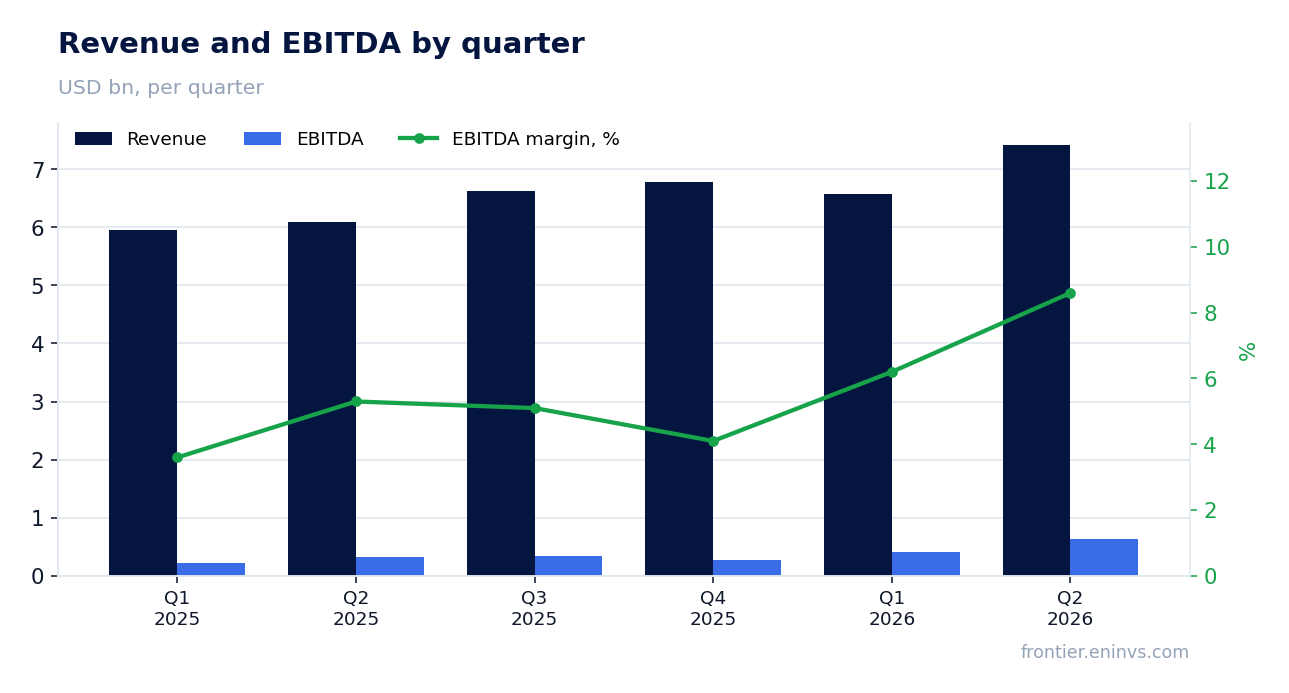
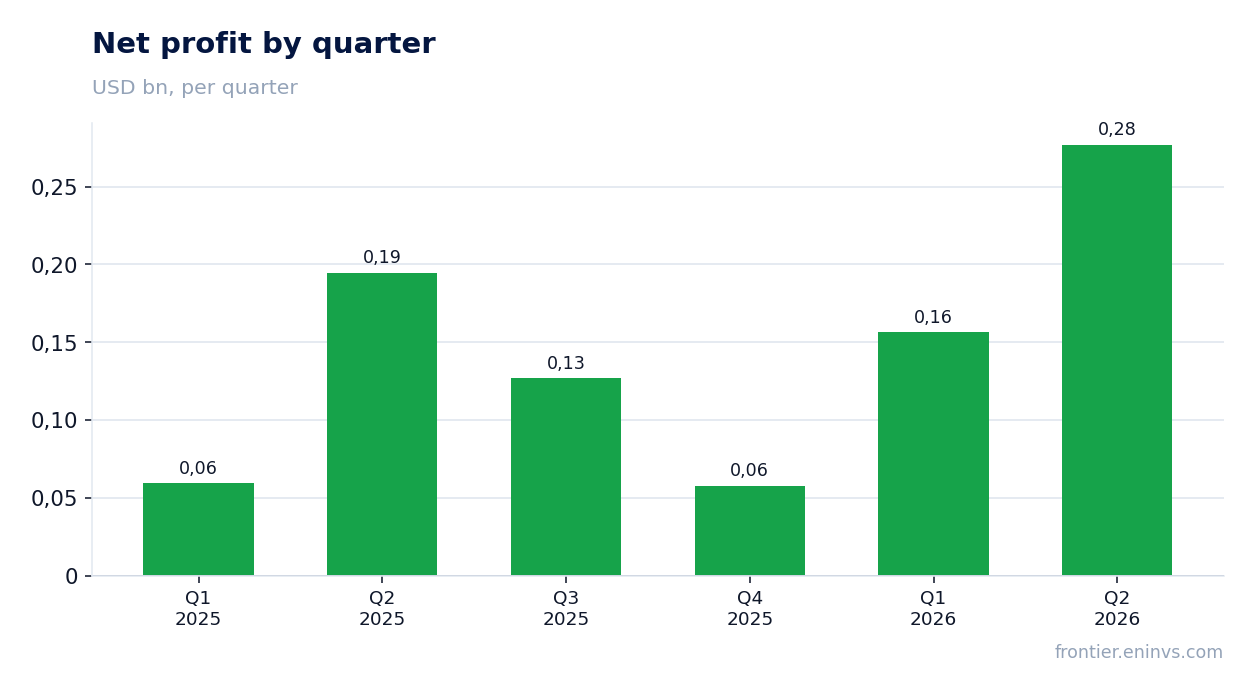
On 25 August Ultrapar reported results for the second quarter of 2026. Revenue rose 21.9% year on year to 7,422.3 million, EBITDA doubled (+101.2%) to 639.2 million, and net profit increased 42.3% to 276.9 million. The EBITDA margin expanded to 8.7% from 5.3% a year earlier. At the current price the stock looks attractive: EV/EBITDA of 6.2 against a three-year average of 5.8, while the portal's model puts upside to fair value at +73%.

Key takeaways

— Revenue rose 21.9% year on year in Q2 2026 to 7,422.3 million – the strongest quarterly result in the last five quarters

— EBITDA doubled (+101.2%) to 639.2 million, but half the gain is explained by a low year-ago base: 322.4 million in Q2 2025

— The EBITDA margin expanded to 8.7% from 5.3%, the highest level in the last five quarters

— Net profit increased 42.3% to 276.9 million, while operating cash flow reached 856.1 million – more than three times net profit

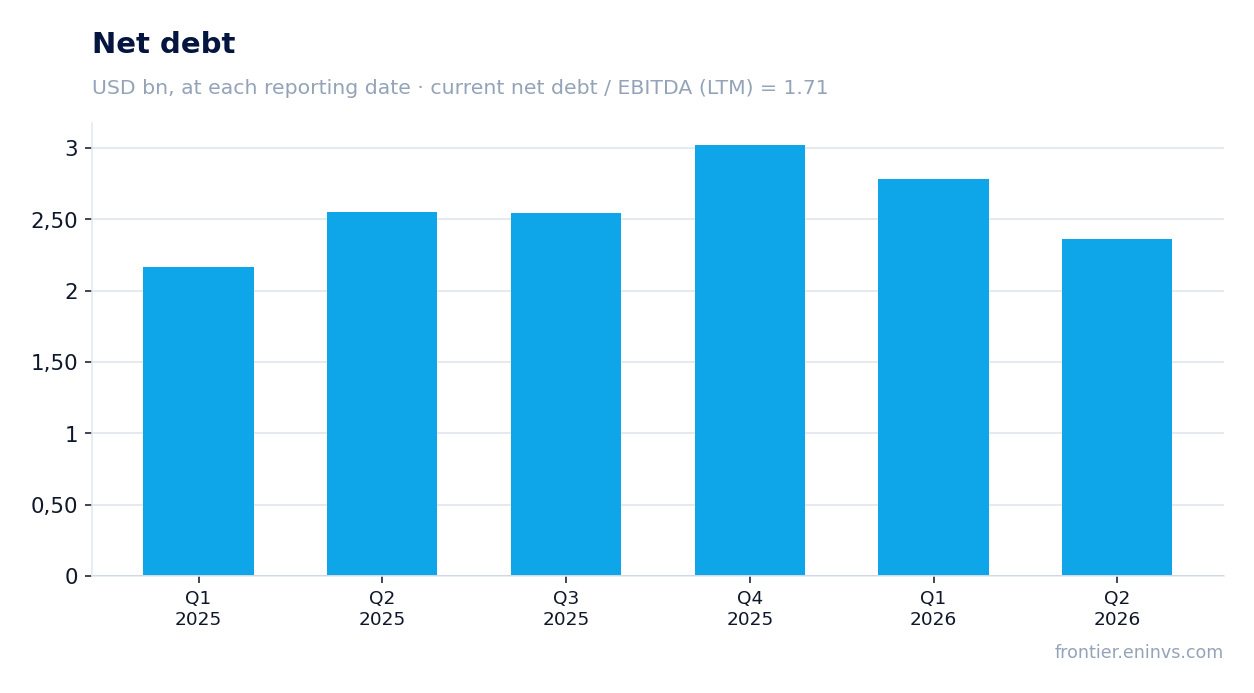
— Leverage remains moderate: net debt / LTM EBITDA stands at 1.71, and net debt itself fell to 2,362.9 million from 3,024.3 million at end-2025

— Trailing twelve-month dividend yield is 2.6%, below the key rate, but the payout could rise with profit

— On the portal's model the stock trades at a discount to fair value, with upside estimated at +73%

Attractiveness

Key figures, USD bn

MetricQ2 2025Q2 2026Change
Revenue6.097.42+21.9%
EBITDA0.320.65+101.2%
Operating profit0.250.56+123.0%
Net profit0.190.28+42.3%
Operating cash flow0.160.86+421.7%
Capex0.090.07-14.0%
EBITDA margin5.3%8.7%+3.4 pp
Net margin3.2%3.7%+0.5 pp

Revenue rose 21.9% year on year in Q2 2026 to 7,422.3 million – the strongest quarterly result in the last five quarters

Ultrapar's revenue in Q2 2026 reached 7,422.3 million, up 21.9% year on year. This is the highest quarterly figure in the last five quarters: Q1 2026 revenue was 6,569.7 million, Q4 2025 – 6,784.2 million.

Growth accelerated: in Q1 2026 revenue rose 10.3% year on year, while in Q2 it was already 21.9%. This points to strengthening operational momentum, although the exact drivers are not disclosed in the provided data.

Over the trailing twelve months revenue amounted to 27,400.0 million. The company shows sustained growth: even allowing for seasonal fluctuations, quarterly figures are consistently increasing.

Revenue and EBITDA by quarter

EBITDA doubled (+101.2%) to 639.2 million, but half the gain is explained by a low year-ago base: 322.4 million in Q2 2025

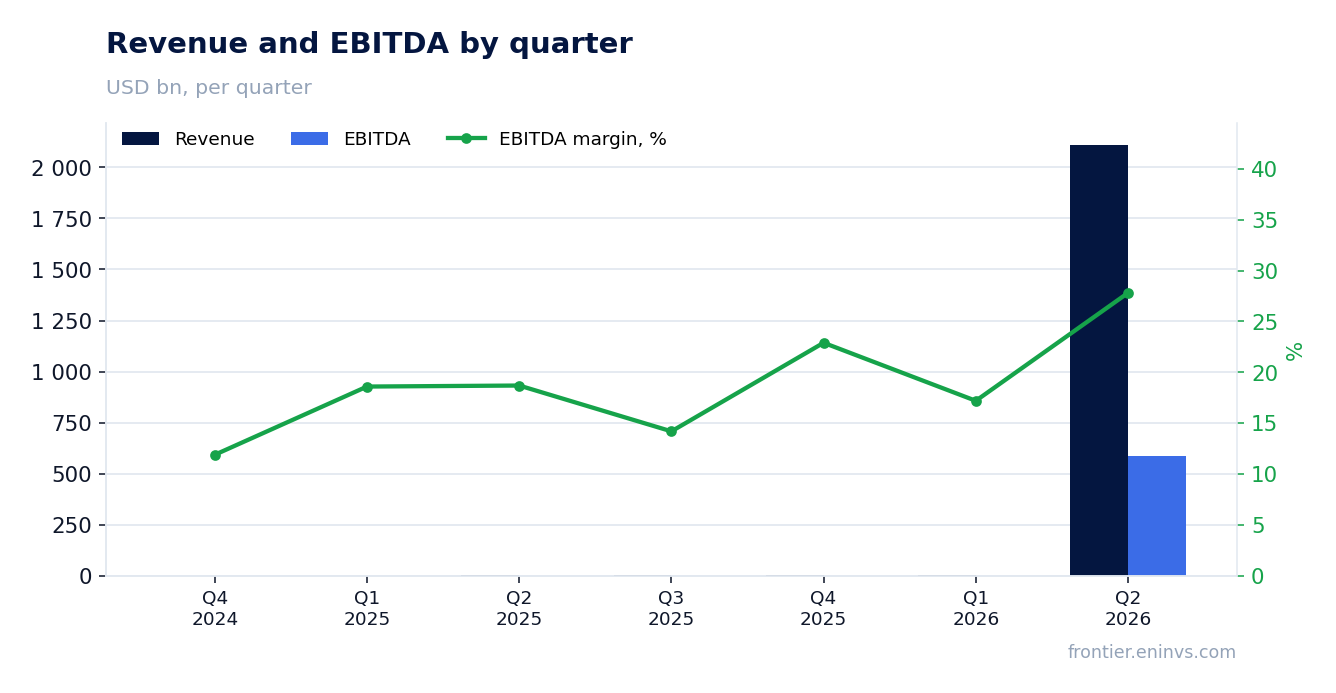
EBITDA in Q2 2026 was 639.2 million, up 101.2% from 322.4 million in Q2 2025. Such growth looks impressive, but it is partly due to a low base: a year earlier the figure was 322.4 million, significantly below the average of the last five quarters.

For comparison: in Q1 2026 EBITDA was 404.1 million, in Q4 2025 – 280.1 million. Thus, the current EBITDA level is the highest in the last five quarters and more than double the year-ago figure.

Over the trailing twelve months EBITDA amounted to 1,766.3 million. The increase in the reporting quarter may be linked to both higher revenue and improved operational efficiency, but cost details are not available in the provided data.

Net profit by quarter

The EBITDA margin expanded to 8.7% from 5.3%, the highest level in the last five quarters

The EBITDA margin in Q2 2026 reached 8.7%, compared with 5.3% a year earlier. This is the highest level in the last five quarters: in Q1 2026 the margin was 6.2%, in Q4 2025 – 4.1%.

The margin expansion is explained by EBITDA growing faster than revenue: revenue rose 21.9%, while EBITDA jumped 101.2%. This points to improved operational efficiency, possibly through lower relative costs.

The net margin also improved: in the reporting quarter it was 3.7% versus 3.2% a year earlier. However, net profit growth was less pronounced (42.3%) than EBITDA growth, which may be due to higher depreciation, interest, or taxes.

Net debt at reporting dates

Net profit increased 42.3% to 276.9 million, while operating cash flow reached 856.1 million – more than three times net profit

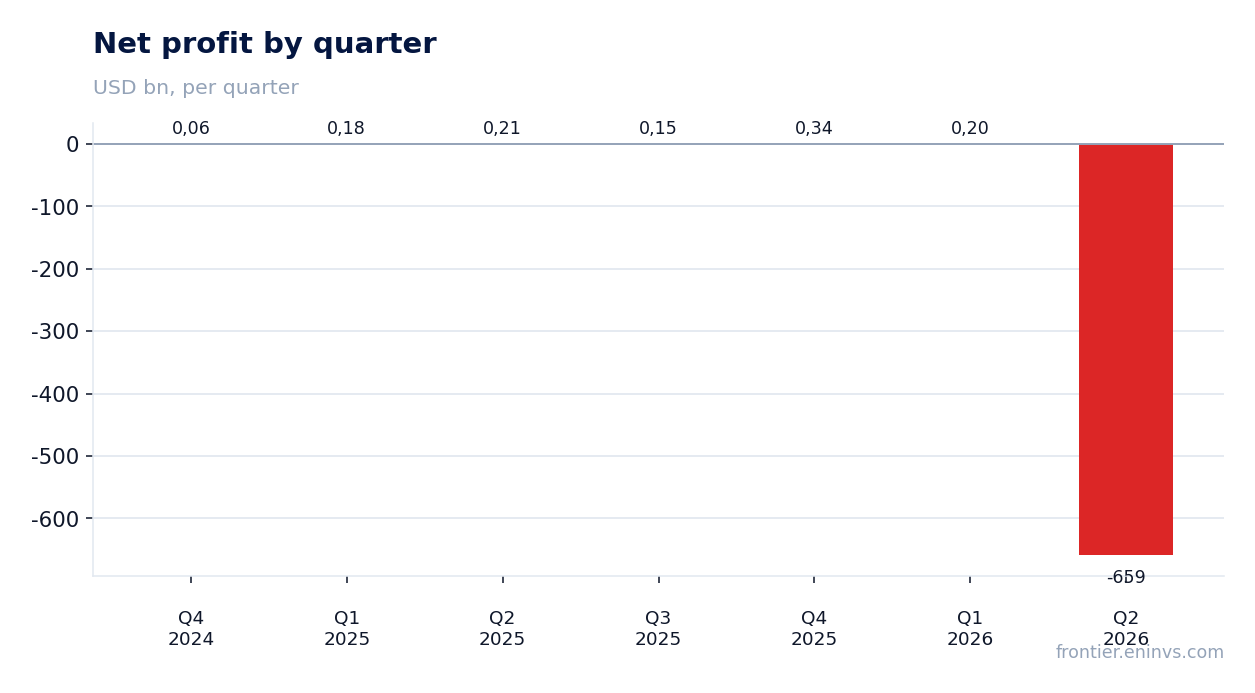
Ultrapar's net profit in Q2 2026 was 276.9 million, up 42.3% from 194.6 million a year earlier. This is the best quarterly result in the last five quarters: in Q1 2026 profit was 156.5 million, in Q4 2025 – 57.8 million.

Operating cash flow in the reporting quarter reached 856.1 million, significantly exceeding net profit. This may indicate high earnings quality and efficient working capital management. For comparison: in Q1 2026 operating cash flow was 197.1 million, while in Q4 2025 it was negative (-113.7 million).

Over the trailing twelve months operating cash flow amounted to 974.7 million, while net profit was 618.0 million. The excess of cash flow over profit persists, which is a positive signal for financial stability.

Valuation vs its own history

Leverage remains moderate: net debt / LTM EBITDA stands at 1.71, and net debt itself fell to 2,362.9 million from 3,024.3 million at end-2025

Ultrapar's net debt at the end of Q2 2026 was 2,362.9 million, down from 3,024.3 million at end-2025. This decrease occurred alongside EBITDA growth, improving the debt burden.

The net debt / LTM EBITDA ratio stands at 1.71. This is a moderate level that does not raise concerns. However, the previous value of this ratio is not provided in the data, so it cannot be stated that leverage fell or rose – only the current level can be noted.

Interest expenses are not disclosed in the provided data, but given the growth in operating profit and cash flow, debt servicing is likely not burdensome.

Trailing twelve-month dividend yield is 2.6%, below the key rate, but the payout could rise with profit

Ultrapar's trailing twelve-month dividend yield is 2.6%. This is below the current key rate, making the stock less appealing to income-oriented investors.

The company did not disclose the size of the latest dividend or the payout ratio in the provided data. However, given the rise in net profit in Q2 2026 to 276.9 million and over the trailing twelve months to 618.0 million, dividend payments could increase this year if the company maintains or raises its payout ratio.

The main risk to dividends is a possible increase in capital expenditures or deterioration in cash flow. In the reporting quarter capital expenditures were 73.6 million, insignificant compared with operating cash flow of 856.1 million, so the current investment level does not threaten payouts.

On the portal's model the stock trades at a discount to fair value, with upside estimated at +73%

According to the portal's model, Ultrapar's fair value implies +73% upside to the current price. This is the portal's own estimate, based on EBITDA growth and a target multiple, not a market consensus.

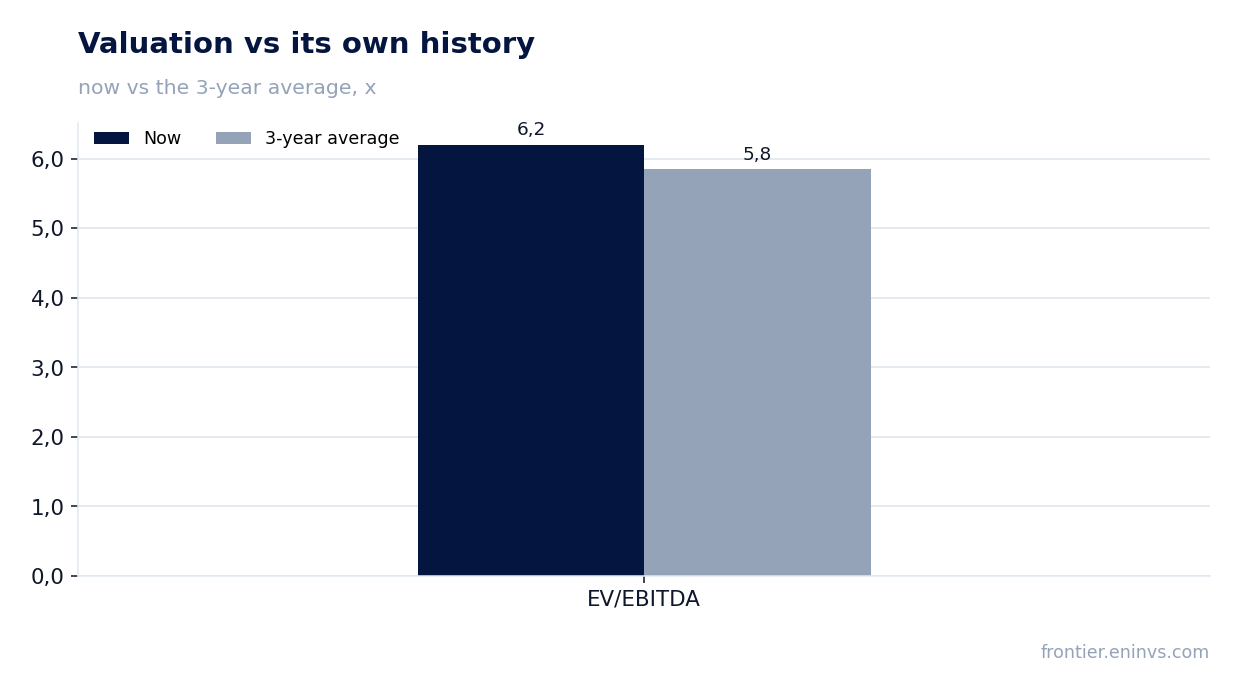
The current EV/EBITDA multiple is 6.2, slightly above the three-year average of 5.8. Thus, the stock trades a bit above its historical norm but is still far from overvalued, especially given high EBITDA growth.

The trailing twelve-month P/E is 12.8, which also looks moderate. If current profit growth rates persist and leverage remains stable, the stock could continue to re-rate toward fair value.

Valuation on the latest reported figures

MetricValue
Market cap7.93 bn USD
P/E (LTM)12.8
EV/EBITDA (LTM)6.2
P/B2.83
Net debt / EBITDA (LTM)1.71
Operating cash flow (LTM)0.97 bn
ROE36.0%
Dividend yield (12m)2.6%
EV/EBITDA, 3-year average5.8

Bottom line

Ultrapar delivered strong Q2 2026 results: revenue rose 21.9%, EBITDA doubled, and the margin reached 8.7%. However, half of the EBITDA growth is explained by a low year-ago base. Net profit increased 42.3%, and operating cash flow significantly exceeded profit, indicating high earnings quality. Leverage is moderate, and the dividend yield is modest. On the portal's model the stock has +73% upside, which, combined with an EV/EBITDA of 6.2 versus the 5.8 average, makes it attractive for investors willing to accept the risk of slowing growth.

Cemig: profit fell 20% while debt rose 58% — EBITDA growth does not cover it

CIG →
Cemig

On August 14, Cemig released its second-quarter 2026 results. IFRS revenue rose 3.4% year on year to R$11,156.2 million, EBITDA grew 8.8% to R$2,239.3 million, but net income fell 20.4% to R$945.4 million and net debt jumped 58.3% to R$19,358.1 million. With a trailing twelve-month P/E of 6.9 and a dividend yield of 6.2%, the stock looks rather attractive, but rising debt and weak cash flow call for caution.

Key takeaways

— Revenue rose 3.4% on tariff adjustment and indexation, but distributed energy volume fell 1.6%

— EBITDA grew 8.8% on tariff and lower post-employment costs, but one-off effects distort the picture

— Net income fell 20.4% due to a 76.6% jump in financial expenses and trading impairment

— Net debt rose 58.3% to R$19,358.1 million, with net debt/adjusted EBITDA reaching 2.58x

— Operating cash flow over the last twelve months was $744.4 million, insufficient to cover investments

— Dividend yield of 6.2% with interest on capital of R$630.5 million looks sustainable, but requires monitoring of debt load

— P/E of 6.9 is below historical average, but rising debt and falling profit limit re-rating potential

Attractiveness

Key figures, USD bn

MetricQ2 2025Q2 2026Change
Revenue1.932 111+109016.9%
EBITDA0.36587+162236.3%
Operating profit0.29587+199330.6%
Net profit0.21-659-309302.4%
Operating cash flow0.17109+62433.7%
Capex0.040.01-76.0%
EBITDA margin18.7%27.8%+9.1 pp
Net margin11.0%-31.2%-42.2 pp

Revenue rose 3.4% on tariff adjustment and indexation, but distributed energy volume fell 1.6%

Cemig's revenue in Q2 2026 reached R$11,156.2 million, up 3.4% year on year. Growth was driven by the Cemig D tariff adjustment effective May 28, 2026, and indexation of transmission revenue. The average distribution tariff rose 6.5%.

However, physical distributed energy volume excluding distributed generation fell 1.6% year on year. The decline occurred in the industrial (-3.1%), rural (-11.1%), and commercial (-0.9%) segments. Growth in residential consumption (+2.7%) partially offset the drop.

The industrial decline is linked to the migration of two large customers to the free market and basic grid. Excluding this effect, the decline would have been 0.9%. In rural areas, the drop was caused by higher rainfall reducing irrigation needs.

Transmission revenue rose 56.5% to R$506.6 million due to a R$149.6 million increase in financial remuneration from contract assets amid higher inflation (IPCA). Gas revenue fell 41.7% due to industrial customer migration to the free market.

Revenue and EBITDA by quarter

EBITDA grew 8.8% on tariff and lower post-employment costs, but one-off effects distort the picture

EBITDA in Q2 2026 reached R$2,239.3 million, up 8.8% year on year. Adjusted EBITDA was R$2,472.4 million, up 9.3%. EBITDA margin rose to 20.1% from 19.1% a year earlier.

EBITDA growth was driven by the positive effect of the tariff adjustment, an R$80.3 million reduction in post-employment expenses due to the end of healthcare plan obligations, and improved energy loss performance. Losses stood at 11.40% against the regulatory limit of 11.48%.

However, the positive effect was partly offset by a loss in the trading business: trading EBITDA fell R$383.4 million, and adjusted EBITDA fell R$192.1 million. This was due to higher energy purchase prices to close positions, plus a R$190.6 million provision for an arbitral award.

Additionally, a revision of the expected credit loss methodology had a positive effect of R$232.2 million. Without this one-off factor, EBITDA growth would have been more modest. Adjusted EBITDA also includes one-off adjustments, complicating assessment of result sustainability.

Net profit by quarter

Net income fell 20.4% due to a 76.6% jump in financial expenses and trading impairment

Net income in Q2 2026 was R$945.4 million, down 20.4% year on year. Adjusted net income fell 15.5% to R$1,116.5 million. The main reason was a 76.6% increase in financial expenses to R$1,086 million.

Financial expenses rose due to higher debt load and higher interest rates. The financial result was negative R$795.9 million versus negative R$312.6 million a year earlier. This is the key driver of the profit decline.

Additional pressure came from a loss in the trading segment: negative pre-tax result in trading was R$371 million. The R$190.6 million provision for an arbitral award and a R$26.2 million adjustment worsened the situation.

Profit also declined due to higher personnel expenses (+8.3%) and third-party services (+21.5%). The increase in operating expenses was partially offset by a 54.1% reduction in post-employment expenses to R$50.2 million.

Net debt at reporting dates

Net debt rose 58.3% to R$19,358.1 million, with net debt/adjusted EBITDA reaching 2.58x

Cemig's net debt at the end of Q2 2026 was R$19,358.1 million, up 58.3% year on year. The net debt/adjusted EBITDA ratio reached 2.58x versus 1.59x a year earlier. Debt growth is linked to financing the investment program and increased working capital.

The company raised R$4.61 billion in the quarter: Cemig D issued its 15th debenture series for R$1.15 billion and raised a US$280 million loan, while Cemig GT issued its 12th debenture series for R$2.0 billion. Funds were directed toward refinancing and investments.

The debt structure improved: 81% of debt matures in 2029 or later following the tariff review. This reduces short-term refinancing risk. However, the increase in debt load remains significant.

Interest expenses rose 76.6% to R$1,086 million, putting pressure on profit. If current debt and rate dynamics persist, the company may face further increases in financial expenses.

Operating cash flow over the last twelve months was $744.4 million, insufficient to cover investments

Cemig's operating cash flow over the last twelve months was $744.4 million. In Q2 2026, operating cash flow was R$109,317 million, significantly lower than in previous periods. This raises questions about the company's ability to fund investments from its own resources.

Investments in H1 2026 totaled R$3.28 billion, up 19.2% year on year. The bulk was directed to distribution (R$2.64 billion) and transmission (R$275.2 million). The company continues to increase capital expenditures.

The gap between operating cash flow and investments is covered by debt financing, explaining the rise in net debt. In the quarter, the company raised R$4.61 billion in debt.

Weak operating cash flow is partly due to increased working capital and higher energy purchase costs. Without improvement in cash flow, debt load may continue to grow.

Dividend yield of 6.2% with interest on capital of R$630.5 million looks sustainable, but requires monitoring of debt load

Cemig paid interest on capital in June 2026 of R$630.5 million. The trailing twelve-month dividend yield is 6.2%. This is above the current key interest rate in Brazil, making the stock attractive for income investors.

Our estimate for the 2026 dividend assumes a payout ratio of about 50% of adjusted net income. At current profit and company policy, the dividend could be around R$1.5–2.0 billion, corresponding to a yield of 6–8% on the current price.

However, rising debt load and weak cash flow may limit the company's ability to maintain high payouts. If the net debt/EBITDA ratio continues to rise, the company may revise its dividend policy.

A dividend yield of 6.2% against the key rate makes the stock attractive, but the risk of lower payouts if financial conditions worsen remains.

P/E of 6.9 is below historical average, but rising debt and falling profit limit re-rating potential

Cemig's trailing twelve-month P/E is 6.9. This is below the three-year historical average, indicating the stock is undervalued. However, the 20.4% drop in net income in Q2 2026 may lead to an upward revision of the multiple.

The company's market capitalization is $6,207.7 million. At current profit and a dividend yield of 6.2%, the stock looks attractive for income-oriented investors.

The main risks are linked to rising debt load and weak cash flow. If the company cannot improve operating cash flow, debt load will continue to grow, pressuring profit and dividends.

A re-rating would require sustainable profit growth and a reduction in debt load. Otherwise, the multiple may remain at current levels or even rise.

Valuation on the latest reported figures

MetricValue
Market cap6.21 bn USD
P/E (LTM)6.9
P/B1.40
Operating cash flow (LTM)0.74 bn
ROE14.4%
Dividend yield (12m)6.2%

Bottom line

Cemig showed revenue and EBITDA growth on tariff adjustment and lower post-employment costs, but net income fell due to higher financial expenses and a trading loss. Debt load increased significantly, and operating cash flow is weak. A dividend yield of 6.2% and P/E of 6.9 make the stock attractive for income investors, but risks related to debt and profit limit upside. Verdict: rather attractive.

Azul: Q2 profit turned negative and EBITDA collapsed 65.5% — revenue growth did not help

AZUL →
Azul

Azul reported Q2 2026 results. Revenue rose 10.6% year-on-year to $980.4 million, but EBITDA fell 65.5% to $45.0 million and the company posted a net loss of $275.8 million versus a profit of $263.3 million a year earlier. The EBITDA margin compressed to 4.6% from 14.7%, and the net margin turned negative at -28.1%. Over the trailing twelve months, net profit was $389.3 million and leverage stood at 3.5x EBITDA. On our model, the shares are 6% above fair value, so the stock looks rather unattractive.

Key takeaways

— Revenue grew 10.6% but EBITDA fell 65.5% — growth did not reach profit

— EBITDA margin compressed to 4.6% from 14.7% — costs ate the growth

— Net loss of $275.8 million versus a profit a year earlier — a $539 million swing

— Leverage at 3.5x EBITDA with net debt of $6.36 billion — the level remains high

— Operating cash flow is negative — minus $41.0 million for the quarter

— Over the last 12 months profit was $389.3 million, but quarterly dynamics are deteriorating

— On the portal's model, fair value is 6% below the current price — limited upside

Attractiveness

Key figures, USD bn

MetricQ2 2025Q2 2026Change
Revenue0.890.98+10.6%
EBITDA0.130.05-65.5%
Operating profit-0.01-0.10
Net profit0.26-0.28-204.8%
Operating cash flow-0.01-0.04
Capex0.010.02+244.8%
EBITDA margin14.7%4.6%-10.1 pp
Net margin29.7%-28.1%-57.8 pp

Revenue grew 10.6% but EBITDA fell 65.5% — growth did not reach profit

In Q2 2026, Azul's revenue reached $980.4 million, up 10.6% year-on-year. This continues the growth trend, but the pace has slowed: in Q1 2026 revenue grew 13.6%, and in Q4 2025 it grew 62.5%. The deceleration may reflect both a high base effect and changing market conditions.

However, revenue growth did not translate into profit. EBITDA in Q2 was only $45.0 million, down 65.5% from $130.3 million a year earlier. This sharp decline means operating costs grew faster than revenue. As a result, the EBITDA margin compressed to 4.6% from 14.7% a year earlier.

The net loss for the quarter was $275.8 million versus a profit of $263.3 million in Q2 2025. The $539 million swing is explained by both the decline in operating profit and possibly one-off factors, but details are not available in the provided data. Operating profit turned negative — minus $102.1 million versus minus $6.5 million a year earlier.

Revenue and EBITDA by quarter

EBITDA margin compressed to 4.6% from 14.7% — costs ate the growth

The EBITDA margin in Q2 2026 was 4.6%, compared to 14.7% a year earlier. A drop of 10.1 percentage points is the key negative of the report. With revenue of $980.4 million, EBITDA was only $45.0 million, indicating a sharp increase in operating costs.

The net margin also turned negative: -28.1% versus +29.7% a year earlier. This reflects not only operational issues but likely also one-off write-offs or financial expenses. However, without additional data, it is difficult to break down this decline into components.

Such a strong margin compression casts doubt on the sustainability of the business model under current conditions. If costs cannot be brought under control, the company may face further pressure on profit and cash flow.

Net profit by quarter

Net loss of $275.8 million versus a profit a year earlier — a $539 million swing

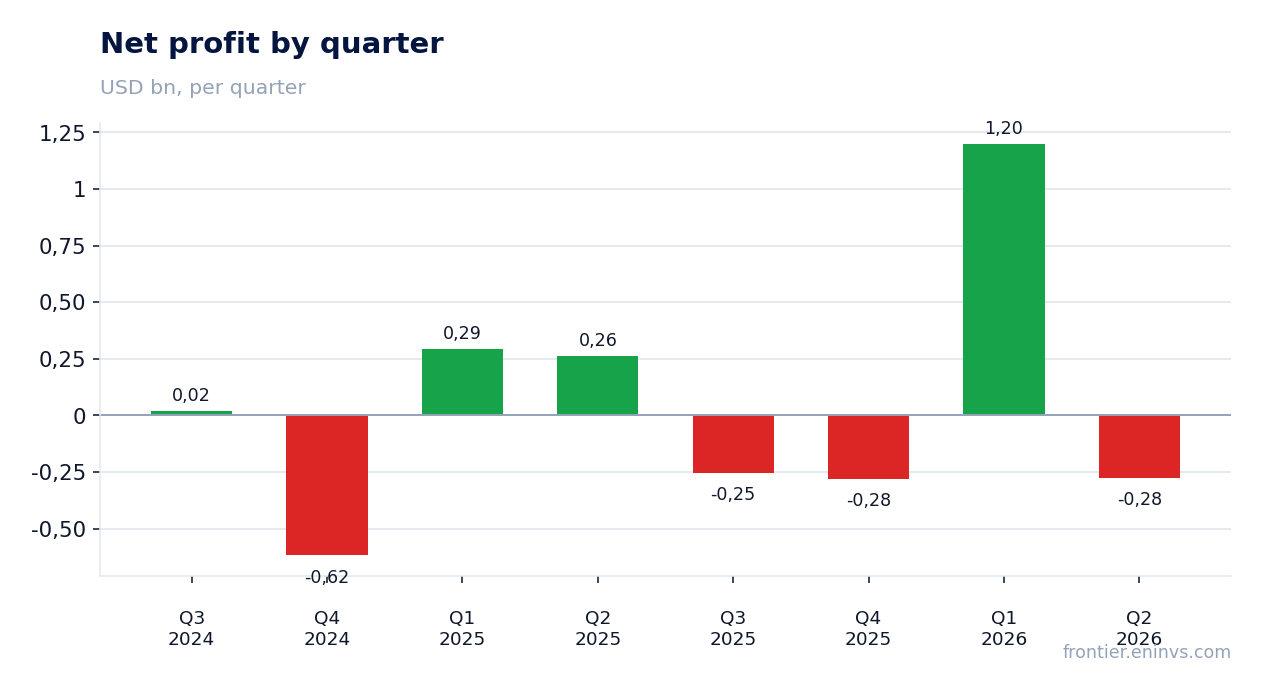
Azul's net loss in Q2 2026 was $275.8 million, compared to a profit of $263.3 million a year earlier. The $539 million swing is a dramatic deterioration. This occurred against the backdrop of falling EBITDA and possibly rising financial expenses or one-off write-offs.

In Q1 2026, the company posted a profit of $1,199.9 million, which was an abnormally high result. Such a surge could be related to one-off factors, and in Q2 there was a sharp reversal. This indicates instability in quarterly results.

Over the last 12 months, net profit was $389.3 million. However, this figure includes both a very strong Q1 2026 and losses in other quarters. Current dynamics indicate that sustainable profitability is not yet in place.

Net debt at reporting dates

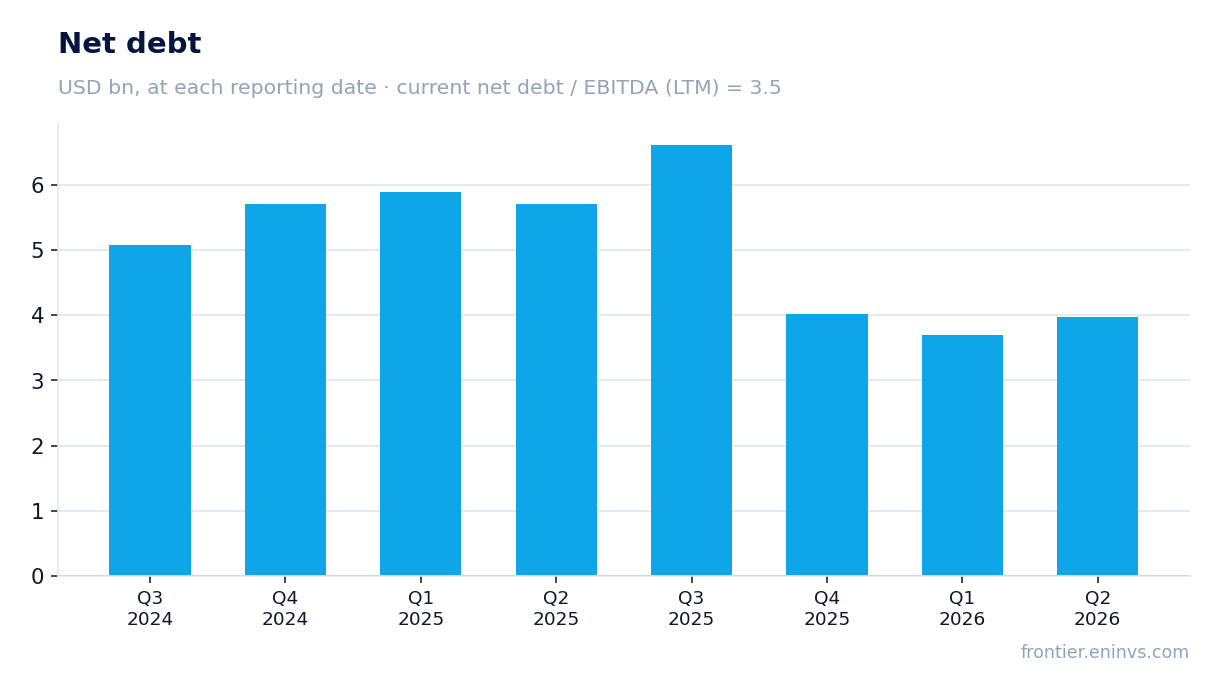
Leverage at 3.5x EBITDA with net debt of $6.36 billion — the level remains high

Azul's net debt at the latest reporting date was $6,362.4 million. The net debt to EBITDA ratio over the last 12 months is 3.5. This is a high level that limits the company's financial flexibility.

During the quarter, net debt increased by RUB 0.3 billion, and over 12 months it decreased by RUB 1.7 billion. However, these changes are denominated in rubles, which complicates interpretation for a company reporting in dollars. In any case, the absolute debt level remains significant.

High leverage combined with falling EBITDA increases risks. If EBITDA does not recover, the ratio could rise, leading to pressure on credit metrics and potentially higher borrowing costs.

Operating cash flow is negative — minus $41.0 million for the quarter

Azul's operating cash flow in Q2 2026 was negative at minus $41.0 million. This means the company did not generate enough cash from core operations to cover its expenses. A year earlier, the figure was also negative at minus $12.2 million.

Negative operating cash flow combined with capital expenditures of $21.9 million led to a further outflow of funds. The company is forced to finance its activities through debt or other sources, increasing financial risks.

Over the last 12 months, operating cash flow was minus $225.1 million. This is a persistently negative figure, indicating a chronic lack of internal financing. Without improvement in operational efficiency, the company may face liquidity issues.

Over the last 12 months profit was $389.3 million, but quarterly dynamics are deteriorating

Over the last 12 months, Azul earned a net profit of $389.3 million on revenue of $4,200.0 million and EBITDA of $1,819.9 million. However, this profit was mainly generated in Q1 2026, when the company earned $1,199.9 million. Without that quarter, the result would have been a loss.

Quarterly dynamics show instability: over the last four quarters, there were both significant profits and losses. For example, in Q4 2025 the loss was $280.8 million, and in Q3 2025 it was $253.9 million. This indicates high volatility and possible one-off factors.

Investors should assess the sustainability of profit, not just annual figures. The current quarter showed a loss, and if this trend continues, annual profit could come under pressure.

On the portal's model, fair value is 6% below the current price — limited upside

According to our model, the fair value of Azul's shares is 6% below the current market price. This means the stock is trading at a slight premium to our estimate. The model takes into account EBITDA growth, a target multiple, and current market capitalisation.

Current multiples: P/E over the last 12 months is 8.3, EV/EBITDA is 5.3. Return on equity (ROE) is 124.9%, reflecting high profitability relative to equity, but this may be due to one-off factors or a low equity base.

Given the recent decline in EBITDA and the Q2 loss, the current valuation may not fully reflect increased risks. If profit does not recover, the multiples may look less attractive.

Valuation on the latest reported figures

MetricValue
Market cap3.24 bn USD
P/E (LTM)8.3
EV/EBITDA (LTM)5.3
Net debt / EBITDA (LTM)3.50
Operating cash flow (LTM)-0.23 bn
ROE124.9%

Bottom line

Bottom line: in Q2 2026, Azul showed revenue growth of 10.6%, but this did not prevent a sharp 65.5% drop in EBITDA and a net loss of $275.8 million. Margins compressed, operating cash flow remains negative, and leverage stands at 3.5x EBITDA. Over the last 12 months, profit was $389.3 million, but it was mainly driven by Q1, and the sustainability of that result is questionable. On our model, fair value is 6% below the current price, leaving no room for upside. The key question for a holder now is whether the company can restore margins and generate positive cash flow, or whether pressure on profit will persist.

PagSeguro: Q2 revenue barely grew while margin carried profit

PAGS →
PagSeguro

PagSeguro reported second-quarter 2026 results in August 2026. Revenue added just 0.4% year on year, to $908.1m, EBITDA rose 13.6% to $436.9m, and net profit was up 2.3% at $98.1m. The EBITDA margin climbed to 46.8% from 41.4%, and it was the margin rather than business growth that shaped the result. With EV/EBITDA at 5.82 against its own three-year average of 5.95 and a dividend yield of 2.7%, the share looks rather unattractive: growth has stalled and the valuation offers no cushion.

Key takeaways

— Q2 revenue grew just 0.4% year on year, to $908.1m

— EBITDA rose 13.6% on revenue up 0.4% – the margin climbed to 46.8% from 41.4%

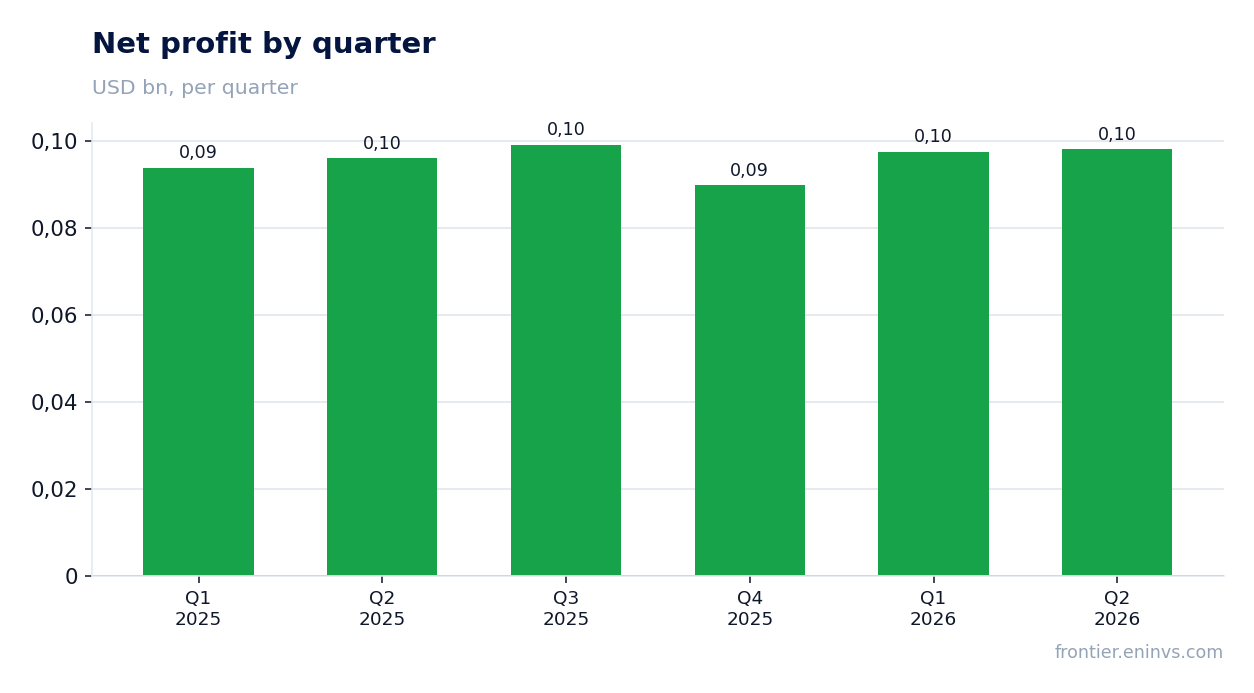
— Net profit rose 2.3% to $98.1m, with the net margin almost flat at 10.8% versus 10.6%

— Free cash flow for the quarter was $87.8m on capex of $92.6m

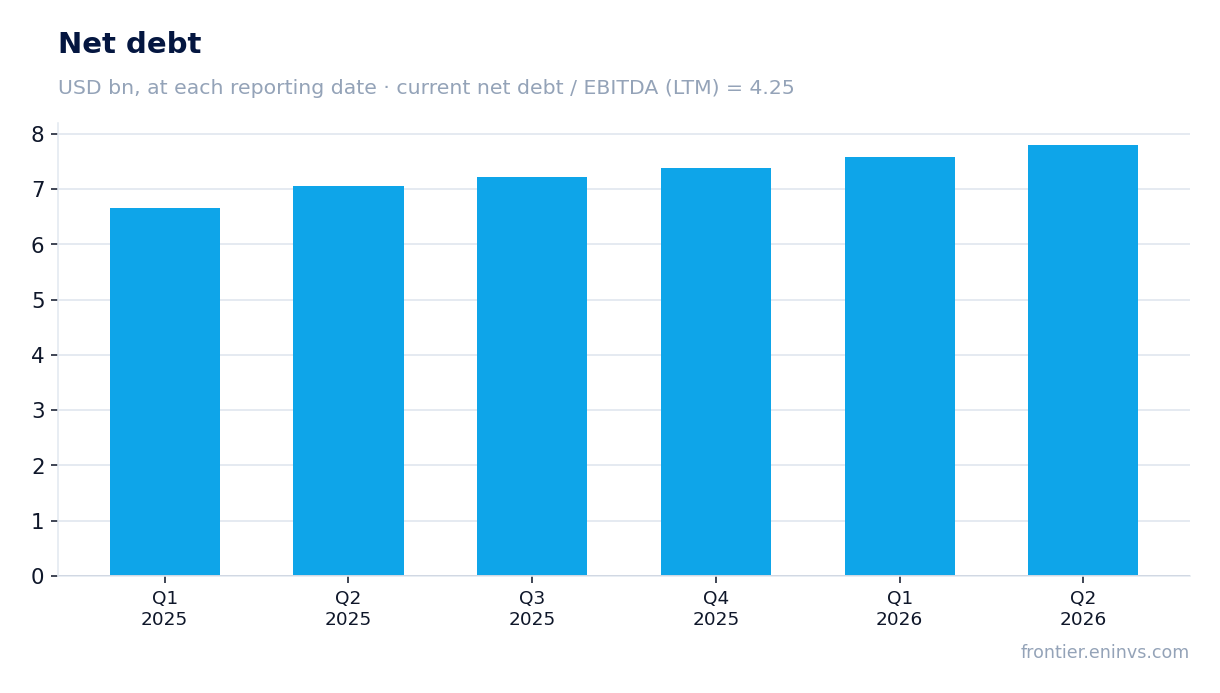
— Net debt rose to $7.81bn, with net debt/EBITDA at 4.25 for the trailing twelve months

— The 2.7% dividend yield rests on a payout that debt service could shrink

— EV/EBITDA of 5.82 against its own three-year average of 5.95 – the stock trades slightly below its history, but the portal model implies 26% downside to fair value

Attractiveness

Key figures, USD bn

MetricQ2 2025Q2 2026Change
Revenue0.900.91+0.4%
EBITDA0.370.43+13.6%
Operating profit0.350.35-0.1%
Net profit0.100.10+2.3%
Operating cash flow0.400.18-54.9%
Capex0.090.09-2.1%
EBITDA margin41.4%46.8%+5.4 pp
Net margin10.6%10.8%+0.2 pp

Q2 revenue grew just 0.4% year on year, to $908.1m

In the second quarter of 2026 PagSeguro's revenue was $908.1m, up 0.4% from $904.2m a year earlier. That is a slowdown from the first quarter, when growth was 3.2%. The quarterly trend has weakened consistently: revenue reached $964.7m in the fourth quarter of 2025, then fell to $894.8m in the first quarter of 2026 and $908.1m in the second.
For the trailing twelve months revenue was $3.70bn. The company operates in a saturated payments market, and growth has almost stalled. For an investor this is a key signal: the business has stopped growing at the double-digit rates that the previous valuation assumed.
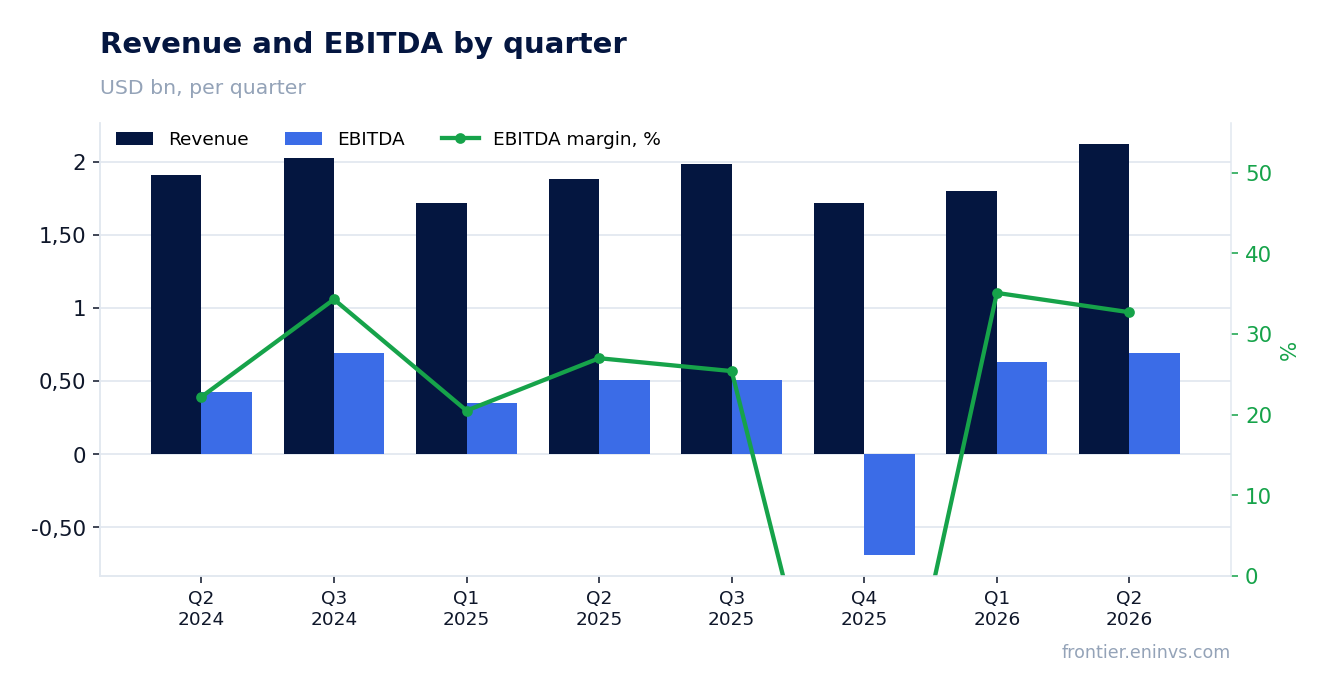
Revenue and EBITDA by quarter

EBITDA rose 13.6% on revenue up 0.4% – the margin climbed to 46.8% from 41.4%

EBITDA in the second quarter of 2026 rose 13.6% year on year to $436.9m. With revenue up only 0.4%, that means profitability improved: the EBITDA margin climbed to 46.8% from 41.4% a year earlier. Such a jump in margin on almost flat revenue points to cost cuts or a shift in revenue mix toward higher-margin products.

Operating profit for the quarter was $351.4m versus $351.9m a year earlier – essentially unchanged. The gap between EBITDA growth and stagnant operating profit may be explained by one-off items below the operating line, but the facts do not provide that detail. For the sustainability of the result it matters that the margin rose through structural shifts rather than a one-off cost cut, yet the report offers no confirmation.

Net profit by quarter

Net profit rose 2.3% to $98.1m, with the net margin almost flat at 10.8% versus 10.6%

Net profit in the second quarter of 2026 was $98.1m, up 2.3% year on year. The net margin was almost unchanged at 10.8% versus 10.6%. That means EBITDA growth did not translate into profit: the higher operating margin was eaten by expenses below the operating line, likely interest payments on debt.

For the trailing twelve months net profit was $384.5m. Against a market capitalisation of $2.72bn that gives a P/E of 7.06. For a company with almost zero revenue growth, that multiple looks neither cheap nor expensive – it reflects stagnation.

Net debt at reporting dates

Free cash flow for the quarter was $87.8m on capex of $92.6m

Operating cash flow in the second quarter of 2026 was $180.4m, with capex of $92.6m. Free cash flow therefore came to $87.8m. That is below the previous quarter, when operating cash flow was $166.2m on capex of $101.2m, and well below the second quarter of 2025, when operating cash flow reached $399.6m.

For the trailing twelve months operating cash flow was $1.40bn. Free cash flow remains positive, but its coverage of dividend payments and debt service raises questions. The company spends about half of operating cash flow on capex, which limits room for additional shareholder payouts.

Valuation vs its own history

Net debt rose to $7.81bn, with net debt/EBITDA at 4.25 for the trailing twelve months

Net debt at the end of the second quarter of 2026 was $7.81bn, up $0.2bn from the previous reporting date and up $0.7bn over twelve months. The net debt/EBITDA ratio for the trailing twelve months is 4.25. That is a high level for a company with almost zero revenue growth, and it limits financial flexibility.

Rising debt against stagnant revenue means the debt burden is not declining. Interest expenses likely consume a significant portion of operating profit, which explains the weak net profit growth despite strong EBITDA. For an investor this is a key risk: further debt increases could pressure profit and dividends.

The 2.7% dividend yield rests on a payout that debt service could shrink

PagSeguro's dividend yield over the trailing twelve months is 2.7%. That is a modest level, especially given the high debt burden. With trailing twelve-month net profit of $384.5m and a market capitalisation of $2.72bn, paying out a significant portion of profit is constrained by the need to service $7.81bn of debt.

Our estimate: the dividend this year may stay at a level that provides a yield of about 2.7%, but that depends on profit holding up and no large one-off write-offs. If the debt burden continues to grow, the company may be forced to cut payments. For an income-oriented investor this creates uncertainty.

EV/EBITDA of 5.82 against its own three-year average of 5.95 – the stock trades slightly below its history, but the portal model implies 26% downside to fair value

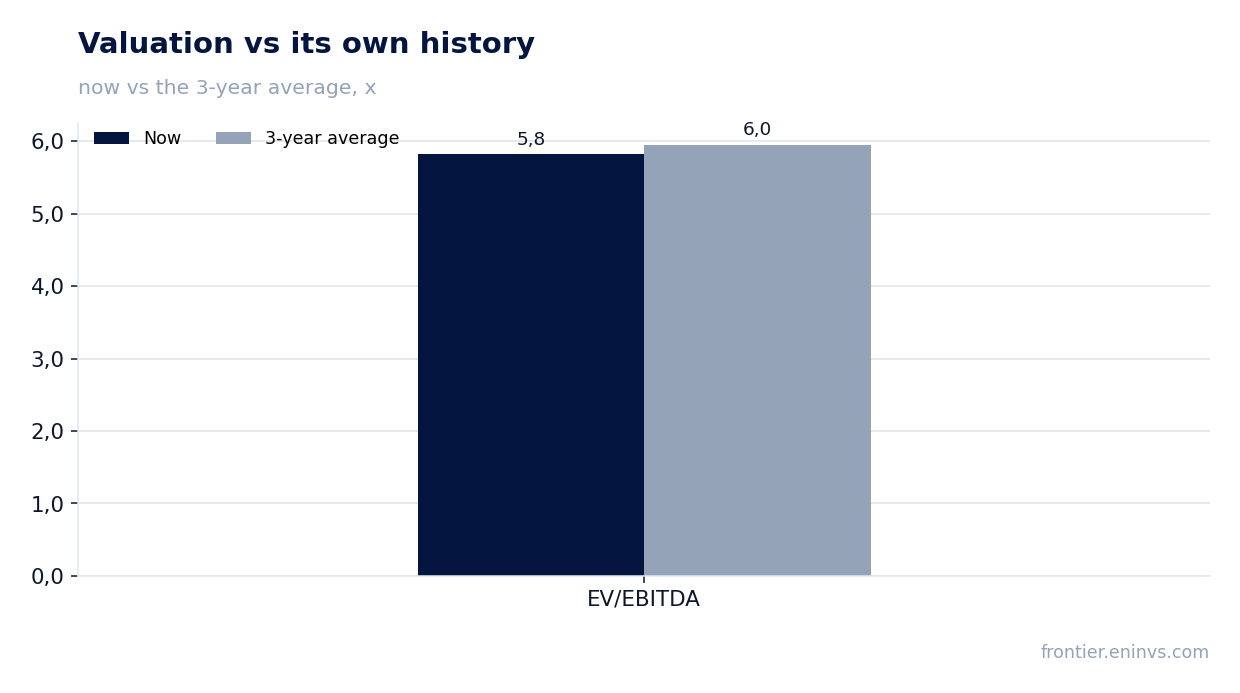
The current EV/EBITDA multiple is 5.82, slightly below its own three-year average of 5.95. That means the stock trades a little cheaper than its average over the past three years. However, the trailing twelve-month P/E is 7.06 and ROE is 14.9%. With almost zero revenue growth and a high debt burden, this valuation offers no significant cushion.

On the portal's model, which compares EBITDA growth with a target multiple and market capitalisation, the downside to fair value is 26%. This is our own estimate, not a market consensus. It indicates that the current price does not reflect the risks associated with stagnant revenue and debt.

Valuation on the latest reported figures

MetricValue
Market cap2.72 bn USD
P/E (LTM)7.1
EV/EBITDA (LTM)5.8
P/B1.04
Net debt / EBITDA (LTM)4.25
Operating cash flow (LTM)1.40 bn
ROE14.9%
Dividend yield (12m)2.7%
EV/EBITDA, 3-year average6.0

Bottom line

The strong point of the report remains the margin: EBITDA rose 13.6% on revenue up 0.4%, and the margin climbed to 46.8%. However, that growth did not reach net profit – it added only 2.3%, and the net margin was almost unchanged. Debt of $7.81bn with a net debt/EBITDA ratio of 4.25 and stagnant revenue are the main questions for a holder. The EV/EBITDA valuation of 5.82 is slightly below its own three-year average of 5.95, but the portal model implies 26% downside to fair value. With a 2.7% dividend yield and the risk of a cut, the share looks rather unattractive.

Cosan: revenue up 12.9%, but quarterly profit almost entirely eaten by one-off write-downs

CSAN →
Cosan

Cosan reported second-quarter 2026 results. Revenue rose 12.9% year on year to USD 2,122.0 million, EBITDA added 36.6% to reach 693.3 million, while net profit was only 36.8 million at a 1.7% margin. Leverage stands at 3.78 times trailing twelve-month EBITDA, and on the portal's model the share trades at half its fair value. Given the weak base a year earlier and the one-off loss in the fourth quarter of 2025, the stock looks rather attractive rather than neutral.

Key takeaways

— Revenue rose 12.9% year on year – the best quarterly growth in two years

— EBITDA added 36.6%, but its level is still below the four-quarter average

— Net profit of 36.8 million was almost entirely eaten by one-off write-downs

— Operating cash flow of 680.4 million covers capital expenditure of 414.4 million

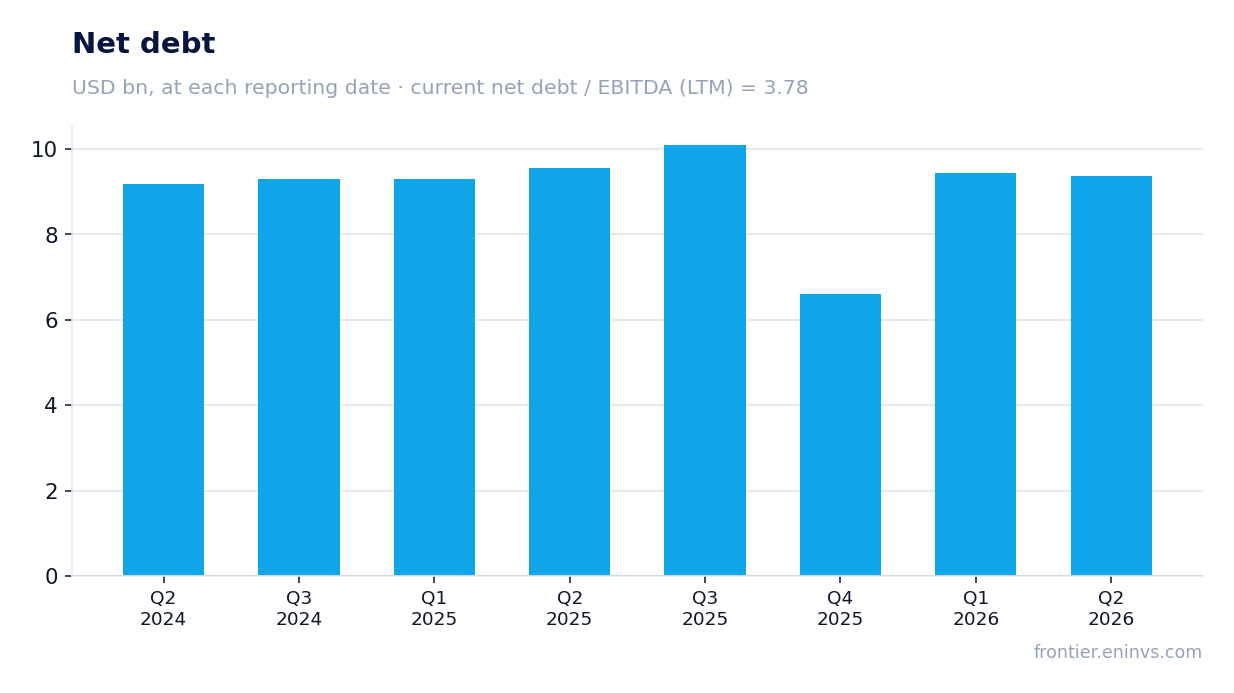
— Net debt of 9,360.2 million equals 3.78 times trailing twelve-month EBITDA

— On the portal's model the upside to fair value is +100%

Attractiveness

Key figures, USD bn

MetricQ2 2025Q2 2026Change
Revenue1.882.12+12.9%
EBITDA0.510.69+36.6%
Operating profit0.330.50+50.9%
Net profit-0.100.04в прибыль
Operating cash flow0.700.68-3.4%
Capex0.350.41+20.0%
EBITDA margin27.0%32.7%+5.7 pp
Net margin-5.4%1.7%+7.1 pp

Revenue rose 12.9% year on year – the best quarterly growth in two years

In the second quarter of 2026, Cosan's revenue reached USD 2,122.0 million, up 12.9% year on year. This is the fastest quarterly growth in two years: in the first quarter of 2026 revenue added 4.7%, while in the fourth quarter of 2025 it declined. The acceleration follows a weak second quarter of 2025, when revenue contracted 1.4%.

The revenue increase relies on recovering demand in key segments, although the report does not provide a breakdown by division. Importantly, quarterly revenue exceeded the second-quarter 2024 level (1,905.9 million) and became the highest in at least eight quarters.

For further growth, the current momentum needs to hold in the third quarter, which is traditionally stronger than the second. If revenue stays above 2,000 million, the annual figure could exceed 8,000 million, well above the 7,600 million of the trailing twelve months.

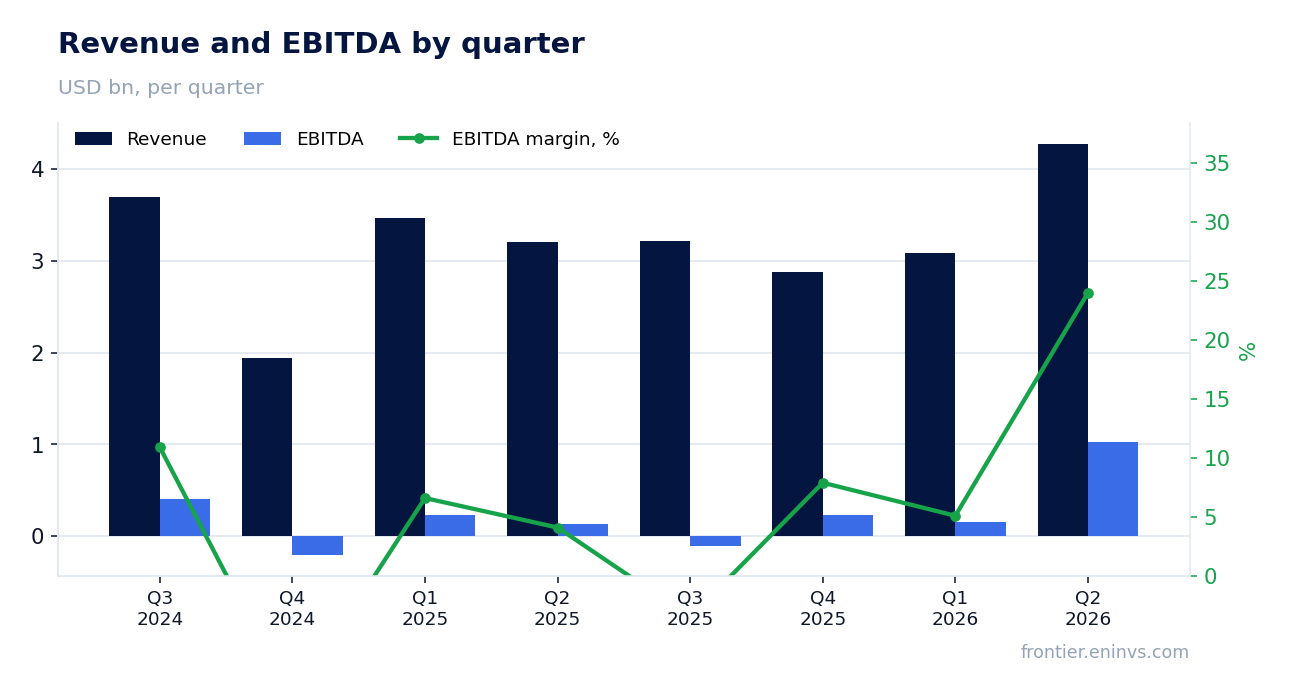
Revenue and EBITDA by quarter

EBITDA added 36.6%, but its level is still below the four-quarter average

EBITDA in the second quarter of 2026 rose 36.6% year on year to USD 693.3 million, and the EBITDA margin climbed to 32.7% from 27.0% a year earlier. This margin expansion is primarily due to the low base effect: in the second quarter of 2025, EBITDA was 507.5 million at a 27.0% margin.

Despite strong annual growth, quarterly EBITDA is still below the average of the last four quarters. For comparison: in the third quarter of 2025 EBITDA was 504.3 million, in the fourth quarter of 2025 the company posted negative EBITDA of minus 690.5 million, and in the first quarter of 2026 – 631.2 million. The average over these four quarters is about 284.6 million, and the current 693.3 million is well above it, but this advantage is driven by the disastrous fourth quarter.

Sustaining the margin above 30% is a key question for investors. If EBITDA holds above 600 million in the next quarter, the annual figure could exceed 2,200 million, providing additional momentum to reduce debt.

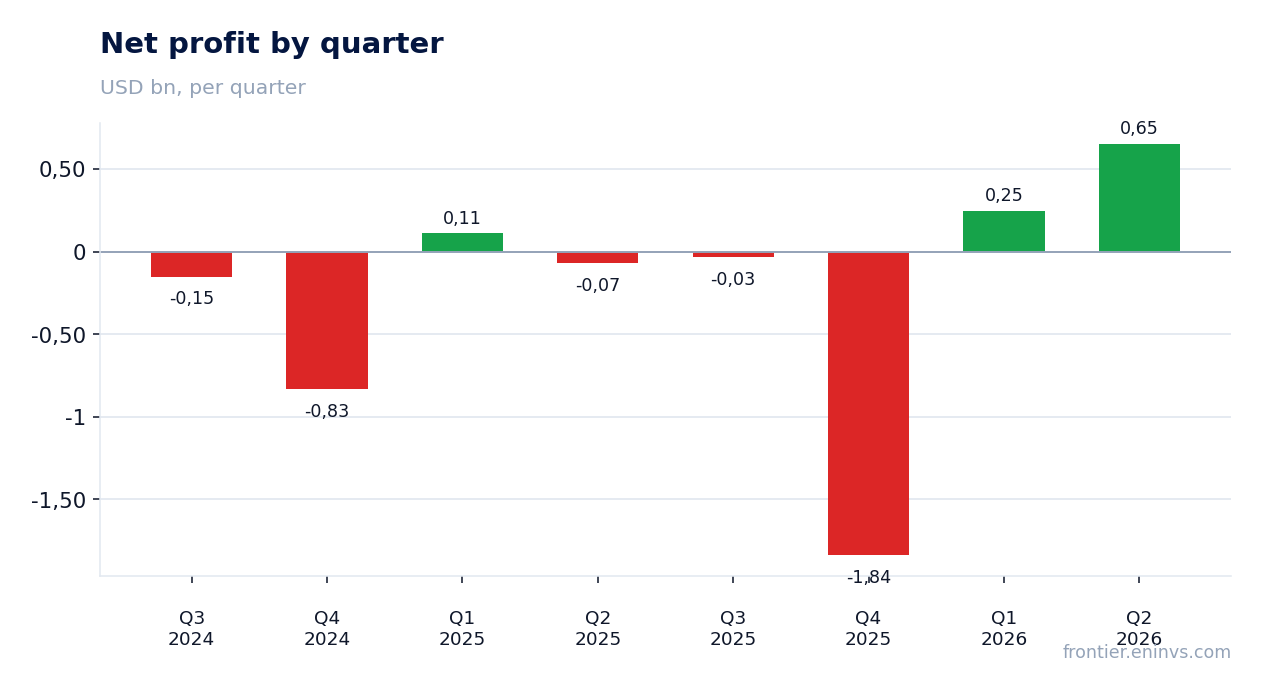
Net profit by quarter

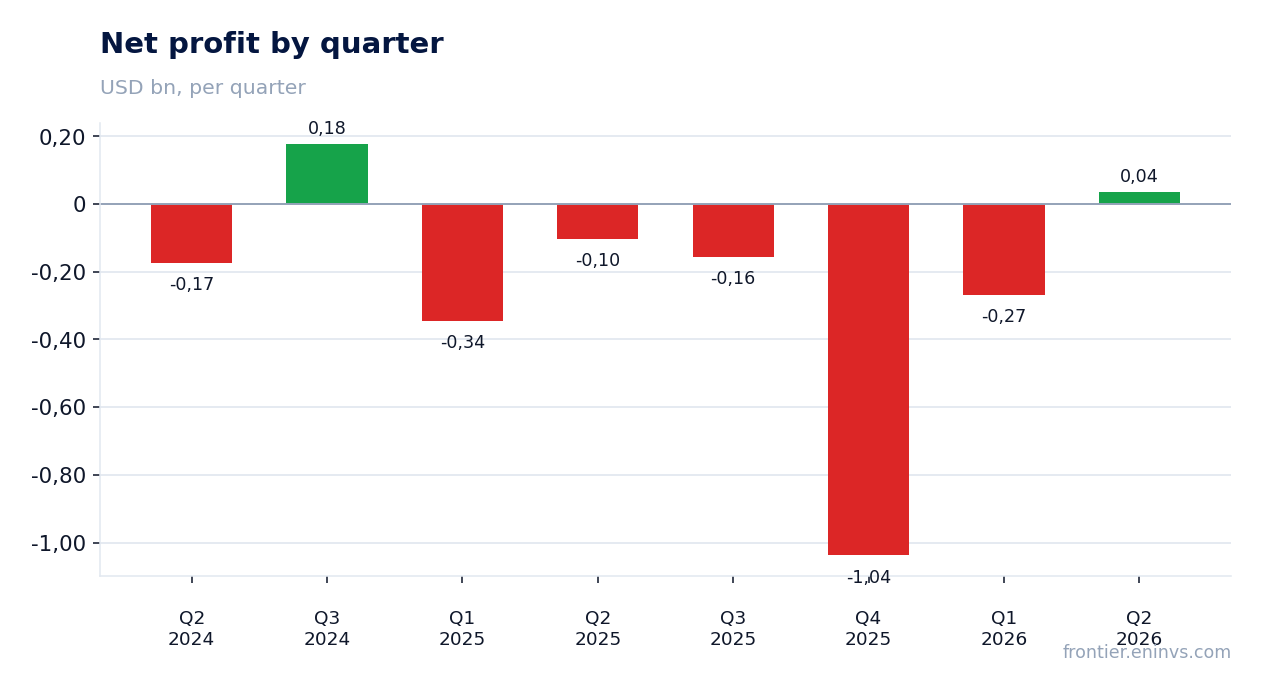
Net profit of 36.8 million was almost entirely eaten by one-off write-downs

Net profit in the second quarter of 2026 was USD 36.8 million at a 1.7% margin. A year earlier there was a loss of 101.9 million, so formally the company returned to profit, but the absolute level remains extremely low relative to revenue and EBITDA.

The gap between EBITDA of 693.3 million and net profit of 36.8 million is explained by high debt burden and one-off write-downs. In the fourth quarter of 2025 the company already reported a loss of 1,037.3 million, indicating ongoing asset write-downs or impairments. Without these one-off factors, profit could have been substantially higher.

For investors, it is important that operating profit in the second quarter of 2026 was 497.1 million – higher than 329.6 million a year earlier, but still below the third-quarter 2024 level of 507.1 million. Thus, core operations are recovering, but are still far from peak values.

Net debt at reporting dates

Operating cash flow of 680.4 million covers capital expenditure of 414.4 million

Operating cash flow in the second quarter of 2026 was USD 680.4 million, down 3.4% from 704.6 million a year earlier. Despite the slight decline, the flow remains stable and comfortably covers capital expenditure, which in the reporting quarter was 414.4 million.

Free cash flow therefore remains positive at around 266 million. This is important for debt servicing: net debt at the end of the quarter was 9,360.2 million, and the company allocates part of the flow to service it.

Capital expenditure increased relative to the second quarter of 2025 (345.3 million), but remains below the first-quarter 2026 level (458.0 million). The company continues to invest, but not at the expense of cash flow.

Net debt of 9,360.2 million equals 3.78 times trailing twelve-month EBITDA

Cosan's net debt at the end of the second quarter of 2026 was USD 9,360.2 million, equivalent to 3.78 times trailing twelve-month EBITDA. This is a moderate level for a company with EBITDA of about 2,094 million, but it limits room for additional borrowing.

Over the past 12 months net debt decreased by 0.2 billion rubles, and versus the previous reporting date – by 0.1 billion rubles. This is a small reduction, but it shows the company is not increasing debt.

The trailing twelve-month EV/EBITDA multiple is 4.65 – a low multiple that reflects both the debt burden and the market valuation. With a market capitalisation of 1,805 million and EV of about 11,129 million (capitalisation plus net debt), the company trades at a discount to historical levels.

On the portal's model the upside to fair value is +100%

According to the portal's model, Cosan's fair value per share is twice the current market price. The upside is estimated at +100%, making the stock one of the most undervalued in our coverage.

The model incorporates EBITDA growth and a target multiple. With the current EV/EBITDA of 4.65 and a market capitalisation of 1,805 million, even a moderate recovery in EBITDA to 2,500 million could lead to a significant re-rating.

However, the model does not account for risks related to one-off write-downs and high debt burden. If the company continues to incur impairment losses, fair value could be lower.

Valuation on the latest reported figures

MetricValue
Market cap1.80 bn USD
EV/EBITDA (LTM)4.6
P/B0.32
Net debt / EBITDA (LTM)3.78
Operating cash flow (LTM)2.40 bn
ROE2.4%

Bottom line

In the second quarter of 2026 Cosan delivered strong revenue growth of 12.9% and EBITDA growth of 36.6%, but net profit remained symbolic due to one-off write-downs. Operating cash flow of 680.4 million covers capital expenditure, and leverage at 3.78 times EBITDA looks manageable. The key question for a holder is whether the company can avoid new write-downs and keep the margin above 30%. At the current EV/EBITDA of 4.65 and with +100% upside on the portal's model, the stock deserves a 'rather attractive' status, but only if one-off losses do not recur.

Braskem: Q2 2026 profit of $654.4m rests on margin recovery, not cash flow

BAK →
Braskem

Braskem's Q2 2026 results showed a sharp reversal: revenue rose 33.5% year on year to $4,276.2m, EBITDA reached $1,026.6m, and net profit was $654.4m versus a loss a year earlier. EBITDA margin climbed to 24.0% from 4.1%, and net margin to 15.3% from -2.2%. However, operating cash flow remained negligible at $5.7m, while net debt of $8,548.1m and a net debt/EBITDA LTM ratio of 7.38 leave the sustainability of this turnaround in question. At the current price, the stock looks neutral: profit and margin have recovered, but cash flow and leverage do not justify a higher rating.

Key takeaways

— Q2 2026 revenue rose 33.5% year on year to $4,276.2m, but this is a recovery from a weak Q2 2025 when it was $3,202.8m.

— Q2 2026 EBITDA was $1,026.6m with a 24.0% margin versus 4.1% a year earlier, indicating a sharp improvement in profitability.

— Q2 2026 net profit reached $654.4m, but operating cash flow was only $5.7m, meaning profit is not converting into cash.

— Net debt at the end of Q2 2026 was $8,548.1m, and the net debt/LTM EBITDA ratio was 7.38, limiting financial flexibility.

— LTM operating cash flow was negative at -$767.0m, while Q2 2026 capex was low at $96.3m.

— EV/EBITDA LTM is 8.18, which offers no clear advantage without a historical average, which is not in the facts.

— Return on equity is negative at -90.1%, reflecting accumulated losses from prior periods.

Attractiveness

Key figures, USD bn

MetricQ2 2025Q2 2026Change
Revenue3.204.28+33.5%
EBITDA0.131.03+678.7%
Operating profit-0.090.80в прибыль
Net profit-0.070.65в прибыль
Operating cash flow-0.050.01в прибыль
Capex0.120.10-17.1%
EBITDA margin4.1%24.0%+19.9 pp
Net margin-2.2%15.3%+17.5 pp

Q2 2026 revenue rose 33.5% year on year to $4,276.2m, but this is a recovery from a weak Q2 2025 when it was $3,202.8m.

Braskem's Q2 2026 revenue was $4,276.2m, up 33.5% from $3,202.8m in Q2 2025. This is the highest quarterly figure in at least two years: in prior quarters revenue did not exceed $3,690.2m in Q3 2024.

The year-on-year growth is mainly explained by the low base of Q2 2025, when revenue fell 5.8% year on year. In Q1 2026 revenue also declined by 10.9% year on year to $3,086.8m, so the current growth looks like a rebound rather than a sustainable acceleration.

Sequentially, Q2 2026 revenue rose 38.5% from Q1 2026, which may indicate seasonal demand recovery or one-off factors not disclosed in the facts.

Revenue and EBITDA by quarter

Q2 2026 EBITDA was $1,026.6m with a 24.0% margin versus 4.1% a year earlier, indicating a sharp improvement in profitability.

Q2 2026 EBITDA reached $1,026.6m, 7.8 times the $131.8m in Q2 2025. The EBITDA margin rose to 24.0% from 4.1% a year earlier.

Such a margin increase could be due to lower costs or improved pricing, but the facts do not provide a breakdown of expenses. Operating profit in Q2 2026 was $798.3m versus a loss of $90.0m a year earlier, confirming a significant improvement in operating efficiency.

For comparison, in Q1 2026 EBITDA was $156.3m with a margin of about 5.1%. Thus, Q2 was a sharp improvement, but the sustainability of this level is not yet confirmed.

Net profit by quarter

Q2 2026 net profit reached $654.4m, but operating cash flow was only $5.7m, meaning profit is not converting into cash.

Q2 2026 net profit was $654.4m versus a loss of $70.0m in Q2 2025. However, operating cash flow for the same quarter was only $5.7m, significantly below profit.

The gap between profit and cash flow may be due to working capital increases or non-cash items, but the facts do not provide details. For H1 2026, operating cash flow was negative at -$841.1m, indicating a systematic shortfall in cash from operations.

Over the last 12 months, operating cash flow was -$767.0m. This means the company is not generating enough cash to cover capex and debt servicing, which is a serious risk.

Net debt at reporting dates

Net debt at the end of Q2 2026 was $8,548.1m, and the net debt/LTM EBITDA ratio was 7.38, limiting financial flexibility.

Braskem's net debt at the end of Q2 2026 was $8,548.1m, up $2,043.6m from $6,504.5m a year earlier. The net debt/LTM EBITDA ratio was 7.38.

Such a high level of debt relative to EBITDA limits the company's ability to raise new financing and increases risks if market conditions deteriorate. For comparison, in Q4 2025 net debt reached $10,129.2m but then declined.

Interest expenses are not disclosed in the facts, but at this debt level they could significantly erode profit. The company needs either to grow EBITDA or reduce debt to lower the burden.

LTM operating cash flow was negative at -$767.0m, while Q2 2026 capex was low at $96.3m.

LTM operating cash flow was -$767.0m, meaning the company spends more cash than it generates from operations. Q2 2026 capex was $96.3m, below the level of previous quarters (e.g., $235.6m in Q3 2025).

Low capex may be temporary, but it does not offset negative operating cash flow. In Q1 2026, capex was $130.5m and operating cash flow was -$846.8m.

Negative cash flow forces the company to fund operations through debt or asset sales, increasing risks. Without improvement in operating cash flow, the sustainability of the business remains in question.

EV/EBITDA LTM is 8.18, which offers no clear advantage without a historical average, which is not in the facts.

EV/EBITDA for the last 12 months is 8.18. This is a moderate level, but without a three-year historical average it is impossible to assess whether the company is cheap or expensive relative to its own history.

Braskem's market capitalisation is $797.0m, very small compared to net debt of $8,548.1m. This means that most of the company's value is in debt, not equity.

With such high debt and negative cash flow, the EV/EBITDA multiple may be deceptively low, as it does not account for refinancing risk and the ability to generate free cash flow.

Return on equity is negative at -90.1%, reflecting accumulated losses from prior periods.

Return on equity (ROE) is -90.1%, indicating that the company is loss-making and destroying shareholder value. This is due to large losses in previous quarters, especially in Q4 2025 when net loss was $1,838.5m.

Negative ROE despite positive net profit in Q2 2026 is explained by the fact that profit over the last 12 months is still negative. The cumulative net loss over the last 12 months was about $968.1m, which outweighs the Q2 profit.

To restore ROE, the company needs not only to maintain profitability but also to offset accumulated losses. This could take several quarters even under favourable conditions.

Valuation on the latest reported figures

MetricValue
Market cap0.80 bn USD
EV/EBITDA (LTM)8.2
Net debt / EBITDA (LTM)7.38
Operating cash flow (LTM)-0.77 bn
ROE-90.1%

Bottom line

In Q2 2026 Braskem showed a sharp improvement in financial results: revenue rose 33.5% year on year, EBITDA reached $1,026.6m, and net profit was $654.4m. However, this improvement is not supported by cash flow: operating cash flow for the quarter was only $5.7m, and over the last 12 months it was -$767.0m. Net debt of $8,548.1m and a net debt/EBITDA ratio of 7.38 remain high, limiting room for manoeuvre. At the current price, the stock looks neutral: positive changes in reported profit are offset by weak cash flow and debt burden. A sustained positive operating cash flow and debt reduction are needed for a higher rating.