Albemarle: profit up 21-fold, but almost all of it comes from lithium price, not volumes
On August 5, Albemarle Corporation released its second-quarter 2026 results. Revenue rose 31.1% year on year to $1,743.3 million, adjusted EBITDA jumped 155% to $858.1 million, and net income increased 21-fold to $480.0 million. That surge was driven by a 60.5% rise in average realized lithium prices with volumes up only 11%, not by business expansion. At the current price the stock looks unattractive: EV/EBITDA LTM of 17.1 against the portal model's -54% upside to fair value, while the 1.3% dividend yield does not compensate for the risk of a lithium price reversal.
Key takeaways
— Revenue rose 31.1% on lithium price, not volumes: average realized price up 60.5%, shipments up only 11%
— EBITDA margin of 34.9% versus 16.3% a year earlier is operating leverage from higher prices, not cost cuts
— Net income of $480.0 million includes $30.6 million of one-off items; adjusted EPS was $3.75
— Free cash flow of $638.3 million on capex of just $71.7 million – but the sustainability of that ratio is questionable
— Net debt of $472.1 million is the lowest in a year, but net debt/EBITDA LTM of 1.86 is still above what the credit agreement implies
— Dividend yield of 1.3% on $95.4 million paid in the half-year – payout below 50% of adjusted earnings, but dependent on lithium prices
— EV/EBITDA LTM of 17.1 leaves no room for error: at a lithium price scenario of about $10/kg, EBITDA would fall to $0.9–1.0 billion
Attractiveness
Key figures, USD bn
| Metric | Q2 2025 | Q2 2026 | Change |
|---|---|---|---|
| Revenue | 1.33 | 1.74 | +31.1% |
| EBITDA | 0.22 | 0.61 | +181.5% |
| Operating profit | 0.05 | 0.45 | +853.0% |
| Net profit | 0.02 | 0.48 | +1996.2% |
| Operating cash flow | -0.01 | 0.71 | to profit |
| Capex | 0.12 | 0.07 | -40.1% |
| EBITDA margin | 16.3% | 34.9% | +18.6 pp |
| Net margin | 1.7% | 27.5% | +25.8 pp |
Revenue rose 31.1% on lithium price, not volumes: average realized price up 60.5%, shipments up only 11%
Second-quarter 2026 revenue came in at $1,743.3 million, up 31.1% year on year. Energy Storage drove the increase: its sales rose 77.9% to $1,276.7 million. The average realized lithium price in that segment climbed 60.5% to $19.53/kg LCE, while shipment volumes grew only 11% to 65 kt LCE. Almost the entire gain came from price, not from higher output.
Specialties added $423.5 million, up 20.5% on 8% volume growth and 11% price gains. That is more sustainable growth, but it accounts for less than a quarter of total revenue. Corporate and other sales fell to $43.1 million from $260.8 million a year earlier – the effect of selling a 51% stake in Ketjen.
Excluding the price factor, volume growth in Energy Storage remains modest. The company expects full-year 2026 shipments of 225–235 kt LCE, implying year-on-year growth but partly constrained by the June fire at Talison CGP3. Without further price increases, revenue could plateau at the current level.
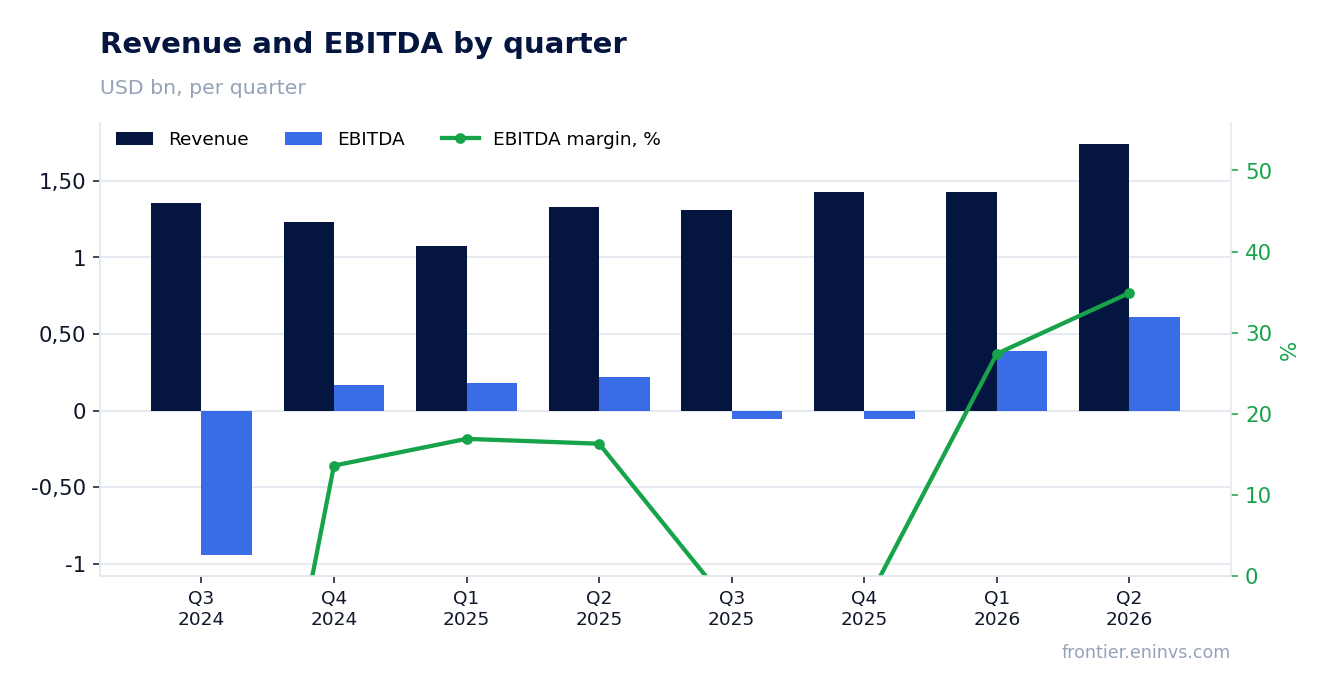
EBITDA margin of 34.9% versus 16.3% a year earlier is operating leverage from higher prices, not cost cuts
Adjusted EBITDA in the second quarter of 2026 reached $858.1 million, up 155% year on year. The EBITDA margin rose to 34.9% from 16.3% a year earlier. The jump is explained by the fact that higher lithium prices came with almost no increase in variable costs: cost of goods sold rose only 1.8% to $1,153.0 million, while revenue added 31.1%.
The Energy Storage segment posted adjusted EBITDA of $723.5 million versus $219.7 million a year earlier – a 3.3-fold increase. Its margin rose to 56.7% from 30.6%. In Specialties, adjusted EBITDA grew 61.3% to $117.7 million with a margin of 27.8% versus 20.8%. Both segments benefited from prices, but Energy Storage remains extremely sensitive to their movements.
The company notes that part of the growth came from its cost-reduction programme: $100 million of annual run-rate savings were achieved in the first half, and Albemarle expects to reach the high end of its $100–150 million target. However, these improvements pale next to the price factor, which delivered hundreds of millions of dollars in additional EBITDA.
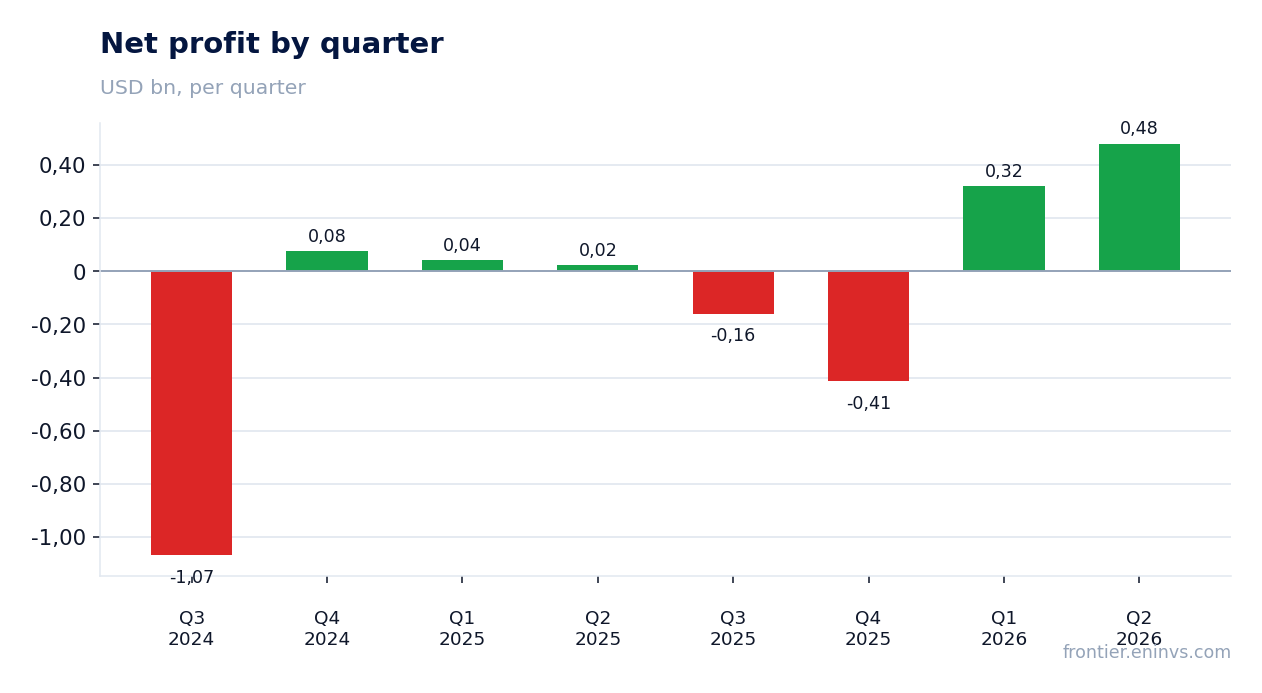
Net income of $480.0 million includes $30.6 million of one-off items; adjusted EPS was $3.75
Net income attributable to Albemarle in the second quarter of 2026 was $480.0 million versus $22.9 million a year earlier. The $457.1 million difference is almost entirely explained by operating income, which rose to $452.9 million from $47.5 million. However, reported profit includes one-off items: $30.6 million of non-recurring and other unusual charges after tax, or $0.22 per share.
These one-off items include $7.3 million of restructuring charges and write-offs, $19.0 million of consulting fees for the cost-savings initiative, and a $6.5 million gain from revaluation of public equities. Excluding these and certain other adjustments, adjusted earnings per share were $3.75 versus $0.11 a year earlier.
Importantly, profit includes $151.6 million of income from unconsolidated investments (mainly Talison), up 93.3% year on year. That income also rose on the back of lithium prices. Thus, the sustainability of profit directly depends on prices remaining high.
Free cash flow of $638.3 million on capex of just $71.7 million – but the sustainability of that ratio is questionable
Operating cash flow in the second quarter of 2026 was $710.0 million, with free cash flow of $638.3 million. That was achieved with capital expenditures of only $71.7 million, well below the levels of previous years. The company attributes this to improved capital efficiency and has cut its 2026 capex forecast to about $500 million, 15% less than in 2025.
Operating cash flow conversion to EBITDA was 83%, higher than usual. The company cites two reasons: increased dividends from the Talison joint venture and one-off working capital benefits. Neither is sustainable. In the first half, operating cash flow reached $1,056.2 million, up $518 million year on year.
Free cash flow of $638.3 million for the quarter looks impressive, but it was generated with abnormally low capex and one-off inflows. If lithium prices fall and capex returns to normal levels, free cash flow could shrink several-fold.
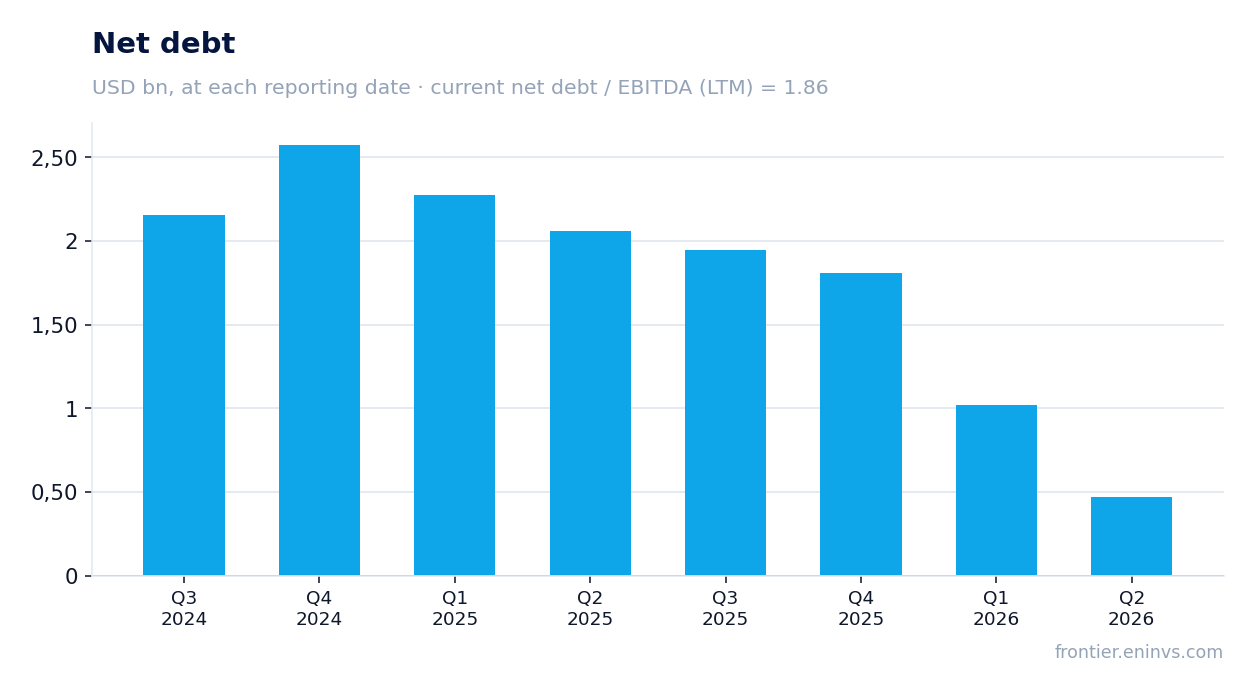
Net debt of $472.1 million is the lowest in a year, but net debt/EBITDA LTM of 1.86 is still above what the credit agreement implies
Albemarle's net debt at the end of the second quarter of 2026 was $472.1 million, down from $1,810.0 million at the end of 2025. The company repaid $1,314.2 million of long-term debt, including a $1.3 billion tender in the first quarter, which generated a $12.5 million gain on early extinguishment. Total debt fell to $1.9 billion, and liquidity stands at $3.2 billion, including $1.6 billion of cash.
The net debt to EBITDA ratio for the trailing twelve months is 1.86. That is not a low level, although it reflects significant debt reduction. The company reports that under its credit agreement the ratio is about 0.5, but that definition may differ from our calculation. We use the standard approach: net debt divided by LTM EBITDA.
Interest expense fell to $30.9 million for the quarter from $49.9 million a year earlier due to debt reduction. The company expects interest expense of $120–140 million for 2026. Lower leverage reduces risks, but at current lithium prices debt is not the main issue.
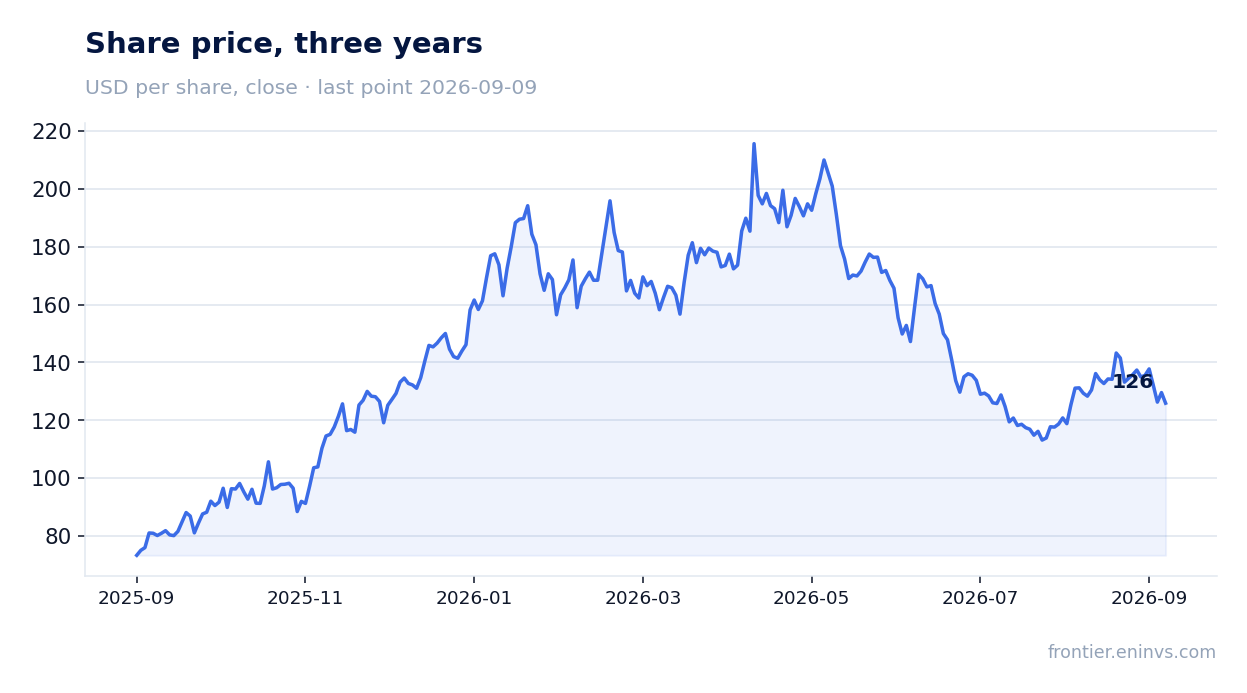
Dividend yield of 1.3% on $95.4 million paid in the half-year – payout below 50% of adjusted earnings, but dependent on lithium prices
Albemarle paid $95.4 million in common dividends in the first half of 2026, equivalent to a quarterly payout of about $0.40 per share. At the current share price of $120.82, the trailing twelve-month dividend yield is 1.3%. That is not a high level and does not compensate for earnings volatility.
Our estimate for the 2026 dividend assumes the current quarterly payout is maintained. With adjusted EPS of $3.75 in the second quarter and an expected annual figure of around $10–12, the payout ratio is below 20%. However, this estimate relies on high lithium prices. If prices fall to $10/kg, as in the company's scenario, EBITDA could be $0.9–1.0 billion, and profit would come under pressure.
The company's dividend policy does not imply a fixed payout, and the board may revise payments if conditions deteriorate. A yield of 1.3% is below the key rate and is not the main argument for investing in these shares. The dividend reflects the residual nature of profit distribution after capital expenditures.
EV/EBITDA LTM of 17.1 leaves no room for error: at a lithium price scenario of about $10/kg, EBITDA would fall to $0.9–1.0 billion
The EV/EBITDA multiple for the trailing twelve months is 17.1, and P/E is 66.1. These are high levels that reflect market expectations for future lithium prices. However, the company itself warns that at an average lithium price of about $10/kg, its 2026 EBITDA would be $0.9–1.0 billion, 2.5 times below the current LTM level. At $20/kg, EBITDA could be $2.4–2.6 billion.
The portal model values the shares based on current commodity prices and a target EV/EBITDA. According to this model, the downside from the current price is minus 54%. This is our own estimate, not a market consensus. It shows that the current price already prices in an optimistic lithium price scenario.
For comparison, Albemarle has historically traded at lower multiples. The current EV/EBITDA of 17.1 is above its average level in recent years, making the stock vulnerable to disappointment. If lithium prices do not hold at current levels, the multiple could quickly rise as the denominator falls.
Valuation on the latest reported figures
| Metric | Value |
|---|---|
| Market cap | 14.8 bn USD |
| P/E (LTM) | 66.1 |
| EV/EBITDA (LTM) | 17.1 |
| P/B | 1.55 |
| Net debt / EBITDA (LTM) | 1.86 |
| Operating cash flow (LTM) | 1.30 bn |
| ROE | 19.1% |
| Dividend yield (12m) | 1.3% |
Bottom line
Bottom line: Albemarle delivered record profit, but its source is the lithium price, not business growth. Volumes rose only 11%, while price rose 60.5%. Free cash flow of $638.3 million looks impressive, but it was generated with capex of $71.7 million and one-off inflows. Debt was cut to $472.1 million, yet the net debt/EBITDA LTM ratio of 1.86 is still not low. The 1.3% dividend yield does not compensate for the risk. At the current price the stock is valued above its own history, and the portal model implies minus 54% to fair value. Verdict – unattractive.
Open the company's financial profile ALB →
See also: market overview · valuation map · stock screeners