Core Natural Resources: profit up 4.5x, but half the quarter came from an insurance payout, not coal
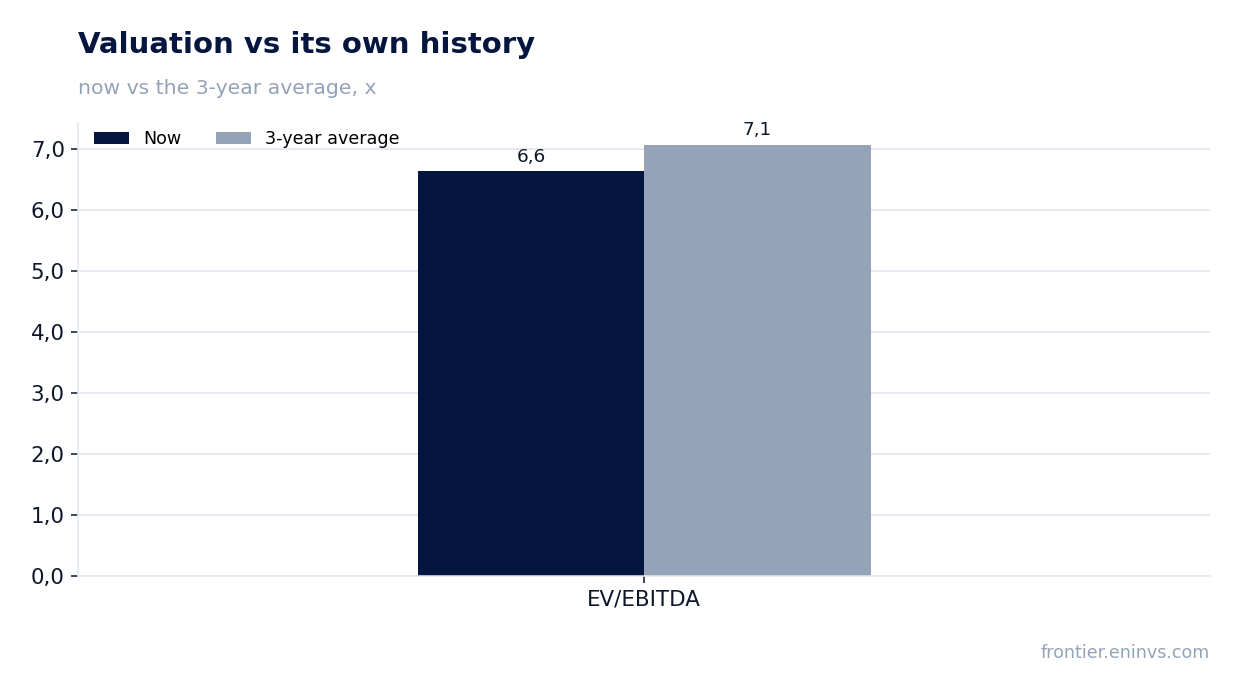
On 6 August Core Natural Resources reported second-quarter 2026 results. Revenue added 3.5% year on year to $1,141.0m, adjusted EBITDA jumped 130.4% to $323.6m, and net income came in at $126.5m against a $36.6m loss a year earlier. Half the profit came from the Leer South insurance payout, not from coal. At an EV/EBITDA of 6.63 against its own three-year average of 7.07 and a portal-model upside of -4%, the share looks rather attractive, but profit growth still rests on one-off receipts rather than on the market.
Key takeaways
— Revenue grew just 3.5%, and the entire gain came from the metallurgical segment, not thermal coal
— EBITDA rose 2.3x, but $125.4m of it is the remainder of the Leer South insurance payout
— Cost per ton fell across all key segments, and that is the quarter's main operational shift
— Free cash flow of $148.0m went mostly into buybacks, not dividends
— Debt fell to $13.0m, and net debt to LTM EBITDA stands at 0.02 – that is a level, not a direction
— A 0.40% dividend yield on a $0.10 per-share payout is not a dividend story, it is a buyback story
— EV/EBITDA of 6.63 against its own three-year average of 7.07 – a discount to its own history on one-off profit
Attractiveness
Key figures, USD bn
| Metric | Q2 2025 | Q2 2026 | Change |
|---|---|---|---|
| Revenue | 1.10 | 1.14 | +3.5% |
| EBITDA | 0.15 | 0.35 | +130.4% |
| Operating profit | -0.02 | 0.16 | to profit |
| Net profit | -0.04 | 0.13 | to profit |
| Operating cash flow | 0.22 | 0.46 | +107.4% |
| Capex | 0.09 | 0.10 | +14.3% |
| EBITDA margin | 13.6% | 30.3% | +16.7 pp |
| Net margin | -3.3% | 11.1% | +14.4 pp |
Revenue grew just 3.5%, and the entire gain came from the metallurgical segment, not thermal coal
Second-quarter 2026 revenue came in at $1,141.0m, up 3.5% from the same quarter a year earlier. That is a sharp deceleration: growth was 6.6% in the first quarter and 61.5% in the fourth quarter of 2025. The slowdown reflects the fact that revenue was already high a year earlier after the merger, and the low-base effect has disappeared.
The entire gain came from the metallurgical segment: its revenue rose to $366.3m from $300.0m a year earlier. The high-C.V. thermal segment, by contrast, slipped to $612.1m from $606.5m, and Powder River Basin fell to $148.3m from $186.9m. Revenue growth rests on one segment while the other two drag.
In the metallurgical segment, coking coal sales rose to 2.3m tons from 1.9m a year earlier, and the realised coking coal price rose to $121.43 per ton from $114.71. That combination of higher volume and higher price produced the gain. In the thermal segment, volume stayed at 8.4m tons, but the price fell to $58.11 from $60.50.
In Powder River Basin, sales fell to 10.2m tons from 12.6m a year earlier on seasonally weak spring shipments. The company expects a substantial improvement in volumes and unit costs in the second half. For now, this segment runs at a negative margin: $14.28 of revenue per ton against $14.85 of cost.
EBITDA rose 2.3x, but $125.4m of it is the remainder of the Leer South insurance payout
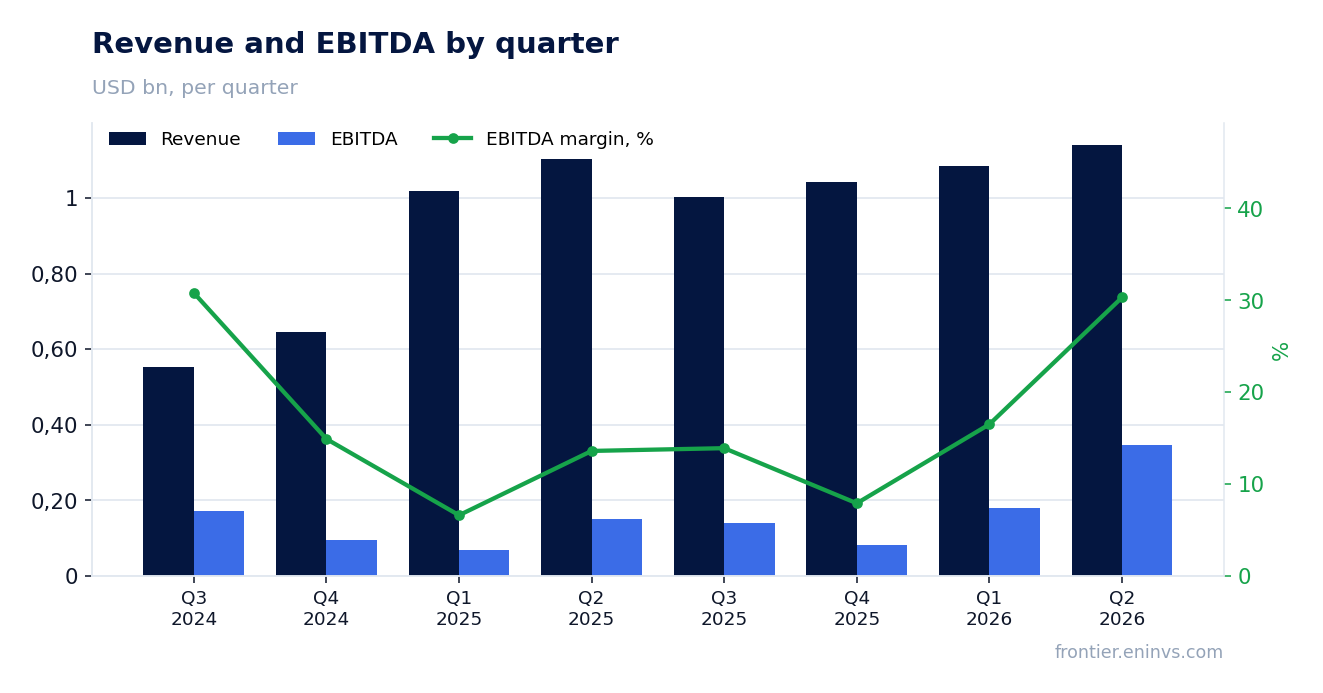
Adjusted EBITDA for the second quarter of 2026 was $323.6m against $150.0m a year earlier, up 130.4%. The EBITDA margin rose to 30.3% from 13.6%. Such a jump needs an explanation, and the report provides one: the company settled its Leer South insurance claim for the full limit and recognised the remaining $125.4m of proceeds.
Without that payout, EBITDA would have been around $198m, meaning growth over the prior year would have been modest. The payout is one-off and will not recur. This matters for assessing earnings quality: the market may price the stock on normalised EBITDA rather than the reported figure.
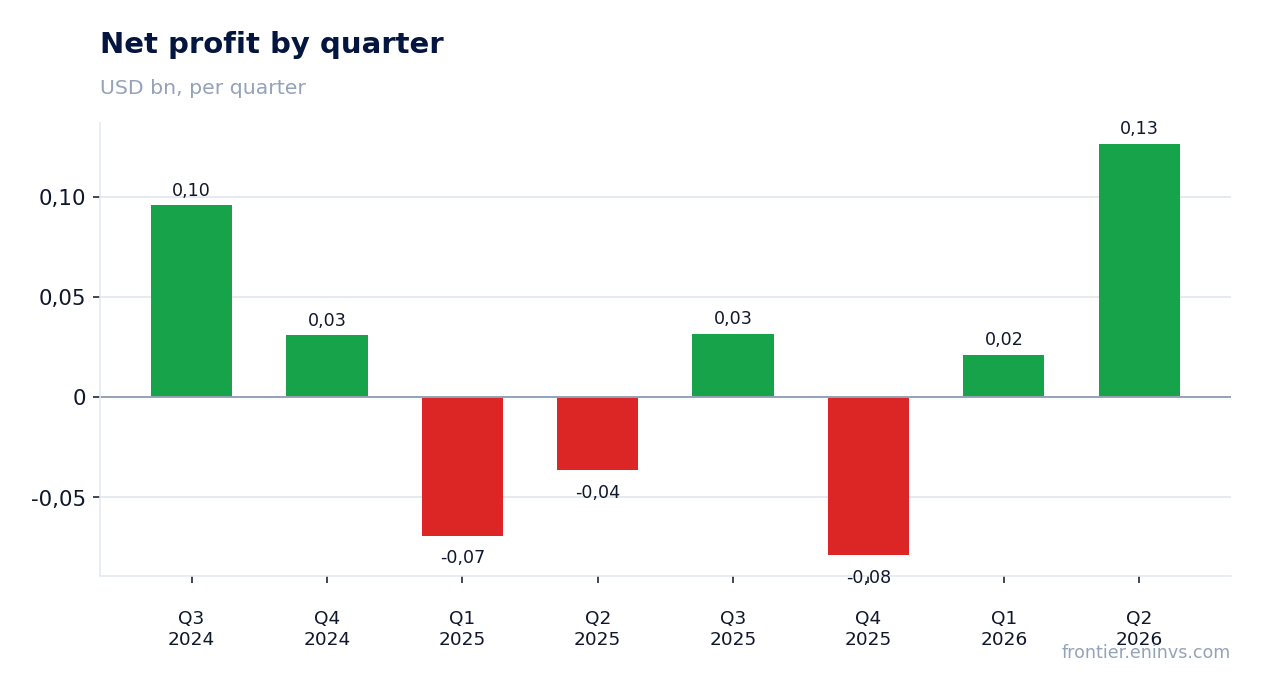
Operating profit in the second quarter was $155.8m against a $19.3m loss a year earlier. Net income was $126.5m against a $36.6m loss. The insurance payout is visible here too: without it, profit would have been significantly lower. The company collected $88.1m of insurance proceeds in the quarter and another $37.9m in July.
Still, the operational improvements are real: cost per ton fell 7% quarter on quarter in the metallurgical segment to $85.65, and 9% in the thermal segment to $38.58. That cost reduction is not a one-off and will stay with the company.
Cost per ton fell across all key segments, and that is the quarter's main operational shift
In the high-C.V. thermal segment, cost per ton was $38.58, 9% better than in the first quarter of 2026. With a realised price of $58.11, the cash margin per ton was $19.53 against $16.30 a quarter earlier. This improvement came despite a slight price decline – meaning the company cut costs.
In the metallurgical segment, cost per ton fell 7% quarter on quarter to $85.65. The cash margin per ton rose to $28.48 from $19.68 in the first quarter. Both higher volume and lower costs contributed. The company notes it continues to market its Leer brand coal as a substitute for Australian premium low-vol coal.
In Powder River Basin, cost per ton rose 9% to $14.85 on lower fixed-cost absorption from reduced shipments and higher fuel costs. This is the only segment where costs rose, and the company expects improvement in the second half. The negative cash margin of $0.57 per ton is temporary if the company's forecast holds.
Cost reduction is what will stay with the company after the one-off insurance payments end. That is why this shift matters more for long-term valuation than the EBITDA jump. If the company holds costs at these levels, earnings will be more resilient than the reported quarter suggests.
Free cash flow of $148.0m went mostly into buybacks, not dividends
Operating cash flow in the second quarter of 2026 was $250.4m, and free cash flow was $148.0m. That is a substantial improvement over the first quarter, when operating cash flow was $119.4m. Both operational improvements and insurance proceeds contributed to the increase.
Capital expenditures were $101.9m, consistent with a quarterly pace within the annual guidance of $325–375m. The company is investing to maintain and expand its asset base, and these investments are necessary for future cash flows. Free cash flow after capex remains positive.
Of the $148.0m of free cash flow, the company allocated $63.0m to buybacks and $5.0m to dividends. Buybacks are the priority for capital returns: since February 2025 the company has returned $360.1m to shareholders, of which $329.2m went to repurchasing 4.3m shares at an average price of $77.04. That is roughly 7.9% of shares outstanding at the programme's launch.
The remaining authorisation under the buyback programme is $670.8m out of $1.0bn. The company says it intends to accelerate the reduction in share count in the second half. For a shareholder, this means capital returns come through buybacks rather than dividends, which matters for assessing yield.
Debt fell to $13.0m, and net debt to LTM EBITDA stands at 0.02 – that is a level, not a direction
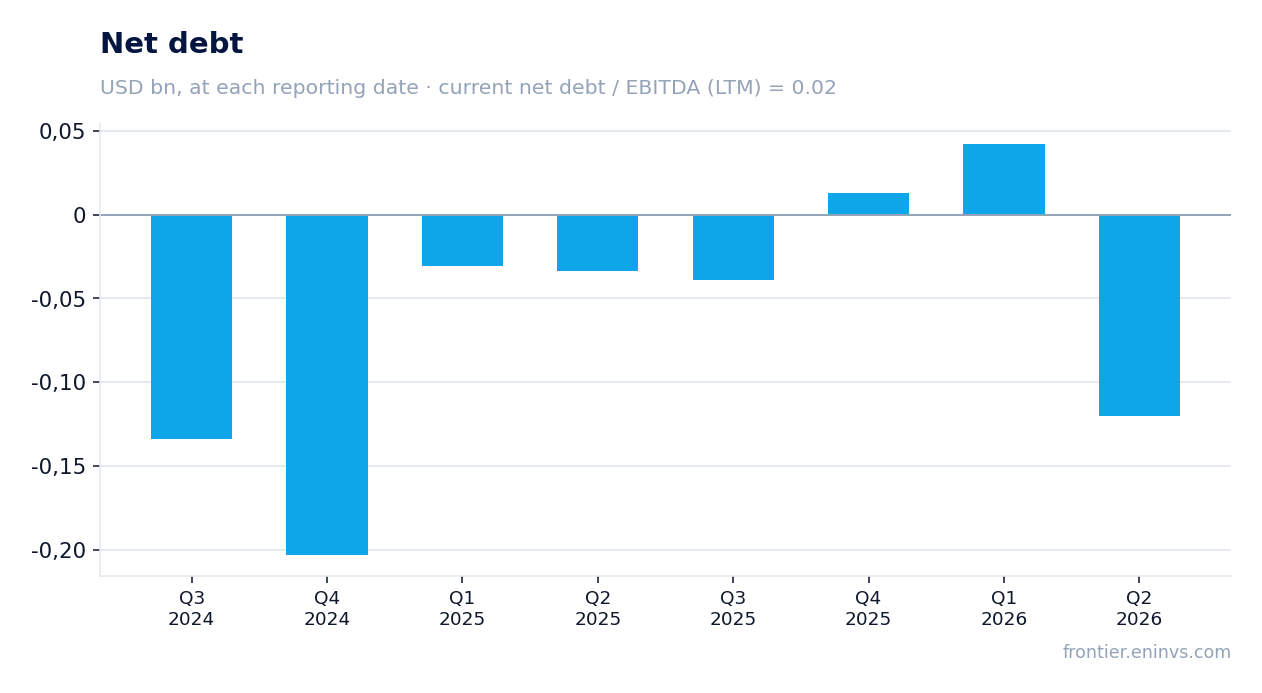
Net debt at the end of the second quarter of 2026 was $13.0m. That is a very low level for a company with a market capitalisation of $5.1bn. The ratio of net debt to LTM EBITDA is 0.02. That is a level indicating virtually no debt burden.
The company has $1.0bn of liquidity, including $474.0m of cash and short-term investments. Such a cushion allows it to fund capital expenditures and buybacks without raising debt. Interest expense for the quarter was $7.1m, insignificant for a company of this scale.
The Leer South insurance proceeds improved the cash position: the company received $88.1m in the quarter and another $37.9m in July. These funds increase liquidity and can be directed toward accelerating buybacks. The company explicitly mentions a 'significant reduction in share count' in the second half.
Low debt is a safety cushion, but it does not create value by itself. The question is how the company uses the free funds: if for buybacks at attractive prices, it creates value for remaining shareholders. If to support inefficient assets, the effect will be the opposite.
A 0.40% dividend yield on a $0.10 per-share payout is not a dividend story, it is a buyback story
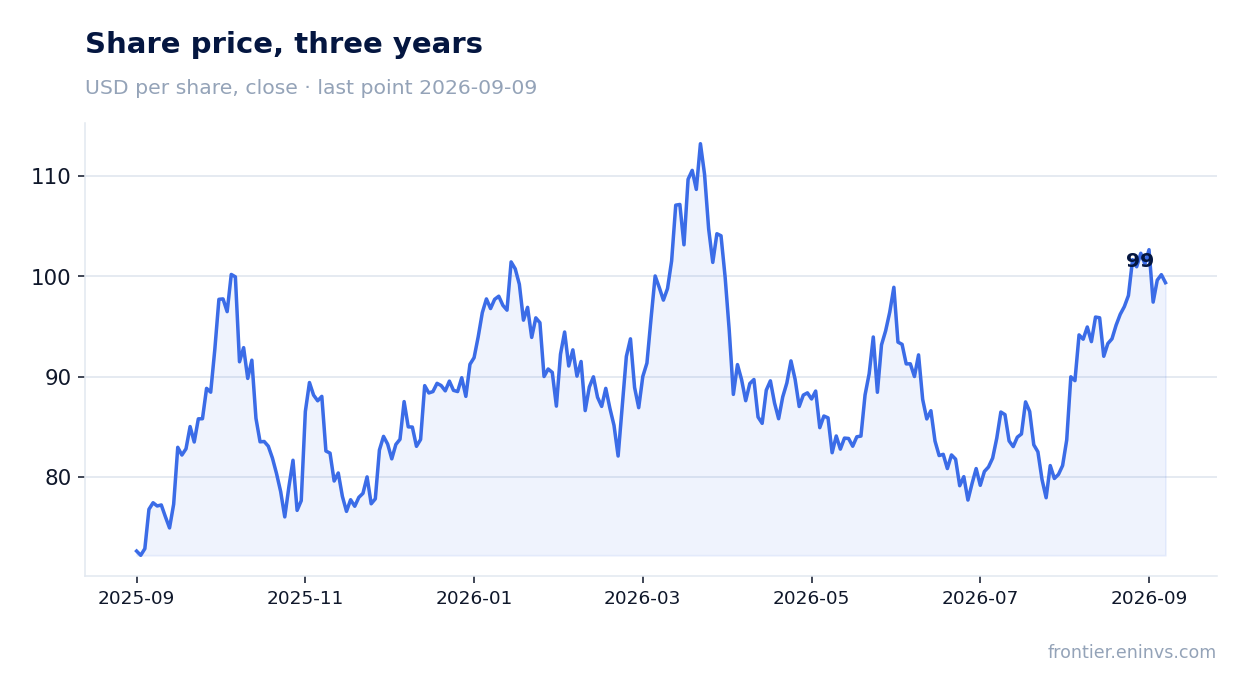
The company pays a quarterly dividend of $0.10 per share. At the current price, that gives a yield of about 0.40% per annum. For comparison, the US key rate is significantly higher, and such a yield is not attractive to income-oriented investors. The dividend here is more of a token payment than the primary means of returning capital.
The main return comes through buybacks. Since February 2025, the company has allocated $329.2m to buybacks and about $31m to dividends. The ratio is roughly ten to one in favour of buybacks. The company states its target return is about 75% of free cash flow, with the majority of that return going to buybacks.
Our estimate for the 2026 dividend: if the $0.10 quarterly rate is maintained, the annual dividend will be $0.40 per share. This is our estimate based on current policy. It could change if the company decides to raise the dividend or if free cash flow falls short of expectations. But for now there is no basis for dividend growth.
What could make the payout smaller: falling coal prices, capital expenditures above guidance, or lower sales volumes. The company has already noted that the US thermal coal market was under pressure from moderate temperatures and low gas prices. If that continues, free cash flow could shrink, and the company might revise the buyback rather than the dividend.
EV/EBITDA of 6.63 against its own three-year average of 7.07 – a discount to its own history on one-off profit
The EV/EBITDA multiple for the last twelve months is 6.63. That is below its own three-year average of 7.07. So the stock trades at a discount to its own history. However, the earnings on which this multiple is based include the one-off insurance payout. Without it, EBITDA would be lower and the multiple higher.
The P/E for the last twelve months is 50.6. That is a high level, reflecting low earnings for the period. Excluding one-off items, the picture might differ. But on reported figures, the stock looks expensive on earnings and moderate on EBITDA.
Our portal model values the fair price at 4% below the current price. This is our own estimate, not a market consensus. It is based on re-pricing EBITDA at current commodity prices at the target EV/EBITDA. So even with current prices, the stock trades slightly above our estimate.
Since the report was published, the stock has risen 18.8%, and 7.5% on the report day itself. The market reacted positively to the results, especially the cost reduction and accelerated buybacks. However, the rally already reflects much of these improvements. Further gains require either a sustained rise in coal prices or continued cost reduction.
Valuation on the latest reported figures
| Metric | Value |
|---|---|
| Market cap | 5.07 bn USD |
| P/E (LTM) | 50.6 |
| EV/EBITDA (LTM) | 6.6 |
| P/B | 1.38 |
| Net debt / EBITDA (LTM) | 0.02 |
| Operating cash flow (LTM) | 0.31 bn |
| ROE | 13.7% |
| Dividend yield (12m) | 0.4% |
| EV/EBITDA, 3-year average | 7.1 |
Bottom line
The quarter delivered two different results. Operationally, the company improved costs across all key segments, increased metallurgical coal sales, and generated strong free cash flow. But half the profit and a significant part of EBITDA growth came from a one-off insurance payout that will not recur. Debt is virtually absent, buybacks are active, but a 0.40% dividend yield does not make the stock attractive for income. At an EV/EBITDA of 6.63 against a three-year average of 7.07 and a portal-model upside of -4%, the share looks rather attractive, but only if the company holds costs and the coal market recovers. If the one-off effects fade and prices stay weak, the current valuation may prove stretched.
Open the company's financial profile CNR →
See also: market overview · valuation map · stock screeners