The gas pause: US gas producers and the widest arbitrage in energy (EXE, GPOR, RRC, CNX)
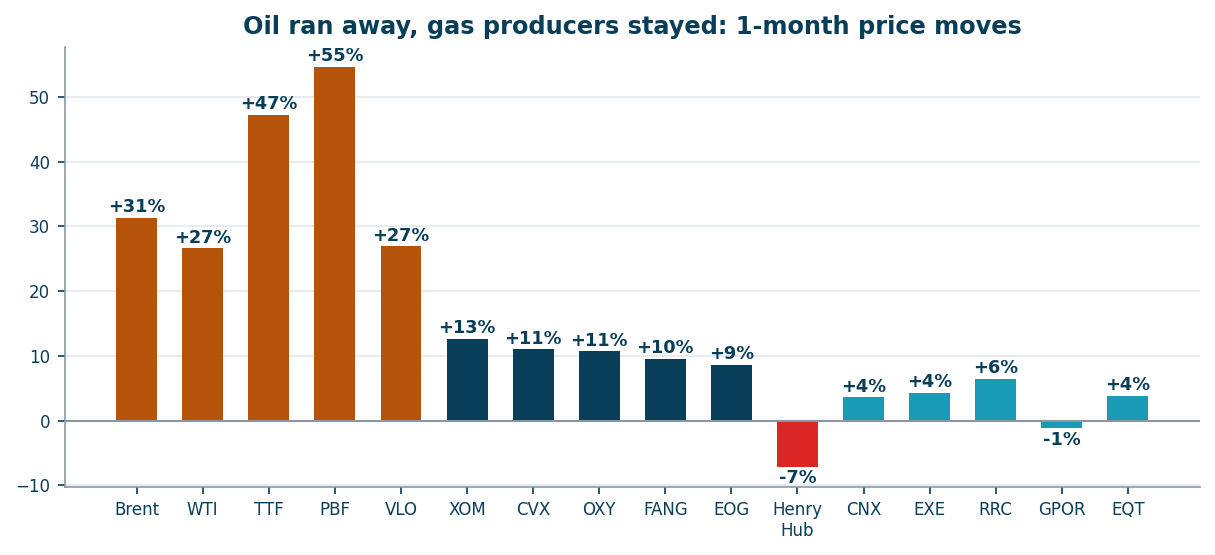
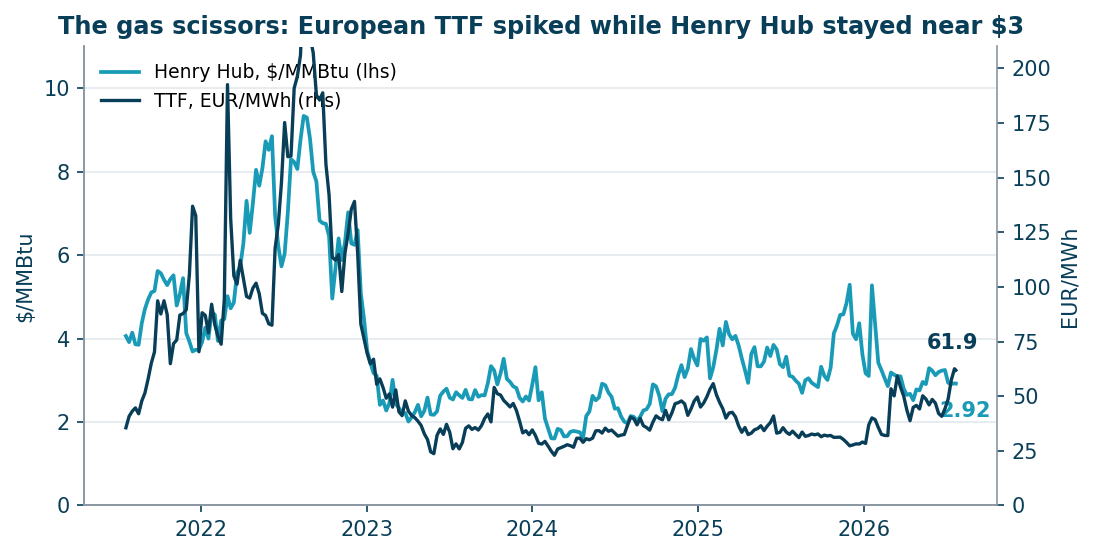
While oil spiked 31% in a month on the Hormuz crisis (Brent ~$101) and European gas jumped to ~EUR 60/MWh, US natural gas went the other way: Henry Hub - the benchmark price at the US pipeline hub in Louisiana - sits near $2.9-3.2/MMBtu, and the producers' shares have gone nowhere. This review checks whether that gap is an opportunity: the macro setup, our screening model, and a hard look at four names - Expand Energy, Gulfport, Range Resources and CNX - through primary filings: hedge books, breakevens, debt and buybacks.
Why not the oil producers: the move is largely priced in
The obvious question is why not simply buy oil names - Exxon, EOG, Occidental, Diamondback. Because their repricing has largely happened: the stocks followed crude up, and on a normalized oil price they are now expensive. Our model values producers on the lower of spot and the 3-year average - for oil that means ~$75-80, not $101 - and on that basis the US oil E&Ps screen deeply negative: OXY -16%, EOG and Chevron around -42%, Exxon -44%, ConocoPhillips -64%, Diamondback -82%. Buying them today means paying for spike-level oil as if it were permanent, while the spike itself is geopolitical and reverses on any Hormuz de-escalation. If your scenario is a prolonged blockade and $100+ oil for quarters, oil producers will deliver earnings upgrades - but that is a bet on geopolitics, not on a mispricing. The gas leg offers the opposite asymmetry: spot near the floor and structural demand still ahead.
Two prices for the same molecule: the widest arbitrage in energy
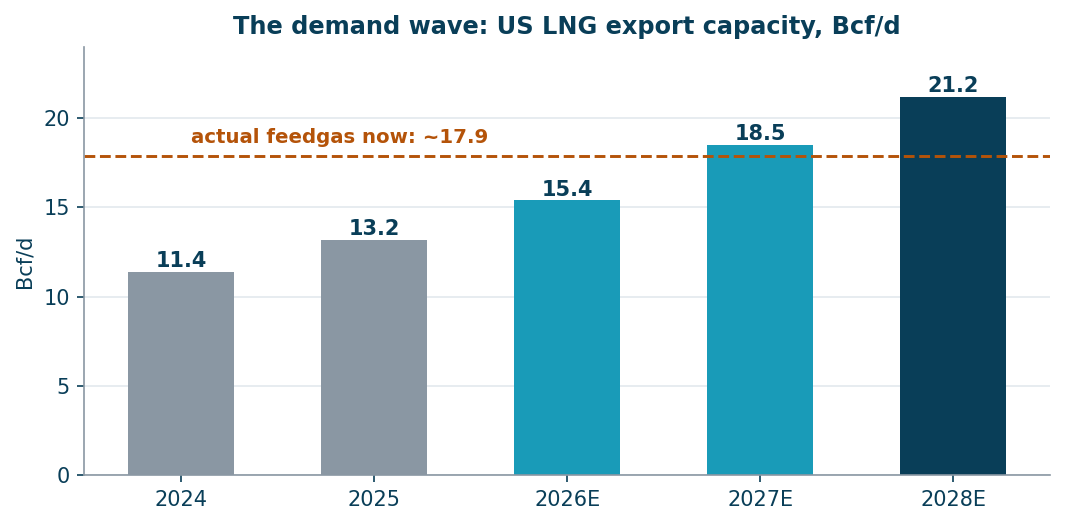
The same unit of energy costs ~$2.9-3.2 in the US and ~$20 equivalent in Europe (TTF is the European gas benchmark). The gross spread of ~$17/MMBtu dwarfs the full cost of liquefying and shipping US gas (~$4-5), so every LNG plant on the Gulf Coast runs at maximum: March 2026 set an export record, and terminals consume ~17.9 billion cubic feet of gas a day (Bcf/d) - about 15% of all US production. The constraint is liquefaction capacity, not economics - and that capacity is in the middle of its biggest expansion wave ever.
Why Henry Hub is cheap - the honest part
US gas is cheap for real reasons. Production is at an all-time record (~111 Bcf/d of dry gas in June, +3.4% y/y). Storage is 6% above the 5-year average. And oil at $100 makes it worse: Permian oil wells produce associated gas as a by-product regardless of gas prices (~28 Bcf/d and growing). The most sobering fact: back in January the US Energy Information Administration forecast $4.60 gas for 2027; by July it had cut that forecast to $3.49 - supply keeps absorbing the demand growth. Anyone buying gas producers must respect this: the bear case is not hypothetical, it is the current trajectory.
What changes in 2026-2028: the LNG wave plus data centers
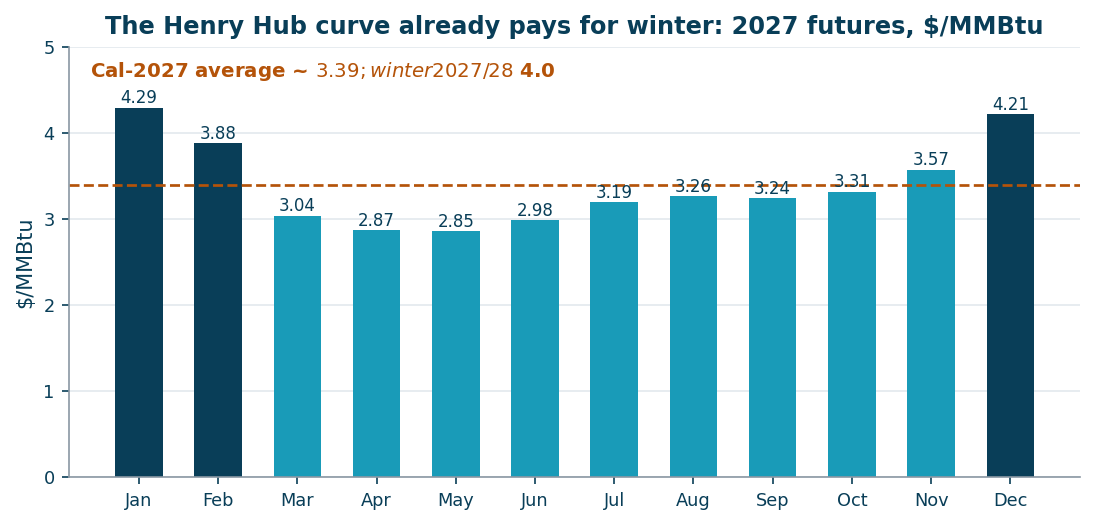
US LNG export capacity grows from 15.4 Bcf/d to ~21.2 Bcf/d by 2028 - a wave of ~6 Bcf/d of new structural demand. It is not a forecast, it is concrete: Plaquemines runs at full rates, Corpus Christi Stage 3 is commissioning, Golden Pass (delayed two years) shipped its first cargo in April 2026 and adds two more trains through 2027, Port Arthur and Rio Grande follow in 2027. On top of that, AI data centers: independent estimates (S&P Global, East Daley) see +3-6 Bcf/d of gas demand for power by 2030, and the deals are already signed - the 4.5 GW Homer City campus in Pennsylvania, the largest gas-fired plant in the US, is contracted to burn Appalachian gas from 2027. The futures curve already prices the shift partially: calendar-2027 averages $3.39 with winter months above $4.20.
Our screen - and why hedges pick your scenario
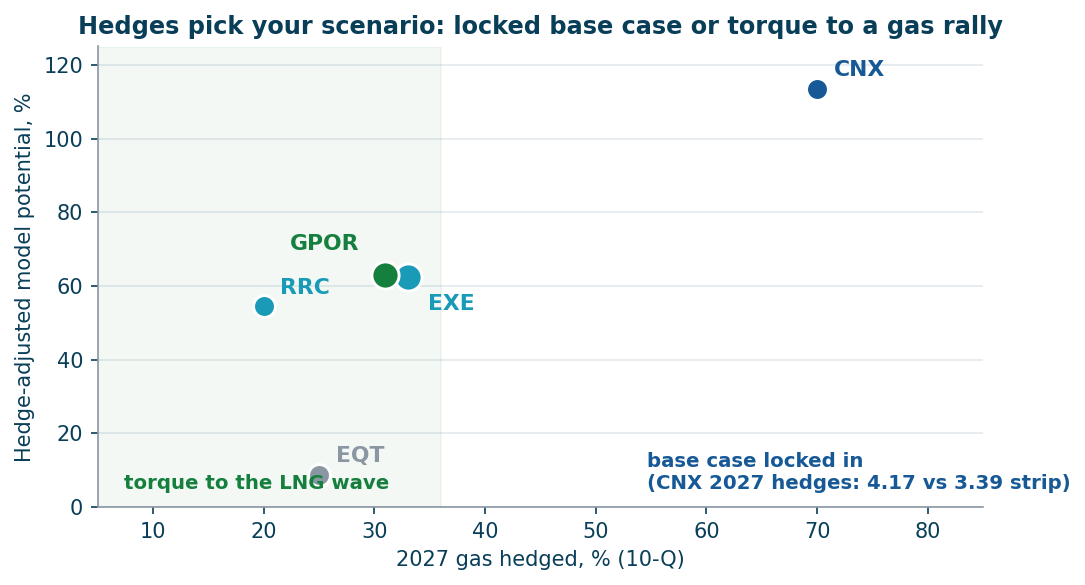
Our spot-potential model (recomputed nightly; conservative price basis = the lower of spot and the 3-year average, EV/EBITDA capped) puts the gas producers at the top of coverage - but the raw screen passes through two mandatory filters before it becomes a recommendation. Filter one, hedges: a hedge is a contract fixing the sale price of future production, so the model values each disclosed hedge book (10-Q volumes and strikes) against its scenario price and books the difference as an adjustment to net debt - a quasi-debt below the scenario price, an asset above it. Filter two, reserve life: for a producer the upside only exists for as long as there is something to produce, so where proved reserves divided by annual production (R/P) come in under 15 years, the model cuts the potential by a finite-life annuity factor. Both filters applied: CNX +114% (16 years of reserves, 2027 hedges at $4.17 - an asset against a ~$3 base), Range +54% (22 years), Gulfport +18% (11 years), Expand +10% (9.9 years), EQT +10% (11 years). The reserve-life filter is harsh - it cut Expand from +62% and Gulfport from +63% - and it flips the ranking of this review.
A note on freshness: the figures in this review are locked as of July 23-24, 2026. The model itself recomputes every night with live prices - gas moved 8% within days of publication - so treat the numbers here as a dated snapshot and check the live potentials on the Frontier company cards.
Pick #1 - CNX: the model leader through both filters
CNX survives both filters better than anyone: 16 years of proved reserves and a hedge book that at today's soft curve is an asset - 2027 NYMEX swaps at $4.17 versus a $3.39 strip. The base case is effectively locked: ~$525mn of guided FCF regardless of gas, all of it going into buybacks that have retired 37% of the share count since 2020. The catch has a clock attached: 70-81% of production is sold through 2027, so CNX participates in the LNG wave only as the hedges roll off - which happens from 2028, right as the export capacity ramp completes. Risks to respect: leverage of 1.8x versus 0.5-0.9x at peers, ~12mn shares of convertible dilution in 2026, ~$70mn of guided FCF riding on 45Z tax credits awaiting a final Treasury rule, and a Hold-leaning Street consensus (~$39 average target) that sees the same hedges and prefers to wait.
Pick #2 - Range Resources: the torque with the longest inventory
Range is the torque leg that survives the reserve-life filter: 22 years of proved reserves (and 30+ years of drilling inventory by management count), the lowest breakeven of the group (~$2.00), only ~20% of 2027 gas hedged - the most open book among the five - plus 30% liquids sold at a record export premium (+$3.49/bbl over Mont Belvieu in Q2). Production grows from 2.30 to ~2.6 Bcfe/d by 2027, and a quarter of its gas contracts with LNG exporters reprices into the 2026-27 wave. The price of all this quality: 6.2x EV/EBITDA - the most expensive multiple in the group after EQT - and a Hold consensus. You are not buying a discount, you are buying the longest-duration exposure to the thesis, with a +54% adjusted potential.
Downgraded on reserve life: Expand and Gulfport
Both remain excellent operating machines - Expand with 0.5x leverage, a 12.5% FCF yield and a Buy consensus (+34-43% targets); Gulfport with 0.9x leverage, a 12.7% FCF yield and ~10%/yr share-count shrink. But their proved reserve lives are short: 9.9 years at Expand, 11.2 at Gulfport - and the model's discipline cuts their potentials to +10% and +18%. One honest caveat cuts the other way: proved R/P understates shale inventory by construction (undrilled locations are not booked as proved - Gulfport's management counts ~15 years of inventory, Expand touts the deepest low-breakeven Haynesville inventory plus the Western Haynesville appraisal). Investors willing to credit unbooked inventory can hold them at smaller size; the Street clearly does. Our model does not credit what is not booked - the same discipline that kept Kumba out of our 13 ideas.
The bench: EQT
EQT (we hold it) is the quality consensus pick with the data-center contracts (1.5 Bcf/d signed) - and it fails both value tests at once: the most expensive multiple (5.8x EV/EBITDA) and an 11-year reserve life that caps the adjusted potential at ~+10%. We are not adding; the position stays as a quality holding, not a potential play.
The Q2 prints landing this week: weak headlines, watch something else
Should you expect strong Q2 reports? Headline-wise, no - and two of the five have already proven it. EQT and Range both reported on July 21. EQT was operationally strong: volumes above the top of guidance, full-year production guide raised by 90 Bcfe with capex cut by $25mn, a record 29,000-foot lateral. Range printed record production and an EPS beat - but realized prices fell from $4.84/mcfe in the spike-quarter Q1 to $3.53, net income declined y/y, and the stock fell on the report. That is the template for Expand (July 28) and CNX (July 30): solid operations, sequentially weaker prices. For the thesis this is fine - expectations are low and the stocks have not moved, so a soft print is already in the price (Range just demonstrated it). What actually matters in these reports: whether 2027 hedge books get extended (that would cut the torque this idea is built on), Expand's buyback ramp now that its debt target is done, production guides into the LNG wave, and CNX's clarity on its 45Z tax credits. One honest irony to note: EQT's guidance raise is itself part of the bear case - operational outperformance is exactly how record supply keeps outrunning demand.
Base case (the current curve, ~$3.4-3.5 through 2027): all four generate high single-digit to low double-digit FCF yields; buybacks convert flat gas into ~10-15%/yr per-share compounding. Bull case (the LNG wave outruns supply, $4.25-4.50 average in 2027): EBITDA of the low-hedged names grows 30-40%+ at multiples of 3-3.5x - this is where Range's +54% adjusted potential gets realized, and CNX's locked economics roll into the same prices from 2028; Expand alone guides to ~$3.85bn annual FCF at $4.00 gas (17% yield). Bear case (supply keeps winning, $2.70-3.00): breakevens of $2.00-2.60 keep everyone FCF-positive, CNX outearns peers on its $4.17 hedges, GPOR/RRC keep shrinking share counts at depressed prices. The main risks: Permian associated gas at $100 oil (price-insensitive supply), LNG project slippage (Golden Pass was two years late), a warm winter on top of +6% storage, and the sector's own capital discipline breaking if prices do rally.
How to buy
All five are liquid US listings (NYSE/NASDAQ), available at any international broker including Interactive Brokers at standard commissions; options are liquid for EXE and EQT. No withholding complexities beyond the standard 15-30% US dividend tax - and for GPOR and CNX there is no dividend at all, returns come via buybacks.
Prepared by Enhanced Investments from company filings (10-Q/10-K, Q1-Q2 2026 releases: Expand Energy, Gulfport, Range Resources, CNX, EQT), EIA data (STEO July 2026, storage and production reports), CME futures and exchange data; July 2026. Not individual investment advice.
Open the company's financial profile NATGAS →
See also: market overview · valuation map · stock screeners