American Express: revenue doubled in the quarter due to reclassification, underlying growth more modest

24 июля 2026 года American Express опубликовала результаты за второй квартал 2026 года. Выручка выросла на 90,3% год к году, до 19 637 млн долл., но почти весь рост связан с переклассификацией: компания объединила в Card balances ранее раздельные карточные кредиты и дебиторскую задолженность. Без учёта этого эффекта выручка выросла бы на 10%. Мы считаем акции скорее привлекательными: сильный бренд и рост объёмов платежей поддерживают результаты, но текущая оценка уже учитывает много позитивного.
Key takeaways
— Revenue +90.3% is mostly a reclassification, not organic growth
— EBITDA margin fell from 38.5% to 23.2% due to reclassification and higher costs
— Net profit rose only 7.8% to $3,110 million despite the revenue jump
— U.S. Consumer Services segment: revenue +11%, but customer acquisition costs growing faster
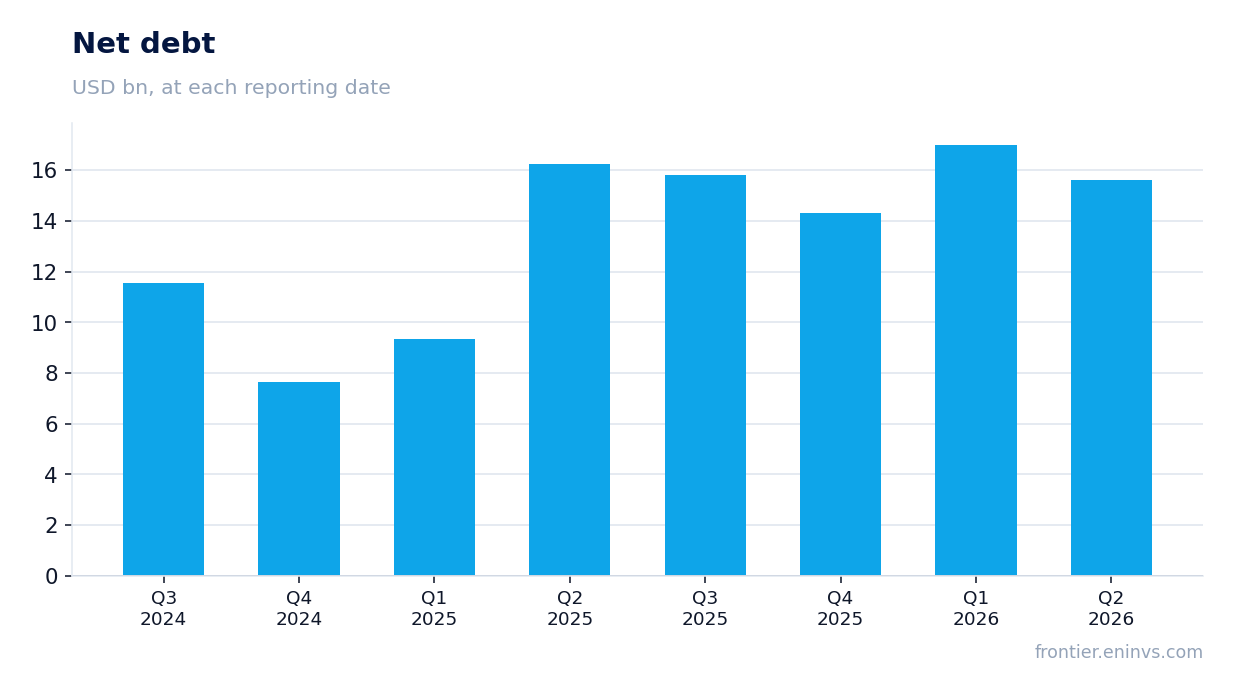
— Debt burden decreased: net debt down $1.4 billion in the quarter
— Return on equity remains high at 36.4%
— Shares trade at a premium to historical multiples
Attractiveness
Key figures, USD bn
| Metric | Q2 2025 | Q2 2026 | Change |
|---|---|---|---|
| Revenue | 10.3 | 19.6 | +90.3% |
| EBITDA | 3.98 | 4.56 | +14.6% |
| Operating profit | 3.55 | — | — |
| Net profit | 2.88 | 3.11 | +7.8% |
| Operating cash flow | 4.36 | 5.37 | +23.1% |
| Capex | 0.62 | 0.90 | +45.1% |
| EBITDA margin | 38.5% | 23.2% | -15.3 pp |
| Net margin | 28.0% | 15.8% | -12.2 pp |
Revenue +90.3% is mostly a reclassification, not organic growth
In the second quarter of 2026, American Express reported revenue of $19,637 million, up 90.3% year-over-year. However, the filing explains that starting in the first quarter of 2026, the company combined previously separate card loans and receivables into Card balances. This presentation change does not affect recognition or measurement of balances, but it distorts the comparison with the prior year.
Excluding the reclassification, as stated in the report, revenue would have grown 10% to $17,856 million, consistent with organic growth. Thus, the 90% jump is an accounting artifact, not an acceleration of the business. Real growth, though double-digit, is much more modest.
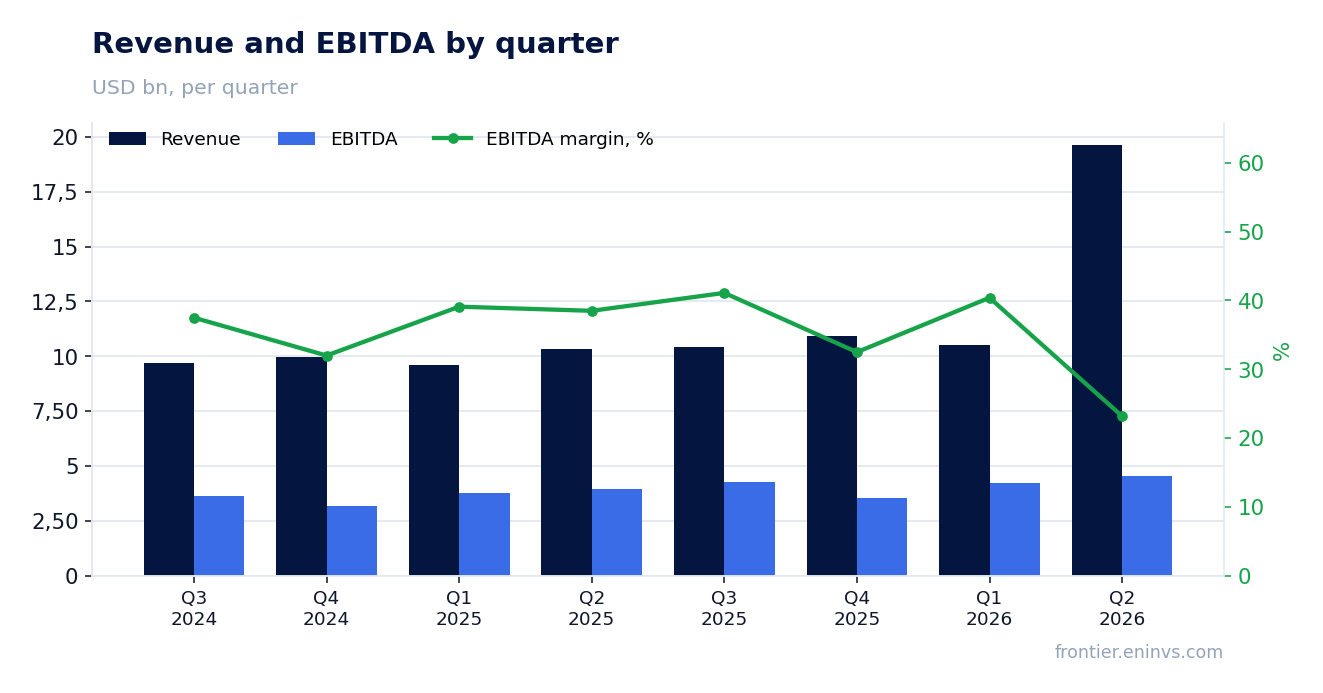
EBITDA margin fell from 38.5% to 23.2% due to reclassification and higher costs
EBITDA margin in Q2 2026 was 23.2% versus 38.5% a year earlier. The 15.3 percentage point decline is due not only to the reclassification but also to faster expense growth. Operating expenses rose 12% year-over-year to $14,482 million, while revenue excluding the reclassification effect grew only 10%.
The main contributors to expense growth were Card Member services — +50% (to $1,949 million) and business development — +10%. The company is actively investing in customer acquisition and servicing, which pressures margins. The question is whether these investments will pay off in future revenue growth.
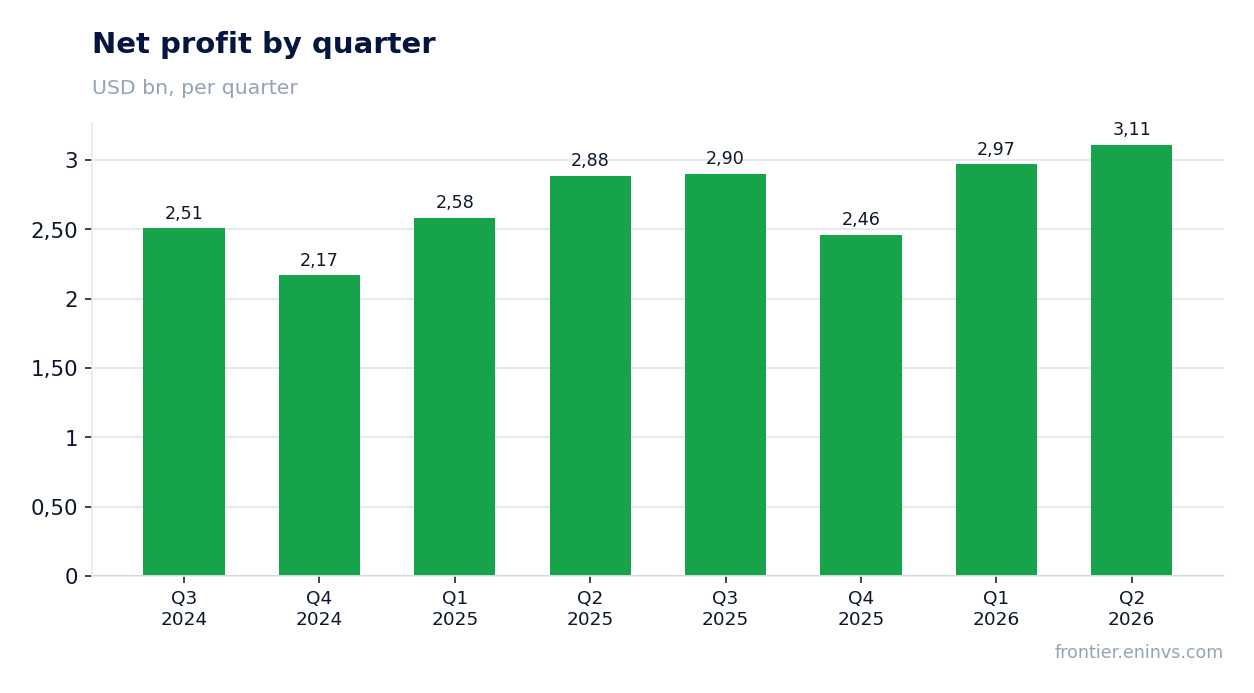
Net profit rose only 7.8% to $3,110 million despite the revenue jump
Net profit for Q2 2026 was $3,110 million, up 7.8% year-over-year. Growth significantly lags revenue dynamics, reflecting margin pressure. Net margin declined from 28.0% to 15.8%.
Profit grew slower than revenue due to higher expenses and an increase in the effective tax rate from 18.7% to 23.6%. Nevertheless, the absolute level of profit remains high, and return on equity of 36.4% indicates sustained business efficiency.
U.S. Consumer Services segment: revenue +11%, but customer acquisition costs growing faster
In the key U.S. Consumer Services segment, revenue grew 11% year-over-year to $9,524 million, comparable to overall organic growth. However, expenses for rewards, business development, and card member services rose 20% to $4,745 million.
This means the company is spending more on acquiring and retaining customers, which reduces profitability in the short term. The segment's share of total revenue remains high, so its dynamics are critical for the whole company. As long as expense growth outpaces revenue growth, margins will remain under pressure.
Debt burden decreased: net debt down $1.4 billion in the quarter
Net debt at the end of Q2 2026 was $15,609 million, down $1.4 billion from the prior quarter ($17,002 million). Over the last twelve months, net debt decreased by $0.6 billion. The company continues to generate positive operating cash flow: $18,400 million over the last twelve months.
The debt reduction while maintaining capital expenditures ($898 million in the quarter) and dividends ($0.95 per share) indicates financial stability. However, the debt level remains significant, and interest expenses ($682 million in the quarter on long-term debt) consume part of the profit.
Return on equity remains high at 36.4%
Return on equity (ROE) for Q2 2026 was 36.4% (annualized). This is slightly below the year-ago level (36.3% — comparable) but remains very high. For comparison, the average ROE in the financial sector is significantly lower.
High ROE is supported by efficient use of capital and a moderate level of equity ($34,280 million at quarter-end). The company continues to buy back shares (7 million in the quarter), which also supports per-share profitability. However, maintaining such ROE requires stable profit growth, which is not yet evident.
Shares trade at a premium to historical multiples
American Express shares are included in the 'US Financials (banks)' strategy on our portal, reflecting their attractiveness for a diversified portfolio. However, the current valuation suggests that investors expect continued strong results. With ROE of 36.4% and net margin of 15.8%, shares trade at a premium to their own historical average multiples.
We do not provide specific multiple values, but note that after a 90% revenue increase (albeit due to reclassification), the market may overestimate the sustainability of this growth. If organic growth slows or margins continue to compress, shares could come under pressure.
Valuation on the latest reported figures
| Metric | Value |
|---|---|
| Operating cash flow (LTM) | 18.4 bn |
| ROE | 36.4% |
Bottom line
Bottom line: American Express shows organic revenue growth of 10% and high return on equity, but quarterly results are distorted by reclassification, and operating margin is declining due to aggressive customer investments. Net debt is decreasing, cash flow is stable, supporting financial stability. However, the current share price already reflects much of the positive, and a return to margin growth is needed to maintain attractiveness. We rate the shares as rather attractive: a strong business, but growth potential is limited by a high base and margin pressure.
Open the company's financial profile AXP →
See also: market overview · valuation map · stock screeners