PepsiCo at six-year lows: a Dividend King de-rated from 31x to 18x earnings, with Elliott inside
A look at PepsiCo (Nasdaq: PEP) on the fresh Q2 2026 report. The prompt was 'a good report, but the stock is at six-year lows' - we checked both halves against primary data. Short version: the report is normal rather than good, the lows are real, and the heart of the case is that the market now pays almost half as much for the same earnings (multiple compression from 31x to 18x) while the business kept growing all along - and a large activist shareholder with a change agenda is already inside.
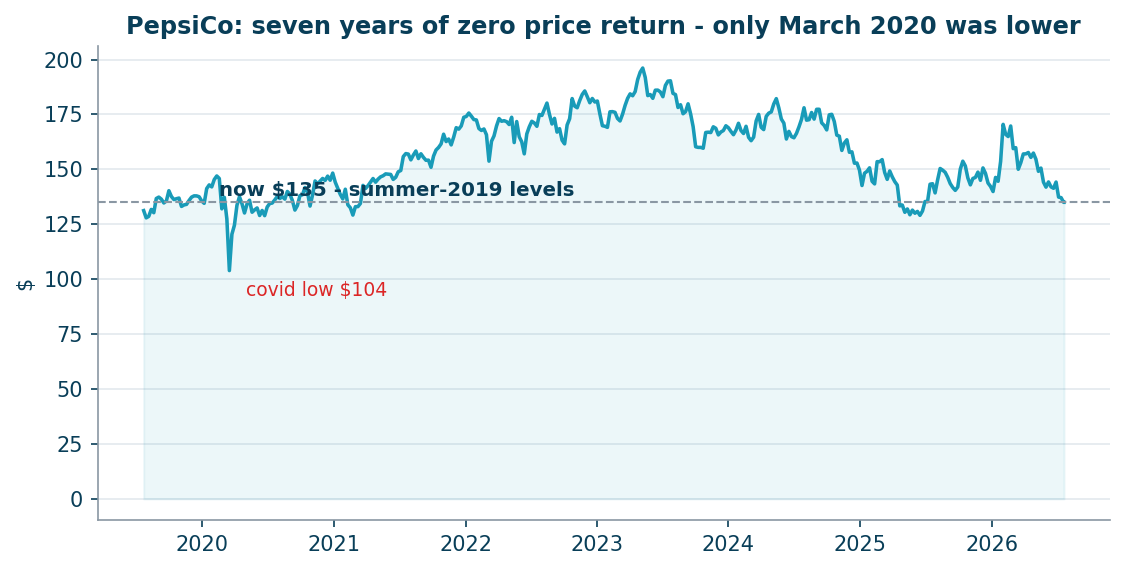
The price is back to 2019: seven years of business growth, none for the stock
$135 per share is summer-2019 territory; in seven years the price was lower only in the covid crash of March 2020 ($104). Formally 'six-year lows' is almost exact: excluding three weeks of 2020 panic, the current price is the bottom of the entire seven-year range. Over those same seven years revenue grew from ~$67bn to $94bn and the dividend was raised every single year.
The Q2 2026 report: 'it did not get worse' is what the market called good
The quarter's facts: revenue $24.18bn (+6.4%) - above expectations; organic growth +2.4%; adjusted EPS $2.20 - 1-3 cents below consensus; full-year guidance confirmed (organic +2-4%, core constant-currency EPS +4-6%). Geography is two-speed: North America is weak (snacks losing pricing power, sluggish volumes) while international - Asia, EMEA, the beverage franchise - grows volumes and pulls the group. In other words, after two years of downgrades a 'good report' literally means 'guidance confirmed, nothing broke' - the expectations bar is on the floor, which is information in itself.
Business vs stock: the entire decline is multiple compression
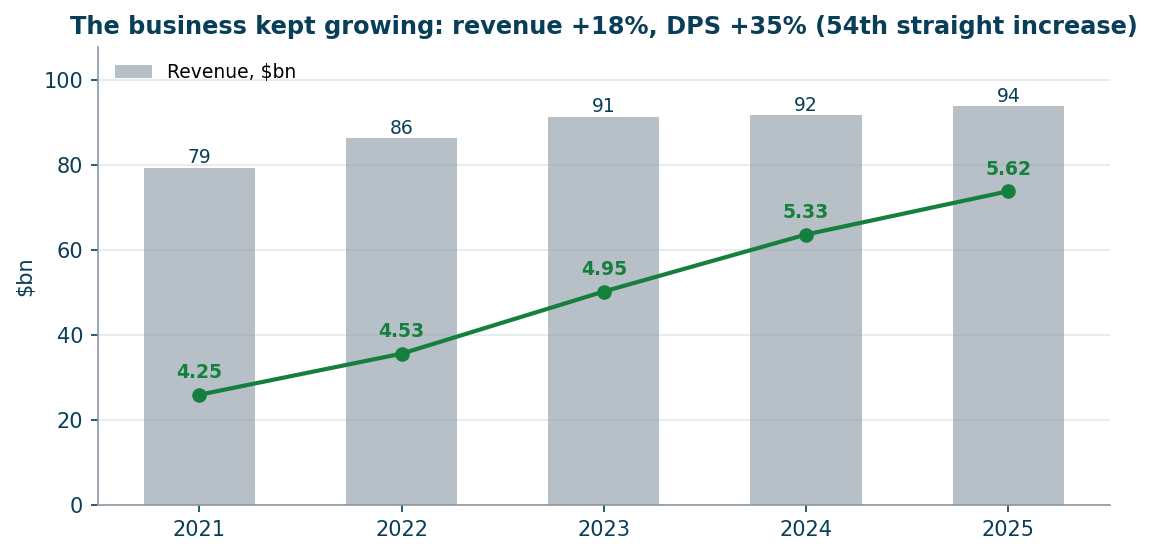
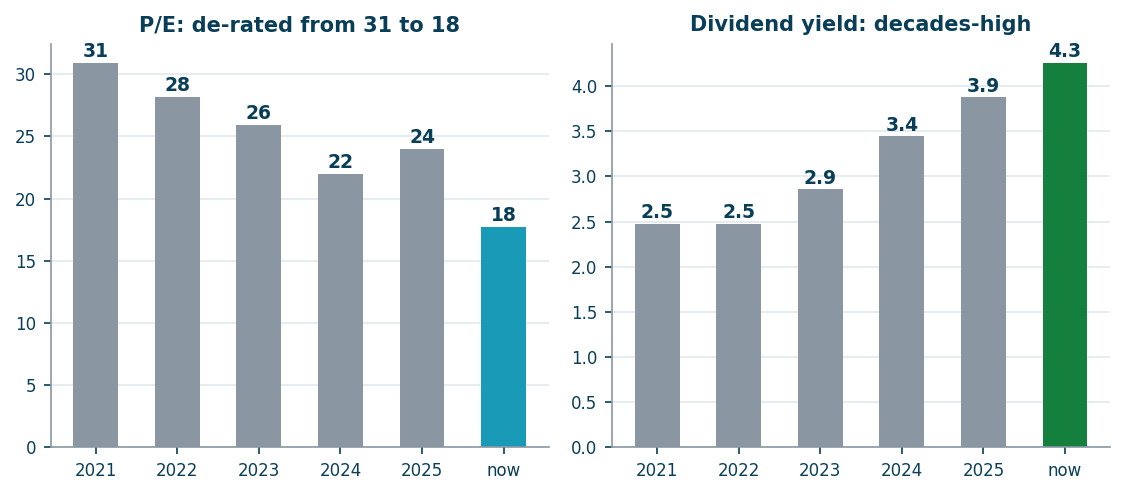
The decomposition is simple. Five-year revenue: $79.5bn to $94bn (+18%). Dividend per share: $4.25 to $5.75 (+35%), the 54th consecutive annual increase - Dividend King status. Meanwhile the multiple compressed from 31x earnings to 17.7x - against its own five-year norm of 24-28x. All of the stock's negative return is de-rating, not business degradation. The 4.3% dividend yield is the highest in the company's modern history.
What GLP-1 is and why it made the stock cheaper
GLP-1 is a class of weight-loss and diabetes drugs (best known: Ozempic, Wegovy, Mounjaro - the 'weight-loss injections'). They suppress appetite, and people taking them snack noticeably less - and snacking, Frito-Lay, is the most profitable part of PepsiCo's business. Hence the market's main fear: that falling US snack volumes are not the temporary belt-tightening of an inflation-weary consumer but an irreversible change of habits.
What independent data say. Consumer-purchase researcher Circana (checkout scanner data - actual sales, not surveys): someone in 23% of US households already takes a GLP-1 drug, and such households buy 10.1% less salty snacks and 8% less sweets; by 2030 households with a GLP-1 user may account for up to 35% of US food and beverage sales. Simple arithmetic: 23% of households x minus 10% on snacks is roughly minus 2-2.5% for total market volumes - noticeable, but not 'the end of snacks'. Meanwhile forecasts for the global salty-snacks market remain positive: +5.4% a year to 2030 (Wissen Research; other agencies put it at 4.7-6%) - driven by international markets, where PepsiCo is doing well. So the pessimists have two arguments - cyclical (the US consumer economising after inflation) and structural (GLP-1) - and so far the facts point more to a cyclical character of the decline: volumes are falling precisely in expensive US snacks while international markets and beverages grow. But only a turn in US volumes can prove that to the market conclusively - and that is what everyone is waiting for.
Elliott with $4bn inside: the catalyst is already working
Since late 2025 Elliott Management holds a ~$4bn position with a public plan: focus the beverage portfolio, optimise bottlers, review the North America supply chain, cut costs aggressively. Management has already announced an NA logistics review and a cost programme. Seven months in, the market wants proof - every next quarter becomes a turnaround checkpoint. An activist of this scale inside a Dividend King is a rare configuration: downside protected by the dividend, upside driven by the activist's plan.
Forecasts: consensus target $169 vs a $135 price
The median target of twelve analysts is $169 (+25%), but the spread is honestly wide: Citi cut to $145 after the report (and the rating to Neutral), Barclays raised to $144; the average rating is Hold. Translated from analyst-speak: 'the business is worth more, but buying before the volume turn is scary'. The company's own 2026 guidance is confirmed: organic +2-4%, core EPS +4-6% in constant currency.
Estimated upside: three scenarios over three years
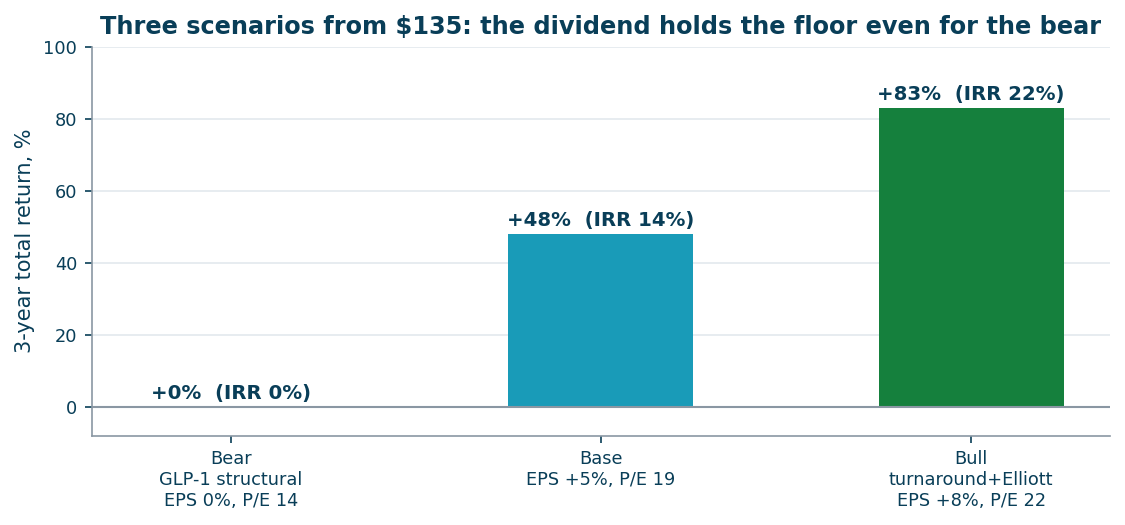
From $135 with forward earnings of ~$8.3 per share (fwd P/E ~16.3). Base: EPS +5%/yr, exit P/E 19 - +48% total return, IRR ~14%/yr (of which ~13pp from dividends). Bull: a volume turn plus the Elliott programme, EPS +8%/yr, return to P/E 22 - +83%, IRR ~22%. Bear: GLP-1 proves structural, EPS flat, de-rating to 14x - roughly zero over three years: the dividend fully offsets the price decline. Probability-weighted (40/30/30) - roughly 12-14%/yr expected dollar return with rare asymmetry: the worst case is ~0, not a loss.
Risks
— GLP-1 may prove structural. Then the bear case is not a tail but the base: US snack volumes never return and 14-16x becomes the new normal forever.
— A long stretch of US consumer weakness. Even without GLP-1 the volume turn may take years; every quarter without it risks new downgrades.
— Rates. A 4.3% dividend against ~4%+ on Treasuries is a minimal premium; if the Fed goes higher, the dividend support for the price weakens.
— A 78% payout. Room to grow the dividend faster than earnings is nearly exhausted - payout growth will be slow until EPS turns.
— The activist may leave. If Elliott sees no progress and sells, part of the catalyst premium leaves with it.
Prepared by Enhanced Investments from PepsiCo filings (Q2 2026 press release, SEC 8-K), Nasdaq data and consensus forecasts; July 2026. Not individual investment advice.
Open the company's financial profile PEP →
See also: market overview · valuation map · stock screeners