PNC: revenue up 21.4% on FirstBank deal, but debt jumps to $85.7 billion

On July 15, 2026, PNC reported second-quarter 2026 results. Revenue rose 21.4% year over year to $6,875 million, net profit increased 24.2% to $2,040 million, and EBITDA margin widened to 39.0% from 36.9%. The shares look rather attractive: growth was driven by the FirstBank acquisition, but debt increased markedly and needs monitoring.
Key takeaways
— Revenue grew 21.4% thanks to the inclusion of FirstBank from January 2026
— Net profit jumped 24.2% to $2,040 million, but $448 million came from a one-off Visa share exchange
— EBITDA margin widened to 39.0% from 36.9% on operating leverage and synergies
— Debt rose to $85.7 billion due to financing the FirstBank acquisition
— Operating cash flow was $2,147 million in the quarter, but only $4,400 million over 12 months
— Retail banking contributed $1,747 million in net profit, corporate banking $1,588 million
— Return on equity is 12.8%, below the average for large US banks
Attractiveness
Key figures, USD bn
| Metric | Q2 2025 | Q2 2026 | Change |
|---|---|---|---|
| Revenue | 5.66 | 6.88 | +21.4% |
| EBITDA | 2.09 | 2.68 | +28.1% |
| Net profit | 1.64 | 2.04 | +24.2% |
| Operating cash flow | 1.48 | 2.15 | +45.1% |
| EBITDA margin | 36.9% | 39.0% | +2.1 pp |
| Net margin | 29.0% | 29.7% | +0.7 pp |
Revenue grew 21.4% thanks to the inclusion of FirstBank from January 2026
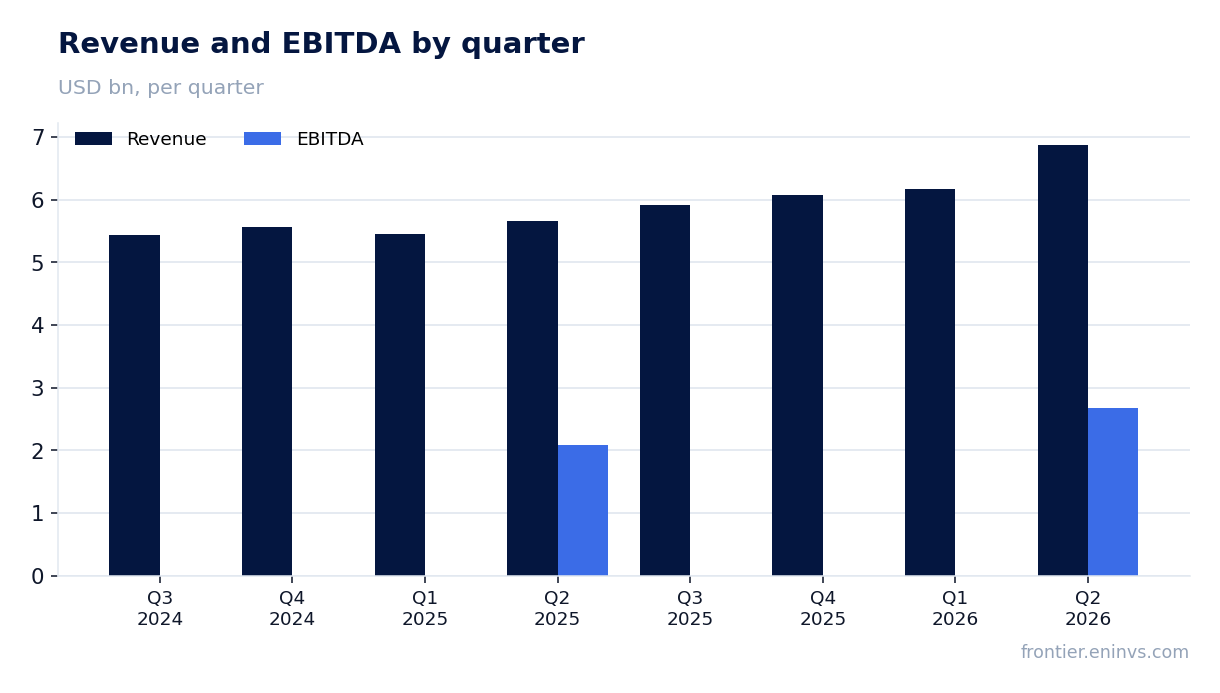
In the second quarter of 2026, PNC's revenue reached $6,875 million, up 21.4% year over year. The main driver was the completed acquisition of FirstBank Holding Company on January 5, 2026: its $26 billion in assets, $16 billion in loans, and $23 billion in deposits have been consolidated into PNC's results since then.
Organic growth also contributed: quarterly dynamics accelerated from +4.6% in Q2 2025 to +13.1% in Q1 2026, but the jump to +21.4% in Q2 2026 is almost entirely the deal effect. Without FirstBank, growth would have been much more modest, though still positive.
Net profit jumped 24.2% to $2,040 million, but $448 million came from a one-off Visa share exchange
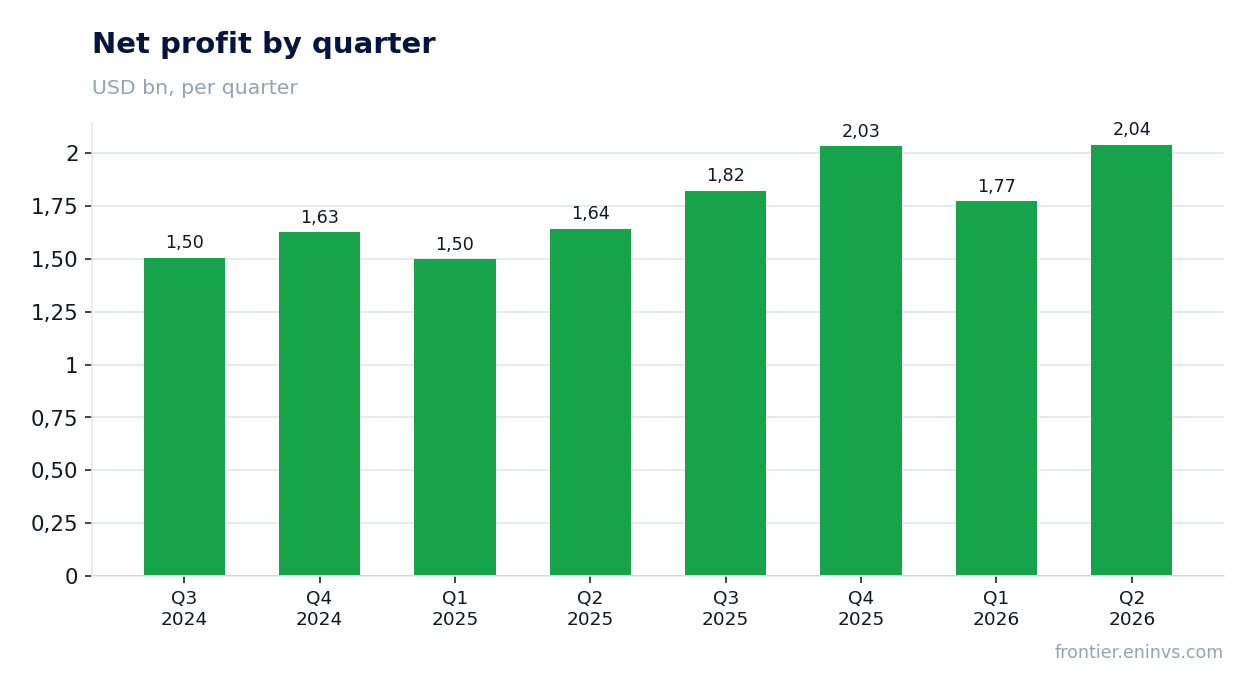
Net profit for the quarter rose 24.2% to $2,040 million. However, other income included $448 million – a gain from the Visa share exchange program. Without this one-off effect, profit would have been about 22% lower, and growth would have been closer to 10–12%.
Still, operating dynamics are strong: net interest income rose to $4,107 million from $3,555 million a year earlier, and credit loss provisions fell to $191 million from $254 million. This indicates good credit portfolio quality despite the FirstBank integration.
EBITDA margin widened to 39.0% from 36.9% on operating leverage and synergies
EBITDA in Q2 rose 28.1% to $2,678 million, and the EBITDA margin expanded to 39.0% from 36.9% a year earlier. Expenses grew slower than revenue: operating costs increased 21% to $4,098 million, while revenue rose 21.4%.
Efficiency (cost-to-income) remained at 60%, typical for a large retail bank. Synergies from the FirstBank integration – conversion of 780,000 customers and 95 branches – are already starting to show, though the full effect will be visible in 2027.
Debt rose to $85.7 billion due to financing the FirstBank acquisition
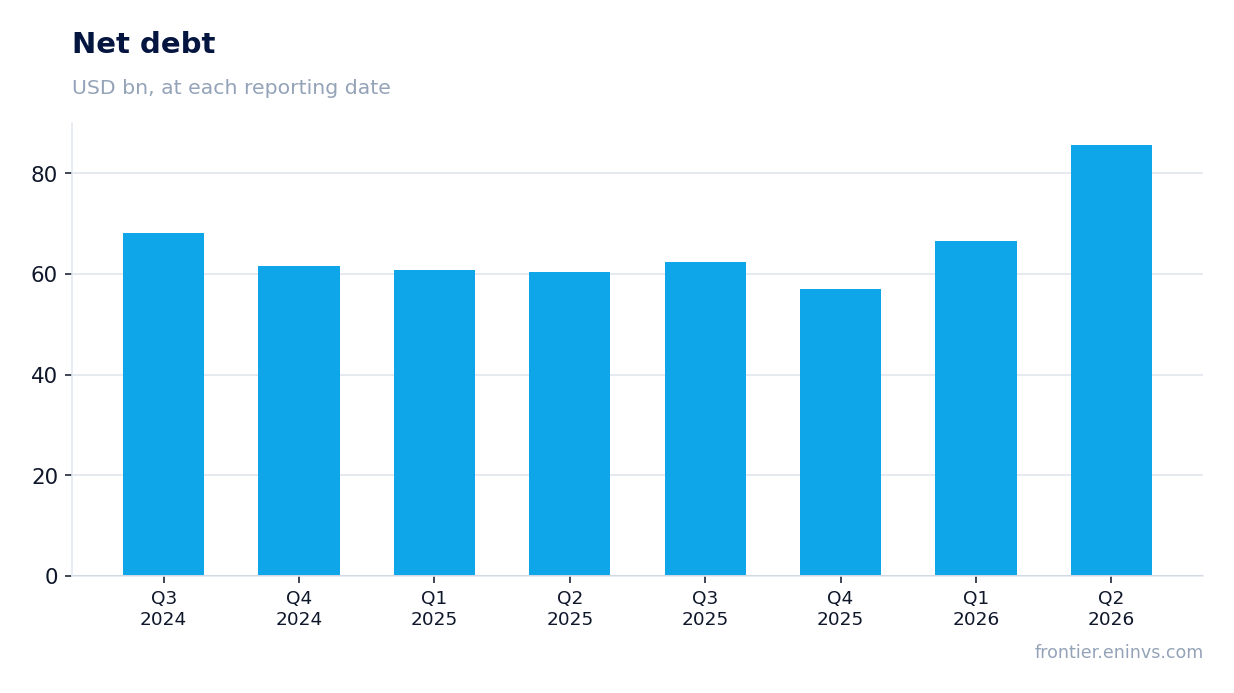
At quarter-end, PNC's total debt stood at $85,723 million versus $60,424 million a year earlier – an increase of 41.8%. The rise was mainly due to Federal Home Loan Bank (FHLB) advances, which grew from $18 billion to $40.4 billion, directly linked to financing the FirstBank acquisition.
Net debt (after cash) jumped by $50.8 billion in the quarter and by $55.7 billion over 12 months, reaching $85,723 million. This is a significant increase in leverage, though manageable for a bank with $616 billion in assets. Interest expense rose to $905 million for the quarter, eating into operating profit.
Operating cash flow was $2,147 million in the quarter, but only $4,400 million over 12 months
In Q2, operating cash flow was $2,147 million, notably higher than a year earlier ($1,480 million). However, over the trailing twelve months it was only $4,400 million – a result of volatility: in Q1 2025 the flow was negative (–$509 million), and in Q4 2025 it was just $757 million.
For a bank, operating cash flow is not a performance metric: it reflects client balances and positions. Still, weak cumulative flow over the year combined with rising debt means PNC is actively using borrowings to finance the deal rather than generating excess liquidity.
Retail banking contributed $1,747 million in net profit, corporate banking $1,588 million
Retail banking earned $1,747 million in net profit for the quarter – the best result among divisions. Segment revenue rose to $4,518 million from $3,792 million a year earlier, helped by the FirstBank inclusion and higher interest income.
Corporate & Institutional Banking contributed $1,588 million versus $1,318 million a year earlier, with revenue of $3,283 million. Asset Management added $135 million. The 'Other' segment showed a loss of $1,430 million – common practice for banks where central items (taxes, unallocated costs) are reported separately.
Return on equity is 12.8%, below the average for large US banks
Return on equity (ROE) over the trailing twelve months was 12.8%. This is decent for a regional bank but below the largest US banks, which often show 15–18%.
The low ROE is explained by the expanded capital base after the FirstBank acquisition: assets grew to $616 billion, and equity to $64 billion. Until synergies are fully realized, ROE will remain under pressure. However, for PNC this is historically a normal level: the bank is not known for high profitability but compensates with stability.
Valuation on the latest reported figures
| Metric | Value |
|---|---|
| Operating cash flow (LTM) | 4.40 bn |
| ROE | 12.8% |
Bottom line
A strong quarter: revenue and profit grew more than 20%, margins expanded, and credit quality remains stable. But a significant part of the growth is the FirstBank acquisition effect, and $448 million of profit is a one-off gain from the Visa deal. Debt rose to $85.7 billion, and this is the main risk: if synergies do not materialize quickly, ROE will stay below 13%, and the shares will trade without a premium to the sector. For now, we view the shares as rather attractive: the bank is strengthening its market position, but investors should watch debt dynamics and integration.
Open the company's financial profile PNC →
See also: market overview · valuation map · stock screeners