SITIME Corp: revenue up 127%, but almost all of the quarter's profit is interest on the cash raised from the bond offering

On August 5, SITIME Corp reported results for the second quarter of 2026. Revenue rose 126.5% year over year to $157.4 million, operating income turned positive for the first time in a while at $8.2 million, and net income reached $18.2 million. Yet $12.5 million of that came from interest on the cash raised for the Renesas acquisition, which only closed on July 1. The shares fell 6.9% the next day, and at $583 the stock looks neutral at best: the growth is real, but profit is still largely financial, and the debt load after the $1.3 billion convertible offering has not yet been tested.
Key takeaways
— Revenue rose 126.5% year over year to $157.4 million, and growth has accelerated for four consecutive quarters
— The 67.1% non-GAAP gross margin rests on amortisation of acquired intangibles, which is excluded from the metric
— Operating income of $8.2 million appeared for the first time, but $8.5 million of costs are one-off acquisition expenses
— A quarter of the $18.2 million net income comes from interest on cash raised for a deal that had not yet closed
— Operating cash flow of $39.8 million covers capital expenditure of $12.4 million, but does not reflect future bond interest
— The $1.3 billion debt appeared on the balance sheet for an acquisition that will only contribute revenue from the third quarter
— At $583, the market values the company at $15.5 billion, leaving no room for error in integrating Renesas
Attractiveness
Key figures, USD bn
| Metric | Q2 2025 | Q2 2026 | Change |
|---|---|---|---|
| Revenue | 0.07 | 0.16 | +126.5% |
| EBITDA | -0.01 | 0.02 | to profit |
| Operating profit | -0.02 | 0.01 | to profit |
| Net profit | -0.02 | 0.02 | to profit |
| Operating cash flow | 0.02 | 0.04 | +159.4% |
| Capex | 0.02 | 0.01 | -32.0% |
| EBITDA margin | -21.3% | 13.5% | +34.8 pp |
| Net margin | -29.0% | 11.5% | +40.5 pp |
Revenue rose 126.5% year over year to $157.4 million, and growth has accelerated for four consecutive quarters
In the second quarter of 2026, revenue reached $157.4 million, up 126.5% from a year earlier. This is the fastest growth in several years: it was 88.3% in the first quarter, 66.3% in the fourth quarter of 2025, and 44.8% in the third. Growth has accelerated for four consecutive quarters, and that is the main fact of the report.
The company attributes the growth to demand for precision timing solutions in data centres, automobiles, and robotics. In the press release, CEO Rajesh Vashist says every segment grew by at least 50%, with the CED segment up 181%. This confirms that growth is not driven by a single customer or market.
However, part of this growth is a low-base effect from last year. In the second quarter of 2025, revenue was $69.5 million, and the company had not yet reached profitability. The base is now higher, and maintaining such growth rates will be harder, especially since the Renesas acquisition closed only on July 1 and was not included in the reported quarter.
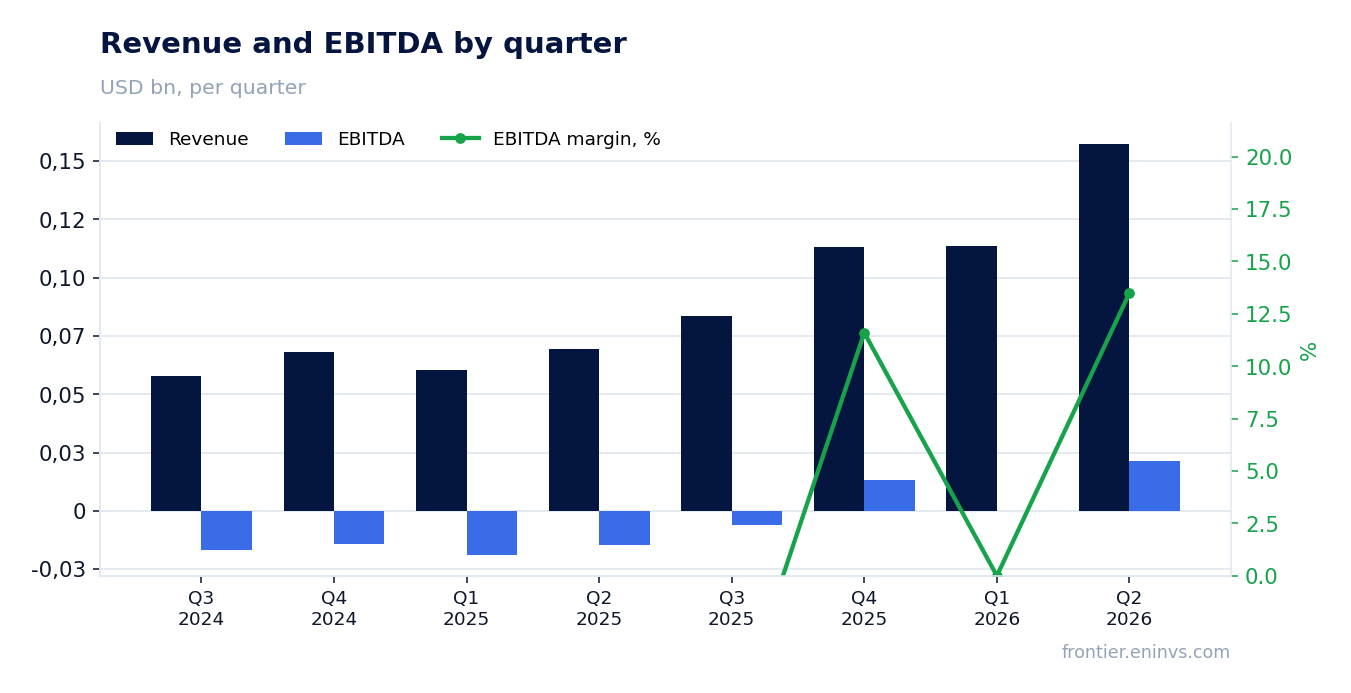
The 67.1% non-GAAP gross margin rests on amortisation of acquired intangibles, which is excluded from the metric
Non-GAAP gross margin was 67.1%, up from 58.2% a year earlier. On a GAAP basis, margin is lower at 63.0%, and the 4.1 percentage point difference is amortisation of acquired intangibles ($5.7 million) and a small share of stock-based compensation. The company prefers to present non-GAAP figures, and this matters for valuation: without excluding amortisation, the margin looks more modest.
The margin improvement is driven not only by scale but also by revenue mix. The higher the share of new products, the higher the margin. The press release does not provide a precise product breakdown, but notes that all segments grew, with CED growing fastest. This suggests the margin improvement is sustainable if there is no pricing pressure.
GAAP operating expenses rose to $90.9 million from $60.7 million a year earlier, mainly due to higher selling, general and administrative expenses ($46.3 million vs. $28.2 million). But on a non-GAAP basis they were $52.1 million, and the main difference here is stock-based compensation ($31.0 million). This is a non-cash expense, but it dilutes existing shareholders.
Operating income of $8.2 million appeared for the first time, but $8.5 million of costs are one-off acquisition expenses
GAAP operating income was $8.2 million versus a loss of $24.6 million a year earlier. This is the first quarter with positive operating income in several years. However, expenses included one-off acquisition costs of $8.5 million. Without them, operating income would have been $16.7 million, but these costs are real and already incurred.
On a non-GAAP basis, operating income was $53.5 million, or 34.0% of revenue, versus $7.2 million and 10.3% a year earlier. This difference arises from excluding stock-based compensation ($31.0 million), amortisation ($5.7 million), and one-off costs ($8.5 million). The company believes non-GAAP better reflects core operations, but investors should also see GAAP profit, which is still much more modest.
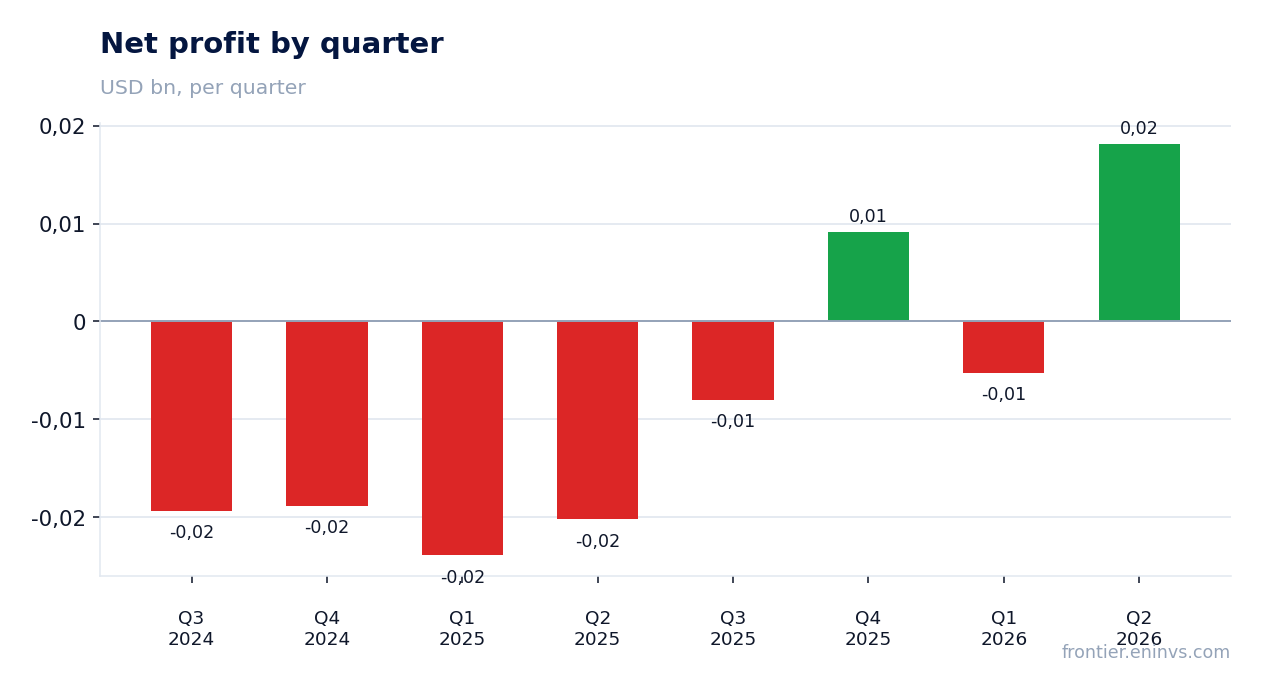
GAAP net income was $18.2 million, or $0.66 per diluted share. The key contribution here came not from operations but from interest income: $12.5 million versus $4.3 million a year earlier. This income arose from the $1.3 billion convertible bond offering the company conducted before closing the deal. So the quarter's profit is largely financial, not operational.
A quarter of the $18.2 million net income comes from interest on cash raised for a deal that had not yet closed
Interest income of $12.5 million is a consequence of the $1.3 billion convertible bond offering. The money arrived before the deal closed, and the company placed it in short-term instruments. As of June 30, 2026, total cash, cash equivalents, and short-term investments were $1,921 million. This is temporary: after the deal closed on July 1, the money will go to the seller, and interest income will decline.
Thus, net income of $18.2 million includes $12.5 million of interest income and only $5.7 million of after-tax operating result. Excluding interest income, profit would be much more modest. This does not mean the business is bad, but it shows that current profitability is largely supported by a financial operation, not core activities.
Diluted earnings per share were $0.66. On a non-GAAP basis, it was $2.34, but that excludes significant non-cash expenses. For assessing business sustainability, operating income and cash flow matter more than net income, which is heavily distorted by one-off factors.
Operating cash flow of $39.8 million covers capital expenditure of $12.4 million, but does not reflect future bond interest
Operating cash flow in the second quarter was $39.8 million, capital expenditure was $12.4 million. Free cash flow was therefore about $27.4 million. This is a healthy figure for a company that was burning cash just a year ago. Over the trailing twelve months, operating cash flow was $87.2 million, confirming the improvement.
However, capital expenditure of $12.4 million is only part of future needs. After the Renesas acquisition, the company may increase investment in integration and development. In addition, interest expenses on the convertible bonds will appear from the third quarter. In the reported quarter they were $2.2 million, but that is only part of the quarter, as the bonds were issued shortly before the period end. The full quarterly interest expense will be higher.
Operating cash flow does not include one-off acquisition costs that passed through operating expenses but are not fully cash. Nevertheless, the ability to generate cash flow is a key argument in favour of the company. If it maintains current momentum, the debt load will not be a problem.
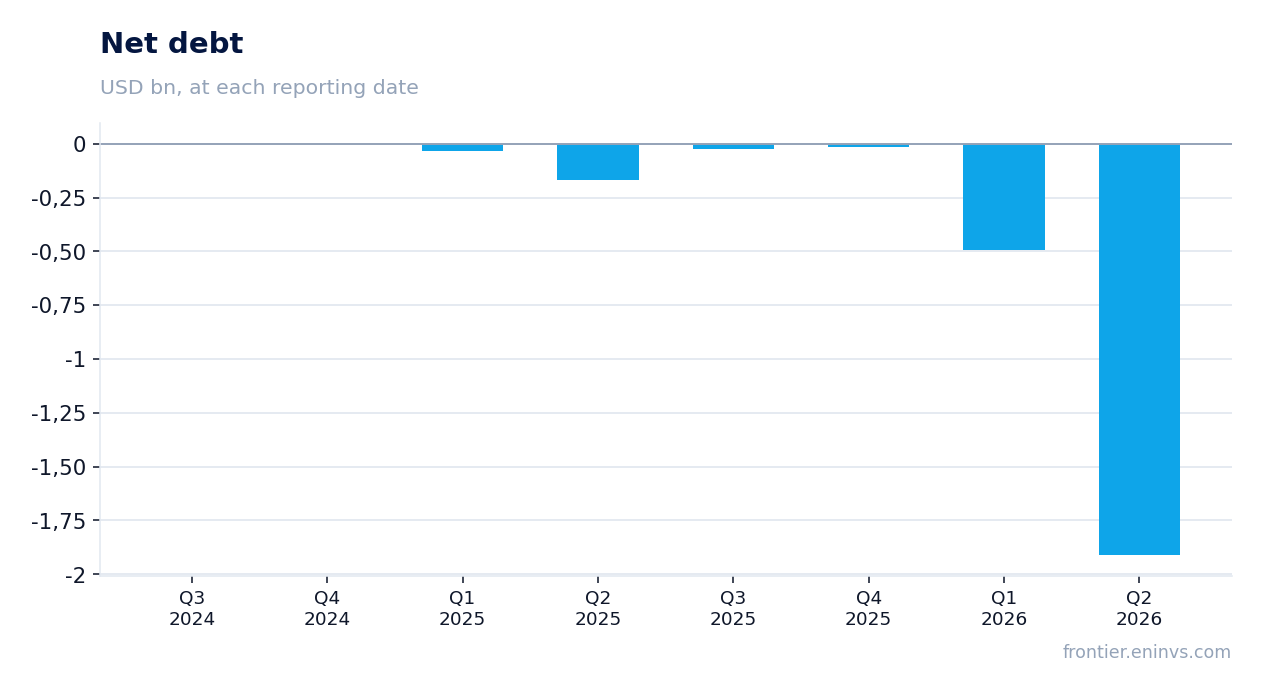
The $1.3 billion debt appeared on the balance sheet for an acquisition that will only contribute revenue from the third quarter
As of June 30, 2026, convertible bonds of $1,317.6 million appeared on the balance sheet. This is a substantial amount for a company with a market capitalisation of $15.5 billion. The money was raised for the acquisition of part of Renesas' business, which closed on July 1. Before that date, the assets generated no revenue, while interest on the debt had already begun to accrue.
Net debt at the end of the quarter was minus $1,911.9 million, meaning the company has more cash than debt thanks to the bond offering. But after the deal closes, cash will decrease by the purchase amount, and net debt will turn positive. The exact deal amount is not disclosed in the press release, but it is comparable to the $1.3 billion raised.
ROE is 6.65%, which is modest for a company with such a market capitalisation. However, it is based on net income, which includes interest income. After the deal closes and amortisation of acquired assets begins, ROE may change. It is important to monitor how quickly the acquired business starts contributing to profit.
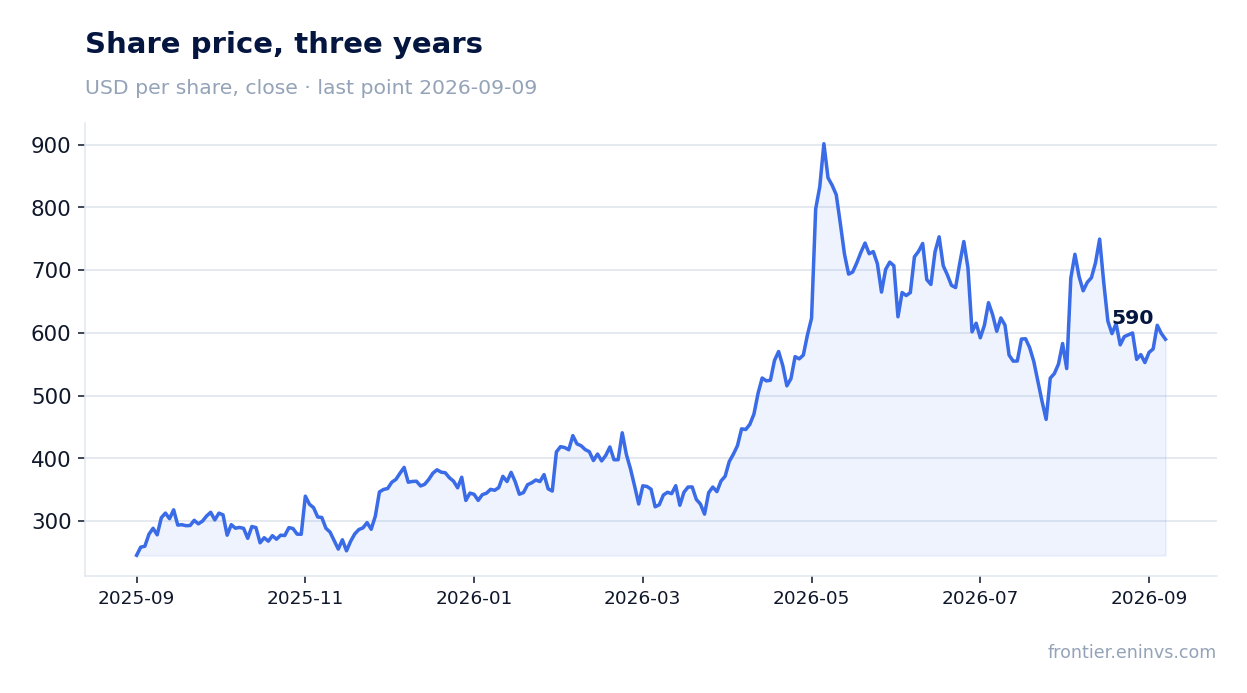
At $583, the market values the company at $15.5 billion, leaving no room for error in integrating Renesas
SITIME Corp shares closed at $583.06 before the report and fell 6.9% the next day. Since then, through September 9, they have gained 1.2%. The market reacted to profit coming in below expectations despite strong revenue. With a market capitalisation of $15.5 billion and trailing twelve-month revenue of $467.9 million, the price-to-sales multiple exceeds 30. This is very high for a chipmaker, even accounting for growth rates.
For comparison, the company historically traded at much lower multiples when it was growing more slowly. Now the market is pricing in continued rapid growth and a successful Renesas integration. If growth slows or integration proves difficult, the valuation could decline. The report does not provide EV/EBITDAC data, so we cannot compare with a historical average, but the price-to-sales ratio speaks for itself.
It is worth noting that the company pays no dividends, so all returns depend on capital appreciation. This makes the investment riskier. At the current price, the stock looks neutral: there is upside potential, but much of it is already priced in.
Valuation on the latest reported figures
| Metric | Value |
|---|---|
| Market cap | 15.5 bn USD |
| P/B | 13.42 |
| Operating cash flow (LTM) | 0.09 bn |
| ROE | 6.7% |
Bottom line
SITIME Corp delivered a strong quarter: revenue rose 126.5% to $157.4 million, and operating income turned positive for the first time. However, a significant portion of net income – $12.5 million out of $18.2 million – is interest income on cash raised for a deal that had not yet closed. The business is indeed growing, but current profitability is largely financial. After the Renesas deal closes, debt load will increase, and the company will need to prove that the acquired assets generate returns. At $583 and a market capitalisation of $15.5 billion, the market is already pricing in very rapid growth, so the shares look neutral. Confirmation of successful integration and sustainable operating cash flow would be needed to improve the assessment.
Open the company's financial profile SITM →
See also: market overview · valuation map · stock screeners