Visa: revenue up 14%, but net income only 7% due to one-off charges

28 июля Visa раскрыла результаты за третий фискальный квартал 2026 года (квартал, закончившийся 30 июня 2026). Выручка выросла на 14% до $11,6 млрд, GAAP чистая прибыль — на 7% до $5,6 млрд, а non-GAAP EPS — на 11% до $3,32. Акции выглядят привлекательно: рост ускоряется, маржа остаётся высокой, а разовые списания не отражают операционную динамику.
Key takeaways
— Revenue +14% driven by acceleration in payments volume and cross-border transactions
— EBITDA margin expanded to 63.6% from 60.3% a year ago, despite higher operating expenses
— Net income rose only 7% due to one-off charges of $0.8 billion
— Free cash flow for the quarter was $6.1 billion, but debt increased by $3.5 billion over the year
— Share repurchases and dividends totaled $6.2 billion in the quarter
— Processed transactions growth of 10% confirms resilience of consumer spending
Attractiveness
Key figures, USD bn
| Metric | Q3 2025 | Q3 2026 | Change |
|---|---|---|---|
| Revenue | 10.7 | 11.6 | +8.5% |
| EBITDA | 6.46 | 7.39 | +14.4% |
| Operating profit | 6.15 | 6.88 | +11.9% |
| Net profit | 5.09 | 5.63 | +10.6% |
| Operating cash flow | 6.24 | 6.55 | +5.1% |
| Capex | 0.39 | 0.42 | +7.2% |
| EBITDA margin | 60.3% | 63.6% | +3.3 pp |
| Net margin | 47.5% | 48.4% | +0.9 pp |
Revenue +14% driven by acceleration in payments volume and cross-border transactions
In the third fiscal quarter of 2026 (quarter ended June 30, 2026), Visa reported revenue growth of 14% to $11.6 billion (13% in constant currency). Key drivers were payments volume, up 10% in constant currency, and cross-border volume, up 13% (excluding intra-Europe, up 12%).
The company notes that growth accelerated compared to previous quarters: in the first fiscal quarter of 2026 (ended December 2025), revenue rose 14.6%, and in the second (ended March 2026), 17.1%. The third quarter showed 8.5% year-over-year, but this deceleration is due to a high base: a year ago growth was 11.5%.
Segment breakdown shows the main contribution came from data processing services (+17% to $6.0 billion) and service revenue (+14% to $4.9 billion). International transactions grew more modestly — by 6% to $3.9 billion, reflecting some slowdown in cross-border, but the overall trend remains positive.
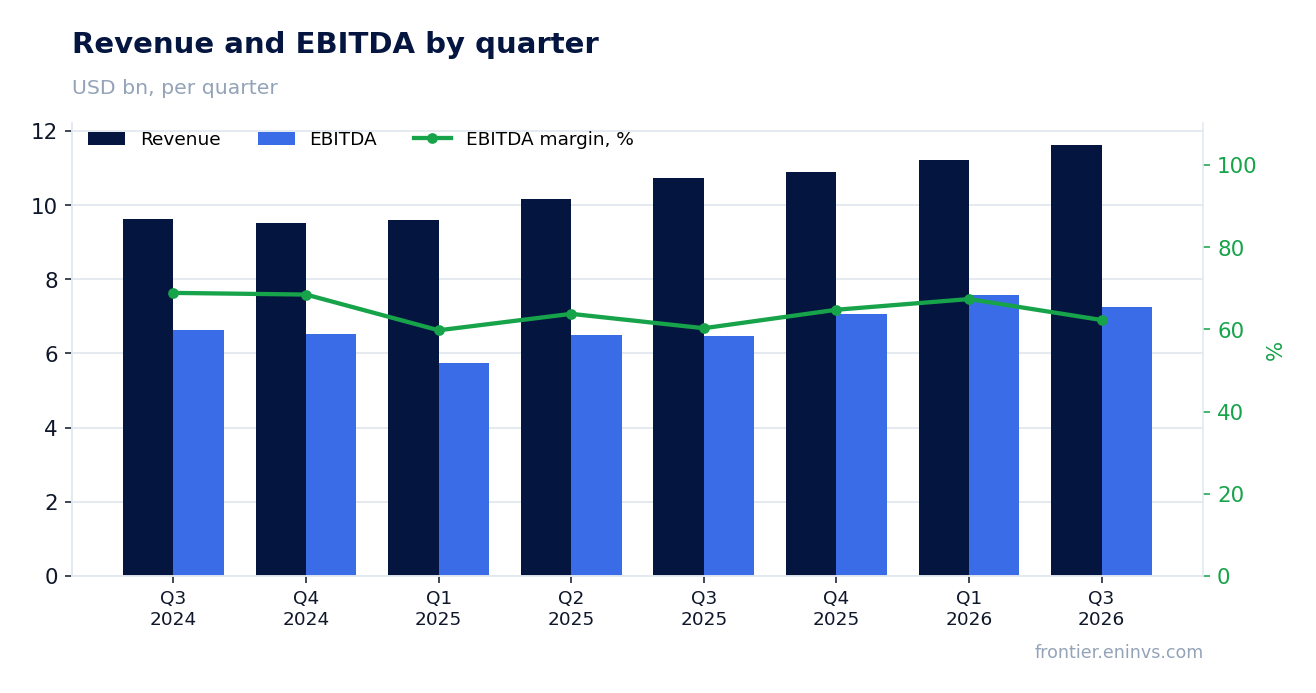
EBITDA margin expanded to 63.6% from 60.3% a year ago, despite higher operating expenses
EBITDA for the reported quarter was $7.2 billion, up 14.4% year-over-year. EBITDA margin expanded to 63.6% from 60.3% in the third fiscal quarter of 2025. The margin improvement was driven by revenue growing faster than operating expenses: GAAP operating expenses rose 19%, but excluding one-off items, only 17%.
The main cost increases were personnel (+41% to $2.5 billion) and marketing (+54% to $0.6 billion), reflecting investments in development and promotion. Nevertheless, high operational efficiency kept the margin above 60%, which is rare for payment companies.
Net margin also improved: 48.4% versus 47.5% a year ago. This confirms that the business generates profit faster than costs grow, even with one-off charges.
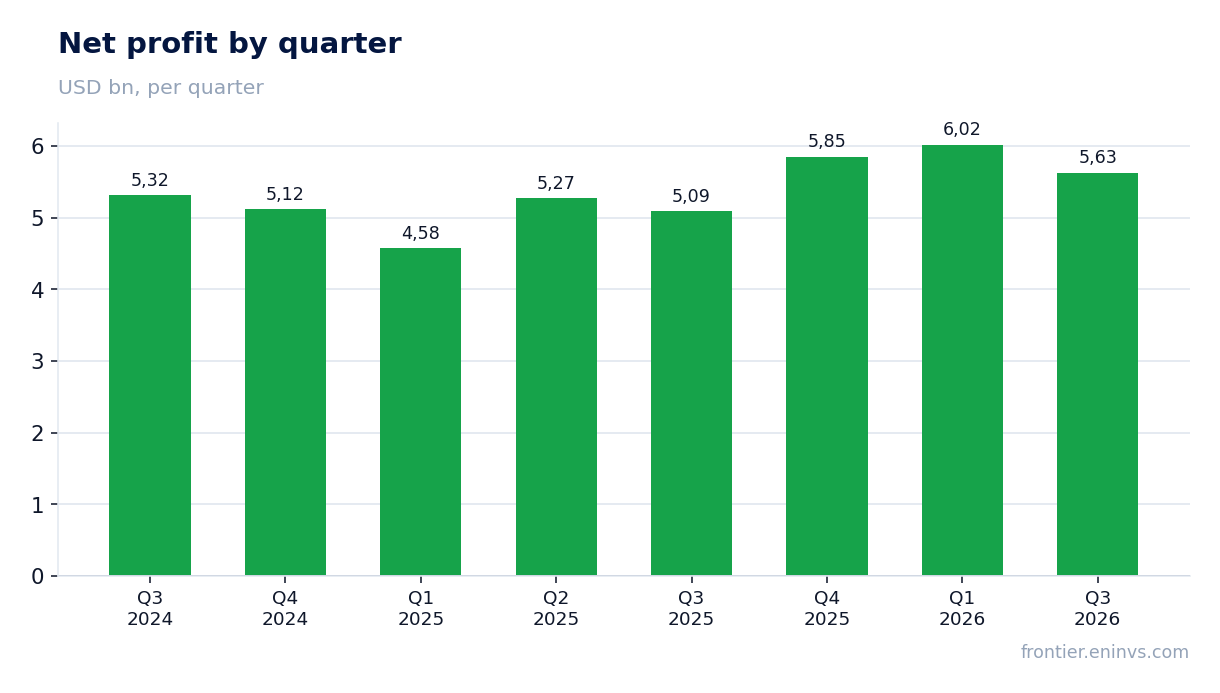
Net income rose only 7% due to one-off charges of $0.8 billion
GAAP net income for the quarter was $5.6 billion, up 7% year-over-year. However, the results include one-off items: $563 million in severance costs, $237 million in litigation provision (interchange MDL), and $18 million deferred tax benefit. Excluding these and other non-operating items, non-GAAP net income rose 8% to $6.3 billion, and non-GAAP EPS rose 11% to $3.32.
The one-off charges are not related to operations: they reflect either legal risks or optimization programs. The company is already depositing funds into escrow accounts to cover litigation costs, reducing uncertainty for shareholders.
Investors should focus on non-GAAP metrics, which better reflect the trend: EPS growth of 11% in constant currency confirms the strength of the business.
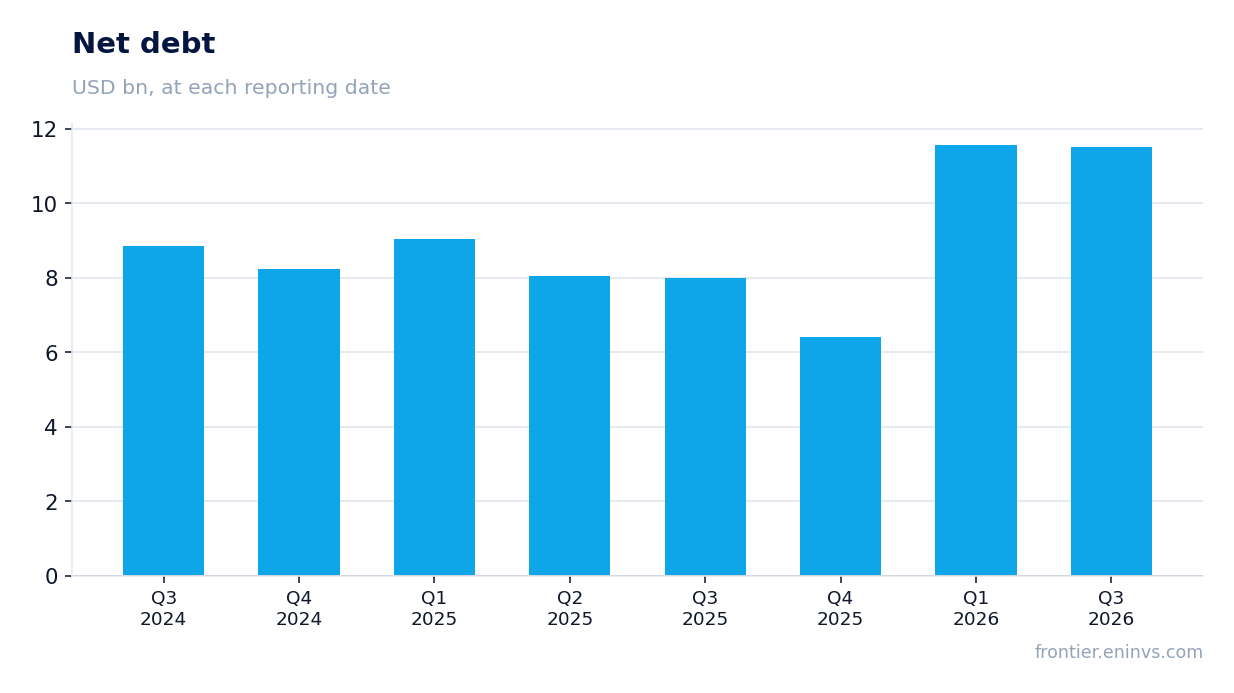
Free cash flow for the quarter was $6.1 billion, but debt increased by $3.5 billion over the year
Operating cash flow for the quarter was $6.6 billion, capital expenditures were $0.4 billion, resulting in free cash flow of about $6.1 billion. This is a strong figure that covers dividends and share repurchases.
However, net debt on the balance sheet rose to $11.5 billion (versus $8.0 billion a year ago), an increase of $3.5 billion over 12 months. The debt increase is related to large buybacks and litigation payments, not operational losses.
The net debt to EBITDA ratio (with LTM EBITDA of $28.3 billion) stands at a comfortable level of about 0.4x, leaving room for further shareholder returns.
Share repurchases and dividends totaled $6.2 billion in the quarter
During the quarter, Visa returned $6.2 billion to shareholders through buybacks (14.5 million shares for $4.9 billion) and dividends (quarterly dividend declared at $0.670 per share). This confirms the company's commitment to returning capital.
At the end of the quarter, the company had $28.4 billion remaining under its authorized share repurchase program, providing flexibility for further purchases. Strong free cash flow allows funding these payments without compromising investments.
For investors, this means that even at current debt levels, the company can sustain and increase dividends, making the shares attractive for long-term holdings.
Processed transactions growth of 10% confirms resilience of consumer spending
Processed transactions reached 71.7 billion in the quarter, up 10% year-over-year. This is a key indicator of activity in Visa's payment ecosystem, and its growth suggests that consumers and businesses continue to spend actively.
Payments volume rose 10% in constant currency, correlating with transaction growth. These metrics confirm that Visa benefits from the structural shift to cashless payments, as well as from the recovery of cross-border travel and e-commerce.
For investors, this means the business has a solid foundation for further revenue growth, even if the macroeconomic environment deteriorates.
Bottom line
In Visa's third fiscal quarter 2026 report, the strong points were revenue acceleration (+14%) and EBITDA margin expansion to 63.6%, confirming operational efficiency. One-off charges of $0.8 billion distorted net income, but non-GAAP EPS rose 11%, reflecting real dynamics. Debt increased but remains at a comfortable level, and free cash flow covers shareholder returns. The main question for holders is whether transaction growth can persist amid a potential economic slowdown. At the current valuation, the shares look attractive for long-term investors.
Open the company's financial profile V →
See also: market overview · valuation map · stock screeners