Amplify Energy: Q2 profit of $22.6m is a non-cash hedge revaluation, not cash
On 10 August Amplify Energy reported second-quarter 2026 results. Revenue fell 22.9% year on year to $52.7m, EBITDA dropped 61.5% to $28.1m, yet net profit rose 171.0% to $17.3m — the gain is entirely due to a $22.6m non-cash unrealised gain on commodity derivatives. Adjusted EBITDA was $8.6m and free cash flow was negative at -$12.9m. At an EV/EBITDA of 2.13 and with no net debt, the share looks attractive, but only if the operating picture recovers in the second half.
Key takeaways
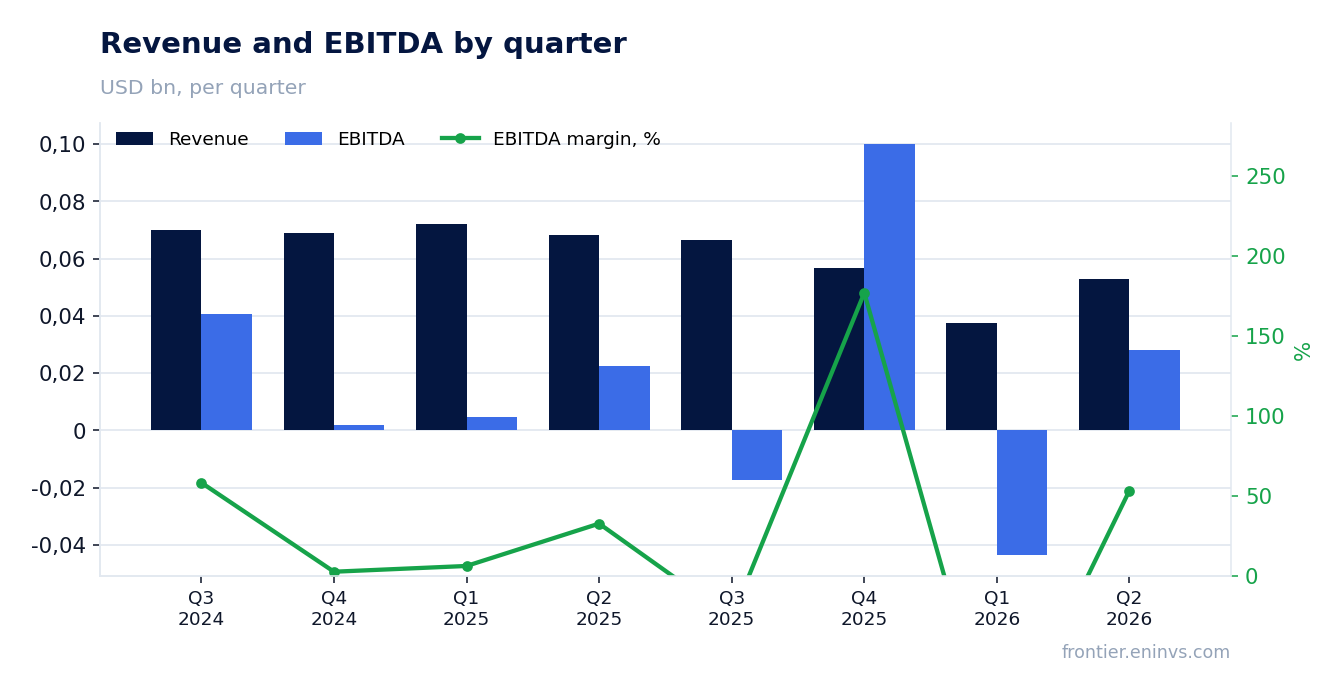
— Revenue fell 22.9% year on year but rose 40.6% sequentially from Q1 — royalty relief at Beta and two new wells helped
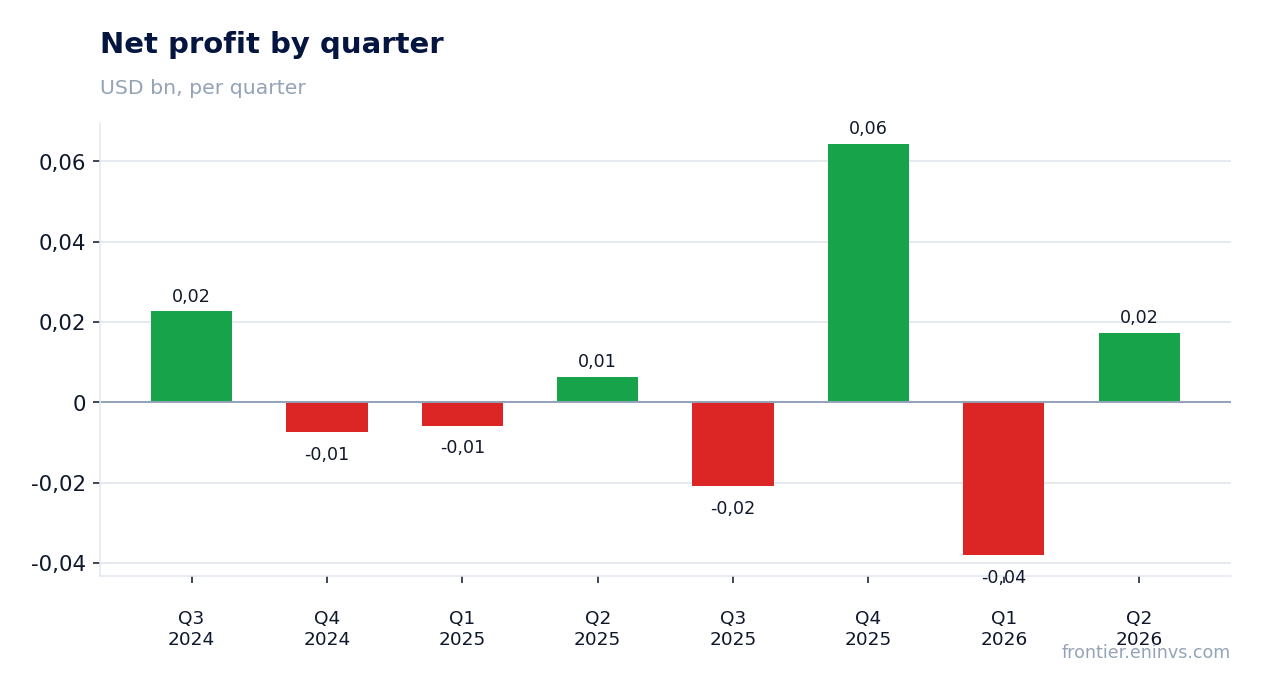
— The $17.3m Q2 profit includes a $22.6m unrealised gain on derivatives, not operating earnings
— Adjusted EBITDA of $8.6m is 3.3 times lower than reported EBITDA of $28.1m — the gap is one-off items
— Free cash flow is negative at -$12.9m because $20.7m capex exceeded $2.8m operating cash flow
— Net debt is negative at -$18.1m, there is no debt burden, and liquidity stands at $36.2m
— The $15.0m share buyback — about 10% of market cap — is management's main signal of undervaluation
— EV/EBITDA of 2.13 and P/E of 4.56 look cheap, but the portal model shows zero upside to fair value
Attractiveness
Key figures, USD bn
| Metric | Q2 2025 | Q2 2026 | Change |
|---|---|---|---|
| Revenue | 0.07 | 0.05 | -22.9% |
| EBITDA | 0.02 | 0.01 | -61.5% |
| Operating profit | 0.01 | 0.02 | +85.1% |
| Net profit | 0.01 | 0.02 | +171.0% |
| Operating cash flow | 0.02 | 0.00 | -88.2% |
| Capex | 0.03 | 0.02 | -16.1% |
| EBITDA margin | 32.7% | 16.3% | -16.4 pp |
| Net margin | 9.3% | 32.8% | +23.5 pp |
Revenue fell 22.9% year on year but rose 40.6% sequentially from Q1 — royalty relief at Beta and two new wells helped
In Q2 2026 Amplify Energy's revenue was $52.7m, down 22.9% from a year earlier. The decline is explained by lower production and prices: average production was 6.8 thousand barrels of oil per day, and the average realised oil price excluding hedges was $85.41 per barrel. A year earlier the figures were higher, but the company was already under pressure from falling prices and rising marketing deductions in California.
However, compared with Q1 2026 revenue rose 40.6%, from $37.5m to $52.7m. This growth was driven by two factors: royalty relief at Beta from 1 May 2026, which cut the royalty burden from 25.0% to 12.5%, and the start of production from two new wells, C29 and C16. According to the company, royalty relief increased average net production by more than 600 barrels per day and improved revenue and cash flow by about $3.0m.
The C29 well was completed in June with a peak IP30 rate of about 525 barrels of oil per day, and C16 in July with an IP30 of about 550 barrels per day. Both were drilled in the Joulters block at the Beta field. At current prices the company expects both wells to pay back in about 15 months and generate an IRR of about 100%. In Q2 these wells contributed only partially, so management expects further growth in production and revenue in coming periods.
The $17.3m Q2 profit includes a $22.6m unrealised gain on derivatives, not operating earnings
Amplify Energy's net profit in Q2 2026 was $17.3m versus a loss of $38.1m in the prior quarter. However, this result is almost entirely due to a non-operating item: an unrealised gain on commodity derivatives of $22.6m. Without it the company would have posted a loss. The adjusted net loss, according to the company, was $1.7m.
Operating profit in Q2 was $23.2m, but it too includes the unrealised gain on derivatives. The realised loss on derivatives was $13.6m, reflecting cash settlements on hedges. Thus, operating activity excluding derivative revaluation remains loss-making at the adjusted level.
The gap between reported and adjusted EBITDA confirms this: reported EBITDA was $28.1m, while adjusted EBITDA was only $8.6m. The $19.5m difference is explained by the unrealised gain on derivatives and other one-off items. For assessing business sustainability, it is more appropriate to focus on adjusted EBITDA, which reflects the company's actual ability to generate profit from core operations.
Adjusted EBITDA of $8.6m is 3.3 times lower than reported EBITDA of $28.1m — the gap is one-off items
Amplify Energy's reported EBITDA in Q2 2026 was $28.1m, down 61.5% from a year earlier. However, this figure includes an unrealised gain on derivatives of $22.6m. Adjusted EBITDA, which the company considers more representative, was only $8.6m. That is 3.3 times lower than reported EBITDA and reflects actual operating efficiency.
The reported EBITDA margin was 16.3% versus 32.7% a year earlier. The margin decline is explained by lower revenue while operating costs remained high. However, adjusted EBITDA of $8.6m gives a margin of just 16.3% — significantly below last year's 32.7%. The company notes that adjusted EBITDA and free cash flow were in line with expectations.
The main pressure on the margin came from rising marketing deductions in California and higher production costs. The company cut its 2026 operating expense guidance to $80–95m thanks to changes in the CO2 agreement and cost-saving initiatives at Beta. This should support the margin in coming quarters, but for now the gap between reported and adjusted EBITDA remains significant.
Free cash flow is negative at -$12.9m because $20.7m capex exceeded $2.8m operating cash flow
Amplify Energy's operating cash flow in Q2 2026 was $2.8m, significantly below $23.7m a year earlier. At the same time, capital expenditure reached $20.7m, of which $20.1m was directed to Beta development. As a result, free cash flow was negative at -$12.9m. The company calls this result in line with expectations.
The main reason for negative free cash flow is the active drilling phase at Beta. In Q2 the C29 and C16 wells were drilled and completed, requiring significant investment. However, these investments should pay back within about 15 months at current prices, creating a basis for future cash flow growth.
The company expects capital expenditure in the second half to fall to $4–14m versus $41m in the first half. This should improve free cash flow. In addition, royalty relief and the commissioning of new wells will begin to have a full quarterly effect, which will also support operating cash flow. However, for now the company remains in an investment phase, and free cash flow remains negative.
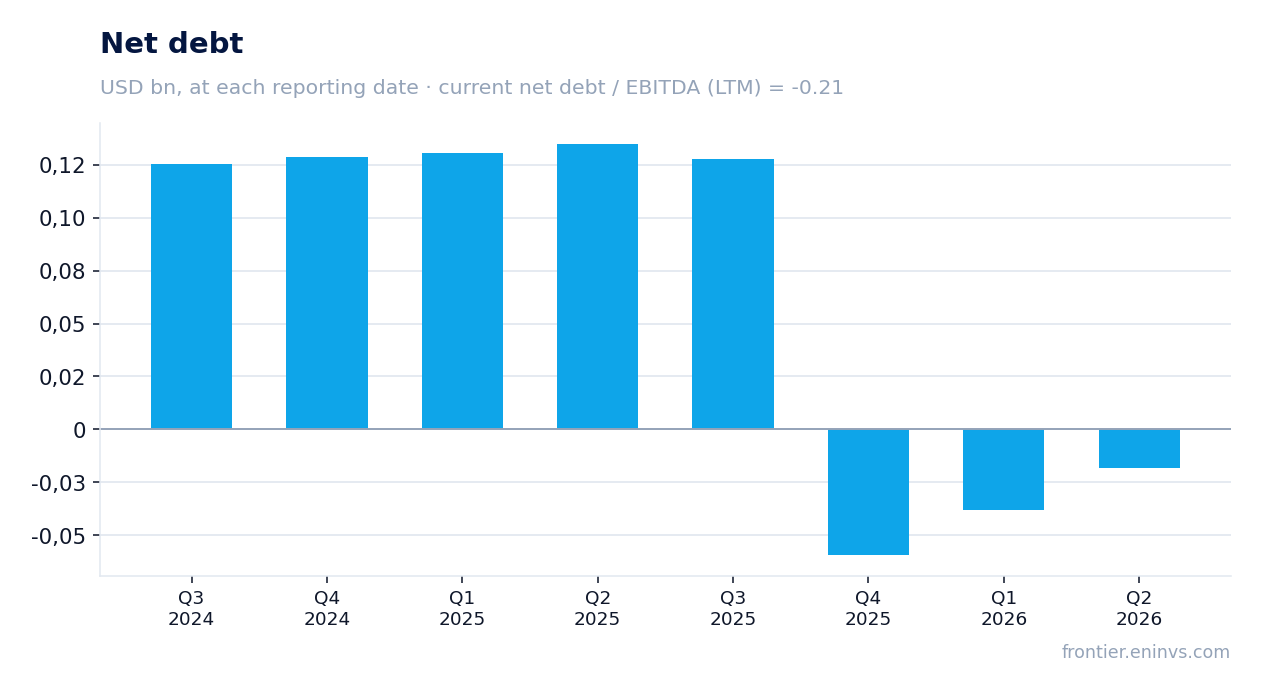
Net debt is negative at -$18.1m, there is no debt burden, and liquidity stands at $36.2m
As of 30 June 2026, Amplify Energy's net debt was -$18.1m, meaning the company has more cash than debt. This is the result of repaying its revolving credit facility, which was fully undrawn at quarter-end. Liquidity stood at $36.2m, including $21.2m in cash and $15.0m in available borrowings. The net debt to EBITDA ratio for the trailing twelve months is -0.21.
The absence of debt burden is an important advantage in current conditions. The company does not depend on creditors and can direct free funds to development or return capital to shareholders. Interest expense in Q2 was only $0.9m and is mainly related to surety bond premiums for the Beta asset. This is a minimal burden on cash flow.
The debt reduction occurred in Q4 2025, when net debt fell from $127.5m to -$59.5m. Since then the company has maintained negative net debt, giving it financial flexibility. Combined with the approved $15.0m share buyback programme, this creates prerequisites for increasing shareholder value.
The $15.0m share buyback — about 10% of market cap — is management's main signal of undervaluation
On 6 August 2026, Amplify Energy's board of directors approved a share repurchase programme of up to $15.0m. At current prices this represents about 10% of total shares outstanding. The programme runs from 11 August to 31 December 2026. The company believes its shares trade at a significant discount to net asset value and that buybacks will enhance shareholder value.
CEO Dan Furbee noted that the company believes its shares are undervalued and intends to allocate capital to opportunities with the best risk-adjusted returns. With no debt and $36.2m in liquidity, the company can fund the buyback without harming operations. This also signals to the market management's confidence in the business outlook.
However, it should be noted that the buyback may be adjusted or suspended depending on market conditions and alternative investment opportunities. The company is not obligated to acquire any particular number of shares. Nevertheless, the programme itself is an important indicator that management sees the shares as undervalued and is ready to return capital to shareholders.
EV/EBITDA of 2.13 and P/E of 4.56 look cheap, but the portal model shows zero upside to fair value
Amplify Energy currently trades at an EV/EBITDA of 2.13 for the trailing twelve months and a P/E of 4.56. Market capitalisation is $198.7m. These multiples look low both in absolute terms and relative to the company's historical levels. However, it is important to understand that trailing twelve-month EBITDA includes one-off items, including unrealised gains on derivatives, which distorts the valuation.
According to the portal model, which reprices EBITDA at current commodity prices and a target EV/EBITDA multiple, the upside to fair value is 0%. This means the current price already reflects current commodity prices and operating results. The model does not assume further growth unless operating performance improves or oil prices rise.
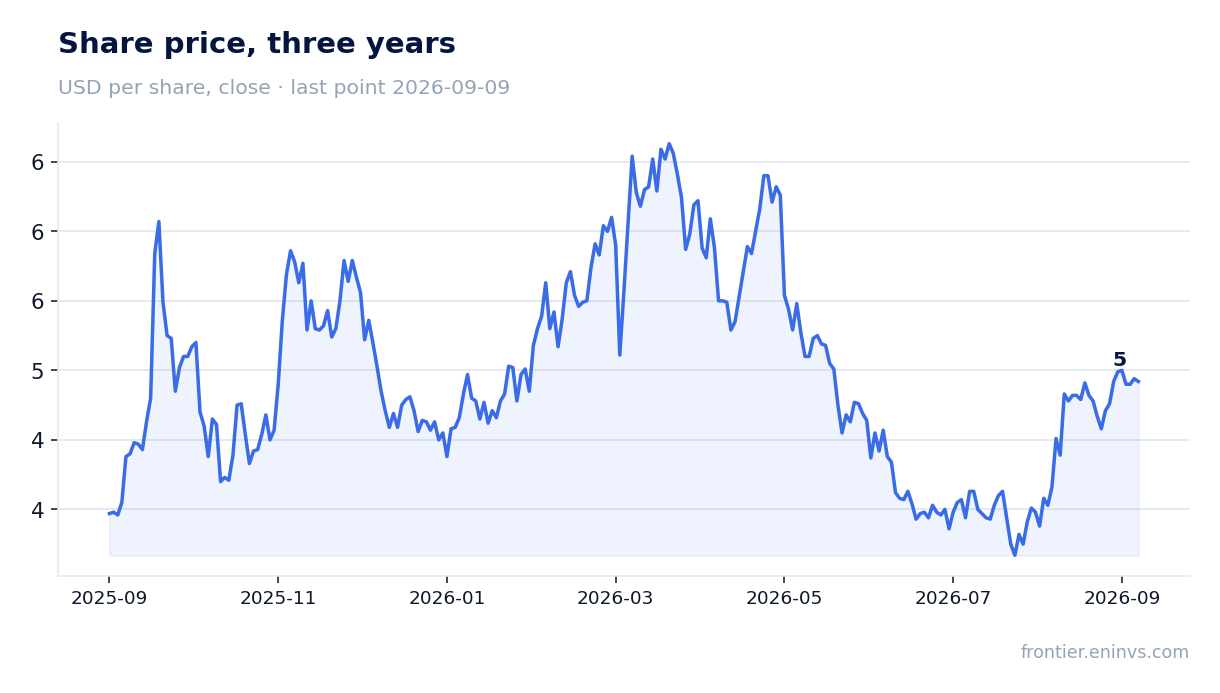
Since the report was published the share has risen 22.1%, and on the report day it gained 3.2%. The market reacted positively to the buyback programme and debt reduction, but further growth requires confirmation of operating recovery. If adjusted EBITDA starts to grow and free cash flow turns positive, the multiples could re-rate upwards. For now, upside is limited.
Valuation on the latest reported figures
| Metric | Value |
|---|---|
| Market cap | 0.20 bn USD |
| P/E (LTM) | 4.6 |
| EV/EBITDA (LTM) | 2.1 |
| P/B | 0.45 |
| Net debt / EBITDA (LTM) | -0.21 |
| Operating cash flow (LTM) | 0.01 bn |
| ROE | 16.1% |
Bottom line
Amplify Energy showed strong sequential improvement: revenue rose 40.6% from Q1, production increased 6%, and net debt remains negative. However, the reported profit of $17.3m consists almost entirely of an unrealised gain on derivatives, while adjusted EBITDA is only $8.6m. Free cash flow is negative at -$12.9m. The key question for a holder is whether the company can turn operating recovery into sustainable cash flow. The buyback programme and absence of debt provide a margin of safety, but the multiples already reflect current prices, and the portal model shows zero upside. The share looks attractive only if one believes in a turnaround in operating dynamics.
Open the company's financial profile AMPY →
See also: market overview · valuation map · stock screeners