Aemetis: first operating profit, but it is entirely made of the Section 45Z tax credit
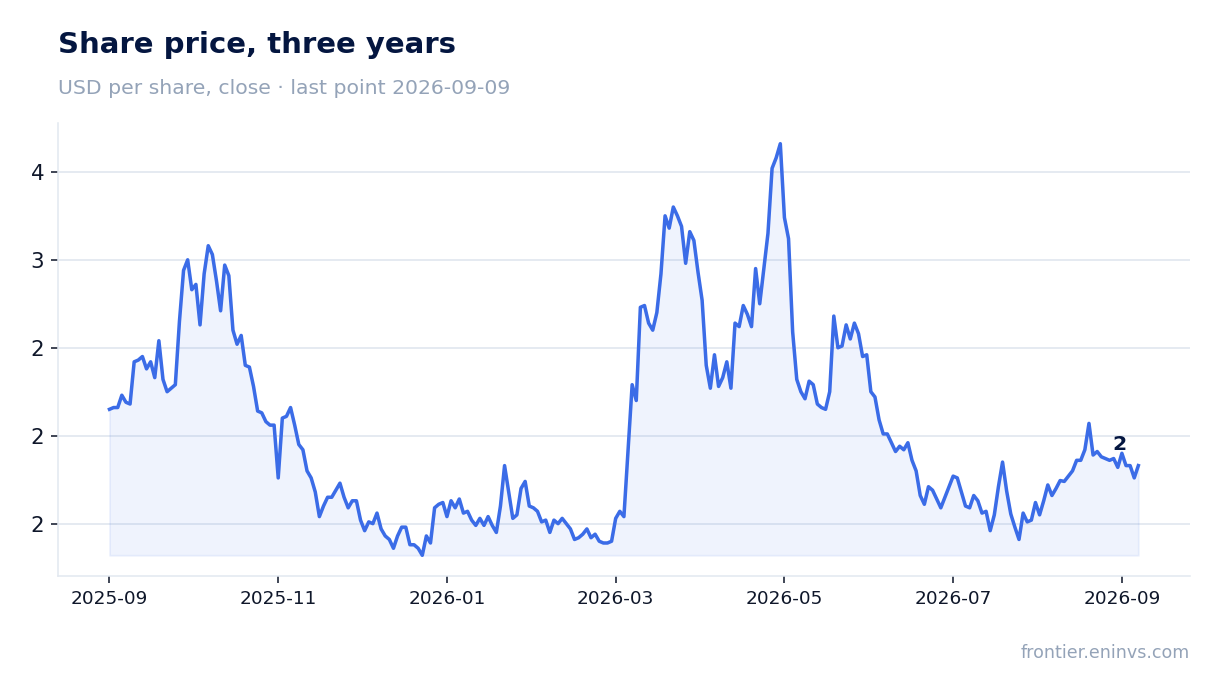
On 6 August Aemetis reported results for the second quarter of 2026. Revenue rose 20% year on year to $62.7 million, adjusted EBITDA came in at $9.7 million against negative $5.8 million a year earlier, and operating income reached $5.8 million versus a $10.7 million loss. The entire quarterly profit rests on $8.6 million of Section 45Z production tax credits recognised in revenue: without them the quarter would have been loss-making again. Net debt stands at $382.3 million while cash on hand is just $1.0 million. At the current price of $1.55 per share the stock looks neutral: the operating turnaround is real but not yet confirmed by cash flow.
Key takeaways
— Revenue rose 20% year on year, with almost all the gain coming from ethanol and dairy RNG, not biodiesel
— The $5.8 million operating profit is entirely assembled from the $8.6 million Section 45Z tax credit
— Gross margin swung from negative 6.4% to positive 21.6% on cheaper corn and higher RNG output
— Interest expense of $13.7 million per quarter exceeds what the company earns at the operating level
— Operating cash flow remains negative, and $8.5 million of capital spending is funded by debt
— Net debt of $382.3 million against $1.0 million of cash is the main risk for a shareholder
Attractiveness
Key figures, USD bn
| Metric | Q2 2025 | Q2 2026 | Change |
|---|---|---|---|
| Revenue | 0.05 | 0.06 | +20.0% |
| EBITDA | -0.01 | 0.01 | to profit |
| Operating profit | -0.01 | 0.01 | to profit |
| Net profit | -0.02 | -0.01 | — |
| Operating cash flow | -0.01 | -0.00 | — |
| Capex | 0.00 | 0.01 | +141.1% |
| EBITDA margin | -15.9% | 15.5% | +31.4 pp |
| Net margin | -44.8% | -14.9% | +29.9 pp |
Revenue rose 20% year on year, with almost all the gain coming from ethanol and dairy RNG, not biodiesel
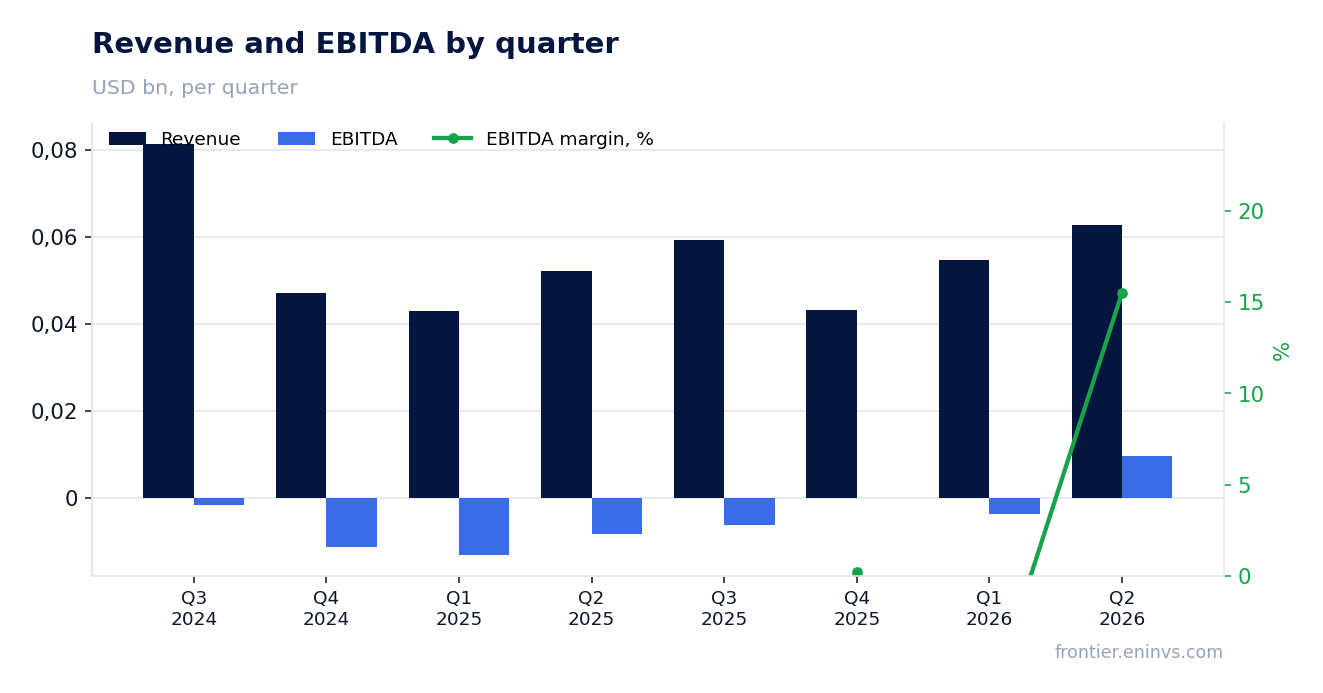
Second-quarter 2026 revenue came in at $62.7 million against $52.2 million a year earlier – growth of 20%. This is the second consecutive quarter of positive annual dynamics after four quarters of decline: in the first quarter of 2026 revenue added 27.4%, having previously fallen by 7.9–41.0%. The turnaround began in late 2025 and took hold in the first half of 2026.
California ethanol provided the main contribution: volumes rose 12% to 15.5 million gallons and the average price climbed 9% to $2.19 per gallon. Utilisation at the Keyes plant reached 113% of nameplate capacity against 100% a year earlier. Dairy RNG sold 146,900 MMBtu – 38% more than the 106,400 MMBtu a year earlier.
India biodiesel, by contrast, slumped: sales fell to $2.5 million because oil marketing companies placed no new orders. Just 1,400 metric tonnes were sold against 9,400 a year earlier, with capacity utilisation at 3.6%. That segment has ceased to be a revenue pillar and is dragging the overall result down.
Within revenue, $8.6 million is the Section 45Z production tax credit: $2.1 million for dairy RNG and $6.5 million for California ethanol. Without it, revenue would have been about $54.1 million, and the year-on-year growth would have been more modest. The tax credit is not a cash receipt from a customer but the recognition of an entitlement to a benefit.
The $5.8 million operating profit is entirely assembled from the $8.6 million Section 45Z tax credit
Operating income for the second quarter of 2026 was $5.8 million against a $10.7 million loss a year earlier – an improvement of $16.4 million. Gross profit reached $13.5 million against a gross loss of $3.4 million, a swing of $17.0 million. This is the first profitable quarter at the operating level in the entire history of the data provided.
All of that profit, however, rests on the tax credit. Without the $8.6 million of Section 45Z, the operating result would again have been negative – roughly minus $2.8 million. The credit is recognised in revenue rather than in other income, so it flatters both gross and operating margin without bringing in live cash from sales.
Selling, general and administrative expenses rose by $423 thousand to $7.7 million, mainly on compensation incentives. That is a moderate increase and it did not eat the operating leverage. But without the tax benefit, even with such cost discipline, the company remains loss-making at the operating level.
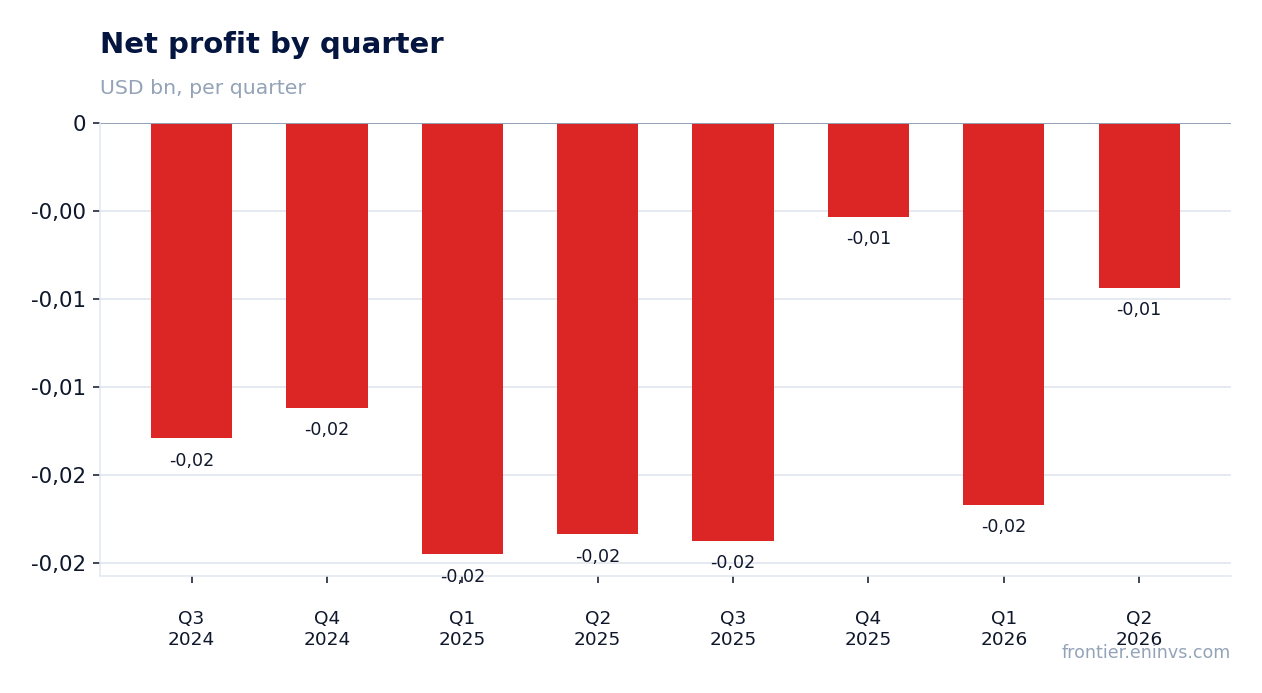
The net loss narrowed to $9.4 million from $23.4 million a year earlier, an improvement of $14.0 million. The net margin rose from negative 44.8% to negative 14.9%. The gap between operating profit and net loss is interest: $13.7 million of interest expense for the quarter, which consumes the entire operating result.
Gross margin swung from negative 6.4% to positive 21.6% on cheaper corn and higher RNG output
Gross margin in the second quarter of 2026 was 21.6% against negative 6.4% a year earlier. Cost of goods sold fell to $49.2 million from $55.6 million while revenue rose by $10.5 million. That means the company did not merely sell more – it produced more cheaply.
The main factor is corn. The average delivered cost per bushel fell to $6.07 from $6.42 a year earlier. With 5.4 million bushels ground, that yields savings of about $1.9 million on feedstock alone. The second factor is higher RNG output, where both volumes and LCFS credit prices rose: the average price per credit climbed to $66 from $55.
The average RNG price per MMBtu, however, fell to $1.51 from $2.75 a year earlier. That means the segment's revenue growth came from volumes and from sales of RINs and LCFS credits, not from the gas price itself. RIN sales rose to 1.26 million units from 0.76 million, and LCFS credits to 27,500 from 14,000.
The gross margin improvement is real, but its durability depends on two variables: the corn price and environmental credit prices. Corn has already delivered an effect that may not repeat, while RIN and LCFS prices are set by regulatory conditions. Without the tax credit, gross margin would have been about 6.2% – still positive, but far more modest.
Interest expense of $13.7 million per quarter exceeds what the company earns at the operating level
Interest expense in the second quarter of 2026 was $13.7 million against $12.3 million a year earlier. That is more than the $5.8 million operating profit and more than the $9.7 million adjusted EBITDA. Even with the tax credit, the company does not cover the cost of its debt from operating results.
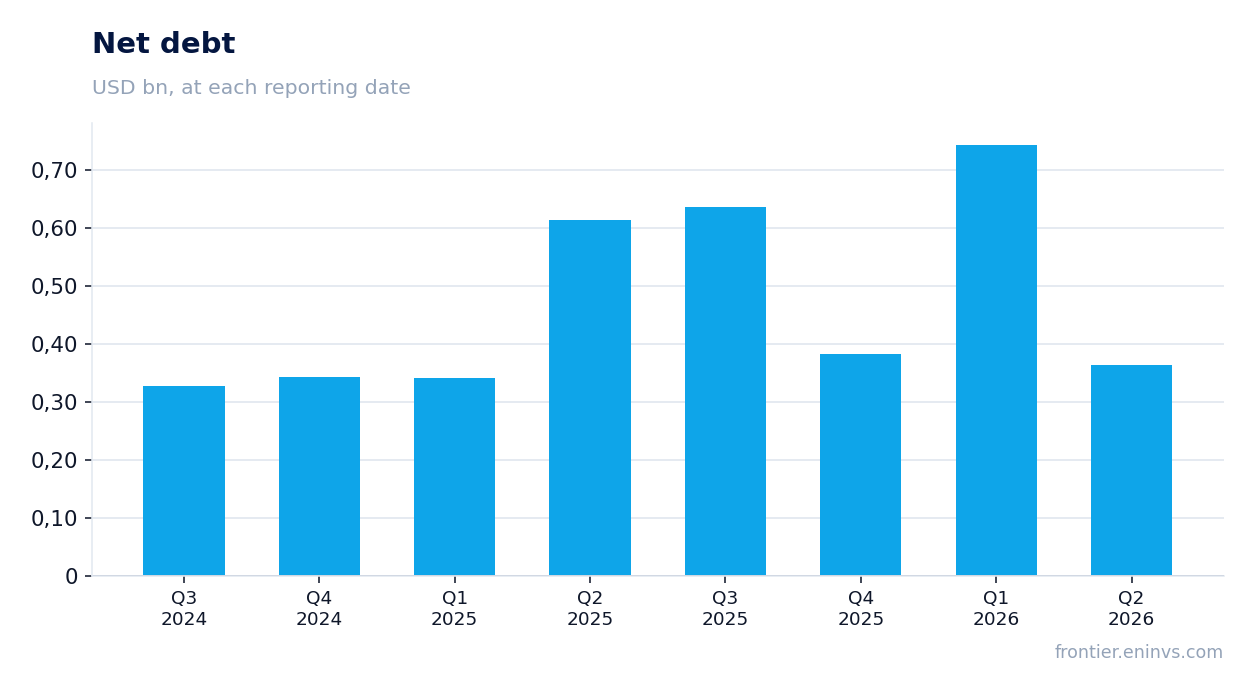
Total debt at the end of the quarter was $382.3 million, of which $303.4 million is the current portion of long-term debt and $50.8 million is short-term borrowings. Cash on hand was $1.0 million against $4.9 million at the end of 2025. The company does not disclose a debt-to-EBITDA ratio, and it cannot be correctly calculated because trailing-twelve-month EBITDA is negative.
The company acknowledges it is pursuing a multi-track financing plan: preparing long-term financing for the Keyes plant, seeking funds for further digester construction, and progressing toward a possible IPO of its Indian subsidiary Universal Biofuels. Legal and accounting advisors for the IPO have been retained. This is an admission that the current capital structure requires refinancing.
For the first half of 2026, interest expense was $28.0 million against $26.0 million a year earlier. With half-year revenue of $117.3 million, interest consumes almost a quarter of revenue. Until the debt is refinanced at longer maturities and lower rates, operating improvement will flow to creditors rather than shareholders.
Operating cash flow remains negative, and $8.5 million of capital spending is funded by debt
Operating cash flow in the second quarter of 2026 was negative – minus $1.9 million. That is better than minus $5.7 million a year earlier, but still an outflow. Over the trailing twelve months, operating cash flow was plus $3.3 million – a positive figure, but not comparable with $28.0 million of half-year interest expense.
Capital expenditure in the second quarter was $8.5 million, of which $8.6 million went to carbon-intensity reduction projects at Keyes and dairy digester construction. For the first half, investment was $15.1 million: $8.9 million in California ethanol and $5.7 million in Aemetis Biogas. The company is building future revenue but funding the construction from debt and raised capital.
The gap between operating outflow and capital expenditure is covered by rising debt and additional share issuance: equity rose to $357.2 million from $340.4 million at the end of 2025. Cash meanwhile shrank to $1.0 million. The company is living on the edge of liquidity and depends on its ability to attract new financing.
The report states that the mechanical vapour recompression project at Keyes is expected to become operational in 2026 and replace about 80% of the fossil natural gas used at the plant. If that happens, the operating economics of the ethanol segment will improve irrespective of tax credits. Until then, cash flow remains negative and debt is rising.
Net debt of $382.3 million against $1.0 million of cash is the main risk for a shareholder
Net debt at the end of the second quarter of 2026 was $382.3 million. That is 0.3 billion roubles less than at the previous reporting date and 0.2 billion roubles less than a year earlier, but the absolute figure remains enormous relative to the scale of the business. With trailing-twelve-month revenue of $219.8 million, debt exceeds it by 1.7 times.
Market capitalisation is $109.8 million, meaning debt is 3.5 times the value of the entire company. That means equity is effectively an option on operating economics improving enough to service and repay the debt. At the current operating profit, which is negative without the tax credit, such an option has no intrinsic value.
Return on equity is 27.7%, but shareholders' equity is negative: minus $322.1 million at the end of the quarter. The metric carries no useful information here because it is calculated on a negative base. The accumulated deficit is $671.0 million and continues to grow.
The shares reacted to the report with gains: they added 5.2% on the publication day and 18.1% from the release to 9 September 2026. The market believed in the operating turnaround story. But the price rise does not change the fact that a company with negative equity and $1.0 million in cash remains hostage to access to capital markets.
Valuation on the latest reported figures
| Metric | Value |
|---|---|
| Market cap | 0.11 bn USD |
| Operating cash flow (LTM) | 0.00 bn |
| ROE | 27.7% |
Bottom line
The quarter is genuinely strong: the first operating profit, gross margin swinging from negative 6.4% to positive 21.6%, revenue up 20%. But all of that profit is created by the $8.6 million Section 45Z tax credit, without which the company remains loss-making. Interest of $13.7 million per quarter exceeds the operating result, cash stands at $1.0 million, and debt of $382.3 million is 3.5 times market capitalisation. The market reacted with an 18.1% gain since the report, but fundamentally the stock remains an option on refinancing and the durability of the tax benefit. At the current price the stock is neutrally valued: the turnaround potential is real, but liquidity risk and dependence on a single profit source prevent calling it attractive.
Open the company's financial profile AMTX →
See also: market overview · valuation map · stock screeners