Battalion Oil: profit tripled, but it came from a paper hedge revaluation, not the business

On August 12, Battalion Oil released its second-quarter 2026 results. Revenue rose 12.1% year on year to $48.1 million, adjusted EBITDA fell 10.8% to $12.3 million, and net profit jumped 223.4% to $15.5 million. Almost all of that profit is a non-operating $13.1 million gain from derivative revaluation, not cash from selling oil. The stock trades at 2.46 times trailing twelve-month EBITDA with net debt of $70.5 million and a leverage ratio of 1.87 – cheap, but the profit growth is misleading, and the verdict on the share is neutral.
Key takeaways
— Revenue rose 12.1% on oil prices, not on production volumes
— Adjusted EBITDA fell 10.8%, and the margin compressed from 32.2% to 25.6%
— Net profit of $15.5 million is almost entirely a paper gain from hedges
— Debt fell to $70.5 million after a $30.3 million equity placement
— Operating cash flow of $8.8 million does not even cover interest expense
— Capex fell to $4.2 million, freeing up cash for debt reduction
Attractiveness
Key figures, USD bn
| Metric | Q2 2025 | Q2 2026 | Change |
|---|---|---|---|
| Revenue | 0.04 | 0.05 | +12.1% |
| EBITDA | 0.01 | 0.01 | -10.8% |
| Operating profit | -0.00 | 0.01 | to profit |
| Net profit | 0.00 | 0.02 | +223.4% |
| Operating cash flow | 0.01 | 0.01 | -14.0% |
| Capex | 0.03 | 0.00 | -87.4% |
| EBITDA margin | 32.2% | 25.6% | -6.6 pp |
| Net margin | 11.2% | 32.3% | +21.1 pp |
Revenue rose 12.1% on oil prices, not on production volumes
Second-quarter 2026 revenue was $48.1 million versus $42.8 million a year earlier. The 12.1% increase is entirely price-driven: average oil realisation rose to $96.38 per barrel from $62.14. That generated $49.2 million of oil revenue versus $36.3 million last year.
Production volumes actually fell: 12,407 barrels of oil equivalent per day versus 12,989 a year earlier. Oil volumes dropped to 510 thousand barrels from 584 thousand. The company sold less oil, but at a much higher price.
Gas revenue went negative – minus $6.9 million versus plus $0.9 million a year earlier. The cause is a negative gas price of minus $3.43 per thousand cubic feet. This is not an accounting anomaly but market reality, where gas in some regions requires paying for disposal.
The takeaway: revenue growth is a price effect that could reverse at any time. Production volumes are falling, and without new wells revenue cannot grow on price alone.
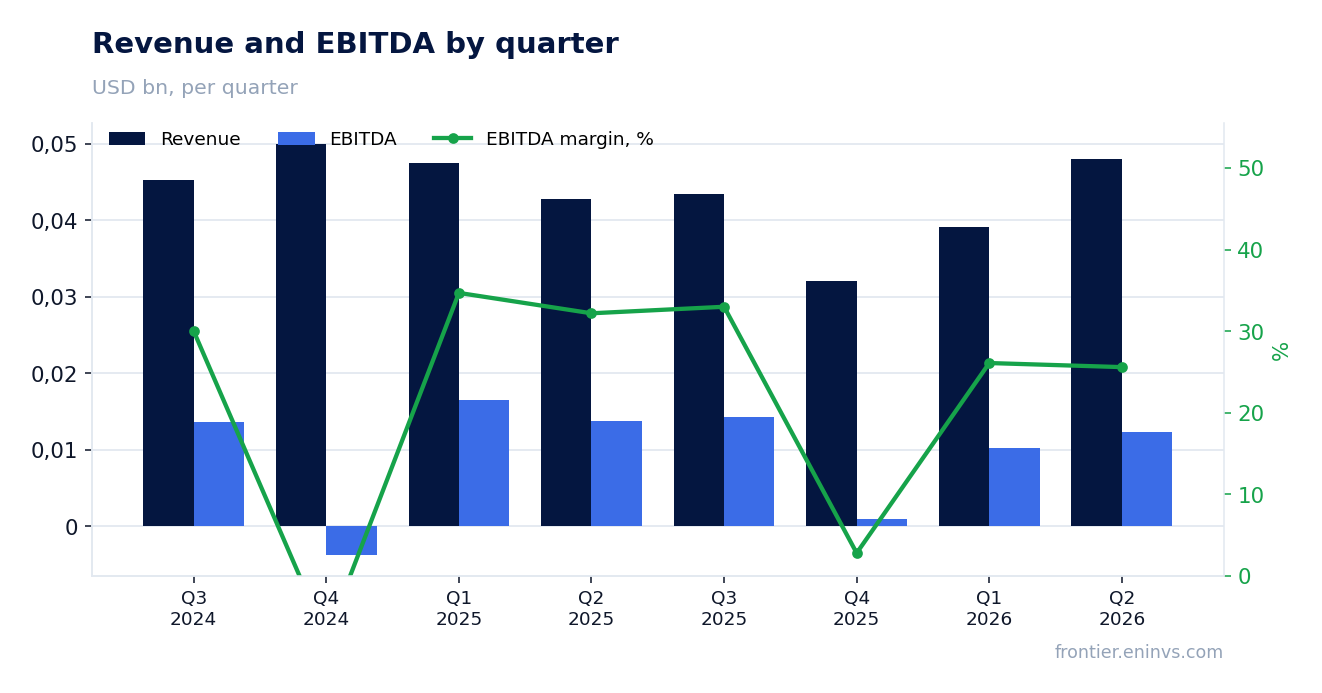
Adjusted EBITDA fell 10.8%, and the margin compressed from 32.2% to 25.6%
Second-quarter 2026 adjusted EBITDA was $12.3 million versus $18.1 million a year earlier. A 10.8% decline alongside 12.1% revenue growth means costs grew faster than revenue. The EBITDA margin compressed from 32.2% to 25.6%.
The main pressure came from gathering and processing costs. Gathering and other expenses rose to $10.87 per barrel from $9.27 a year earlier. The company attributes this to higher throughput volumes after entering a long-term processing agreement with a large midstream provider in January 2026.
General and administrative expenses also rose – to $3.60 per barrel from $2.17. Legal costs and stock compensation drove the increase. Excluding non-recurring items, they would have been $2.83 per barrel versus $2.11 a year earlier.
Part of the pressure was offset by lower lease operating costs: lease operating and workover expense fell to $8.69 per barrel from $10.98. But that was not enough to keep the margin at its previous level.
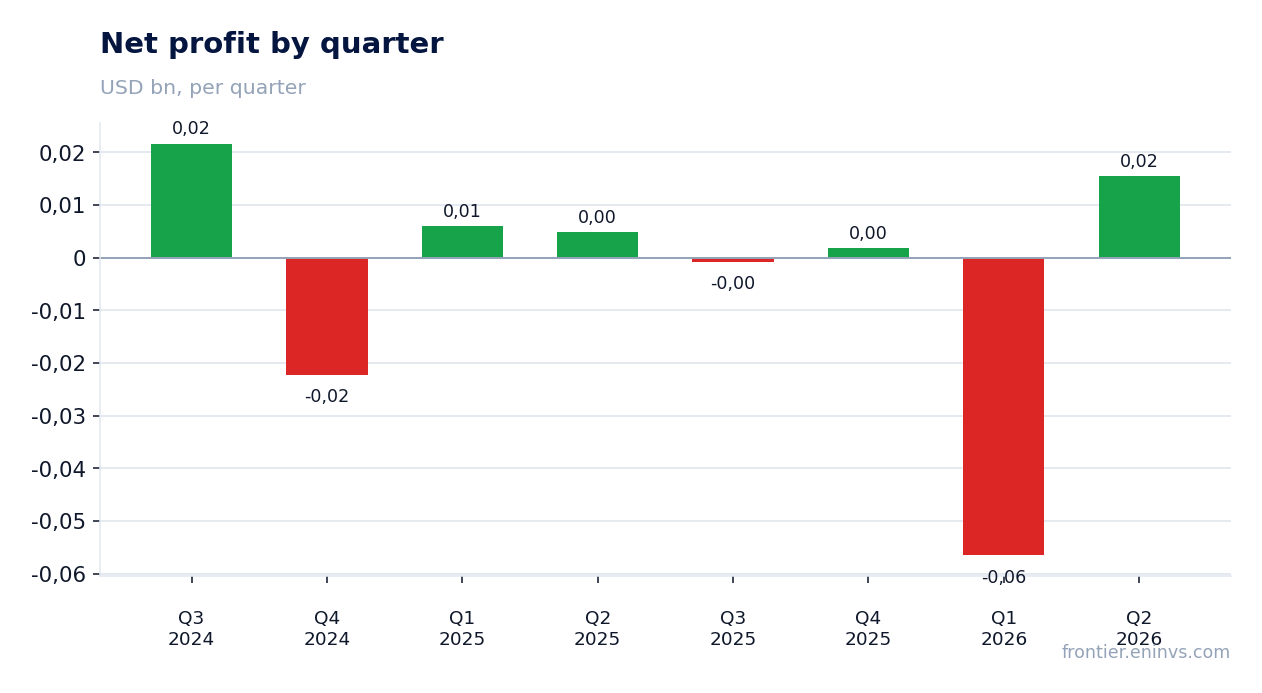
Net profit of $15.5 million is almost entirely a paper gain from hedges
Second-quarter 2026 net profit was $15.5 million versus $4.8 million a year earlier. The 223.4% increase looks impressive, but the source is not operations. Operating income was just $6.8 million.
The main contribution came from non-operating income: net gain on derivative contracts was $13.1 million. Of that, $20.9 million was unrealised hedge revaluation – paper profit not backed by cash. Realised hedge losses were $7.8 million.
Stripping out one-off items, the company posted an adjusted net loss of $4.9 million, or minus $0.11 per share. A year earlier the adjusted loss was $10.6 million, or minus $0.65 per share. The loss narrowed, but there is no real profit.
Interest expense fell to $4.3 million from $6.6 million a year earlier – the result of the June 2026 loan refinancing. But even with interest savings, the loss does not turn into profit.
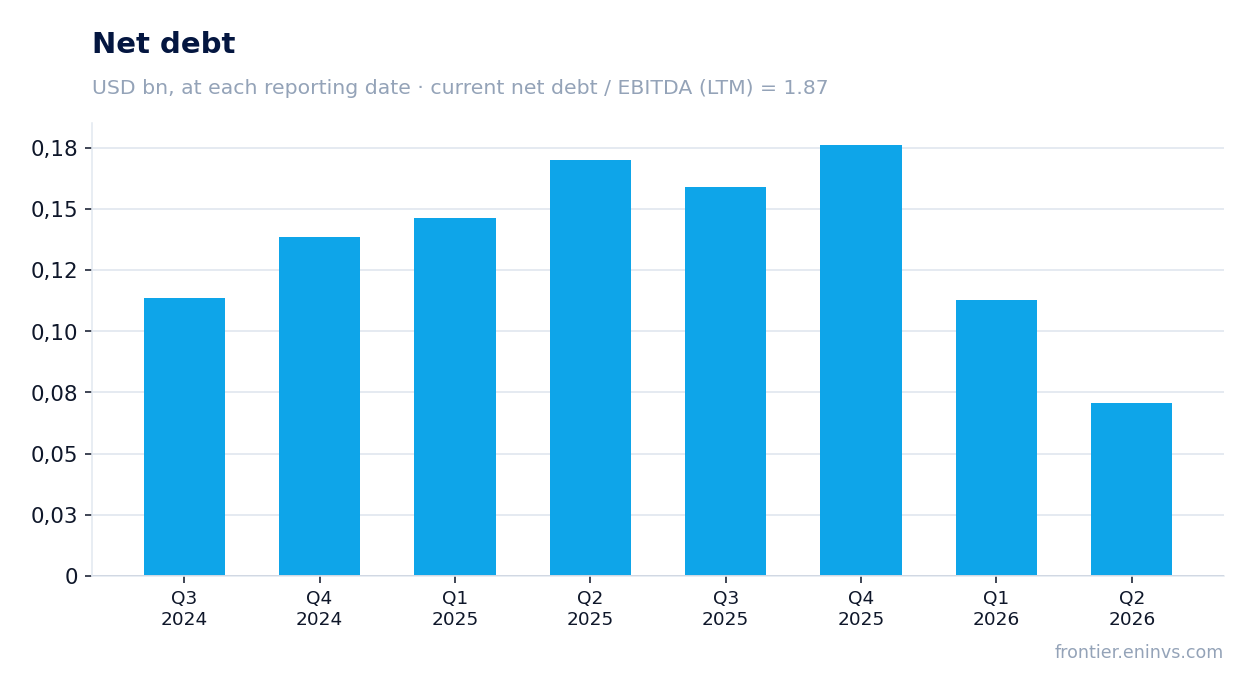
Debt fell to $70.5 million after a $30.3 million equity placement
Net debt at the end of the second quarter of 2026 was $70.5 million. That is well below previous periods: $112.6 million in the first quarter of 2026 and $170.1 million a year earlier. The reduction came from equity issuance and asset sales.
The company placed 17.4 million shares under its ATM programme, raising $30.3 million net. Another 14.9 million shares for $25.6 million were placed after the reporting date. The proceeds went to repay debt and redeem preferred stock.
The trailing twelve-month net debt / EBITDA ratio is 1.87. The company calls this a record low. However, comparison with the previous value is impossible: the FACTS do not contain an earlier ratio, so the direction of change is not stated.
In June 2026 the company refinanced its loan: maturity extended to December 2029, rate fixed at SOFR + 6.50% instead of the previous grid of 7.75% to 8.50%. This lowers the cost of debt service and provides access to an additional $175 million subject to lender consent.
Operating cash flow of $8.8 million does not even cover interest expense
Second-quarter 2026 operating cash flow was $8.8 million versus $10.2 million a year earlier. With interest expense of $5.1 million and capex of $4.2 million, free cash flow is barely positive – around minus $0.5 million.
For comparison: a year earlier, with operating cash flow of $10.2 million, the company spent $33.3 million on capex. Free cash flow was deeply negative then. Now capex has been cut to $4.2 million, which kept it positive.
The capex cut is not a sign of efficiency but a forced measure. The company is preparing to drill under a joint agreement in Monument Draw, expected to start in August 2026. That will require new spending, and free cash flow could turn negative again.
Over the trailing twelve months, operating cash flow was $27.0 million. That covers debt service but not development. The company depends on external financing – equity placements and asset sales.
Capex fell to $4.2 million, freeing up cash for debt reduction
Second-quarter 2026 capex was $4.2 million versus $33.3 million a year earlier. That is an almost eightfold reduction. The company attributes it to the completion of infrastructure projects at Monument Draw, finished ahead of schedule and 8% under budget.
In April 2026 the company completed infrastructure expansion, driving a 20% increase in gas throughput and record well productivity. It also secured an additional 50% of sour gas compression capacity, raising handling from 35 to more than 50 million cubic feet per day at no capital cost.
The capex cut allowed funds to be directed to debt repayment and preferred stock redemption. After the reporting date, the company redeemed preferred stock with a liquidation value of $42 million for $19 million in cash and 3.5 million common shares.
However, the investment cut cannot last. Drilling under the joint agreement starts in August 2026, and costs will rise. The question is whether the company can fund them from operating cash flow or will need to issue more equity.
Valuation on the latest reported figures
| Metric | Value |
|---|---|
| Market cap | 0.02 bn USD |
| EV/EBITDA (LTM) | 2.5 |
| P/B | 0.11 |
| Net debt / EBITDA (LTM) | 1.87 |
| Operating cash flow (LTM) | 0.03 bn |
| ROE | 34.4% |
Bottom line
Battalion Oil delivered strong headline revenue and net profit, but both are misleading. Revenue rose 12.1% on oil prices, not production volumes, which fell to 12,407 barrels per day. Net profit of $15.5 million is almost entirely a paper hedge revaluation of $20.9 million, while the adjusted loss was $4.9 million. The real improvement is the debt reduction to $70.5 million and the loan refinancing, but it was achieved through a $30.3 million equity placement and a capex cut to $4.2 million, not through operational efficiency. The real question for a holder now is whether the company can fund drilling at Monument Draw without further dilution, and whether it can hold the margin if oil prices reverse.
Open the company's financial profile BATL →
See also: market overview · valuation map · stock screeners