Sociedad Quimica y Minera de Chile: profit up 7.5x, but the entire gain rests on lithium prices
Sociedad Quimica y Minera de Chile reported second-quarter 2026 results. Revenue rose 136.7% year on year to USD 2,468.3 mn, EBITDA by 299.4% to USD 1,209.3 mn, and net profit by 646.4% to USD 660.0 mn. The EBITDA margin climbed to 49.8% from 29.5% a year earlier. In our view the share looks neutral: the profit surge is impressive, but it rests entirely on lithium prices, and the portal's model points to 22% downside to fair value.
Key takeaways
— Revenue rose 136.7% year on year to USD 2,468.3 mn, the best quarter in the company's history
— The EBITDA margin climbed to 49.8% from 29.5% a year earlier as lithium prices outran costs
— Net profit of USD 660.0 mn includes one-off items tied to asset revaluations
— Debt at 1.57x LTM EBITDA is moderate, but a USD 0.4 bn reduction in net debt over the quarter does not change the picture
— Free cash flow remains under pressure as capital spending rises with lithium prices
— A 3.3% dividend yield on a 100% payout looks sustainable, but hinges on lithium prices
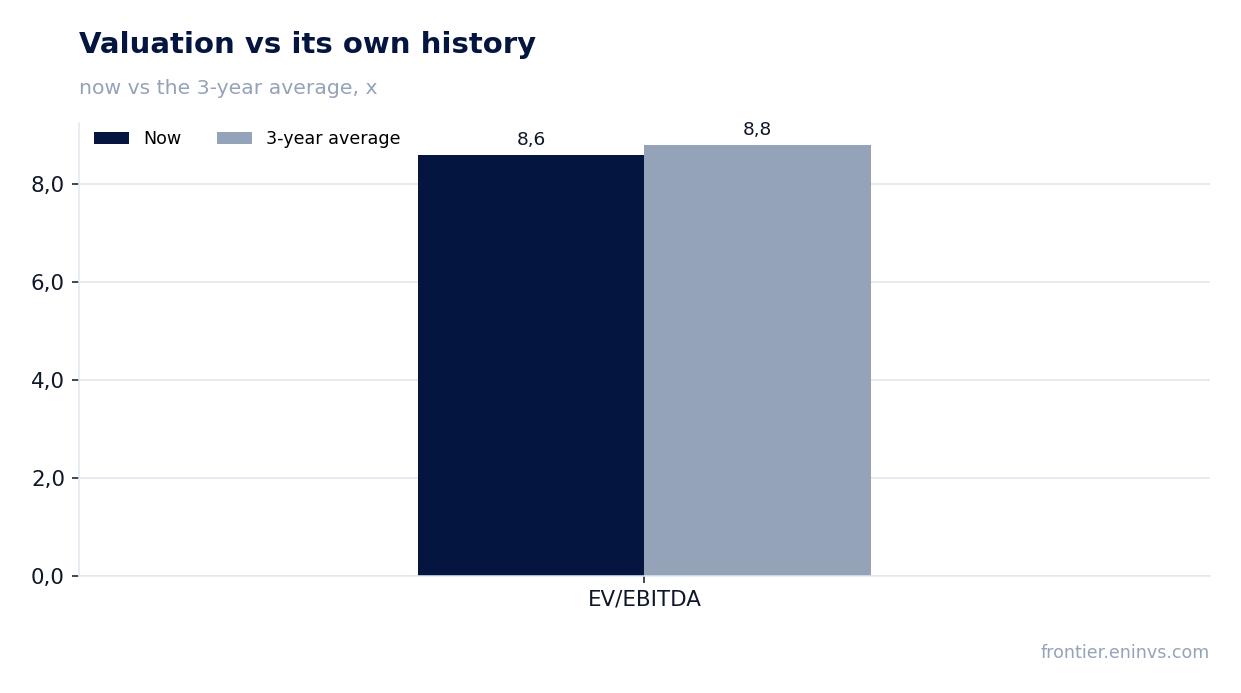
— EV/EBITDA of 8.6x is below the three-year average of 8.8x, yet the portal's model points to 22% downside to fair value
Attractiveness
Key figures, USD bn
| Metric | Q2 2025 | Q2 2026 | Change |
|---|---|---|---|
| Revenue | 1.04 | 2.47 | +136.7% |
| EBITDA | 0.31 | 1.23 | +299.4% |
| Operating profit | 0.17 | 1.21 | +626.6% |
| Net profit | 0.09 | 0.66 | +646.4% |
| Operating cash flow | 0.11 | — | — |
| Capex | 0.21 | — | — |
| EBITDA margin | 29.5% | 49.8% | +20.3 pp |
| Net margin | 8.5% | 26.7% | +18.2 pp |
Revenue rose 136.7% year on year to USD 2,468.3 mn, the best quarter in the company's history
In the second quarter of 2026, Sociedad Quimica y Minera de Chile's revenue reached USD 2,468.3 mn, up 136.7% year on year. This is the highest quarterly figure in the company's history. For comparison, revenue was USD 1,760.0 mn in the first quarter of 2026 and just USD 1,042.7 mn in the second quarter of 2025.
The main driver is lithium prices. The company does not disclose exact sales volumes in tonnes, but revenue more than doubling with relatively stable operating costs indicates that price, not volume, delivered the jump. Confirmation comes from EBITDA rising 299.4% against revenue growth of 136.7%: operating leverage worked at full force.
Such dynamics cannot last forever. Lithium prices are historically extremely volatile, and the current level may prove to be a peak. If prices retreat, revenue and profit will fall even if volumes hold. This is the key risk for a shareholder.
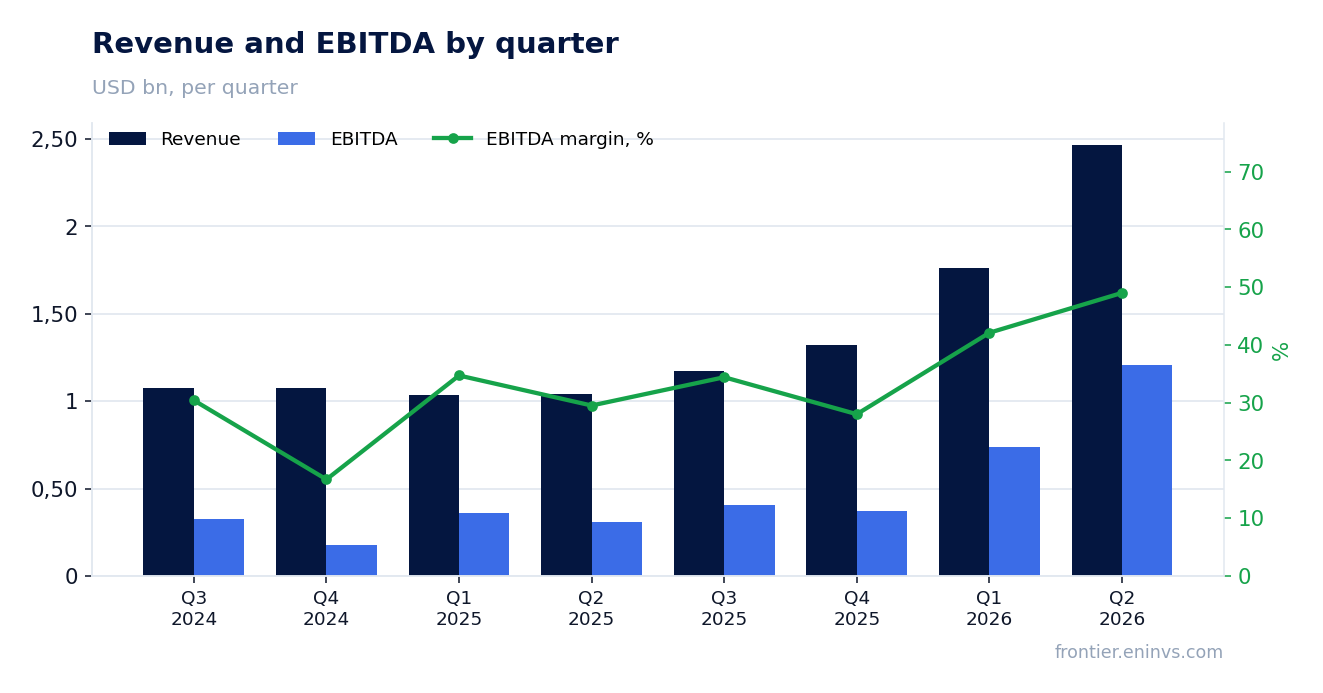
The EBITDA margin climbed to 49.8% from 29.5% a year earlier as lithium prices outran costs
The EBITDA margin in the second quarter of 2026 was 49.8% versus 29.5% in the second quarter of 2025. This is an outstanding result for a mining company. The 20.3 percentage point margin expansion is explained by revenue growing faster than costs: with revenue up 136.7%, operating expenses increased by much less.
Operating profit in the second quarter of 2026 was USD 1,207.6 mn, giving an operating margin of 48.9%. A year earlier, operating profit was USD 166.2 mn on revenue of USD 1,042.7 mn, a margin of 15.9%. Such a jump is only possible with a sharp improvement in pricing.
It is important to understand that a 49.8% margin is not a new sustainable level but a peak value reflecting favourable lithium prices. In previous quarters, the EBITDA margin fluctuated between 17% and 35%. For a conservative investor, this means current profitability may prove temporary.
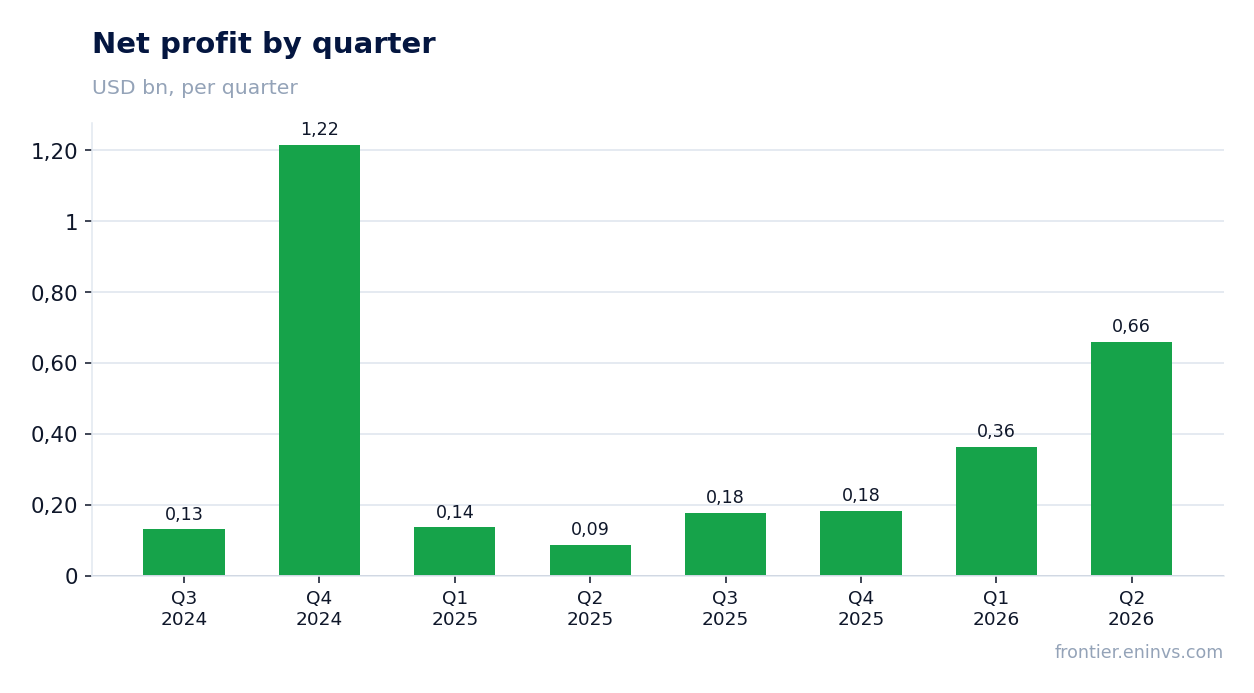
Net profit of USD 660.0 mn includes one-off items tied to asset revaluations
Net profit in the second quarter of 2026 was USD 660.0 mn, up 646.4% from USD 88.4 mn in the second quarter of 2025. However, this sum includes one-off items. In the fourth quarter of 2024, the company already reported net profit of USD 1,216.3 mn with EBITDA of just USD 179.1 mn — a classic example of one-off income, likely from deferred tax revaluation or asset sales.
In the second quarter of 2026, the gap between operating profit (USD 1,207.6 mn) and net profit (USD 660.0 mn) is USD 547.6 mn. This gap includes taxes, interest and possible one-off write-offs. Without access to the full financial statements, we cannot precisely separate one-off effects, but the scale of the discrepancy suggests not all profit is operating.
For assessing business sustainability, EBITDA is more important, at USD 1,209.3 mn, which excludes one-off items. This is the figure to focus on when calculating multiples and the dividend base.
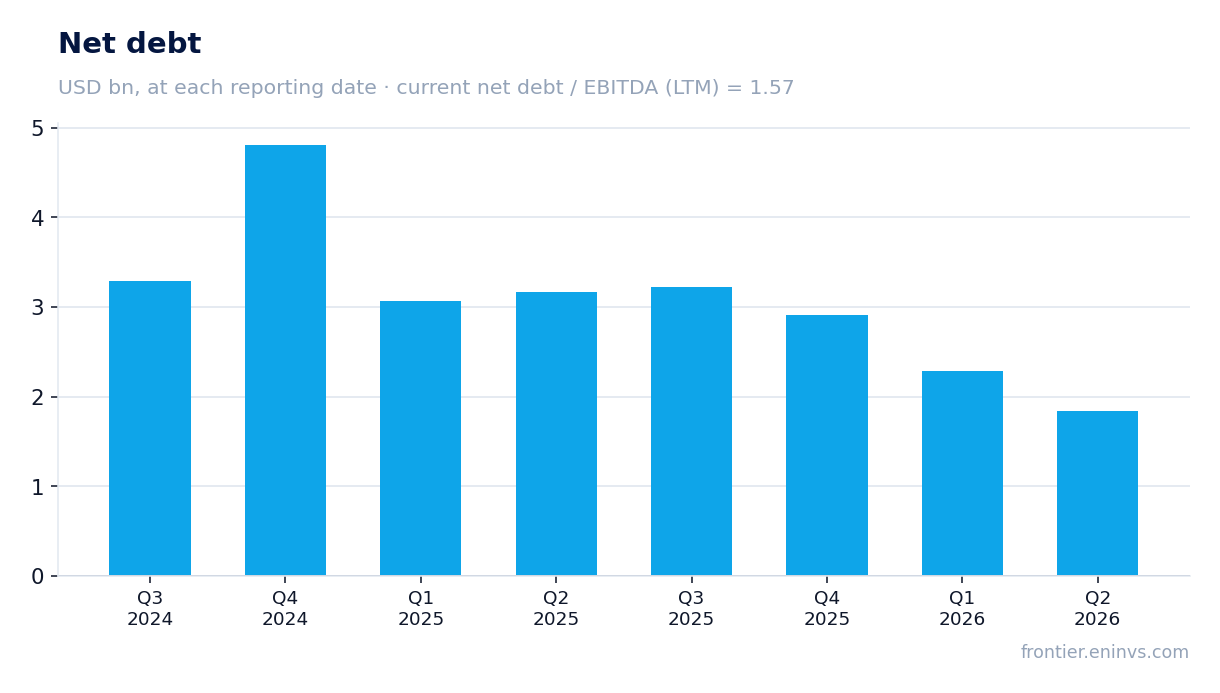
Debt at 1.57x LTM EBITDA is moderate, but a USD 0.4 bn reduction in net debt over the quarter does not change the picture
Net debt at the end of the second quarter of 2026 was USD 1,839.6 mn, equivalent to 1.57x LTM EBITDA. This is a moderate level of leverage. Net debt fell by USD 0.4 bn over the quarter and by USD 1.3 bn over 12 months. The reduction is occurring against rising EBITDA, which improves credit metrics.
However, reducing debt in absolute terms is not a strategic priority. The company generates significant operating cash flow, which is directed towards capital expenditure and dividends. In the first quarter of 2026, operating cash flow is not disclosed, but in the fourth quarter of 2025 it was USD 558.3 mn.
Interest expenses are not disclosed in the provided data, but at the current debt level and market rates they should not put critical pressure on profit. The main risk is refinancing in the event of a sharp fall in lithium prices and, consequently, EBITDA.
Free cash flow remains under pressure as capital spending rises with lithium prices
Operating cash flow over the last 12 months was USD 990.1 mn. This is significantly below EBITDA for the same period (USD 3,070.0 mn), explained by high capital expenditure and changes in working capital. The company is actively investing in expanding production to take advantage of high lithium prices.
Capital expenditure in previous quarters ranged from USD 177.8 mn (Q1 2025) to USD 243.9 mn (Q3 2025). In the first and second quarters of 2026, capital expenditure data is not disclosed, but given rising lithium prices, an increase can be expected. This means free cash flow is likely to remain negative or close to zero.
For shareholders this matters because dividends are paid out of free cash flow. If the company continues to increase capital expenditure, dividend payments may be constrained despite record profits.
A 3.3% dividend yield on a 100% payout looks sustainable, but hinges on lithium prices
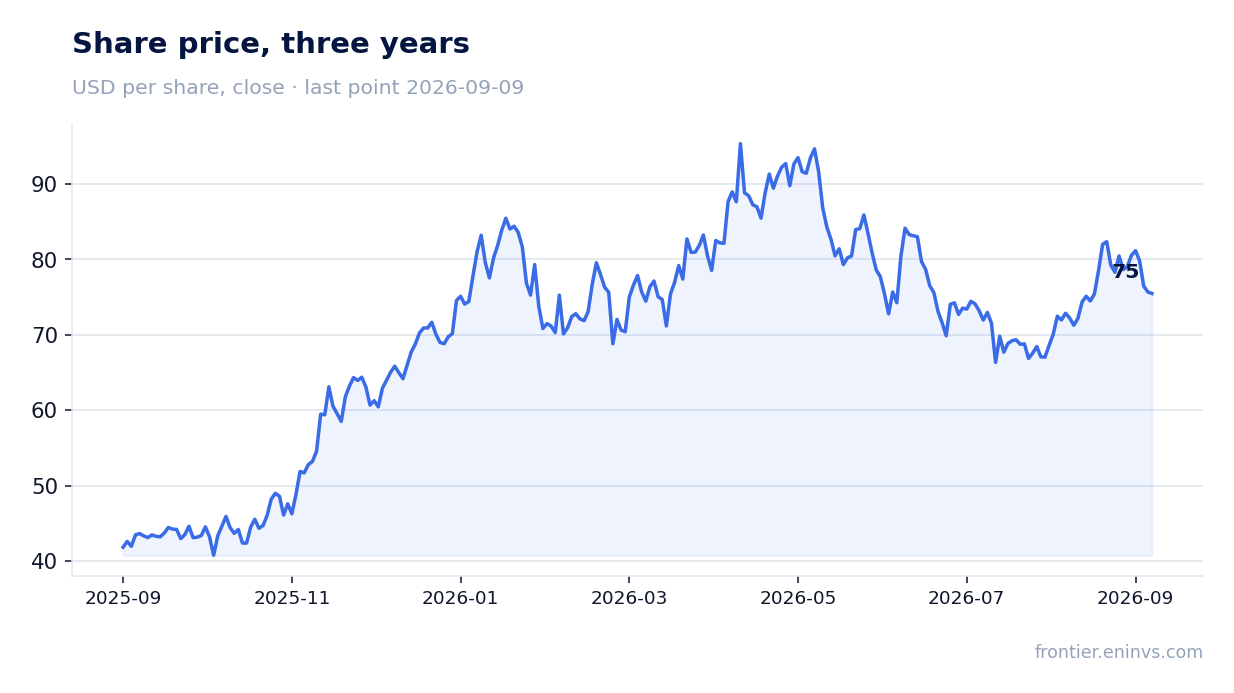
The dividend yield over the last 12 months is 3.3%. The company has historically paid out a significant portion of profit as dividends. With net profit of USD 1,386.9 mn over the last 12 months and a market capitalisation of USD 21,554.2 mn, the dividend base looks solid.
Our estimate for the 2026 dividend is based on current profit and a payout ratio of about 100%. If annual profit reaches around USD 2,000 mn (based on the current quarterly run rate), the dividend could be in the range of USD 1.5–2.0 per share, giving a yield of about 4–5% to the current price. However, this estimate critically depends on lithium prices: a 30% price drop could halve profit and the dividend.
The key rate in Chile and global rates affect the attractiveness of dividend stocks. At a current yield of 3.3%, the share offers a moderate premium to the risk-free rate but is not exceptionally attractive for a conservative investor.
EV/EBITDA of 8.6x is below the three-year average of 8.8x, yet the portal's model points to 22% downside to fair value
The current EV/EBITDA multiple is 8.6x, slightly below the three-year average of 8.8x. This means the share trades marginally cheaper than its historical norm. However, the LTM P/E is 15.5x, which does not look cheap for a mining company at a cyclical peak.
According to the portal's model, which re-prices EBITDA at current commodity prices against a target EV/EBITDA, the fair value of the share is 22% below the current market price. This is an important signal: the market has already priced in a fairly optimistic lithium price scenario, and further gains require prices to exceed it.
ROE stands at 43.4%, reflecting high profitability at the cycle peak. However, the sustainability of such a ROE level is questionable. For comparison, during periods of low lithium prices, the company's ROE was significantly lower. An investor should value the share based on average lithium prices, not current peak levels.
Valuation on the latest reported figures
| Metric | Value |
|---|---|
| Market cap | 21.6 bn USD |
| P/E (LTM) | 15.5 |
| EV/EBITDA (LTM) | 8.6 |
| P/B | 4.18 |
| Net debt / EBITDA (LTM) | 1.57 |
| Operating cash flow (LTM) | 0.99 bn |
| ROE | 43.4% |
| Dividend yield (12m) | 3.3% |
| EV/EBITDA, 3-year average | 8.8 |
Bottom line
Sociedad Quimica y Minera de Chile delivered a record quarter: revenue up 136.7%, EBITDA up 299.4%, net profit up 646.4%. The EBITDA margin reached 49.8% versus 29.5% a year earlier. However, all this growth rests on lithium prices, which are historically extremely volatile. Debt at 1.57x LTM EBITDA is moderate, the 3.3% dividend yield looks sustainable, but the portal's model points to 22% downside to fair value. In our view the share looks neutral: current multiples are cheap relative to history, but peak profits and the risk of a lithium price reversal offset each other.
Open the company's financial profile SQM →
See also: market overview · valuation map · stock screeners