Apple Inc.: record June quarter, but 16% growth is already priced in

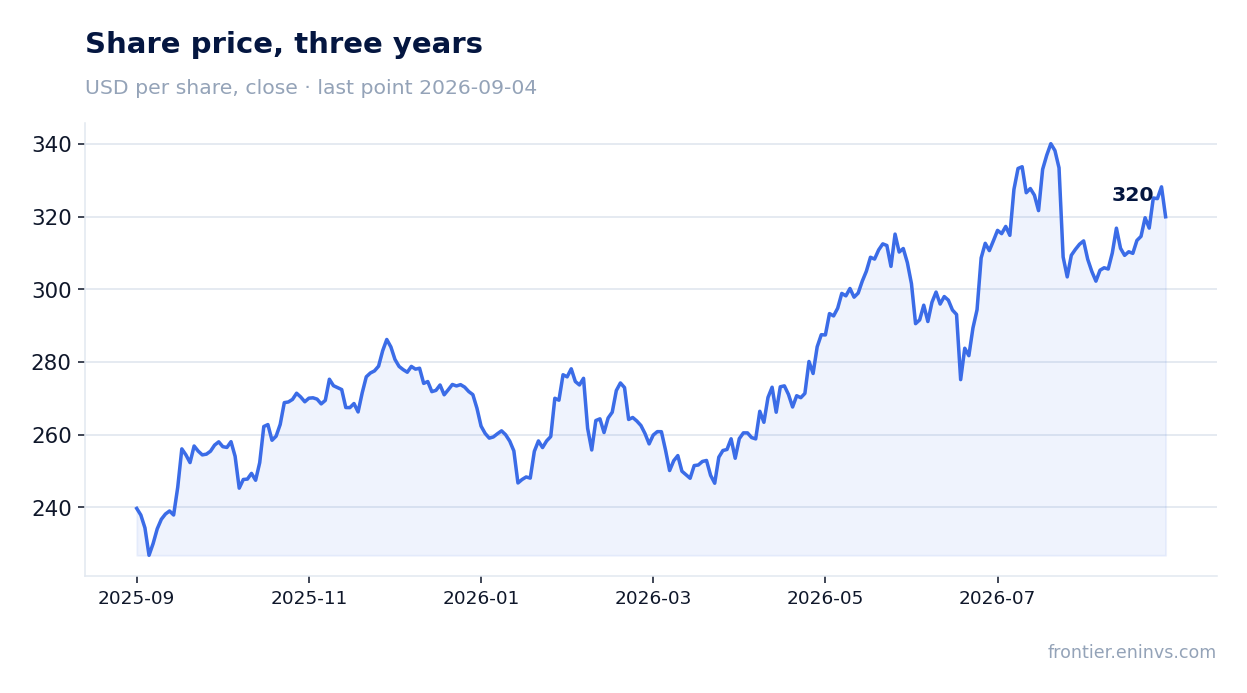
30 июля Apple Inc. раскрыла результаты за третий квартал 2026 финансового года: выручка выросла на 16,4% до 109,4 млрд долларов, чистая прибыль – на 27,1% до 29,8 млрд. Акции после отчёта подешевели на 1,4%, а к 4 сентября – ещё на 5,4%, что отражает сдержанную реакцию на сильные цифры. При текущей цене бумага выглядит скорее привлекательно: рост ускоряется, маржа расширяется, долг отрицательный, но мультипликаторы выше собственной истории.
Key takeaways
— Revenue grew 16.4% in Q3 – record June quarter driven by iPhone, Mac and Services
— EBITDA margin expanded to 35.7% from 33.0% a year ago, helped by tariff refunds
— Net profit rose 27.1% to $29.8 billion, including $0.11 per share from tariff refunds
— Company moved to a net cash position: net debt of minus $85.0 billion
— Operating cash flow of $34.4 billion in the quarter – a June quarter record
— Capital expenditures fell to $2.5 billion in the quarter, supporting free cash flow
— Dividend of $0.27 per share yields 0.34% – below market average
Attractiveness
Key figures, USD bn
| Metric | Q3 2025 | Q3 2026 | Change |
|---|---|---|---|
| Revenue | 94.0 | 109 | +16.4% |
| EBITDA | 31.0 | 39.0 | +25.7% |
| Operating profit | 28.2 | 35.7 | +26.6% |
| Net profit | 23.4 | 29.8 | +27.1% |
| Operating cash flow | 27.9 | 34.4 | +23.3% |
| Capex | 3.46 | 2.46 | -29.1% |
| EBITDA margin | 33.0% | 35.7% | +2.7 pp |
| Net margin | 24.9% | 27.2% | +2.3 pp |
Revenue grew 16.4% in Q3 – record June quarter driven by iPhone, Mac and Services
In the third quarter of fiscal 2026 (ended June 27), Apple Inc. revenue reached $109.4 billion, up 16.4% year over year. This is the best June quarter in the company's history: growth accelerated from 9.6% in the same quarter last year and 7.9% in Q4 2025.
The main driver was iPhone sales – $54.3 billion, up 21.7% year over year. Mac grew 28.7% to $10.4 billion, Services rose 12.1% to $30.7 billion. All geographic segments posted double-digit growth: Americas +11.1%, Europe +22.4%, Greater China +22.4%, Japan +13.3%, Rest of Asia Pacific +15.6%.
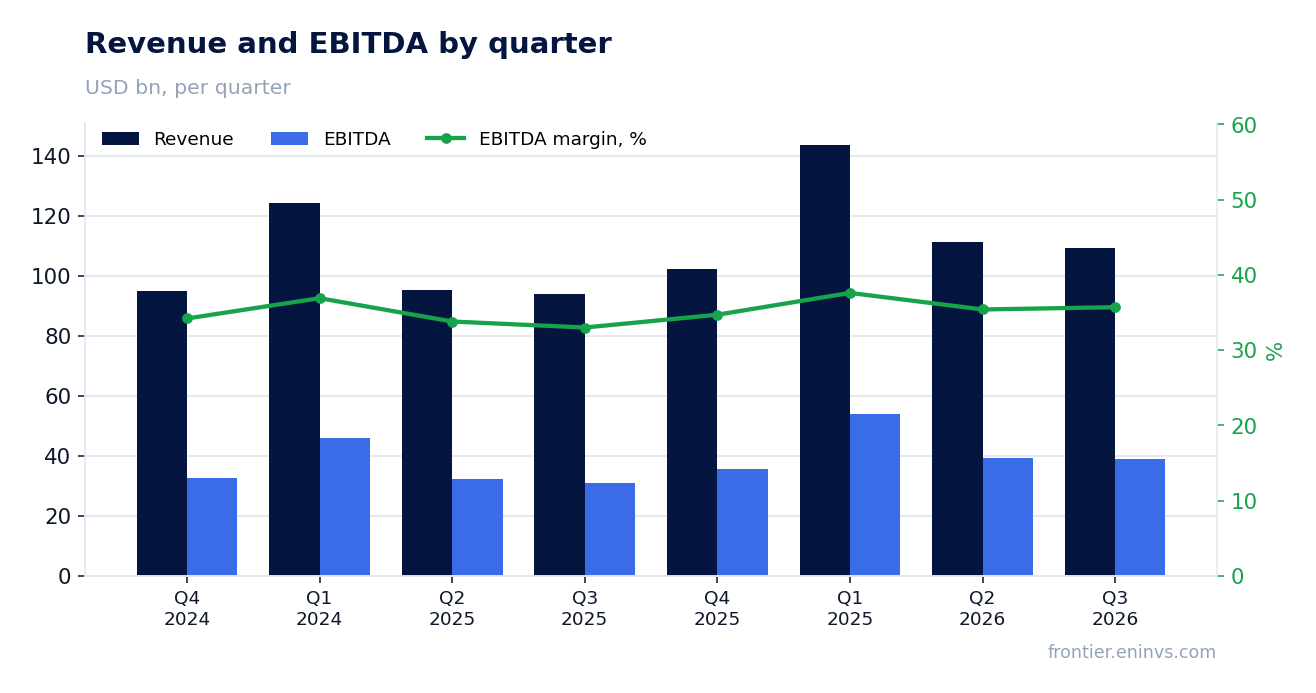
EBITDA margin expanded to 35.7% from 33.0% a year ago, helped by tariff refunds
EBITDA for the reported quarter grew 25.7% to $39.0 billion, with EBITDA margin reaching 35.7% versus 33.0% a year earlier. Margin expansion was driven by gross margin rising to 50.1%, helped by tariff refunds – they added roughly 2 percentage points to gross margin.
Operating profit rose 26.6% to $35.7 billion. Higher R&D expenses (from $8.9 to $11.7 billion) and SG&A (from $6.7 to $7.3 billion) were offset by strong revenue growth and gross profit.
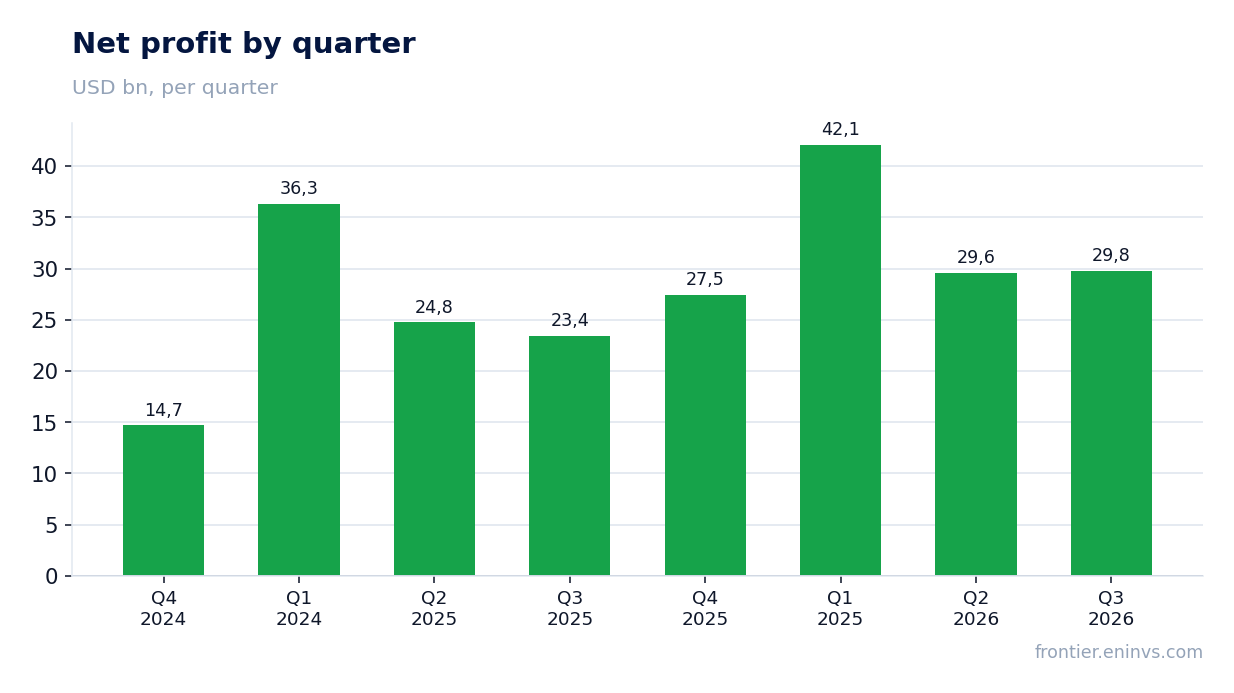
Net profit rose 27.1% to $29.8 billion, including $0.11 per share from tariff refunds
Net profit for the third quarter was $29.8 billion, up 27.1% year over year. Diluted EPS rose 29% to $2.02, of which $0.11 came from tariff refunds – a one-off item.
Excluding this effect, EPS would have been around $1.91, still up about 22% year over year. Net margin expanded to 27.2% from 24.9% a year earlier.
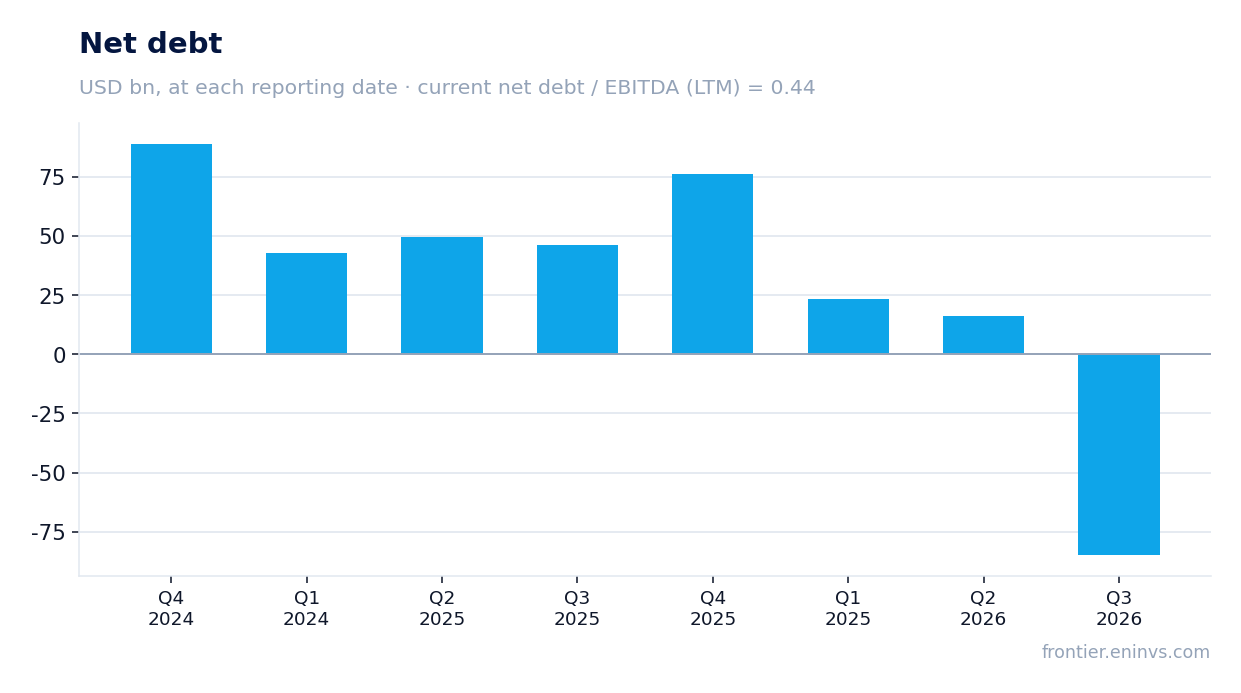
Company moved to a net cash position: net debt of minus $85.0 billion
At the end of the quarter, Apple Inc.'s net cash position was minus $85.0 billion (i.e., cash and marketable securities exceed debt by this amount). A year ago, the company had net debt of $46.3 billion, so over 12 months the position improved by $131.4 billion.
Net debt to EBITDA for the trailing twelve months stands at 0.44 – a level, not a direction, but it reflects low leverage. The company has been actively repaying debt: in the first nine months of fiscal 2026, term debt repayments totaled $8.1 billion, and commercial paper was reduced by $5.9 billion.
Operating cash flow of $34.4 billion in the quarter – a June quarter record
Operating cash flow in Q3 reached $34.4 billion – a June quarter record, said CFO Kevan Parekh. Over the trailing twelve months, operating cash flow was $111.5 billion.
Strong cash flow allowed the company to spend $62.1 billion on share repurchases in the first nine months of fiscal 2026 and pay $11.8 billion in dividends. Capital expenditures in the quarter fell to $2.5 billion from $3.5 billion a year earlier, further supporting free cash flow.
Capital expenditures fell to $2.5 billion in the quarter, supporting free cash flow
Capital expenditures in Q3 were $2.5 billion versus $3.5 billion a year earlier – a 29% decline. Over the trailing twelve months, capex totaled about $10.6 billion (sum of four quarters: 2.9 + 3.1 + 3.2 + 2.5).
The low capex level is typical for Apple Inc. – the company does not build its own factories but relies on contract manufacturers. This allows it to convert almost all operating profit into free cash flow, which over the trailing twelve months was about $100.9 billion (111.5 – 10.6).
Dividend of $0.27 per share yields 0.34% – below market average
The board declared a quarterly dividend of $0.27 per share, payable on August 13, 2026. Over the trailing twelve months, dividend yield was 0.34% – a modest level, but Apple Inc. traditionally focuses on share buybacks, which totaled $62.1 billion in the first nine months of fiscal 2026.
Given the net cash position and stable cash flow, the company has significant room to raise dividends, but the current yield is unlikely to attract income-oriented investors.
Valuation on the latest reported figures
| Metric | Value |
|---|---|
| Market cap | 4 727 bn USD |
| P/E (LTM) | 36.7 |
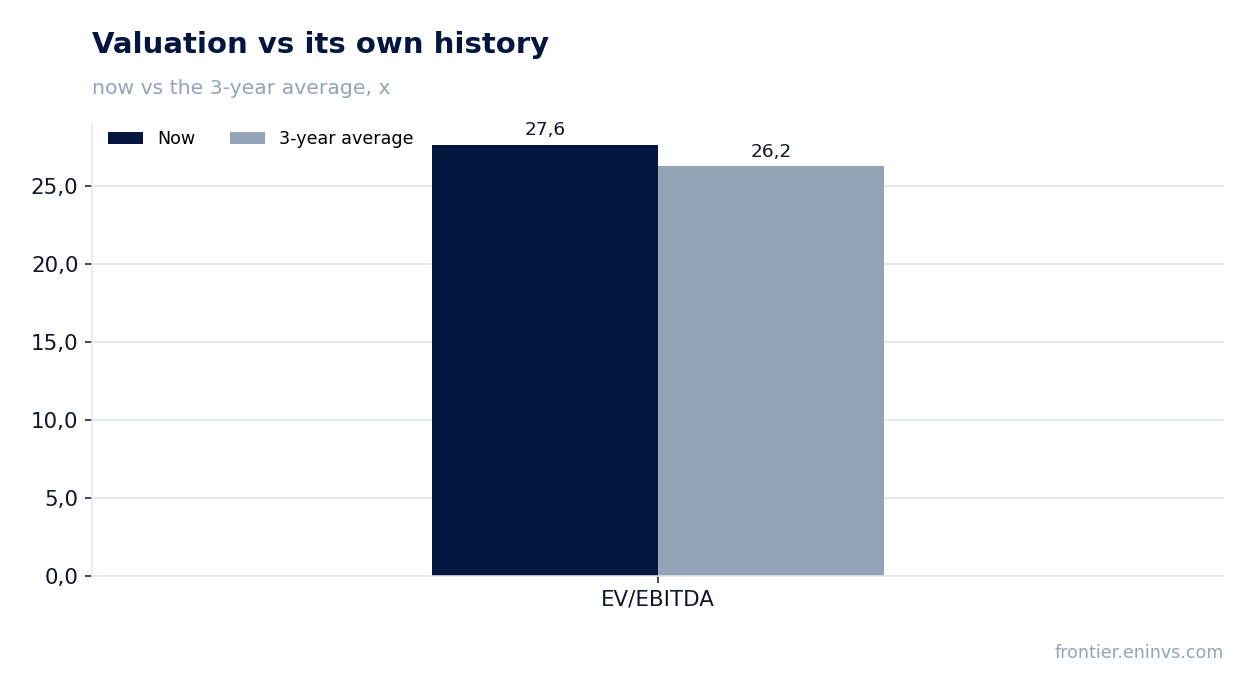
| EV/EBITDA (LTM) | 27.6 |
| Net debt / EBITDA (LTM) | 0.44 |
| Operating cash flow (LTM) | 112 bn |
| ROE | 37.1% |
| Dividend yield (12m) | 0.3% |
| EV/EBITDA, 3-year average | 26.2 |
Bottom line
The report is strong: revenue and profit are growing at double-digit rates, margins are expanding, the company has moved to a net cash position, and cash flow is setting records. However, part of the profit growth was driven by one-off tariff refunds, and the stock fell after the report despite the positive news – the market was apparently expecting even higher numbers. At P/E of 36.7 and EV/EBITDA of 27.6 versus the three-year average of 26.2, valuation remains stretched, but the portal's model sees 19% upside. Verdict – rather attractive: a strong business with accelerating growth and a clean balance sheet, but investors may want to wait for a more attractive entry point or confirmation that growth is sustainable without one-offs.
Open the company's financial profile AAPL →
See also: market overview · valuation map · stock screeners