BOEING CO: revenue grows, but profit remains negative — recovery is slower than hoped
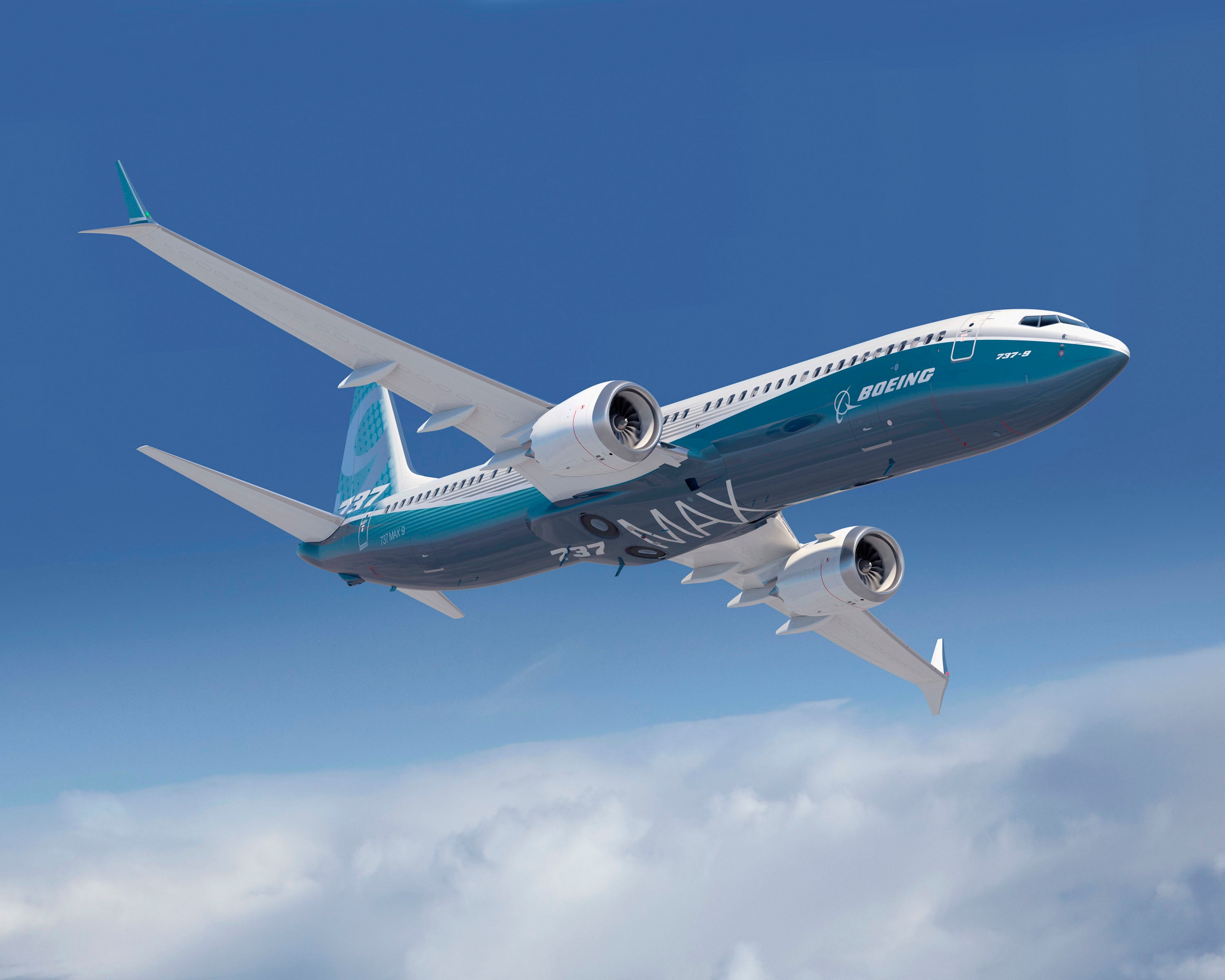
On July 28, 2026, BOEING CO reported results for the second quarter of 2026. Revenue increased by 8.0% year-over-year to $24,560 million, but net loss was $444 million, although it was larger a year earlier. EBITDA in the second quarter grew by 164.8% to $752 million, yet EBITDA margin remains low at 3.1%. Our verdict: the shares look rather unattractive at the current price, as the recovery in profitability is slow and valuation remains high.
Key takeaways
— Revenue in the second quarter grew by 8% to $24.6 billion, mainly driven by 171 commercial deliveries
— EBITDA in the second quarter increased by 164.8%, but EBITDA margin was only 3.1%
— Net loss narrowed to $444 million, but negative margin persists
— Operating cash flow in the second quarter rose to $1.4 billion, but free cash flow was only $0.6 billion
— Net debt declined to $13.1 billion, but net debt/EBITDA for the trailing twelve months stands at 5.64
— Backlog reached a record $715 billion, including over 6,200 commercial airplanes
— According to the portal's model, the upside potential of the share is -1%, indicating a fair valuation
Attractiveness
Key figures, USD bn
| Metric | Q2 2025 | Q2 2026 | Change |
|---|---|---|---|
| Revenue | 22.7 | 24.6 | +8.0% |
| EBITDA | 0.28 | 0.75 | +164.8% |
| Operating profit | -0.18 | 0.16 | to profit |
| Net profit | -0.61 | -0.44 | — |
| Operating cash flow | 0.23 | 1.36 | +500.9% |
| Capex | 0.43 | 0.73 | +71.7% |
| EBITDA margin | 1.2% | 3.1% | +1.9 pp |
| Net margin | -2.7% | -1.8% | +0.9 pp |
Revenue in the second quarter grew by 8% to $24.6 billion, mainly driven by 171 commercial deliveries
In the second quarter of 2026, BOEING CO's revenue reached $24,560 million, up 8.0% year-over-year. Growth was driven by commercial deliveries: the company handed over 171 airplanes to customers versus 150 a year earlier. The Commercial Airplanes segment increased revenue by 8% to $11,751 million, and Defense, Space & Security by 13% to $7,483 million. Global Services added only 1% to $5,344 million.
Growth rates slowed compared to previous quarters: in Q2 2025 growth was 34.9%, in Q3 – 30.4%, in Q4 – 57.1%. In Q1 2026 growth was 14.0%, now – 8.0%. This indicates normalization after the recovery period following strikes and quality issues.
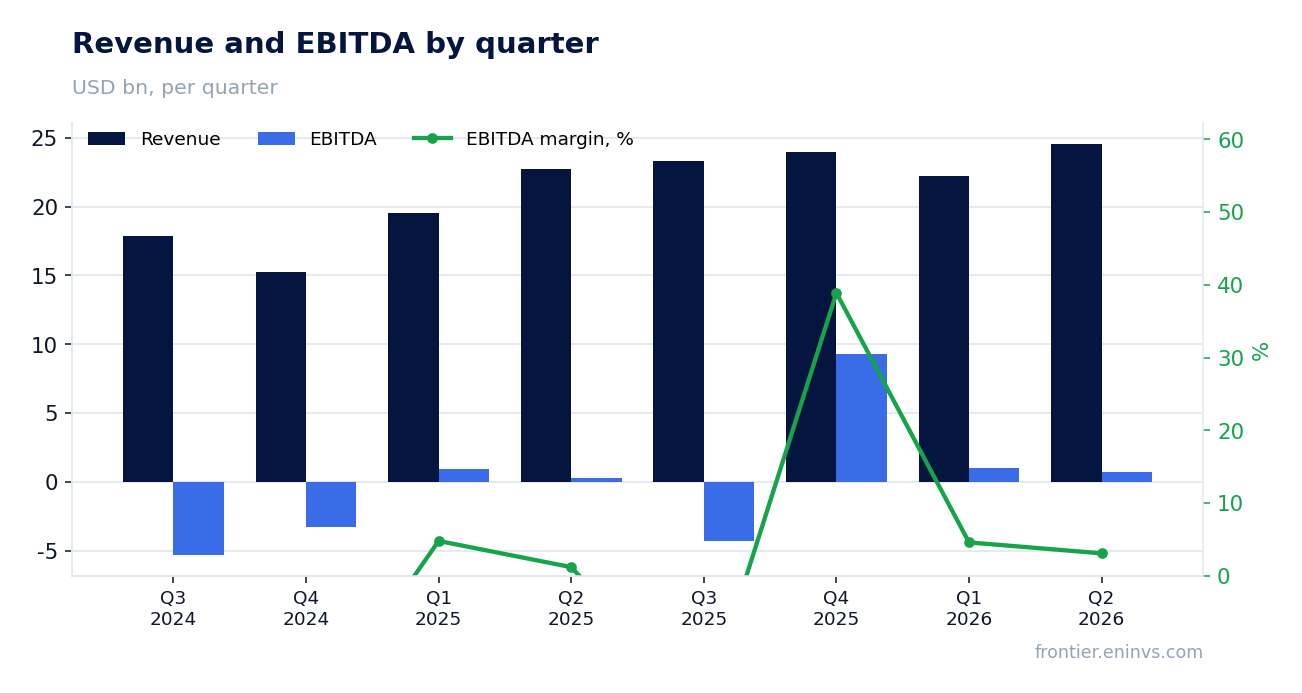
EBITDA in the second quarter increased by 164.8%, but EBITDA margin was only 3.1%
EBITDA in Q2 2026 was $752 million versus $284 million a year earlier, up 164.8%. However, EBITDA margin is only 3.1%, although it was 1.2% a year earlier. This is still a very low level for an aircraft manufacturer: operating profit in Q2 was only $156 million, and operating margin was 0.6%.
The main losses are generated by Commercial Airplanes: operating loss was $322 million, although a year earlier it was $557 million. Defense, Space & Security also posted a small loss of $15 million due to losses on the VC-25B program of $280 million. Only Global Services remains profitable with an operating margin of 18.1%.
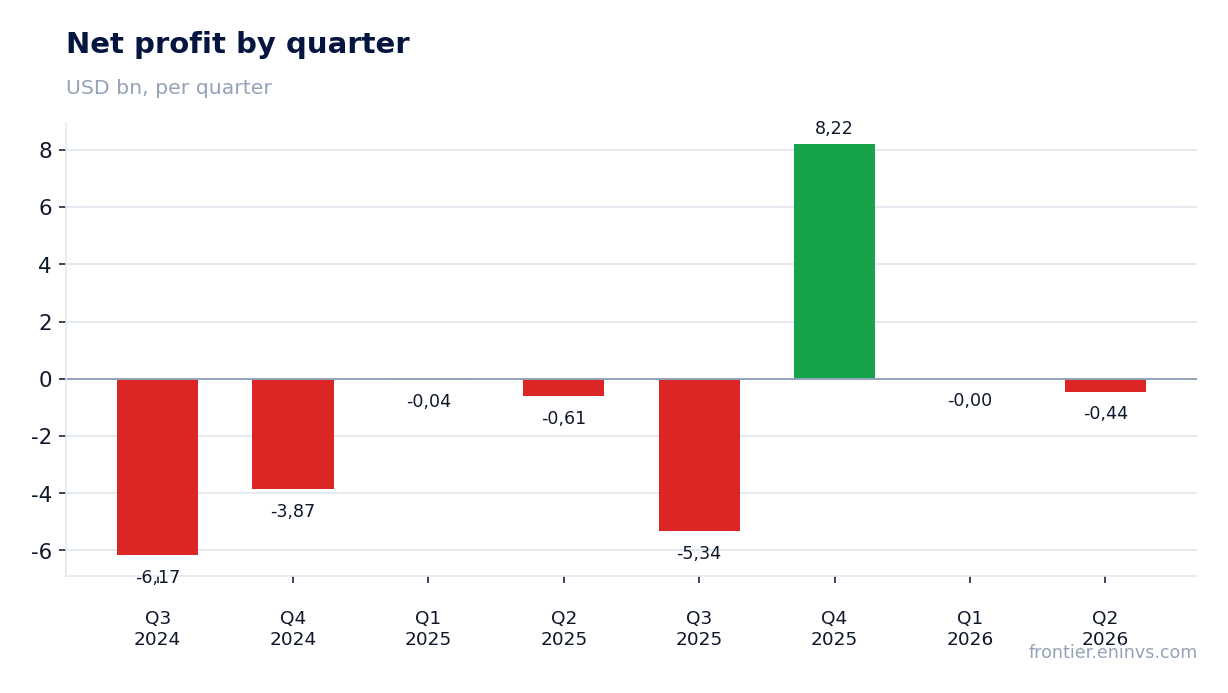
Net loss narrowed to $444 million, but negative margin persists
Net loss attributable to BOEING CO shareholders in Q2 2026 was $444 million versus $611 million a year earlier. Net margin improved from -2.7% to -1.8%, but remains negative. Loss per share was $0.67 on a GAAP basis and $0.76 on a non-GAAP core basis.
The improvement is due to higher revenue and reduced losses in Commercial Airplanes, but the company is still not profitable. Interest expense declined to $600 million from $710 million a year earlier, which helped reduce the loss.
Operating cash flow in the second quarter rose to $1.4 billion, but free cash flow was only $0.6 billion
Operating cash flow in Q2 2026 was $1,364 million versus $227 million a year earlier, up 501%. Capital expenditures increased to $733 million from $427 million, driven by investments in Charleston and St. Louis sites. As a result, free cash flow was $631 million versus negative $200 million a year earlier.
In the first half, operating cash flow was positive at $1,185 million, whereas a year earlier it was negative. However, free cash flow for the half-year remains negative: minus $823 million due to high capital expenditures. This is an important point: the company generates operating cash flow, but investments still exceed it.
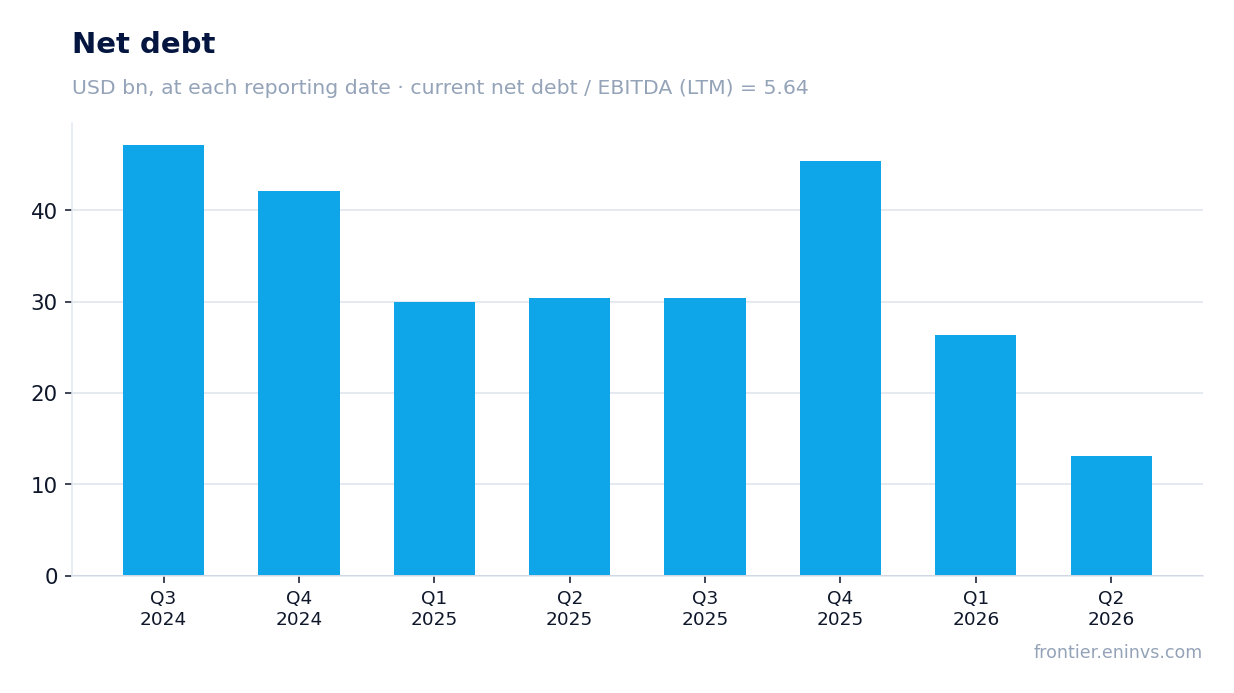
Net debt declined to $13.1 billion, but net debt/EBITDA for the trailing twelve months stands at 5.64
At the end of Q2 2026, BOEING CO's net debt was $13,117 million, down $13.2 billion from the previous reporting date and $17.2 billion lower than a year ago. The company is actively repaying debt: debt repayments in the first half totaled $8,376 million. Cash and investments in marketable securities amounted to $20.0 billion.
However, net debt/EBITDA for the trailing twelve months is 5.64 – a high level reflecting low EBITDA. Trailing twelve-month EBITDA was $8,050.7 million, only slightly above the quarterly level a year ago. Debt reduction is positive, but leverage remains significant.
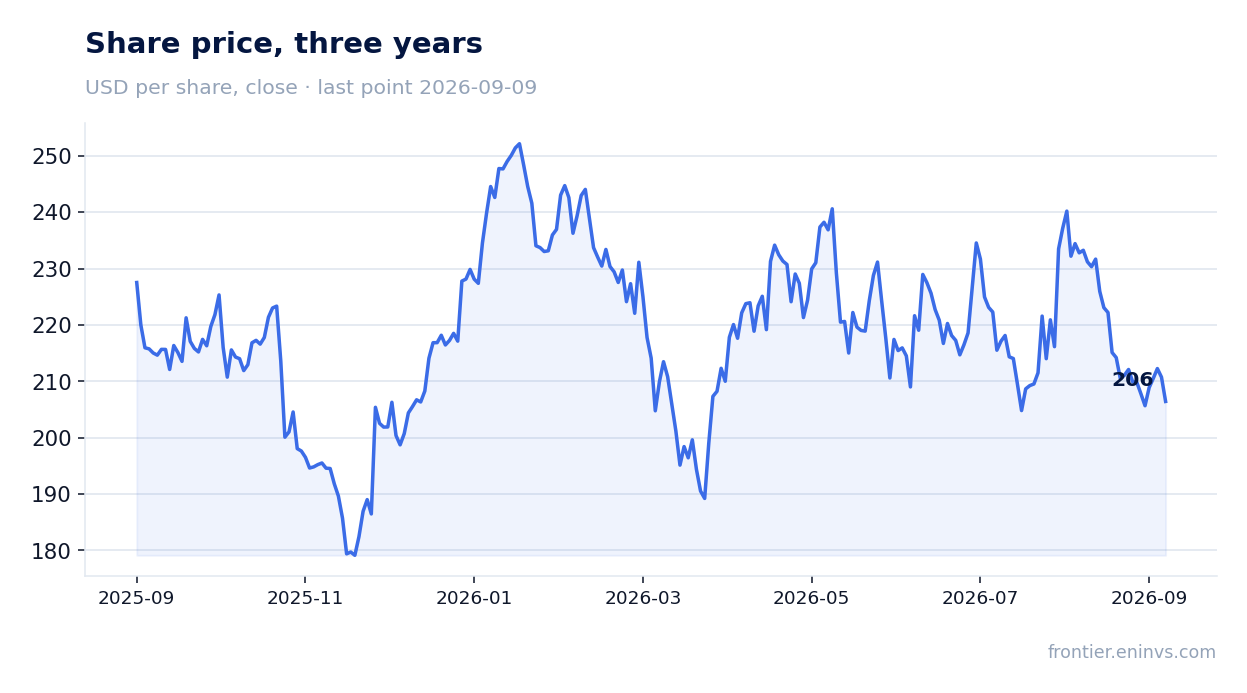
Backlog reached a record $715 billion, including over 6,200 commercial airplanes
BOEING CO's total backlog at the end of Q2 2026 reached a record $715 billion, up from $682 billion at the end of 2025. The Commercial Airplanes backlog is valued at a record $597 billion and includes over 6,200 airplanes. Defense, Space & Security has a backlog of $85 billion, Global Services – $33 billion.
In Q2, Commercial Airplanes booked 246 net orders, including orders from Korean Air, Delta Air Lines, and SMBC Capital. This confirms sustained demand for the company's products despite current financial difficulties.
According to the portal's model, the upside potential of the share is -1%, indicating a fair valuation
Our value-creation model, based on EBITDA growth and target multiple, shows that the upside potential of BOEING CO's shares is -1% relative to the current market capitalization. This means the shares are trading approximately at fair value according to our model.
Current multiples: P/E LTM is 66.5, EV/EBITDA LTM is 25.8. These are high values, reflecting market expectations of future profitability recovery. However, given the current low profitability and negative net income, such multiples appear stretched.
Valuation on the latest reported figures
| Metric | Value |
|---|---|
| Market cap | 162 bn USD |
| P/E (LTM) | 66.5 |
| EV/EBITDA (LTM) | 25.8 |
| P/B | 29.70 |
| Net debt / EBITDA (LTM) | 5.64 |
| Operating cash flow (LTM) | 1.10 bn |
| ROE | -29.4% |
Bottom line
In Q2 2026, BOEING CO showed 8% revenue growth and a significant improvement in EBITDA, but the company still generates a net loss. Operating cash flow turned positive, yet free cash flow remains weak due to high capital expenditures. The reduction in net debt is positive, but leverage remains high. The backlog is record, providing visibility of future revenue. However, given the current valuation (P/E 66.5, EV/EBITDA 25.8) and slow profitability recovery, the shares look rather unattractive.
Open the company's financial profile BA →
See also: market overview · valuation map · stock screeners