Camden Property Trust: revenue falls for the first time in five quarters, and the $1.625bn California portfolio sale radically reshapes the balance sheet
On July 30, Camden Property Trust reported second-quarter 2026 results. Revenue fell 1.5% year over year to $392.9 million, EBITDA dropped 18.7% to $220.5 million, and net profit plunged 76.7% to $18.8 million due to one-off charges and the absence of gains on sales. The shares look rather attractive: the $1.625 billion California portfolio sale will sharply reduce debt, but operating metrics are deteriorating, and recovery will depend on the rental market.
Key takeaways
— Revenue fell for the first time in five quarters, down 1.5% year over year to $392.9 million, as new and renewal lease rates declined
— EBITDA dropped 18.7% to $220.5 million, and EBITDA margin fell from 68.0% to 56.1% due to higher operating expenses and one-off items
— Net profit plunged 76.7% to $18.8 million, hit by a $53 million litigation settlement and the absence of gains on sales that were present a year ago
— Debt rose $0.6 billion in the quarter to $4.8 billion, but the $1.625 billion California portfolio sale will allow repayment of a significant portion of borrowings
— Operating cash flow for the trailing twelve months was $826.6 million, covering capex and dividends, but free cash flow is shrinking
— The company continues its share repurchase program: $144.1 million bought in the quarter, with $297.9 million remaining
— The California portfolio sale distorts comparable metrics: excluding those properties, same-property revenue fell only 0.1%
Attractiveness
Key figures, USD bn
| Metric | Q2 2025 | Q2 2026 | Change |
|---|---|---|---|
| Revenue | 0.40 | 0.39 | -1.5% |
| EBITDA | 0.27 | 0.22 | -18.7% |
| Operating profit | 0.07 | 0.02 | -69.4% |
| Net profit | 0.08 | 0.02 | -76.7% |
| Operating cash flow | 0.23 | 0.21 | -8.3% |
| Capex | 0.00 | — | — |
| EBITDA margin | 68.0% | 56.1% | -11.9 pp |
| Net margin | 20.2% | 4.8% | -15.4 pp |
Revenue fell for the first time in five quarters, down 1.5% year over year to $392.9 million, as new and renewal lease rates declined
In the second quarter of 2026, Camden's revenue was $392.9 million, 1.5% below the prior year. This is the first decline in five quarters: in the previous four quarters, growth ranged from 2.1% to 2.4%. The main reason is deteriorating market conditions: effective new lease rates fell 3.3% year over year, while renewals rose only 2.8%, resulting in a negative blended rate of -0.2%.
Importantly, the revenue decline is largely related to the California portfolio sale. Excluding those properties, same-property revenue fell only 0.1% year over year. Nevertheless, lease rate dynamics remain negative: in the first quarter of 2026, new lease rates fell even more – by 5.5% – and in the second quarter the decline slowed to 3.3%, which may indicate market stabilization.
Occupancy remains high at 95.7% for same-property communities, only slightly above the year-ago level of 95.6%. This suggests demand is holding, but renters are receiving discounts and concessions.
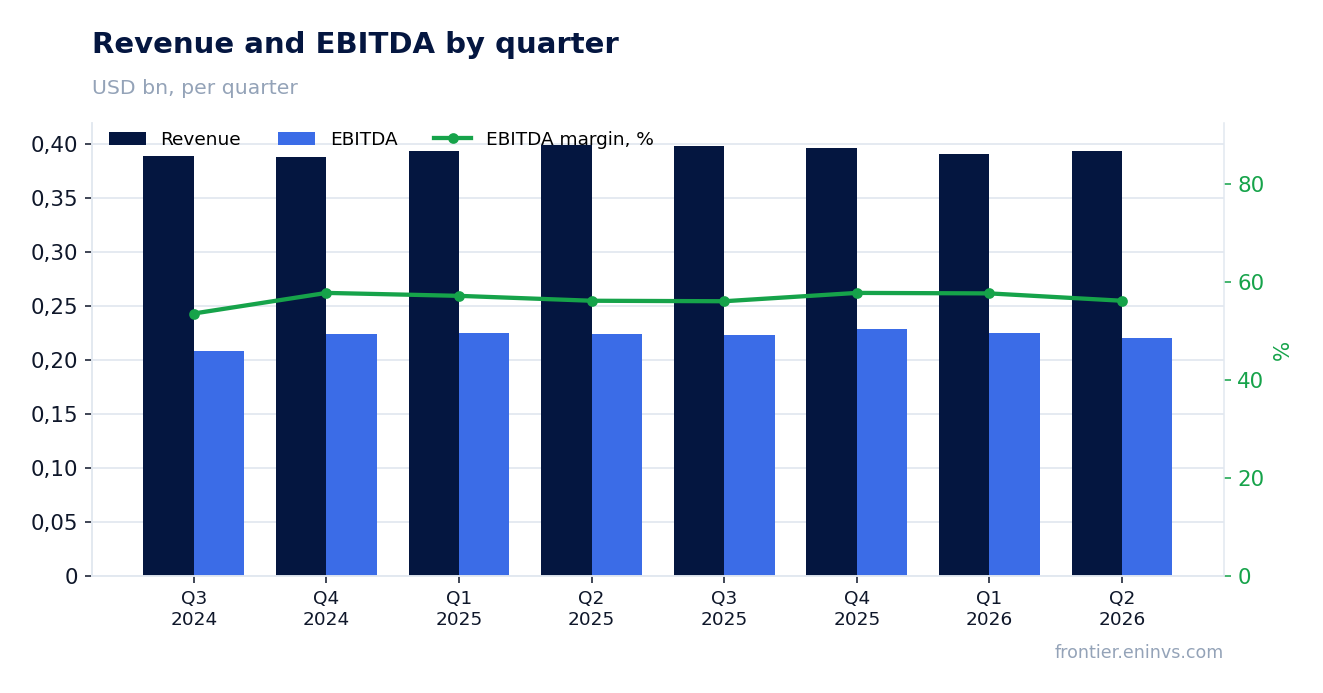
EBITDA dropped 18.7% to $220.5 million, and EBITDA margin fell from 68.0% to 56.1% due to higher operating expenses and one-off items
EBITDA in the second quarter of 2026 was $220.5 million, 18.7% below the prior year. EBITDA margin fell from 68.0% to 56.1%. The main reasons are higher operating expenses (up 2.4% on a same-property basis) and one-off items, including litigation settlement costs.
Operating profit fell even more sharply – to $22.0 million from $71.8 million a year earlier. This is due to higher general and administrative expenses (to $22.3 million from $19.0 million) and the appearance of other operating expenses of $0.4 million versus $2.2 million a year ago, as well as the absence of gains on sales, which were $47.3 million in the prior year.
Adjusted metrics look better: Core FFO per share was $1.68 versus $1.70 a year ago, indicating relative stability of the operating business when one-off effects are excluded.
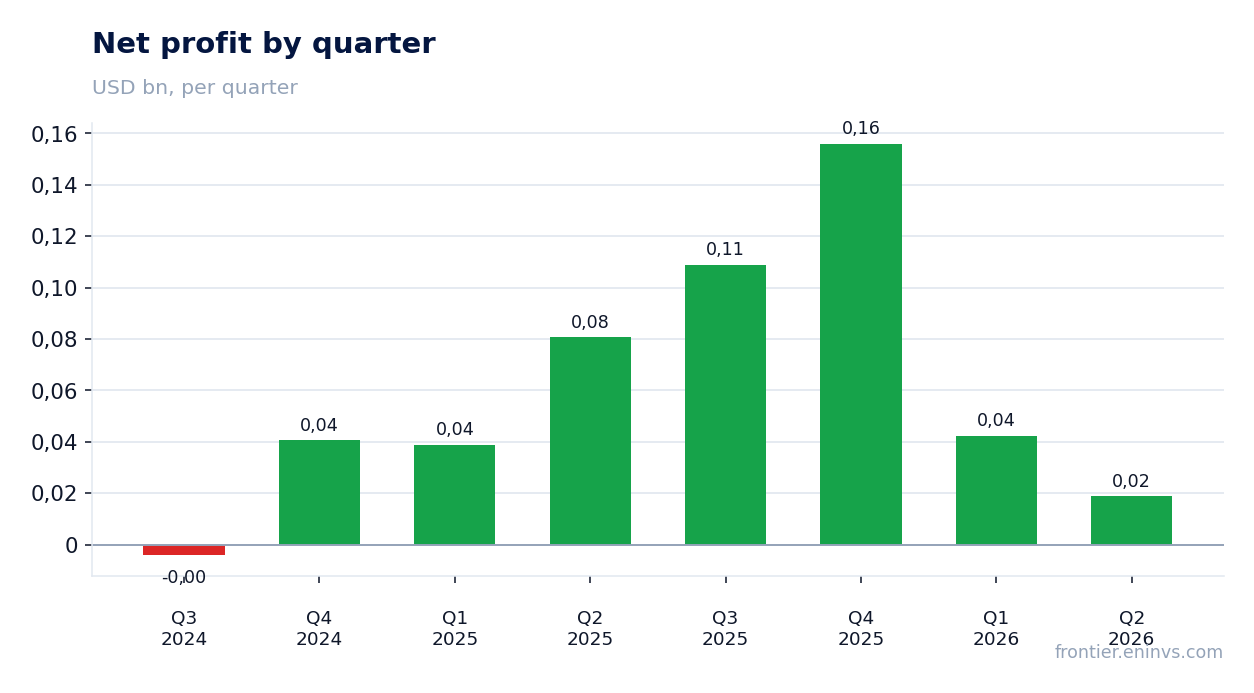
Net profit plunged 76.7% to $18.8 million, hit by a $53 million litigation settlement and the absence of gains on sales that were present a year ago
Net income attributable to common shareholders in the second quarter of 2026 was $18.8 million versus $80.7 million a year earlier. The 76.7% decline is explained by two main factors: a $53.0 million charge for settling a class action lawsuit related to the use of revenue management software, and the absence of gains on property sales, which were $47.3 million a year ago.
Excluding these one-off items, operating activity remains profitable: Core FFO per share was $1.68, only slightly below last year's $1.70. Net margin fell from 20.2% to 4.8%, but this largely reflects the one-off nature of the charges.
The company confirmed that the litigation settlement will not affect 2026 Core FFO, as such costs are excluded from the calculation of that metric.
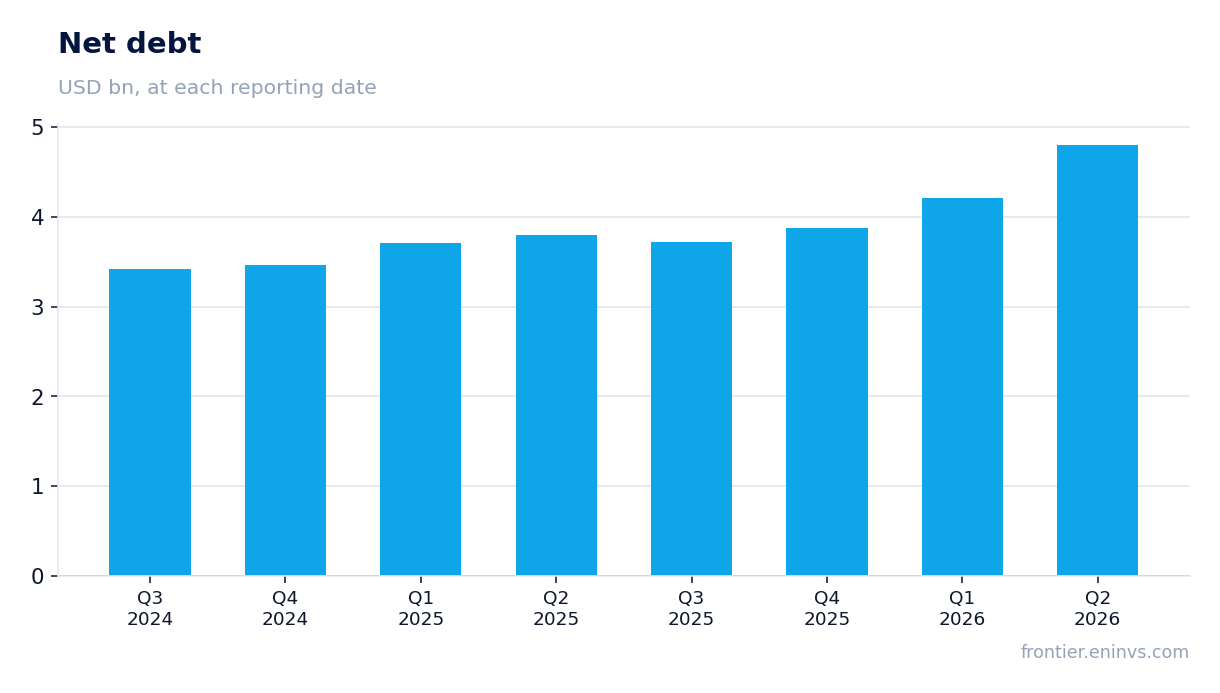
Debt rose $0.6 billion in the quarter to $4.8 billion, but the $1.625 billion California portfolio sale will allow repayment of a significant portion of borrowings
At the end of the second quarter of 2026, Camden's total debt was $4.85 billion, up $0.6 billion in the quarter and $1.0 billion over the year. The increase is related to an active investment program: the company acquired five apartment communities and two land parcels for a total of $645.4 million and continued to fund development.
However, on July 29, immediately after the reporting date, Camden sold its California portfolio of 11 communities with 3,620 apartment homes for $1.625 billion. Approximately $0.9 billion of the proceeds will be used to repay borrowings under its unsecured credit facility and commercial paper program. This will significantly reduce leverage.
Net debt to annualized EBITDA rose from 4.2x to 5.3x over the year, reflecting both higher debt and lower EBITDA. After the portfolio sale and debt repayment, this ratio should improve markedly.
Operating cash flow for the trailing twelve months was $826.6 million, covering capex and dividends, but free cash flow is shrinking
For the trailing twelve months ended June 30, 2026, Camden's operating cash flow was $826.6 million. This is a significant amount that covers both capital expenditures and dividend payments. Over the same period, the company paid dividends of approximately $440 million (based on $1.06 per share quarterly and roughly 104 million shares).
However, free cash flow is shrinking: capital expenditures in the second quarter of 2026 were $85.0 million (versus $196.4 million in the first quarter), while operating cash flow for the quarter was $211.6 million. The company is actively investing in development: at quarter-end, $140.1 million remained to fund under-construction projects.
The dividend yield remains attractive: a quarterly dividend of $1.06 per share at a price of $114.49 gives an annual yield of about 3.7%. The FFO payout ratio is 63.1%, leaving room to maintain the dividend.
The company continues its share repurchase program: $144.1 million bought in the quarter, with $297.9 million remaining
In the second quarter of 2026, Camden repurchased 1,429,136 common shares at an average price of $100.78 per share for a total of $144.1 million. Year to date, the company has repurchased $422.9 million worth of shares (4,062,166 shares at an average price of $104.08).
The share repurchase program supports the stock price and offsets dilution from option programs. The remaining authorization is $297.9 million, giving the company room to continue buybacks in the future.
Buybacks are funded by operating cash flow and partly by debt, which explains the rise in leverage. Nevertheless, management appears to view the shares as undervalued, as evidenced by active purchases.
The California portfolio sale distorts comparable metrics: excluding those properties, same-property revenue fell only 0.1%
At quarter-end, the California assets were classified as held for sale and excluded from same-property metrics. On a same-property basis (excluding California), revenue fell only 0.1% year over year, while NOI declined 1.4%. This indicates that the overall revenue decline is largely due to the portfolio sale, not deterioration in operating performance.
However, same-property expenses rose 2.4%, leading to a 1.4% NOI decline. Higher expenses partly reflect increased property taxes and operating costs, putting pressure on margins.
The company raised its 2026 revenue growth guidance (excluding California) to 0.5% (from 0.5%), but lowered NOI guidance to -0.6% (from -0.9%). This suggests management expects continued pressure on operating profitability.
Valuation on the latest reported figures
| Metric | Value |
|---|---|
| Operating cash flow (LTM) | 0.83 bn |
| ROE | 1.9% |
Bottom line
Camden finished the quarter with mixed results. On one hand, the operating business remains stable: Core FFO per share was nearly unchanged, occupancy is high, and the $1.625 billion California portfolio sale will significantly strengthen the balance sheet and allow repayment of a large portion of debt. On the other hand, revenue declined for the first time in five quarters, lease rates are falling, and expenses are rising, pressuring margins. Net profit fell 76.7% largely due to one-off litigation charges, but operational difficulties are not one-off. At the current price of $114.49, the shares yield about 3.7%, which looks attractive for a REIT, especially given the share repurchase program. However, the recovery of the stock will depend on the company's ability to stabilize lease rates and control expenses. Verdict – rather attractive.
Open the company's financial profile CPT →
See also: market overview · valuation map · stock screeners