JPMorgan: quarterly revenue accelerated to +27.7%, but nearly half of the gain is one-off items

14 июля JPMorgan Chase раскрыл результаты за второй квартал 2026 года: выручка выросла на 27,7% год к году, до 57 347 млн долл., чистая прибыль – на 41,2%, до 21 155 млн долл.. Однако в составе прочих доходов – 4,6 млрд долл. чистого выигрыша от обмена акций Visa и ещё 1,0 млрд долл. разовых доходов от оценки инвестиций. На текущей цене акция выглядит скорее привлекательно: банк торгуется заметно ниже своего трёхлетнего среднего мультипликатора, а органический рост бизнеса остаётся устойчивым.
Key takeaways
— Revenue grew 27.7% in Q2 – the fastest in eight quarters, but USD 5.6bn of the USD 12.4bn increase came from one-off gains
— EBITDA margin widened to 56.4% from 45.6% a year ago – helped by one-off gains and contained expense growth
— Net profit rose 41.2% to USD 21.2bn – half of the increase came from one-off items
— Debt rose by USD 85.9bn over the year to USD 72.4bn, but the bank's capital remains strong
— Operating cash flow over the last twelve months is negative at minus USD 147.8bn – a result of loan growth and client activity
— The bank continues to return capital: the dividend rose 7% and a new USD 50bn buyback started on July 1
— Return on equity reached 24% – 6 percentage points higher than a year ago
Attractiveness
Key figures, USD bn
| Metric | Q2 2025 | Q2 2026 | Change |
|---|---|---|---|
| Revenue | 44.9 | 57.3 | +27.7% |
| EBITDA | 20.5 | 32.3 | +57.8% |
| Operating profit | — | 30.0 | — |
| Net profit | 15.0 | 21.2 | +41.2% |
| Operating cash flow | 29.5 | -25.3 | -185.6% |
| EBITDA margin | 45.6% | 56.4% | +10.8 pp |
| Net margin | 33.4% | 36.9% | +3.5 pp |
Revenue grew 27.7% in Q2 – the fastest in eight quarters, but USD 5.6bn of the USD 12.4bn increase came from one-off gains
In Q2 2026, JPMorgan's revenue reached USD 57,347m, up 27.7% year-on-year. This is the strongest acceleration in eight quarters: previous growth rates ranged from -10.5% to +10.0%. The main contribution came from the Commercial & Investment Bank (revenue +27% YoY) and the Corporate segment, where revenue jumped almost fourfold.
However, a significant part of the increase is one-off. Other income included a USD 4.6bn net gain from the exchange of Visa Class B shares for Class C, as well as USD 1.0bn of gains from the remeasurement of equity investments. Without these items, revenue growth would have been much more modest – roughly +12% YoY, still above the average pace of previous quarters.
Organic growth was supported by investment banking fees (+28% YoY to USD 3,208m), asset management fees (+18%) and net interest income growth (+10% to USD 25,511m). The loan book grew 9% over the year, providing a base for further growth in interest income.
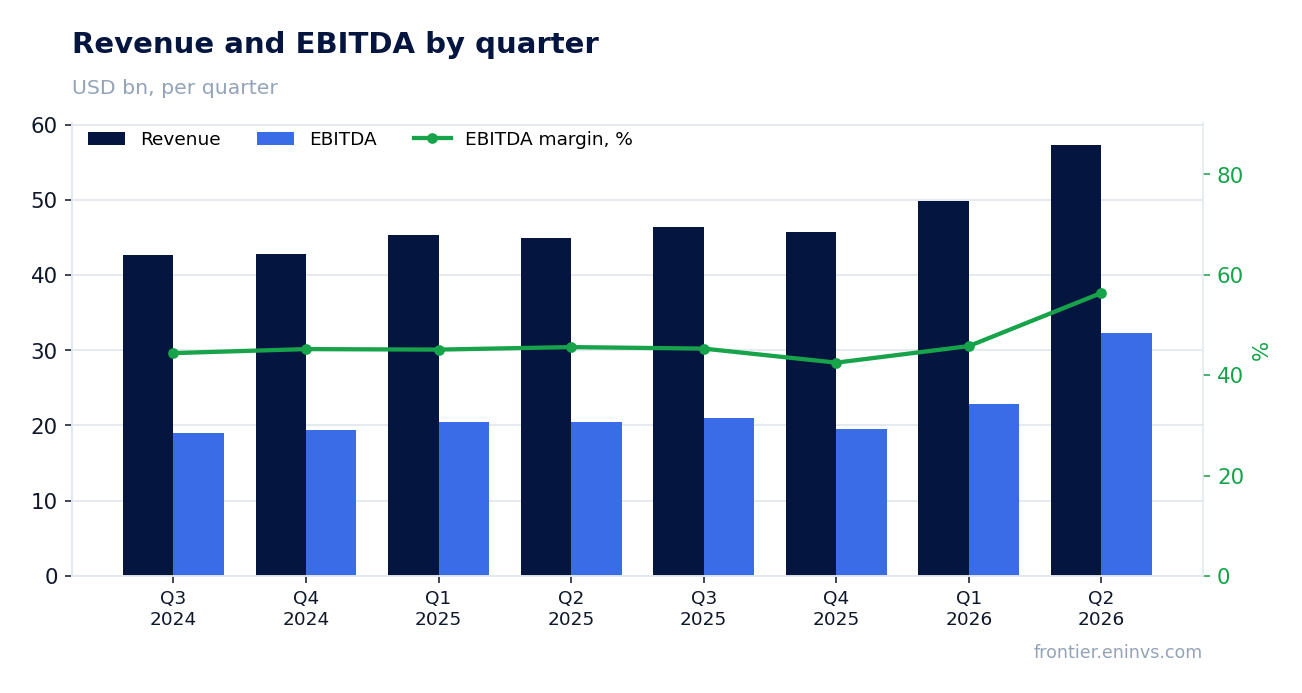
EBITDA margin widened to 56.4% from 45.6% a year ago – helped by one-off gains and contained expense growth
EBITDA in Q2 grew 57.8% YoY to USD 32,348m, and the EBITDA margin reached 56.4% versus 45.6% a year ago. The 10.8 pp margin expansion was driven by revenue growing faster than expenses: operating expenses rose only 15%.
The key expense item – compensation – grew just 11% to USD 15,159m, well below the revenue growth rate. Other items such as marketing (+31%) and professional services (+28%) grew faster, but their share in expenses is small.
Importantly, the margin includes one-off gains. Without the USD 5.6bn of one-off items, the EBITDA margin would have been around 46%, close to the level of a year ago. Thus, the margin improvement is largely due to one-off factors, although organic revenue growth also helped.
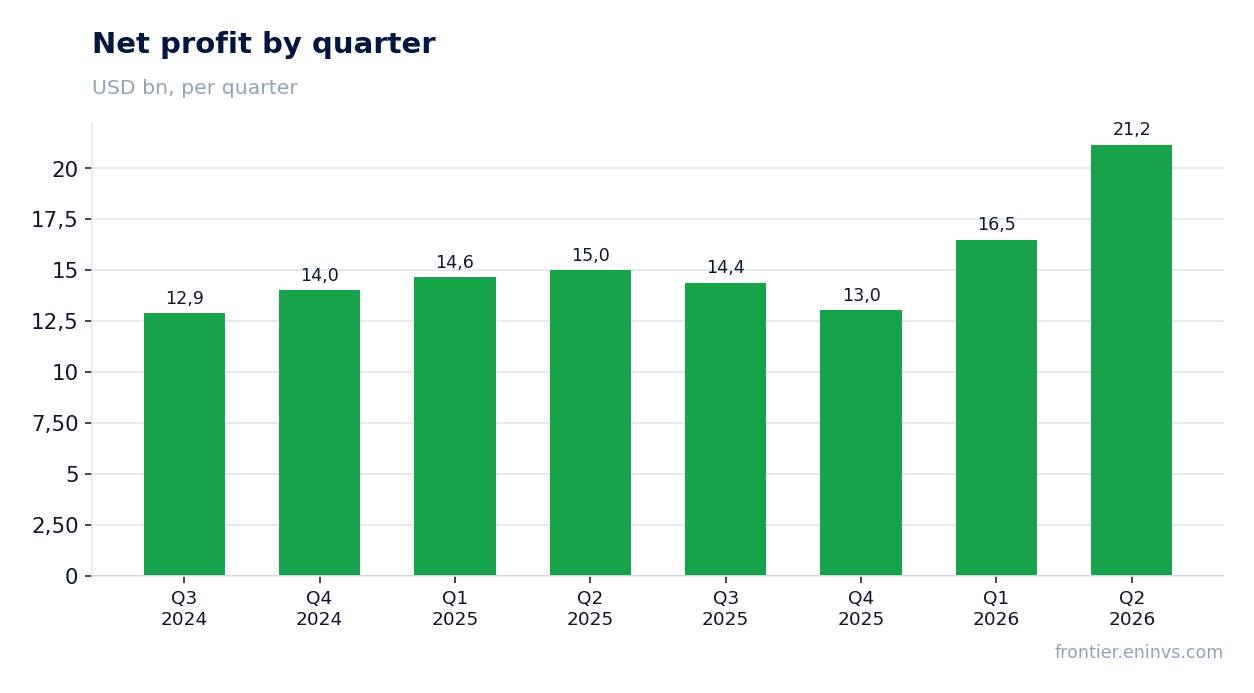
Net profit rose 41.2% to USD 21.2bn – half of the increase came from one-off items
Net profit for Q2 was USD 21,155m, up 41.2% YoY. The increase of USD 6.2bn was almost half driven by one-off gains: USD 4.6bn from the Visa share exchange and USD 1.0bn from the remeasurement of investments. Without them, profit growth would have been around 20%.
Organic profit growth was supported by strong results from the Commercial & Investment Bank: its net profit rose 46% YoY to USD 9,678m, driven by high investment banking and trading revenues. The Consumer & Community Banking segment grew more modestly – +3%.
The effective tax rate rose to 23.1% from 18.0% a year ago, partially offsetting the growth in pre-tax profit. Nevertheless, the net margin improved to 36.9% from 33.4% a year ago.
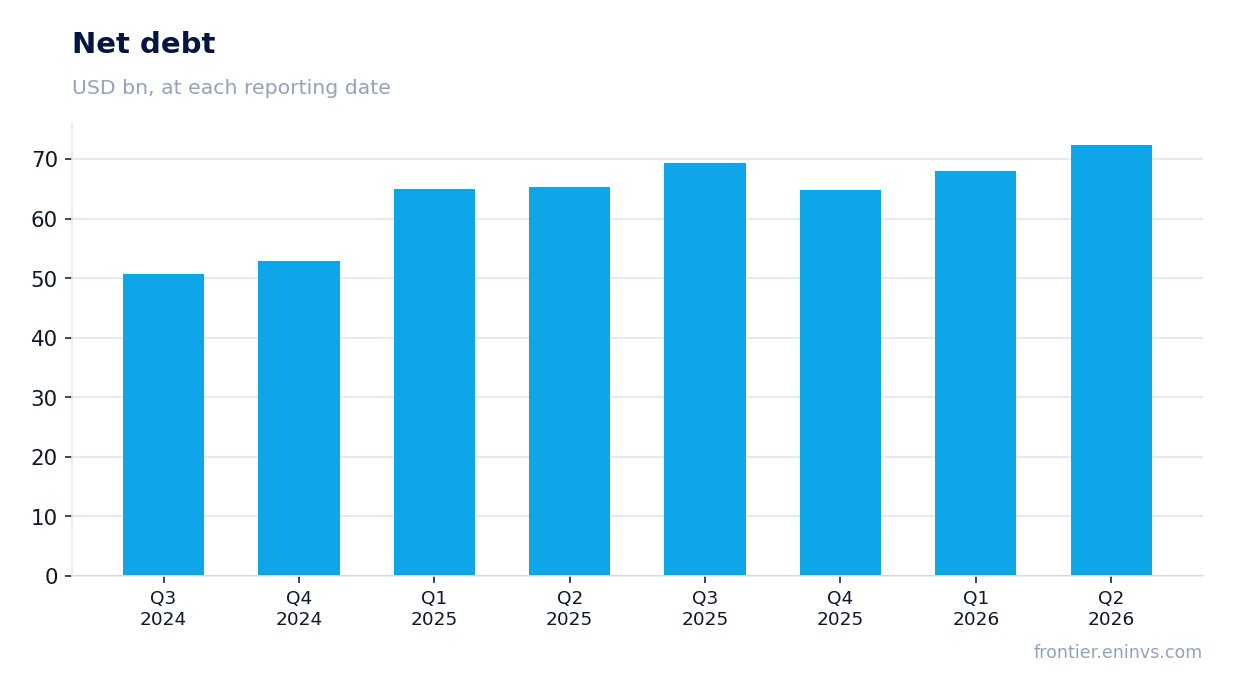
Debt rose by USD 85.9bn over the year to USD 72.4bn, but the bank's capital remains strong
Net debt at the end of Q2 stood at USD 72,430m, up USD 85.9bn from a year ago. The increase in debt is related to balance sheet growth: assets rose 10% YoY to USD 5,015bn, mainly due to loan book and trading asset growth.
However, for a bank, net debt is not a key risk indicator. Capital remains strong: the CET1 capital ratio (Standardized) was 14.1% – above the regulatory minimum. Common equity grew 5% over the year to USD 353.6bn.
Return on equity reached 24% – 6 percentage points higher than a year ago. This is one of the highest figures among major US banks.
Operating cash flow over the last twelve months is negative at minus USD 147.8bn – a result of loan growth and client activity
Over the last twelve months (LTM), JPMorgan's operating cash flow was minus USD 147,800m. For a bank, this metric is not very informative: it reflects changes in client balances, deposits and securities transactions, not the ability to generate profit.
Quarterly OCF swings are extremely wide: from -USD 251.8bn in Q1 2025 to +USD 147.8bn in Q4 2025. Such volatility is related to client fund movements and margin requirements, not to a deterioration in the business.
The performance metric for a bank is net profit, which over the last twelve months was USD 65.1bn (sum of four quarters), and return on equity of 24%.
The bank continues to return capital: the dividend rose 7% and a new USD 50bn buyback started on July 1
JPMorgan remains committed to returning capital to shareholders. The quarterly dividend rose 7% YoY to USD 1.50 per share, and the payout ratio was 19% of net profit – a conservative level that leaves room for capital accumulation.
A new USD 50bn share repurchase program started on July 1, 2026, replacing the previous program of the same size. In Q2, the bank repurchased shares worth USD 6.7bn at an average price of USD 308.21 per share.
Total capital return (dividends plus buybacks) for the quarter was about USD 10.7bn, which is less than net profit attributable to common shares (USD 20.8bn), so the payout is sustainable given the high profit generation.
Return on equity reached 24% – 6 percentage points higher than a year ago
ROE in Q2 was 24% versus 18% a year ago. The improvement was driven by net profit growth of 41% while equity grew only 5%.
The high profitability is not only due to one-off gains but also to sustainable organic growth: investment banking and asset management fees are growing at double-digit rates, and the loan book is expanding.
An ROE of 24% is one of the best among major US banks. Even excluding one-off items, ROE would have been around 19-20%, still above the average level of recent years.
Valuation on the latest reported figures
| Metric | Value |
|---|---|
| Operating cash flow (LTM) | -148 bn |
| ROE | 22.9% |
Bottom line
JPMorgan's Q2 2026 report is strong: revenue and profit grew at double-digit rates, return on equity reached 24%, and the bank continues to return capital to shareholders. However, almost half of the profit increase came from one-off gains from the Visa share exchange and investment remeasurement, so organic growth is more modest than it appears at first glance. Nevertheless, even without one-off items, the bank is growing faster than in previous quarters, and its capital position remains solid. At the current price, the share looks rather attractive: the P/E multiple is in the lower part of its three-year range, and an ROE of 24% supports the valuation. The key question for a holder is whether the bank can sustain double-digit growth in fee income after the normalisation of one-off items.
Open the company's financial profile JPM →
See also: market overview · valuation map · stock screeners