Banco do Brasil: Q2 profit barely grew while the 157x EV/EBITDA valuation rests on a one-off effect
On 12 August Banco do Brasil released its results for the second quarter of 2026. Revenue rose 15.8% year on year to 16,102.8 mln, but net profit was almost flat – 641.3 mln against 642.5 mln – and the net margin fell to 4.0% from 4.6%. At the same time EBITDA jumped to 335.2 mln from 244.2 mln, and the valuation rests on that jump: EV/EBITDA over the trailing twelve months stands at 157.1, while the portal's model puts the upside to fair value at minus 92%. At the current price the share looks unattractive.
Key takeaways
— Revenue rose 15.8% year on year, but profit stood still – 641.3 mln against 642.5 mln
— The net margin fell to 4.0% from 4.6% as costs outran revenue
— EBITDA jumped to 335.2 mln from 244.2 mln, and the entire valuation rests on that jump
— Debt load stands at 135.5 EBITDA over the trailing twelve months
— Trailing twelve-month dividend yield is 2.97%, below the key rate
— On the portal's model the upside to fair value is negative – minus 92%
— The trailing twelve-month P/E is 8.3, and it does not offset the EBITDA-based overvaluation
Attractiveness
Key figures, USD bn
| Metric | Q2 2025 | Q2 2026 | Change |
|---|---|---|---|
| Revenue | 13.9 | 16.1 | +15.8% |
| Operating profit | 0.24 | 0.34 | +37.3% |
| Net profit | 0.64 | 0.64 | -0.2% |
| Operating cash flow | 4.30 | 2.62 | -39.1% |
| Capex | 0.29 | 0.42 | +41.9% |
| Net margin | 4.6% | 4.0% | -0.6 pp |
Revenue rose 15.8% year on year, but profit stood still – 641.3 mln against 642.5 mln
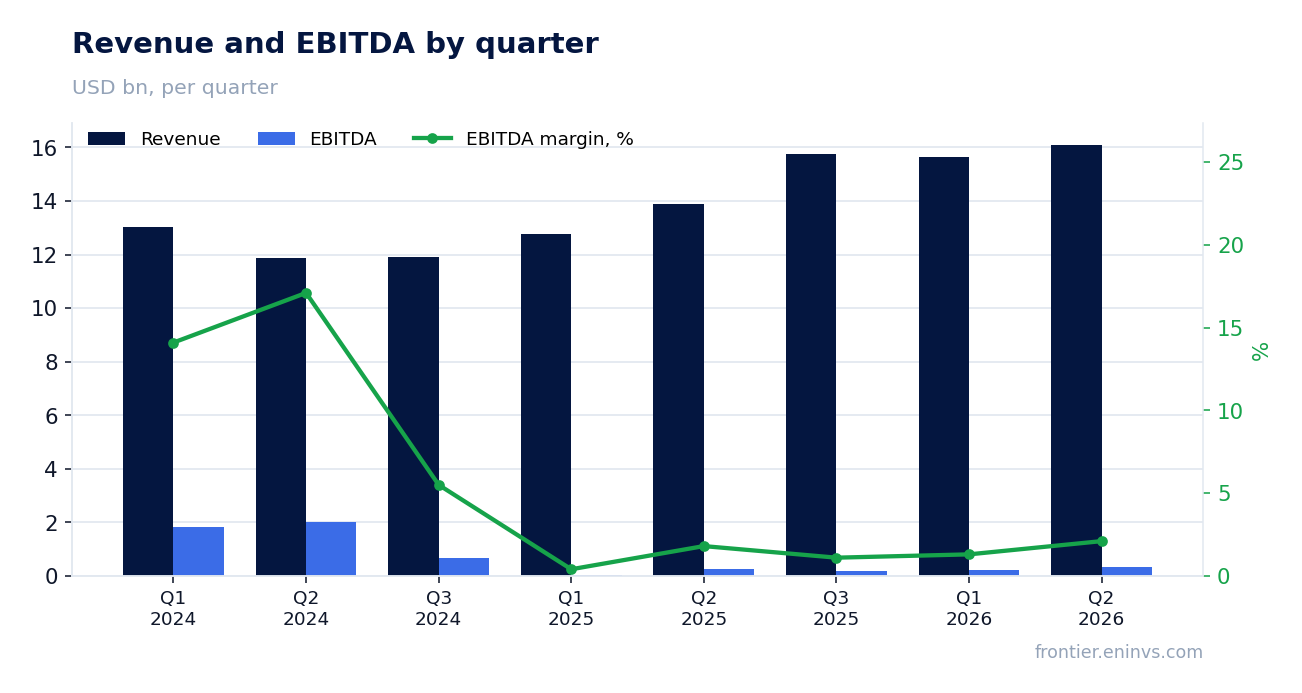
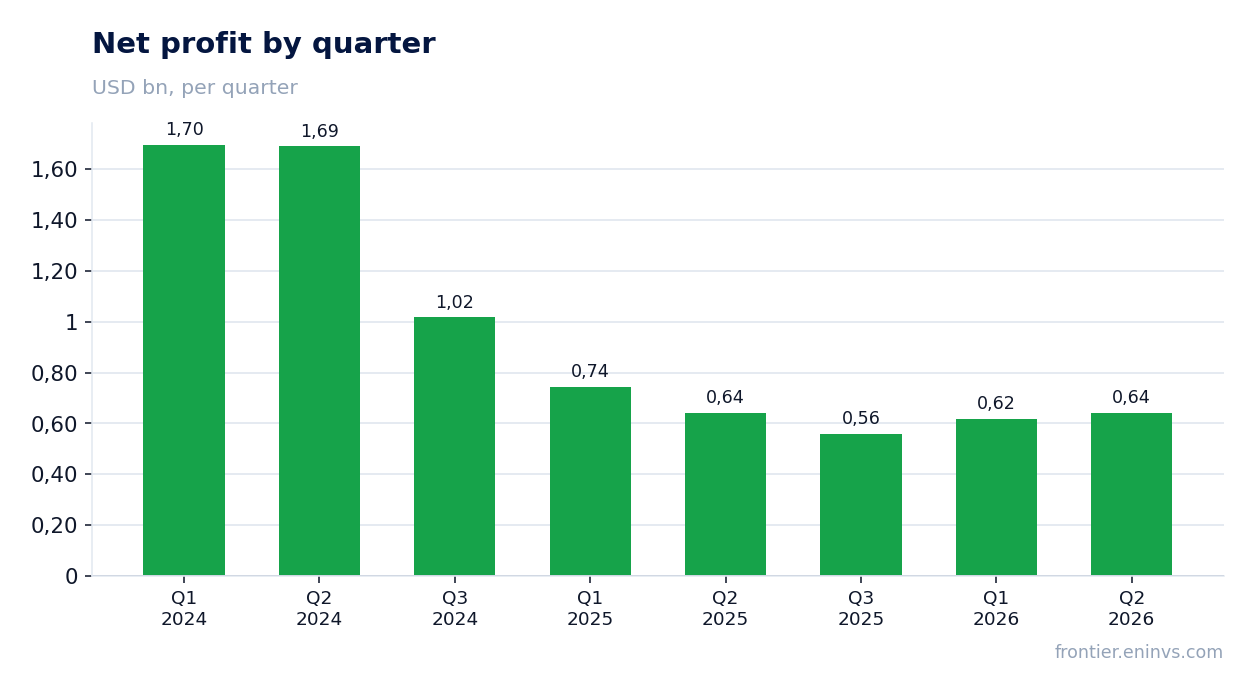
In the second quarter of 2026 Banco do Brasil's revenue reached 16,102.8 mln, up 15.8% from a year earlier. This continues a strong trend: revenue added 22.5% in the first quarter and 32.4% in the fourth quarter of last year. Yet net profit over the same period barely changed: 641.3 mln against 642.5 mln a year earlier, a decline of 0.2%.
This dynamic means that business growth is not converting into profit. Costs are rising faster than income, and the net margin shows it: 4.6% a year earlier versus 4.0% now. Profit remains under pressure despite higher turnover.
For a bank this is a warning sign: scaling brings no effect, which means either funding costs are rising or operating expenses are eating revenue. Without a breakdown of cost items the exact cause cannot be named, but the fact stands – profit is not growing.
The net margin fell to 4.0% from 4.6% as costs outran revenue
The net margin in the second quarter of 2026 was 4.0% against 4.6% a year earlier. A decline of 0.6 percentage points is a direct consequence of revenue growing 15.8% while profit stood still. Each additional dollar of income brings less profit.
The cause lies in costs. EBITDA for the quarter was 335.2 mln, significantly above 244.2 mln a year earlier, but this figure includes one-off items that do not flow into net profit. The main pressure on the margin likely comes from interest expenses or loan-loss provisions, but an exact breakdown is not available in the provided data.
For an investor this means the quality of profit is deteriorating. Revenue growth without profit growth does not create value, it only inflates the balance sheet. If the trend persists, the dividend base may shrink.
EBITDA jumped to 335.2 mln from 244.2 mln, and the entire valuation rests on that jump
EBITDA in the second quarter of 2026 was 335.2 mln, up 37.3% from 244.2 mln a year earlier. This is the highest quarterly figure in the last five quarters. Yet net profit did not grow, which points to the one-off nature of this jump – likely from items below operating profit, such as asset revaluation or one-time gains.
The valuation rests on this EBITDA. EV/EBITDA over the trailing twelve months stands at 157.1 – an extremely high level that does not reflect the business's real ability to generate cash flow. Excluding the one-off effect, the multiple would be significantly lower, but the actual data do not allow such an adjustment.
For an investor this means the current valuation is not supported by sustainable profit. EBITDA growth without net profit growth is not organic growth but an accounting effect. Until it is confirmed by cash flow, it cannot be trusted.
Debt load stands at 135.5 EBITDA over the trailing twelve months
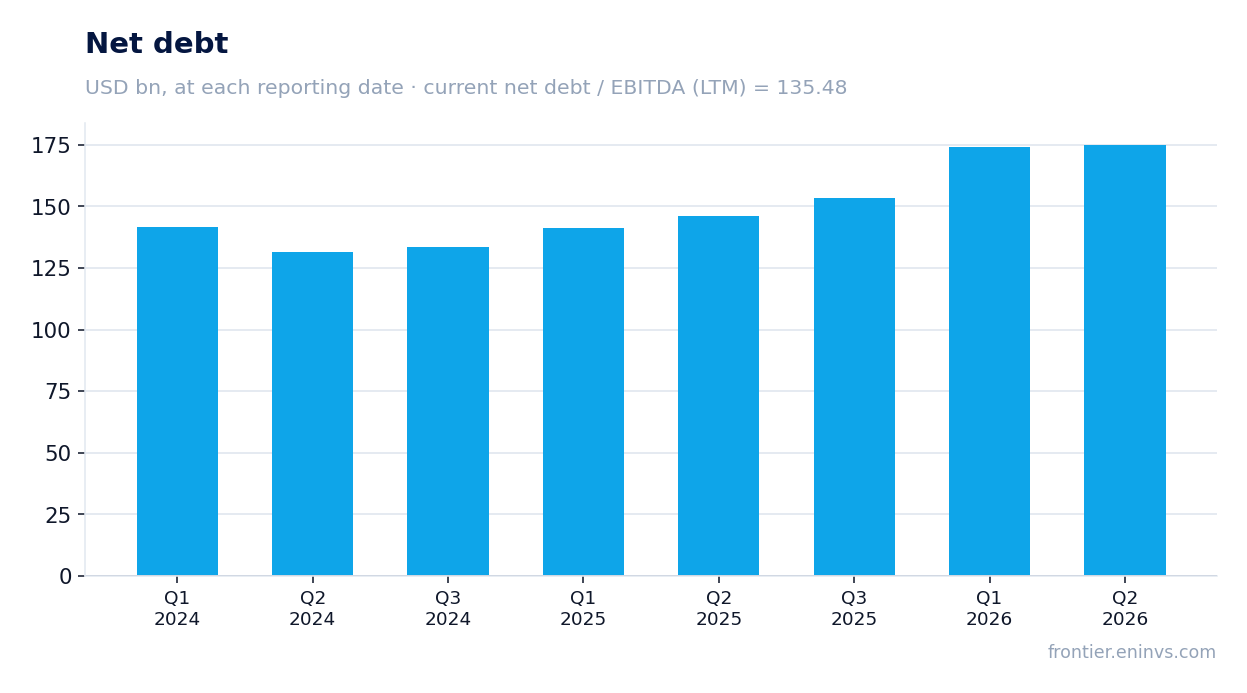
Net debt at the latest reporting date was 153,081.0 mln, and the ratio of net debt to trailing twelve-month EBITDA is 135.5. This is a very high level, indicating that debt is many times annual operating profit. For a bank such a metric is less indicative than for an industrial company, since debt is part of the business model, but it still reflects elevated risk.
Over the quarter net debt rose by 1.0 bn, and over 12 months by 28.8 bn. Rising debt with stagnant profit increases pressure on capital. If profit does not start growing, debt servicing will require an ever larger share of income.
It is important to understand that for a bank operating cash flow is not a reliable indicator, as it reflects client fund movements and central counterparty positions. Therefore negative or volatile cash flow should not be interpreted here as a signal of liquidity problems.
Trailing twelve-month dividend yield is 2.97%, below the key rate
The trailing twelve-month dividend yield is 2.97%. This is a modest level, especially against the high key rate. For an income-oriented investor such a yield does not compensate for the risks associated with profit volatility and high debt load.
Our estimate of the current-year dividend assumes the payout ratio remains at its previous level and profit shows no significant growth. If profit stays near current levels, the dividend is unlikely to materially exceed last year's. The main risk is a profit decline due to rising costs, which would directly reduce the dividend base.
The comparison with the key rate is not in the share's favour: a yield of 2.97% is below the risk-free rate, making the stock less attractive to conservative investors. If the rate remains at its current level, dividend support for the price will be weak.
On the portal's model the upside to fair value is negative – minus 92%
Our fundamental valuation model, based on EBITDA growth with a target multiple, shows that the upside to fair value is minus 92%. This means the current market price significantly exceeds the model's estimate. Such a gap is explained by the model relying on sustainable EBITDA rather than one-off jumps.
Market capitalisation is 24,399.7 mln, while trailing twelve-month EV/EBITDA is 157.1. For comparison, the P/E for the same period is 8.3. Such a low P/E against such a high EV/EBITDA indicates that the market values the business based on profit, not EBITDA, and possibly does not trust the sustainability of the latter.
The portal's model is our own tool and is not a market consensus or a target price. It merely shows that at current fundamentals the share looks overvalued. A change in the valuation would require sustainable net profit growth, not one-off effects.
The trailing twelve-month P/E is 8.3, and it does not offset the EBITDA-based overvaluation
The trailing twelve-month P/E is 8.3. This is a low level that may attract investors looking for undervalued assets. However, the low P/E is explained not so much by cheapness as by low profit: over the trailing twelve months net profit was 2,939.0 mln, and the market values it at 8.3 times annual profit.
The problem is that this profit is not growing. If profit stagnates, a low P/E is not a signal of undervaluation – it reflects a lack of growth. Moreover, with high debt load (135.5 EBITDA) and a declining margin, the sustainability of profit is questionable.
Thus, even with a formally low P/E, the share does not look attractive. The risk/reward ratio is not in the investor's favour: growth potential is limited, while risks related to debt and profit remain high.
Valuation on the latest reported figures
| Metric | Value |
|---|---|
| Market cap | 24.4 bn USD |
| P/E (LTM) | 8.3 |
| EV/EBITDA (LTM) | 157.1 |
| P/B | 3.45 |
| Net debt / EBITDA (LTM) | 135.48 |
| Operating cash flow (LTM) | 29.1 bn |
| ROE | 32.6% |
| Dividend yield (12m) | 3.0% |
Bottom line
Bottom line: Banco do Brasil's revenue rose 15.8%, but net profit stayed at last year's level and the margin fell to 4.0%. The EBITDA jump to 335.2 mln is one-off and not confirmed by cash flow. A debt load of 135.5 EBITDA and a dividend yield of 2.97% do not add appeal. On the portal's model the upside is negative – minus 92%. At the current price the share looks unattractive.
Open the company's financial profile BBAS →
See also: market overview · valuation map · stock screeners