Cyrela: revenue up 29.3% but profit lagged, and net debt at 1.87x EBITDA remains high
On 30 June 2026, Cyrela reported results for the second quarter of 2026. Revenue rose 29.3% year-on-year to USD 488.5 million, EBITDA added 23.2% to USD 107.4 million, and net profit reached USD 102.2 million, up 18.9%. Revenue growth accelerated, but margins declined: EBITDA margin was 22.0% versus 23.1% a year earlier, and net margin was 20.9% versus 22.7%. Leverage remains at 1.87x trailing twelve-month EBITDA, while the dividend yield of 10.5% looks attractive. At the current price, the stock trades at 4.0x earnings and 5.9x EBITDA, below historical averages, but profit growth lags revenue and debt is rising. Given the portal model's +15% upside and the high dividend yield, the share looks rather attractive, but risks of margin compression and rising debt limit the assessment.
Key takeaways
— Revenue rose 29.3% year-on-year to USD 488.5 million, but this acceleration comes with margin compression
— EBITDA added 23.2% to USD 107.4 million, yet its margin fell to 22.0% from 23.1% a year earlier
— Net profit increased 18.9% to USD 102.2 million, lagging revenue growth due to faster cost increases
— Operating cash flow in Q2 was USD 41.1 million and capital expenditures USD 17.1 million, leaving free cash flow of USD 24.0 million
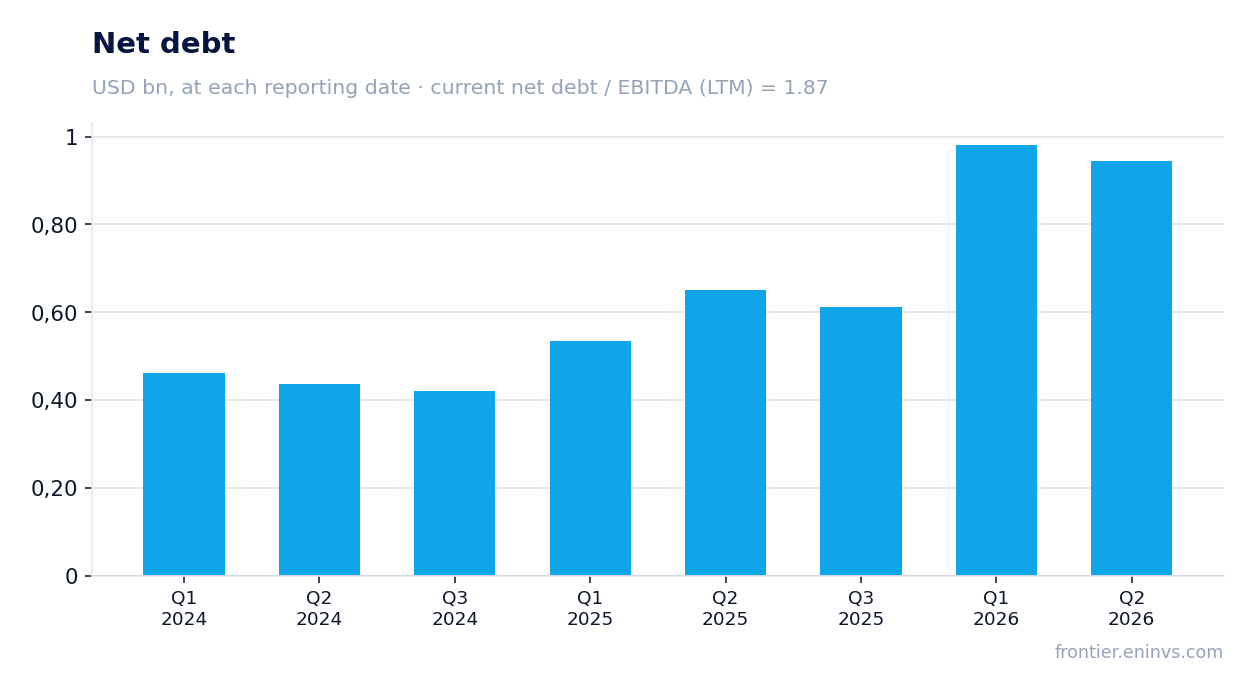
— Net debt reached USD 944.8 million, and the net debt/EBITDA LTM ratio is 1.87, limiting financial flexibility
— Dividend yield of 10.5% over the trailing twelve months supports the stock's appeal
— Valuation at 4.0x earnings and 5.9x EBITDA LTM looks low, and the portal model implies 15% upside
Attractiveness
Key figures, USD bn
| Metric | Q2 2025 | Q2 2026 | Change |
|---|---|---|---|
| Revenue | 0.38 | 0.49 | +29.3% |
| EBITDA | 0.09 | 0.11 | +23.2% |
| Operating profit | 0.08 | 0.10 | +19.8% |
| Net profit | 0.09 | 0.10 | +18.9% |
| Operating cash flow | -0.10 | 0.04 | в прибыль |
| Capex | 0.01 | 0.02 | +97.1% |
| EBITDA margin | 23.1% | 22.0% | -1.1 pp |
| Net margin | 22.7% | 20.9% | -1.8 pp |
Revenue rose 29.3% year-on-year to USD 488.5 million, but this acceleration comes with margin compression
In the second quarter of 2026, Cyrela's revenue reached USD 488.5 million, up 29.3% year-on-year. This is the fastest growth in several quarters: in Q1 2026 revenue grew 16.2%, and in Q2 2025 it grew 14.2%. The acceleration may indicate strong demand for the company's products, but it comes with lower profitability.
Revenue growth did not translate proportionally into profit: EBITDA rose only 23.2% and net profit 18.9%. This means costs grew faster than revenue, compressing margins. EBITDA margin fell to 22.0% from 23.1% a year earlier, and net margin dropped to 20.9% from 22.7%. The reasons for this divergence may be related to higher cost of goods sold or operating expenses, but the provided data lacks detail.
Accelerating revenue growth while margins decline raises the question of growth quality: if the company achieves higher sales through lower prices or more expensive inputs, it could hurt future profitability. Nevertheless, the absolute revenue increase remains significant and supports the overall scale of the business.
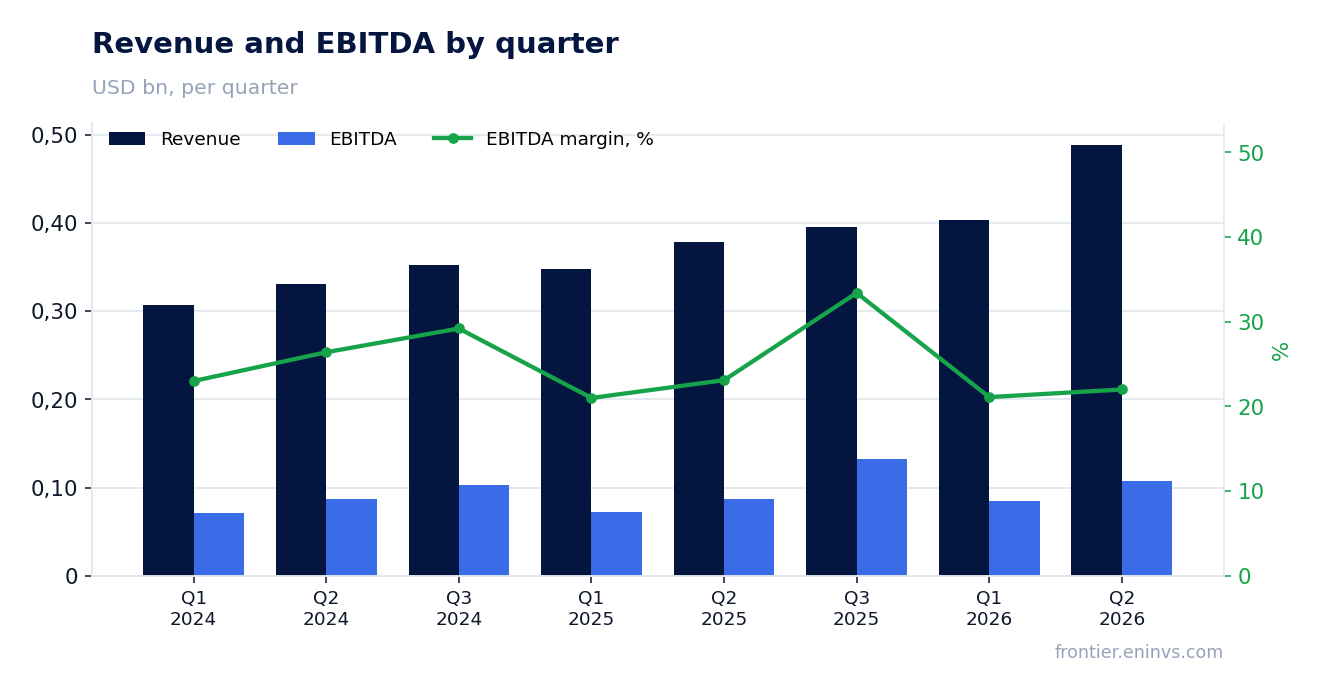
EBITDA added 23.2% to USD 107.4 million, yet its margin fell to 22.0% from 23.1% a year earlier
EBITDA in Q2 2026 was USD 107.4 million, up 23.2% from Q2 2025. However, the EBITDA margin declined to 22.0% from 23.1% a year earlier. This 1.1 percentage point drop indicates that operating expenses grew faster than revenue.
The margin decline could be due to several factors: a higher share of more expensive projects, rising material or labour costs, or possible one-off expenses. Without further detail from the report, it is difficult to pinpoint the cause, but the fact of margin compression is an important signal for investors, as it affects profitability and cash generation.
Despite the margin decline, absolute EBITDA growth remains substantial. The company continues to increase operating profit, which supports its ability to service debt and pay dividends. However, if the margin trend persists, it could limit future profit growth.
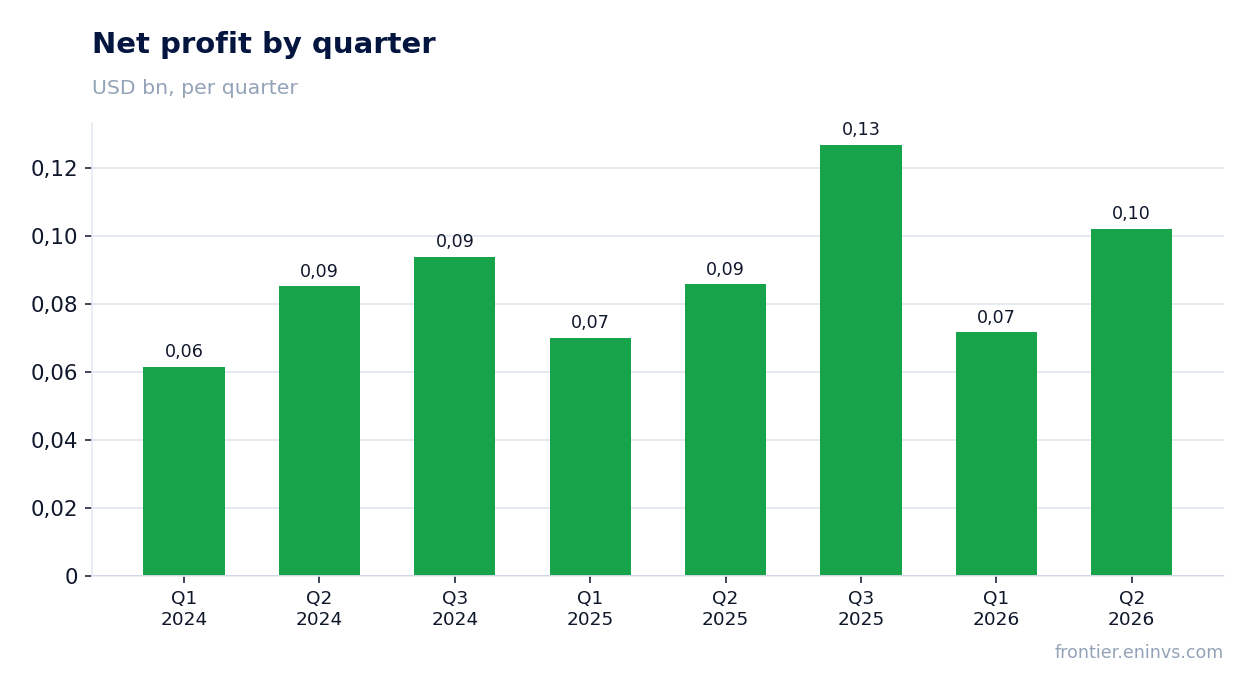
Net profit increased 18.9% to USD 102.2 million, lagging revenue growth due to faster cost increases
Net profit in Q2 2026 was USD 102.2 million, up 18.9% year-on-year. This is significantly slower than revenue growth (29.3%) and EBITDA growth (23.2%), reflecting pressure on profitability at all levels.
The decline in net margin to 20.9% from 22.7% a year earlier means the company retains a smaller share of revenue as profit. Besides operating factors, net profit could be affected by interest expenses related to debt servicing or changes in the tax rate. The provided data lacks detail, but the overall trend is clear: profit growth lags business growth.
For investors, it is important that even with slower profit growth, its absolute level remains high, and the P/E LTM multiple is only 4.0, which may indicate undervaluation. However, if margins continue to decline, it could lead to further deceleration in profit growth.
Operating cash flow in Q2 was USD 41.1 million and capital expenditures USD 17.1 million, leaving free cash flow of USD 24.0 million
In Q2 2026, Cyrela's operating cash flow was USD 41.1 million, a significant improvement from Q1 2026 when it was negative (-USD 21.8 million). Capital expenditures for the quarter were USD 17.1 million, resulting in positive free cash flow of USD 24.0 million. This is an important indicator, as it demonstrates the company's ability to generate cash after investments.
However, over the trailing twelve months, operating cash flow remains negative at -USD 65.4 million. This means the company overall spent more cash than it generated from operations over the year, which could be related to working capital investments or seasonal factors. Negative LTM cash flow raises questions about funding sustainability, especially given the high debt level.
Capital expenditures in Q2 2026 were USD 17.1 million, about 3.5% of revenue. This is a moderate level, but combined with negative LTM operating cash flow, it means the company may need additional financing to sustain growth.
Net debt reached USD 944.8 million, and the net debt/EBITDA LTM ratio is 1.87, limiting financial flexibility
Cyrela's net debt at the end of Q2 2026 was USD 944.8 million, up USD 0.3 billion over the trailing twelve months. The net debt/EBITDA LTM ratio stands at 1.87. This is a moderate level of leverage, but it limits financial flexibility, especially given negative operating cash flow over the last twelve months.
The increase in debt over the year may be related to financing capital expenditures and working capital, as well as dividend payments. With LTM EBITDA of USD 462.6 million, debt is 1.87 times annual EBITDA, which is acceptable but not comfortable. If EBITDA starts to decline due to margin compression, leverage could rise quickly.
Interest expenses on debt are not disclosed in the provided data, but they likely put pressure on net profit. Given that net debt represents a significant portion of capital, the company may be sensitive to changes in interest rates.
Dividend yield of 10.5% over the trailing twelve months supports the stock's appeal
Cyrela's dividend yield over the trailing twelve months is 10.5%. This is a high level, significantly above many other instruments, and may be attractive to income-oriented investors. However, the sustainability of such payments depends on the company's ability to generate free cash flow.
Over the last twelve months, operating cash flow was negative (-USD 65.4 million), and capital expenditures were substantial. This means dividends were likely financed through debt or accumulated reserves. If operating cash flow does not recover, the company may be forced to cut dividends or increase debt, negatively impacting yield.
Nevertheless, the current dividend yield of 10.5%, with a payout ratio that can be assessed as moderate (dividends to profit), looks sustainable if profit remains at current levels. It is important to monitor free cash flow and debt dynamics to assess the company's ability to maintain such payments.
Valuation at 4.0x earnings and 5.9x EBITDA LTM looks low, and the portal model implies 15% upside
Currently, Cyrela's shares trade at a P/E LTM of 4.0 and EV/EBITDA LTM of 5.9. These are low levels that may indicate undervaluation compared to historical averages. However, without data on the three-year averages, it is impossible to say precisely how much the current valuation deviates from the norm.
The portal's model, based on EBITDA growth and a target multiple, estimates the stock's upside to fair value at +15%. This is the portal's own estimate, not market consensus. If the company can sustain EBITDA growth and stabilise margins, the stock could realise this potential.
The low valuation may be a consequence of investor concerns about margin compression and rising debt. If these concerns do not materialise, multiples could expand, driving the price higher. However, if margins continue to fall, even the low valuation may be justified.
Valuation on the latest reported figures
| Metric | Value |
|---|---|
| Market cap | 1.84 bn USD |
| P/E (LTM) | 4.0 |
| EV/EBITDA (LTM) | 5.9 |
| P/B | 0.88 |
| Net debt / EBITDA (LTM) | 1.87 |
| Operating cash flow (LTM) | -0.07 bn |
| ROE | 16.9% |
| Dividend yield (12m) | 10.5% |
Bottom line
The strong points of Cyrela's Q2 2026 report were accelerated revenue growth of 29.3% and positive free cash flow of USD 24.0 million. However, profit growth lags revenue, and margins are declining, indicating deteriorating operating efficiency. Leverage at 1.87x EBITDA and negative operating cash flow over 12 months raise questions about financial flexibility. The high dividend yield of 10.5% is attractive, but its sustainability is in question. At the current valuation of 4.0x earnings and 5.9x EBITDA, the stock looks rather attractive, but risks of margin compression and rising debt limit the upside.
Open the company's financial profile CYRE →
See also: market overview · valuation map · stock screeners