PRIO: profit tripled, but 3.86x EBITDA leverage is the real question
PRIO reported second-quarter 2026 results. Revenue rose 131.5% year on year to USD 1,381.7 million, EBITDA by 259.6% to USD 547.0 million, and net profit by 216.1% to USD 385.9 million. The EBITDA margin climbed to 62.8% from 40.4% a year earlier, while operating cash flow for the quarter reached USD 761.7 million. Leverage remains high: net debt of USD 4,572.5 million, or 3.86x trailing-twelve-month EBITDA. At 13.1x trailing earnings and 12.6x trailing EBITDA, the stock does not look cheap for a company carrying this much debt, so at the current price the shares merit a neutral rating.
Key takeaways
— Revenue rose 131.5% year on year to USD 1,381.7 million, the strongest quarter in the company's history
— The EBITDA margin climbed to 62.8% from 40.4%, with profit growth nearly double the top-line expansion
— Net profit rose 216.1% to USD 385.9 million, but the quarter rests on one-off items that are not disclosed
— Operating cash flow of USD 761.7 million exceeded EBITDA, while capital expenditure fell to USD 196.2 million
— Net debt of USD 4,572.5 million equals 3.86x trailing-twelve-month EBITDA, and debt service consumes a significant share of profit
— At 13.1x trailing earnings and 12.6x trailing EBITDA, the stock is valued above its historical norm
Attractiveness
Key figures, USD bn
| Metric | Q2 2025 | Q2 2026 | Change |
|---|---|---|---|
| Revenue | 0.60 | 1.38 | +131.5% |
| EBITDA | 0.24 | 0.87 | +259.6% |
| Operating profit | 0.01 | 0.55 | +3824.8% |
| Net profit | 0.12 | 0.39 | +216.1% |
| Operating cash flow | 0.60 | 0.76 | +26.3% |
| Capex | 0.28 | 0.20 | -29.3% |
| EBITDA margin | 40.4% | 62.8% | +22.4 pp |
| Net margin | 20.5% | 27.9% | +7.4 pp |
Revenue rose 131.5% year on year to USD 1,381.7 million, the strongest quarter in the company's history
In the second quarter of 2026, PRIO's revenue reached USD 1,381.7 million, up 131.5% year on year. This is not only an absolute record but also the fastest growth in the company's observable history. For comparison, revenue grew 64.7% in the first quarter of 2026 and declined 27.1% in the second quarter of 2025. The acceleration is more than twofold and pushed quarterly revenue above USD 1.3 billion for the first time.
The growth was likely driven either by a sharp jump in product prices or a significant increase in production and sales volumes. The company does not disclose details, but the fact that revenue more than doubled while the first quarter was relatively stable points to a one-off or seasonal factor. Without additional data on physical volumes and selling prices, the sustainability of this growth cannot be assessed.
For an investor, it is important that even accounting for the possible one-off nature of the surge, the company demonstrates the ability to generate substantial revenue. However, the sustainability of this level is the key question for valuing future cash flows.
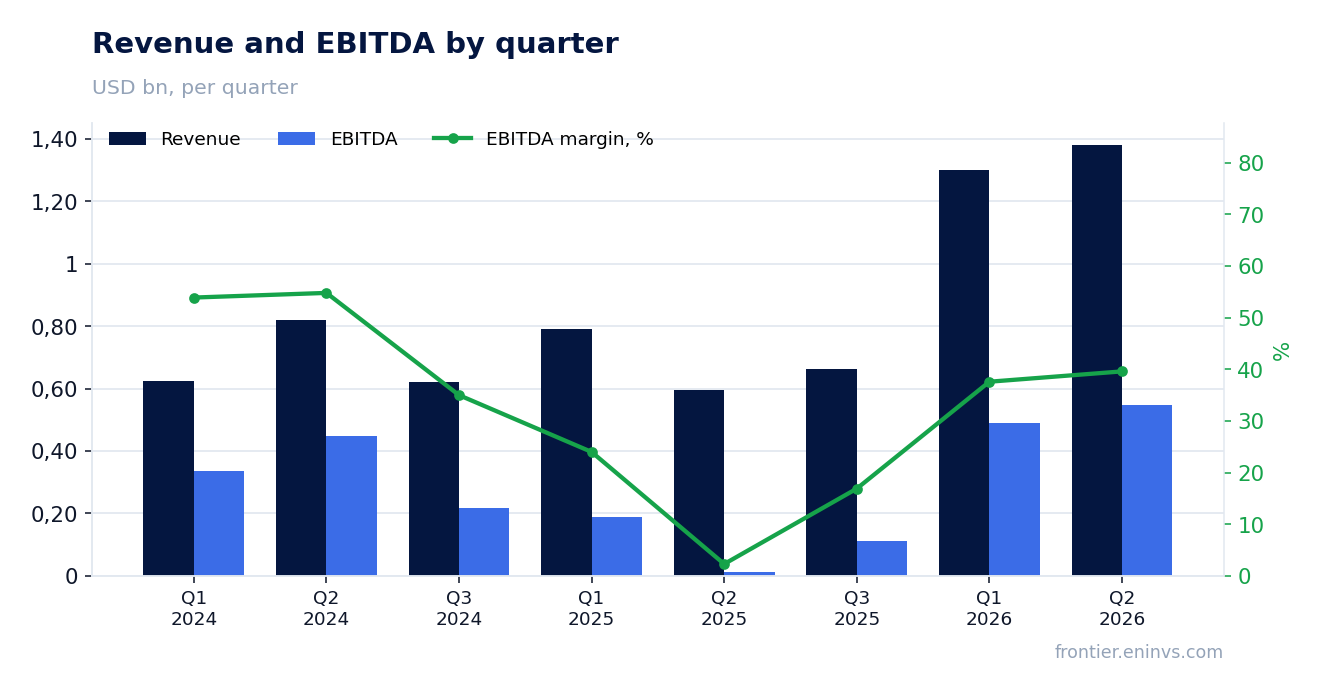
The EBITDA margin climbed to 62.8% from 40.4%, with profit growth nearly double the top-line expansion
EBITDA in the second quarter of 2026 was USD 547.0 million, up 259.6% year on year. The EBITDA margin reached 62.8% versus 40.4% a year earlier. Such margin expansion means revenue grew faster than costs, and operating leverage worked at full force. EBITDA growth more than doubled revenue growth, confirming that most of the incremental revenue flowed to profit rather than costs.
Such a high margin is rare for a commodity company. It could be explained by favourable pricing as well as one-off factors, such as asset sales or inventory revaluation. The company does not disclose its cost structure, so the source of the margin expansion remains unclear. If the margin holds at this level, the company's profitability will be exceptional, but the sustainability of such a level is questionable.
For an investor, it is important that even if the margin falls to a more usual 40%, EBITDA would be around USD 550 million at current revenue, still significantly above last year's levels. However, without understanding the reasons for the margin expansion, long-term forecasts cannot be built.
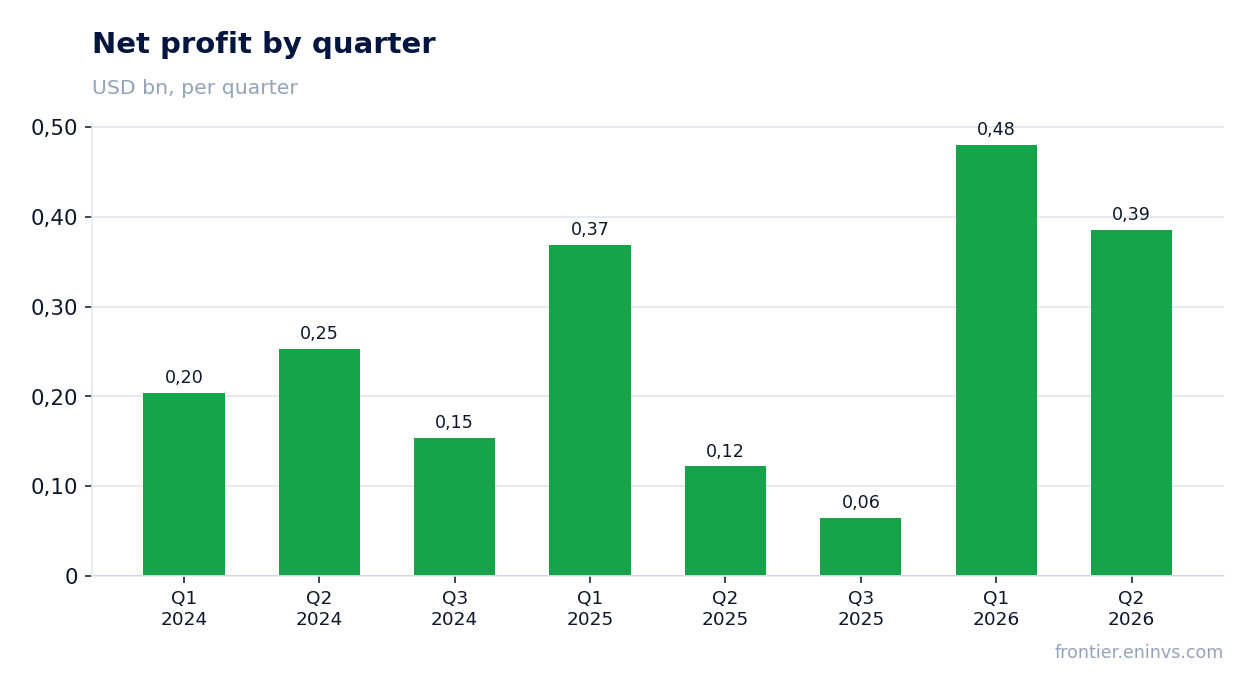
Net profit rose 216.1% to USD 385.9 million, but the quarter rests on one-off items that are not disclosed
Net profit in the second quarter of 2026 was USD 385.9 million, up 216.1% year on year. Profit growth lags EBITDA growth, indicating higher expenses below the operating line – likely interest payments or taxes. The net margin rose to 27.9% from 20.5%, but remains well below the EBITDA margin, pointing to substantial obligations.
The gap between EBITDA and net profit is USD 161.0 million. This amount includes depreciation, interest, and taxes. Given the high debt, a significant portion of the gap is interest expense. The company does not disclose details, but with net debt of USD 4,572.5 million, even a moderate rate implies hundreds of millions of dollars in annual interest payments.
Thus, while quarterly profit is impressive, it largely depends on operating results that may be unsustainable. To assess the sustainability of profit, it is necessary to understand what portion of the growth is due to one-off factors and what portion reflects fundamental improvements.
Operating cash flow of USD 761.7 million exceeded EBITDA, while capital expenditure fell to USD 196.2 million
Operating cash flow in the second quarter of 2026 was USD 761.7 million, exceeding EBITDA of USD 547.0 million. Such an excess is usually due to favourable working capital changes – for example, inventory reduction or growth in accounts payable. This is a one-off source of cash that may not repeat. Nevertheless, the company generated significant cash flow.
Capital expenditure fell to USD 196.2 million from USD 277.6 million a year earlier. A decline in CAPEX alongside revenue growth may mean the company is not investing in maintaining or expanding production, which is risky for a commodity company in the long term. Free cash flow thus amounted to about USD 565.5 million, a very high figure.
However, the sustainability of such free cash flow is questionable: if working capital ceases to be a source of funds and CAPEX returns to a normal level, free cash flow could shrink. For an investor, it is important that the company can generate significant cash, but its stability is uncertain.
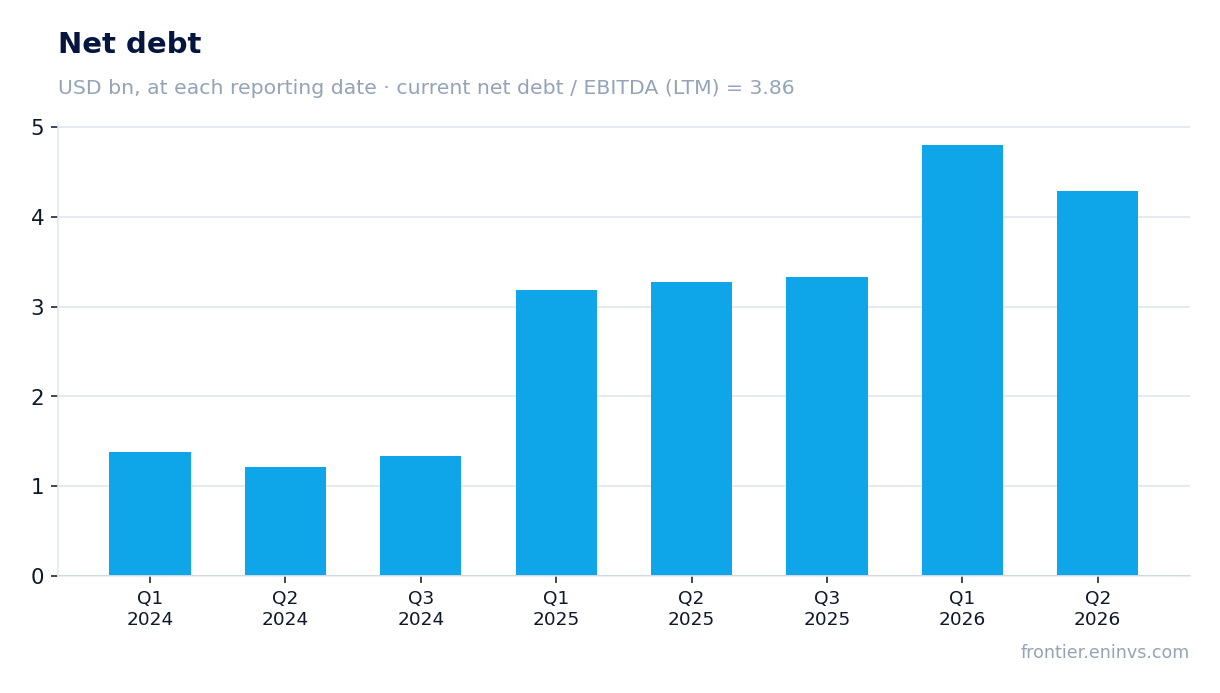
Net debt of USD 4,572.5 million equals 3.86x trailing-twelve-month EBITDA, and debt service consumes a significant share of profit
PRIO's net debt at the end of the second quarter of 2026 was USD 4,572.5 million. This is USD 0.5 billion less than at the previous reporting date, but USD 1.0 billion more than a year earlier. The ratio of net debt to trailing-twelve-month EBITDA is 3.86. This is a high level that limits the company's financial flexibility and increases risks if market conditions deteriorate.
For comparison, trailing-twelve-month EBITDA was USD 1,185.3 million. Against this base, debt of USD 4,572.5 million appears substantial. Interest expense is likely a significant part of the gap between EBITDA and net profit. If rates remain high, debt service will weigh on profit and limit opportunities for investment or dividends.
The reduction in net debt by USD 0.5 billion over the quarter is a positive signal, but it may have been achieved through one-off operating cash flow. A sustainable reduction in debt will require consistent cash generation. For now, leverage remains high, and this is a key risk for shareholders.
At 13.1x trailing earnings and 12.6x trailing EBITDA, the stock is valued above its historical norm
Based on the trailing twelve months, PRIO trades at a P/E of 13.1 and EV/EBITDA of 12.6. Market capitalisation is USD 10,314.8 million. For a company with this level of debt and a commodity business, these multiples look somewhat high. The historical norm for PRIO was likely lower, especially during periods of low commodity prices.
Return on equity (ROE) over the trailing twelve months was 28.4%, a strong figure. However, it was achieved with high leverage, which increases risk. If profit falls, ROE could decline sharply. The current valuation assumes the market expects high profitability to persist, which is not guaranteed.
With no dividend payments (the company has not announced any), investment appeal depends solely on capital appreciation. At current multiples, upside is limited unless profit continues to grow at the same pace. However, the sustainability of such growth is questionable.
Valuation on the latest reported figures
| Metric | Value |
|---|---|
| Market cap | 10.3 bn USD |
| P/E (LTM) | 13.1 |
| EV/EBITDA (LTM) | 12.6 |
| P/B | 2.19 |
| Net debt / EBITDA (LTM) | 3.86 |
| Operating cash flow (LTM) | 1.50 bn |
| ROE | 28.4% |
Bottom line
PRIO delivered an exceptionally strong quarter: revenue rose 131.5%, EBITDA 259.6%, and net profit 216.1%. However, this growth rests on factors the company does not disclose and may largely be one-off. Leverage remains high at 3.86x EBITDA, and the multiples of 13.1x earnings and 12.6x EBITDA do not look cheap for a commodity company with such debt. At the current price, the stock merits a neutral rating: the potential for profit growth is already priced in, while risks related to margin sustainability and debt service remain significant.
Open the company's financial profile PRIO →
See also: market overview · valuation map · stock screeners