Ecopetrol: profit up 3.9x, but the quarter rests on the oil price, not on volumes
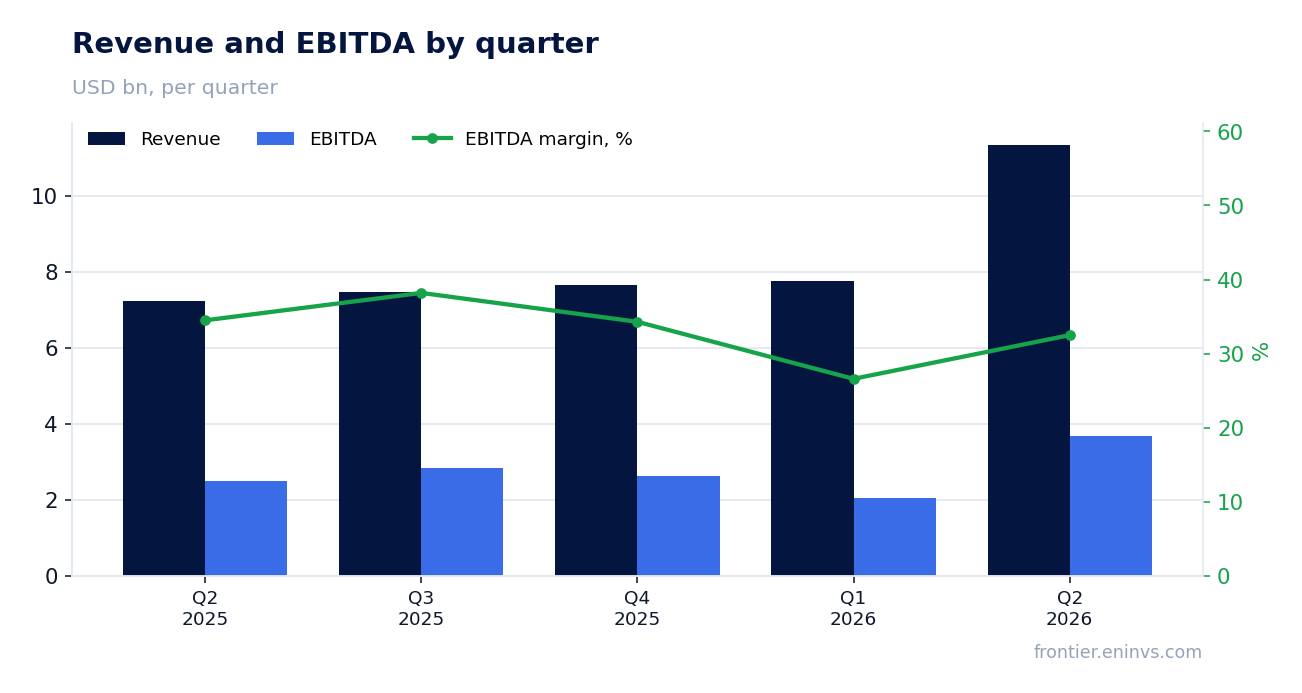
On 25 August Ecopetrol reported results for the second quarter of 2026. Revenue rose 56.8% year on year to USD 11,355.0 mn, EBITDA by 49.1% to USD 3,959.2 mn, and net profit by 287.6% to USD 1,712.9 mn. The EBITDA margin slipped to 34.9% from 36.7%, while the net margin climbed to 15.1% from 6.1%. Leverage of 2.34x LTM EBITDA and an EV/EBITDA of 5.34 leave the share rather attractive rather than neutral, though the portal's model puts it 24% below the current price.
Key takeaways
— Revenue added 56.8% year on year, but the EBITDA margin narrowed to 34.9% from 36.7%
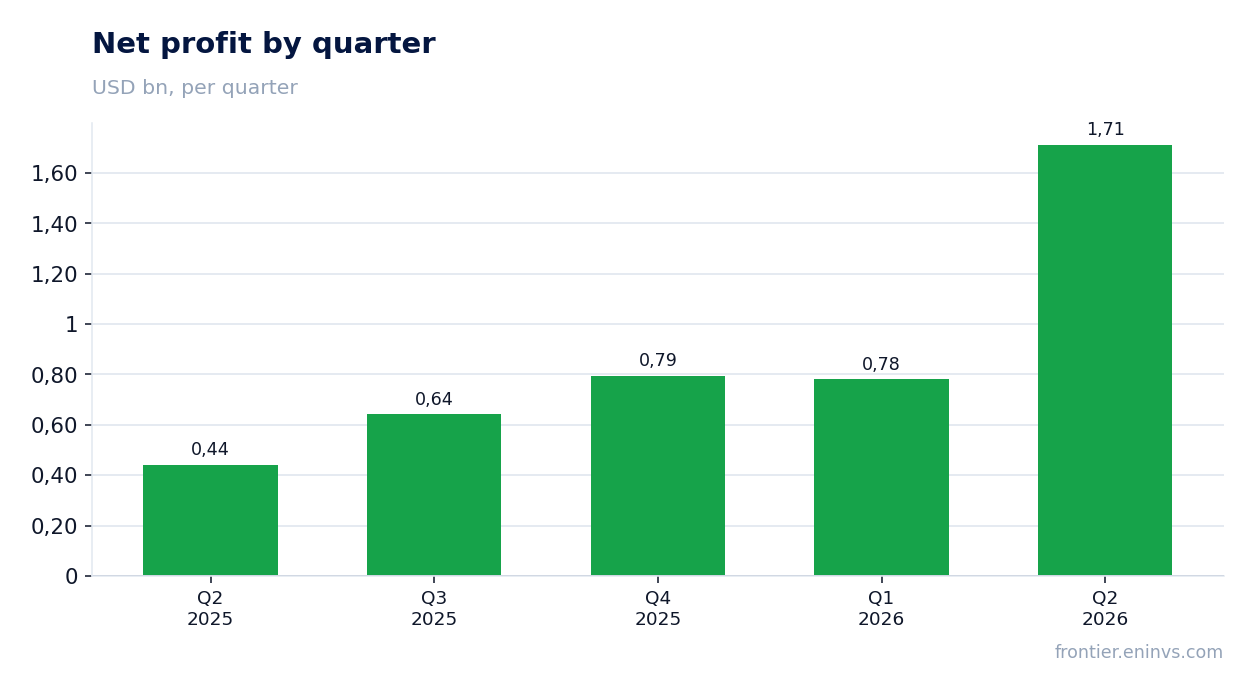
— Net profit rose 3.9x to USD 1,712.9 mn on EBITDA growth of only 49.1%
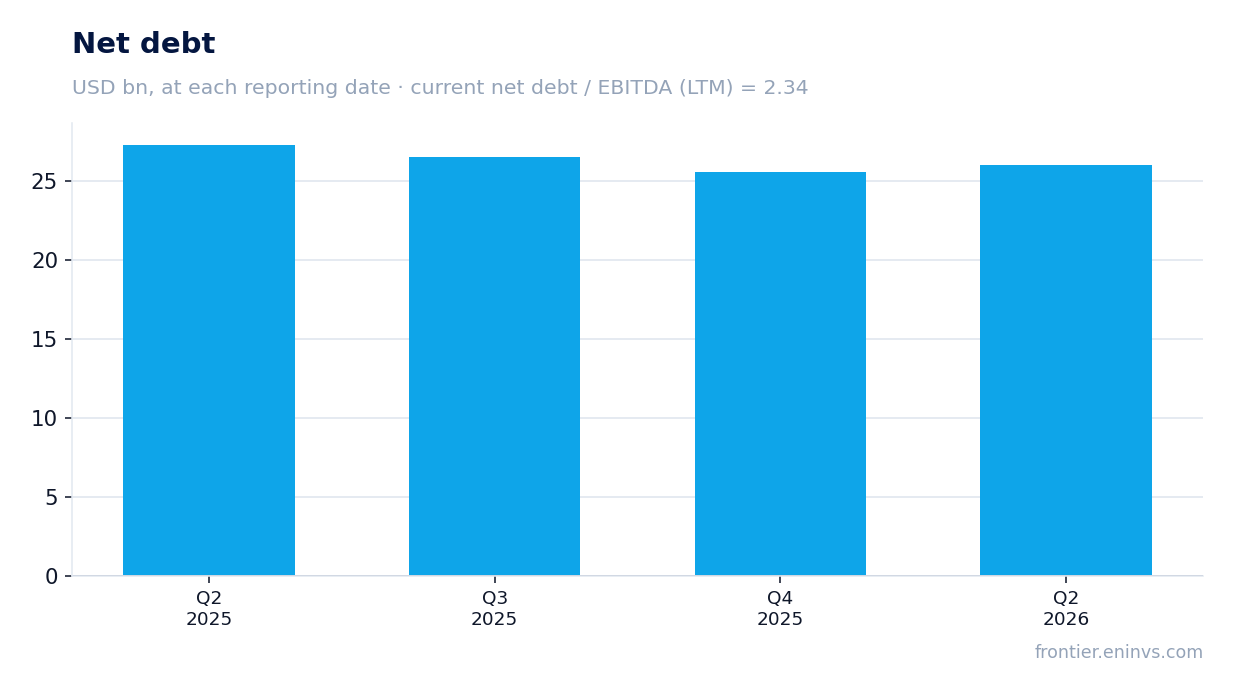
— Debt of USD 26.0 bn costs 2.34x LTM EBITDA
— Trailing dividend yield of 4.01% lags the policy rate
— Valuation of 5.34x EV/EBITDA and 8.62x P/E LTM does not look stretched
— The portal's model implies 24% downside if EBITDA is repriced to spot commodities
Attractiveness
Key figures, USD bn
| Metric | Q2 2025 | Q2 2026 | Change |
|---|---|---|---|
| Revenue | 7.24 | 11.4 | +56.8% |
| EBITDA | 2.66 | 3.96 | +49.1% |
| Operating profit | 1.40 | 3.64 | +159.7% |
| Net profit | 0.44 | 1.71 | +287.6% |
| Operating cash flow | 2.45 | — | — |
| EBITDA margin | 36.7% | 34.9% | -1.8 pp |
| Net margin | 6.1% | 15.1% | +9.0 pp |
Revenue added 56.8% year on year, but the EBITDA margin narrowed to 34.9% from 36.7%
Revenue for the second quarter of 2026 was USD 11,355.0 mn against USD 7,240.6 mn a year earlier – growth of 56.8%. That is the highest quarterly level in the last four quarters: revenue was USD 7,754.8 mn in Q1 2026, USD 7,671.1 mn in Q4 2025 and USD 7,463.9 mn in Q3 2025. Such a jump in revenue with broadly unchanged output points to price rather than volume driving sales.
EBITDA rose to USD 3,959.2 mn from USD 2,499.9 mn a year earlier, or 49.1%. Growth is there, but it lags revenue growth: the EBITDA margin fell to 34.9% from 36.7%. That means each extra unit of revenue brought less operating profit than a year ago – costs grew faster than sales.
Operating profit was USD 3,644.8 mn, close to EBITDA: the gap between them is only USD 314.4 mn. That points to a low share of depreciation and other non-cash items in the cost structure. For an oil company that is an unusually narrow gap, and it explains why net profit is so sensitive to the oil price.
Net profit rose 3.9x to USD 1,712.9 mn on EBITDA growth of only 49.1%
Net profit for the second quarter of 2026 was USD 1,712.9 mn against USD 442.0 mn a year earlier – growth of 287.6%. That is 3.9 times the year-earlier figure and well above EBITDA growth of 49.1%. The gap is explained by the fact that a year ago profit was heavily suppressed by below-the-line items – interest, taxes or FX – while now those items have not eaten the result.
The net margin rose to 15.1% from 6.1% a year earlier. Such margin growth alongside a falling EBITDA margin means the improvement came not from operating efficiency but from the company giving less away to creditors and the state. That distinction matters: the operating part of the report improved more modestly than the bottom line.
Profit over the last twelve months was USD 3,931.0 mn on revenue of USD 34,200.0 mn and EBITDA of USD 11,142.1 mn. That gives a P/E of 8.62 and EV/EBITDA of 5.34 – levels that look moderate for an oil company in a rising price phase. Return on equity of 29.5% confirms the business earns above its cost of capital.
Debt of USD 26.0 bn costs 2.34x LTM EBITDA
Net debt at 30 June 2026 was USD 26,025.7 mn. Since the end of 2025 it rose from USD 25,564.2 mn to USD 26,025.7 mn, a change of +0.5 bn. Over twelve months debt fell: at 30 June 2025 it was USD 27,293.4 mn, and a year later USD 26,025.7 mn, or 1.3 bn less. These are two different movements: within the year debt edged up, while year on year it shrank.
The ratio of net debt to LTM EBITDA is 2.34. That is a moderate level for an oil company: below three, but not unambiguously low. Importantly, it cannot be compared with a prior value – the facts do not contain one, so saying whether leverage rose or fell would be incorrect. Only the current level can be stated.
Interest expense is not broken out in the facts, but the gap between operating profit of USD 3,644.8 mn and net profit of USD 1,712.9 mn for the quarter is USD 1,931.9 mn. That sum includes taxes, interest and other items. With debt of USD 26.0 bn, even a moderate rate creates a noticeable drag on profit, and that is the main constraint on dividends.
Trailing dividend yield of 4.01% lags the policy rate
The trailing twelve-month dividend yield is 4.01%. That is a modest level: below the yield on many debt instruments and not enough to compensate for oil price volatility. For a company with a 29.5% return on equity and LTM profit of USD 3,931.0 mn, such a payout looks conservative – a significant part of profit stays in the business.
What the current year brings depends on two things: the final profit and the dividend policy. If quarterly profit stays at the Q2 level, annual profit could be around USD 6.9 bn, but that is our estimate, not a fact: it assumes the oil price holds and one-offs do not recur. If profit stays closer to the LTM level of USD 3,931.0 mn, the dividend is unlikely to rise.
The main risk to the payout is debt. Net debt of USD 26.0 bn against LTM EBITDA of USD 11,142.1 mn means the company must service and gradually repay debt. If the oil price falls, free cash will go to debt rather than dividends. The 4.01% yield is what has already been paid, not a promise for the future.
Valuation of 5.34x EV/EBITDA and 8.62x P/E LTM does not look stretched
On trailing twelve-month multiples the share is valued at 5.34x EV/EBITDA and 8.62x P/E. These are moderate levels: the market is not pricing in sustainably high oil. A market cap of USD 33,880.2 mn plus net debt of USD 26,025.7 mn gives an enterprise value of about USD 59.9 bn, a little over five times annual EBITDA.
These multiples cannot be compared with their own three-year history – the facts do not contain it. Even without that, the valuation does not look stretched: a P/E below 9 with a 29.5% return on equity means the market demands a high risk premium. That premium is justified if the oil price falls and excessive if it holds.
The portal's model reprices EBITDA to current commodity prices at a target EV/EBITDA. On that model the upside of the share to fair value is -24%. This is our own estimate, not a market consensus: it shows that at current commodity prices the stock trades above what the model considers fair.
The portal's model implies 24% downside if EBITDA is repriced to spot commodities
The portal's model recalculates EBITDA at current commodity prices and applies a target EV/EBITDA. The result is -24% against the current market price. This is not a forecast or a recommendation but a check on how much the current valuation depends on oil prices: if they stay at today's level, the stock looks expensive.
The flip side is that the market, judging by multiples of 5.34x EV/EBITDA and 8.62x P/E, is already pricing in lower prices. If oil holds above current forward levels, profit will be higher than the model assumes and the downside will shrink. It is the oil price, not output or costs, that determines whether this scenario plays out.
For a holder this means the current valuation is a stand-off between a cheap multiple and commodity downside risk. A 4.01% dividend yield does not offset the 24% potential decline on the model. Until the oil price shows durability, the valuation remains vulnerable.
Valuation on the latest reported figures
| Metric | Value |
|---|---|
| Market cap | 33.9 bn USD |
| P/E (LTM) | 8.6 |
| EV/EBITDA (LTM) | 5.3 |
| P/B | 1.56 |
| Net debt / EBITDA (LTM) | 2.34 |
| ROE | 29.5% |
| Dividend yield (12m) | 4.0% |
Bottom line
The strong part of the report is revenue growth of 56.8% and a 3.9x rise in net profit to USD 1,712.9 mn. But the operating side improved more modestly: EBITDA rose 49.1% and the EBITDA margin fell to 34.9% from 36.7%. The net margin improvement to 15.1% from 6.1% came not from efficiency but from the company giving less away to creditors and the state. Debt of USD 26.0 bn at 2.34x LTM EBITDA is moderate, but a 4.01% dividend yield does not offset the 24% downside on the portal's model. The question for a holder now is whether the oil price holds: profit, dividend and valuation all depend on it.
Open the company's financial profile EC →
See also: market overview · valuation map · stock screeners