Rio Tinto: profit grew almost twice as fast as revenue, but the multiple is already above its own history
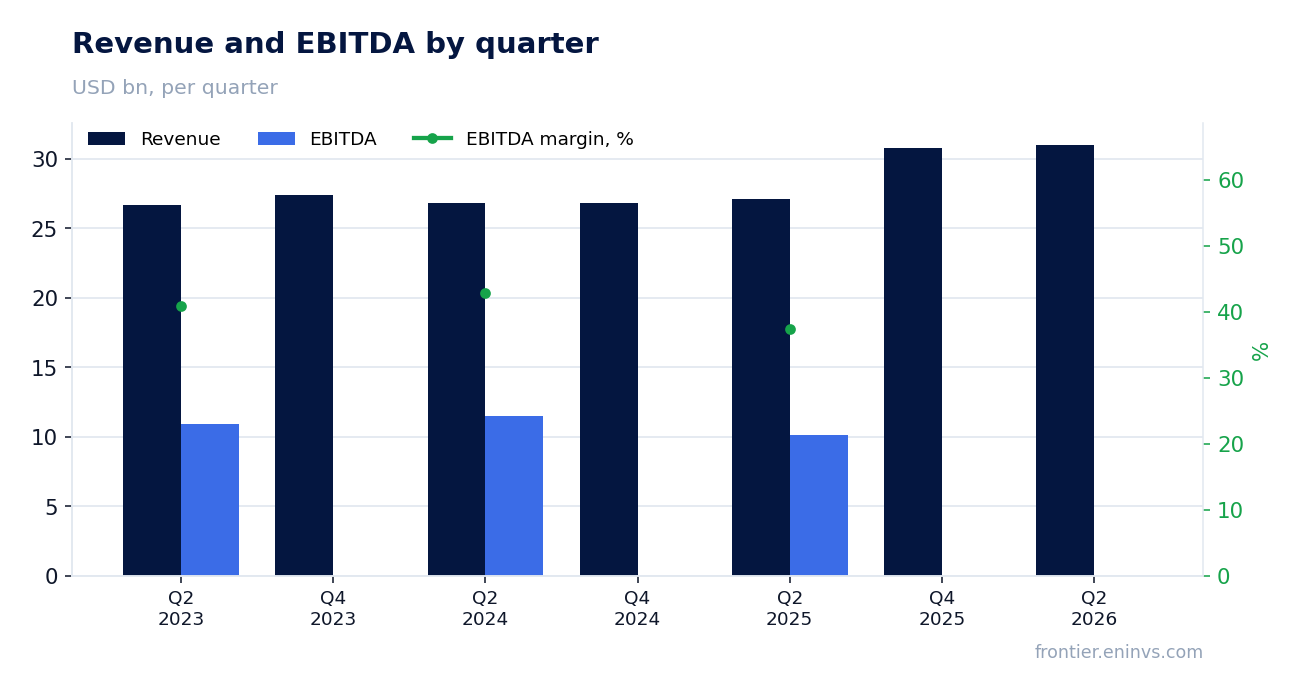
Rio Tinto's Q2 2026 results, as disclosed, showed revenue of $31.0 billion and net profit of $6.7 billion. Revenue rose 14.5% year on year, while net profit grew 45.9%, lifting the net margin to 21.5% from 16.8% a year earlier. Net debt fell to $12.5 billion from $15.0 billion at end-2025. At the current price the stock trades at 7.8 EV/EBITDA against its own three-year average of 5.9, which, with revenue and profit growth and a dividend yield of about 4.9%, makes the share rather attractive rather than neutral.
Key takeaways
— Revenue rose 14.5% year on year, and the pace was roughly the same as 14.6% a quarter earlier
— Net profit added 45.9%, lifting the margin to 21.5% from 16.8%
— Net debt fell to $12.5 billion from $15.0 billion at end-2025
— Dividend yield of 4.9% rests on profit and the company's payout policy
— EV/EBITDA of 7.8 is above its own three-year average of 5.9
— Net debt at 0.57 LTM EBITDA leaves room for payouts and investment
Attractiveness
Key figures, USD bn
| Metric | Q2 2025 | Q2 2026 | Change |
|---|---|---|---|
| Revenue | 27.1 | 31.0 | +14.5% |
| EBITDA | 10.1 | — | — |
| Operating profit | 6.77 | 9.16 | +35.2% |
| Net profit | 4.57 | 6.66 | +45.9% |
| Operating cash flow | 7.04 | — | — |
| Capex | 4.77 | — | — |
| EBITDA margin | 37.4% | — | — |
| Net margin | 16.8% | 21.5% | +4.7 pp |
Revenue rose 14.5% year on year, and the pace was roughly the same as 14.6% a quarter earlier
Rio Tinto's Q2 2026 revenue came in at $31.0 billion, up 14.5% year on year. This extends a solid growth trend: in Q4 2025 revenue rose 14.6%, so the pace was roughly the same. For a mining company, such growth implies either favourable pricing, higher shipment volumes, or a combination of both.
Notably, growth accelerated compared with early 2025: in Q2 2025 the increase was only 1.1%, and in Q4 2024 revenue even declined 1.9%. The current 14.5% is well above those levels, pointing to a recovery in demand and possibly prices for the company's key commodities.
The stability of the pace at around 14–15% for two consecutive quarters is a positive signal. If revenue maintains this momentum in the next report, it would confirm that the growth was not one-off. However, to assess sustainability it is important to know how much of the increase came from prices versus volumes, and those data are not disclosed in the facts.
Net profit added 45.9%, lifting the margin to 21.5% from 16.8%
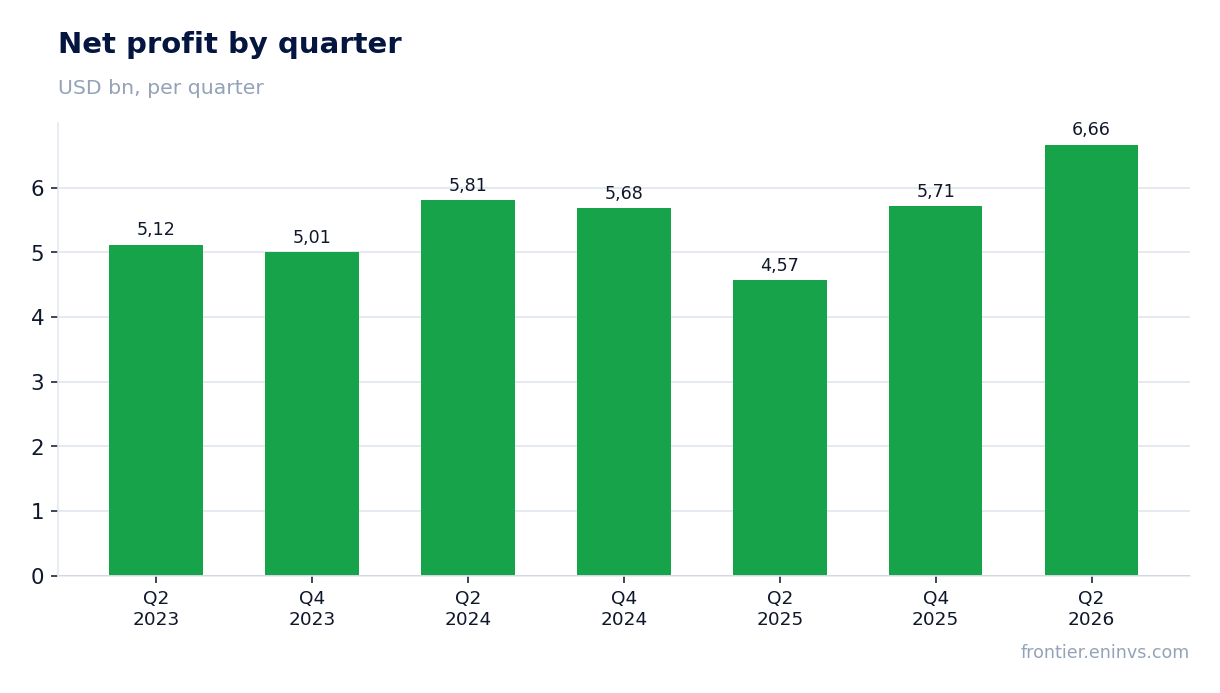
Net profit for Q2 2026 reached $6.7 billion, up 45.9% year on year. This growth significantly outpaces the revenue increase, lifting the net margin to 21.5% from 16.8% in Q2 2025. This means the company is not only growing its top line but doing so more efficiently.
Operating profit also rose, from $6.8 billion a year earlier to $9.2 billion in the reported quarter. The faster growth of profit relative to revenue could be explained by lower unit costs, favourable pricing, or operating leverage. The facts do not provide a breakdown of cost lines, so the exact cause is not disclosed, but the improvement in profitability is clear.
A 21.5% net margin is a high level for the mining sector. It reflects the company's ability to generate substantial profit even amid volatile commodity prices. The sustainability of this level will depend on maintaining the current pricing environment and cost discipline.
Net debt fell to $12.5 billion from $15.0 billion at end-2025
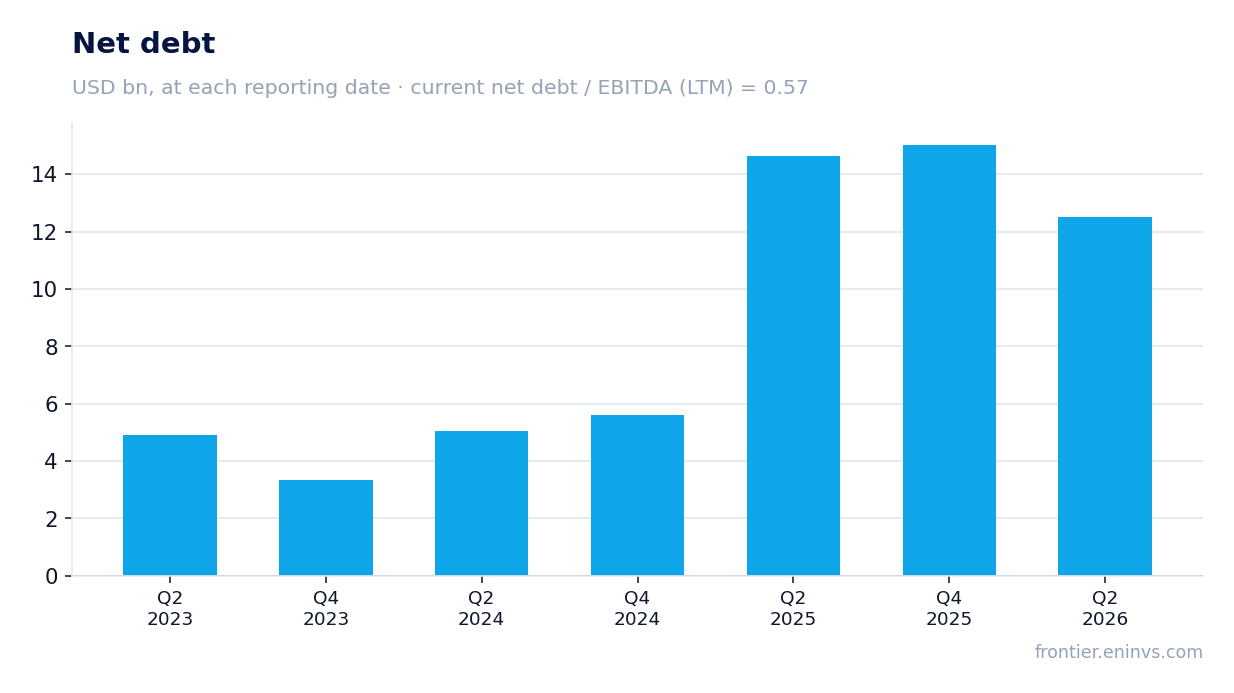
Rio Tinto's net debt as of 30 June 2026 stood at $12.5 billion, down from $15.0 billion at 31 December 2025. The $2.5 billion reduction over six months reflects the company's ability to generate cash flow sufficient to service and repay obligations. Over the last 12 months, net debt fell by $2.1 billion: from $14.6 billion on 30 June 2025 to the current $12.5 billion.
The net debt to LTM EBITDA ratio is 0.57. This is a moderate level that leaves room for manoeuvre: the company can fund investments and pay dividends without increasing leverage. The facts do not provide an earlier value for this ratio, so leverage dynamics cannot be assessed, but the current level looks comfortable.
Reducing debt while growing profit is a sign of financial strength. If the company continues to generate cash flow at the current level, debt could fall further, strengthening the balance sheet and reducing risks.
Dividend yield of 4.9% rests on profit and the company's payout policy
Rio Tinto's dividend yield over the last 12 months is 4.9%. This is a moderate but stable level for a large mining company. Payouts rest on profit and the company's dividend policy, which typically links the dividend to financial results.
With LTM net profit of $10.2 billion and a market capitalisation of about $154.6 billion, a 4.9% yield looks balanced. It is not a record level, but it does not imply excessive strain on the balance sheet. For comparison, the dollar key rate is currently lower, making the yield attractive for income-oriented investors.
Our estimate for the current year's dividend assumes the payout ratio remains at the level the company has demonstrated in recent periods. If profit stays at the current level or continues to grow, the dividend could be increased. The main risks to payouts are lower commodity prices and higher capital expenditures, which could require reallocating cash flow.
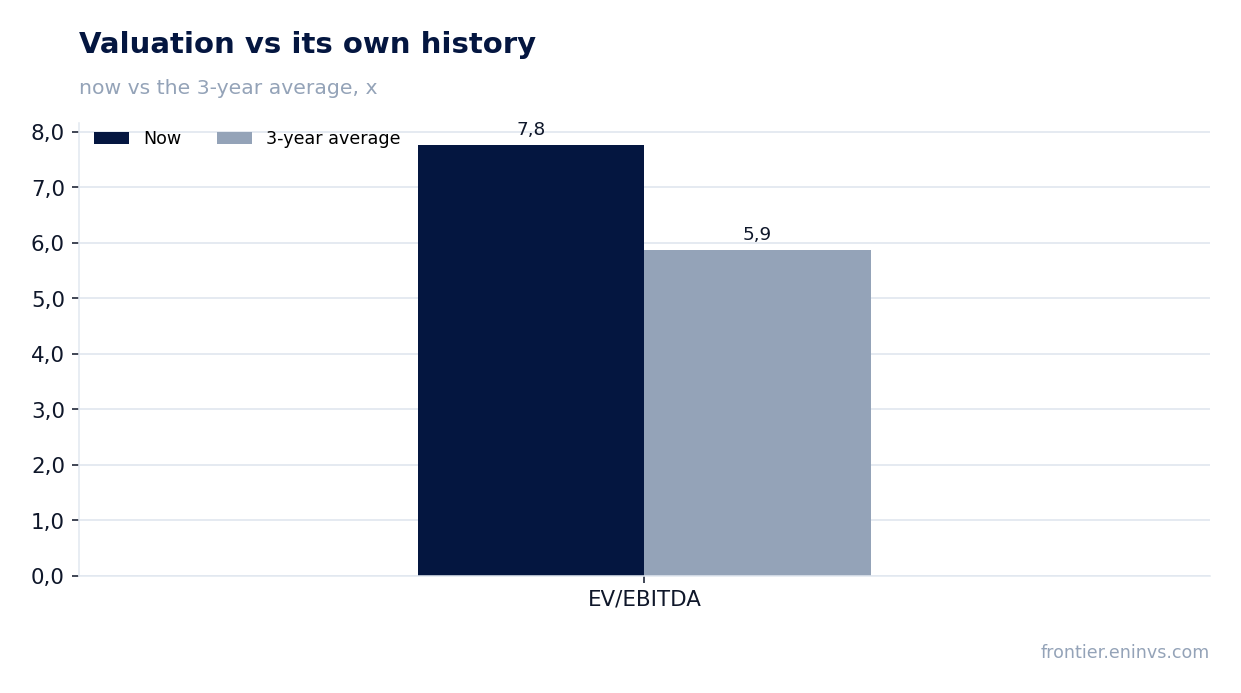
EV/EBITDA of 7.8 is above its own three-year average of 5.9
Rio Tinto's current EV/EBITDA multiple is 7.8, above its own three-year average of 5.9. This means the stock is valued more richly than its average over the past three years. Investors may be pricing in expectations of sustained profit and cash flow growth.
The LTM P/E ratio is 15.1. For a mining company this is a moderate level, but it is also above historical values, judging by the three-year average EV/EBITDA. The 45.9% profit growth in the reported quarter could justify a higher valuation if it proves sustainable.
Comparison with its own history shows that the market has already priced in some of the positive changes. Further multiple expansion is possible only if high profit and cash flow persist. If profit returns to more modest levels, the current valuation could prove stretched.
Net debt at 0.57 LTM EBITDA leaves room for payouts and investment
The net debt to LTM EBITDA ratio is 0.57. This is a low level, indicating conservative financial policy. The company can service its debt without strain while directing significant funds to dividends and capital expenditures.
LTM EBITDA stood at $21.8 billion, more than 1.7 times the current net debt. Such a cushion allows the company to remain resilient even if commodity prices decline. If conditions deteriorate, leverage could rise, but the current level is far from critical.
Low leverage is a competitive advantage in a cyclical sector. It gives Rio Tinto the ability to ride out periods of low prices and continue investing in projects without resorting to expensive financing.
Valuation on the latest reported figures
| Metric | Value |
|---|---|
| Market cap | 155 bn USD |
| P/E (LTM) | 15.1 |
| EV/EBITDA (LTM) | 7.8 |
| P/B | 2.49 |
| Net debt / EBITDA (LTM) | 0.57 |
| ROE | 41.8% |
| Dividend yield (12m) | 4.9% |
| EV/EBITDA, 3-year average | 5.9 |
Bottom line
Rio Tinto delivered a strong quarter: revenue rose 14.5%, net profit added 45.9%, and the margin climbed to 21.5%. Net debt fell to $12.5 billion, with a comfortable 0.57 net debt to EBITDA ratio. However, the EV/EBITDA multiple of 7.8 exceeds its own three-year average of 5.9, suggesting the market has already priced in much of the positive news. The 4.9% dividend yield remains attractive, but its sustainability depends on maintaining high profit. At the current price, the stock looks rather attractive for investors willing to accept sector cyclicality, but further valuation upside is limited.
Open the company's financial profile RIO →
See also: market overview · valuation map · stock screeners