Shell: profit tripled, but it came from a one-off revenue surge, not a durable improvement
Shell reported results for the second quarter of 2026. Revenue reached $94,664 million, up 44.7% year-on-year, net profit hit $10,821 million, tripling from $3,601 million a year earlier, and EBITDA rose 79.2% to $22,427 million. The EBITDA margin climbed to 23.7% from 19.1% a year ago. At the same time, the shares look attractive: EV/EBITDA LTM stands at 5.14, below historical levels, and a dividend yield of 3.18% provides support, although the bulk of profit growth is one-off in nature.
Key takeaways
— Revenue rose 44.7% year-on-year to $94,664 million, but this jump was driven by a one-off factor rather than organic growth
— EBITDA increased 79.2% to $22,427 million, with the EBITDA margin rising to 23.7% from 19.1% a year earlier
— Net profit tripled to $10,821 million, while the net margin reached 11.4% versus 5.5% a year earlier
— Operating cash flow for the quarter was $21,432 million, significantly above last year's $11,937 million
— Debt rose from $17,080 million at end-2025 to $21,934 million at end-Q1 2026, an increase of $4,854 million
— The trailing 12-month dividend yield is 3.18%, providing support, but payouts depend on profit sustainability
— EV/EBITDA LTM is 5.14 and P/E LTM is 10.89, below historical averages, leaving room for upside
Attractiveness
Key figures, USD bn
| Metric | Q2 2025 | Q2 2026 | Change |
|---|---|---|---|
| Revenue | 65.4 | 94.7 | +44.7% |
| EBITDA | 12.5 | 22.4 | +79.2% |
| Operating profit | 6.01 | 15.2 | +152.4% |
| Net profit | 3.60 | 10.8 | +200.5% |
| Operating cash flow | 11.9 | 21.4 | +79.5% |
| EBITDA margin | 19.1% | 23.7% | +4.6 pp |
| Net margin | 5.5% | 11.4% | +5.9 pp |
Revenue rose 44.7% year-on-year to $94,664 million, but this jump was driven by a one-off factor rather than organic growth
Shell's revenue for the second quarter of 2026 was $94,664 million, up 44.7% from $65,406 million in the second quarter of 2025. This growth looks impressive, but it contrasts sharply with the dynamics of previous quarters: in the first quarter of 2026, revenue was $69,691 million, and in the fourth quarter of 2025, $64,093 million. The jump occurred specifically in the second quarter, indicating a one-off factor rather than a sustainable acceleration.
The main reason for this growth was likely a sharp rise in energy prices or an increase in sales volumes amid favourable market conditions. However, without additional data from the report, the exact cause is not disclosed. Importantly, the revenue growth was not accompanied by a proportional increase in operating expenses, which led to faster profit growth.
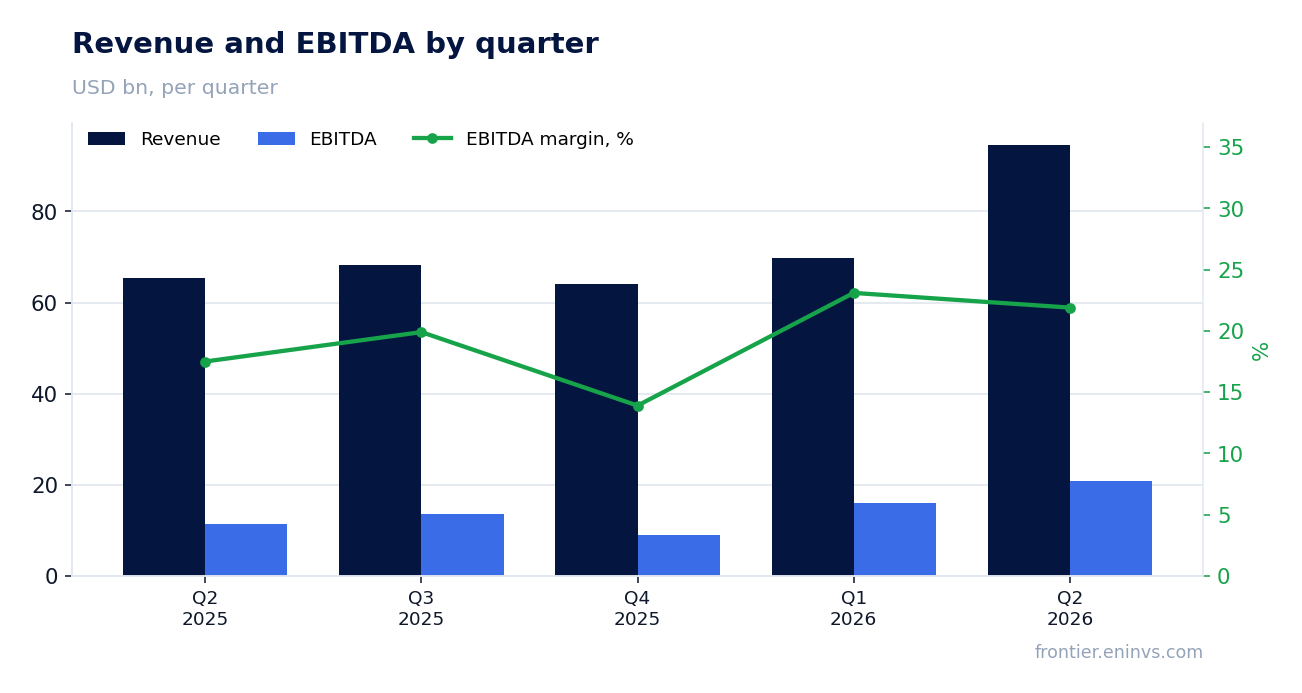
EBITDA increased 79.2% to $22,427 million, with the EBITDA margin rising to 23.7% from 19.1% a year earlier
EBITDA for the second quarter of 2026 reached $22,427 million, up 79.2% from $11,476 million in the second quarter of 2025. The EBITDA margin rose to 23.7% from 19.1% a year earlier. This increase in profitability is explained by revenue growing faster than costs, which is typical during periods of favourable pricing.
Operating profit also showed significant growth: from $6,013 million to $15,177 million. This confirms that the improvement in profitability came not from one-off items below the operating line, but from core operations. However, the sustainability of such a margin level is questionable given the volatility of energy prices.
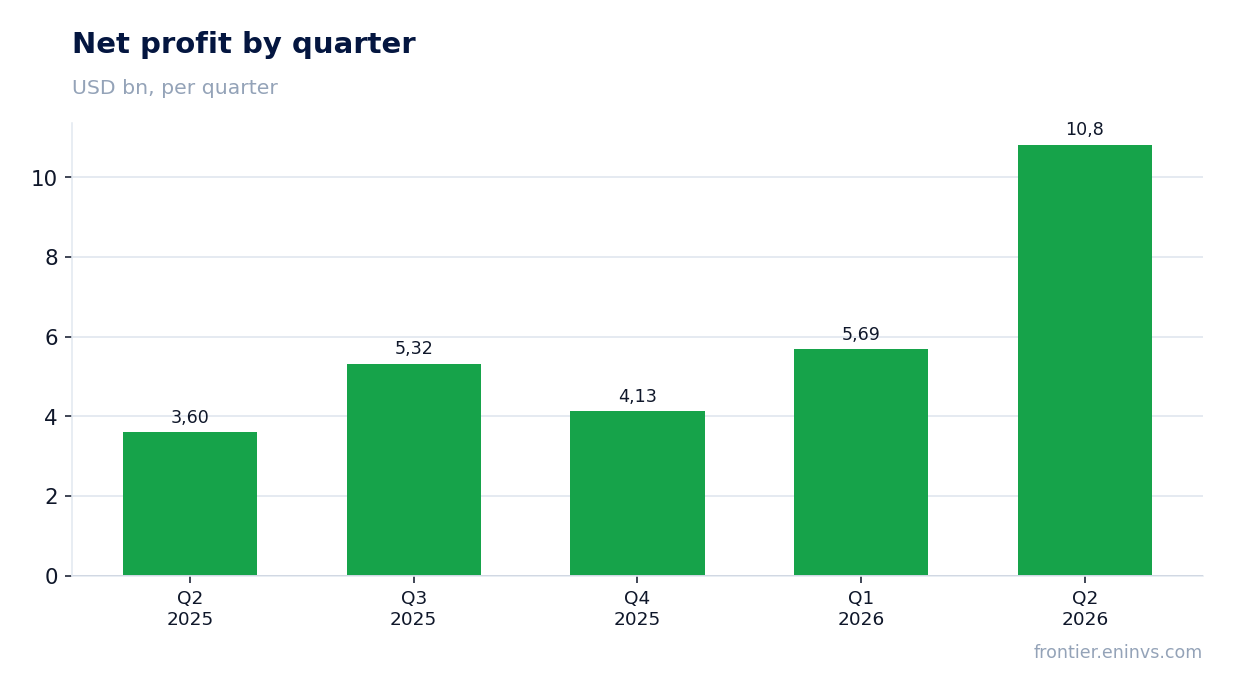
Net profit tripled to $10,821 million, while the net margin reached 11.4% versus 5.5% a year earlier
Shell's net profit for the second quarter of 2026 was $10,821 million, tripling from $3,601 million in the second quarter of 2025. The net margin rose to 11.4% from 5.5% a year earlier. This profit growth is partly due to operational improvements, but also possibly to one-off factors not disclosed in the provided data.
It is worth noting that net profit for the trailing twelve months (LTM) stands at $25,971 million, giving a sense of the average annual profit level. However, the current quarterly result is significantly above average, confirming its one-off nature. To assess the sustainability of the business, it is important to understand how repeatable such results will be in the future.
Operating cash flow for the quarter was $21,432 million, significantly above last year's $11,937 million
Operating cash flow in the second quarter of 2026 reached $21,432 million, nearly double the $11,937 million in the second quarter of 2025. This indicates high earnings quality and the company's ability to generate cash. Over the trailing twelve months, operating cash flow was $49,139 million.
The increase in cash flow occurred alongside higher revenue and profit, which is logical. However, it is important to note that capital expenditures (capex) are not disclosed in the provided data, so it is impossible to assess how much was directed to investments. This limits the analysis of free cash flow.
Debt rose from $17,080 million at end-2025 to $21,934 million at end-Q1 2026, an increase of $4,854 million
Shell's net debt at the end of the first quarter of 2026 was $21,934 million, up from $17,080 million at the end of 2025. The $4,854 million increase in debt occurred alongside significant operating cash flow, which may indicate active investment or shareholder payouts. Data on debt at the end of the second quarter of 2026 is not available.
Given that EBITDA for the trailing twelve months is around $59,326 million (sum of quarterly values), the net debt to EBITDA ratio remains at a comfortable level. However, without precise data for the second quarter, it is difficult to assess the current debt burden. The rise in debt warrants attention, especially if it is tied to financing one-off projects.
The trailing 12-month dividend yield is 3.18%, providing support, but payouts depend on profit sustainability
Shell's dividend yield over the trailing 12 months is 3.18%. This is a moderate level that provides some support to the shares but is not exceptionally high. For comparison, the key US rate is at a level that makes such payouts less attractive relative to risk-free instruments.
Dividend payments depend on profit and cash flow. In the current quarter, the company earned $10,821 million in net profit and $21,432 million in operating cash flow, which comfortably covers dividends. However, if profit returns to average levels, the dividend yield could decline. Our forecast for the current year's dividend will depend on the sustainability of quarterly results.
EV/EBITDA LTM is 5.14 and P/E LTM is 10.89, below historical averages, leaving room for upside
Shell's EV/EBITDA LTM is 5.14 and P/E LTM is 10.89. These levels appear low relative to the company's historical averages, which may indicate undervaluation. Market capitalisation stands at $282,707 million, and return on equity (ROE) reaches 24.4%, confirming business efficiency.
According to the portal's model, which re-prices EBITDA at current commodity prices and the target EV/EBITDA, the upside to fair value is estimated at +4%. This is a moderate but positive signal. With a dividend yield of 3.18%, the total return could be attractive for value-oriented investors.
Valuation on the latest reported figures
| Metric | Value |
|---|---|
| Market cap | 283 bn USD |
| P/E (LTM) | 10.9 |
| EV/EBITDA (LTM) | 5.1 |
| P/B | 1.62 |
| Operating cash flow (LTM) | 49.1 bn |
| ROE | 24.4% |
| Dividend yield (12m) | 3.2% |
Bottom line
Shell delivered exceptionally strong results for the second quarter of 2026: revenue rose 44.7%, EBITDA grew 79.2%, and net profit tripled. However, this growth was largely driven by one-off factors rather than a sustainable improvement in the business. Debt increased but remains at an acceptable level, and cash flow remains high. The shares look attractive given low multiples and dividend yield, but confirmation of sustainability is needed from the next quarter's data.
Open the company's financial profile SHEL →
See also: market overview · valuation map · stock screeners