US Energy: revenue grew for the first time in a year, but construction costs eat the entire gain
On August 11, US Energy reported results for the second quarter of 2026. Revenue came in at $2.134 million, up 5.2% year-on-year – the first positive growth in five quarters. EBITDA loss narrowed to $1.793 million from $5.121 million a year earlier, and net loss narrowed to $2.279 million from $6.058 million. The company is completing its transformation from an oil and gas producer into an industrial gas player: production is falling, construction is underway, and first gas is expected in the first quarter of 2027. At the current price the stock looks rather unattractive: the market has already priced in project success, while first helium revenue is still two quarters away.
Key takeaways
— Revenue grew for the first time in a year, but the growth came from one-off sales, not the core business
— EBITDA loss narrowed threefold, but the improvement came from one-off items, not operating efficiency
— Production continues to fall, undermining the base for future revenue
— Debt rose to $4.5 million, but liquidity of $21.5 million is enough to complete construction
— Operating cash flow remains negative, and the company cannot avoid raising capital
— Valuation makes no sense on current earnings – the market is paying for the future helium project
Attractiveness
Key figures, USD bn
| Metric | Q2 2025 | Q2 2026 | Change |
|---|---|---|---|
| Revenue | 0.00 | 0.00 | +5.2% |
| EBITDA | -0.01 | -0.00 | — |
| Operating profit | -0.01 | -0.00 | — |
| Net profit | -0.01 | -0.00 | — |
| Operating cash flow | -0.00 | -0.00 | — |
| Capex | 0.00 | — | — |
| EBITDA margin | -252.5% | -84.0% | +168.5 pp |
| Net margin | -298.7% | -106.8% | +191.9 pp |
Revenue grew for the first time in a year, but the growth came from one-off sales, not the core business
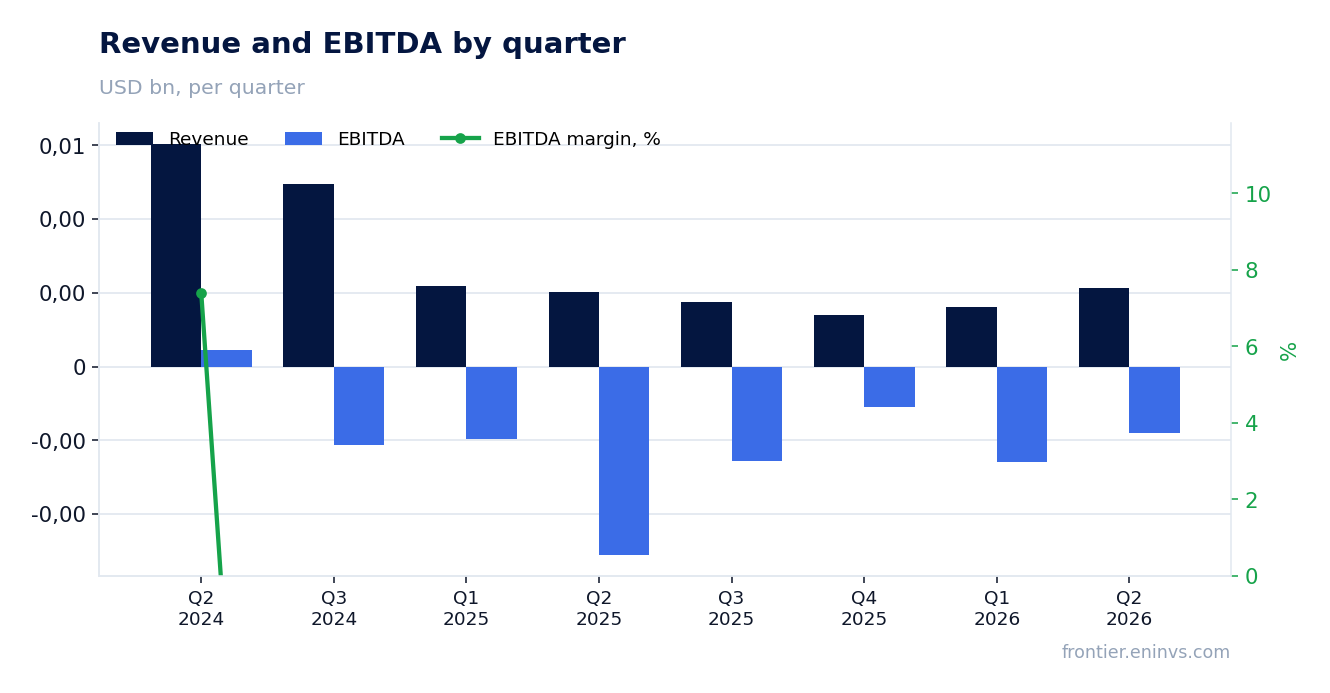
Revenue in the second quarter of 2026 was $2.134 million, up 5.2% year-on-year. This is the first positive quarterly growth since the first quarter of 2025, when the decline was 59.3%. However, the growth was not driven by production: output fell to 33,747 barrels of oil equivalent from 48,816 a year earlier. The company attributes this to the completion of its asset divestiture programme, which funded the transition to the new business.
The average realised price rose to $63.24 per barrel of oil equivalent from $41.54 a year earlier. It was the price factor, not volumes, that pulled revenue into positive territory. Oil accounted for 84% of revenue, and its share continues to grow as gas assets are divested.
For investors, this means current revenue is the revenue of a departing business. It will continue to fall until helium sales begin in the first quarter of 2027. Until then, the financials will show only shrinking oil production and rising construction costs.
EBITDA loss narrowed threefold, but the improvement came from one-off items, not operating efficiency
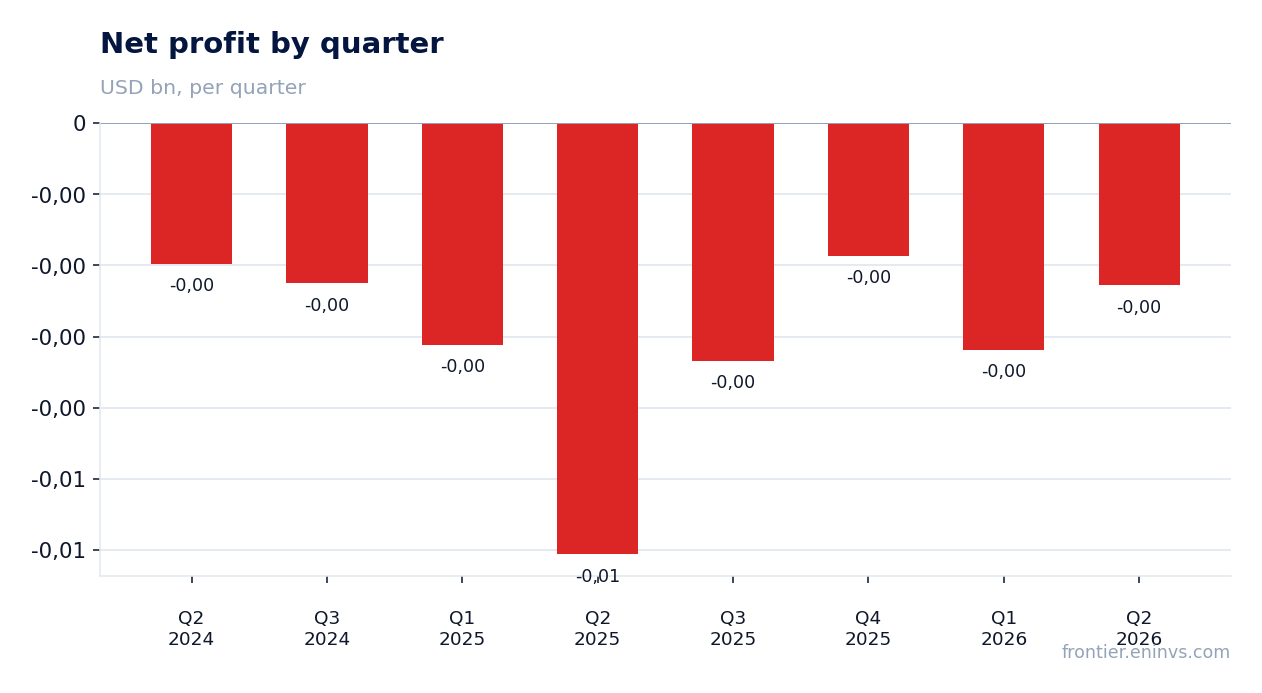
EBITDA loss in the second quarter of 2026 was $1.793 million versus $5.121 million a year earlier. The nearly threefold reduction looks impressive, but it is largely explained by the base effect: a year earlier the company recognised a $2.8 million impairment of oil and gas properties. Without that one-off factor, the prior-year loss would have been substantially smaller.
Operating loss narrowed to $2.385 million from $6.239 million. Here too, the absence of impairment played a role. At the same time, general and administrative expenses rose to $2.647 million from $2.246 million – the company is spending more on legal and advisory services related to the business transition. These costs are expected to normalise after construction is completed, according to management.
Adjusted EBITDA, which the company reports separately, was negative $0.949 million versus negative $1.290 million a year earlier. This metric excludes impairment and non-cash items, and it shows that the operating loss has narrowed but remains significant. The company is still burning cash, and this will not stop until helium production begins.
Production continues to fall, undermining the base for future revenue
Production in the second quarter of 2026 was 33,747 barrels of oil equivalent, down 30.9% year-on-year. The decline is due to asset sales and natural field depletion. The company states that the monetisation programme that funded the transition to the new business is substantially complete.
The production decline is not temporary but part of the strategy. The company is deliberately divesting oil and gas assets to focus on helium and carbon management. However, until the new project starts, oil production remains the only source of revenue, and its decline will weigh on financial results.
For investors, this means that financials for the next two quarters will be weak. Revenue will continue to fall, losses will persist, and only the launch of the helium project in the first quarter of 2027 can change the situation. Until then, the stock will trade on expectations, not actual results.
Debt rose to $4.5 million, but liquidity of $21.5 million is enough to complete construction
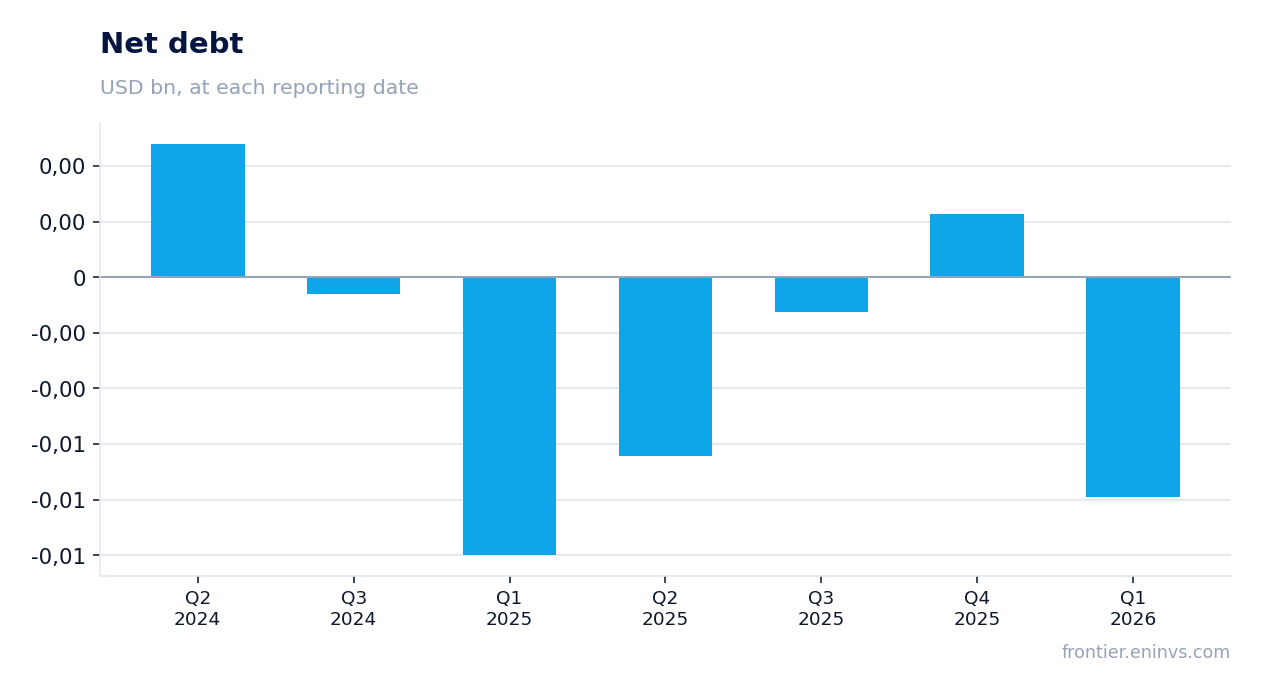
Total debt as of June 30, 2026 was $4.5 million versus $2.5 million at the end of 2025. The increase is due to drawdowns under the credit facility. At the same time, cash was $5.987 million, and total liquidity was $21.487 million, including $15.5 million of undrawn capacity under the credit facility. After the reporting date, the company drew an additional $4.0 million, and as of August 4, liquidity stood at $16.4 million.
In April 2026, the company doubled its credit facility to $20 million, fixed the margin at 200 basis points over the base rate, and suspended financial covenant testing through the first quarter of 2027. This provides a cushion to complete construction without pressure from lenders.
With capital expenditures of $9.7 million in the first half of 2026 and expected costs to complete construction, current liquidity should be sufficient until the project starts. However, if timelines slip or costs rise, the company will need to raise additional capital, which could dilute existing shareholders.
Operating cash flow remains negative, and the company cannot avoid raising capital
Operating cash flow in the second quarter of 2026 was negative $0.8 million. For the first half, the outflow was $3.252 million. The company is funding construction through raised capital: in March 2026 it completed an equity offering of $8.086 million and also used a committed equity facility of $9.103 million. This helped increase cash to $5.987 million by the end of the quarter.
Industrial gas capital expenditures in the first half were $9.7 million versus $2.5 million a year earlier. Costs nearly quadrupled, reflecting the shift from development to construction. The company states it invested $9.6 million in Big Sky over the six months.
Negative operating cash flow and high capital expenditures mean the company depends on external financing. As long as the credit facility and equity offerings cover needs, the situation is manageable, but if the project is delayed, pressure on liquidity will intensify. This is a key risk for investors.
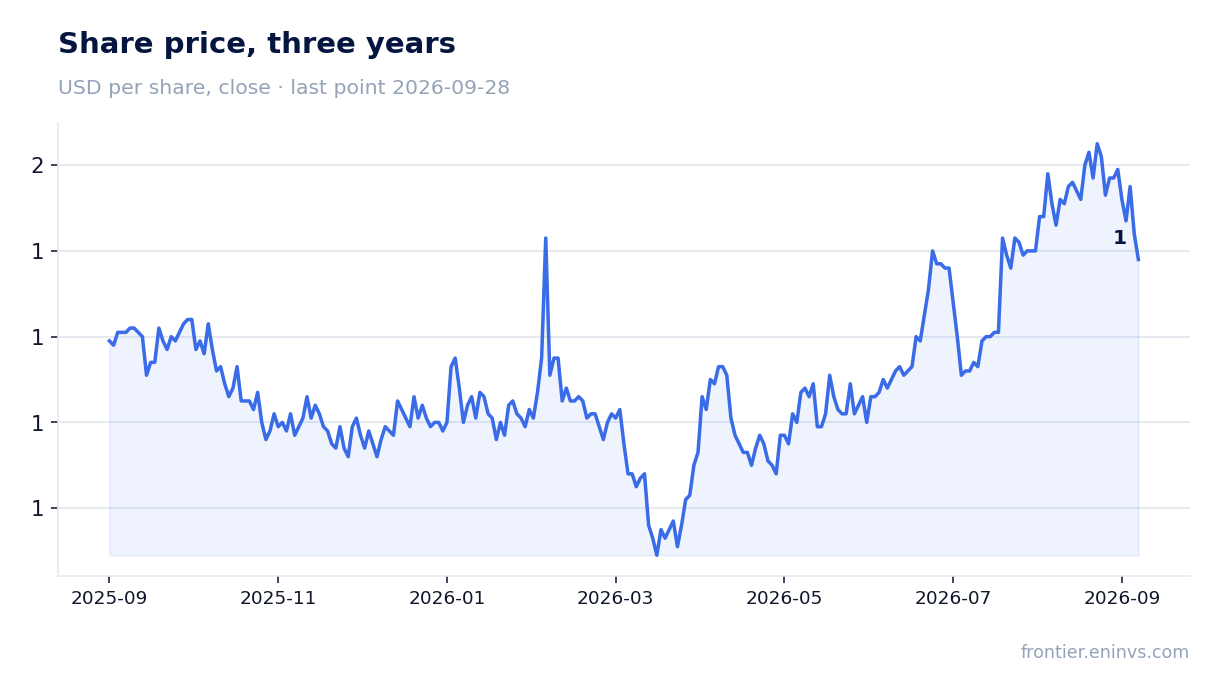
Valuation makes no sense on current earnings – the market is paying for the future helium project
The company's market capitalisation is $72.4 million. With trailing twelve-month revenue of $6.9 million and negative EBITDA, valuation multiples are meaningless. The company is loss-making, and financials will not improve until the helium project starts. The market is valuing the future Big Sky Carbon Hub project, not the current business.
The key factor for valuation is the helium sales contract. In April 2026, the company signed a five-year agreement with an investment-grade global industrial gas counterparty for 100% take-or-pay at a fixed price of $285 per Mcf at the plant gate. The contract includes indexation from 2028 and a price redetermination in year three. This provides a basis for future revenue.
However, first helium revenue is still two quarters away, and the project is not yet complete. Construction is underway, but MRV approvals from the EPA have not yet been received. If the launch is delayed or helium prices fall, the valuation could decline significantly. The current share price already prices in a successful launch, leaving little margin of safety.
Valuation on the latest reported figures
| Metric | Value |
|---|---|
| Market cap | 0.07 bn USD |
| P/B | 2.99 |
| Operating cash flow (LTM) | -0.00 bn |
| ROE | -24.1% |
Bottom line
In the second quarter of 2026, US Energy showed its first revenue growth in a year, but it was driven by oil prices, not volumes. EBITDA loss narrowed threefold, but mainly due to the absence of impairment that occurred a year earlier. Production continues to fall, operating cash flow is negative, and the company depends on external financing. The entire investment thesis rests on the helium project, which is expected to launch in the first quarter of 2027. Until then, the stock will trade on expectations, and the current price already reflects a successful scenario. At the current price, the stock looks rather unattractive: the market is paying for the future, while risks of delay and dilution remain high.
Open the company's financial profile USEG →
See also: market overview · valuation map · stock screeners