Kazatomprom: KZT 240.4bn quarterly profit, but cash flow inflated by a one-off inflow
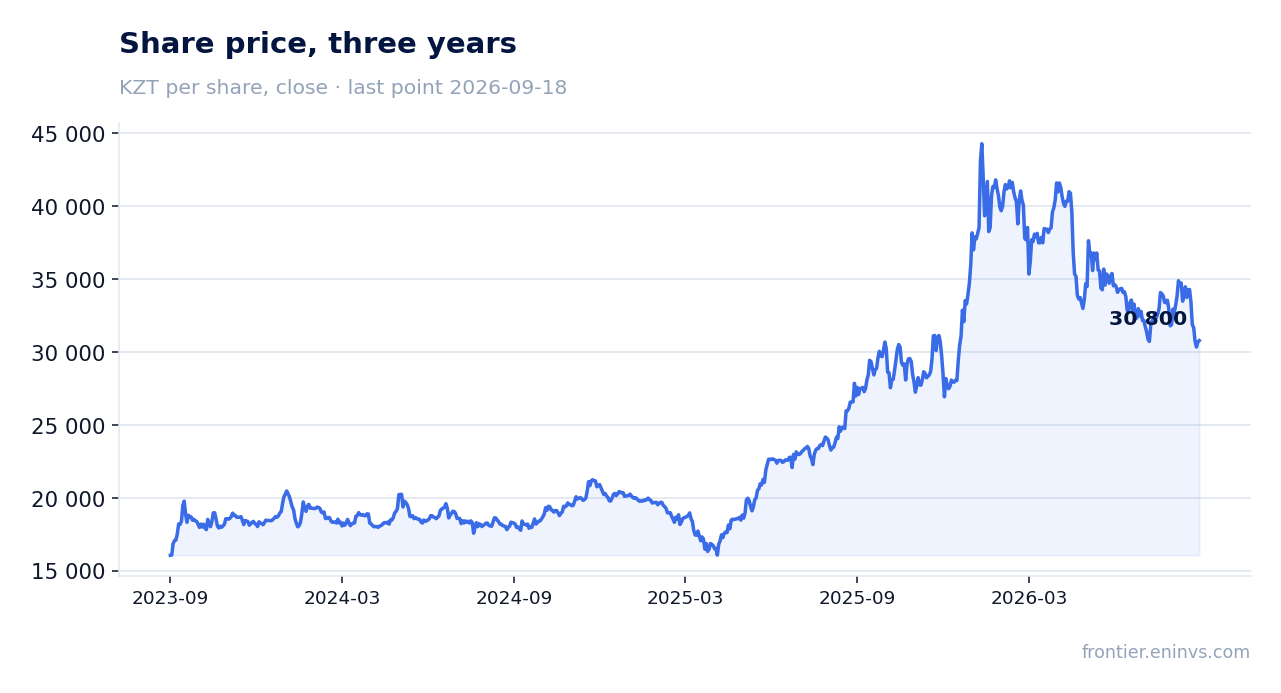
On 21 August, Kazatomprom released its operating and financial review for the six months ended 30 June 2026. In the second quarter, revenue reached KZT 717.8bn, EBITDA – KZT 252.6bn with a 35.2% margin, and net profit – KZT 240.4bn at a 33.5% net margin. Operating cash flow in the reported quarter hit KZT 7.1bn, which looks abnormally high relative to profit and is explained by a one-off return of investments from ANU Energy. Leverage remains low: net debt to LTM EBITDA stands at 0.23, while the stock trades at a P/E LTM of 10.4 and EV/EBITDA LTM of 9.35. Our model puts fair value almost exactly at the market price – an upside of minus 1% – so at the current price the share looks neutral: the strong quarter is already priced in, and one-off factors plus a rising tax burden limit further upward re-rating.
Key takeaways
— Quarterly revenue of KZT 717.8bn was driven by an average uranium spot price of USD 85.98 per pound
— The 35.2% EBITDA margin holds despite a 38.7% rise in sulphuric acid costs
— Net profit of KZT 240.4bn includes a one-off return of investments from ANU Energy worth KZT 24.4bn
— Operating cash flow of KZT 7.1bn is inflated by a one-off inflow and does not reflect sustainable generation
— Leverage at 0.23x LTM EBITDA remains low, but net debt rose by RUB 236.5bn
— A dividend yield of 3.0% on the 2025 payout looks modest against the key rate
— P/E of 10.4 and EV/EBITDA of 9.35 leave no upside: the portal model shows minus 1%
Attractiveness
Key figures, KZT bn
| Metric | — | Q2 2026 | Change |
|---|---|---|---|
| Revenue | — | 718 | — |
| EBITDA | — | 253 | — |
| Operating profit | — | 253 | — |
| Net profit | — | 240 | — |
| Operating cash flow | — | 7 100 | — |
| EBITDA margin | — | 35.2% | — |
| Net margin | — | 33.5% | — |
Quarterly revenue of KZT 717.8bn was driven by an average uranium spot price of USD 85.98 per pound
In the second quarter of 2026, revenue amounted to KZT 717.8bn. The main driver was the rise in the average uranium spot price: in the first half it reached USD 85.98 per pound, up 24% year-on-year. The group's average realised price for the same period was USD 67.88 per pound, an increase of 16% year-on-year.
Sales volumes also supported revenue growth, although the company does not disclose exact figures in the provided excerpt. The document notes that quarterly metrics in the uranium sector are rarely representative of annual expectations, so full-year dynamics may differ from the half-year.
Importantly, 93% of revenue is denominated in US dollars, and the weakening of the tenge against the dollar (average rate of KZT 486.34 per dollar versus KZT 512.08 a year earlier) had a restraining effect on tenge revenue. Nevertheless, in tenge terms revenue grew, indicating a strong price factor.
The 35.2% EBITDA margin holds despite a 38.7% rise in sulphuric acid costs
EBITDA in the second quarter amounted to KZT 252.6bn, corresponding to a 35.2% margin. This is a high level, maintained thanks to the low cost of in-situ recovery mining. However, cost pressure is mounting: the weighted average cost of sulphuric acid increased by 38.7% to KZT 97,312 per tonne in the first half of 2026.
Sulphuric acid accounts for about 15.3% of uranium production costs, and its rise has not yet led to a significant margin squeeze. The document also notes growth in other operating expenses due to inflation and logistical constraints, but the company offsets this with higher uranium prices.
The introduction of a differentiated mineral extraction tax (MET) rate from 1 January 2026 raised the average rate to 12.4% versus 9% a year earlier. This has already affected tax payments, but the main pressure on the margin may materialise later if uranium prices stabilise.
Net profit of KZT 240.4bn includes a one-off return of investments from ANU Energy worth KZT 24.4bn
Net profit in the second quarter amounted to KZT 240.4bn, with a net margin of 33.5%. This includes a one-off gain from the partial return of investments in ANU Energy: in July 2026, the company received KZT 24.4bn (USD 51.71m) as part of a distribution among ANU Energy shareholders.
Without this inflow, profit would have been lower, although core operations remain profitable. Operating profit also stood at KZT 252.6bn, matching EBITDA, which indicates the absence of significant depreciation or other non-operating items in this metric.
Such a high net margin is explained not only by the one-off factor but also by the general rise in uranium prices. However, the sustainability of this profit level is questionable: in subsequent quarters the one-off effect will disappear, and tax payments will increase.
Operating cash flow of KZT 7.1bn is inflated by a one-off inflow and does not reflect sustainable generation
Operating cash flow in the second quarter amounted to KZT 7.1bn, significantly exceeding net profit. This is explained by the one-off inflow from ANU Energy of KZT 24.4bn, which was recognised in the reporting period despite actual receipt in July. Without this inflow, cash flow would have been negative or close to zero.
Such a sharp discrepancy between profit and cash flow indicates that the quality of earnings in this quarter is low. The company does not disclose working capital details, but it is clear that sustainable cash generation is significantly lower than reported.
For investors, this means the dividend base could come under pressure if one-off factors do not recur. At the same time, low net debt and the absence of major capital expenditures in the reporting period allow the company to maintain financial stability.
Leverage at 0.23x LTM EBITDA remains low, but net debt rose by RUB 236.5bn
Net debt at the latest reporting date stood at KZT 207.5bn, with a net debt to LTM EBITDA ratio of 0.23. This is a low level, providing the company with a significant margin of safety. However, net debt increased by RUB 236.5bn compared to the previous reporting date, driven by changes in the borrowing structure and currency fluctuations.
The rise in debt in ruble terms may be partly due to the revaluation of dollar-denominated liabilities, as 94% of borrowings are in US dollars. At the same time, the company does not disclose details of the debt change in the provided excerpt, so the direction of future dynamics remains unclear.
Low leverage allows the company to remain resilient even amid uranium price volatility. At the same time, the rise in absolute debt warrants attention, especially if operating cash flow remains weak.
A dividend yield of 3.0% on the 2025 payout looks modest against the key rate
The dividend yield over the last 12 months is 3.0%. This is a moderate level that does not compensate for the current key rate. The company does not disclose the 2025 dividend amount in the provided excerpt, but the yield is calculated based on actual payments.
Our estimate for the 2026 dividend depends on profit and dividend policy. If the company maintains a high payout level, the yield may remain at the current level or increase slightly. However, one-off factors in profit and a rising tax burden could limit the dividend base.
A dividend cut is possible if operating cash flow remains weak and capital expenditures rise. The document mentions that construction of the TQZ plant is delayed by 6–12 months, which could increase financing needs.
P/E of 10.4 and EV/EBITDA of 9.35 leave no upside: the portal model shows minus 1%
The shares trade at a P/E LTM of 10.4 and EV/EBITDA LTM of 9.35. These are moderate multiples that appear neither clearly cheap nor overvalued. However, our model, which reprices EBITDA at current commodity prices and the target EV/EBITDA, shows an upside to fair value of minus 1%.
Thus, the market already prices in the current level of uranium prices and the company's profitability. Further growth is possible only with a significant increase in uranium prices or improved operational efficiency. At the same time, low leverage and strong market positions limit downside risk.
A comparison with the company's own multiple history is not available, as the facts do not contain three-year averages. Therefore, the assessment relies on current levels and the portal model.
Valuation on the latest reported figures
| Metric | Value |
|---|---|
| Market cap | 8 176 bn KZT |
| P/E (LTM) | 10.4 |
| EV/EBITDA (LTM) | 9.4 |
| P/B | 2.52 |
| Net debt / EBITDA (LTM) | 0.23 |
| Operating cash flow (LTM) | 810 bn |
| ROE | 26.6% |
| Dividend yield (12m) | 3.0% |
Bottom line
The quarter was strong on profit: KZT 240.4bn net profit at a 33.5% margin, driven by high uranium prices and a one-off inflow from ANU Energy. However, operating cash flow of KZT 7.1bn would have been close to zero without this inflow, casting doubt on the sustainability of generation. Leverage remains low (0.23x LTM EBITDA), but net debt rose by RUB 236.5bn. A dividend yield of 3.0% does not compensate for the key rate, and the portal model shows no upside. At the current price, the share looks neutral: strengths are already priced in, while rising taxes and project delays limit further growth.
Open the company's financial profile KZAP →
See also: market overview · valuation map · stock screeners