Memory chips and gold miners torch a stalling energy patch
This season's Kazakhstan corporate tape is defined by one violent divergence: the top of the growth table is all hard assets and silicon. Semiconductor memory revenue rose a median 256.8% year over year, gold mining 199.1%, semiconductors and electronics 130.0%, fertilizers 91.9%. The bottom is a different world: gas processing fell 33.2%, toll roads 12.0%, insurance 11.8%, nickel and lithium 9.7%. The spread between the best and worst industry median is roughly 290 percentage points — not a rotation, a rout.
Revenue growth by industry (median YoY)
Memory chips and gold miners delivered the season's most explosive growth
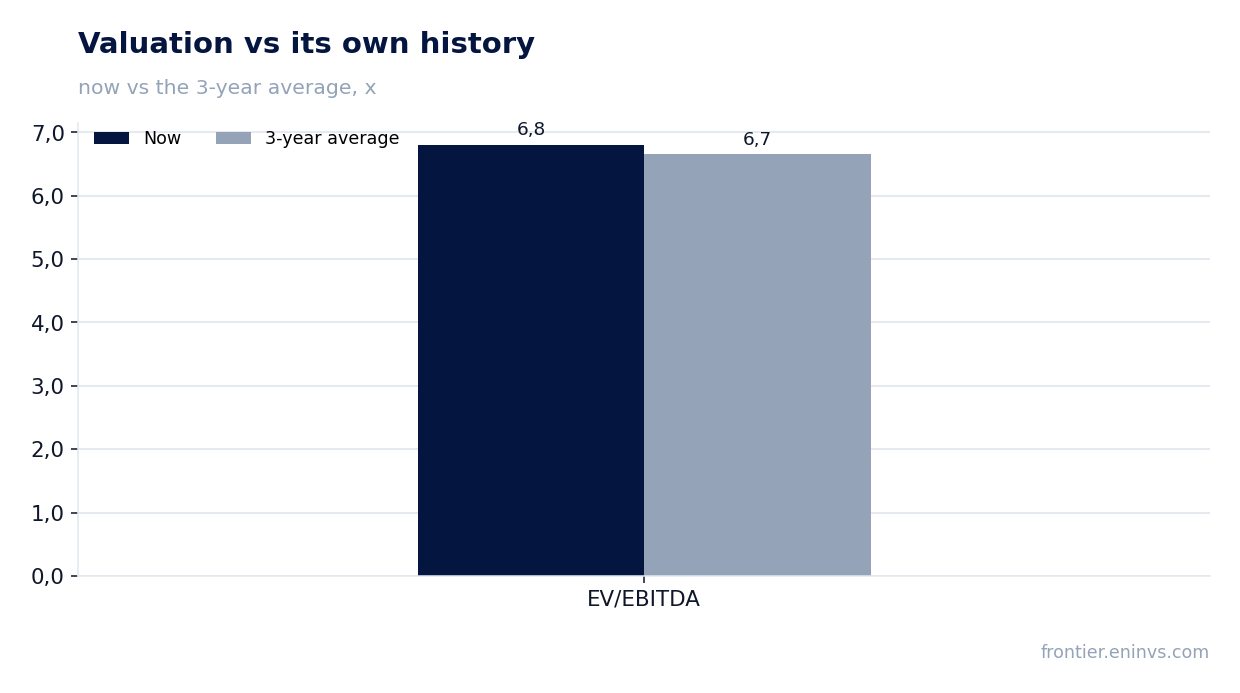
SK hynix is the single most impressive print: revenue +256.8% year over year, EBITDA +420.9%, in an industry whose median revenue growth was also +256.8%. Winbond Electronics added +184.7% revenue, and Samsung Electronics +130.0%. This is not a broad tech recovery — it is a memory-specific squeeze, and the market is paying for it: SK hynix trades at just 5.6x earnings despite that growth.
In gold, SOLIDCORE posted revenue +199.1% and net profit +432.9%, while Genesis Minerals grew revenue +89.4% and net profit +172.1%. The median gold miner still grew revenue +42.8%, so this is a sector-wide wave, not a one-off. Even the laggards in this group — Evolution Mining at +27.7% revenue — would be heroes in most other industries.
Gas processing and toll roads are the season's ugly underbelly
ADNOC Gas is the clearest warning sign: revenue -33.2%, EBITDA -42.0%, net profit -52.0% year over year. The pain is not isolated — Salik, the toll-road operator, saw revenue -12.0% and net profit -16.4%, while Air Arabia posted revenue -0.2% but net profit -74.9% as margins collapsed. Insurance was the weakest industry median at -11.8%, with Old Mutual revenue -32.7% and Momentum -57.0%. These are not cyclical dips; they are structural margin squeezes.
The plot twist: ASBN accelerated revenue growth while profit fell — a red flag, not a triumph
ASBN's revenue growth accelerated from +45.0% in the prior period to +45.2% year over year, but net profit fell -35.4% — worse than the prior period's -31.5% decline. That is the definition of growth without earnings: the bank is buying revenue at the expense of profitability. Contrast that with Capitec Bank, where revenue surged +94.8% and net profit still rose +19.2%. The market is rewarding the latter: Capitec trades at 31.2x earnings, ASBN at 9.8x.
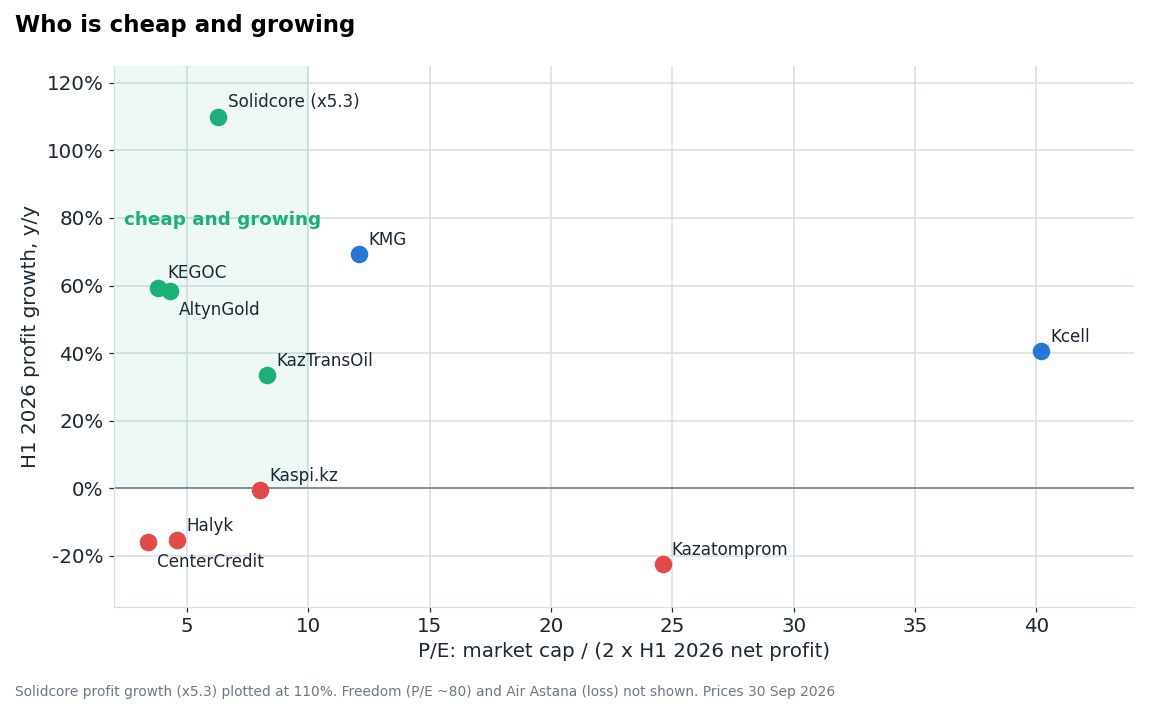
Cheap for the growth: Emaar Development at 3.7x earnings and SK hynix at 5.6x
Emaar Development grew revenue +32.1% and net profit +43.6% yet trades at just 3.7x earnings and 0.5x EV/EBITDA — absurdly cheap if the growth holds. SK hynix, growing revenue +256.8%, trades at 5.6x earnings and 6.3x EV/EBITDA. At the other extreme, Lynas Rare Earths grew revenue +80.2% but trades at 48.5x earnings and 35.7x EV/EBITDA — priced for perfection. Parkin, with revenue +13.6%, trades at 25.2x earnings and 21.0x EV/EBITDA. The market is paying up for stability and ignoring the cyclical growers.
Income hunters: KEGC yields 16.8% and HALYK 15.6%
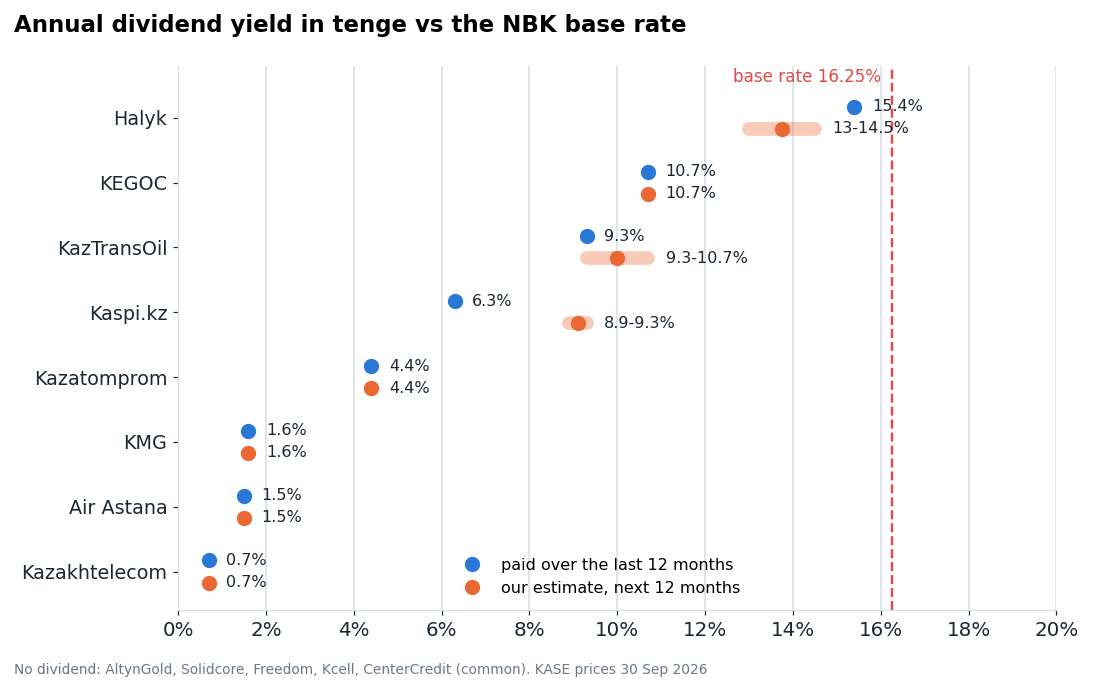
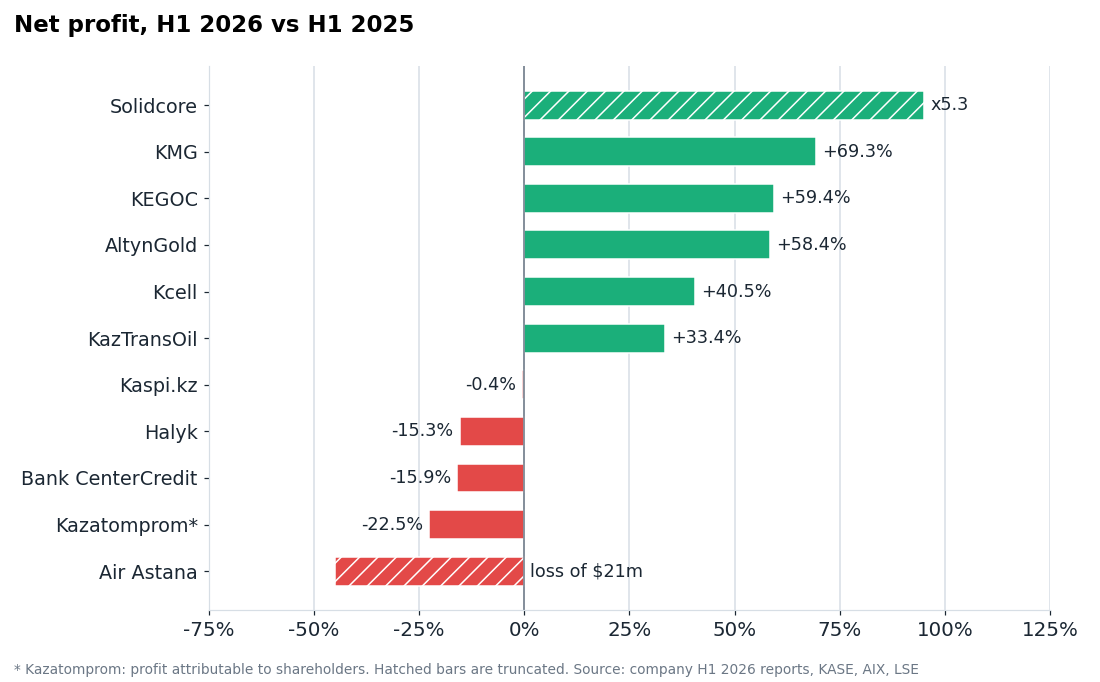
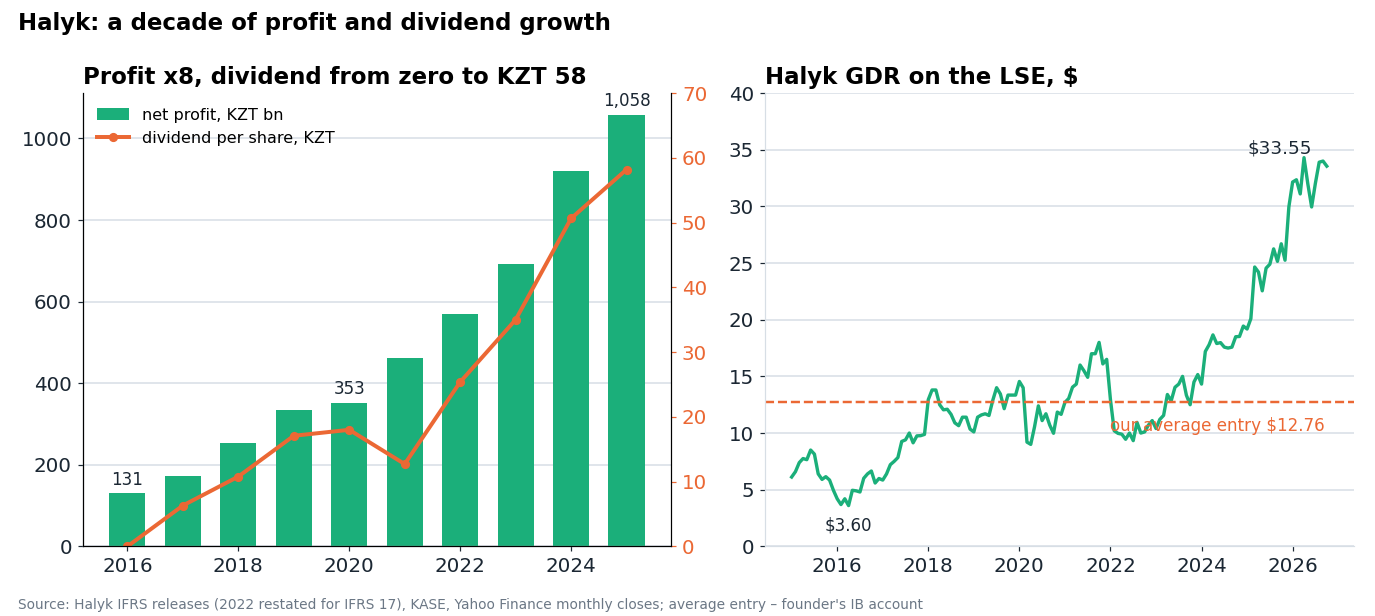
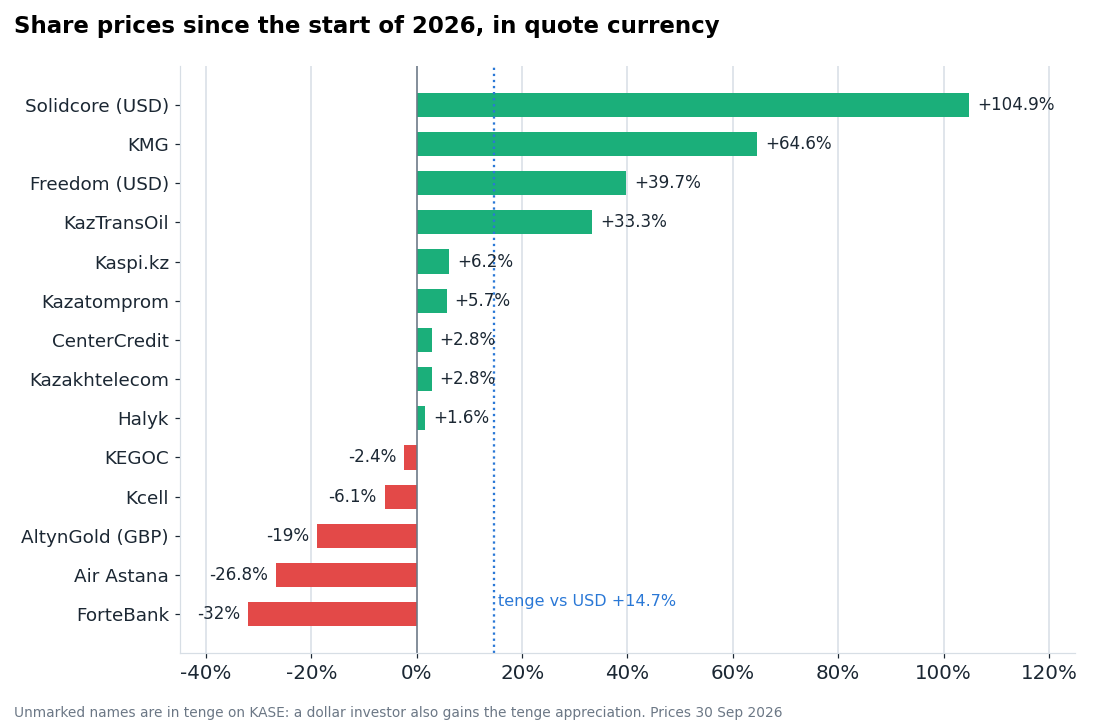
KEGC, the power-grid operator, offers a 16.8% dividend yield (DPS 243.15₸ on a 1,448.5₸ price) while growing revenue +31.1% and net profit +59.4% — a rare combination of high yield and high growth. HALYK yields 15.6% (DPS 58.19₸ on 374.0₸) despite a -15.3% net profit decline, which may test the payout. KZTO yields 9.0% (DPS 118.0₸ on 1,315.01₸) with revenue +10.3% and net profit +36.3%. For income investors, KEGC is the standout.
The long view belongs to the compounders: Northern Star Resources has a three-year revenue CAGR of +360.7%, and Genesis Minerals +182.9%. But the most interesting long-term story is SK hynix's +29.6% three-year CAGR — proof that the current memory boom is not a flash in the pan. Watch next quarter for whether ASBN's revenue growth finally translates into profit, and whether ADNOC Gas can stabilize its margins. The divergence will not last forever, but for now, the market is paying for growth and punishing stagnation.
Players: growth & yield (no absolute levels)
| Company | Industry | Revenue YoY | EBITDA YoY | Net profit YoY | P/E | Div yield |
|---|---|---|---|---|---|---|
| Samsung Electronics (Q2) | Semiconductors & electronics | +130.0% | n/m | n/m | 8.3x | — |
| SK hynix (Q2) | Memory semiconductors | +256.8% | +420.9% | n/m | 5.6x | — |
| Hyundai Motor (Q2) | Automobiles | +1.9% | -29.6% | -15.9% | 7.3x | — |
| Kia (Q2) | Automobiles | +12.6% | -7.3% | +2.6% | 5.9x | — |
| LG Electronics (Q2) | Consumer electronics | +14.9% | +35.9% | +10.5% | 24.5x | — |
| POSCO Holdings (Q2) | Steel | +9.7% | +17.5% | +328.3% | 15.5x | — |
| Hyundai Mobis (Q2) | Auto components | +2.4% | +12.4% | +13.5% | 7.9x | — |
| LG Chem (Q2) | Chemicals & batteries | +19.0% | +52.9% | +126.1% | n/m | — |
| S-Oil (Q2) | Oil refining | +40.9% | n/m | n/m | 10.1x | — |
| Hanwha Aerospace (Q2) | Defence & aerospace | +47.2% | +107.8% | +253.1% | 17.3x | — |
| KT Corporation (Q2) | Telecom | -10.1% | -20.3% | -36.0% | 8.6x | — |
| HD Hyundai Heavy Industries (Q2) | Shipbuilding | +52.7% | +194.4% | +289.8% | 12.7x | — |
| LG Display (Q2) | Displays | +0.4% | -17.4% | -146.7% | n/m | — |
| KMGZ (H1) | Oil and gas | +23.7% | +45.0% | +69.1% | 22.0x | 1.6% |