Banorte: profit holds flat as provisions and one-offs eat the upside
On August 25, Grupo Financiero Banorte released its first-quarter 2026 results. Net income came in at 15.46 billion pesos, just 1% above the first quarter of last year, while net interest income rose 10% to 39.48 billion pesos. Loan loss provisions jumped 36% year-on-year to 6.92 billion pesos, and one-off gains from asset sales supported profit. With a P/E LTM of 9.2 and a dividend yield of 8.9%, the stock looks attractive, but the sustainability of earnings raises questions.
Key takeaways
— Net interest income rose 10% year-on-year, but provisions for loan losses jumped 36% and consumed almost the entire gain
— Consumer lending growth of 11% year-on-year remains the main driver, but asset quality is deteriorating: the NPL ratio rose to 1.43%
— The sale of a stake in Trans Union de México and other one-off gains added about 20 basis points to the 12-month ROE, distorting the picture of sustainable profit
— The bank's net interest income rose 10% year-on-year, but quarterly dynamics show margin compression to 6.5% from 6.6% in the previous quarter
— A dividend yield of 8.9% with a 35% payout ratio looks sustainable, but earnings per share fell 3% quarter-on-quarter
— The P/E LTM of 9.2 is below the historical average, but ROE of 24.2% is supported by one-off factors and may normalise
Attractiveness
Key figures, MXN bn
| Metric | — | Q2 2026 | Change |
|---|---|---|---|
| Net profit | — | 15.6 | — |
Net interest income rose 10% year-on-year, but provisions for loan losses jumped 36% and consumed almost the entire gain
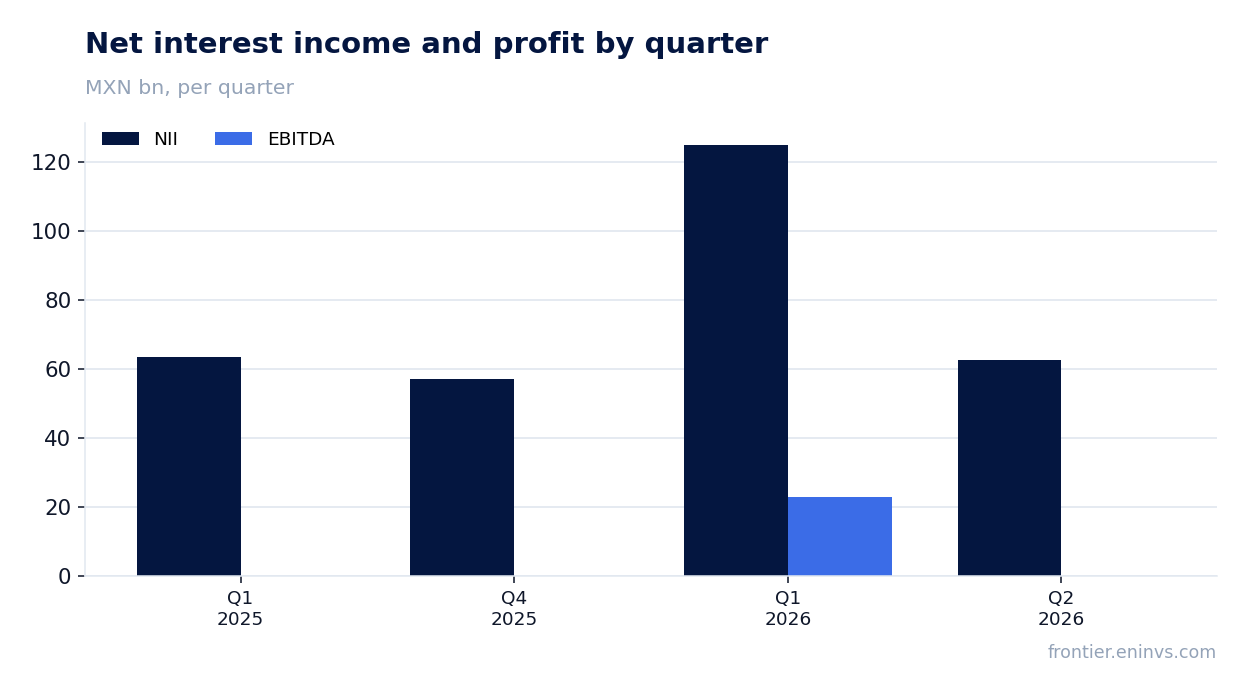
The group's net interest income in the first quarter of 2026 reached 39.48 billion pesos, up 10% year-on-year and 1% quarter-on-quarter. Growth was supported by lower funding costs and an improved loan mix, as well as positive revaluation of inflation-indexed instruments in the annuity business. The group's net interest margin reached 6.5%, expanding 34 basis points year-on-year but declining 4 basis points quarter-on-quarter.
However, provisions for loan losses surged 60% quarter-on-quarter and 36% year-on-year to 6.92 billion pesos. The main drivers were the integration of Tarjetas del Futuro's portfolio in December 2025, the periodic recalibration of internal risk models, and additional provisioning for an isolated case in the commercial portfolio classified as Stage 3 in the third quarter of 2025. The cost of risk jumped to 2.2% from 1.4% in the fourth quarter and 1.7% a year earlier.
As a result, net interest income adjusted for credit risk fell 6% quarter-on-quarter and rose only 6% year-on-year to 32.56 billion pesos. This means that the growth in interest income was almost entirely absorbed by provisions, and the sustainability of profit depends on the bank's ability to keep the cost of risk under control.
Consumer lending growth of 11% year-on-year remains the main driver, but asset quality is deteriorating: the NPL ratio rose to 1.43%
The consumer portfolio grew 11% year-on-year to 542.2 billion pesos, supported by the hyper-personalisation strategy and process optimisation. Auto loans added 30% year-on-year, credit cards 14%, payroll loans 12%, and mortgages 6%. The commercial portfolio grew 6%, corporate 2%, while government loans contracted 5% due to prepayments.
However, the non-performing loan (NPL) ratio rose to 1.43%, up 5 basis points quarter-on-quarter and 51 basis points year-on-year. This reflects an isolated case in the commercial portfolio, growth in consumer lending, and recent changes to the write-off policy for mortgages. The coverage ratio fell to 139.8% from 187.9% a year earlier, indicating a reduced buffer.
Consumer lending growth remains the key profit driver, but deteriorating asset quality warrants close attention. If the cost of risk stays at 2.2%, it could limit profit growth in the coming quarters.
The sale of a stake in Trans Union de México and other one-off gains added about 20 basis points to the 12-month ROE, distorting the picture of sustainable profit
The group's net income in the first quarter of 2026 was 15.46 billion pesos, up 1% year-on-year but down 3% quarter-on-quarter. The 12-month ROE was 22.9%, and the quarterly ROE was 23.9%. However, the report explicitly states that the sale of a stake in Trans Union de México positively contributed about 20 basis points to the 12-month ROE.
In addition, non-interest income fell 9% year-on-year to 4.0 billion pesos due to normalisation of trading income and a weaker technical result in insurance. This was partially offset by a solid base of banking fees and gains from asset sales. One-off gains mask the weakness in operating dynamics.
Excluding one-off factors, profit would likely have been lower, casting doubt on the sustainability of the current ROE level. To assess earnings sustainability, it is important to monitor the dynamics of fee income and the technical result in the coming quarters.
The bank's net interest income rose 10% year-on-year, but quarterly dynamics show margin compression to 6.5% from 6.6% in the previous quarter
The group's net interest margin declined to 6.5% in the first quarter of 2026 from 6.6% in the fourth quarter, but remained above 6.2% a year earlier. The bank's margin was 6.6%, down 13 basis points quarter-on-quarter due to higher earning assets, but up 25 basis points year-on-year thanks to funding cost optimisation and a focus on consumer lending.
The 25 basis point cut in the Bank of Mexico's reference rate to 6.75% will be reflected in the margin starting next quarter. The bank has immunised its balance sheet against rate cuts, which supported the margin in previous periods, but further rate cuts could weigh on it.
The bank's net interest income rose 10% year-on-year, but the quarterly margin decline suggests that peak profitability may have passed. Margin sustainability will depend on the bank's ability to offset rate cuts with volume growth and improved portfolio mix.
A dividend yield of 8.9% with a 35% payout ratio looks sustainable, but earnings per share fell 3% quarter-on-quarter
The dividend yield over the last 12 months is 8.9%, significantly above the Bank of Mexico's reference rate of 6.75%. The payout ratio for the fourth quarter of 2025 was 35%, with a dividend per share of 6.99 pesos. No dividends were paid in the first quarter of 2026, consistent with seasonality.
Earnings per share in the first quarter of 2026 were 5.49 pesos, down 3% quarter-on-quarter and up 1% year-on-year. Basic earnings per share were 5.48 pesos. The quarter-on-quarter decline reflects pressure on profit from higher provisions and one-off factors.
Dividend sustainability depends on the bank's ability to generate profit. If profit remains under pressure, the payout ratio could rise, limiting room for dividend growth. Nevertheless, the current yield looks attractive for income-oriented investors.
The P/E LTM of 9.2 is below the historical average, but ROE of 24.2% is supported by one-off factors and may normalise
The P/E LTM is 9.2, which is below the historical average for the bank, given the current ROE of 24.2%. Market capitalisation is 542.2 billion pesos. According to the portal's model, based on comparing ROE and P/B, the upside to fair value is estimated at +11%.
However, ROE is supported by one-off gains, such as the sale of a stake in Trans Union de México, which added about 20 basis points to the 12-month ROE. Excluding one-off factors, ROE could be lower, making the current valuation less attractive.
In addition, margin pressure from rate cuts and rising cost of risk could limit future profit. If profit normalises, the P/E multiple could rise, reducing the upside. Nevertheless, the current valuation looks attractive against the backdrop of high ROE and dividend yield.
Valuation on the latest reported figures
| Metric | Value |
|---|---|
| Market cap | 542 bn MXN |
| P/E (LTM) | 9.2 |
| P/B | 2.18 |
| ROE | 24.2% |
| Dividend yield (12m) | 8.9% |
Bottom line
The report's strengths include 10% year-on-year growth in net interest income, a resilient consumer portfolio, and a high dividend yield of 8.9%. However, net income rose only 1% year-on-year, as provisions for loan losses jumped 36% and almost entirely absorbed revenue growth. One-off gains from asset sales supported ROE, but their contribution is not sustainable. With a P/E of 9.2 and a portal model upside of +11%, the stock looks attractive, but confirmation of earnings sustainability requires stabilisation in the cost of risk and margin in the coming quarters.
Open the company's financial profile BANORTE →
See also: market overview · valuation map · stock screeners