GDP growth 2026 (proj.)1.6%Inflation YoY (proj.)3.9%FX vs USD (3y avg p.a.)+0.9%Macro: IMF World Economic Outlook, April 2026 (Annex tables 1.1.2–1.1.4)
Our recommended portfolios
Performance & current holdings of our strategies for this market — why it makes sense to join.
Commodity-Upsidebacktest CAGR +23% · excess +13%Paper-track · 15 Jun 2026
CAGR +23% · vs index +13% · Sharpe 0.96 · maxDD -37%
This season was defined by a brutal divergence: the top industry median revenue growth (+90.2%) was more than 15 times the bottom (-6.0%). Beverages and metals soared while consumer health and packaged foods shrank. The spread between the best and worst performer is a chasm, not a gap — and it separates companies with pricing power and volume from those fighting for every peso.
Revenue growth by industry (median YoY)
median revenue YoY, %
Beverages and metals delivered the quarter's biggest upside surprises
AC posted a stunning +90.2% revenue jump, with EBITDA up +53.1% and net profit +59.9% — the strongest top-line growth in the dataset by a wide margin. GMEXICO wasn't far behind: revenue +35.0%, EBITDA +50.6%, and net profit +78.5%, showing that metals & mining is running hot on both volume and price.
FEMSA also impressed with revenue +9.3%, EBITDA +21.5%, and net profit more than doubling (+104.2%), proving that beverage & retail can deliver explosive bottom-line growth even at a more modest top line. CEMEX added a solid +12.2% revenue and +23.9% EBITDA, rounding out the winners' circle.
Consumer health and restaurants served up the ugliest numbers
LAB led the laggards with revenue -6.0% and EBITDA -14.2%, though net profit still eked out +5.5% — a rare case of margin compression masked by below-the-line gains. ALSEA saw revenue slip -1.8% and net profit collapse -52.0%, a clear warning sign for discretionary dining. Banks were mixed: BBAJIO revenue -2.9%, INBURSA revenue -1.0% but net profit -29.0%, showing that even mild top-line pressure can crush profitability.
The real plot twist: FEMSA's profit explosion and ASUR's revenue mirage
FEMSA's net profit accelerated from a prior-period decline of -15.5% to a gain of +104.2% — a massive swing that few would have predicted. Meanwhile, ASUR's revenue plunged -60.3%, yet EBITDA rose +27.7% and net profit +4.4% — a bizarre decoupling likely from accounting or one-off effects, but a genuine head-scratcher that demands scrutiny.
Cheap for growth: GMEXICO and CEMEX look like bargains; CARSO and FEMSA are priced for perfection
GMEXICO trades at 18.9x earnings while growing net profit +78.5% — a PEG ratio well below 1. CEMEX is even cheaper on EV/EBITDA at 5.7x despite +12.2% revenue growth and +23.9% EBITDA growth. In contrast, CARSO sits at a lofty 46.6x P/E with only +3.9% revenue growth, and FEMSA at 42.4x P/E after its profit surge — both look priced for perfection. LAB at 9.3x P/E is cheap but declining, a value trap if margins don't stabilize.
Income hunters: BBAJIO and INBURSA offer the richest yields among banks
BBAJIO leads with a P/E of 7.7x and a 3-year revenue CAGR of +10.3%, suggesting a solid dividend base. INBURSA follows at 9.2x P/E with a +16.0% three-year revenue CAGR, though its -29.0% net profit drop this quarter is a concern. BANORTE at 10.1x P/E rounds out the trio, but without growth data its yield appeal is less certain. For income-focused investors, these banks offer the highest implied yields in the dataset.
Looking longer term, INBURSA's +16.0% three-year revenue CAGR and GAP's +14.8% stand out as the most consistent compounders, though GAP's current +3.7% revenue growth is a slowdown from its historical pace. Watch for whether FEMSA's profit surge is sustainable and if ASUR's revenue collapse reverses. The next quarter will reveal whether the beverage and metals rally has legs or if consumer weakness spreads further.
On October 22 ASUR reported third-quarter 2026 results. Revenue came in at MXN 10,420.5 million, down 60.3% year on year, while EBITDA reached MXN 4,719.3 million (+27.7%) and net profit MXN 2,307.9 million (+4.4%). The revenue decline reflects an exceptionally high construction-services base a year earlier, while profit growth was driven by the consolidation of Brazilian and U.S. assets and a one-off gain on FX forwards. At an EV/EBITDA of 7.9 versus its own three-year average of 8.9 and a dividend yield of 5.3%, the share looks rather attractive, though weak Mexican traffic and leverage call for caution.
Key takeaways
— Revenue fell 60.3% on a high construction-services base; excluding construction, the decline was only 12.6%
— EBITDA rose 27.7% on consolidation of Brazilian and U.S. assets, but the margin compressed to 45.3%
— Net profit was supported by a one-off MXN 719.2 million gain on FX forwards
— Debt rose to MXN 69,970.0 million, with net debt to LTM EBITDA at 2.6x
— The 5.3% dividend yield is backed by announced extraordinary payouts of MXN 10.00 per share
— EV/EBITDA of 7.9 is below its own three-year average of 8.9, pointing to undervaluation
Attractiveness
Key figures, MXN bn
Metric
Q3 2025
Q3 2026
Change
Revenue
26.3
10.4
-60.3%
EBITDA
3.70
4.72
+27.7%
Operating profit
3.69
3.89
+5.3%
Net profit
2.21
2.31
+4.4%
Operating cash flow
4.52
—
—
Capex
1.87
—
—
EBITDA margin
14.1%
45.3%
+31.2 pp
Net margin
8.4%
22.1%
+13.7 pp
Revenue fell 60.3% on a high construction-services base; excluding construction, the decline was only 12.6%
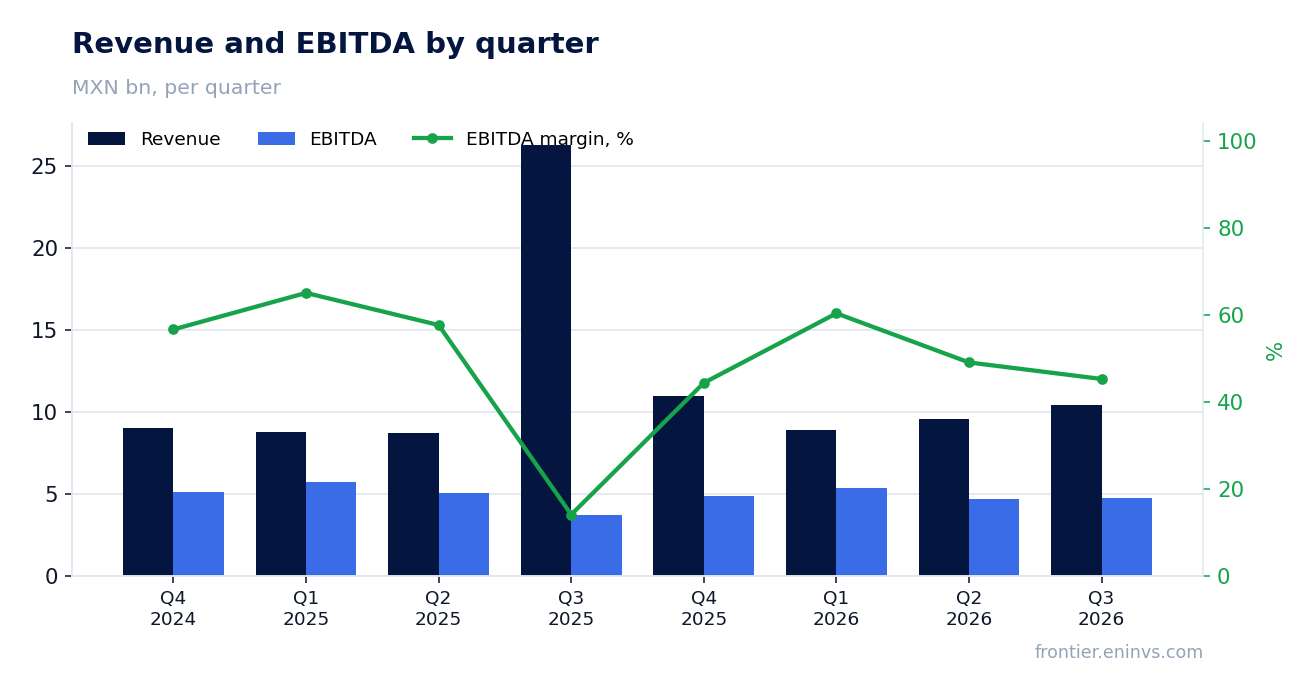
Third-quarter 2026 revenue came in at MXN 10,420.5 million, down 60.3% from the third quarter of 2025. The sharp decline reflects an exceptionally high base a year earlier, when construction-services revenue was unusually large, while in the current quarter it amounted to MXN 2,591.1 million. Excluding construction services, revenue fell 12.6% to MXN 7,829.4 million.
The main drag came from Mexico, where revenue excluding construction dropped 6.8% on a 4.6% decline in passenger traffic. International traffic in Mexico fell 11.8%, partly offset by a 1.6% increase in domestic traffic. Puerto Rico revenue declined 4.1%, Colombia grew 22.0%, and the newly acquired assets in Brazil and the U.S. added MXN 841.2 million and MXN 456.4 million respectively.
The deceleration from 9.9% growth in the second quarter of 2026 reflects both the base effect and a genuine weakening in the Mexican business. The consolidation of CPC Aeroportos from September 1, 2026, contributed MXN 841.2 million in revenue for one month, partly offsetting the organic decline.
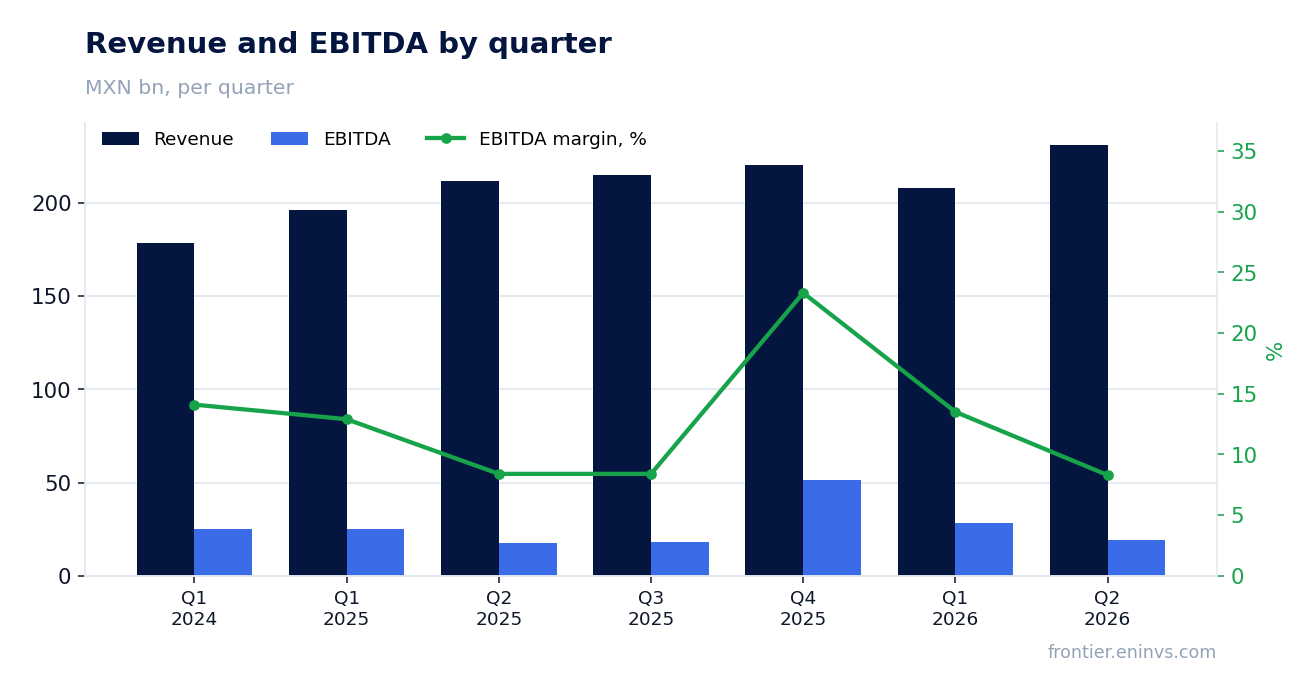
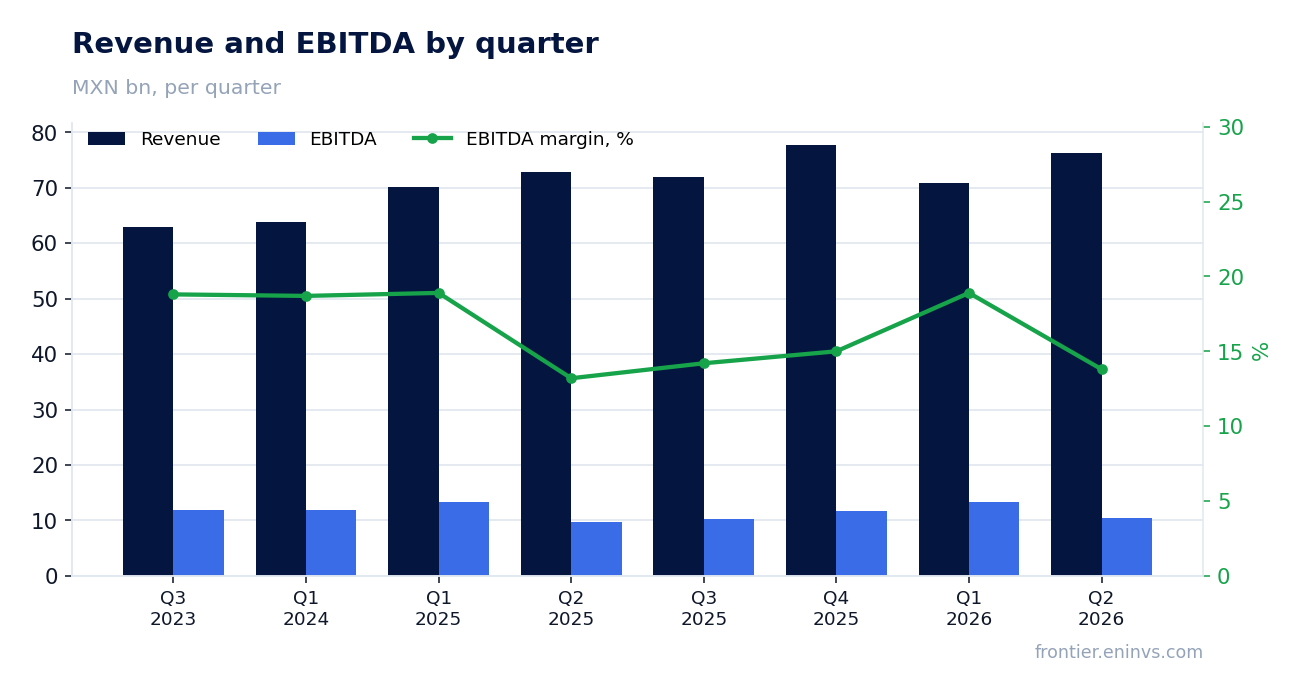
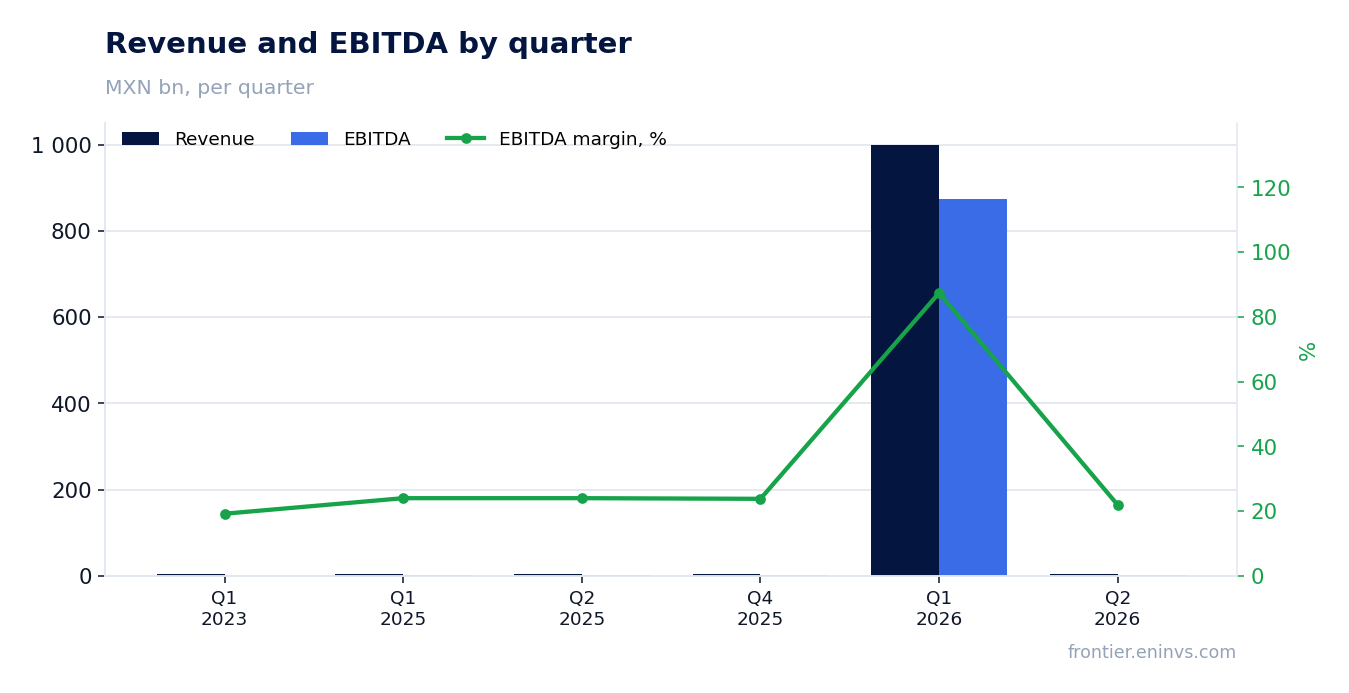
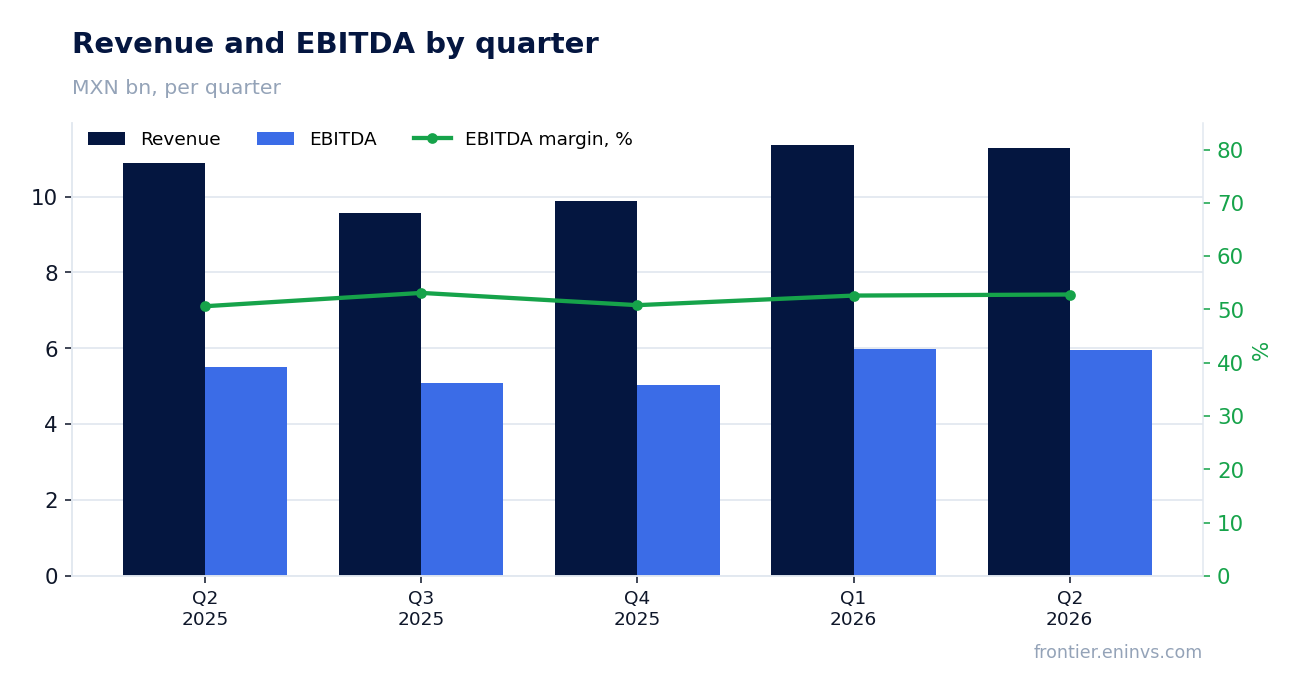
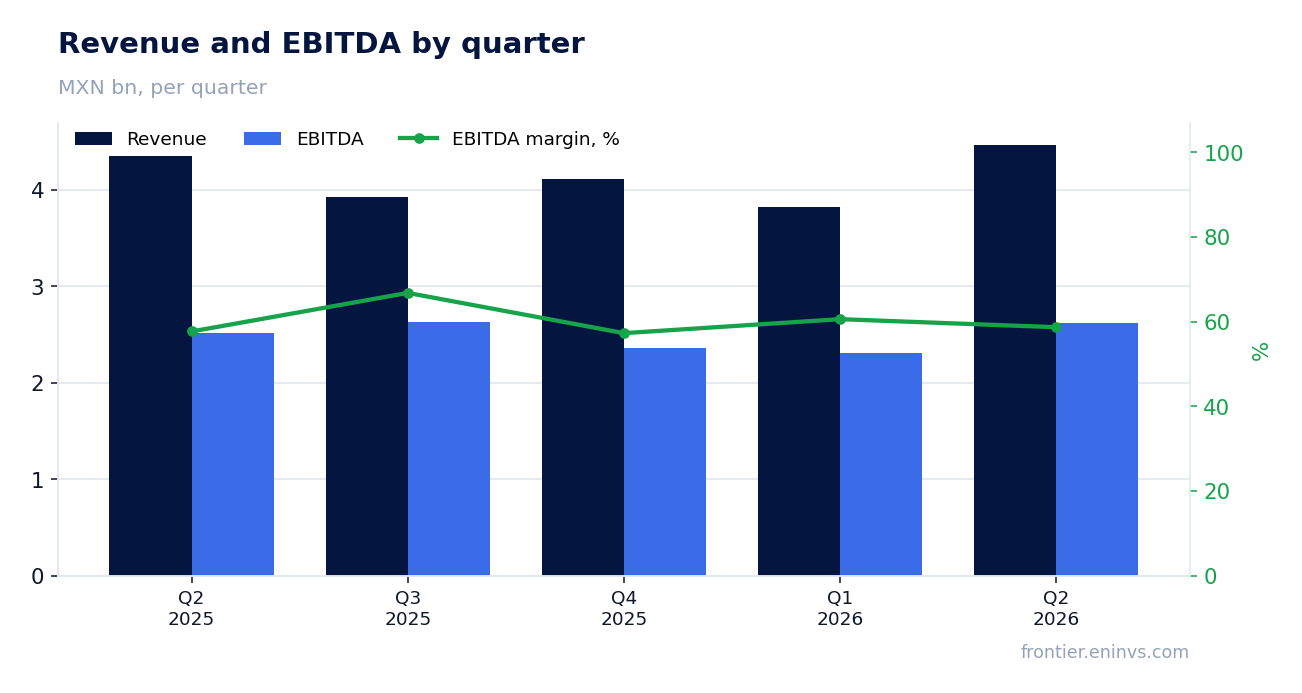
Revenue and EBITDA by quarter
EBITDA rose 27.7% on consolidation of Brazilian and U.S. assets, but the margin compressed to 45.3%
EBITDA in the third quarter of 2026 rose 27.7% to MXN 4,719.3 million. However, the EBITDA margin declined to 45.3% from 52.9% a year earlier. The adjusted EBITDA margin, excluding the IFRIC 12 effect, was 60.3% versus 66.7% in the third quarter of 2025.
EBITDA growth was driven by new assets: Brazil & Others contributed MXN 313.2 million, U.S. operations MXN 49.0 million. Puerto Rico increased EBITDA by 7.1% to MXN 602.4 million, Colombia by 1.6% to MXN 590.0 million. These gains were partly offset by a 9.5% decline in Mexico EBITDA to MXN 3,164.7 million.
The margin compression reflects a shift in revenue mix: the share of low-margin construction services increased, and the consolidation of Brazilian assets with lower profitability also weighed. In addition, operating expenses excluding construction rose 20.9%, outpacing the 12.6% growth in revenue excluding construction.
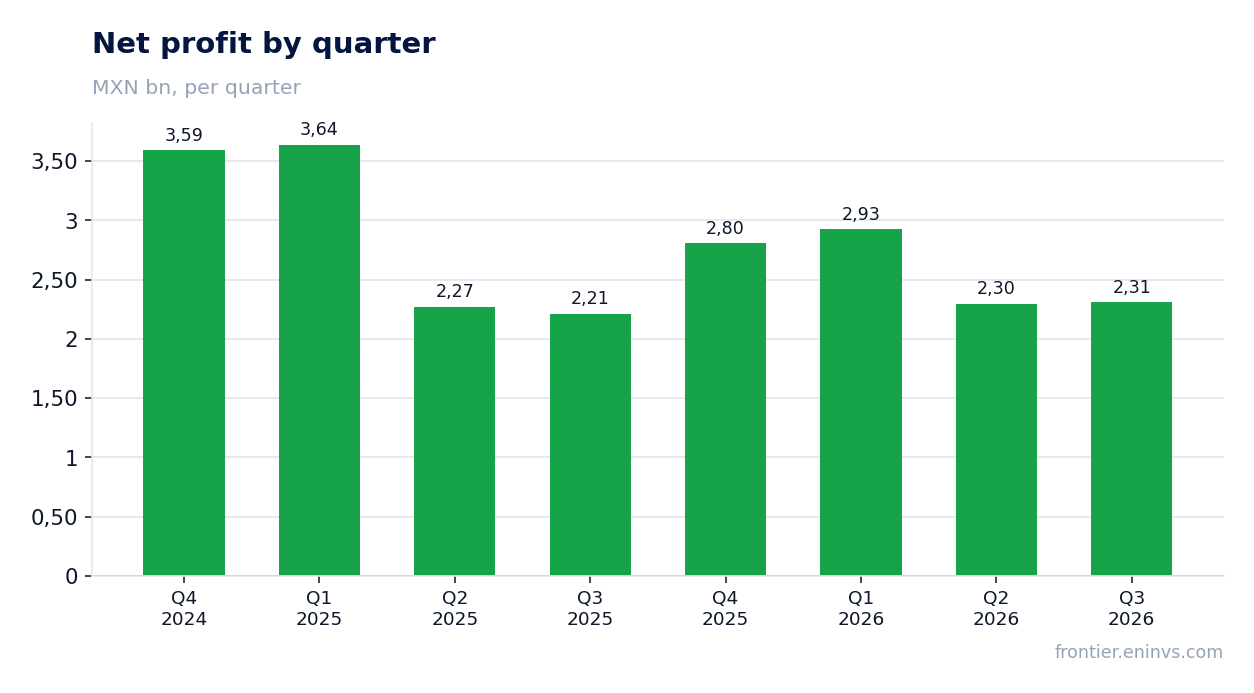
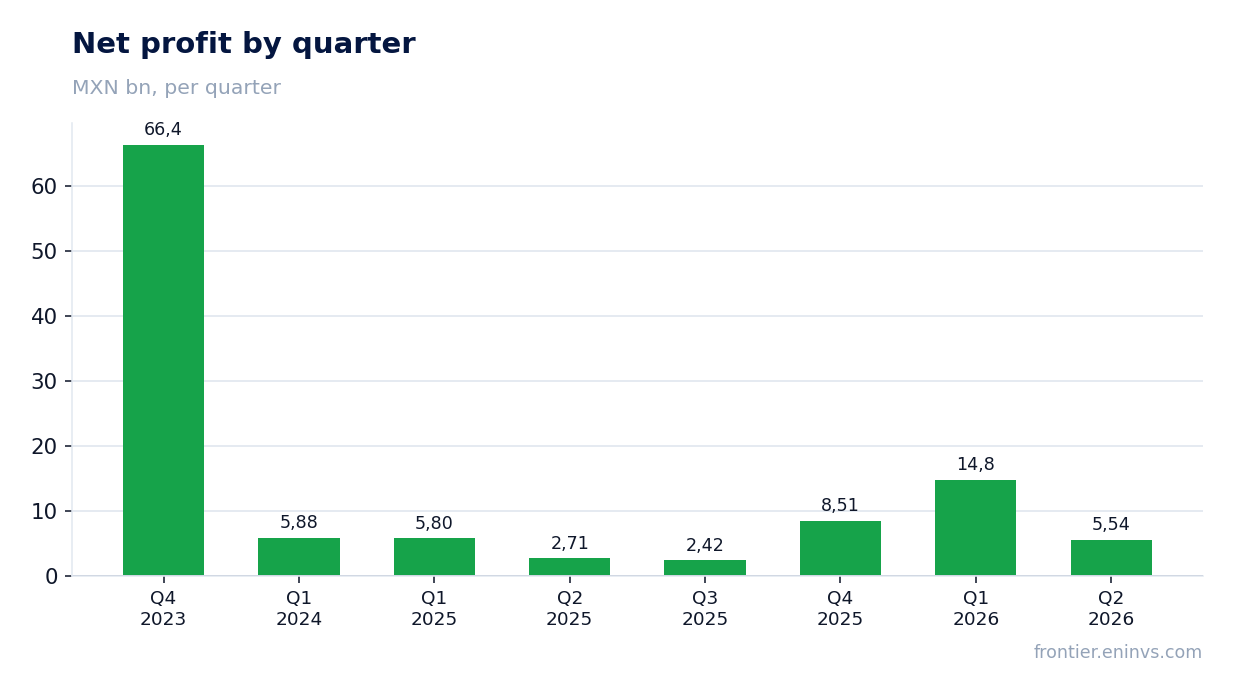
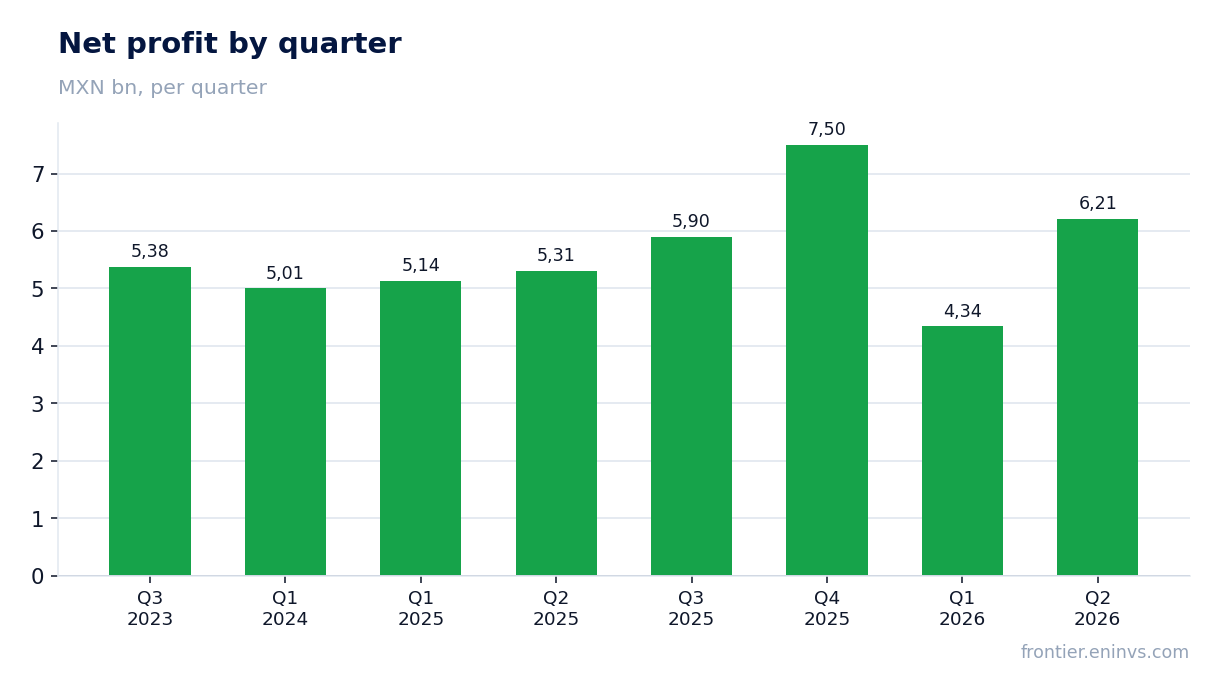
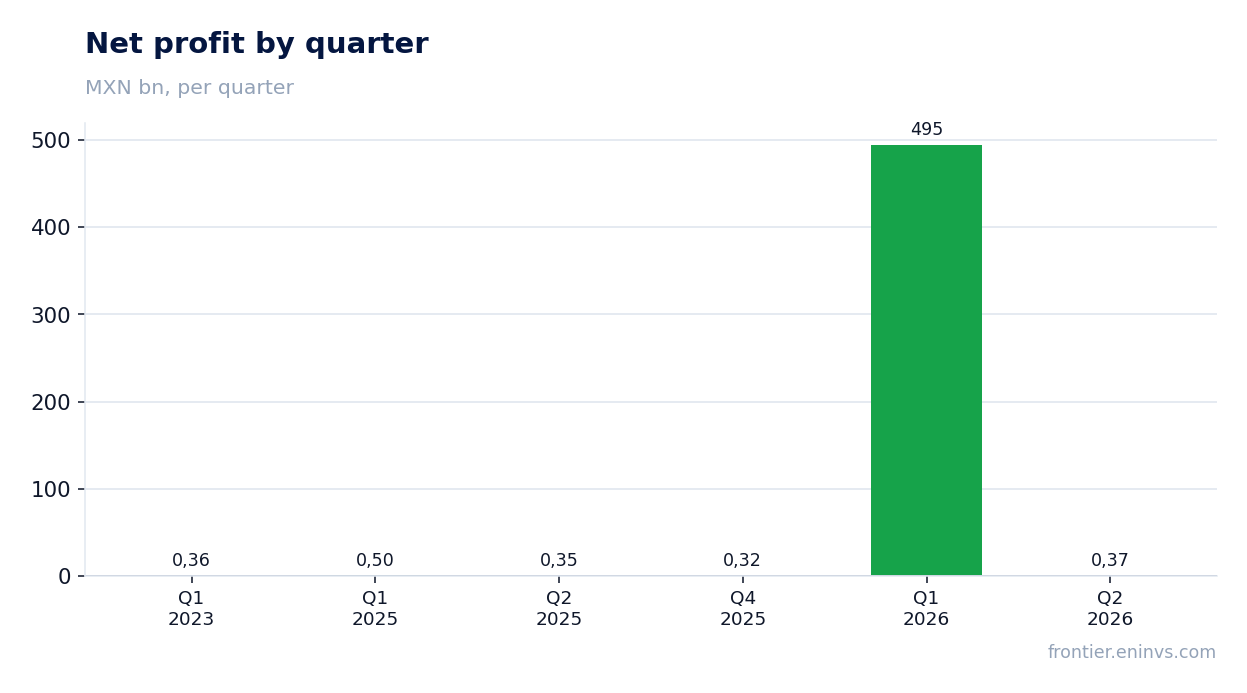
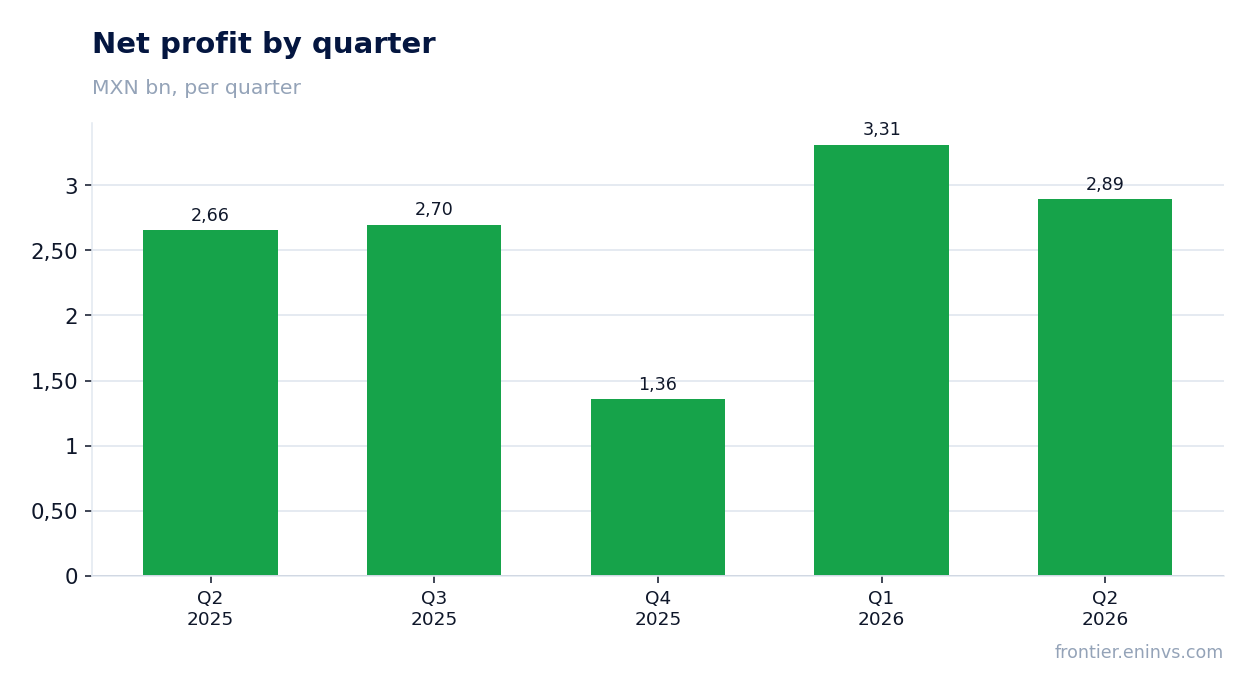
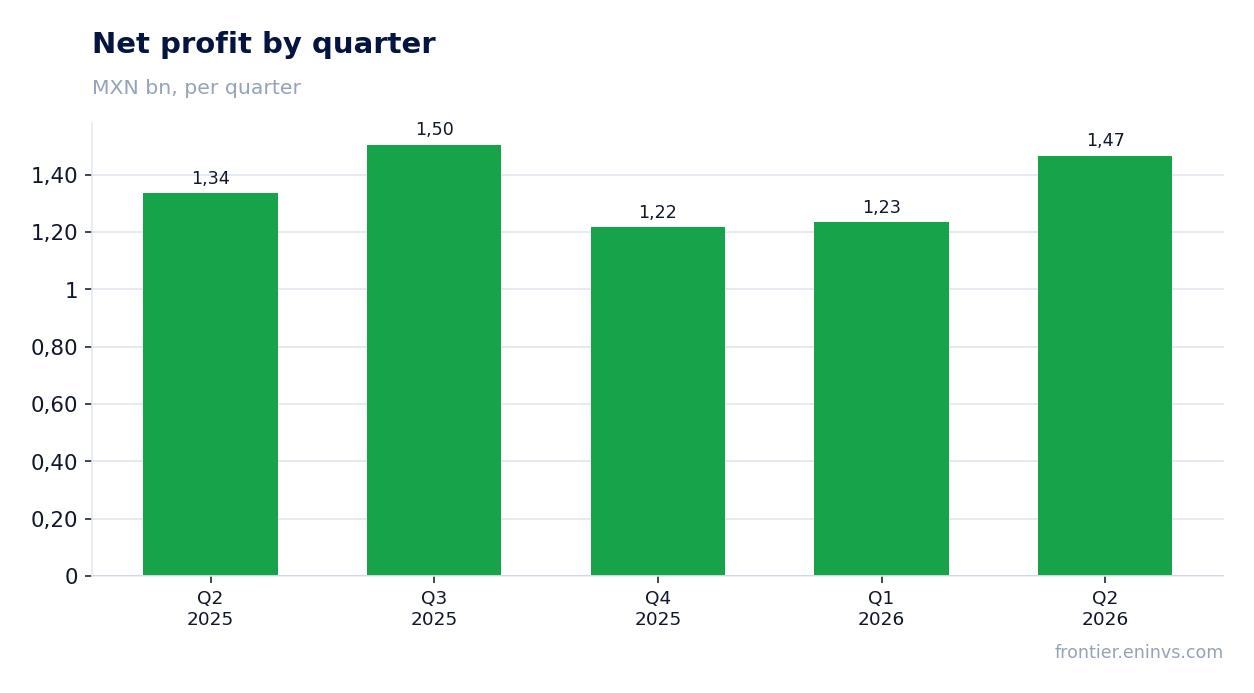
Net profit by quarter
Net profit was supported by a one-off MXN 719.2 million gain on FX forwards
Net profit in the third quarter of 2026 was MXN 2,307.9 million, up 4.4% year on year. However, this growth would not have been possible without a one-off gain of MXN 719.2 million on three FX forward contracts entered into for hedging purposes. Excluding this gain, profit would have declined.
Interest expense rose 95.6% to MXN 871.7 million due to two loans raised in Mexico in December 2025 and August 2026, as well as lease liabilities in the U.S. and debt from Brazilian assets. Interest income fell 32.6% to MXN 237.3 million. Foreign exchange losses increased 112.1% to MXN 803.5 million.
Operating profit rose 5.3% to MXN 3,889.8 million, but the operating margin declined to 37.3% from 42.2%. The adjusted operating margin was 49.7% versus 53.1% a year earlier. The margin decline is explained by the change in the concession amortization method in Colombia introduced in the third quarter of 2025.
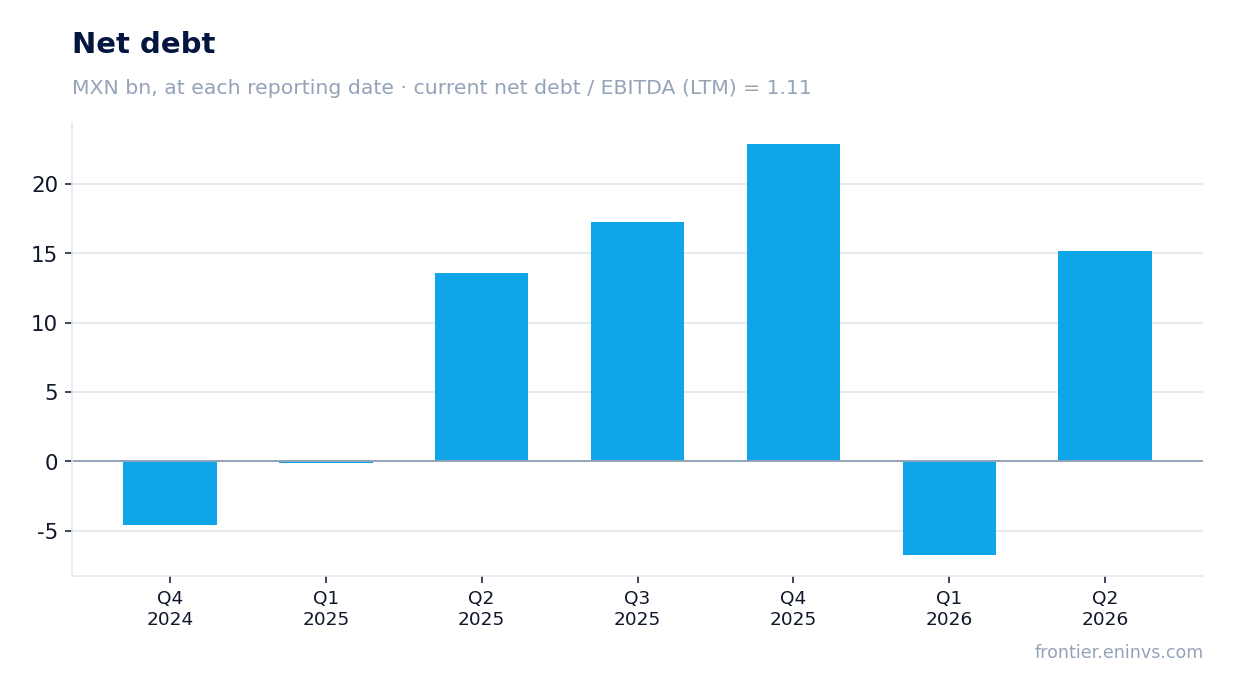
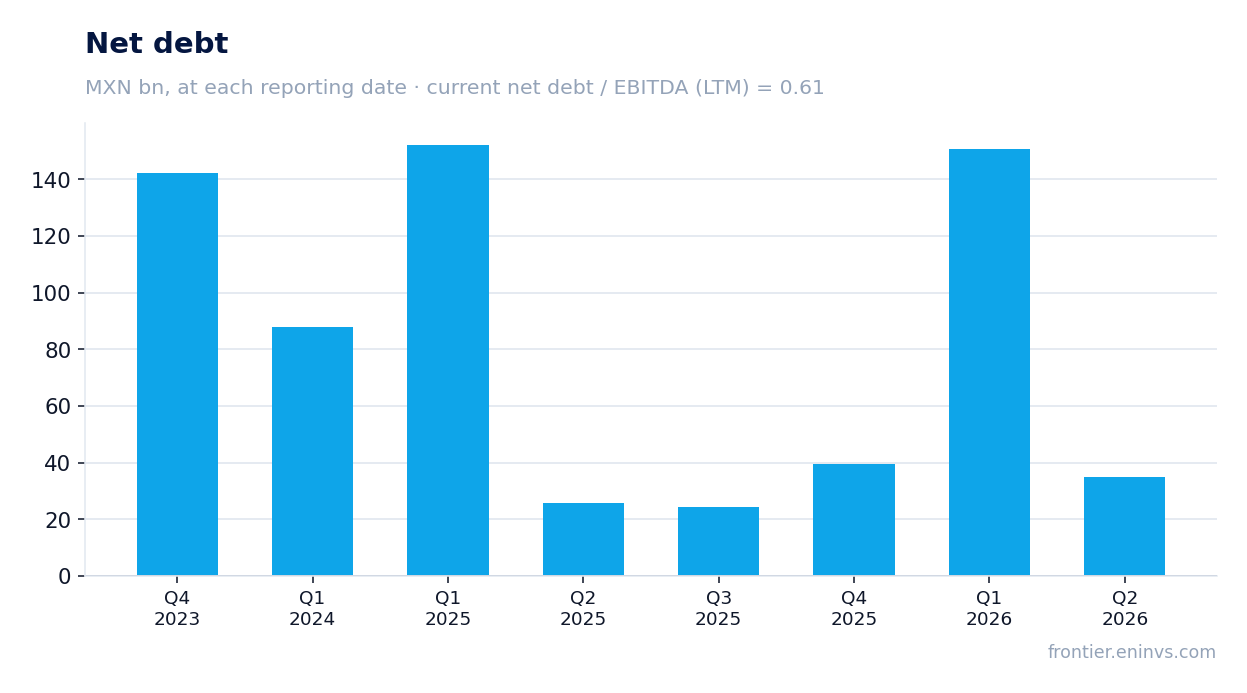
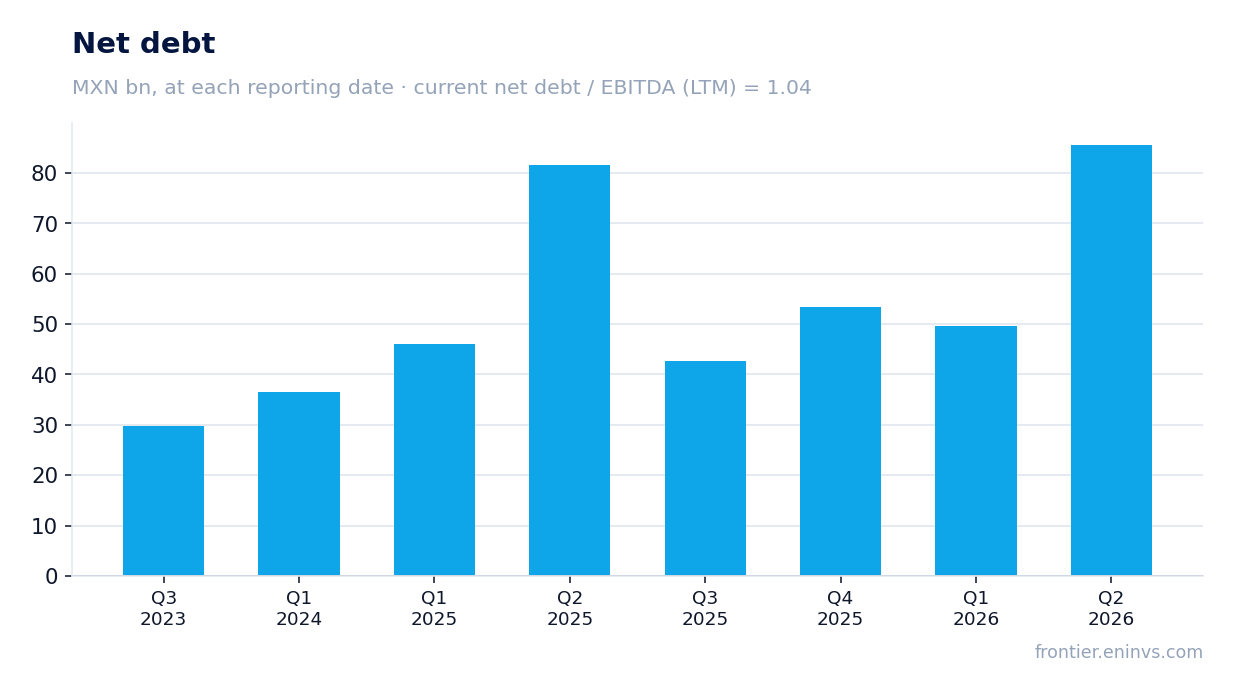
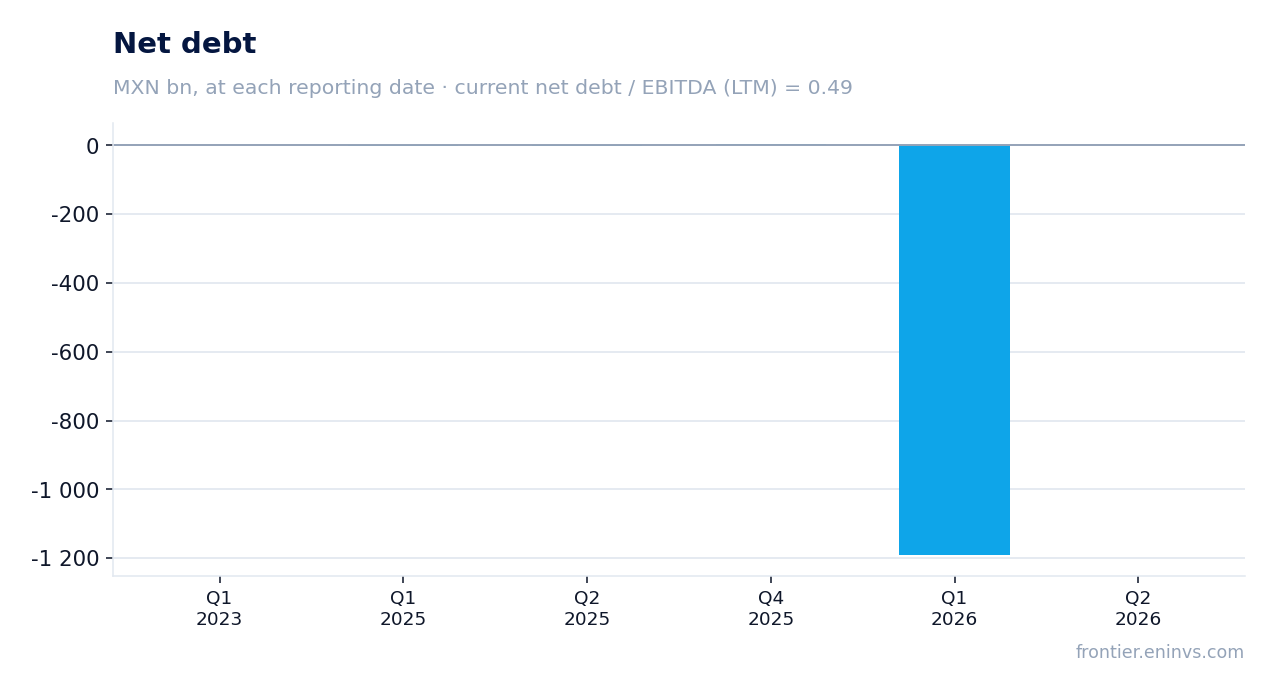
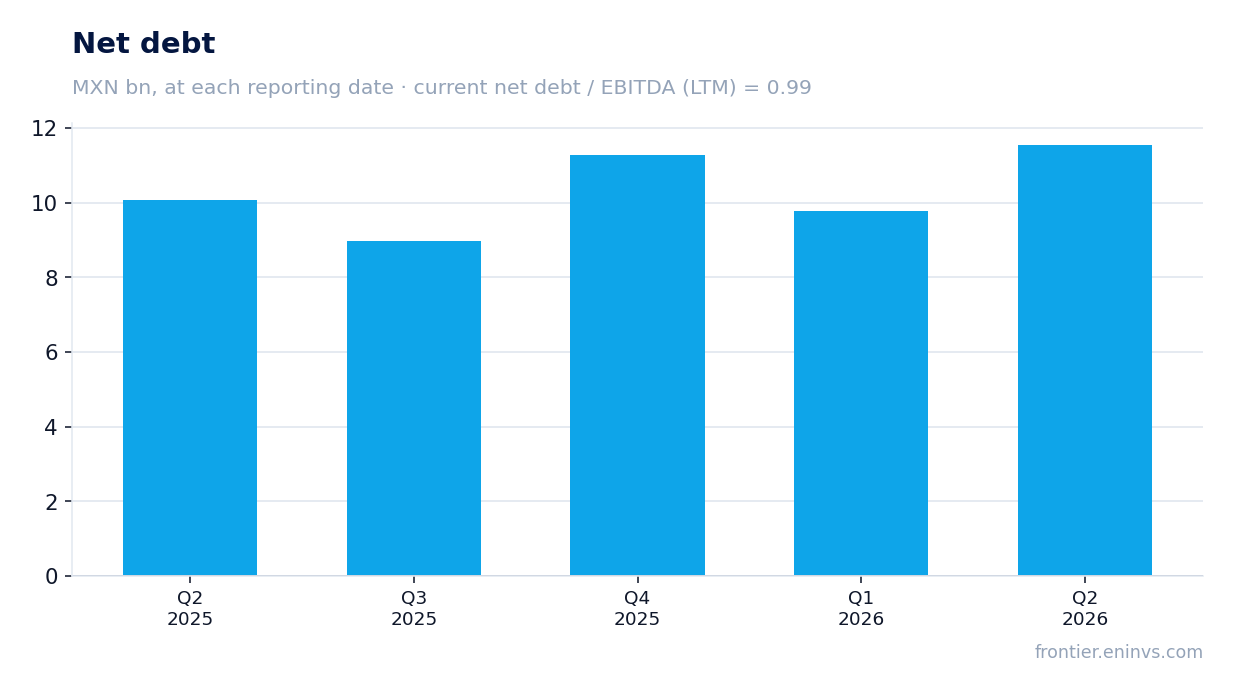
Net debt at reporting dates
Debt rose to MXN 69,970.0 million, with net debt to LTM EBITDA at 2.6x
Total debt at the end of the third quarter of 2026 was MXN 69,969.9 million, up 154.6% from MXN 27,486.6 million at the end of 2025. The increase was driven by the addition of MXN 21,009.2 million in debt from Brazilian assets and a MXN 22,225.1 million bridge loan raised in Mexico on August 14, 2026. Net debt reached MXN 49,878.1 million.
The net debt to LTM EBITDA ratio stands at 2.6x. For comparison, at the end of the third quarter of 2025 this ratio was 0.2x. The interest coverage ratio declined to 5.2x from 12.8x. Cash and cash equivalents totaled MXN 20,091.8 million.
On October 8, 2026, ASUR placed senior notes for USD 900 million at 6.711% maturing in 2031 and another USD 900 million at 7.491% maturing in 2036. The proceeds were used to fully repay the bridge loans related to the acquisitions of ASUR US Airports and CPC Aeroportos, as well as to partially prepay the BBVA Mexico loan.
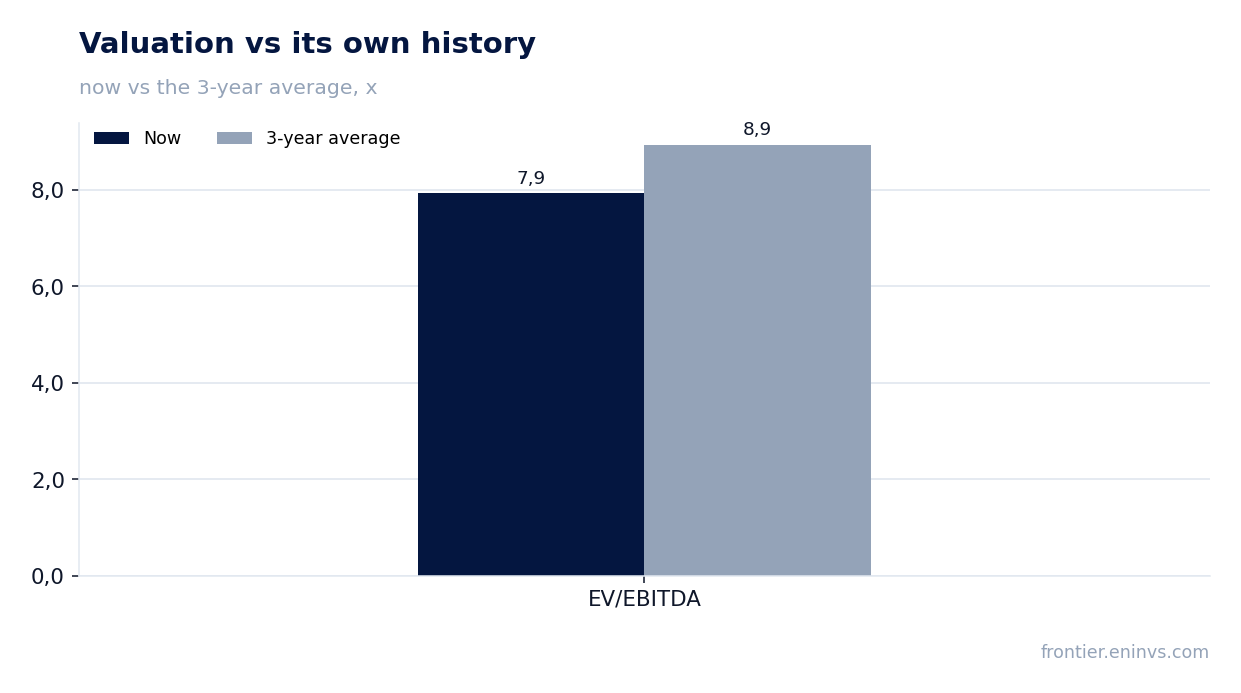
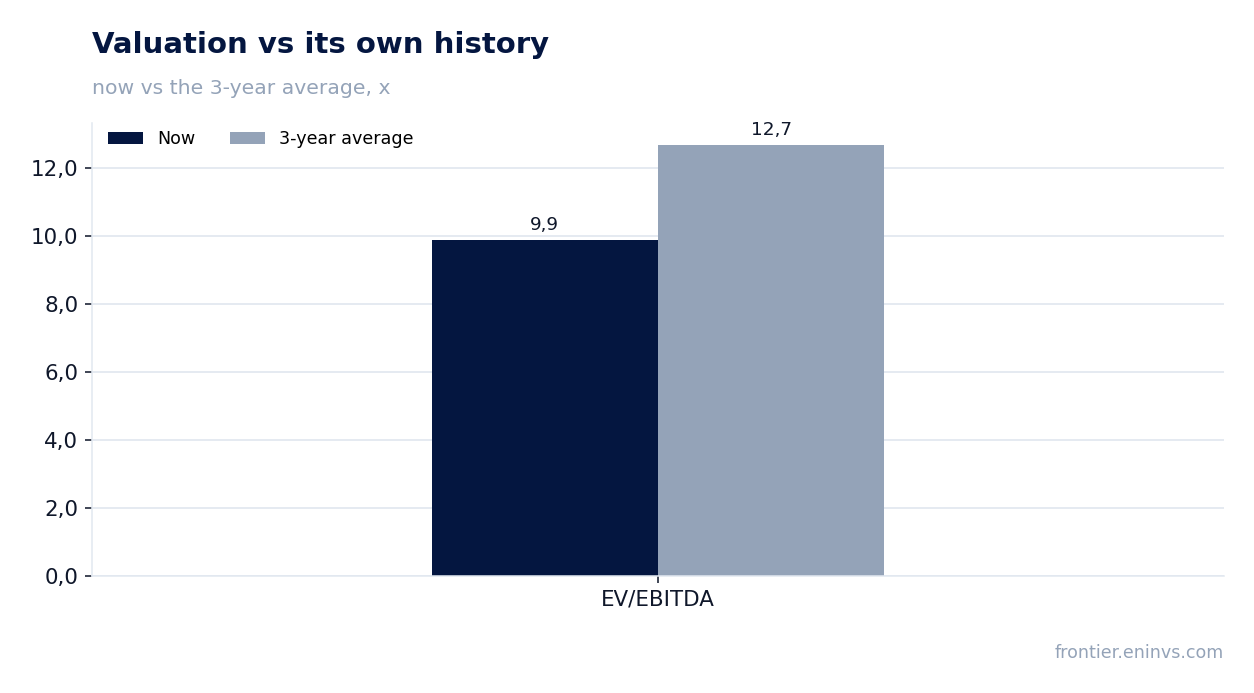
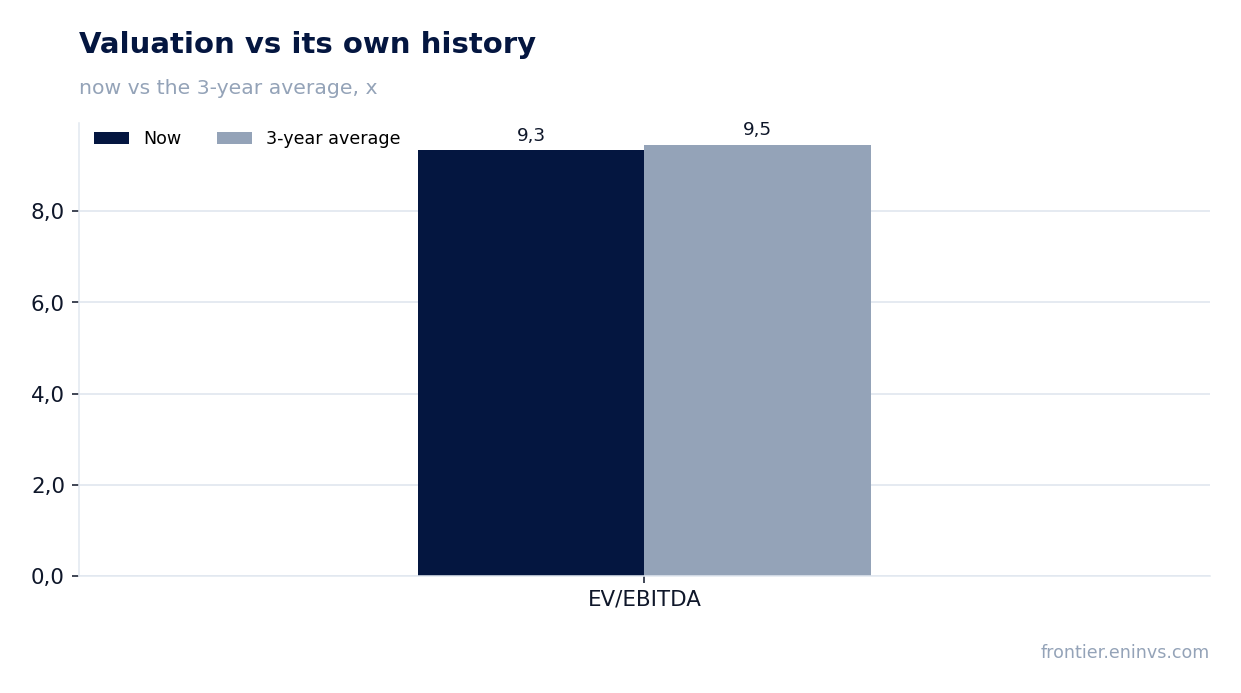
Valuation vs its own history
The 5.3% dividend yield is backed by announced extraordinary payouts of MXN 10.00 per share
The dividend yield over the last 12 months is 5.3%. On August 20, 2026, the shareholders' meeting approved the payment of two extraordinary cash dividends from the share buyback reserve of MXN 10.00 per share each, payable on November 30, 2026, and December 23, 2026. Thus, a total of MXN 20.00 per share may be paid for 2026.
Our estimate for the 2026 dividend is based on the announced payments and the current dividend policy. The payout depends on profit and cash flow, which in turn are affected by one-off items such as the gain on FX forwards and exchange rate differences. A decline in profit could lead to a smaller dividend.
The 5.3% yield exceeds the key rate, making the share attractive for income-oriented investors. However, the sustainability of payments depends on the company's ability to generate free cash flow, which came under pressure in the third quarter due to capex rising to MXN 2,716.6 million.
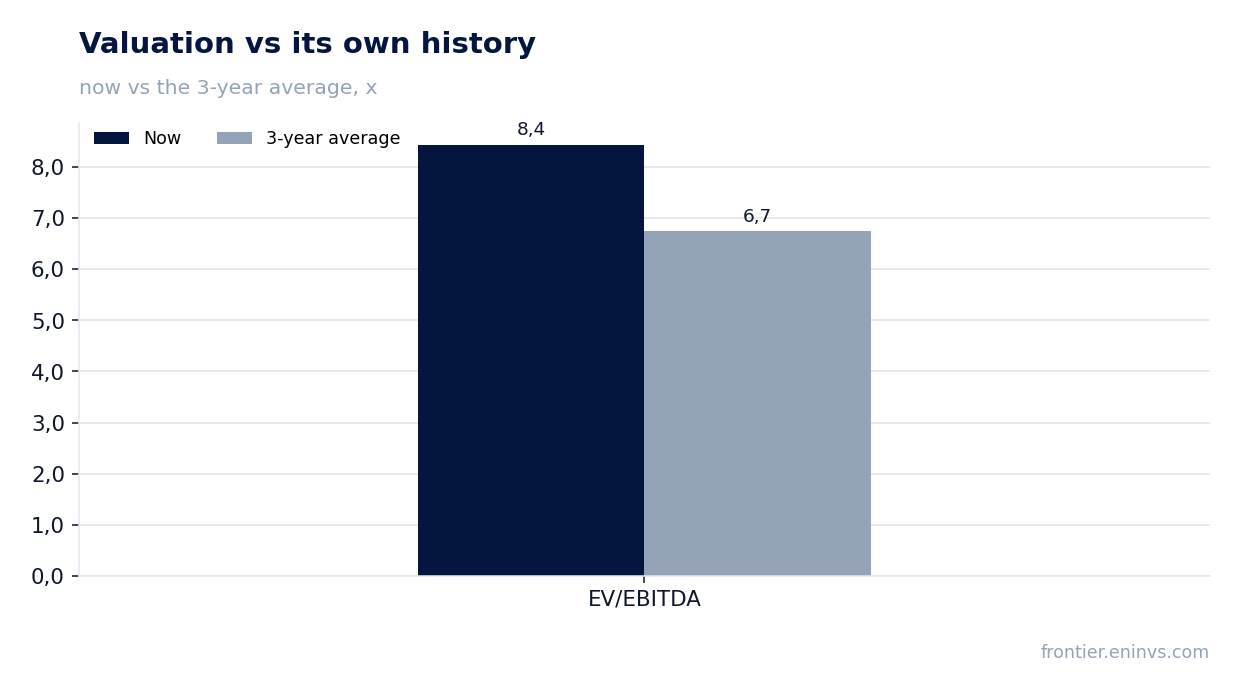
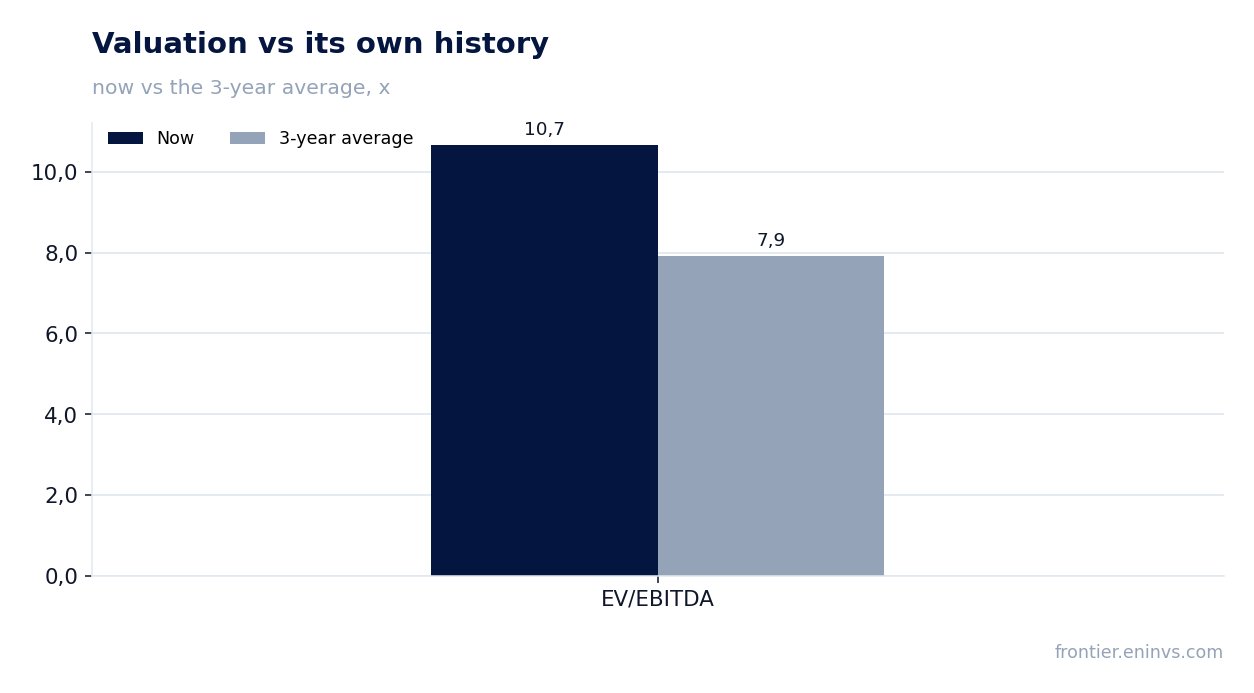
EV/EBITDA of 7.9 is below its own three-year average of 8.9, pointing to undervaluation
The EV/EBITDA LTM multiple is 7.9, which is 11% below its own three-year average of 8.9. This indicates that the share is trading cheaper than its average over the past three years. The P/E LTM is 13.6. Market capitalization stands at MXN 140,568.0 million.
According to the portal's model, which compares EBITDA growth with the target multiple and market capitalization, the upside to fair value is estimated at +28%. This is our own estimate, not a market consensus.
However, the current undervaluation may be justified by risks related to the decline in Mexican passenger traffic and rising debt. The net debt to LTM EBITDA ratio of 2.6x limits financial flexibility, while rising interest expenses weigh on profit.
Valuation on the latest reported figures
Metric
Value
Market cap
141 bn MXN
P/E (LTM)
13.6
EV/EBITDA (LTM)
7.9
P/B
3.03
Net debt / EBITDA (LTM)
1.11
ROE
21.9%
Dividend yield (12m)
5.3%
EV/EBITDA, 3-year average
8.9
Bottom line
ASUR's third-quarter 2026 report presents a mixed picture. On the one hand, revenue fell 60.3% due to the base effect, but excluding construction services the decline was only 12.6%. EBITDA rose 27.7% on consolidation of new assets, yet the margin compressed. Net profit increased 4.4%, but was supported by a one-off gain on FX forwards. Leverage rose, with net debt to LTM EBITDA at 2.6x. At an EV/EBITDA of 7.9 versus a three-year average of 8.9 and a dividend yield of 5.3%, the share looks rather attractive, but risks from declining traffic and one-off items call for caution.
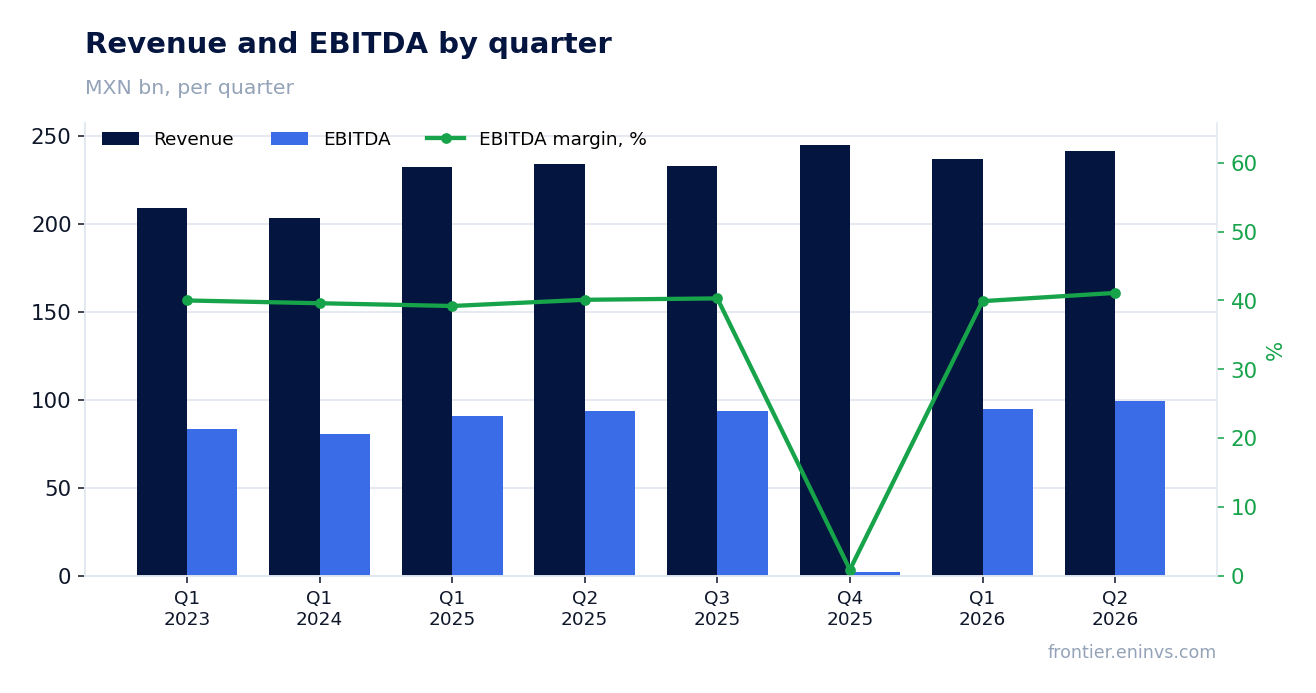
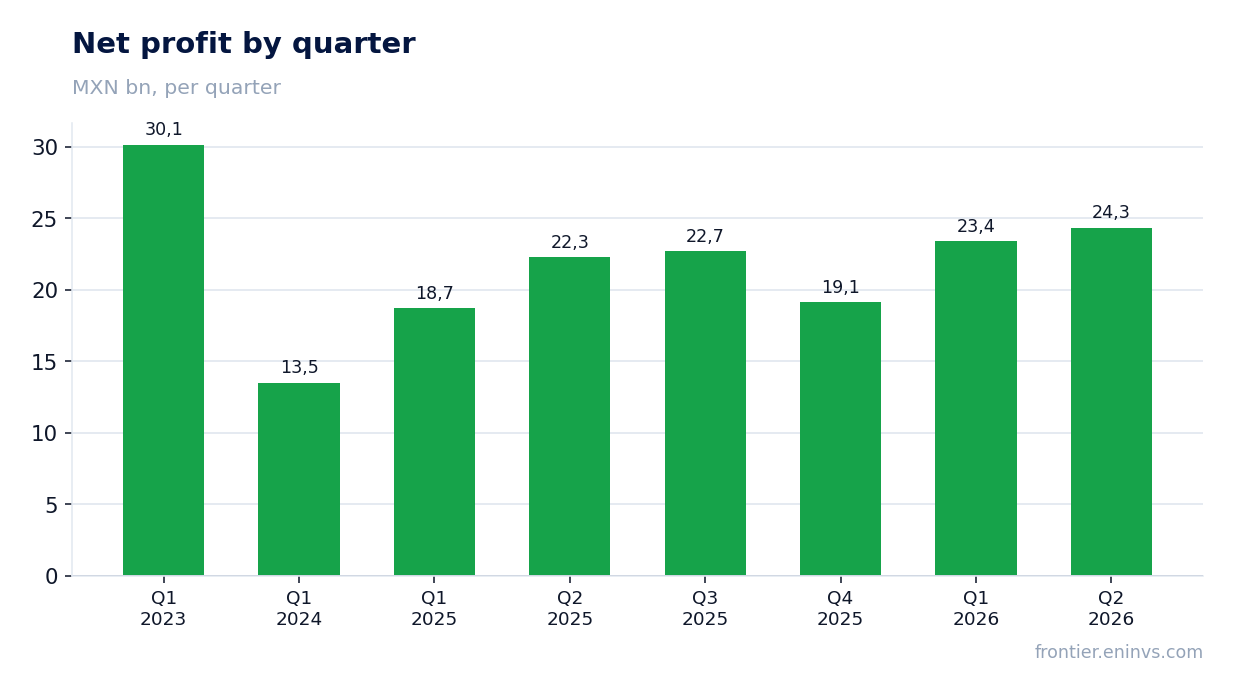
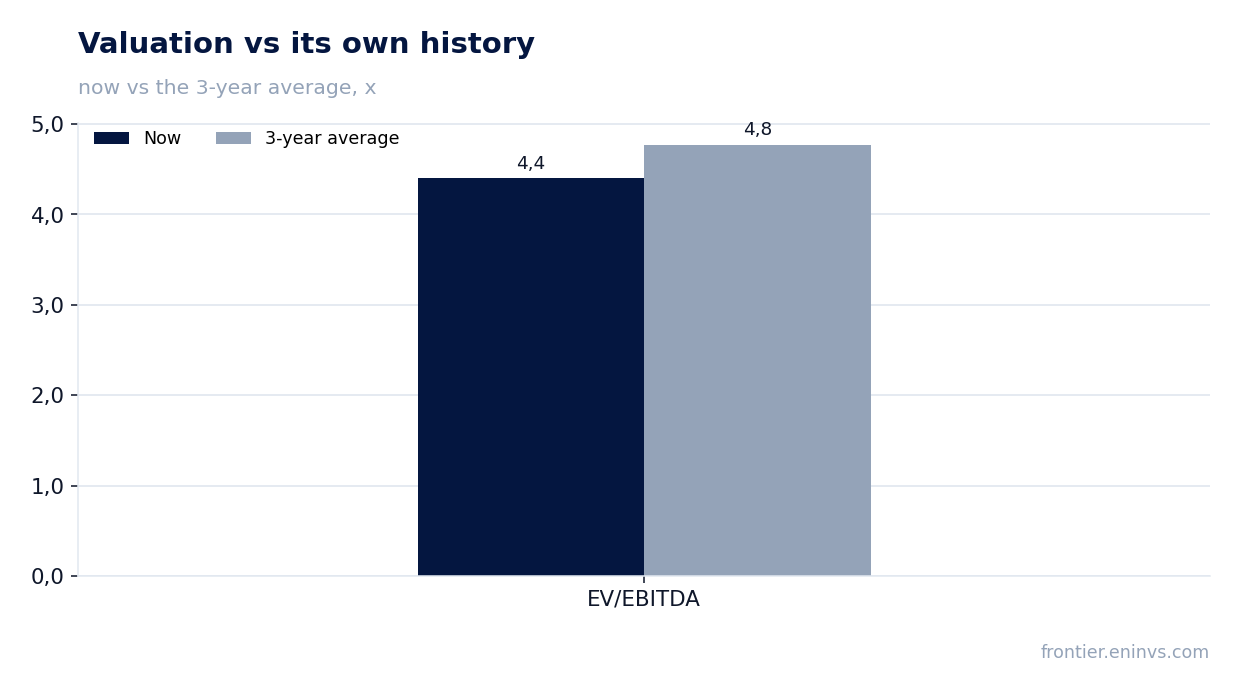
On 21 April América Móvil released its first-quarter 2026 results. Revenue rose 2.1% year on year to 236.8 bn pesos, EBITDA – 3.8% to 94.5 bn, net profit – 25.1% to 23.4 bn. Without the one-off gain from a Chilean TV-rights dispute and without the peso's appreciation the growth would have been more modest, while the EV/EBITDA multiple of 4.4 sits below its own three-year average of 4.77 – the share looks rather attractive than neutral.
Key takeaways
— Revenue added only 2.1% in pesos but 6.1% at constant currency – the peso ate almost all the growth
— A one-off gain from the Chilean TV-rights dispute brought 43 bn Chilean pesos and inflated EBITDA
— EBITDA margin fell to 40.4% from 42.1% a year earlier, despite operating profit growth
— Net profit rose 25.1% on lower financial expenses, not on operating performance
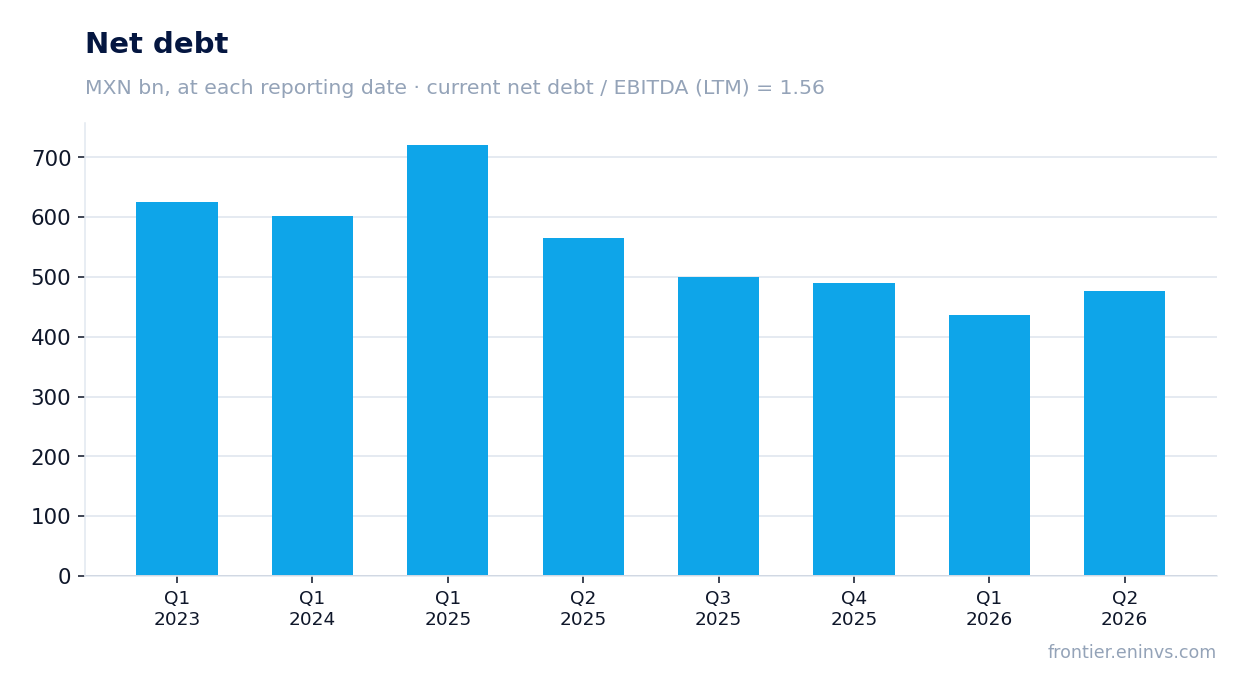
— Leverage at 1.56x EBITDA LTM is moderate, but debt rose 39.9 bn pesos in the quarter
— Dividend of 0.54 pesos per share at a 2.66% yield is modest, but the company is spending on buybacks
— EV/EBITDA of 4.4 is below its own three-year average of 4.77 – valuation is not stretched
Attractiveness
Key figures, MXN bn
Metric
Q2 2025
Q2 2026
Change
Revenue
234
241
+3.1%
EBITDA
98.4
97.3
-1.1%
Operating profit
48.8
55.1
+12.9%
Net profit
22.3
24.3
+9.2%
EBITDA margin
42.1%
40.4%
-1.7 pp
Net margin
9.5%
10.1%
+0.6 pp
Revenue added only 2.1% in pesos but 6.1% at constant currency – the peso ate almost all the growth
First-quarter 2026 revenue came in at 236.8 bn pesos, up 2.1% year on year. The company's report states that at constant exchange rates growth was 6.1%, with service revenue up 4.6%. The gap is explained by the appreciation of the Mexican peso: it gained 16.3% against the US dollar year on year, 4.6% against the euro, and 4.5% against the Brazilian real.
The mobile segment was the main contributor: service revenue there rose 6.4%, including prepaid up 5.0% and postpaid up 7.3%. In Mexico mobile service revenue added 5.7% – the best in two years; in Brazil 7.8%; in Colombia 10.2%, the strongest in a decade. Fixed-line service revenue grew more slowly, at 1.7%.
The weak peso-denominated growth should not mislead: operating metrics in local currencies look stronger. In Mexico revenue rose 5.1%, in Brazil 6.8% in reais, in Colombia 5.9% in Colombian pesos. But for reporting in Mexican pesos these gains are almost entirely offset by currency movements.
Revenue and EBITDA by quarter
A one-off gain from the Chilean TV-rights dispute brought 43 bn Chilean pesos and inflated EBITDA
The report explicitly states that first-quarter revenue includes proceeds from a favourable ruling in a Chilean TV-rights dispute amounting to 43 bn Chilean pesos. This one-off gain boosted consolidated EBITDA: excluding it, the company calculates constant-currency EBITDA growth would have been 7.0% rather than 8.0%.
This one-off factor explains why Southern Cone EBITDA jumped 94.0% in Chilean pesos and the block's margin leapt to 29.9% from 19.2%. Excluding the Chilean gain, Southern Cone EBITDA would have risen 23.2%, with the margin at 21.3%. For the whole company the effect is smaller but present: without it, EBITDA would have grown roughly 3.0% in pesos instead of 3.8%.
The one-off nature of the gain means this contribution will disappear next quarter. Investors should assess the company's sustainable EBITDA generation, not the reported first-quarter figure.
Net profit by quarter
EBITDA margin fell to 40.4% from 42.1% a year earlier, despite operating profit growth
The EBITDA margin in the first quarter of 2026 was 40.4% against 42.1% a year earlier. A margin decline with revenue up 2.1% means costs grew faster than income. The report notes that cost of service fell 1.2%, but cost of equipment rose 6.3% and selling, general and administrative expenses added 0.3%.
Operating profit nevertheless rose 12.7% to 50.5 bn pesos, with its margin up to 21.3% from 19.3%. The gap between EBITDA and EBIT dynamics is explained by a 4.9% decline in depreciation – the company likely completed part of its investment programmes from previous years.
The net margin, by contrast, improved to 10.1% from 9.5%. This came not from operating efficiency but from a 9.9% reduction in financial expenses and a positive effect from exchange-rate differences: in the first quarter of 2026 the company recorded a foreign-exchange gain of 5.0 bn pesos versus a loss of 1.2 bn a year earlier.
Net debt at reporting dates
Net profit rose 25.1% on lower financial expenses, not on operating performance
Net profit for the first quarter of 2026 was 23.4 bn pesos, up 25.1% year on year. However, this growth was driven mainly not by operations but by a 9.9% reduction in comprehensive financing costs – to 12.1 bn pesos. Interest expenses fell 6.7% thanks to lower rates and debt refinancing.
An additional contribution came from a positive exchange-rate effect: a gain of 5.0 bn pesos from the revaluation of foreign-currency liabilities versus a loss of 1.2 bn a year earlier. Without this factor, net profit growth would have been considerably more modest.
Operating profit rose 12.7% to 50.5 bn pesos, which is decent in itself, but net profit growth is almost twice as fast. This means the quality of profit this quarter is lower than it appears: the sustainable component is operating profit, while financial factors can swing either way.
Valuation vs its own history
Leverage at 1.56x EBITDA LTM is moderate, but debt rose 39.9 bn pesos in the quarter
Net debt at the end of the first quarter of 2026 stood at 661.6 bn pesos, equivalent to 1.56x EBITDA for the trailing twelve months. The company's report states that net debt excluding leases was 437.0 bn pesos, equivalent to 1.41x EBITDAaL. The difference is explained by the inclusion of lease liabilities of around 218 bn pesos.
Net debt rose 39.9 bn pesos in the quarter but fell 87.8 bn pesos over the last twelve months. The company allocated 1.0 bn pesos of free cash flow to debt reduction and spent 21.6 bn on capital expenditure, 1.4 bn on share buybacks and 1.5 bn on labour obligations.
A leverage level of 1.56x EBITDA LTM is not a concern for a telecommunications company. Interest expenses are covered by operating profit with a large margin, and falling rates in Mexico and the US create conditions for further reductions in debt servicing costs.
Dividend of 0.54 pesos per share at a 2.66% yield is modest, but the company is spending on buybacks
The board proposed that the annual shareholders' meeting approve a dividend of 0.54 pesos per share, payable in two equal instalments. At the current price the trailing twelve-month yield is 2.66%. This is a modest level, especially given that Mexican rates remain high.
The company also proposed allocating an additional 10 bn pesos to the share-buyback fund for April 2026 to April 2027. In the first quarter 1.4 bn pesos was already spent on buybacks. Buybacks reduce the number of shares outstanding – from 60.9 bn a year earlier to 60.2 bn – supporting earnings per share.
The company's dividend policy remains conservative: payouts represent only a portion of free cash flow, which in the first quarter was just 3.3 bn pesos. The bulk of funds goes to capital expenditure and debt reduction. For an income-oriented investor this is not the most attractive option, but for long-term value creation it is a reasonable balance.
EV/EBITDA of 4.4 is below its own three-year average of 4.77 – valuation is not stretched
The trailing twelve-month EV/EBITDA multiple is 4.40, below its own three-year average of 4.77. This means the market values the company more cheaply than it did on average over the past three years. The trailing P/E is 13.4 and return on equity is 22.3%.
According to the portal's model, the fair value of the share based on EBITDA growth and the target multiple implies +14% upside to the current price. This is our own estimate, not a market consensus or a target price. It assumes the company maintains its current EBITDA growth rate and the multiple stays at its current level.
The share trades at a discount to its own history, which may reflect the slowdown in peso-denominated revenue growth and the one-off nature of part of the profit. If the company can accelerate revenue growth in local currencies or if the peso stops appreciating, the discount could narrow.
Valuation on the latest reported figures
Metric
Value
Market cap
1 202 bn MXN
P/E (LTM)
13.4
EV/EBITDA (LTM)
4.4
P/B
2.81
Net debt / EBITDA (LTM)
1.56
Operating cash flow (LTM)
272 bn
ROE
22.3%
Dividend yield (12m)
2.7%
EV/EBITDA, 3-year average
4.8
Bottom line
The first quarter of 2026 showed that América Móvil remains a resilient telecommunications business with growing operating profit and low leverage. However, reported revenue rose only 2.1% due to the peso's appreciation, and almost all of the EBITDA and net profit growth came from the one-off Chilean dispute gain and lower financial expenses. The EV/EBITDA multiple of 4.4 is below its own three-year average, and the portal's model implies +14% upside, making the share rather attractive. The key question for a holder is whether the company can accelerate revenue growth in local currencies and sustain its margin without one-off factors.
On April 30, FEMSA reported results for the first quarter of 2026. Revenue rose 6.1% year on year to MXN 207.8 bn, EBITDA – by 11.2% to MXN 28.1 bn, and net profit – by 97.3% to MXN 17.6 bn. However, excluding a one-off non-cash gain from the BradyPLUS–Imperial Dade merger, net profit would have been MXN 5.7 bn, down 36.4% year on year. With EV/EBITDA at 8.4 versus its own three-year average of 6.7 and the portal model implying only +1% upside to fair value, the share looks neutral: a 6.6% dividend yield supports it, but operating momentum outside OXXO Mexico is weak.
Key takeaways
— Profit doubled, but excluding a one-off merger gain it would have fallen 36.4%
— Revenue was driven by OXXO Mexico: +8.3% with operating profit up 20.9%
— EBITDA margin rose to 13.5% amid one-off effects in Europe and Health
— Net debt / EBITDA ex-KOF rose to 1.24x due to dividends and buybacks
— Capex fell 29.5%, but dividends and buybacks consumed more
— Dividend yield 6.6% with a payout of MXN 4.75 per unit for 2025
— EV/EBITDA 8.4 versus three-year average of 6.7 – valuation above its own history
Attractiveness
Key figures, MXN bn
Metric
Q2 2025
Q2 2026
Change
Revenue
211
231
+9.3%
EBITDA
16.1
19.6
+21.5%
Operating profit
17.8
19.1
+7.2%
Net profit
2.71
5.54
+104.2%
EBITDA margin
7.6%
8.5%
+0.9 pp
Net margin
1.3%
2.4%
+1.1 pp
Profit doubled, but excluding a one-off merger gain it would have fallen 36.4%
Net profit for the first quarter of 2026 was MXN 17.6 bn, up 97.3% year on year. However, the report explicitly states that the increase was driven by a one-off non-cash gain from the BradyPLUS–Imperial Dade merger, in which FEMSA retained approximately 19% ownership. Excluding this gain, net profit would have been MXN 5.7 bn, down 36.4% from the first quarter of 2025.
The decline in adjusted profit was caused by higher financial expenses: foreign exchange loss of MXN 444 mn versus a gain of MXN 439 mn a year earlier, an expense of MXN 189 mn on financial instruments versus a gain of MXN 1,107 mn, and lower interest income due to a smaller cash position. Additionally, last year's profit included MXN 2.49 bn from discontinued operations, which is absent now.
Thus, reported profit looks impressive, but its quality is low: the core business earned significantly less than a year ago. For assessing sustainability, EBITDA is more relevant, as it grew 11.2% and excludes one-off financial items.
Revenue and EBITDA by quarter
Revenue was driven by OXXO Mexico: +8.3% with operating profit up 20.9%
Consolidated revenue in Q1 2026 grew 6.1% year on year to MXN 207.8 bn. The main contributor was OXXO Mexico: its revenue rose 8.3% to MXN 74.4 bn, and operating profit – by 20.9% to MXN 5.6 bn. Same-store sales increased 6.0% with average ticket up 6.6% and traffic down 0.5%.
OXXO Mexico's operating margin expanded by 80 basis points to 7.6%, helped by a 140 bps increase in gross margin (to 46.2%) and cost control. Gross margin benefited from income from key suppliers, the contribution of financial services, and revenue management initiatives. Operating expenses rose 9.8%, slightly above revenue growth, due to higher labor costs, but operating leverage and efficiency measures offset this pressure.
The Americas & Mobility division also delivered strong results: revenue rose 12.9% and operating profit – by 34.0%. However, its contribution to consolidated profit remains small at MXN 281 mn. The remaining segments – Coca-Cola FEMSA, Europe, and Health – showed weak dynamics: Coca-Cola FEMSA revenue grew only 1.1%, operating profit fell 2.3%; Europe revenue added 0.1%, Health – 0.9% with operating profit down 14.2%.
Net profit by quarter
EBITDA margin rose to 13.5% amid one-off effects in Europe and Health
Consolidated EBITDA margin in Q1 2026 was 13.5%, up 60 basis points from 12.9% a year earlier. The increase was supported by margin expansion in OXXO Mexico, Americas & Mobility, and Coca-Cola FEMSA, partially offset by contraction in Europe and Health. However, in Europe and Health the gross margin contraction is explained by a reclassification of distribution expenses from selling to cost of goods sold, which does not affect operating profit. Excluding this effect, the comparable gross margin for Q1 2025 would have been 39.9%, and the expansion would have been 60 bps.
Operating margin remained stable at 6.9%. The 5.5% increase in operating profit was driven by OXXO Mexico, Americas & Mobility, and Europe, but partially offset by declines at Coca-Cola FEMSA and Health. On a comparable basis, operating profit rose 12.1%, reflecting the strength of local currency results outside Mexico.
Thus, the margin improvement is largely due to one-off factors and translation effects rather than a sustainable efficiency gain across all segments. Margin sustainability will depend on OXXO Mexico maintaining its high gross margin and on profitability recovering in Health and Coca-Cola FEMSA.
Net debt at reporting dates
Net debt / EBITDA ex-KOF rose to 1.24x due to dividends and buybacks
Net debt at the end of Q1 2026 was MXN 93.6 bn (ex-KOF), and the net debt / EBITDA ratio was 1.24x versus 0.69x a year earlier. The increase was driven by cash outflows for capital allocation: over the last twelve months, the company paid MXN 47.2 bn in ordinary and extraordinary dividends and spent MXN 16.1 bn on share repurchases. This reduced the cash position and increased debt.
Total debt (ex-KOF) was MXN 166.8 bn, including financial debt of MXN 56.9 bn and lease liabilities of MXN 109.9 bn. Cash and investments stood at MXN 73.2 bn. The average interest rate on debt is 7.2%, with 83.5% of debt at fixed rates, reducing interest rate risk. The maturity profile is spread out: 13.9% of debt matures in 2026, 7.9% in 2027, 10.9% in 2028, 3.8% in 2029, 12.2% in 2030, and 51.3% after 2031.
The rise in leverage is a consequence of an active capital return policy rather than deteriorating operations. However, if the current pace of payouts and buybacks continues, the ratio may remain elevated, limiting financial flexibility.
Valuation vs its own history
Capex fell 29.5%, but dividends and buybacks consumed more
Capital expenditures in Q1 2026 were MXN 6.2 bn, down 29.5% year on year and representing 3.0% of revenue. The decrease occurred in OXXO Mexico, Coca-Cola FEMSA, and Health, driven by a cautious approach to investments. In OXXO Mexico, the high base of Q1 2025, when many stores were opened, also played a role. This was partially offset by higher capex in Americas & Mobility, where expansion plans in Latin America and Brazil were resumed.
Despite lower capex, the company directed significant funds to shareholder payouts: over the last twelve months, dividends amounted to MXN 47.2 bn and share buybacks to MXN 16.1 bn. These payments exceeded operating cash flow, leading to an increase in net debt. Operating cash flow over the last twelve months was MXN 71.1 bn, covering capex but not fully covering dividends and buybacks.
Thus, the company maintains a high level of capital return, partly financing it with debt. This may be sustainable in the short term but limits growth investments and reduces financial headroom.
Dividend yield 6.6% with a payout of MXN 4.75 per unit for 2025
For 2025, shareholders approved an ordinary dividend of MXN 4.7520 per BD unit (MXN 47.52 per ADS), payable in four equal installments in April, July, October 2026, and January 2027. Additionally, an extraordinary dividend of MXN 8.0597 per BD unit (MXN 80.597 per ADS) was declared, also payable in four equal installments on the same schedule. The total payout for 2025 is MXN 12.81 per unit.
The current trailing twelve-month dividend yield is 6.6%. This is above the key rate, making the stock attractive for income-oriented investors. However, the sustainability of the payout depends on the company's ability to generate sufficient free cash flow. Over the last twelve months, operating cash flow was MXN 71.1 bn, and capex was about MXN 6.2 bn per quarter, leaving room for payouts, but dividends and buybacks have already exceeded cash flow and are partly financed by debt.
Our estimate for the 2026 dividend assumes a payout ratio of about 50% of net profit. However, the one-off merger gain may distort the base; excluding it, Q1 profit would have been MXN 5.7 bn. If operating profit does not recover, the dividend could be lower. The risk of a cut is linked to further debt growth and the need to fund capex.
EV/EBITDA 8.4 versus three-year average of 6.7 – valuation above its own history
The current trailing twelve-month EV/EBITDA multiple is 8.4, above its own three-year average of 6.7. This means the stock trades at a premium to its historical valuation. The trailing P/E is 22.6. Market capitalisation is MXN 708.1 bn. The net debt / EBITDA LTM ratio is 0.61, lower than the ex-KOF figure of 1.24x due to the inclusion of Coca-Cola FEMSA.
According to the portal's model, which compares EBITDA growth with a target multiple, the upside to fair value is +1%. This does not imply significant upside. For comparison, the 6.6% dividend yield provides most of the expected return.
Thus, the current valuation does not look attractive: the multiple is above its historical average, and the portal model indicates limited upside. A re-rating would require a sustainable acceleration in operating profit and a reduction in debt.
Valuation on the latest reported figures
Metric
Value
Market cap
708 bn MXN
P/E (LTM)
22.6
EV/EBITDA (LTM)
8.4
P/B
2.55
Net debt / EBITDA (LTM)
0.61
Operating cash flow (LTM)
71.1 bn
ROE
8.7%
Dividend yield (12m)
6.6%
EV/EBITDA, 3-year average
6.7
Bottom line
Q1 2026 showed strong results at OXXO Mexico, where operating profit rose 20.9% on gross margin expansion and cost control. However, consolidated profit owes its growth to a one-off merger gain, without which it would have fallen 36.4%. Leverage rose to 1.24x ex-KOF due to shareholder payouts, while capex was cut. Valuation at EV/EBITDA 8.4 is above its own three-year average of 6.7, and the portal model implies only +1% upside. With a 6.6% dividend yield, the stock looks neutral: the yield supports it, but operating momentum outside OXXO Mexico and the high valuation limit upside.
On April 29, Coca-Cola FEMSA reported first-quarter 2026 results. Revenue rose 4.7% year on year to 76,318 mn pesos, EBITDA – 8.3% to 10,527 mn pesos, net profit – 16.9% to 6,211 mn pesos. Profit growth against a lower operating margin looks contradictory, and debt increased by 36.1 bn rubles in the quarter. With EV/EBITDA at 10.7 versus its own three-year average of 7.9, the share looks rather unattractive despite a 3.9% dividend yield.
Key takeaways
— Revenue grew 4.7% year on year, but in Mexico and Central America it fell 1.4%
— EBITDA rose 8.3%, although operating profit declined 2.3% due to higher expenses
— Net profit increased 16.9% despite a lower operating margin – one-off items helped
— Debt increased by 36.1 bn rubles in the quarter, with net debt/EBITDA at 1.04
— Dividend yield of 3.9% with a payout of 7.74 pesos per unit for 2025
— EV/EBITDA at 10.7 versus its own three-year average of 7.9 – valuation above historical
— On the portal's model, upside to fair value is zero
Attractiveness
Key figures, MXN bn
Metric
Q2 2025
Q2 2026
Change
Revenue
72.9
76.3
+4.7%
EBITDA
10.6
11.5
+8.3%
Operating profit
9.65
10.5
+9.0%
Net profit
5.31
6.21
+16.9%
EBITDA margin
14.6%
15.1%
+0.5 pp
Net margin
7.3%
8.1%
+0.8 pp
Revenue grew 4.7% year on year, but in Mexico and Central America it fell 1.4%
Revenue in the first quarter of 2026 amounted to 76,318 mn pesos, up 4.7% year on year. Growth was driven by South America and revenue management initiatives, while the Mexican market contracted. In Mexico and Central America, revenue fell 1.4% to 39,117 mn pesos due to a 1.6% decline in sales volume and unfavourable currency translation.
In South America, revenue rose 4.3% to 31,809 mn pesos, supported by a 4.8% volume increase and higher prices. Excluding currency effects, South American revenue grew 12.3%. In Mexico, currency-neutral revenue rose 1.4%, indicating weak consumer demand and the impact of the excise tax increase.
Total sales volume increased 1.2% to 998.4 mn unit cases. Growth in Brazil, Colombia, Argentina and Guatemala offset the decline in Mexico. The average price per unit case fell 0.5% to 68.64 pesos, highlighting the difficulty of passing on costs.
Revenue and EBITDA by quarter
EBITDA rose 8.3%, although operating profit declined 2.3% due to higher expenses
EBITDA in the first quarter of 2026 rose 8.3% year on year to 10,527 mn pesos. However, operating profit declined 2.3% to 9,032 mn pesos, and the operating margin contracted by 50 basis points to 12.7%. The discrepancy is explained by higher depreciation and other non-cash charges, which are added to EBITDA but not to operating profit.
The main pressure on operating profit came from restructuring and SAP4Hana implementation costs, as well as higher marketing expenses and depreciation. In Mexico and Central America, operating profit fell 17.4% to 4,461 mn pesos due to lower volume and unfavourable mix. In South America, operating profit rose 18.8% to 4,571 mn pesos, supported by operating leverage and cost control.
Gross margin expanded by 150 basis points to 46.9%, driven by lower sugar and PET costs and the appreciation of operating currencies against the US dollar. This partially offset higher fixed costs such as labour and depreciation.
Net profit by quarter
Net profit increased 16.9% despite a lower operating margin – one-off items helped
Net profit in the first quarter of 2026 rose 16.9% year on year to 6,211 mn pesos. This occurred despite a 2.3% decline in operating profit. Support came from a lower effective tax rate and one-off items, notably the recognition of a 95 mn peso income from insurance claims related to Hurricane John in Mexico.
Net margin increased to 8.1% from 7.3% a year earlier. However, profit growth was not accompanied by improved operating efficiency: the operating margin contracted. This means the quality of profit in the reporting period was lower than the net profit dynamics suggest.
The comprehensive financing result was an expense of 1,752 mn pesos versus an expense of 1,126 mn pesos a year earlier. The increase was driven by a loss on financial instruments of 167 mn pesos versus a gain of 135 mn pesos a year earlier, as well as higher interest expenses from new bond issuances.
Net debt at reporting dates
Debt increased by 36.1 bn rubles in the quarter, with net debt/EBITDA at 1.04
Net debt at the end of the first quarter of 2026 was 43,321 mn pesos. It increased by 36.1 bn rubles in the quarter and by 4.1 bn rubles over 12 months. The net debt to EBITDA ratio for the trailing twelve months is 1.04. This is a moderate level, but the quarterly debt increase is significant.
Total debt rose due to new bond issuances in US dollars and Mexican pesos, which also led to higher interest expenses. Interest expense increased 11.1% to 2,087 mn pesos, and net interest expense rose 22.1% to 1,572 mn pesos. This is due to higher debt and lower interest income from a reduced cash position.
Operating cash flow for the trailing twelve months was 42,400 mn pesos. This is sufficient to cover capital expenditures, but the debt increase raises questions about financial discipline. The company is actively investing, which may justify the debt increase, but so far it has not led to improved operating profit.
Valuation vs its own history
Dividend yield of 3.9% with a payout of 7.74 pesos per unit for 2025
For 2025, the company pays a dividend of 7.74 pesos per unit (0.9675 pesos per share), in four equal installments of 1.935 pesos per unit. The first payment was made on April 21, 2026, totalling 4,065.1 mn pesos. The current trailing twelve-month dividend yield is 3.9%.
Our estimate for the 2026 dividend is around 8.0–8.5 pesos per unit, implying a yield of 4.0–4.3% at the current price. This depends on maintaining the payout ratio and the absence of large one-off write-offs. However, rising debt and capital expenditures could limit the ability to increase payouts.
The 3.9% dividend yield exceeds the yield on many Mexican government bonds but is not exceptionally high. For a company with rising debt and volatile operating margins, such a yield looks adequate but not attractive.
EV/EBITDA at 10.7 versus its own three-year average of 7.9 – valuation above historical
The current trailing twelve-month EV/EBITDA multiple is 10.7. This is above its own three-year average of 7.9. Thus, the share trades above its historical valuation. The trailing P/E is 16.8, which may also be above historical levels, but we lack data for comparison.
The multiple expansion occurred against a backdrop of declining operating profit and rising debt. This means the market values the company higher despite deteriorating operating performance. The market may expect margin recovery and profit growth in the future, but current results do not confirm this trend.
On the portal's model, the upside to fair value is 0%. This means the current price fully reflects fair value according to our model. Given the high multiple and lack of upside, the share looks unattractive for new investments.
On the portal's model, upside to fair value is zero
Our fundamental valuation model, based on EBITDA growth and a target multiple, shows that the upside to fair value is 0%. This means the current market price fully corresponds to our fair value estimate.
The model takes into account current operating results and expected growth. At the current EBITDA level and multiple, further price growth is possible only with improved operating performance or reduced risks. However, in the first quarter of 2026, operating profit declined and debt increased, which does not create prerequisites for growth.
Thus, according to our model, the share is fairly valued, and there is no upside potential. This confirms our verdict that the share is unattractive at the current level.
Valuation on the latest reported figures
Metric
Value
Market cap
403 bn MXN
P/E (LTM)
16.8
EV/EBITDA (LTM)
10.7
P/B
2.81
Net debt / EBITDA (LTM)
1.04
Operating cash flow (LTM)
42.4 bn
ROE
17.2%
Dividend yield (12m)
3.9%
EV/EBITDA, 3-year average
7.9
Bottom line
Bottom line: in the first quarter of 2026, Coca-Cola FEMSA showed revenue growth of 4.7% and net profit growth of 16.9%, but operating profit declined 2.3% and debt increased by 36.1 bn rubles. Profit growth was supported by one-off items and a lower tax rate, not by improved operating efficiency. The EV/EBITDA multiple of 10.7 exceeds its own three-year average of 7.9, and the portal model's upside is zero. The 3.9% dividend yield looks adequate but does not compensate for the risks. The share is assessed as unattractive at the current level.
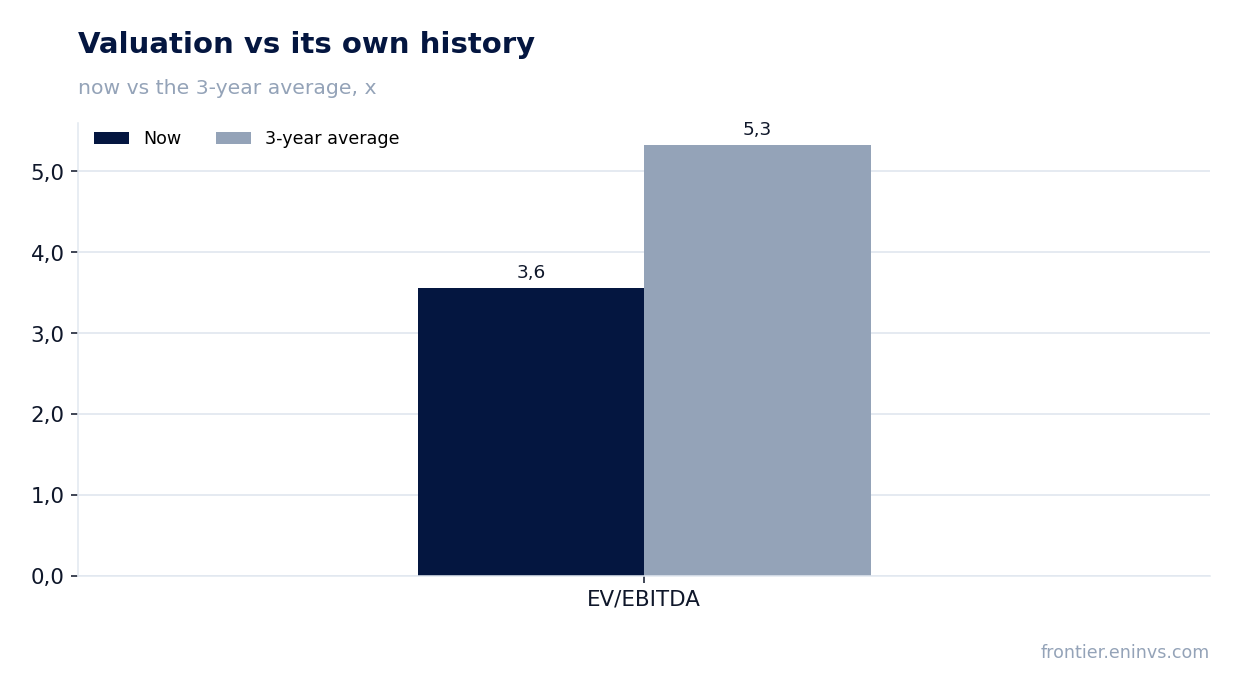
On 22 April MX_LAB released its first-quarter 2026 results. Revenue for the reported period was MXN 4,190.6 million, down 4.9% year on year, EBITDA was MXN 956.4 million at a 22.8% margin, and net profit was MXN 494.6 million. In the second quarter of 2026 revenue fell 6.0% year on year, EBITDA dropped 28.6%, while net profit rose 5.5%. With an EV/EBITDA of 3.56 against its own three-year average of 5.33 and a dividend yield of 6.5%, the share looks rather attractive, but weak Mexican consumption and margin pressure require confirmation of a turnaround.
Key takeaways
— Q1 2026 revenue fell 4.9%, with Mexico accounting for almost the entire decline
— EBITDA dropped 8.7% as operating expenses rose against falling sales
— Net profit held up thanks to lower financial expenses, not operations
— Debt load at 1.31x for the quarter remains comfortable, but net debt increased
— Trailing-twelve-month free cash flow fell 31.6% on higher working capital
— Dividend yield of 6.5% on a MXN 0.20 per share payout looks sustainable
— EV/EBITDA of 3.56 versus a three-year average of 5.33 points to undervaluation
Attractiveness
Key figures, MXN bn
Metric
Q2 2025
Q2 2026
Change
Revenue
4.68
4.40
-6.0%
EBITDA
1.12
0.80
-28.6%
Operating profit
1.03
0.87
-15.3%
Net profit
0.35
0.37
+5.5%
Operating cash flow
0.51
0.38
-24.8%
EBITDA margin
24.0%
18.2%
-5.8 pp
Net margin
7.6%
8.5%
+0.9 pp
Q1 2026 revenue fell 4.9%, with Mexico accounting for almost the entire decline
Revenue for the first quarter of 2026 was MXN 4,190.6 million, down 4.9% from a year earlier. Like-for-like sales declined 3.9% in constant currency. Mexico contributed MXN 1,877.8 million, losing 8.6% year on year, which the company attributes to continued retailer destocking amid weak consumption and a tough comparison base.
Latin American sales rose 2.9% in pesos and 5.3% like-for-like, supported by Central America and the Andean region. Argentina grew 72% in local currency but only 15.2% in Mexican pesos due to the Argentine peso devaluation. The US fell 22.0% in pesos and 9.7% in local currency on disruptions in Hispanic retail and a mild cold season.
By product, isotonic beverages fell 20.3%, OTC dropped 4.7%, while infant nutrition rose 35.6% and personal care added 1.5%. Weakness in key categories outweighed growth in niche segments.
Revenue and EBITDA by quarter
EBITDA dropped 8.7% as operating expenses rose against falling sales
EBITDA for Q1 2026 was MXN 956.4 million, down 8.7% year on year. The EBITDA margin contracted 96 basis points to 22.8%. The company attributes this to operating deleverage and higher operating expenses to support sales growth in the second half of 2026.
Gross margin expanded 61 basis points to 63.4% thanks to productivity initiatives. However, a 1.0% increase in selling, general and administrative expenses against a 4.9% revenue decline offset this improvement. In Mexico, EBITDA margin fell 119 basis points to 23.1%; in the US, it dropped 377 basis points to 13.1%.
In Q2 2026, EBITDA was MXN 963.4 million, down 28.6% year on year, with the margin falling to 18.2% from 24.0%. This points to intensifying pressure on profitability in the second quarter.
Net profit by quarter
Net profit held up thanks to lower financial expenses, not operations
Net profit for Q1 2026 was MXN 494.6 million, down just 0.8% year on year. The net margin expanded 49 basis points to 11.8%. Support came from a 19.2% drop in interest expense to MXN 177.8 million and a 26.6% rise in interest income to MXN 35.8 million.
However, operating profit fell 9.0% to MXN 874.4 million, and the inflationary loss from the monetary position in the hyperinflationary subsidiary more than doubled to MXN 108.1 million. Without the decline in financial expenses, net profit would have shown weaker dynamics.
In Q2 2026, net profit rose 5.5% year on year to MXN 374.5 million, with the margin improving to 8.5% from 7.6%. This improvement is also driven by financial items rather than operating efficiency.
Net debt at reporting dates
Debt load at 1.31x for the quarter remains comfortable, but net debt increased
The net debt to EBITDA ratio at the end of Q1 2026 was 1.31x, which the company considers comfortable. The debt service coverage ratio reached 5.32x. However, net debt increased by RUB 1,194.0 million compared to the previous reporting date and by RUB 4.7 million over 12 months.
Total debt rose: short-term debt and current portion of long-term debt increased 12.5% to MXN 3,329.1 million, long-term debt securities jumped 54.6% to MXN 3,389.0 million. Cash and equivalents rose 30.2% to MXN 2,809.0 million, but this was not enough to reduce net debt.
The debt increase is partly tied to financing working capital and investments. At the current EBITDA level, debt servicing is not a concern, but further debt growth without profit recovery could limit financial flexibility.
Valuation vs its own history
Trailing-twelve-month free cash flow fell 31.6% on higher working capital
Trailing-twelve-month free cash flow fell 31.6% to MXN 1,964.5 million. The main reasons are lower operating profit and higher working capital requirements. Operating cash flow in Q1 2026 was negative at minus MXN 229.2 million versus minus MXN 151.0 million a year earlier.
Working capital increased: receivable days rose by 6 to 109 days, payable days fell by 5 to 99 days. This pushed the cash conversion cycle up by 3 days to 119 days. The company attributes the rise in receivables to a more competitive retail environment and the drop in payables to a strategic hedge against raw material cost increases.
Capital expenditure in Q1 2026 was MXN 115.3 million, of which MXN 93.0 million went to the manufacturing plant and distribution center. If weak operating cash flow persists, the company may need additional financing.
Dividend yield of 6.5% on a MXN 0.20 per share payout looks sustainable
On 31 March 2026, the company paid a quarterly dividend of MXN 0.20 per share, totaling MXN 200 million. This is the fifteenth payment, and the company intends to continue quarterly dividends. The current trailing-twelve-month dividend yield is 6.5%.
Our estimate for the annual dividend assumes the quarterly payout remains at MXN 0.20, giving MXN 0.80 per share per year. At the current price, this corresponds to a yield of about 6.5%. The payout is covered by net profit: over the last 12 months, net profit was MXN 1,633.5 million, while annual dividend payments are about MXN 800 million, less than half of profit.
However, dividend sustainability depends on the company's ability to generate free cash flow. The 31.6% decline in FCF over 12 months and negative operating cash flow in Q1 2026 could pressure payouts if the situation does not improve. If weak operating results persist, the company may revise the dividend.
EV/EBITDA of 3.56 versus a three-year average of 5.33 points to undervaluation
The current trailing-twelve-month EV/EBITDA multiple is 3.56, well below its own three-year average of 5.33. This indicates the market values the company cheaper than its average over the past three years. The trailing P/E is 7.37.
According to the portal's model, the fair value of the share implies a 41% downside from the current market capitalization. This is our own estimate, not a market consensus. Market capitalization is MXN 12,036.1 million.
Return on equity over the last 12 months was 13.1%. At current multiples and a 6.5% dividend yield, the share looks attractive, but confirmation of the valuation requires a recovery in revenue and margin. If operating performance continues to deteriorate, the current discount may prove justified.
Valuation on the latest reported figures
Metric
Value
Market cap
12.0 bn MXN
P/E (LTM)
7.4
EV/EBITDA (LTM)
3.6
P/B
1.08
Net debt / EBITDA (LTM)
0.49
Operating cash flow (LTM)
2.10 bn
ROE
13.1%
Dividend yield (12m)
6.5%
EV/EBITDA, 3-year average
5.3
Bottom line
The strong point of the report is the ability to hold net profit: in Q1 2026 it was almost unchanged, and in Q2 it rose 5.5% thanks to lower financial expenses. However, the operating picture is weaker: revenue is falling, EBITDA in Q2 dropped 28.6%, and the margin fell to 18.2%. Debt load at 1.31x is comfortable, but net debt is rising, and trailing-twelve-month free cash flow fell 31.6%. A dividend yield of 6.5% and an EV/EBITDA of 3.56 versus a three-year average of 5.33 make the share attractive for income-oriented investors, but sustainable growth requires stabilisation of revenue and margin.
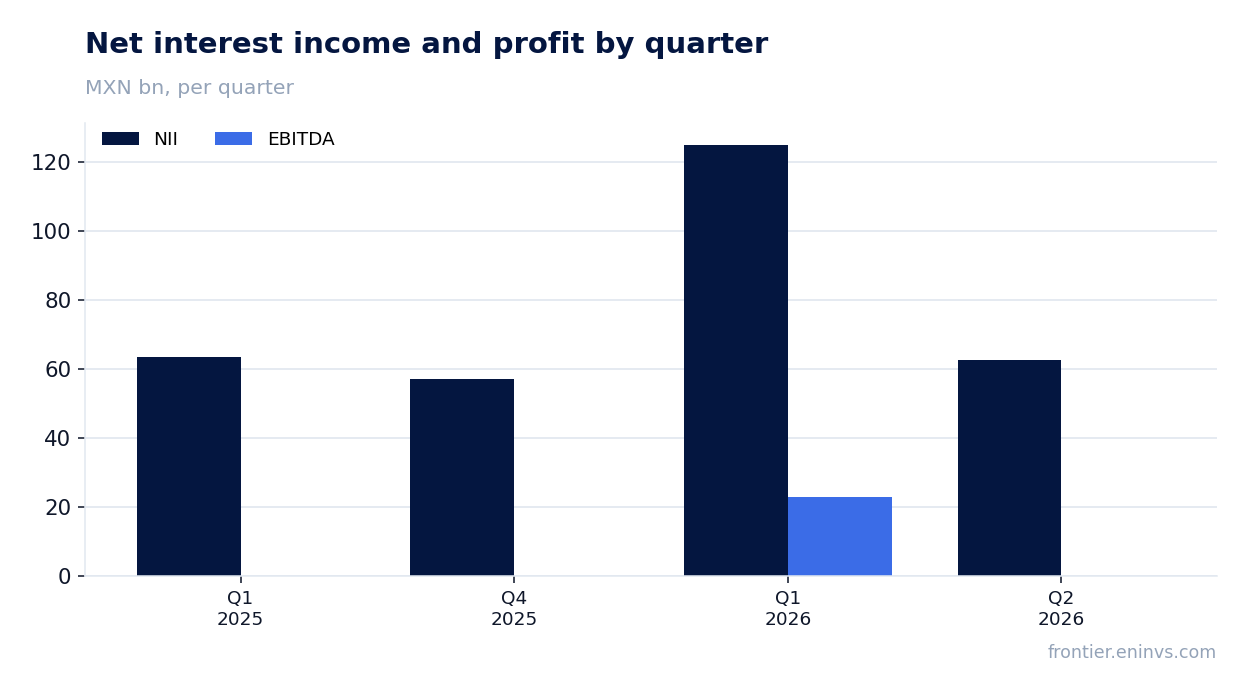
On August 25, Grupo Financiero Banorte released its first-quarter 2026 results. Net income came in at 15.46 billion pesos, just 1% above the first quarter of last year, while net interest income rose 10% to 39.48 billion pesos. Loan loss provisions jumped 36% year-on-year to 6.92 billion pesos, and one-off gains from asset sales supported profit. With a P/E LTM of 9.2 and a dividend yield of 8.9%, the stock looks attractive, but the sustainability of earnings raises questions.
Key takeaways
— Net interest income rose 10% year-on-year, but provisions for loan losses jumped 36% and consumed almost the entire gain
— Consumer lending growth of 11% year-on-year remains the main driver, but asset quality is deteriorating: the NPL ratio rose to 1.43%
— The sale of a stake in Trans Union de México and other one-off gains added about 20 basis points to the 12-month ROE, distorting the picture of sustainable profit
— The bank's net interest income rose 10% year-on-year, but quarterly dynamics show margin compression to 6.5% from 6.6% in the previous quarter
— A dividend yield of 8.9% with a 35% payout ratio looks sustainable, but earnings per share fell 3% quarter-on-quarter
— The P/E LTM of 9.2 is below the historical average, but ROE of 24.2% is supported by one-off factors and may normalise
Attractiveness
Key figures, MXN bn
Metric
—
Q2 2026
Change
Net profit
—
15.6
—
Net interest income rose 10% year-on-year, but provisions for loan losses jumped 36% and consumed almost the entire gain
The group's net interest income in the first quarter of 2026 reached 39.48 billion pesos, up 10% year-on-year and 1% quarter-on-quarter. Growth was supported by lower funding costs and an improved loan mix, as well as positive revaluation of inflation-indexed instruments in the annuity business. The group's net interest margin reached 6.5%, expanding 34 basis points year-on-year but declining 4 basis points quarter-on-quarter.
However, provisions for loan losses surged 60% quarter-on-quarter and 36% year-on-year to 6.92 billion pesos. The main drivers were the integration of Tarjetas del Futuro's portfolio in December 2025, the periodic recalibration of internal risk models, and additional provisioning for an isolated case in the commercial portfolio classified as Stage 3 in the third quarter of 2025. The cost of risk jumped to 2.2% from 1.4% in the fourth quarter and 1.7% a year earlier.
As a result, net interest income adjusted for credit risk fell 6% quarter-on-quarter and rose only 6% year-on-year to 32.56 billion pesos. This means that the growth in interest income was almost entirely absorbed by provisions, and the sustainability of profit depends on the bank's ability to keep the cost of risk under control.
Revenue and EBITDA by quarter
Consumer lending growth of 11% year-on-year remains the main driver, but asset quality is deteriorating: the NPL ratio rose to 1.43%
The consumer portfolio grew 11% year-on-year to 542.2 billion pesos, supported by the hyper-personalisation strategy and process optimisation. Auto loans added 30% year-on-year, credit cards 14%, payroll loans 12%, and mortgages 6%. The commercial portfolio grew 6%, corporate 2%, while government loans contracted 5% due to prepayments.
However, the non-performing loan (NPL) ratio rose to 1.43%, up 5 basis points quarter-on-quarter and 51 basis points year-on-year. This reflects an isolated case in the commercial portfolio, growth in consumer lending, and recent changes to the write-off policy for mortgages. The coverage ratio fell to 139.8% from 187.9% a year earlier, indicating a reduced buffer.
Consumer lending growth remains the key profit driver, but deteriorating asset quality warrants close attention. If the cost of risk stays at 2.2%, it could limit profit growth in the coming quarters.
The sale of a stake in Trans Union de México and other one-off gains added about 20 basis points to the 12-month ROE, distorting the picture of sustainable profit
The group's net income in the first quarter of 2026 was 15.46 billion pesos, up 1% year-on-year but down 3% quarter-on-quarter. The 12-month ROE was 22.9%, and the quarterly ROE was 23.9%. However, the report explicitly states that the sale of a stake in Trans Union de México positively contributed about 20 basis points to the 12-month ROE.
In addition, non-interest income fell 9% year-on-year to 4.0 billion pesos due to normalisation of trading income and a weaker technical result in insurance. This was partially offset by a solid base of banking fees and gains from asset sales. One-off gains mask the weakness in operating dynamics.
Excluding one-off factors, profit would likely have been lower, casting doubt on the sustainability of the current ROE level. To assess earnings sustainability, it is important to monitor the dynamics of fee income and the technical result in the coming quarters.
The bank's net interest income rose 10% year-on-year, but quarterly dynamics show margin compression to 6.5% from 6.6% in the previous quarter
The group's net interest margin declined to 6.5% in the first quarter of 2026 from 6.6% in the fourth quarter, but remained above 6.2% a year earlier. The bank's margin was 6.6%, down 13 basis points quarter-on-quarter due to higher earning assets, but up 25 basis points year-on-year thanks to funding cost optimisation and a focus on consumer lending.
The 25 basis point cut in the Bank of Mexico's reference rate to 6.75% will be reflected in the margin starting next quarter. The bank has immunised its balance sheet against rate cuts, which supported the margin in previous periods, but further rate cuts could weigh on it.
The bank's net interest income rose 10% year-on-year, but the quarterly margin decline suggests that peak profitability may have passed. Margin sustainability will depend on the bank's ability to offset rate cuts with volume growth and improved portfolio mix.
A dividend yield of 8.9% with a 35% payout ratio looks sustainable, but earnings per share fell 3% quarter-on-quarter
The dividend yield over the last 12 months is 8.9%, significantly above the Bank of Mexico's reference rate of 6.75%. The payout ratio for the fourth quarter of 2025 was 35%, with a dividend per share of 6.99 pesos. No dividends were paid in the first quarter of 2026, consistent with seasonality.
Earnings per share in the first quarter of 2026 were 5.49 pesos, down 3% quarter-on-quarter and up 1% year-on-year. Basic earnings per share were 5.48 pesos. The quarter-on-quarter decline reflects pressure on profit from higher provisions and one-off factors.
Dividend sustainability depends on the bank's ability to generate profit. If profit remains under pressure, the payout ratio could rise, limiting room for dividend growth. Nevertheless, the current yield looks attractive for income-oriented investors.
The P/E LTM of 9.2 is below the historical average, but ROE of 24.2% is supported by one-off factors and may normalise
The P/E LTM is 9.2, which is below the historical average for the bank, given the current ROE of 24.2%. Market capitalisation is 542.2 billion pesos. According to the portal's model, based on comparing ROE and P/B, the upside to fair value is estimated at +11%.
However, ROE is supported by one-off gains, such as the sale of a stake in Trans Union de México, which added about 20 basis points to the 12-month ROE. Excluding one-off factors, ROE could be lower, making the current valuation less attractive.
In addition, margin pressure from rate cuts and rising cost of risk could limit future profit. If profit normalises, the P/E multiple could rise, reducing the upside. Nevertheless, the current valuation looks attractive against the backdrop of high ROE and dividend yield.
Valuation on the latest reported figures
Metric
Value
Market cap
542 bn MXN
P/E (LTM)
9.2
P/B
2.18
ROE
24.2%
Dividend yield (12m)
8.9%
Bottom line
The report's strengths include 10% year-on-year growth in net interest income, a resilient consumer portfolio, and a high dividend yield of 8.9%. However, net income rose only 1% year-on-year, as provisions for loan losses jumped 36% and almost entirely absorbed revenue growth. One-off gains from asset sales supported ROE, but their contribution is not sustainable. With a P/E of 9.2 and a portal model upside of +11%, the stock looks attractive, but confirmation of earnings sustainability requires stabilisation in the cost of risk and margin in the coming quarters.
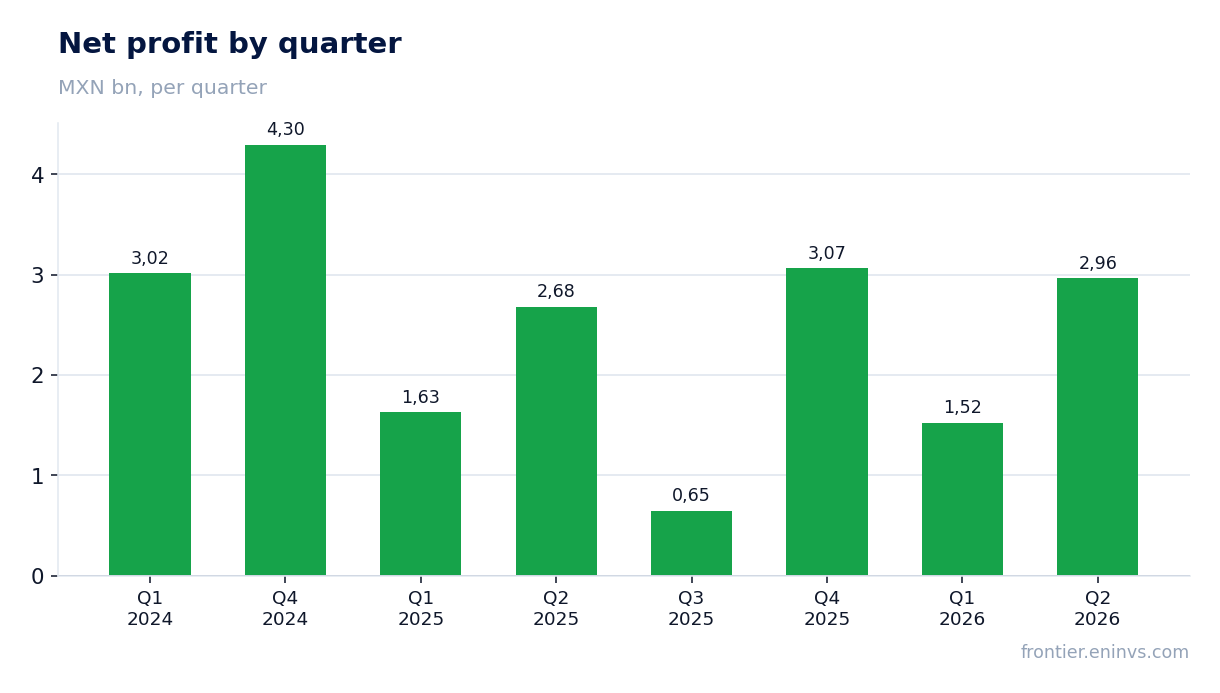
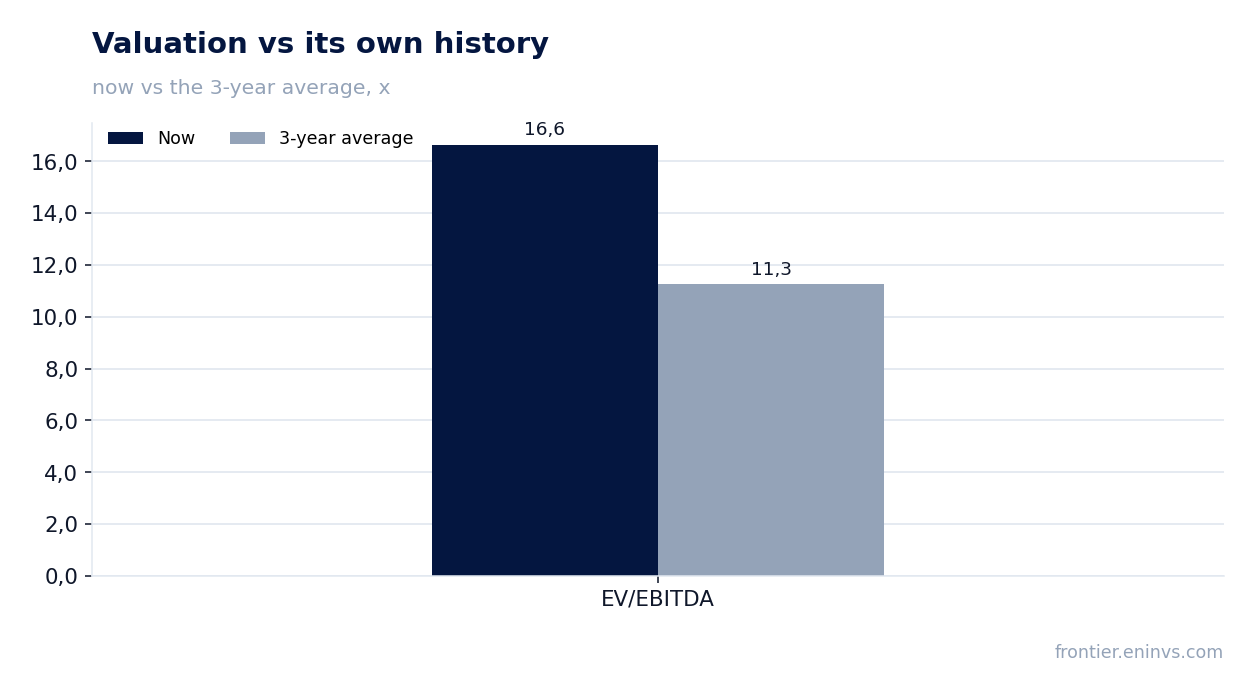
On August 25, Grupo Carso released its results for the second quarter of 2026. Revenue rose 3.9% year on year to MXN 48,194.4 mn, EBITDA fell 1.3% to MXN 6,213.8 mn, and net profit added 10.6% to MXN 2,964.0 mn. The profit gain came from financial income and a low base rather than from operations, so with EV/EBITDA at 16.6 against its own three-year average of 11.3 the share looks neutral.
Key takeaways
— Revenue rose 3.9% year on year, but this is a recovery after a 4.3% decline a quarter earlier
— EBITDA fell 1.3% and the margin compressed to 16.0% from 16.8% a year earlier
— Net profit rose 10.6%, but operating profit fell 19.8%
— Financial income grew tenfold to MXN 2,902.1 mn and is the main source of profit growth
— Operating cash flow for the quarter was MXN 3,898.1 mn, while capital expenditure was MXN 3,188.5 mn
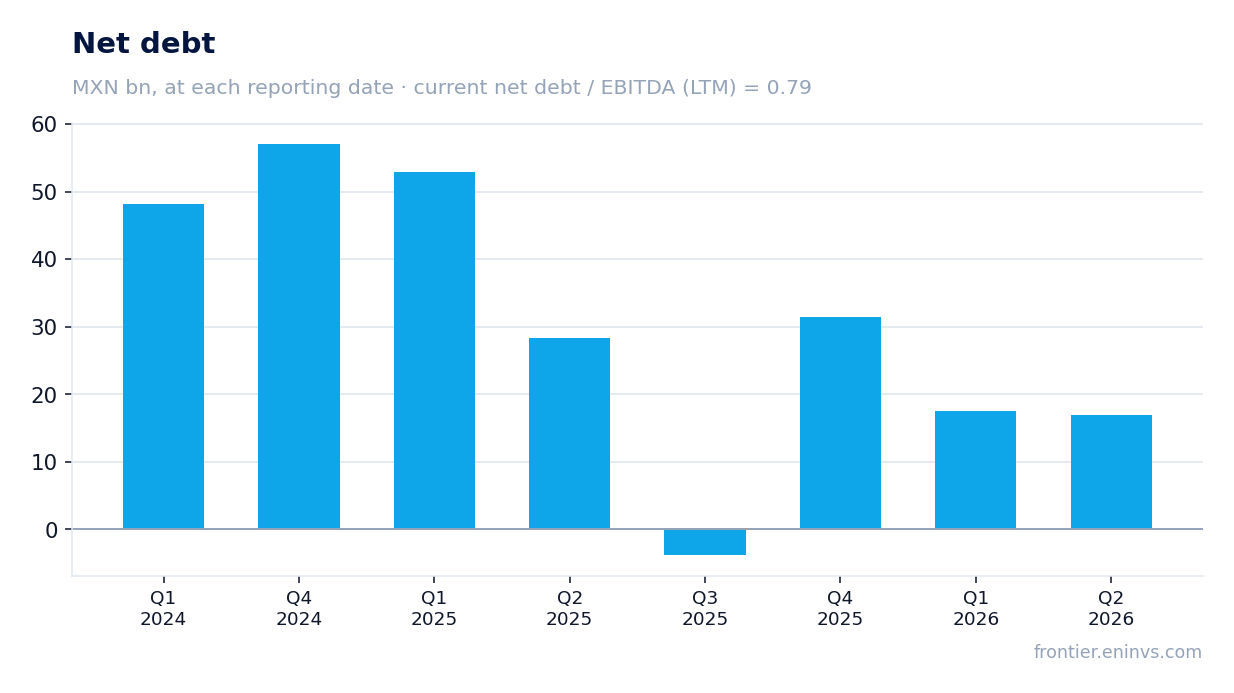
— Net debt fell to MXN 16,901.0 mn, and net debt/EBITDA LTM stands at 0.79
— EV/EBITDA at 16.6 against its own three-year average of 11.3 — the stock trades above its history
Attractiveness
Key figures, MXN bn
Metric
Q2 2025
Q2 2026
Change
Revenue
46.4
48.2
+3.9%
EBITDA
7.79
7.69
-1.3%
Operating profit
4.46
4.47
+0.3%
Net profit
2.68
2.96
+10.6%
Operating cash flow
6.78
3.90
-42.5%
EBITDA margin
16.8%
16.0%
-0.8 pp
Net margin
5.8%
6.2%
+0.4 pp
Revenue rose 3.9% year on year, but this is a recovery after a 4.3% decline a quarter earlier
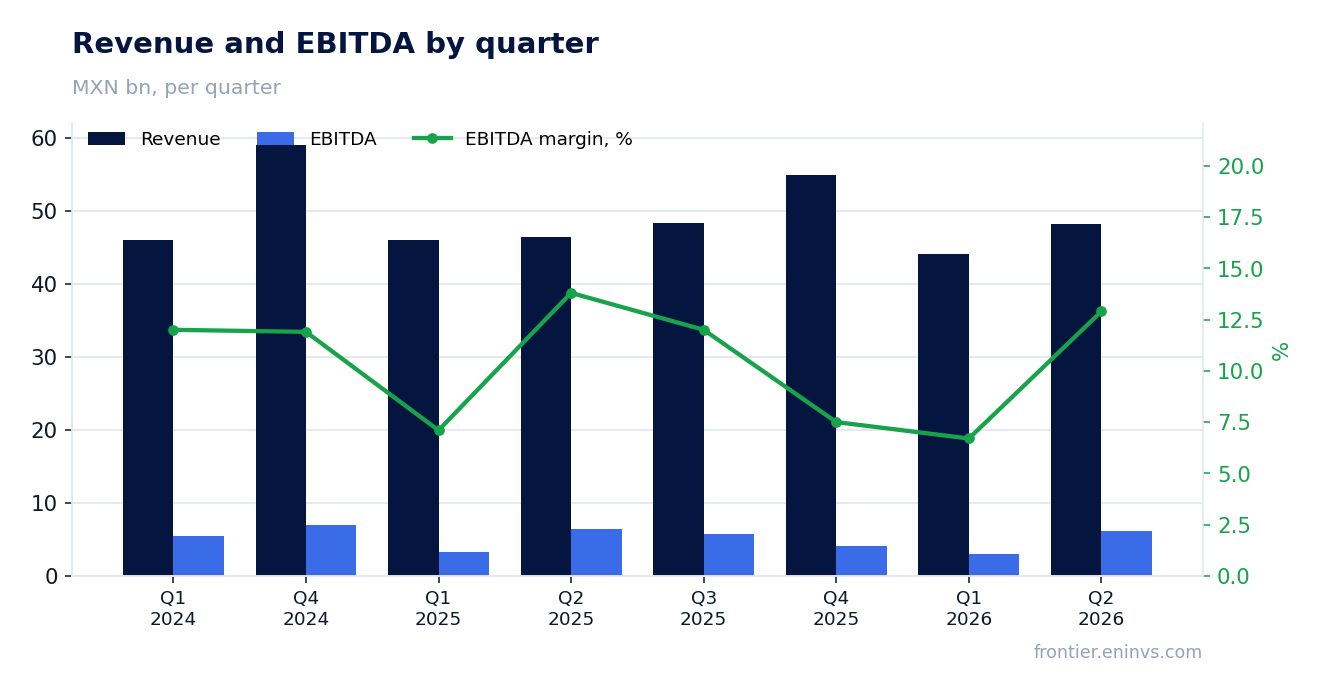
In the second quarter of 2026, Grupo Carso's revenue was MXN 48,194.4 mn, up 3.9% from a year earlier. This is the first quarterly growth after a 4.3% decline in Q1 2026 and a 7.1% drop in Q4 2025. Thus, the current growth is more a recovery after two quarters of decline than an acceleration.
For comparison: in Q1 2026 revenue was MXN 44,107.2 mn, and in Q2 2025 it was MXN 46,369.5 mn. Quarter-on-quarter growth was 9.3%, partly due to seasonality. Year-on-year growth is modest at 3.9% and does not offset the decline of previous quarters.
Revenue dynamics remain weak against the high base of 2024, when quarterly revenue reached MXN 59,075.8 mn in Q4. The current revenue level is 18.4% below the peak, indicating continued pressure on the business.
Revenue and EBITDA by quarter
EBITDA fell 1.3% and the margin compressed to 16.0% from 16.8% a year earlier
EBITDA in Q2 2026 was MXN 6,213.8 mn, down 1.3% from a year earlier. The EBITDA margin fell to 16.0% from 16.8% in the same period last year. A margin decline alongside revenue growth means costs are rising faster than income.
Operating profit fell more significantly — by 19.8% to MXN 4,469.8 mn, compared with MXN 5,578.0 mn a year earlier. The gap between EBITDA and operating profit dynamics is explained by higher depreciation and other operating expenses. The Q1 2026 report shows administrative expenses rose to MXN 2,191.9 mn from MXN 1,895.8 mn a year earlier, indicating pressure on operating efficiency.
Margin compression is a key negative in the report. While in Q1 2026 the EBITDA margin was 6.7%, in Q2 it recovered to 12.9%, but still below last year's levels. The company has not yet demonstrated a sustainable improvement in profitability.
Net profit by quarter
Net profit rose 10.6%, but operating profit fell 19.8%
Net profit in Q2 2026 was MXN 2,964.0 mn, up 10.6% from a year earlier. However, this growth was not driven by operations: operating profit fell 19.8% to MXN 4,469.8 mn. The gap is explained by financial income and one-off tax savings.
In Q1 2026 net profit was MXN 1,523.7 mn, and in Q2 2025 it was MXN 2,679.0 mn. Year-on-year growth looks positive, but it is not supported by an improvement in operating metrics. Earnings per share in Q1 2026 was MXN 0.68 versus MXN 0.72 a year earlier, reflecting pressure on profitability.
Thus, net profit growth is more a result of financial engineering and a low base than business improvement. For sustainable profit growth, the company needs to restore operating efficiency.
Net debt at reporting dates
Financial income grew tenfold to MXN 2,902.1 mn and is the main source of profit growth
Financial income in Q1 2026 was MXN 2,902.1 mn versus MXN 278.0 mn a year earlier — more than a tenfold increase. This is the key factor behind net profit growth despite the fall in operating profit. Financial expenses also rose to MXN 3,698.7 mn from MXN 1,065.6 mn, but the net financial result remained positive.
Such growth in financial income may be related to foreign exchange differences or investment income. The Q1 2026 report states that financial income includes interest income and other financial receipts. However, the sustainability of this source is questionable — it may be one-off.
For the investor, it is important that profit growth is not supported by operations. If financial income declines, net profit may return to a decline. This makes the quality of earnings low.
Valuation vs its own history
Operating cash flow for the quarter was MXN 3,898.1 mn, while capital expenditure was MXN 3,188.5 mn
Operating cash flow in Q2 2026 was MXN 3,898.1 mn, significantly better than the negative value in Q1 (-MXN 357.6 mn). However, this is not enough to cover capital expenditure, which in Q1 2026 was MXN 3,188.5 mn. As a result, free cash flow remains under pressure.
Over the last 12 months, operating cash flow was MXN 31,100.0 mn, which covers capital expenditure, but its volume is growing. In Q1 2026, capital expenditure rose to MXN 3,188.5 mn from MXN 1,732.2 mn a year earlier — almost double. This may be related to business development investments.
The growth in capital expenditure amid weak operating cash flow limits the company's ability to pay dividends and reduce debt. In Q1 2026, dividends amounted to MXN 48.8 mn, which is insignificant relative to the scale of the business.
Net debt fell to MXN 16,901.0 mn, and net debt/EBITDA LTM stands at 0.79
Net debt at the end of Q2 2026 was MXN 16,901.0 mn, down from MXN 17,543.5 mn in Q1 2026. The net debt/EBITDA LTM ratio is 0.79 — a moderate level of leverage. The decline in debt for the quarter was MXN 0.6 bn, and over 12 months — MXN 11.4 bn.
The debt reduction occurs amid rising capital expenditure, which may indicate asset sales or improved working capital management. In Q1 2026, the company raised borrowings of MXN 13,185.6 mn and repaid MXN 9,975.2 mn, resulting in a net inflow from financing activities of MXN 2,065.0 mn.
The debt level is not a concern, but its reduction is not a consequence of improved operations. To further reduce debt, the company needs to increase operating profit and cash flow.
EV/EBITDA at 16.6 against its own three-year average of 11.3 — the stock trades above its history
The current EV/EBITDA LTM multiple is 16.6, significantly above its own three-year average of 11.3. This means the stock trades at a premium to its historical valuation. At the same time, P/E LTM is 36.6, also indicating a high valuation relative to earnings.
The company's market capitalisation is MXN 300,180.5 mn. With EBITDA LTM of MXN 18,943.3 mn and net debt of MXN 16,901.0 mn, EV/EBITDA is indeed 16.6. For comparison: at the three-year average multiple of 11.3, the fair value of the share would be significantly lower.
According to the portal's model, the fundamental value of the share implies an upside of +9% to the current price. This is a moderate upside that does not compensate for the risks associated with earnings quality and weak operating metrics. The dividend yield over the last 12 months is 1.15%, which is below the key rate and does not make the stock attractive for income investors.
Valuation on the latest reported figures
Metric
Value
Market cap
300 bn MXN
P/E (LTM)
36.6
EV/EBITDA (LTM)
16.6
P/B
2.07
Net debt / EBITDA (LTM)
0.79
Operating cash flow (LTM)
31.1 bn
ROE
8.8%
Dividend yield (12m)
1.1%
EV/EBITDA, 3-year average
11.3
Bottom line
The strengths of the report are revenue growth of 3.9% and a reduction in net debt to MXN 16,901.0 mn with a net debt/EBITDA ratio of 0.79. However, profit growth of 10.6% was driven by financial income, not operations: operating profit fell 19.8%, and the EBITDA margin compressed to 16.0%. Earnings quality is low, and the EV/EBITDA multiple of 16.6 against its own three-year average of 11.3 indicates overvaluation. With a portal-model upside of only +9% and a dividend yield of 1.15%, the share looks neutral. For the valuation to improve, the company needs to restore operating efficiency and sustainable profit growth.
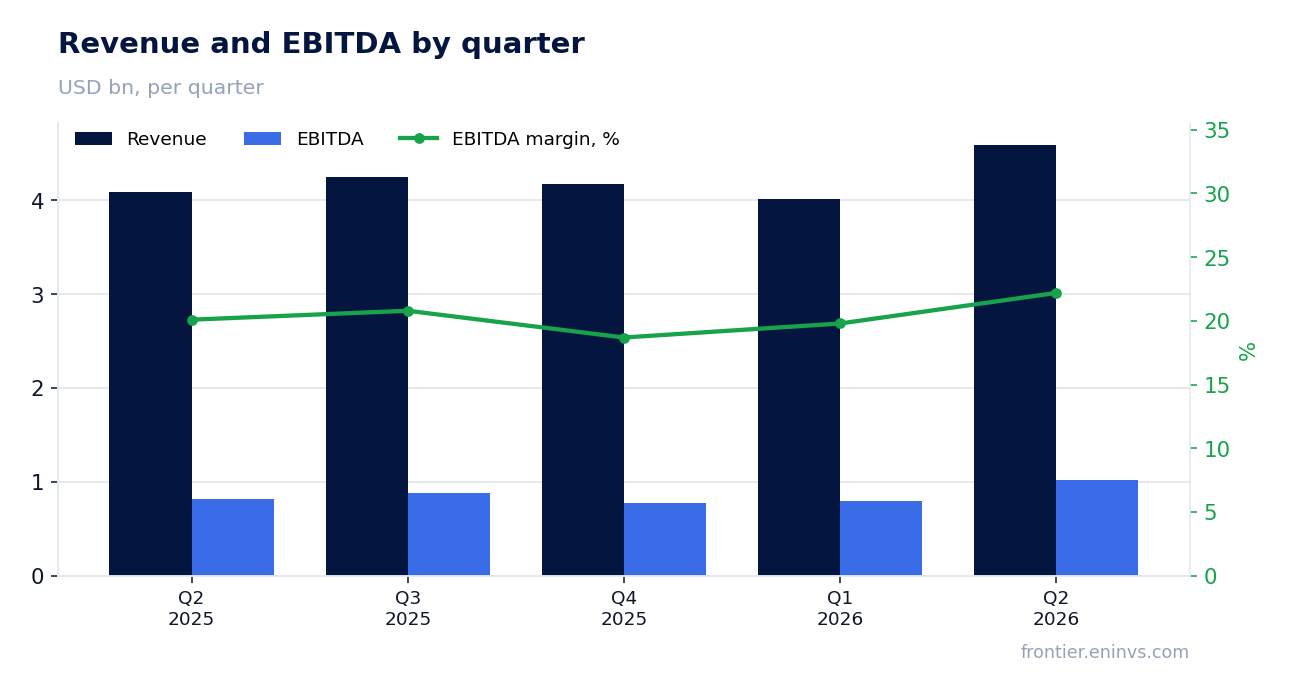
Cemex reported Q2 2026 results. Revenue rose 12.2% year-on-year to $4,593.4 million, EBITDA grew 6.6% to $1,018.3 million, and net profit increased 9.0% to $346.6 million. However, EBITDA margin declined to 19.6% from 20.6% a year earlier. At the current price, the stock looks neutral: EV/EBITDA of 5.87x is slightly above its own three-year average of 5.74x, and revenue growth is not accompanied by margin improvement.
Key takeaways
— Q2 revenue rose 12.2% year-on-year to $4,593.4 million, but EBITDA margin fell to 19.6% from 20.6%
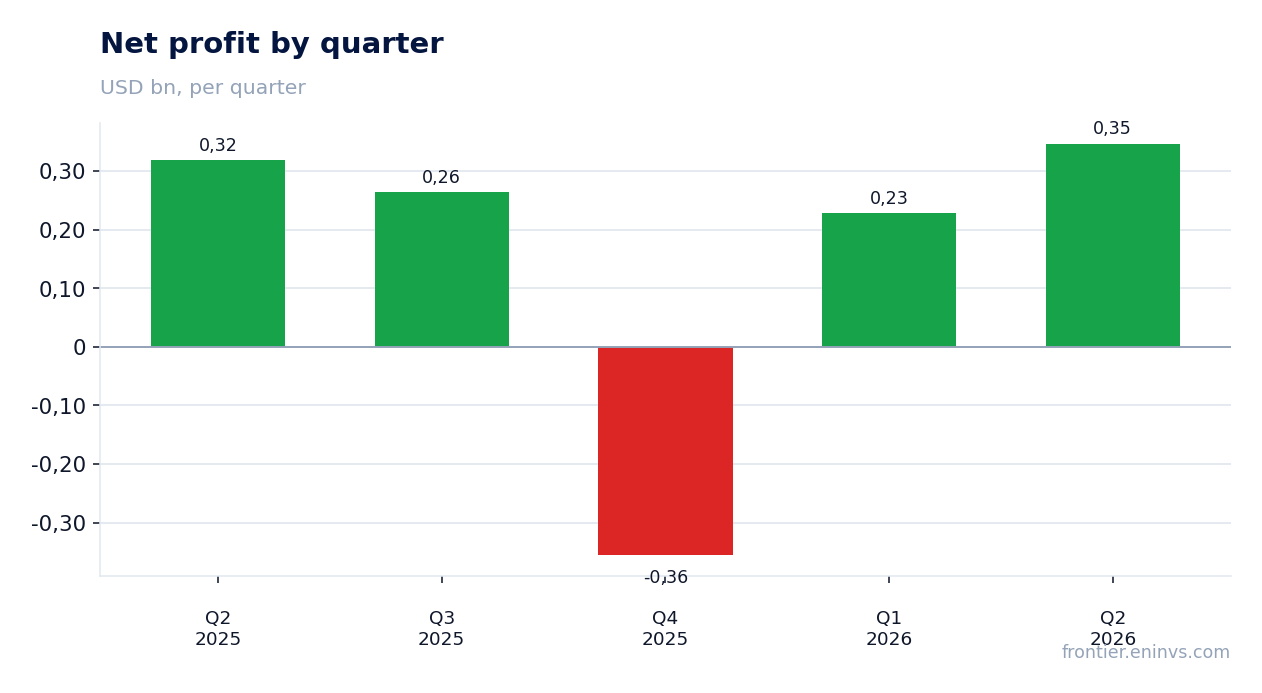
— Q2 net profit increased 9.0% year-on-year to $346.6 million, with a net margin of 7.5%
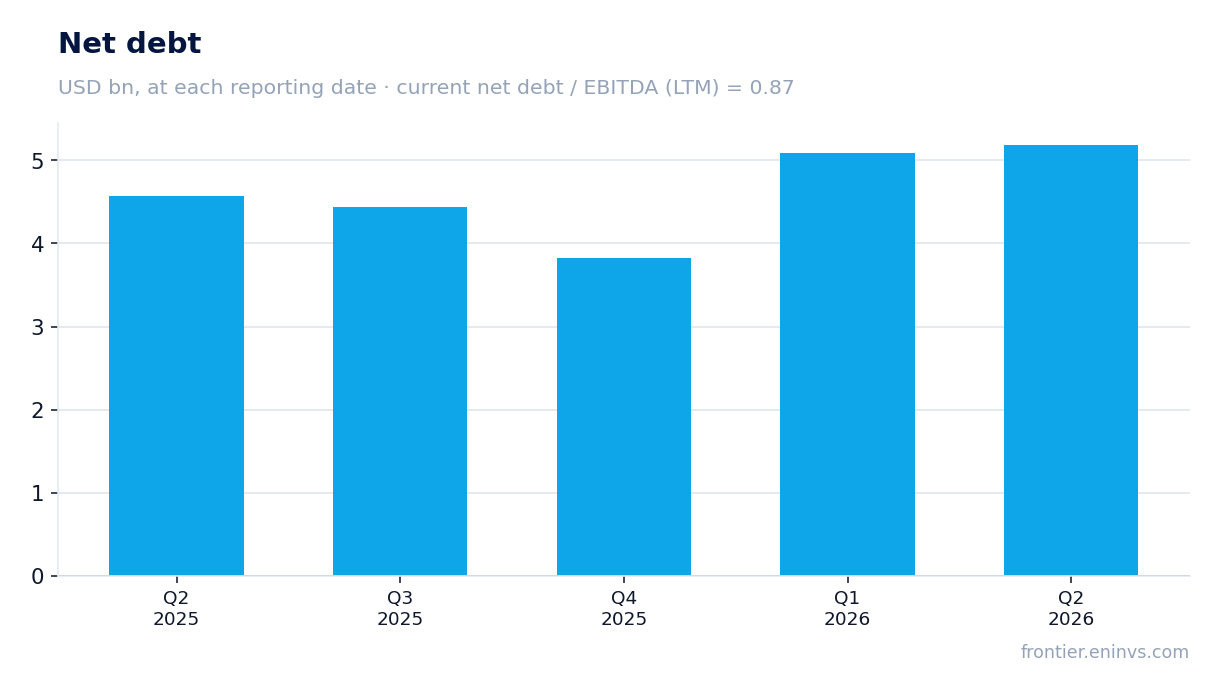
— Leverage remains moderate: net debt/EBITDA for the trailing twelve months is 0.87x
— Operating cash flow for the trailing twelve months was $2,000.0 million, supporting dividend payments
— Dividend yield for the trailing twelve months is 1.3%, below the yield on alternative investments
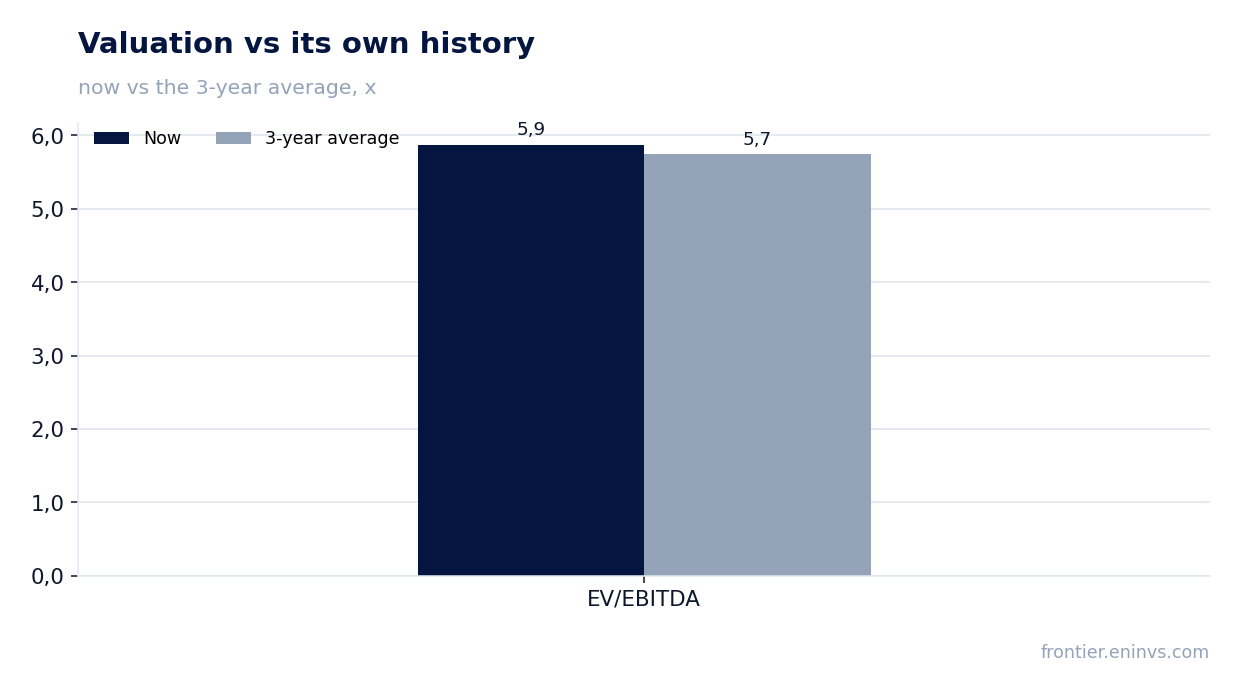
— EV/EBITDA of 5.87x is slightly above its own three-year average of 5.74x, offering no clear advantage
Attractiveness
Key figures, USD bn
Metric
Q2 2025
Q2 2026
Change
Revenue
4.09
4.59
+12.2%
EBITDA
0.84
0.90
+6.6%
Operating profit
0.49
0.68
+37.6%
Net profit
0.32
0.35
+9.0%
Operating cash flow
0.36
0.75
+107.5%
EBITDA margin
20.6%
19.6%
-1.0 pp
Net margin
7.8%
7.5%
-0.3 pp
Q2 revenue rose 12.2% year-on-year to $4,593.4 million, but EBITDA margin fell to 19.6% from 20.6%
Cemex's Q2 2026 revenue reached $4,593.4 million, up 12.2% year-on-year. This is a notable acceleration from previous quarters: Q1 2026 revenue was $4,019.0 million, Q4 2025 was $4,179.8 million. The growth is likely driven by higher sales volumes or cement prices, but the exact cause is not disclosed in the provided data.
However, EBITDA margin fell to 19.6% from 20.6% in Q2 2025. This means costs grew faster than revenue. EBITDA increased only 6.6% year-on-year to $1,018.3 million, while revenue rose 12.2%. This gap points to cost pressure, possibly from energy or logistics, but specific factors are not detailed in the report.
The margin decline alongside revenue growth is the key takeaway. If the company cannot restore profitability, revenue growth will translate less into profit. In the next quarter, watch cost dynamics and the ability to pass cost increases on to customers.
Q2 2026 EBITDA was $1,018.3 million, up 6.6% from Q2 2025. For comparison, Q1 2026 EBITDA was $794.0 million, Q4 2025 was $781.0 million. There is growth, but it significantly lags the 12.2% revenue increase.
This lag is explained by faster growth in operating expenses. Q2 operating profit was $680.6 million versus $494.5 million a year earlier, up 37.6%. This is higher than EBITDA growth, which may indicate lower depreciation or a change in cost structure. However, without a detailed breakdown, the exact cause cannot be identified.
EBITDA for the trailing twelve months was $3,040.8 million. This metric is important for assessing debt burden and dividend sustainability. If the margin continues to decline, annual EBITDA could come under pressure, affecting the ability to service debt and pay dividends.
Net profit by quarter
Q2 net profit increased 9.0% year-on-year to $346.6 million, with a net margin of 7.5%
Cemex's Q2 2026 net profit was $346.6 million, up 9.0% year-on-year. Net margin declined to 7.5% from 7.8% in Q2 2025. This decline is smaller than the EBITDA margin drop, which may be due to one-off factors or changes in tax burden.
Net profit for the trailing twelve months was $482.7 million. This includes a Q4 2025 loss of $355.7 million, likely due to one-off write-offs or impairments. Without this loss, annual profit would be significantly higher. It is important to understand that one-off factors can distort the assessment of profit sustainability.
Net profit growth of 9.0% despite a lower EBITDA margin suggests the company partially offset operational pressure through other items, possibly lower interest expenses or tax optimization. However, the sustainability of this trend is questionable.
Net debt at reporting dates
Leverage remains moderate: net debt/EBITDA for the trailing twelve months is 0.87x
Cemex's net debt at the latest reporting date was $2,635.0 million. The net debt/EBITDA ratio for the trailing twelve months is 0.87x. This is a moderate level that does not raise concerns. However, the facts do not provide the previous value of this ratio, so it cannot be stated whether leverage has decreased or increased.
Absolute net debt increased by 0.6 billion rubles over 12 months (the currency in the facts is USD, but the change is given in rubles, which may be a technical detail). Rising debt with stable EBITDA could lead to a higher ratio if EBITDA does not grow. For now, the 0.87x level remains comfortable.
Interest expenses are not disclosed in the facts, but at this leverage level they are likely not critical. In the next report, watch the dynamics of net debt and EBITDA to see if the current leverage level is maintained.
Valuation vs its own history
Operating cash flow for the trailing twelve months was $2,000.0 million, supporting dividend payments
Cemex's operating cash flow for the trailing twelve months was $2,000.0 million. This is a substantial amount that covers capital expenditures and dividends. In Q2 2026, operating cash flow was $749.3 million, significantly higher than in Q1 (141.0 million) and Q2 2025 (361.1 million).
Capital expenditures are only given for Q1 2026 in the facts – $145.0 million. If this level is extrapolated for the year, capex could be around $580 million, well below operating cash flow. This leaves room for dividends and debt reduction. However, without data for other quarters, the exact annual figure is unknown.
Dividend yield for the trailing twelve months is 1.3%. At the current share price, this is a low level that may not attract income-oriented investors. However, stable operating cash flow allows the company to maintain payments.
Dividend yield for the trailing twelve months is 1.3%, below the yield on alternative investments
Cemex's dividend yield for the trailing twelve months is 1.3%. This is lower than the yield on many debt instruments and is unlikely to attract income-oriented investors. The company is not a high-yield dividend story.
The facts do not provide the dividend per share or payout ratio, so it is impossible to assess what share of profit the company allocates to dividends. However, with net profit for the trailing twelve months of $482.7 million and a market capitalisation of $15,225.9 million, a 1.3% dividend yield corresponds to annual payments of about $198 million. This is roughly 41% of net profit, a moderate level.
If profit remains under pressure due to margin decline, the company may maintain or increase the dividend, but growth in payments is unlikely. For income-oriented investors, this stock is not attractive.
EV/EBITDA of 5.87x is slightly above its own three-year average of 5.74x, offering no clear advantage
Cemex's EV/EBITDA multiple currently stands at 5.87x. This is slightly above its own three-year average of 5.74x. Thus, the stock is valued a bit more expensively than its average over the past three years. This offers no clear advantage for buying.
For comparison, the P/E for the trailing twelve months is 31.5x, which is a high level. However, this may be distorted by the one-off loss in Q4 2025. Without it, profit would be higher and P/E lower. EV/EBITDA is more stable as it does not account for one-off write-offs.
According to the portal's model, the upside to fair value is +4%. This is a very modest potential that does not justify aggressive buying. Given the current valuation and margin pressure, the stock looks neutral.
Valuation on the latest reported figures
Metric
Value
Market cap
15.2 bn USD
P/E (LTM)
31.5
EV/EBITDA (LTM)
5.9
P/B
1.18
Net debt / EBITDA (LTM)
0.87
Operating cash flow (LTM)
2.00 bn
ROE
10.8%
Dividend yield (12m)
1.3%
EV/EBITDA, 3-year average
5.7
Bottom line
Cemex showed 12.2% revenue growth in Q2, but EBITDA margin fell to 19.6%, indicating cost pressure. Net profit rose 9.0%, but the annual figure is distorted by a one-off loss in Q4. Leverage remains moderate, and operating cash flow is sufficient to cover capex and dividends. However, dividend yield is only 1.3%, and EV/EBITDA is slightly above its own three-year average. The stock looks neutral: revenue growth is not accompanied by improved efficiency, and the portal model's upside is only +4%.
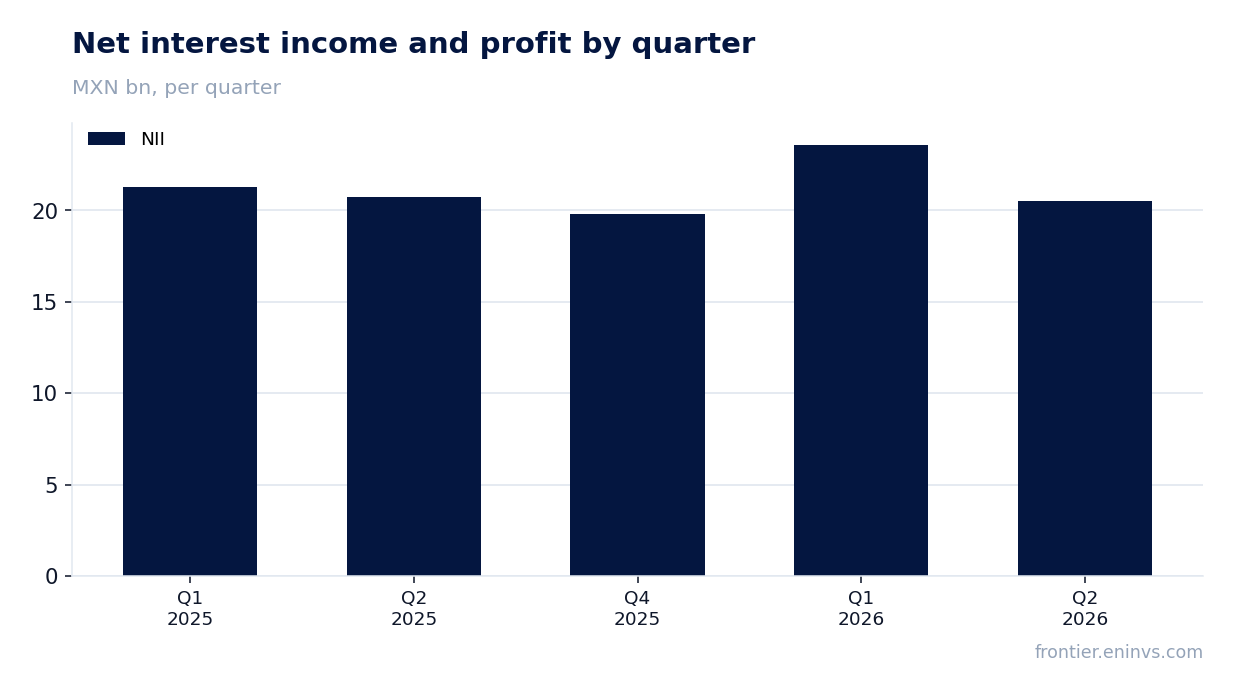
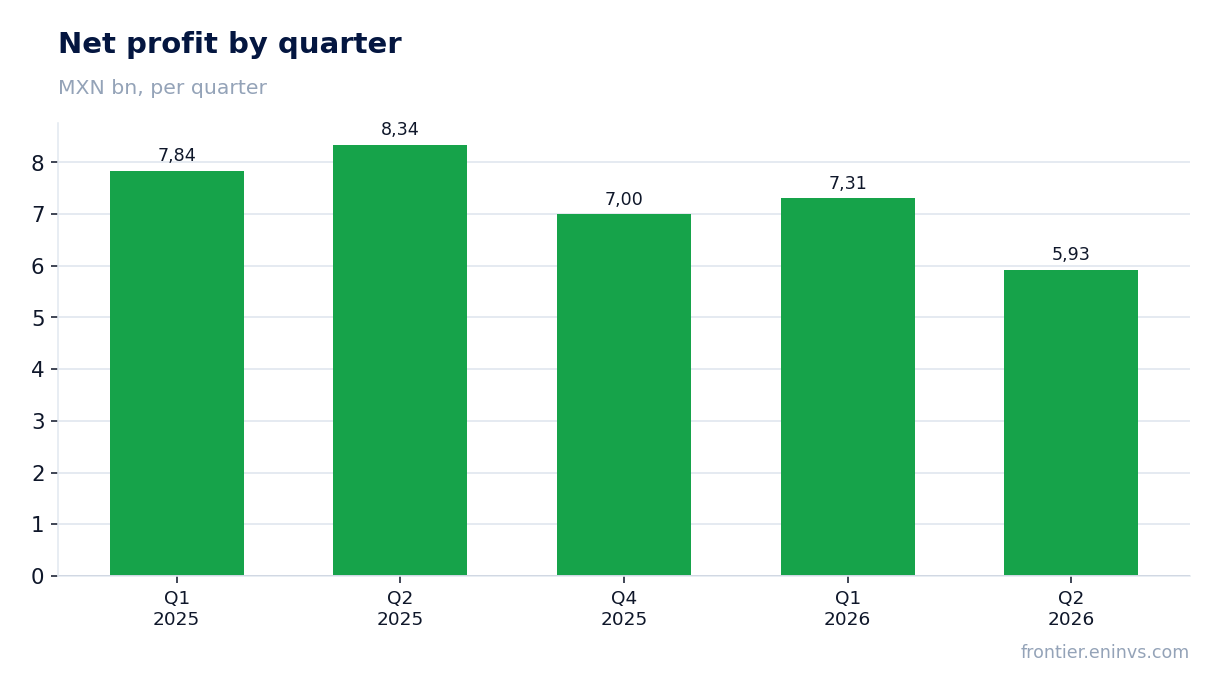
MX_INBURSA reported its second-quarter 2026 results. Net profit for the reported period fell 29.0% year on year to MXN 5,926.4 million, while net interest income in the second quarter came in at MXN 20,515.5 million, down 1.0% from a year earlier. Over the trailing twelve months the bank earned MXN 30,931.2 million in net profit on net interest income of MXN 83,200.0 million. At a trailing P/E of 8.28 and a return on equity of 8.3%, the share looks rather attractive, but the weakness in second-quarter net interest income needs confirmation of a turn.
Key takeaways
— Second-quarter net profit fell 29.0% year on year to MXN 5,926.4 million — the lowest in five quarters
— Second-quarter net interest income declined 1.0% year on year to MXN 20,515.5 million, while in the first quarter it grew 10.9%
— A return on equity of 8.3% at a trailing P/E of 8.28 leaves room for a re-rating if profit returns to growth
— The trailing twelve-month dividend yield of 2.6% is modest against the key rate, but the payout is stable
— On the portal's model the share trades at a 9% discount to fair value, supporting its appeal at the current price
— The absence of one-offs in second-quarter profit makes the year-on-year comparison clean, but does not explain the cause of the decline
Attractiveness
Key figures, MXN bn
Metric
Q2 2025
Q2 2026
Change
Net profit
8.34
5.93
-29.0%
Second-quarter net profit fell 29.0% year on year to MXN 5,926.4 million — the lowest in five quarters
In the second quarter of 2026, MX_INBURSA earned MXN 5,926.4 million in net profit. That is 29.0% less than a year earlier and 18.9% less than in the first quarter of the current year. The profit decline came alongside a fall in net interest income, which stood at MXN 20,515.5 million — 1.0% below the second quarter of 2025 and 13.1% below the first quarter of 2026.
Profit dynamics have deteriorated for two consecutive quarters: MXN 7,002.4 million in the fourth quarter of 2025, MXN 7,306.5 million in the first quarter of 2026, and MXN 5,926.4 million in the second. Such a sequential decline points to pressure on the interest margin that is not being offset by other revenue lines. Without access to the breakdown of costs and provisions, it is hard to pinpoint the cause, but the scale of the profit drop against relatively stable interest income suggests higher expenses or provisions.
For a shareholder, it matters that the profit decline is not accompanied by one-off write-offs that could be excluded. This means the current profit level is the new base from which recovery will be measured. If margin pressure persists in the third quarter, full-year profit could fall short of consensus expectations, limiting the share's upside.
Revenue and EBITDA by quarter
Second-quarter net interest income declined 1.0% year on year to MXN 20,515.5 million, while in the first quarter it grew 10.9%
Net interest income — the bank's main revenue source — came in at MXN 20,515.5 million in the second quarter. That is 1.0% less than in the second quarter of 2025, when the figure was MXN 20,729.1 million. The contrast with the first quarter, where growth was 10.9% year on year, is stark: the dynamics of interest income have reversed sharply.
The decline in interest income could stem from either a contraction in earning assets or a fall in the interest margin. Without data on average balances and funding costs, the exact cause cannot be named, but the fact that income fell 1.0% while Mexican inflation is above 4% means the real margin is shrinking. If this is a consequence of higher deposit costs, the pressure may persist as long as the key rate remains high.
For assessing the sustainability of the business, it matters that net interest income over the trailing twelve months was MXN 83,200.0 million. That is roughly 2.6% more than the sum of the four quarters from mid-2025, suggesting that overall the bank is still growing, but a turning point emerged in the second quarter of 2026. The next quarter will show whether this was a one-off blip or the start of a trend.
Net profit by quarter
A return on equity of 8.3% at a trailing P/E of 8.28 leaves room for a re-rating if profit returns to growth
MX_INBURSA earns 8.3% on equity over the trailing twelve months. That is a low figure for the banking sector, where sustainable profitability typically exceeds 10–12%. At the same time, the share trades at a trailing P/E of 8.28, implying an earnings yield of about 12.1% — a spread of roughly 3.8 percentage points over the return on equity.
Such a spread may be justified if the market expects further profit declines. However, if profit stabilises at the current level or begins to grow, the multiple could expand. On the portal's model, which compares return on equity with the price-to-book ratio, the share is undervalued by 9% relative to fair value. This is not a consensus forecast but our own estimate, and it points to upside at the current price.
For a shareholder, the key question is whether the bank can keep its return on equity above 8% amid slowing interest income. If profitability drops below 7%, the discount to fair value may disappear and the share would cease to look attractive. Conversely, a return to 10% ROE at the same multiple would deliver notable upside.
The trailing twelve-month dividend yield of 2.6% is modest against the key rate, but the payout is stable
Over the trailing twelve months, MX_INBURSA paid dividends that provided a yield of 2.6% at the current price. That is below the yield on Mexican government bonds, which has exceeded 9% in recent months, and below the Bank of Mexico's key rate. For an income-oriented investor, such a yield looks insufficient.
Our estimate for the current year's dividend assumes the payout remains close to its historical level. With trailing twelve-month net profit of MXN 30,931.2 million and a market capitalisation of MXN 256,233.2 million, paying out half of profit would give a yield of about 6.0%. However, the actual yield is half that, suggesting a conservative approach to profit distribution or that part of profit is retained to support capital.
What could make the dividend smaller: a further decline in profit, tighter capital requirements, or higher provisioning costs. If profit in the second half remains at the second-quarter level, the annual dividend could come under pressure. For a current shareholder, the dividend is not the main source of return but rather a welcome addition to potential capital gains.
On the portal's model the share trades at a 9% discount to fair value, supporting its appeal at the current price
Our model, which compares return on equity with the price-to-book ratio, shows that MX_INBURSA's share is undervalued by 9% relative to fair value. This means that at the current level of profit and capital, the market values the bank below its fundamental worth. Such a discount may stem from concerns about the sustainability of the interest margin.
The trailing P/E of 8.28 is neither high nor low without comparison to history. We do not have data on the three-year average, so we cannot say whether the share trades above or below its historical level. However, the combination of an 8.3% ROE and a P/E of 8.28 produces a ratio that looks attractive to a long-term investor if profit stabilises.
If profit returns to growth, the discount could narrow, delivering above-market returns. If margin pressure persists, fair value may be revised downward and the current price would prove adequate. Thus, the assessment of the share's appeal depends directly on whether the bank can stabilise net interest income.
The absence of one-offs in second-quarter profit makes the year-on-year comparison clean, but does not explain the cause of the decline
Unlike many banks, MX_INBURSA did not report one-off write-offs or gains that would distort the year-on-year profit comparison. This means the 29.0% decline reflects a genuine deterioration in operating performance rather than accounting effects. For an investor this is both good and bad: good because earnings quality is high, bad because the problem is fundamental.
The cause of the profit decline against relatively stable interest income likely lies in higher operating expenses or provisions. Without access to the report's breakdown, we cannot name the exact line, but the scale of the profit drop — MXN 1,380.0 million year on year — against a fall in interest income of only MXN 213.6 million suggests the main hit came on the expense side.
For the next report, the key question will be whether this level of expenses persists. If the cost increase was one-off, profit could recover quickly. If it is a new trend, the bank will need time to adapt its model. In any case, the absence of one-offs makes forecasting more predictable, but does not remove the need to understand the causes.
Valuation on the latest reported figures
Metric
Value
Market cap
256 bn MXN
P/E (LTM)
8.3
P/B
0.92
ROE
8.3%
Dividend yield (12m)
2.6%
Bottom line
Bottom line: MX_INBURSA delivered a weak second quarter — profit fell 29.0% year on year, and net interest income declined for the first time in a year. However, an 8.3% return on equity and a trailing P/E of 8.28 leave room for a re-rating if the bank can stabilise its margin. The 2.6% dividend yield is modest but the payout is stable, and on the portal's model the share is 9% undervalued. The key question for a shareholder now is whether the bank can restore growth in interest income in the third quarter; if so, the current price looks attractive, if not, the share may remain under pressure.
MX_GAP reported second-quarter 2026 results. Revenue grew 3.7% year-on-year, EBITDA rose 8.4%, net profit increased 9.0%, and the EBITDA margin reached 52.8%. However, operating cash flow for the quarter was only MXN 2,637.0 million versus MXN 4,379.7 million a year earlier, while net debt rose to MXN 45,893.6 million. With an EV/EBITDA of 9.9 against its own three-year average of 12.7 and the portal model indicating –3% upside, the stock looks neutral: profitability is strong, but cash flow and leverage are concerning.
Key takeaways
— Revenue grew 3.7% year-on-year, but quarterly operating cash flow fell more than 40%
— EBITDA margin rose to 52.8% as EBITDA grew faster than revenue
— Net profit increased 9.0% year-on-year, but the quarterly result was lower than the previous quarter
— Net debt rose to MXN 45,893.6 million, with net debt/EBITDA LTM at 1.61 – a moderate level
— EV/EBITDA of 9.9 is below its own three-year average of 12.7, indicating undervaluation on this multiple
— The portal model estimates –3% upside to fair value, implying no significant growth
Attractiveness
Key figures, MXN bn
Metric
Q2 2025
Q2 2026
Change
Revenue
10.9
11.3
+3.7%
EBITDA
5.50
5.97
+8.4%
Operating profit
4.58
4.99
+8.9%
Net profit
2.66
2.89
+9.0%
Operating cash flow
4.38
2.64
-39.8%
EBITDA margin
50.6%
52.8%
+2.2 pp
Net margin
24.4%
25.6%
+1.2 pp
Revenue grew 3.7% year-on-year, but quarterly operating cash flow fell more than 40%
In the second quarter of 2026, MX_GAP's revenue reached MXN 11,289.7 million, up 3.7% year-on-year. This continues the growth trend, but the pace remains modest. For comparison, in the first quarter of 2026 revenue was MXN 11,369.6 million, so sequentially it even declined slightly.
Operating cash flow for the quarter was MXN 2,637.0 million, down 40% from MXN 4,379.7 million in the second quarter of 2025. This is a sharp divergence from profit growth. Over the trailing twelve months, operating cash flow is MXN 18,200.0 million, but the quarterly dynamics raise questions.
The decline in cash flow despite revenue and profit growth may indicate deteriorating earnings quality or an increase in working capital. Without additional details from the report, the exact cause is unclear, but this is a key risk for investors.
Revenue and EBITDA by quarter
EBITDA margin rose to 52.8% as EBITDA grew faster than revenue
EBITDA in the second quarter of 2026 was MXN 5,965.3 million, up 8.4% year-on-year. EBITDA growth outpaced revenue growth (3.7%), leading to an expansion in the EBITDA margin to 52.8% from 50.6% a year earlier.
The net profit margin also improved: 25.6% versus 24.4% a year earlier. Net profit for the quarter was MXN 2,893.5 million, up 9.0% year-on-year.
Margin improvement is a strong point of the report. However, the sustainability of this trend depends on keeping costs under control. In the next report, it is worth monitoring the dynamics of operating expenses.
Net profit by quarter
Net profit increased 9.0% year-on-year, but the quarterly result was lower than the previous quarter
Net profit in the second quarter of 2026 was MXN 2,893.5 million, up 9.0% from the second quarter of 2025. However, compared to the first quarter of 2026 (MXN 3,312.0 million), profit declined by 12.6%.
This dynamics may be due to seasonal factors or one-off effects, but without details from the report, the exact cause is unclear. Over the trailing twelve months, net profit amounted to MXN 10,257.4 million.
The net profit margin remains high at 25.6%. This supports the valuation of the business, but the quarterly decline in profit may concern investors.
Net debt rose to MXN 45,893.6 million, with net debt/EBITDA LTM at 1.61 – a moderate level
Net debt at the end of the second quarter of 2026 was MXN 45,893.6 million, an increase of MXN 3.3 billion compared to the previous reporting date. The net debt/EBITDA LTM ratio is 1.61, which is a moderate level for a company with high profitability.
The increase in debt may be related to financing investments or to deteriorating cash flow. It is important to note that operating cash flow for the quarter was low, which could have forced the company to raise borrowed funds.
The debt level does not cause immediate concern, but its further growth amid weak cash flow could become a problem. In the next report, it is worth monitoring the dynamics of debt and interest expenses.
Valuation vs its own history
EV/EBITDA of 9.9 is below its own three-year average of 12.7, indicating undervaluation on this multiple
The current EV/EBITDA LTM multiple is 9.9, below its own three-year average of 12.7. This may indicate that the stock is trading at a discount to its historical valuation.
However, the P/E LTM is 16.8, which may also be an attractive level. Return on equity (ROE) is 29.5%, confirming the high efficiency of the business.
Comparison with history shows that the market values the company more modestly than on average over the past three years. This creates potential for re-rating if financial performance continues to improve.
The portal model estimates –3% upside to fair value, implying no significant growth
According to the portal model, the fair value of MX_GAP shares is 3% below the current market price. This means the stock is valued close to its fair value, and upside potential is limited.
The model takes into account EBITDA growth and a target multiple. At current profit growth rates and moderate debt levels, the stock is unlikely to show significant growth in the short term.
Nevertheless, if the company can improve cash flow and reduce debt, this could lead to a revaluation. For now, the model indicates a neutral assessment.
Valuation on the latest reported figures
Metric
Value
Market cap
172 bn MXN
P/E (LTM)
16.8
EV/EBITDA (LTM)
9.9
P/B
7.67
Net debt / EBITDA (LTM)
1.61
Operating cash flow (LTM)
18.2 bn
ROE
29.5%
EV/EBITDA, 3-year average
12.7
Bottom line
MX_GAP delivered strong profit and margin results: EBITDA grew 8.4%, net profit rose 9.0%, and the EBITDA margin reached 52.8%. However, operating cash flow for the quarter fell sharply, and net debt increased to MXN 45,893.6 million. The EV/EBITDA multiple of 9.9 is below its own three-year average of 12.7, which may indicate undervaluation, but the portal model does not imply significant growth. The stock looks neutral: strong profitability is offset by weak cash flow and moderate debt.
On 25 August MX_OMA released its Q2 2026 results. Revenue rose 2.6% year on year to MXN 4,466.5 mn, EBITDA – by 6.2%, net profit – by 9.8%. The EBITDA margin improved to 59.9% from 57.9%, and the net margin to 32.8% from 30.7%. Yet revenue is growing at only 2.6% – a modest pace – and the main contribution to profit comes not from business expansion but from lower relative costs. Leverage remains below one EBITDA, and the dividend yield exceeds 5.8%. In our view, the share looks attractive for a dividend-oriented investor, but limited revenue growth and no clear acceleration driver prevent it from being called unambiguously undervalued.
Key takeaways
— Revenue grew just 2.6% year on year, and that is the main constraint on the story
— EBITDA margin rose to 59.9% – profit is growing faster than revenue on the back of costs
— Net profit added 9.8% year on year, with no visible one-offs
— Leverage at 0.99 EBITDA LTM is comfortable, but absolute debt rose by MXN 1.8 bn in the quarter
— Free cash flow remains under pressure from capital expenditure
— Dividend yield of 5.8% is above the key rate, and that is the key argument for the share
— EV/EBITDA of 9.3x is slightly below its own three-year average of 9.5x, but offers no cushion
Attractiveness
Key figures, MXN bn
Metric
Q2 2025
Q2 2026
Change
Revenue
4.35
4.47
+2.6%
EBITDA
2.52
2.68
+6.2%
Operating profit
2.30
2.39
+4.1%
Net profit
1.34
1.47
+9.8%
Operating cash flow
1.82
1.76
-3.3%
EBITDA margin
57.9%
59.9%
+2.0 pp
Net margin
30.7%
32.8%
+2.1 pp
Revenue grew just 2.6% year on year, and that is the main constraint on the story
Revenue in Q2 2026 came in at MXN 4,466.5 mn, up 2.6% from MXN 4,353.2 mn a year earlier. This is a modest pace that lags noticeably behind profit dynamics. The bulk of revenue, given the scale of the business, comes from the core segment, but the facts do not provide a breakdown by business line.
Over the trailing twelve months revenue reached MXN 16,300.0 mn. That is roughly 3.6 times the quarterly figure, indicating a stable base. However, annual growth of 2.6% is a pace that does not create an operating leverage effect. Acceleration would require either tariff increases or volume growth, but the facts contain no indication that either occurred.
Weak revenue growth is the main risk to the story. If it stays at 2–3%, then even with margin expansion profit will grow only moderately. The investor should watch whether the next report shows revenue acceleration, or at least signs of it.
Revenue and EBITDA by quarter
EBITDA margin rose to 59.9% – profit is growing faster than revenue on the back of costs
EBITDA in Q2 2026 was MXN 2,623.1 mn, up 6.2% from MXN 2,513.5 mn a year earlier. The EBITDA margin rose to 59.9% from 57.9% a year earlier. This means the company not only maintained but improved cost control: with revenue up 2.6%, EBITDA grew 6.2%.
The outperformance of EBITDA is explained by costs growing slower than revenue. The facts do not provide a breakdown by line item, but the very fact of a 2 percentage point margin improvement suggests the company either cut variable costs or benefited from fixed-cost leverage. This is an important positive signal, but it cannot offset weak revenue growth indefinitely.
A margin of 59.9% is a very high level that is hard to improve further. If revenue stays flat, further EBITDA growth is possible only through cost cuts, and that reserve is limited. Therefore, profit sustainability will depend on the company's ability to resume revenue growth.
Net profit by quarter
Net profit added 9.8% year on year, with no visible one-offs
Net profit in Q2 2026 was MXN 1,466.5 mn, up 9.8% from MXN 1,335.5 mn a year earlier. Profit growth outpaces EBITDA growth, which may be explained by lower interest expenses or tax burden. The facts contain no data on one-off items, so profit appears organic.
The net margin rose to 32.8% from 30.7% a year earlier. This also confirms that margin improvement is occurring at all levels. However, it is worth remembering that profit growth of 9.8% with revenue growth of 2.6% is the result of faster cost reduction, not business expansion.
Over the trailing twelve months net profit reached MXN 5,421.2 mn. That is roughly 3.7 times the quarterly figure, indicating stability. If the company can maintain the current margin level, annual profit may remain at this level or grow slightly.
Net debt at reporting dates
Leverage at 0.99 EBITDA LTM is comfortable, but absolute debt rose by MXN 1.8 bn in the quarter
Net debt at the latest reporting date was MXN 9,638.2 mn. The ratio of net debt to EBITDA over the trailing twelve months is 0.99. This is a comfortable level that does not create risks to financial stability. However, compared with the previous reporting date, net debt rose by MXN 1.8 bn, and over twelve months – by MXN 1.5 bn.
The rise in absolute debt with stable leverage is explained by EBITDA growth, which over the trailing twelve months reached MXN 9,714.5 mn. The company can service its debt without strain. Interest expenses are likely moderate, but the facts do not disclose them.
It is important to note that leverage below one EBITDA is a strength. However, if revenue does not accelerate and debt continues to grow, the ratio could start to rise. For now, the debt level is not a problem.
Valuation vs its own history
Free cash flow remains under pressure from capital expenditure
Operating cash flow in Q2 2026 was MXN 1,758.9 mn, slightly below MXN 1,819.0 mn a year earlier. Capital expenditure in Q1 2026 was MXN 841.6 mn, while Q2 data are absent. Assuming capital expenditure remains at a comparable level, free cash flow could be close to MXN 900–1,000 mn.
Over the trailing twelve months operating cash flow reached MXN 7,400.0 mn. This is a solid base, but capital expenditure likely consumes a significant portion. The facts do not provide Q2 capital expenditure, so free cash flow cannot be precisely estimated.
Nevertheless, the ability to generate operating cash flow remains key for dividend payments. If capital expenditure stays at the Q1 level, the company can fund dividends from free cash flow, but the cushion may be small.
Dividend yield of 5.8% is above the key rate, and that is the key argument for the share
The dividend yield over the trailing twelve months is 5.8%. This is above the current key rate, making the share attractive for income-oriented investors. The company appears to pay dividends regularly, but the facts do not provide the exact size of the latest payment or the payout ratio.
Our estimate of the future dividend is based on current profit. Over the trailing twelve months net profit was MXN 5,421.2 mn. If the company maintains a payout ratio that provides a 5.8% yield, the annual dividend could be around MXN 4,700 mn. However, this is our estimate, and it depends on profit and dividend policy.
The risk of a dividend cut is linked to a possible decline in profit or an increase in capital expenditure. If free cash flow proves insufficient, the company may reduce payments. Nevertheless, the current yield looks sustainable given low leverage.
EV/EBITDA of 9.3x is slightly below its own three-year average of 9.5x, but offers no cushion
EV/EBITDA over the trailing twelve months is 9.3x. This is slightly below its own three-year average of 9.5x. Thus, the share trades a bit cheaper than its average over the past three years, but the difference is insignificant. P/E LTM is 14.9x.
On the portal's model, the fair value of the share based on EBITDA growth and the target multiple implies an upside of 9%. This is our own estimate, not a market consensus. It points to moderate upside, mainly supported by the dividend yield.
Given low leverage and high profitability, the current valuation looks fair. However, a significant upward revision would require accelerating revenue growth, which is not yet present. Therefore, the margin of safety is limited.
Valuation on the latest reported figures
Metric
Value
Market cap
81.0 bn MXN
P/E (LTM)
14.9
EV/EBITDA (LTM)
9.3
P/B
6.87
Net debt / EBITDA (LTM)
0.99
Operating cash flow (LTM)
7.40 bn
ROE
54.3%
Dividend yield (12m)
5.8%
EV/EBITDA, 3-year average
9.5
Bottom line
MX_OMA reported Q2 2026 results with revenue up 2.6%, EBITDA up 6.2%, and net profit up 9.8%. The strengths are high profitability and low leverage of 0.99 EBITDA LTM. The weakness is slow revenue growth, which does not create operating leverage. The dividend yield of 5.8% is above the key rate, making the share attractive for income-oriented investors. However, EV/EBITDA of 9.3x is only slightly below its own three-year average, and the upside on the portal's model is 9%. Overall, the share looks rather attractive, but without a significant margin of safety.
P/E and EV/EBITDA use LTM from up to four quarter rows when they look comparable (incl. Q2/Q4); if the feed is only Q1 and Q3, we use latest FY profit/EBITDA instead of summing them. P/B is market cap ÷ latest FY equity. Hover multiples for the exact formula. Financial rows: year(period_end) ≥ max(2023, current calendar year − 2) (hide older).