Grupo Bimbo: revenue falls for a second straight quarter, yet margin and profit rise on one-offs

On 29 July Grupo Bimbo released its second-quarter 2026 results. Revenue fell 2.2% year on year to MXN 105,025.8 million, EBITDA rose 1.6% to MXN 15,148.3 million, and net profit added 3.9% to MXN 2,934.9 million. The EBITDA margin rose to 14.4% from 13.9%, and the net margin to 2.8% from 2.6%. The stock trades below its own three-year average EV/EBITDA, and the portal model implies about 10% upside to fair value, so at the current price the share looks rather attractive than neutral.
Key takeaways
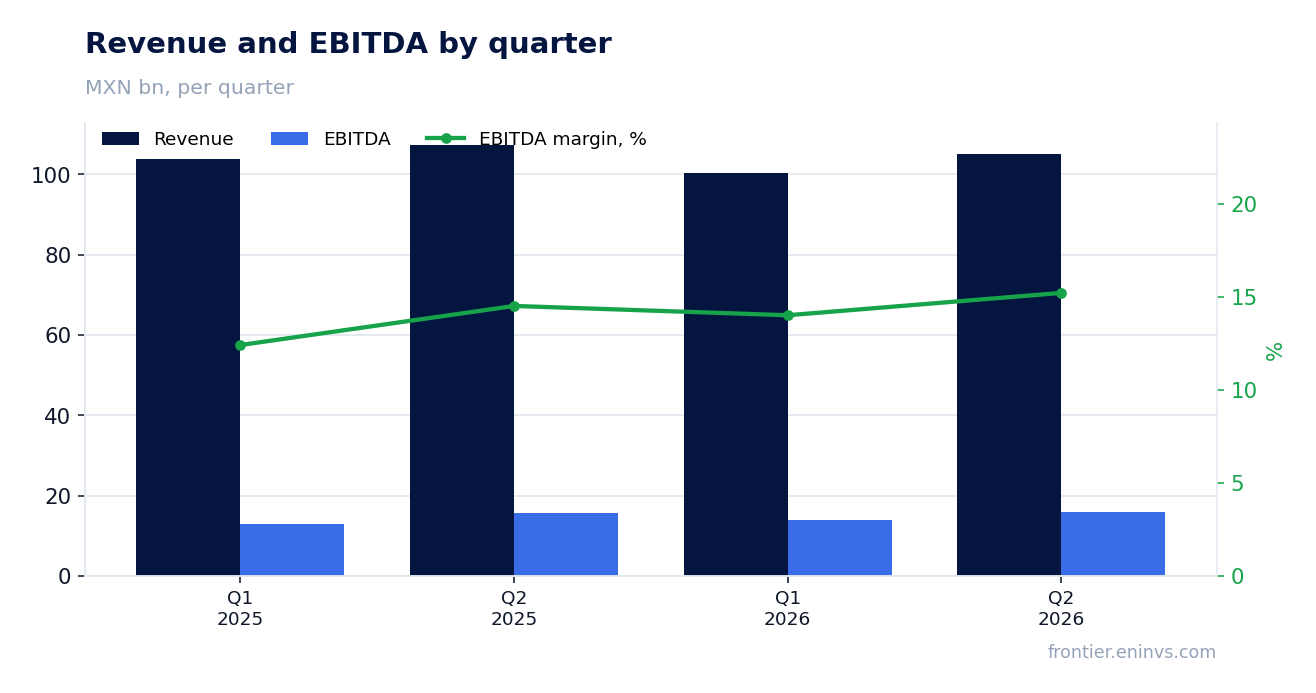
— Revenue falls for a second straight quarter: down 2.2% year on year to MXN 105,025.8 million
— EBITDA margin rose to 14.4% thanks to a one-off sale of a stake in a Mexican associate
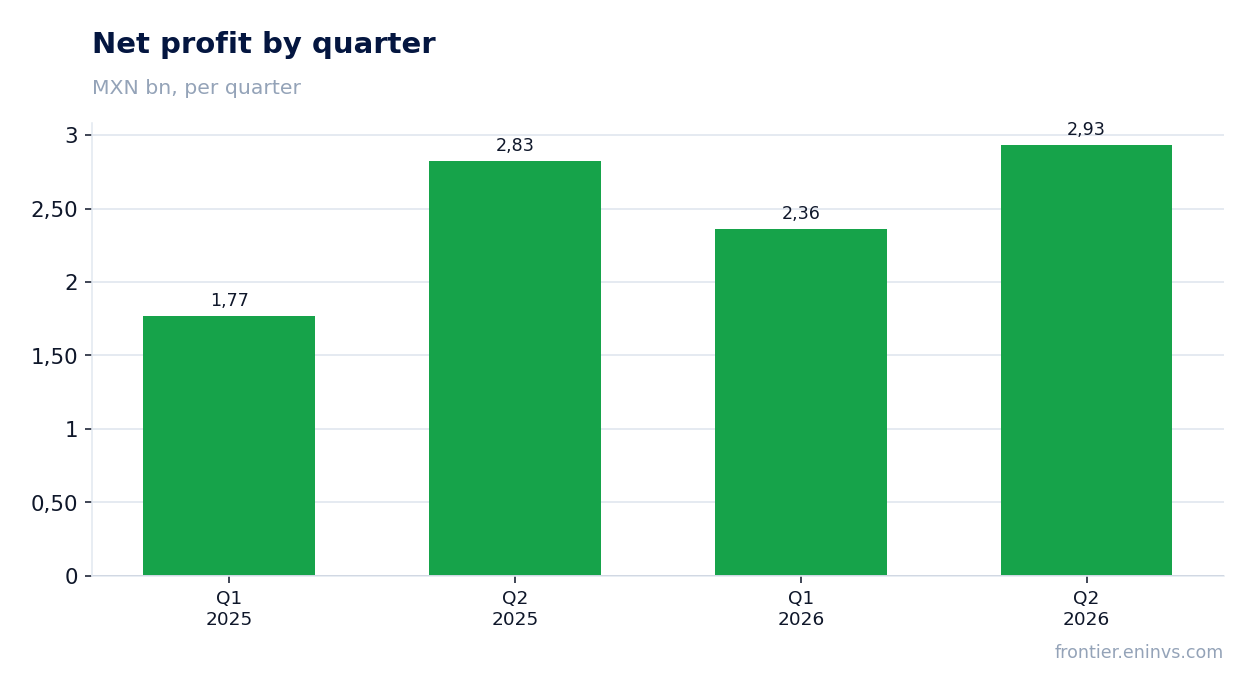
— Net profit added 3.9%, but its quality weakened on higher hedging costs
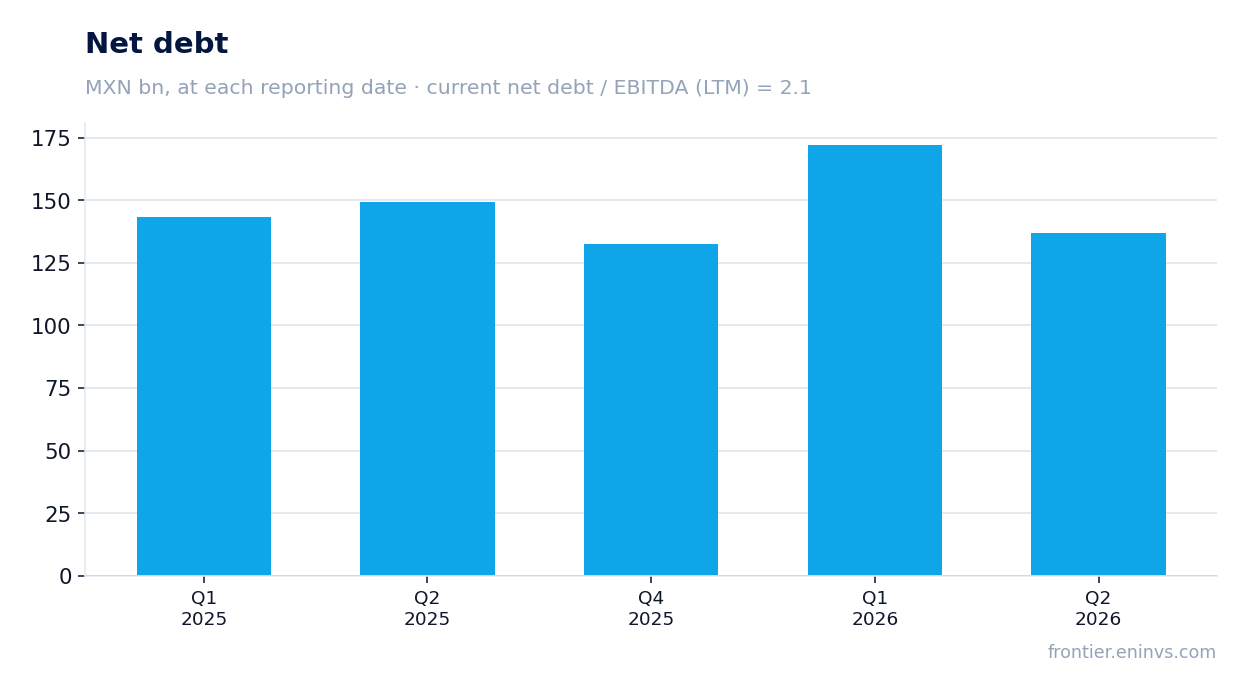
— Leverage at 2.1x LTM EBITDA is moderate, yet debt has grown over 12 months
— Free cash flow remains under pressure: operating cash flow fell to MXN 10,075.3 million
— Dividend yield of 1.95% is modest, but the payout is sustainable at current earnings
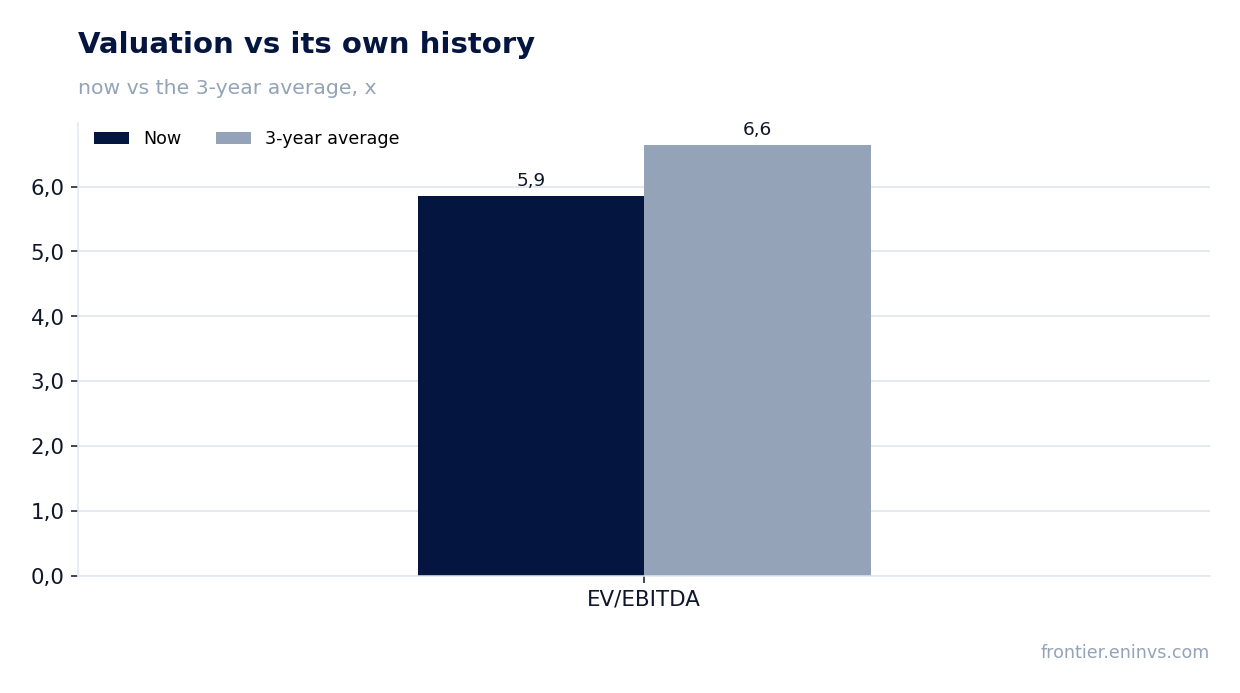
— EV/EBITDA of 5.86 is below the three-year average of 6.64, offering room to fair value
Attractiveness
Key figures, MXN bn
| Metric | Q2 2025 | Q2 2026 | Change |
|---|---|---|---|
| Revenue | 107 | 105 | -2.2% |
| EBITDA | 14.9 | 15.1 | +1.6% |
| Operating profit | 9.33 | 9.88 | +5.9% |
| Net profit | 2.83 | 2.93 | +3.9% |
| Operating cash flow | 10.6 | 10.1 | -4.6% |
| EBITDA margin | 13.9% | 14.4% | +0.5 pp |
| Net margin | 2.6% | 2.8% | +0.2 pp |
Revenue falls for a second straight quarter: down 2.2% year on year to MXN 105,025.8 million
In the second quarter of 2026, Grupo Bimbo's revenue was MXN 105,025.8 million, down 2.2% from a year earlier. This is the second consecutive quarterly decline: in the first quarter, the drop was 3.3%. The main reason is the appreciation of the Mexican peso, which reduces peso revenue when translating from other currencies. In its first-quarter report, the company noted that excluding FX effects, sales grew 4.8%, and a similar trend likely persisted in the second quarter, although the source does not provide exact second-quarter figures.
The peso decline does not mean the business is shrinking. In the first quarter, sales in Mexico reached a record MXN 39,726 million, North America grew 0.7% in local currency, and the EAA region grew 12.6%. These trends likely continued in the second quarter, but without confirmation from the second-quarter report, we cannot state this with certainty. For an investor, the key point is that operating performance in volume terms and local currencies remains strong, and the peso revenue decline is primarily a translation effect.
EBITDA margin rose to 14.4% thanks to a one-off sale of a stake in a Mexican associate
The EBITDA margin in the second quarter of 2026 was 14.4% versus 13.9% a year earlier. The 0.5 percentage point increase looks modest, but it is driven by an important one-off factor. In its first-quarter report, the company explicitly stated that the margin expansion in Mexico to a record 20.5% was largely due to a gain from the sale of a stake in an associate. That deal closed in the first quarter, but its effect likely carried over partially into the second quarter, although exact data on its contribution in the second quarter is not available.
Without this one-off, the margin would likely have remained at last year's level or even declined. Operating profit in the second quarter rose to MXN 9,876.7 million from MXN 9,326.1 million a year earlier, but net profit increased only 3.9% to MXN 2,934.9 million. This suggests that operating efficiency gains are partly offset by expenses below the operating line – primarily higher hedging costs. In the first quarter, the company noted a 6.6% increase in hedging costs, and this trend likely persisted.
Net profit added 3.9%, but its quality weakened on higher hedging costs
Net profit in the second quarter of 2026 was MXN 2,934.9 million, up 3.9% from a year earlier. However, profit growth would have been more modest without the one-off gain from the sale of the associate stake. In the first quarter, the company reported that net profit growth of 32.3% was largely driven by this deal, as well as strong operating performance. In the second quarter, the deal's effect was likely smaller but still supportive.
The main factor holding back profit growth was hedging costs. In the first quarter, comprehensive financing costs rose 6.6% due to mark-to-market losses on hedging instruments. This trend likely continued in the second quarter, reducing the quality of earnings. Investors should watch how sustainable profit growth is excluding one-offs and FX volatility.
Leverage at 2.1x LTM EBITDA is moderate, yet debt has grown over 12 months
Grupo Bimbo's net debt at the end of the second quarter of 2026 was MXN 137,097.1 million, with a net debt to LTM EBITDA ratio of 2.1x. This is a moderate level for a company with such a large operating base. However, over the past 12 months, net debt increased by MXN 12.3 billion, while compared to the previous reporting date it decreased by MXN 35.1 billion. The sequential decline is due to strong cash flow, but the annual increase indicates the company continues to invest and fund acquisitions.
The debt structure remains comfortable: average maturity is 9.8 years, average cost is 6.45%, and long-term debt accounts for 97% of the total. In the first quarter, the company noted that 43% of debt was denominated in US dollars, 41% in Mexican pesos, and the rest in euros, Canadian dollars, and British pounds. This diversification reduces currency risk, but the appreciation of the peso in recent months could increase the peso value of foreign-currency debt. Investors should monitor net debt dynamics and the debt/EBITDA ratio in coming quarters.
Free cash flow remains under pressure: operating cash flow fell to MXN 10,075.3 million
Operating cash flow in the second quarter of 2026 was MXN 10,075.3 million, lower than in the first quarter (MXN 15,111.1 million) but comparable to the second quarter of 2025 (MXN 10,562.5 million). The sequential decline may be due to seasonal factors and working capital growth. The company does not disclose working capital details for the second quarter, but in the first quarter it reported free cash flow of MXN 7,428 million, up MXN 4,633 million from a year earlier.
Capital expenditure in the second quarter is not disclosed, but in the first quarter it was MXN 2,743.2 million. Assuming similar capex in the second quarter, free cash flow could be around MXN 7,300 million. This is sufficient to cover dividend payments, but the 12-month increase in debt indicates the company is actively investing in growth and acquisitions. For investors, it is important that operating cash flow remains stable, as it is the main source of dividend funding and debt reduction.
Dividend yield of 1.95% is modest, but the payout is sustainable at current earnings
Grupo Bimbo's dividend yield over the past 12 months is 1.95%. This is a low level compared to the yield on Mexican government bonds, which has fluctuated around 8–10% in recent years. However, the company's dividend policy focuses on stable payments, and with LTM net profit of MXN 11,242.1 million and a market capitalisation of MXN 237,105.3 million, the payout ratio is about 41%. This is a moderate level that leaves room for investment and debt reduction.
In the current year, the dividend is likely to remain close to last year's level if earnings do not surprise. Our estimate assumes a payout ratio of around 40% of net profit. The main risks to the dividend are further appreciation of the peso, which could reduce peso earnings, and higher hedging costs. If LTM profit declines, the dividend could be revised downward. Nevertheless, the current payout level appears sustainable, and the dividend is not the main factor in the stock's attractiveness.
EV/EBITDA of 5.86 is below the three-year average of 6.64, offering room to fair value
On the LTM EV/EBITDA multiple, the stock trades at 5.86x, below the three-year average of 6.64x. This means the market values the company cheaper than its average over the past three years. On LTM P/E, the multiple is 21.1x, which may also indicate undervaluation compared to historical levels, although the three-year average P/E is not provided in the facts. Our valuation model, based on EBITDA growth and a target multiple, implies about 10% upside to fair value.
The lower multiple relative to history may reflect market concerns about the appreciation of the peso and its impact on revenue and profit. However, the company's fundamentals remain strong: LTM EBITDA was MXN 63,115.0 million, and operating cash flow was MXN 47,700.0 million. If the company can stabilise peso revenue and maintain margins, the multiple could revert to its average, providing additional upside. The main risk is further peso appreciation and pressure on earnings.
Valuation on the latest reported figures
| Metric | Value |
|---|---|
| Market cap | 237 bn MXN |
| P/E (LTM) | 21.1 |
| EV/EBITDA (LTM) | 5.9 |
| P/B | 1.98 |
| Net debt / EBITDA (LTM) | 2.10 |
| Operating cash flow (LTM) | 47.7 bn |
| ROE | 9.9% |
| Dividend yield (12m) | 2.0% |
| EV/EBITDA, 3-year average | 6.6 |
Bottom line
Grupo Bimbo reported second-quarter 2026 results with a 2.2% decline in peso revenue but a 1.6% rise in EBITDA and a 3.9% increase in net profit. Margin and profit growth were supported by a one-off gain from the sale of an associate stake, without which the results would have looked weaker. Leverage remains moderate, and the EV/EBITDA multiple is below its three-year average, offering about 10% upside to fair value on the portal model. The key question for a holder is whether the company can offset the pressure from a strong peso on revenue and profit. At the current price, the share looks rather attractive than neutral.
Open the company's financial profile BIMBO →
See also: market overview · valuation map · stock screeners