FEMSA: Q1 profit doubled, but almost all of the gain came from a one-off merger gain
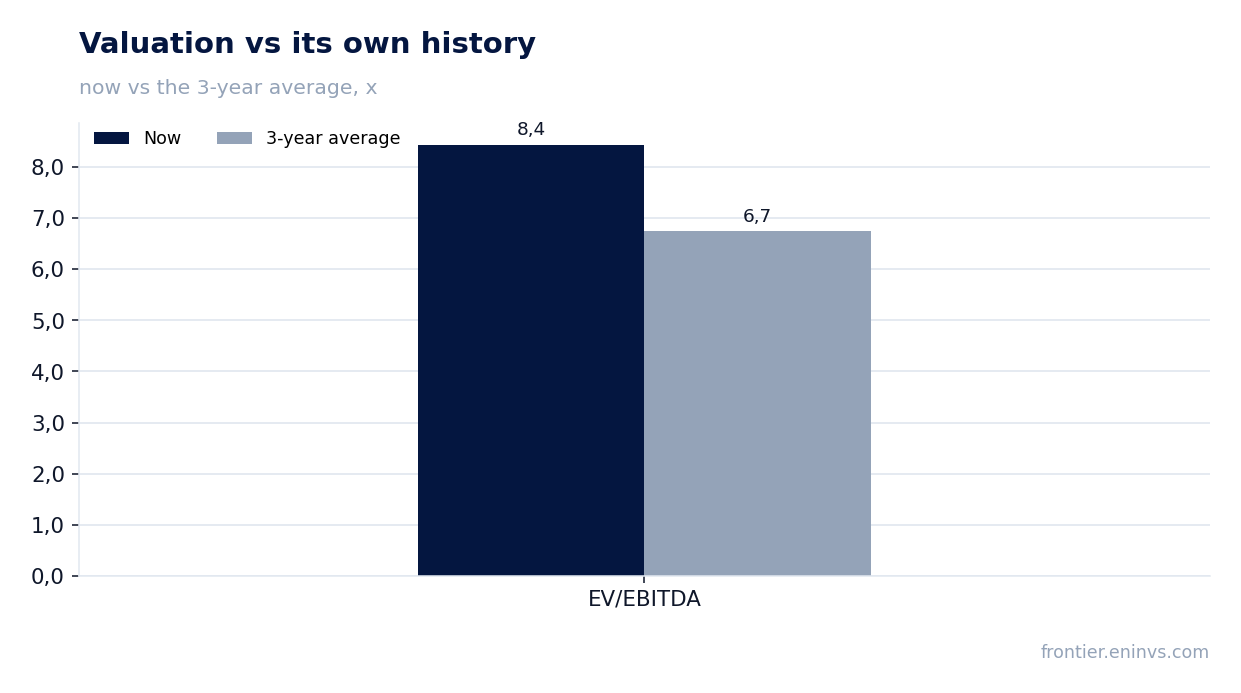
On April 30, FEMSA reported results for the first quarter of 2026. Revenue rose 6.1% year on year to MXN 207.8 bn, EBITDA – by 11.2% to MXN 28.1 bn, and net profit – by 97.3% to MXN 17.6 bn. However, excluding a one-off non-cash gain from the BradyPLUS–Imperial Dade merger, net profit would have been MXN 5.7 bn, down 36.4% year on year. With EV/EBITDA at 8.4 versus its own three-year average of 6.7 and the portal model implying only +1% upside to fair value, the share looks neutral: a 6.6% dividend yield supports it, but operating momentum outside OXXO Mexico is weak.
Key takeaways
— Profit doubled, but excluding a one-off merger gain it would have fallen 36.4%
— Revenue was driven by OXXO Mexico: +8.3% with operating profit up 20.9%
— EBITDA margin rose to 13.5% amid one-off effects in Europe and Health
— Net debt / EBITDA ex-KOF rose to 1.24x due to dividends and buybacks
— Capex fell 29.5%, but dividends and buybacks consumed more
— Dividend yield 6.6% with a payout of MXN 4.75 per unit for 2025
— EV/EBITDA 8.4 versus three-year average of 6.7 – valuation above its own history
Attractiveness
Key figures, MXN bn
| Metric | Q2 2025 | Q2 2026 | Change |
|---|---|---|---|
| Revenue | 211 | 231 | +9.3% |
| EBITDA | 16.1 | 19.6 | +21.5% |
| Operating profit | 17.8 | 19.1 | +7.2% |
| Net profit | 2.71 | 5.54 | +104.2% |
| EBITDA margin | 7.6% | 8.5% | +0.9 pp |
| Net margin | 1.3% | 2.4% | +1.1 pp |
Profit doubled, but excluding a one-off merger gain it would have fallen 36.4%
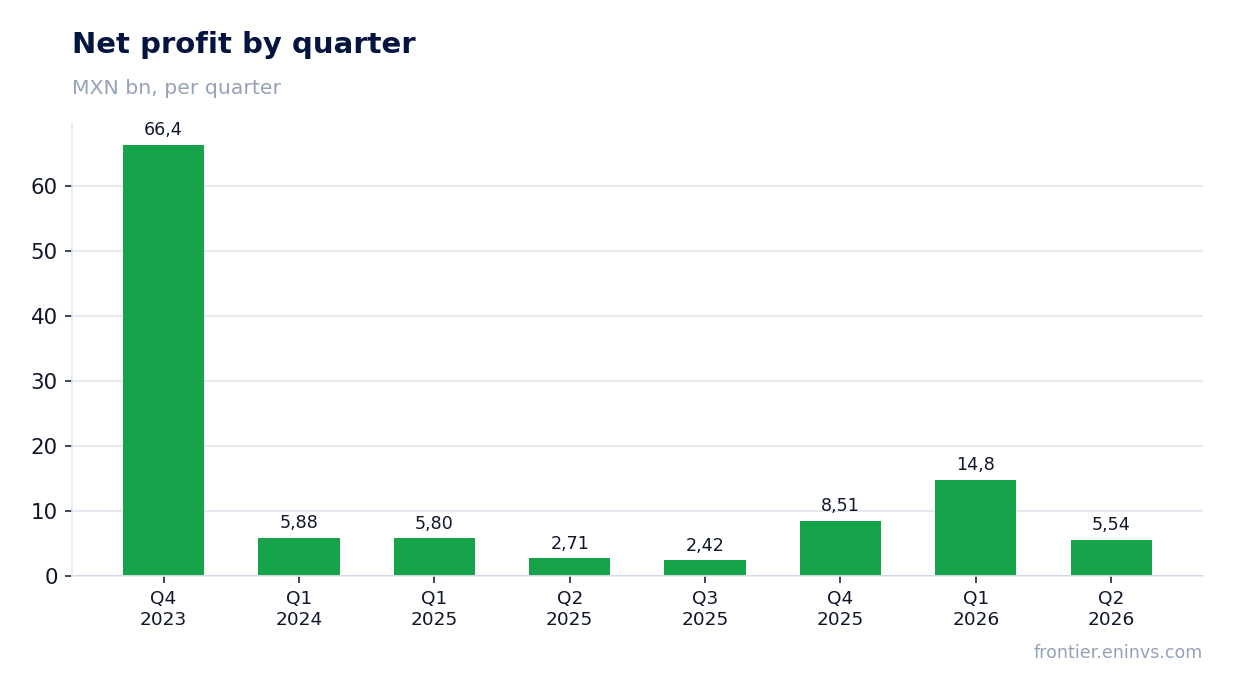
Net profit for the first quarter of 2026 was MXN 17.6 bn, up 97.3% year on year. However, the report explicitly states that the increase was driven by a one-off non-cash gain from the BradyPLUS–Imperial Dade merger, in which FEMSA retained approximately 19% ownership. Excluding this gain, net profit would have been MXN 5.7 bn, down 36.4% from the first quarter of 2025.
The decline in adjusted profit was caused by higher financial expenses: foreign exchange loss of MXN 444 mn versus a gain of MXN 439 mn a year earlier, an expense of MXN 189 mn on financial instruments versus a gain of MXN 1,107 mn, and lower interest income due to a smaller cash position. Additionally, last year's profit included MXN 2.49 bn from discontinued operations, which is absent now.
Thus, reported profit looks impressive, but its quality is low: the core business earned significantly less than a year ago. For assessing sustainability, EBITDA is more relevant, as it grew 11.2% and excludes one-off financial items.
Revenue was driven by OXXO Mexico: +8.3% with operating profit up 20.9%
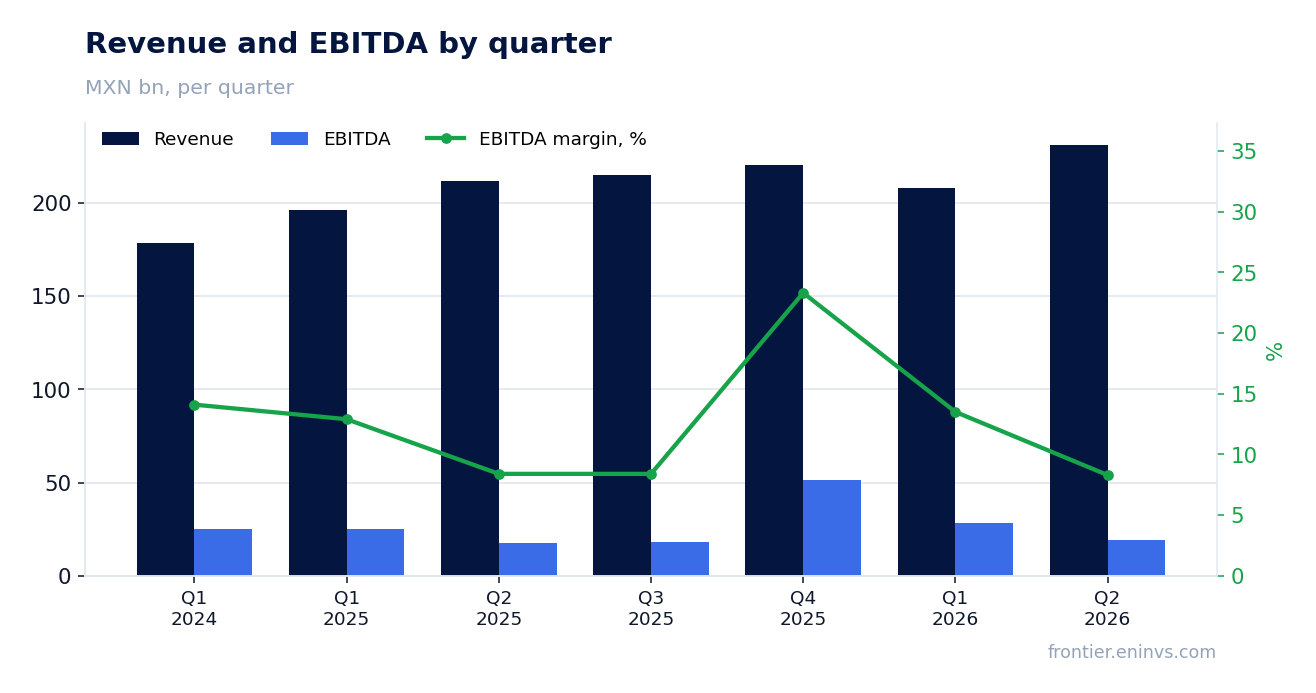
Consolidated revenue in Q1 2026 grew 6.1% year on year to MXN 207.8 bn. The main contributor was OXXO Mexico: its revenue rose 8.3% to MXN 74.4 bn, and operating profit – by 20.9% to MXN 5.6 bn. Same-store sales increased 6.0% with average ticket up 6.6% and traffic down 0.5%.
OXXO Mexico's operating margin expanded by 80 basis points to 7.6%, helped by a 140 bps increase in gross margin (to 46.2%) and cost control. Gross margin benefited from income from key suppliers, the contribution of financial services, and revenue management initiatives. Operating expenses rose 9.8%, slightly above revenue growth, due to higher labor costs, but operating leverage and efficiency measures offset this pressure.
The Americas & Mobility division also delivered strong results: revenue rose 12.9% and operating profit – by 34.0%. However, its contribution to consolidated profit remains small at MXN 281 mn. The remaining segments – Coca-Cola FEMSA, Europe, and Health – showed weak dynamics: Coca-Cola FEMSA revenue grew only 1.1%, operating profit fell 2.3%; Europe revenue added 0.1%, Health – 0.9% with operating profit down 14.2%.
EBITDA margin rose to 13.5% amid one-off effects in Europe and Health
Consolidated EBITDA margin in Q1 2026 was 13.5%, up 60 basis points from 12.9% a year earlier. The increase was supported by margin expansion in OXXO Mexico, Americas & Mobility, and Coca-Cola FEMSA, partially offset by contraction in Europe and Health. However, in Europe and Health the gross margin contraction is explained by a reclassification of distribution expenses from selling to cost of goods sold, which does not affect operating profit. Excluding this effect, the comparable gross margin for Q1 2025 would have been 39.9%, and the expansion would have been 60 bps.
Operating margin remained stable at 6.9%. The 5.5% increase in operating profit was driven by OXXO Mexico, Americas & Mobility, and Europe, but partially offset by declines at Coca-Cola FEMSA and Health. On a comparable basis, operating profit rose 12.1%, reflecting the strength of local currency results outside Mexico.
Thus, the margin improvement is largely due to one-off factors and translation effects rather than a sustainable efficiency gain across all segments. Margin sustainability will depend on OXXO Mexico maintaining its high gross margin and on profitability recovering in Health and Coca-Cola FEMSA.
Net debt / EBITDA ex-KOF rose to 1.24x due to dividends and buybacks
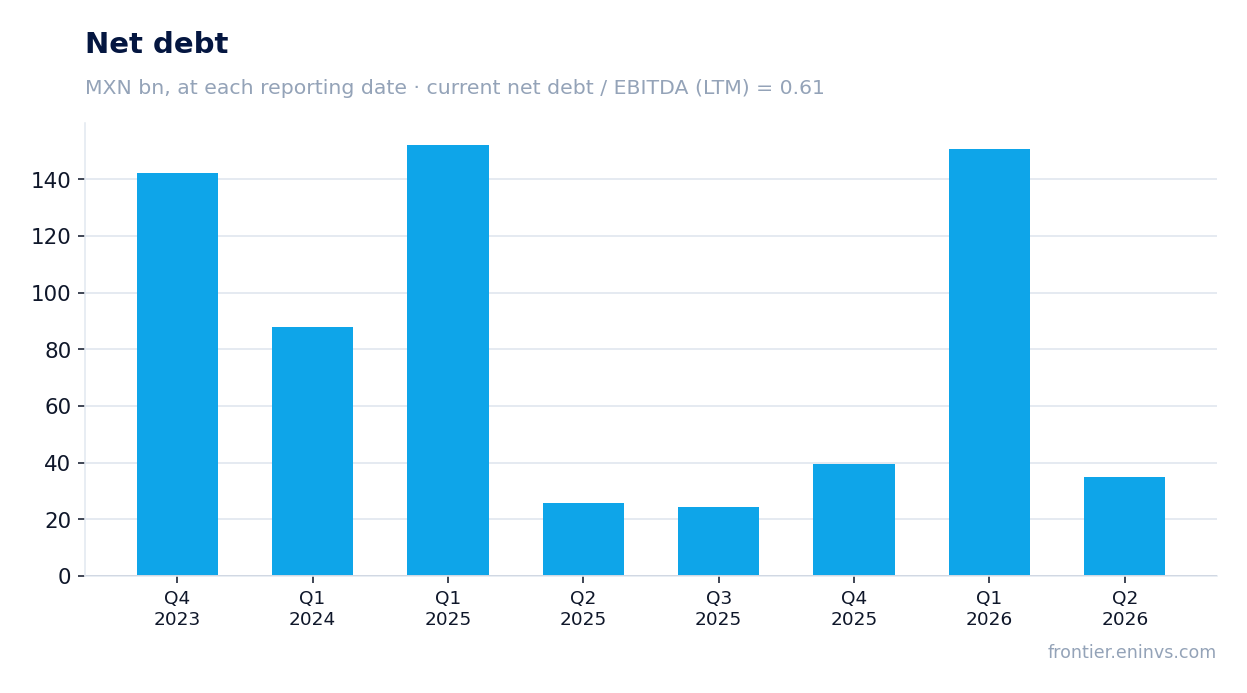
Net debt at the end of Q1 2026 was MXN 93.6 bn (ex-KOF), and the net debt / EBITDA ratio was 1.24x versus 0.69x a year earlier. The increase was driven by cash outflows for capital allocation: over the last twelve months, the company paid MXN 47.2 bn in ordinary and extraordinary dividends and spent MXN 16.1 bn on share repurchases. This reduced the cash position and increased debt.
Total debt (ex-KOF) was MXN 166.8 bn, including financial debt of MXN 56.9 bn and lease liabilities of MXN 109.9 bn. Cash and investments stood at MXN 73.2 bn. The average interest rate on debt is 7.2%, with 83.5% of debt at fixed rates, reducing interest rate risk. The maturity profile is spread out: 13.9% of debt matures in 2026, 7.9% in 2027, 10.9% in 2028, 3.8% in 2029, 12.2% in 2030, and 51.3% after 2031.
The rise in leverage is a consequence of an active capital return policy rather than deteriorating operations. However, if the current pace of payouts and buybacks continues, the ratio may remain elevated, limiting financial flexibility.
Capex fell 29.5%, but dividends and buybacks consumed more
Capital expenditures in Q1 2026 were MXN 6.2 bn, down 29.5% year on year and representing 3.0% of revenue. The decrease occurred in OXXO Mexico, Coca-Cola FEMSA, and Health, driven by a cautious approach to investments. In OXXO Mexico, the high base of Q1 2025, when many stores were opened, also played a role. This was partially offset by higher capex in Americas & Mobility, where expansion plans in Latin America and Brazil were resumed.
Despite lower capex, the company directed significant funds to shareholder payouts: over the last twelve months, dividends amounted to MXN 47.2 bn and share buybacks to MXN 16.1 bn. These payments exceeded operating cash flow, leading to an increase in net debt. Operating cash flow over the last twelve months was MXN 71.1 bn, covering capex but not fully covering dividends and buybacks.
Thus, the company maintains a high level of capital return, partly financing it with debt. This may be sustainable in the short term but limits growth investments and reduces financial headroom.
Dividend yield 6.6% with a payout of MXN 4.75 per unit for 2025
For 2025, shareholders approved an ordinary dividend of MXN 4.7520 per BD unit (MXN 47.52 per ADS), payable in four equal installments in April, July, October 2026, and January 2027. Additionally, an extraordinary dividend of MXN 8.0597 per BD unit (MXN 80.597 per ADS) was declared, also payable in four equal installments on the same schedule. The total payout for 2025 is MXN 12.81 per unit.
The current trailing twelve-month dividend yield is 6.6%. This is above the key rate, making the stock attractive for income-oriented investors. However, the sustainability of the payout depends on the company's ability to generate sufficient free cash flow. Over the last twelve months, operating cash flow was MXN 71.1 bn, and capex was about MXN 6.2 bn per quarter, leaving room for payouts, but dividends and buybacks have already exceeded cash flow and are partly financed by debt.
Our estimate for the 2026 dividend assumes a payout ratio of about 50% of net profit. However, the one-off merger gain may distort the base; excluding it, Q1 profit would have been MXN 5.7 bn. If operating profit does not recover, the dividend could be lower. The risk of a cut is linked to further debt growth and the need to fund capex.
EV/EBITDA 8.4 versus three-year average of 6.7 – valuation above its own history
The current trailing twelve-month EV/EBITDA multiple is 8.4, above its own three-year average of 6.7. This means the stock trades at a premium to its historical valuation. The trailing P/E is 22.6. Market capitalisation is MXN 708.1 bn. The net debt / EBITDA LTM ratio is 0.61, lower than the ex-KOF figure of 1.24x due to the inclusion of Coca-Cola FEMSA.
According to the portal's model, which compares EBITDA growth with a target multiple, the upside to fair value is +1%. This does not imply significant upside. For comparison, the 6.6% dividend yield provides most of the expected return.
Thus, the current valuation does not look attractive: the multiple is above its historical average, and the portal model indicates limited upside. A re-rating would require a sustainable acceleration in operating profit and a reduction in debt.
Valuation on the latest reported figures
| Metric | Value |
|---|---|
| Market cap | 708 bn MXN |
| P/E (LTM) | 22.6 |
| EV/EBITDA (LTM) | 8.4 |
| P/B | 2.55 |
| Net debt / EBITDA (LTM) | 0.61 |
| Operating cash flow (LTM) | 71.1 bn |
| ROE | 8.7% |
| Dividend yield (12m) | 6.6% |
| EV/EBITDA, 3-year average | 6.7 |
Bottom line
Q1 2026 showed strong results at OXXO Mexico, where operating profit rose 20.9% on gross margin expansion and cost control. However, consolidated profit owes its growth to a one-off merger gain, without which it would have fallen 36.4%. Leverage rose to 1.24x ex-KOF due to shareholder payouts, while capex was cut. Valuation at EV/EBITDA 8.4 is above its own three-year average of 6.7, and the portal model implies only +1% upside. With a 6.6% dividend yield, the stock looks neutral: the yield supports it, but operating momentum outside OXXO Mexico and the high valuation limit upside.
Open the company's financial profile FEMSA →
See also: market overview · valuation map · stock screeners