MX_INBURSA: profit fell 29%, but capital still earns 8.3% — the question is whether the bank can hold its margin
MX_INBURSA reported its second-quarter 2026 results. Net profit for the reported period fell 29.0% year on year to MXN 5,926.4 million, while net interest income in the second quarter came in at MXN 20,515.5 million, down 1.0% from a year earlier. Over the trailing twelve months the bank earned MXN 30,931.2 million in net profit on net interest income of MXN 83,200.0 million. At a trailing P/E of 8.28 and a return on equity of 8.3%, the share looks rather attractive, but the weakness in second-quarter net interest income needs confirmation of a turn.
Key takeaways
— Second-quarter net profit fell 29.0% year on year to MXN 5,926.4 million — the lowest in five quarters
— Second-quarter net interest income declined 1.0% year on year to MXN 20,515.5 million, while in the first quarter it grew 10.9%
— A return on equity of 8.3% at a trailing P/E of 8.28 leaves room for a re-rating if profit returns to growth
— The trailing twelve-month dividend yield of 2.6% is modest against the key rate, but the payout is stable
— On the portal's model the share trades at a 9% discount to fair value, supporting its appeal at the current price
— The absence of one-offs in second-quarter profit makes the year-on-year comparison clean, but does not explain the cause of the decline
Attractiveness
Key figures, MXN bn
| Metric | Q2 2025 | Q2 2026 | Change |
|---|---|---|---|
| Net profit | 8.34 | 5.93 | -29.0% |
Second-quarter net profit fell 29.0% year on year to MXN 5,926.4 million — the lowest in five quarters
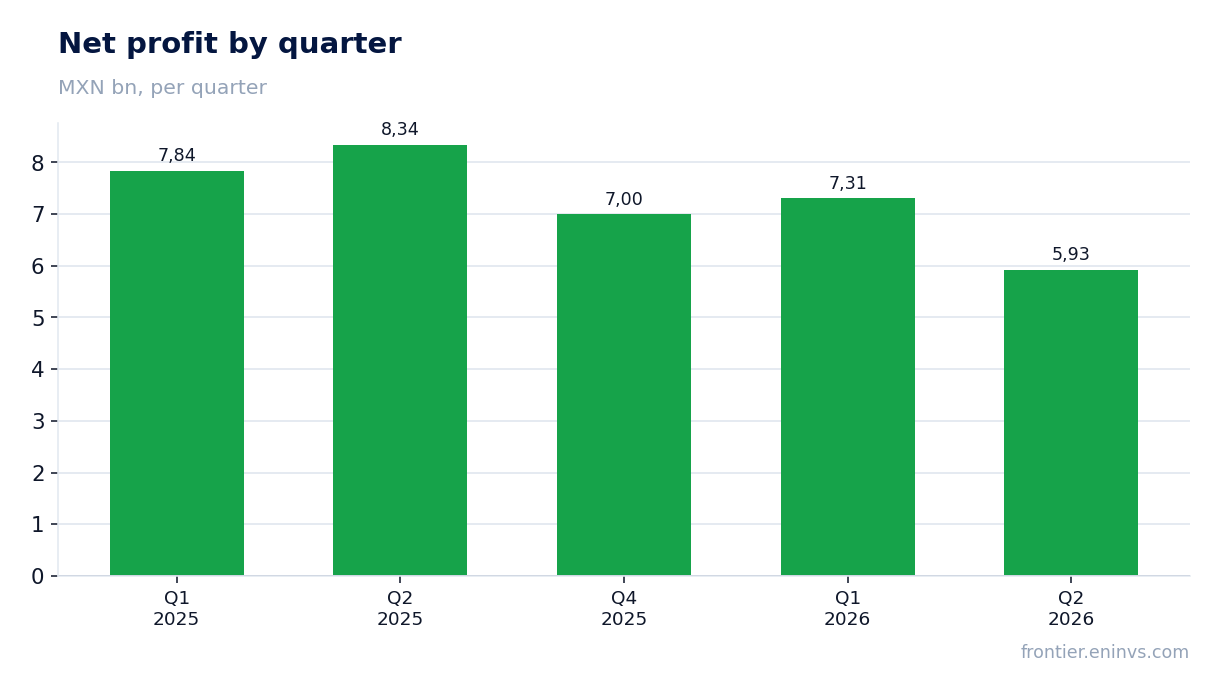
In the second quarter of 2026, MX_INBURSA earned MXN 5,926.4 million in net profit. That is 29.0% less than a year earlier and 18.9% less than in the first quarter of the current year. The profit decline came alongside a fall in net interest income, which stood at MXN 20,515.5 million — 1.0% below the second quarter of 2025 and 13.1% below the first quarter of 2026.
Profit dynamics have deteriorated for two consecutive quarters: MXN 7,002.4 million in the fourth quarter of 2025, MXN 7,306.5 million in the first quarter of 2026, and MXN 5,926.4 million in the second. Such a sequential decline points to pressure on the interest margin that is not being offset by other revenue lines. Without access to the breakdown of costs and provisions, it is hard to pinpoint the cause, but the scale of the profit drop against relatively stable interest income suggests higher expenses or provisions.
For a shareholder, it matters that the profit decline is not accompanied by one-off write-offs that could be excluded. This means the current profit level is the new base from which recovery will be measured. If margin pressure persists in the third quarter, full-year profit could fall short of consensus expectations, limiting the share's upside.
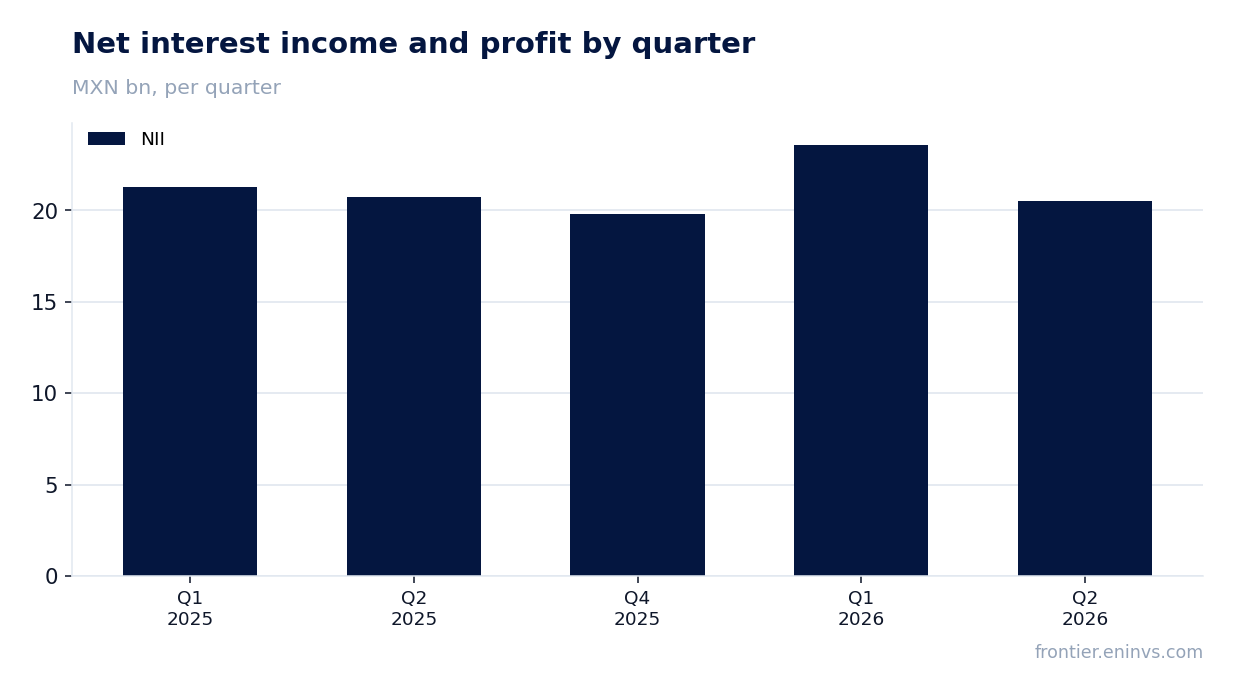
Second-quarter net interest income declined 1.0% year on year to MXN 20,515.5 million, while in the first quarter it grew 10.9%
Net interest income — the bank's main revenue source — came in at MXN 20,515.5 million in the second quarter. That is 1.0% less than in the second quarter of 2025, when the figure was MXN 20,729.1 million. The contrast with the first quarter, where growth was 10.9% year on year, is stark: the dynamics of interest income have reversed sharply.
The decline in interest income could stem from either a contraction in earning assets or a fall in the interest margin. Without data on average balances and funding costs, the exact cause cannot be named, but the fact that income fell 1.0% while Mexican inflation is above 4% means the real margin is shrinking. If this is a consequence of higher deposit costs, the pressure may persist as long as the key rate remains high.
For assessing the sustainability of the business, it matters that net interest income over the trailing twelve months was MXN 83,200.0 million. That is roughly 2.6% more than the sum of the four quarters from mid-2025, suggesting that overall the bank is still growing, but a turning point emerged in the second quarter of 2026. The next quarter will show whether this was a one-off blip or the start of a trend.
A return on equity of 8.3% at a trailing P/E of 8.28 leaves room for a re-rating if profit returns to growth
MX_INBURSA earns 8.3% on equity over the trailing twelve months. That is a low figure for the banking sector, where sustainable profitability typically exceeds 10–12%. At the same time, the share trades at a trailing P/E of 8.28, implying an earnings yield of about 12.1% — a spread of roughly 3.8 percentage points over the return on equity.
Such a spread may be justified if the market expects further profit declines. However, if profit stabilises at the current level or begins to grow, the multiple could expand. On the portal's model, which compares return on equity with the price-to-book ratio, the share is undervalued by 9% relative to fair value. This is not a consensus forecast but our own estimate, and it points to upside at the current price.
For a shareholder, the key question is whether the bank can keep its return on equity above 8% amid slowing interest income. If profitability drops below 7%, the discount to fair value may disappear and the share would cease to look attractive. Conversely, a return to 10% ROE at the same multiple would deliver notable upside.
The trailing twelve-month dividend yield of 2.6% is modest against the key rate, but the payout is stable
Over the trailing twelve months, MX_INBURSA paid dividends that provided a yield of 2.6% at the current price. That is below the yield on Mexican government bonds, which has exceeded 9% in recent months, and below the Bank of Mexico's key rate. For an income-oriented investor, such a yield looks insufficient.
Our estimate for the current year's dividend assumes the payout remains close to its historical level. With trailing twelve-month net profit of MXN 30,931.2 million and a market capitalisation of MXN 256,233.2 million, paying out half of profit would give a yield of about 6.0%. However, the actual yield is half that, suggesting a conservative approach to profit distribution or that part of profit is retained to support capital.
What could make the dividend smaller: a further decline in profit, tighter capital requirements, or higher provisioning costs. If profit in the second half remains at the second-quarter level, the annual dividend could come under pressure. For a current shareholder, the dividend is not the main source of return but rather a welcome addition to potential capital gains.
On the portal's model the share trades at a 9% discount to fair value, supporting its appeal at the current price
Our model, which compares return on equity with the price-to-book ratio, shows that MX_INBURSA's share is undervalued by 9% relative to fair value. This means that at the current level of profit and capital, the market values the bank below its fundamental worth. Such a discount may stem from concerns about the sustainability of the interest margin.
The trailing P/E of 8.28 is neither high nor low without comparison to history. We do not have data on the three-year average, so we cannot say whether the share trades above or below its historical level. However, the combination of an 8.3% ROE and a P/E of 8.28 produces a ratio that looks attractive to a long-term investor if profit stabilises.
If profit returns to growth, the discount could narrow, delivering above-market returns. If margin pressure persists, fair value may be revised downward and the current price would prove adequate. Thus, the assessment of the share's appeal depends directly on whether the bank can stabilise net interest income.
The absence of one-offs in second-quarter profit makes the year-on-year comparison clean, but does not explain the cause of the decline
Unlike many banks, MX_INBURSA did not report one-off write-offs or gains that would distort the year-on-year profit comparison. This means the 29.0% decline reflects a genuine deterioration in operating performance rather than accounting effects. For an investor this is both good and bad: good because earnings quality is high, bad because the problem is fundamental.
The cause of the profit decline against relatively stable interest income likely lies in higher operating expenses or provisions. Without access to the report's breakdown, we cannot name the exact line, but the scale of the profit drop — MXN 1,380.0 million year on year — against a fall in interest income of only MXN 213.6 million suggests the main hit came on the expense side.
For the next report, the key question will be whether this level of expenses persists. If the cost increase was one-off, profit could recover quickly. If it is a new trend, the bank will need time to adapt its model. In any case, the absence of one-offs makes forecasting more predictable, but does not remove the need to understand the causes.
Valuation on the latest reported figures
| Metric | Value |
|---|---|
| Market cap | 256 bn MXN |
| P/E (LTM) | 8.3 |
| P/B | 0.92 |
| ROE | 8.3% |
| Dividend yield (12m) | 2.6% |
Bottom line
Bottom line: MX_INBURSA delivered a weak second quarter — profit fell 29.0% year on year, and net interest income declined for the first time in a year. However, an 8.3% return on equity and a trailing P/E of 8.28 leave room for a re-rating if the bank can stabilise its margin. The 2.6% dividend yield is modest but the payout is stable, and on the portal's model the share is 9% undervalued. The key question for a shareholder now is whether the bank can restore growth in interest income in the third quarter; if so, the current price looks attractive, if not, the share may remain under pressure.
Open the company's financial profile INBURSA →
See also: market overview · valuation map · stock screeners