BPI: Q2 profit slipped 2% as provisions swallowed the entire net interest income gain

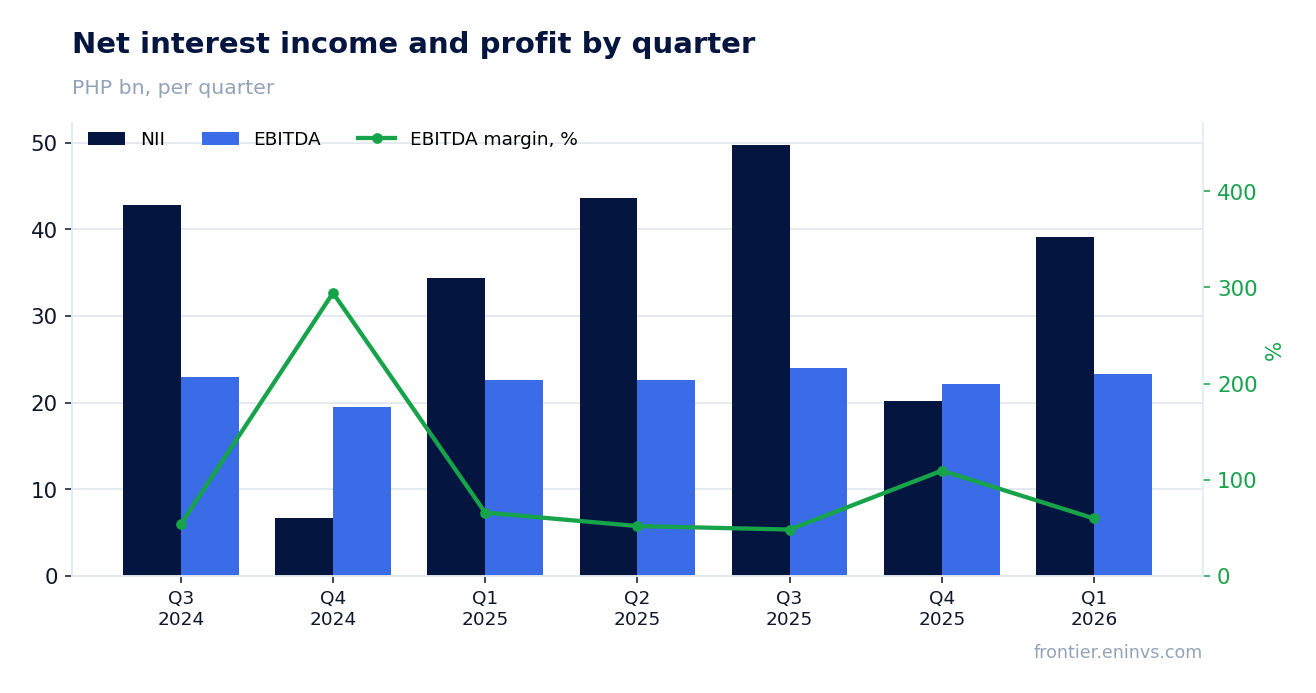
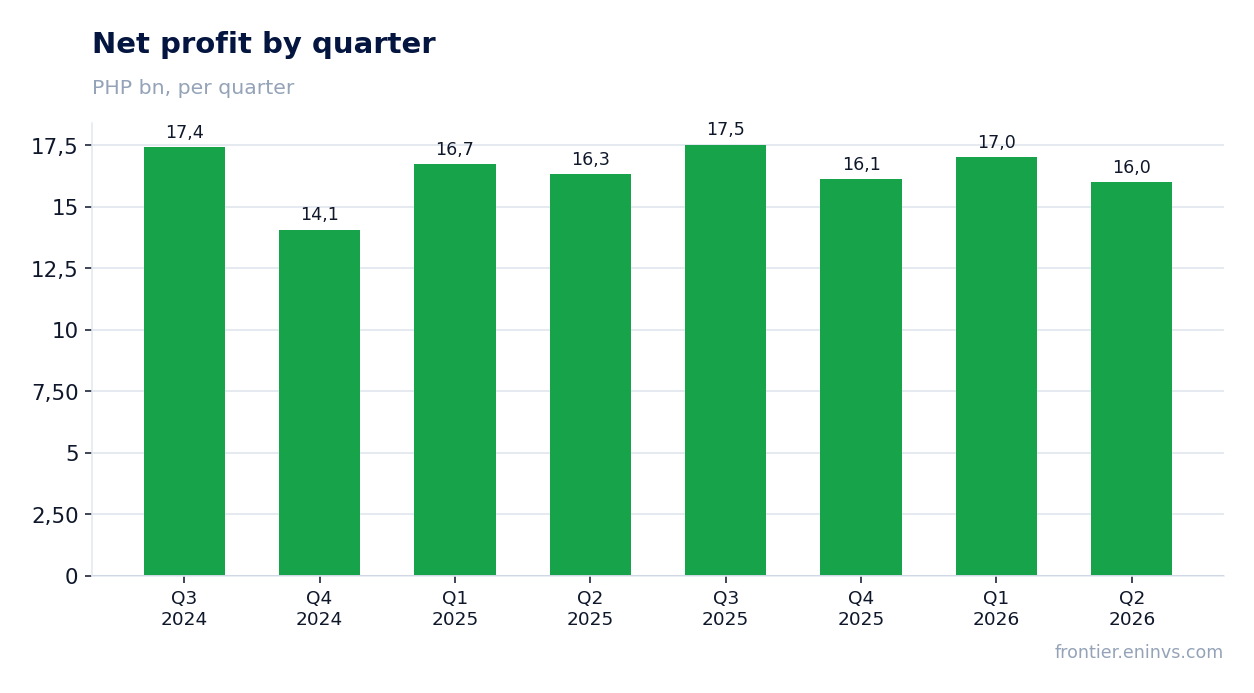
On 17 July Bank of the Philippine Islands released its Q2 2026 report. Quarterly net profit came in at PHP 15.99bn, down 2.0% year on year, even as net interest income rose to PHP 40.89bn from PHP 36.74bn. The entire increase in net interest income – and about PHP 4.15bn more – was absorbed by impairment provisions, which jumped to PHP 7.84bn from PHP 4.25bn a year earlier. The stock trades at a P/E LTM of 8.1 and a dividend yield of 4.7%, and with trailing-twelve-month profit of PHP 66.7bn and a 12% upside on the portal's model, the share looks rather attractive than neutral.
Key takeaways
— Net interest income rose 11.3% year on year, but profit fell 2.0% because of provisions
— Impairment provisions nearly doubled and swallowed the entire net interest income gain
— Fee and commission income added 27.3% and partly offset the pressure on profit
— Personnel and infrastructure costs are growing faster than revenue, pushing cost-to-income up
— P/E of 8.1 and dividend yield of 4.7% look attractive against ROE of 25.3%
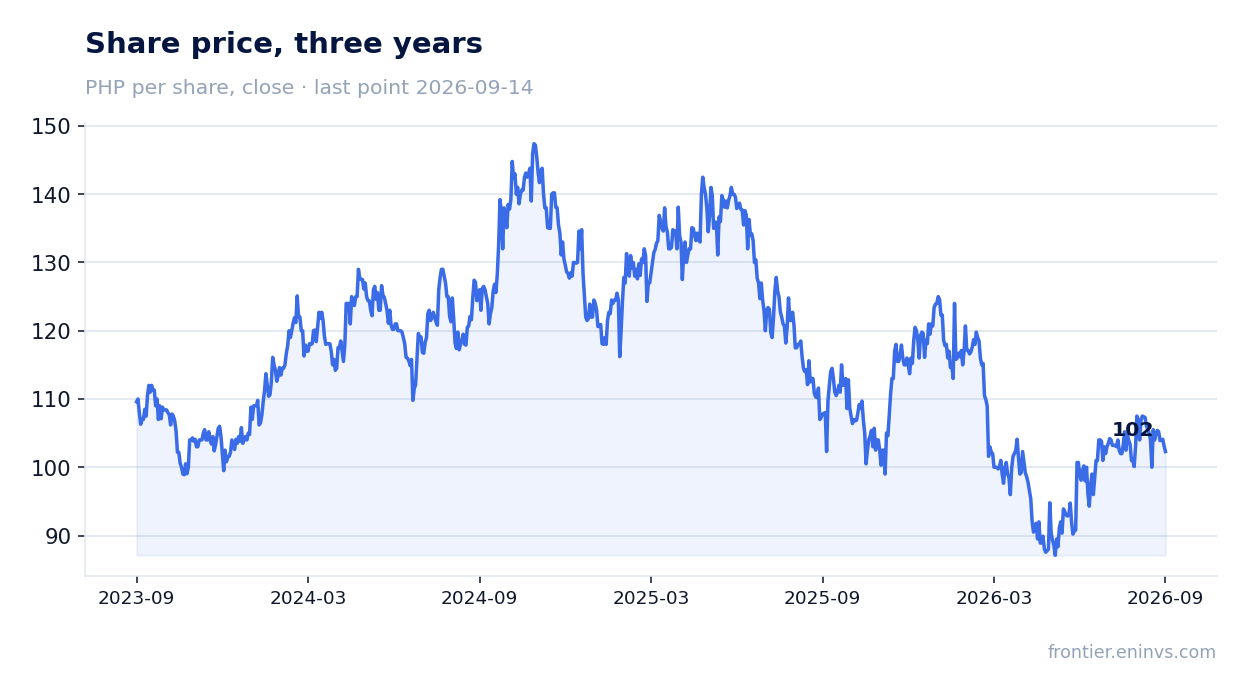
— The portal's model implies 12% upside to fair value, outweighing the quarterly weakness
Attractiveness
Key figures, PHP bn
| Metric | Q2 2025 | Q2 2026 | Change |
|---|---|---|---|
| Net interest income | 43.6 | — | — |
| EBITDA | 22.6 | — | — |
| Operating profit | 21.2 | 20.1 | -4.9% |
| Net profit | 16.3 | 16.0 | -2.0% |
| Capex | 1.56 | — | — |
| EBITDA margin | 51.8% | — | — |
| Net margin | 37.4% | — | — |
Net interest income rose 11.3% year on year, but profit fell 2.0% because of provisions
In Q2 2026, BPI's net interest income reached PHP 40.89bn, up 11.3% from PHP 36.74bn in the same quarter last year. Interest income rose to PHP 58.50bn from PHP 52.73bn, while interest expense increased to PHP 17.61bn from PHP 16.00bn. Loan growth drove the revenue increase: interest income on loans and advances added 10.9% year on year, to PHP 49.81bn.
However, quarterly net profit fell to PHP 15.99bn from PHP 16.44bn a year earlier. The culprit was a sharp rise in impairment provisions: they amounted to PHP 7.84bn versus PHP 4.25bn in Q2 2025. That increase of PHP 3.59bn more than offset the PHP 4.15bn gain in net interest income, leaving profit below last year's level.
The provision build reflects deteriorating credit quality: the non-performing loan (NPL) ratio reached 2.42%, which the report attributes to risks in business banking, consumer loans (credit cards and auto loans), and the corporate portfolio. The bank notes that the NPL ratio remains acceptable and below the industry average, with sufficient provisioning.
Impairment provisions nearly doubled and swallowed the entire net interest income gain
Impairment provisions in Q2 2026 amounted to PHP 7.84bn, up 84.4% from PHP 4.25bn a year earlier. This was the largest increase among all expense items. As a result, net interest income after impairment losses rose only 1.7%, to PHP 33.05bn, even though the pre-provision figure grew 11.3%.
The provision build is linked to deteriorating asset quality: the NPL ratio rose to 2.42%, which the report attributes to credit risks in business banking, consumer loans (credit cards and auto loans), and borrower-specific risks in the corporate portfolio. The bank emphasises that the NPL ratio remains below the industry average, with sufficient provisioning.
If provisions stay at this level, pressure on profit will persist. However, the bank notes that it regularly updates macroeconomic forecasts and uses them to estimate expected credit losses, allowing it to respond promptly to changes in portfolio quality.
Fee and commission income added 27.3% and partly offset the pressure on profit
Fee and commission income in Q2 2026 rose to PHP 4.53bn, up 27.3% from PHP 3.56bn a year earlier. This was the fastest growth among all revenue lines. Together with insurance income (PHP 1.14bn) and other operating income (PHP 5.66bn), total other income reached PHP 12.21bn, up 9.9% year on year.
The growth in fee income partly offset the pressure on profit from provisions. However, its contribution to the overall picture is limited: fees account for about 7.7% of total income, while net interest income generates more than 70%. Nevertheless, steady growth in fee income indicates diversification of revenue sources.
The report does not provide a detailed breakdown of fee income by type, but its dynamics noticeably outpace interest income growth, which may point to increased volumes in transaction banking and asset management services.
Personnel and infrastructure costs are growing faster than revenue, pushing cost-to-income up
Operating expenses in Q2 2026 rose to PHP 25.13bn, up 12.0% from PHP 22.45bn a year earlier. Compensation and fringe benefits increased 11.0%, to PHP 8.80bn; occupancy and equipment-related expenses rose 10.4%, to PHP 7.37bn; other operating expenses grew 14.2%, to PHP 8.97bn. Expense growth outpaced total income growth (which rose 10.5%), pushing the cost-to-income ratio higher.
According to the financial indicators, the cost-to-income ratio for H1 2026 was 46.76% versus 46.19% a year earlier. This is a moderate increase, but it indicates that the bank cannot yet fully offset cost growth with revenue growth.
The main contributor to expense growth is other operating expenses, which include technology, marketing, and administrative costs. The bank is actively investing in digitalisation and cybersecurity, which partly explains the rise in this line.
P/E of 8.1 and dividend yield of 4.7% look attractive against ROE of 25.3%
BPI shares trade at a P/E (LTM) of 8.1 and a dividend yield of 4.7% (trailing 12 months). At the same time, return on equity (ROE) over the last 12 months stands at 25.3%, well above the cost of capital, supporting the bank's ability to generate profit and pay dividends.
The bank's market capitalisation is PHP 540.2bn, with trailing-twelve-month profit of PHP 66.7bn. Net interest income for the same period was PHP 152.8bn. A price-to-earnings ratio below 10 with ROE above 25% points to potential undervaluation if the bank can sustain its current profitability.
According to the portal's model, the fair value of the share implies 12% upside to the current price. This is our own estimate based on comparing ROE and P/B, not a market consensus.
The portal's model implies 12% upside to fair value, outweighing the quarterly weakness
Despite the decline in quarterly profit, the bank's fundamentals remain strong. Return on equity (ROE) over the last 12 months is 25.3%, well above the banking sector average. This provides a basis for maintaining dividend payments and capital growth.
According to our model, the fair value of the share is 12% above the current market price. This estimate takes into account the current ROE level and the price-to-book ratio. If the bank can stabilise provisions and return profit to growth, the upside may increase.
The dividend yield of 4.7% also supports the stock's appeal, especially amid declining deposit rates. The latest declared dividend was PHP 2.58 per share, paid on 18 June 2026. If current profit and the payout ratio are maintained, dividend payments are likely to remain at a comparable level.
Valuation on the latest reported figures
| Metric | Value |
|---|---|
| Market cap | 540 bn PHP |
| P/E (LTM) | 8.1 |
| P/B | 1.13 |
| ROE | 0.3% |
| Dividend yield (12m) | 4.7% |
Bottom line
Bottom line: BPI delivered a weak quarter on profit but strong fundamentals. Net interest income rose 11.3%, fee income added 27.3%, and ROE remains at 25.3%. However, impairment provisions nearly doubled and expense growth outpaced revenue, pushing profit down 2.0%. The stock trades at a P/E of 8.1 and a dividend yield of 4.7%, which looks attractive against current profitability. The portal's model implies 12% upside to fair value. The key question for a holder is whether the bank can stabilise provisions and return profit to growth next quarter.
Open the company's financial profile BPI →
See also: market overview · valuation map · stock screeners