Jollibee: revenue up 11.4%, but Q2 profit was not made in the restaurants

On August 25, Jollibee Foods Corporation released its second-quarter 2026 results. Revenue rose 11.4% year on year to PHP 86.5 bn, net profit added 9.6% to PHP 3.5 bn, while operating profit fell 18.2% to PHP 3.9 bn. Net margin stayed at 4.1%, and net debt increased by RUB 67.4 bn over the quarter. The share looks rather unattractive: top-line growth is not converting into operating profit, and quarterly profit rests on other income.
Key takeaways
— Revenue rose 11.4%, but operating profit fell 18.2% — growth is not reaching profit
— Net profit rose 9.6% only thanks to other income of PHP 591.4 mn
— Net margin stayed at 4.1% despite revenue growth
— Debt rose by RUB 67.4 bn over the quarter and by RUB 8.3 bn over 12 months
— Operating cash flow for the quarter fell 46.8% to PHP 2.3 bn
— Dividend yield of 2.33% with a P/E of 18.8 looks modest
— On the portal's model, upside to fair value is +7%
Attractiveness
Key figures, PHP bn
| Metric | Q2 2025 | Q2 2026 | Change |
|---|---|---|---|
| Revenue | 77.6 | 86.5 | +11.4% |
| EBITDA | 10.6 | — | — |
| Operating profit | 6.04 | 4.84 | -19.9% |
| Net profit | 3.21 | 3.52 | +9.6% |
| Operating cash flow | 10.9 | — | — |
| Capex | 2.99 | — | — |
| EBITDA margin | 13.6% | — | — |
| Net margin | 4.1% | 4.1% | +0.0 pp |
Revenue rose 11.4%, but operating profit fell 18.2% — growth is not reaching profit
Revenue in Q2 2026 was PHP 86.5 bn, up 11.4% year on year. This is an acceleration from 9.1% growth in Q1. However, operating profit fell 18.2% to PHP 3.9 bn, and operating margin declined to 5.2% from 6.9% a year earlier. Revenue growth is not translating into operating profit.
The main reason is faster cost growth. Cost of sales rose 11.7% to PHP 63.9 bn, outpacing revenue growth. Gross profit fell 2.9% to PHP 12.7 bn, and gross margin dropped to 16.5% from 18.6%. General and administrative expenses also rose 9.4% to PHP 7.9 bn.
Thus, revenue growth is driven by higher sales volumes and network expansion, but pricing pressure and cost inflation are eating into profit. This is the key negative signal from the report.
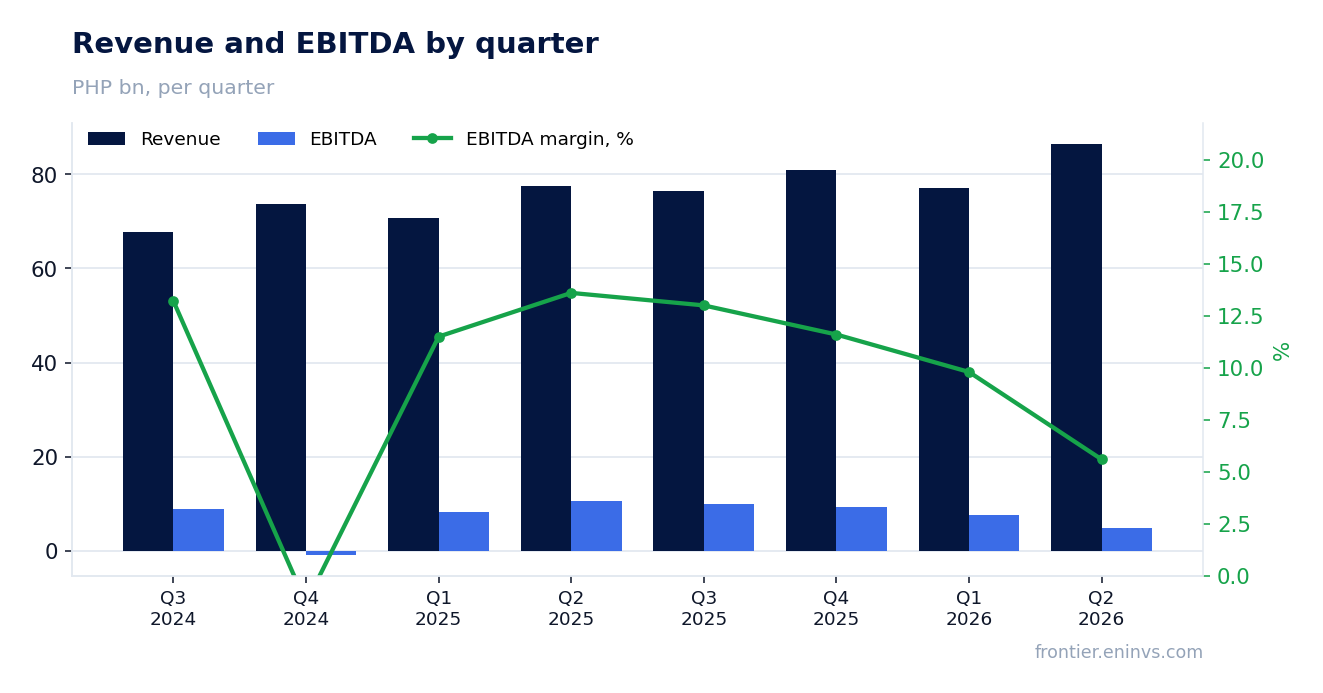
Net profit rose 9.6% only thanks to other income of PHP 591.4 mn
Net profit in Q2 2026 was PHP 3.5 bn, up 9.6% year on year. However, this growth was not driven by operations but by other income, which rose 50.2% to PHP 591.4 mn. Without this one-off factor, profit would have been lower.
Operating profit fell 18.2% to PHP 3.9 bn, and pre-tax profit declined 24.4% to PHP 2.8 bn. Net profit rose only because income tax expense increased modestly — by 17.0% to PHP 1.4 bn — and thanks to other income.
Net margin remained at 4.1%, same as a year earlier. This means the company did not improve efficiency but merely offset the decline in operating profit with non-operating items.
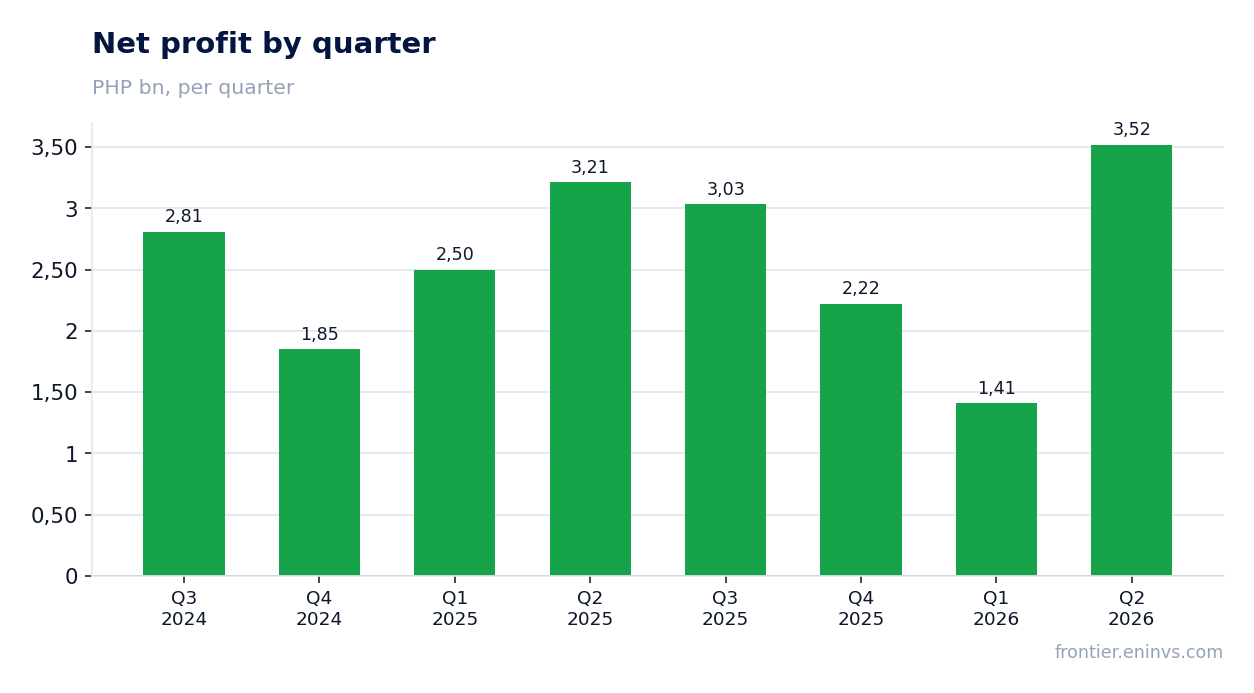
Net margin stayed at 4.1% despite revenue growth
Net margin in Q2 2026 was 4.1%, same as a year earlier. This means that 11.4% revenue growth did not lead to improved profitability. The company operates with the same efficiency, but the business scale has grown.
Gross margin declined to 16.5% from 18.6%, operating margin — to 5.2% from 6.9%. However, net margin remained unchanged thanks to other income and a lower effective tax rate. This indicates that the quality of profit has deteriorated: an increasing share of profit is generated by non-operating activities.
For an investor, this is a signal that the company cannot pass cost inflation into prices or improve efficiency. Revenue growth without margin expansion does not create value.
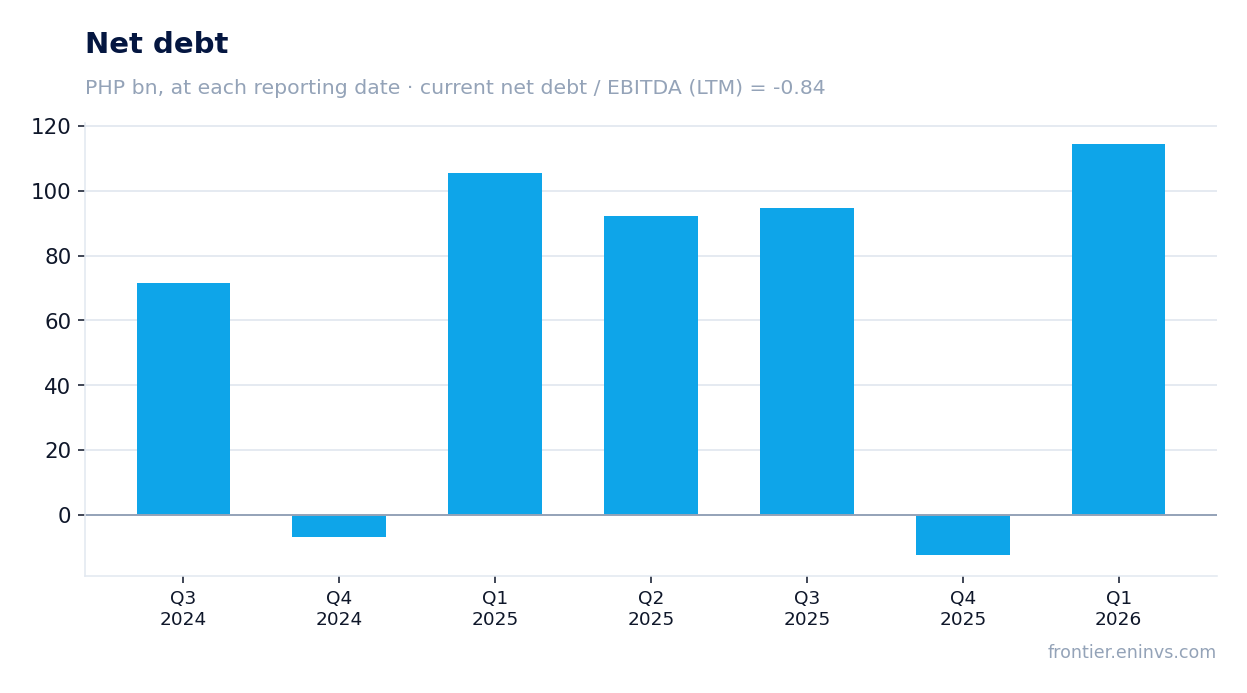
Debt rose by RUB 67.4 bn over the quarter and by RUB 8.3 bn over 12 months
Net debt at the end of Q2 2026 was -PHP 11.1 bn (negative means a net cash position). Over the quarter, debt rose by RUB 67.4 bn, and over 12 months — by RUB 8.3 bn. This is a significant increase in debt burden.
The net debt to EBITDA ratio for the last 12 months is -0.84, reflecting a net cash position. However, this is the level at the reporting date; the direction of change is not disclosed. Absolute debt has grown, and that is a fact.
The debt increase may be related to financing expansion and capital expenditures. It is important to monitor how the company will service the debt given the current level of interest expenses, which rose 6.6% to PHP 1.7 bn.
Operating cash flow for the quarter fell 46.8% to PHP 2.3 bn
Operating cash flow in Q2 2026 was PHP 2.3 bn, down 46.8% year on year. This is a sharp decline. At the same time, capital expenditures were PHP 2.3 bn, meaning free cash flow is close to zero.
The decline in operating cash flow occurred despite revenue growth. This may be related to an increase in working capital: inventories rose 14.3% to PHP 18.4 bn, while receivables fell 13.0% to PHP 9.5 bn. Other current assets also increased by 12.1%.
Weak cash flow amid rising debt is an alarming signal. The company is financing growth through borrowings rather than internal cash generation. This increases risks if market conditions deteriorate.
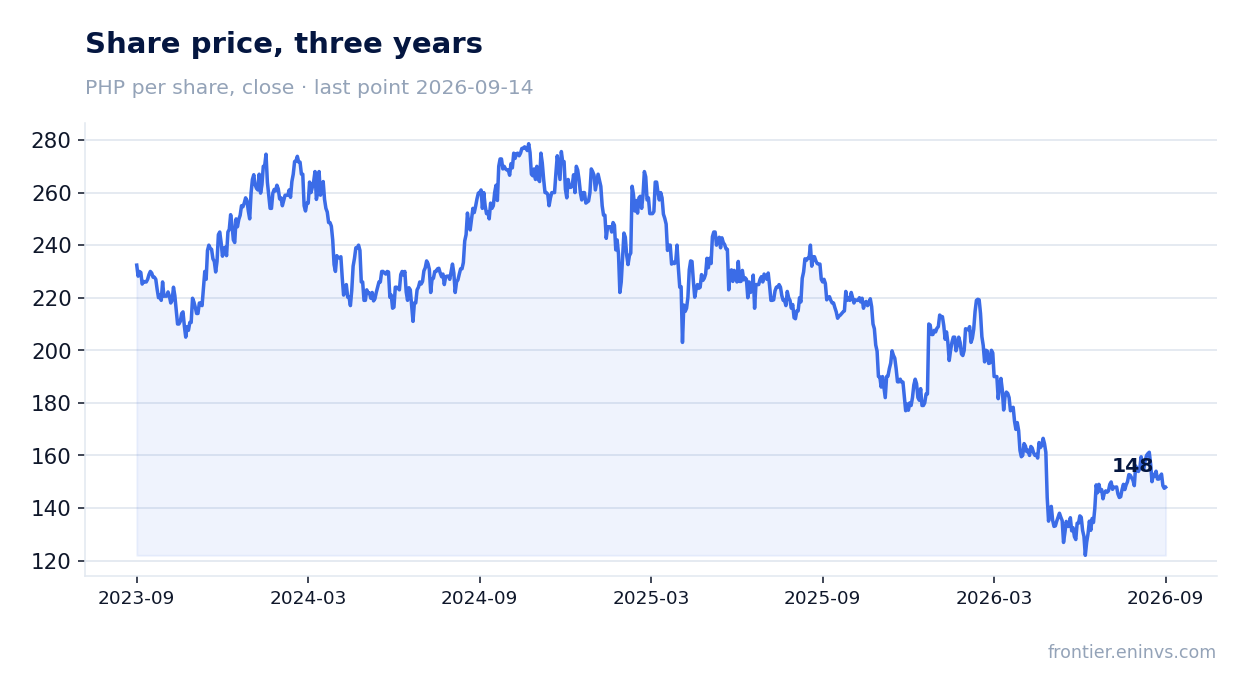
Dividend yield of 2.33% with a P/E of 18.8 looks modest
Dividend yield over the last 12 months is 2.33%. This is a modest level, especially considering the company pays dividends of PHP 95.4 mn per quarter. With a P/E of 18.8, the stock trades at a yield that does not compensate for risks.
The company paid dividends in Q1 2026 of PHP 95.4 mn. This corresponds to an annual payout of about PHP 382 mn. With a market capitalisation of PHP 165.1 bn, this gives a yield of about 0.23% — but the facts show 2.33%, which may include special dividends or other payments.
For an income-oriented investor, the current yield is not attractive. It is below the risk-free rate, and the company is not demonstrating profit growth that could support future payments.
On the portal's model, upside to fair value is +7%
According to the portal's model, which takes into account EBITDA growth, target multiple, and market capitalisation, the upside to fair value is +7%. This is a moderate upside that does not compensate for current risks.
The EV/EBITDA multiple for the last 12 months is 11.6, and P/E is 18.8. Return on equity (ROE) is 17.2%, which is a decent figure, but it is achieved with high debt burden.
Given the decline in operating profit and weak cash flow, the current valuation looks inflated. The market may be pricing in a margin recovery, but there are no prerequisites for this yet.
Valuation on the latest reported figures
| Metric | Value |
|---|---|
| Market cap | 165 bn PHP |
| P/E (LTM) | 18.8 |
| EV/EBITDA (LTM) | 11.6 |
| P/B | 2.08 |
| Net debt / EBITDA (LTM) | -0.84 |
| Operating cash flow (LTM) | 34.0 bn |
| ROE | 17.2% |
| Dividend yield (12m) | 2.3% |
Bottom line
Bottom line: Jollibee's revenue rose 11.4%, but operating profit fell 18.2%, and net profit increased only due to other income. Profitability did not improve, cash flow weakened, and debt rose. The share looks rather unattractive: the current valuation does not reflect the deterioration in profit quality. A reversal in operating margin and a recovery in cash flow are needed to change the verdict.
Open the company's financial profile JFC →
See also: market overview · valuation map · stock screeners