Security Bank: profit grows, but loan-loss provisions, not the business, eat it
On 14 May Security Bank Corporation released its first-quarter 2026 report. Net interest income rose to PHP 15,161.4 mn from 11,881.3 mn a year earlier, quarterly net profit came in at PHP 2,704.2 mn versus 2,821.2 mn, while loan-loss provisions jumped to PHP 3,880.2 mn from 2,377.6 mn. The bank trades at 4.1x LTM P/E with an 8.7% ROE, and the portal model puts the upside to fair value at +28%; with a 4.7% dividend yield and a growing top line, the share looks rather attractive, but the key question is credit quality.
Key takeaways
— Net interest income grew 27.6% YoY, but quarterly profit fell 4.1% due to provisions
— Loan-loss provisions rose 1.6x and consumed the entire increase in net interest income
— Fee income fell 4.4%, while trading and FX losses added pressure on revenue
— Personnel and tax expenses were almost flat, but depreciation rose 20.5%
— The bank trades at 4.1x P/E and 8.7% ROE, below cost of equity, yet the portal model sees +28% upside
— A 4.7% dividend yield on a PHP 5.7 mn quarterly payout is a low base for re-rating
— Deposits grew by PHP 7.5 bn in the quarter, but the mix shifted toward expensive time deposits
Attractiveness
Key figures, PHP bn
| Metric | Q2 2025 | Q2 2026 | Change |
|---|---|---|---|
| Net interest income | 13.5 | — | — |
| EBITDA | 4.45 | — | — |
| Operating profit | 3.99 | 4.22 | +5.8% |
| Net profit | 3.04 | 3.38 | +11.3% |
| Capex | 0.85 | — | — |
| EBITDA margin | 33.1% | — | — |
| Net margin | 22.6% | — | — |
Net interest income grew 27.6% YoY, but quarterly profit fell 4.1% due to provisions
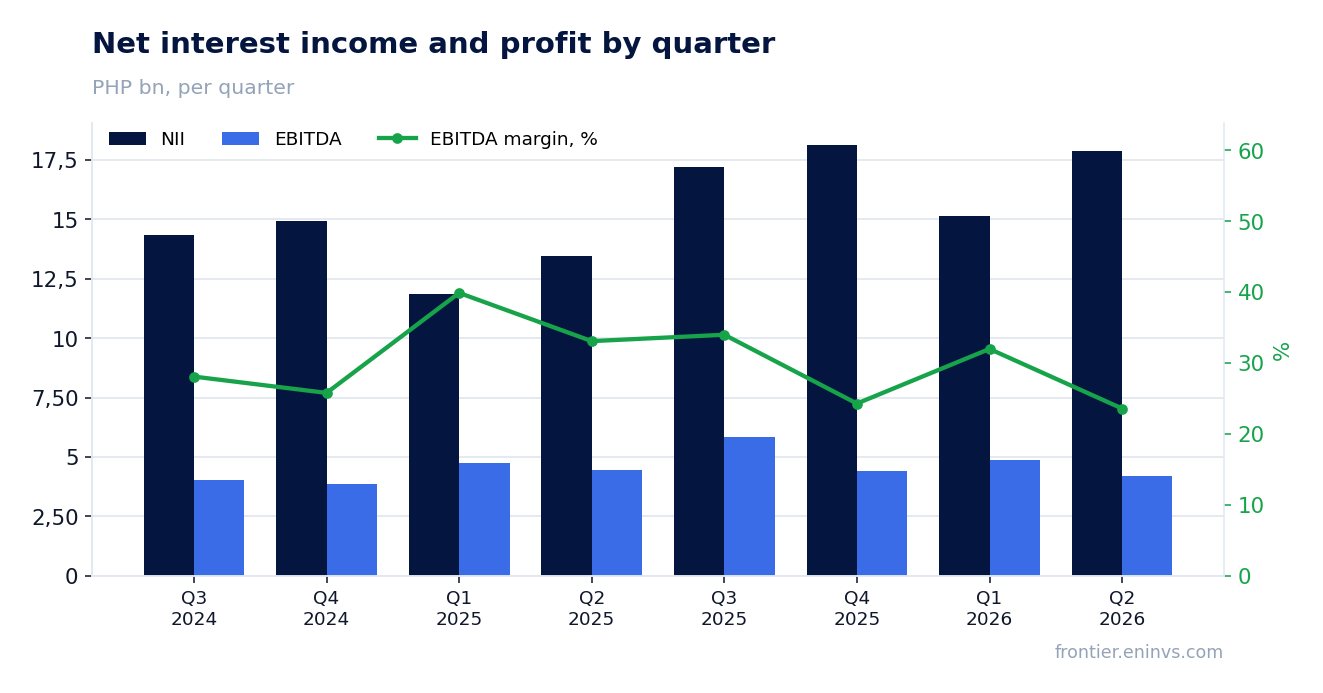
In Q1 2026, net interest income reached PHP 15,161.4 mn, up 27.6% year-on-year. This is the fastest growth in five quarters: 21.7% in Q4 2025 and 20.0% in Q3. The acceleration was driven by higher interest income on loans and investments, coupled with a decline in funding costs: interest expense fell to PHP 4,762.6 mn from 6,764.6 mn a year earlier.
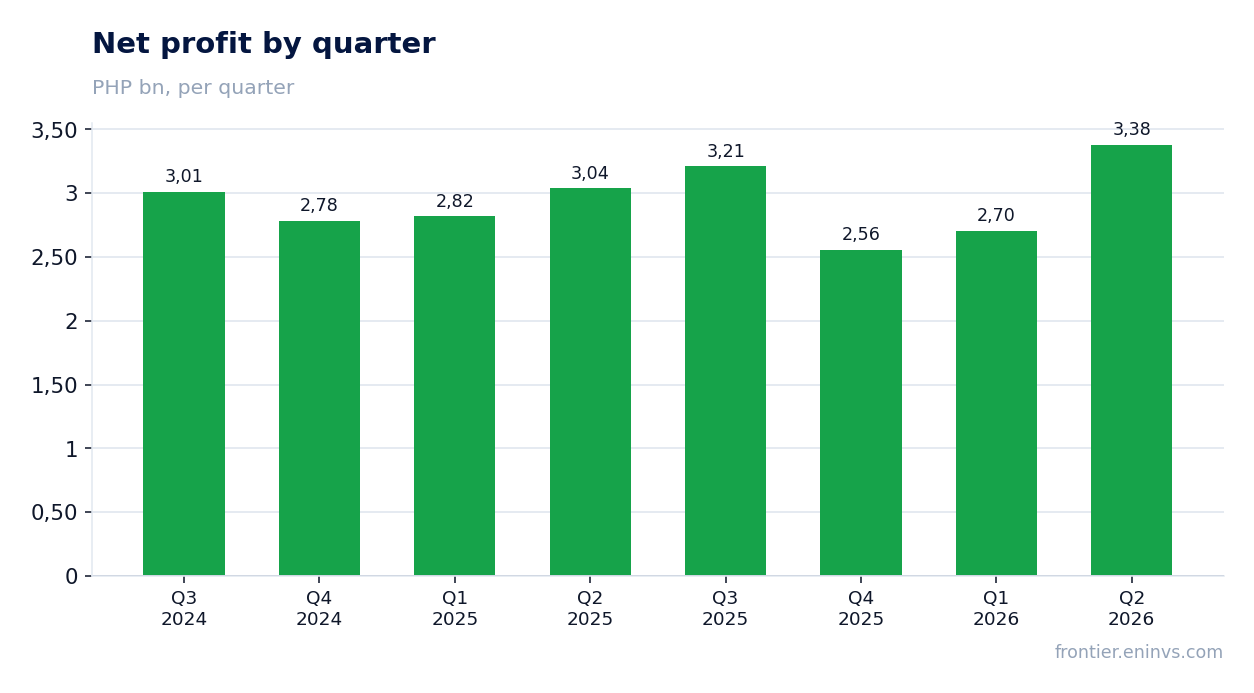
However, quarterly net profit declined to PHP 2,704.2 mn from 2,821.2 mn a year earlier. The reason is a sharp increase in loan-loss provisions, which reached PHP 3,880.2 mn versus 2,377.6 mn in Q1 2025. Without this jump, profit would have been significantly higher. The 1.6x rise in provisions points to either deteriorating asset quality or a conservative approach to risk assessment.
Thus, the operating growth remains strong, but its conversion into profit is hampered by credit costs. This is a key risk for future dynamics.
Loan-loss provisions rose 1.6x and consumed the entire increase in net interest income
Loan-loss provisions in Q1 2026 amounted to PHP 3,880.2 mn, an increase of PHP 1,502.6 mn from a year earlier. This increase is almost equal to the entire rise in net interest income (PHP 3,280.1 mn). Thus, all the additional income from loan growth and lower funding costs was directed to cover potential loan losses.
The share of provisions in operating expenses rose to 29.0% from 20.3% a year earlier. This significantly pressures profitability. If provisions had remained at last year's level, pre-tax profit would have been around PHP 5,133 mn, and net profit around PHP 3,800 mn. In reality, the bank earned only PHP 2,704.2 mn.
The reasons for the provision increase are not disclosed in the report. However, such a jump could be linked to either deteriorating portfolio quality or changes in macroeconomic forecasts used in the expected credit loss model. For investors, this is the main signal to monitor: if provisions remain high, profit will not grow even with strong net interest income.
Fee income fell 4.4%, while trading and FX losses added pressure on revenue
Service charges, fees and commissions in Q1 2026 amounted to PHP 2,061.9 mn, down 4.4% from PHP 2,155.8 mn a year earlier. This decline contrasts with the growth in net interest income and points to weakness in non-interest operations. It may be due to lower transaction volumes or pressure on fees.
In addition, the bank recorded a net trading loss of PHP 712.5 mn versus a gain of PHP 165.8 mn a year earlier, and a foreign exchange loss of PHP 977.5 mn versus a gain of PHP 145.8 mn. These two items together worsened the result by PHP 2,001.6 mn compared to last year. This is a significant negative contribution that added pressure on profit.
Rental income and other operating income partially offset the decline: rent brought PHP 408.4 mn, and share in net income of joint ventures was PHP 316.4 mn versus a loss a year earlier. Nevertheless, the overall dynamics of non-interest income remain weak.
Personnel and tax expenses were almost flat, but depreciation rose 20.5%
Operating expenses excluding loan-loss provisions grew moderately. Compensation and fringe benefits amounted to PHP 3,357.3 mn versus PHP 3,326.3 mn a year earlier, taxes and licenses – PHP 1,175.1 mn versus PHP 1,161.1 mn. This indicates tight control over fixed costs.
However, depreciation and amortization of software costs increased more notably: together they reached PHP 1,225.9 mn versus PHP 1,042.3 mn a year earlier, up 17.6%. This may be linked to investments in technology and infrastructure expansion. Rising depreciation reflects past capital expenditures that now weigh on profit.
Other operating expenses also rose to PHP 3,641.1 mn from PHP 3,680.5 mn, but here there was a decline. Overall, excluding provisions, operating expenses grew 8.5%, below revenue growth, but provisions completely offset this effect.
The bank trades at 4.1x P/E and 8.7% ROE, below cost of equity, yet the portal model sees +28% upside
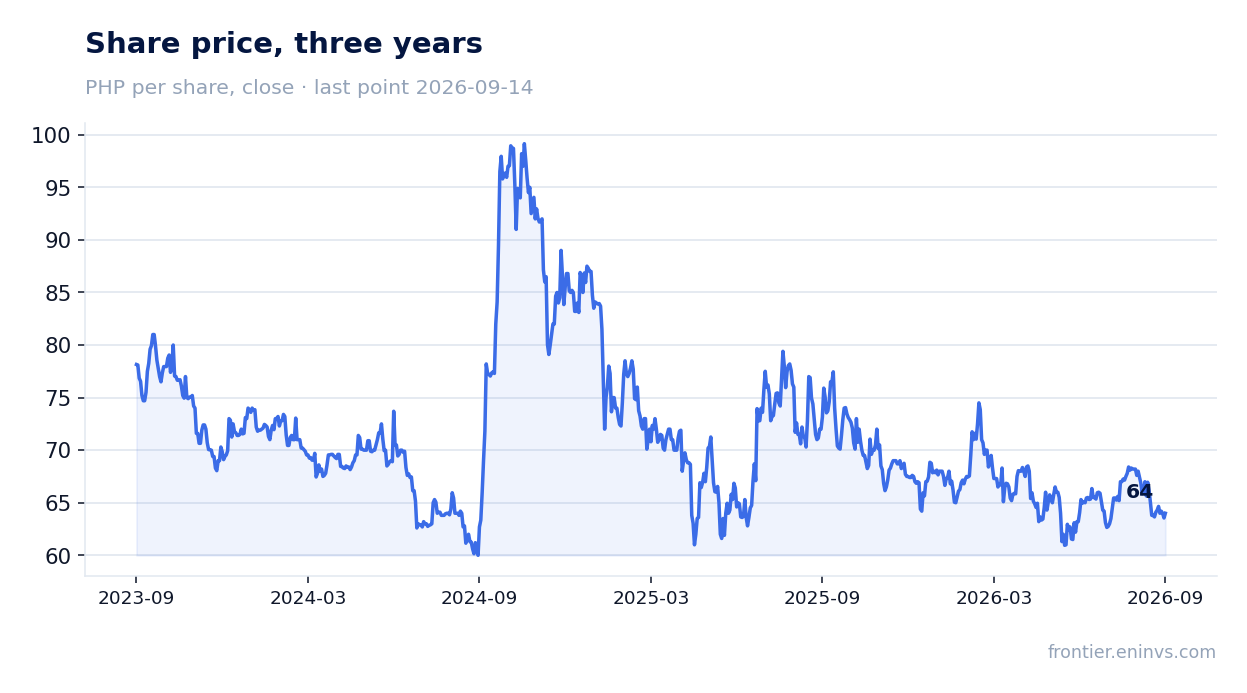
The current LTM P/E multiple is 4.1x, below the historical average for the bank. At the same time, ROE is 8.7%, below the cost of equity estimated by the market. This combination suggests that the market is pricing in either further deterioration in asset quality or low growth rates.
The portal's model, based on comparing ROE and P/B, estimates upside to fair value at +28%. This is the portal's own estimate, not a market consensus. It implies that the current price is undervalued relative to the fundamental value of the bank's capital.
For comparison: a 4.7% dividend yield and 4.1x P/E create prerequisites for a re-rating if the bank manages to stabilize provisions and return profit to growth. Without that, multiples may remain low.
A 4.7% dividend yield on a PHP 5.7 mn quarterly payout is a low base for re-rating
In Q1 2026, the bank paid dividends of PHP 5.7 mn, corresponding to a 4.7% dividend yield on the current price. This is a low absolute payout compared to net profit of PHP 2,704.2 mn. The payout ratio is less than 1% of quarterly profit, indicating a conservative dividend policy.
For comparison: a year earlier, PHP 1,136.0 mn was paid in Q1. The current payout is significantly lower, which may be due to a decision to direct profit toward capital strengthening or covering credit losses. If the bank maintains this approach, the dividend yield will remain at or below 4.7%.
Our estimate for the current year: if profit remains at the LTM level (PHP 11,854.0 mn) and the payout ratio is around 30%, the dividend could be approximately PHP 3,556 mn, yielding about 7.3% on the current market cap. However, this is only an assumption based on historical payout ratios and is not guaranteed. The key risk is further growth in provisions, which could reduce profit and payouts.
Deposits grew by PHP 7.5 bn in the quarter, but the mix shifted toward expensive time deposits
Total deposits as of 31 March 2026 amounted to PHP 937,981.8 mn, up PHP 7,479.1 mn from the beginning of the year. However, the structure changed: time deposits rose to PHP 459,962.9 mn from PHP 471,193.1 mn at end-2025, while demand and savings deposits increased. This means the bank is attracting more expensive funding, which could pressure the net interest margin in the future.
Despite deposit growth, the loan portfolio contracted to PHP 679,443.6 mn from PHP 696,637.5 mn at end-2025. This decline of PHP 17,193.9 mn may indicate caution in issuing new loans or loan repayments. The combination of rising deposits and shrinking loans leads to liquidity accumulation, reflected in the increase in cash and cash equivalents to PHP 109,566.5 mn from PHP 85,674.4 mn at the beginning of the year.
This dynamic may be temporary, but it signals a possible slowdown in the lending business. If lending does not recover, interest income may stop growing.
Valuation on the latest reported figures
| Metric | Value |
|---|---|
| Market cap | 48.6 bn PHP |
| P/E (LTM) | 4.1 |
| P/B | 0.32 |
| ROE | 8.7% |
| Dividend yield (12m) | 4.7% |
Bottom line
The strong side of the report is the acceleration in net interest income growth to 27.6% YoY and tight control over operating expenses. However, all this growth was consumed by loan-loss provisions, which rose 1.6x. Quarterly profit fell 4.1%, and without stabilization of provisions, the bank will not be able to realize the potential embedded in the current low valuation. A 4.7% dividend yield and 4.1x P/E look attractive but require confirmation of asset quality. The verdict is rather attractive, with a caveat on credit risk.
Open the company's financial profile SECB →
See also: market overview · valuation map · stock screeners