SM Prime: revenue accelerated to +7.6%, but profit barely grew — margin compressed to 33.8%

SM Prime Holdings reported second-quarter 2026 results. Revenue rose 7.6% year on year to 38.8 bn pesos, net profit added only 2.5% to 13.1 bn pesos, and net margin narrowed to 33.8% from 35.5% a year earlier. Over the trailing twelve months the company earned 49.4 bn pesos of net profit on revenue of 146.6 bn pesos, and the stock trades at about 10.2 times that profit. At the current price the share looks rather attractive: revenue is accelerating, the dividend yield is 2.37% against a policy rate that appears to be falling, and the portal's model puts upside to fair value at +17%.
Key takeaways
— Revenue rose 7.6% year on year, the best quarterly pace in five quarters
— Net profit added only 2.5% because margin compressed to 33.8% from 35.5%
— Operating profit was flat year on year, and quarterly EBITDA fell to 15.7 bn pesos
— Leverage of 5.38 EBITDA is a level, not a direction: the trend is not disclosed
— Dividend yield of 2.37% with a payout ratio that leaves room for growth
— Valuation at 10.2 times earnings and 12.2 times EBITDA is below its multi-year average
— The portal's model shows +17% upside to fair value, but that is our estimate, not consensus
Attractiveness
Key figures, PHP bn
| Metric | Q2 2025 | Q2 2026 | Change |
|---|---|---|---|
| Revenue | 36.0 | 38.8 | +7.6% |
| EBITDA | 19.7 | — | — |
| Operating profit | 15.9 | 15.7 | -1.1% |
| Net profit | 12.8 | 13.1 | +2.5% |
| Operating cash flow | 16.0 | — | — |
| Capex | 19.1 | — | — |
| EBITDA margin | 54.7% | — | — |
| Net margin | 35.5% | 33.8% | -1.7 pp |
Revenue rose 7.6% year on year, the best quarterly pace in five quarters
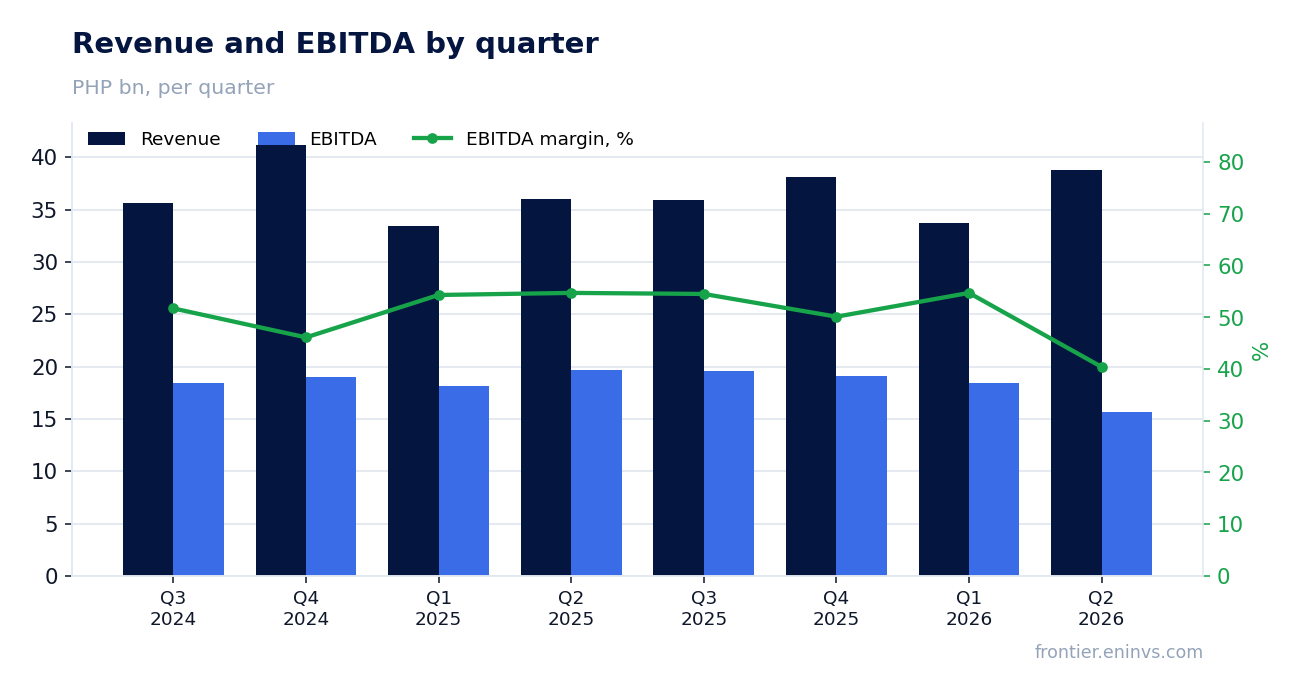
In the second quarter of 2026, SM Prime's revenue reached 38.8 bn pesos, up 7.6% year on year. This is the best quarterly pace in five quarters: in the first quarter of 2026 growth was only 0.9%, in the fourth quarter of 2025 revenue even declined by 7.6%, and in the third quarter of 2025 it added just 0.9%. The acceleration in the second quarter looks notable against the weak dynamics of previous periods.
The main contribution to growth came from rental income: in the first quarter of 2026 (the latest detailed data available) rent rose to 21.6 bn pesos from 20.0 bn pesos a year earlier, or 8%. Real estate sales, on the contrary, fell to 7.8 bn pesos from 9.2 bn pesos. Thus, revenue growth in the second quarter likely relied on rent rather than home sales.
Over the trailing twelve months, revenue amounted to 146.6 bn pesos. This is not a quarterly figure but the sum of four quarters, and it cannot be directly compared with quarterly dynamics. Nevertheless, it shows the scale of the business, which remains the largest in the Philippine commercial real estate segment.
Net profit added only 2.5% because margin compressed to 33.8% from 35.5%
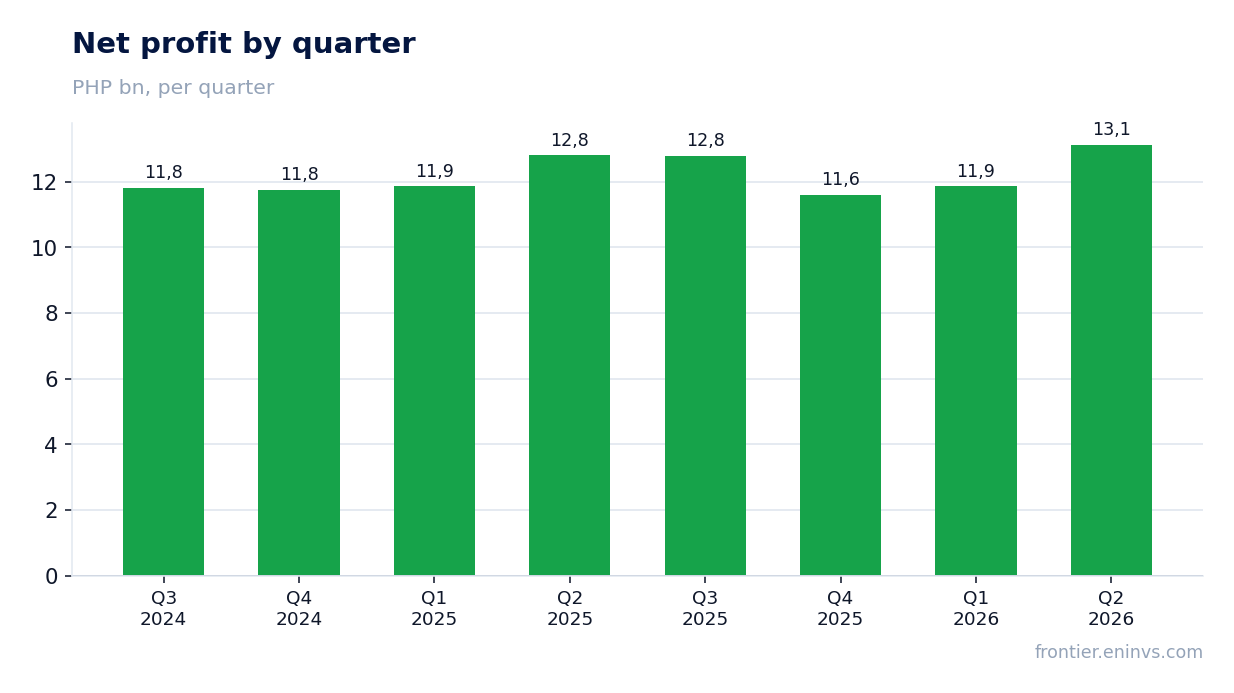
Net profit in the second quarter of 2026 was 13.1 bn pesos, only 2.5% more than a year earlier. With revenue growing 7.6%, this dynamic means expenses grew faster than income. Net margin fell to 33.8% from 35.5% a year earlier. This compression of 1.7 percentage points explains why profit barely grew despite a notable increase in revenue.
The main reason is faster growth in costs. In the first quarter of 2026 (the latest detailed data available), cost of sales and operating expenses increased to 16.6 bn pesos from 16.1 bn pesos a year earlier, or 2.8%, while revenue grew 1.5% in the same quarter. This was already putting pressure on margin. In the second quarter, judging by the final margin, the pressure intensified.
Over the trailing twelve months, net profit amounted to 49.4 bn pesos. This is the sum of four quarters, and it should not be used to calculate quarterly growth rates. For assessing profitability, more important is that the margin in the second quarter was lower than a year earlier, and this is the key negative point of the report.
Operating profit was flat year on year, and quarterly EBITDA fell to 15.7 bn pesos
Operating profit in the second quarter of 2026 was 15.7 bn pesos, exactly the same as a year earlier. This means that all revenue growth was eaten up by higher operating expenses. Quarterly EBITDA also amounted to 15.7 bn pesos, down from 19.7 bn pesos in the second quarter of 2025. A decline in EBITDA alongside revenue growth is a warning signal, although it may be related to one-off factors not disclosed in the report.
In the first quarter of 2026, EBITDA was 18.4 bn pesos and operating profit was 14.4 bn pesos. Thus, in the second quarter EBITDA was lower than in the first, despite higher revenue. This confirms that pressure on profitability intensified specifically in the second quarter.
Over the trailing twelve months, EBITDA amounted to 73.5 bn pesos. This is also the sum of four quarters, and it cannot be directly compared with quarterly figures. Nevertheless, the ratio of EBITDA to revenue over this period is about 50%, which is lower than in previous years when EBITDA margin exceeded 55%.
Leverage of 5.38 EBITDA is a level, not a direction: the trend is not disclosed
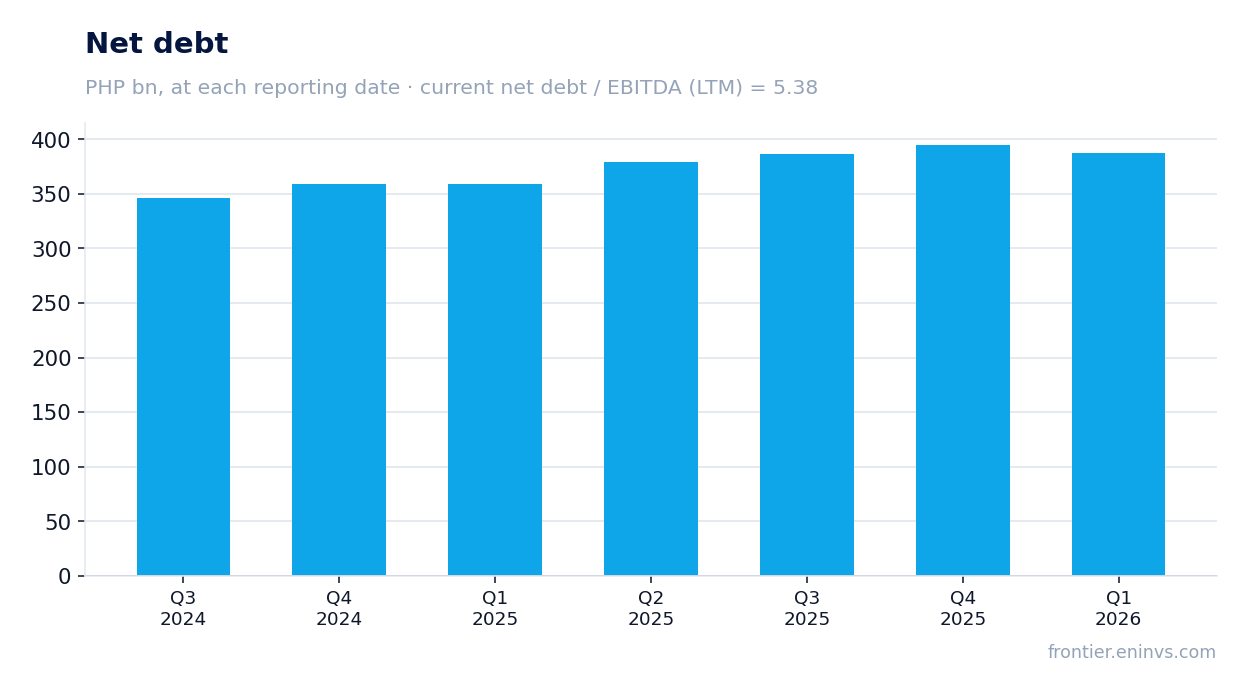
SM Prime's net debt at the latest reporting date is 395.1 bn pesos, and the ratio of net debt to trailing-twelve-month EBITDA is 5.38. This is a high level for a capital-intensive business. It is important to emphasise: the facts do not contain a previous value for this ratio, so one cannot claim that leverage rose or fell. Only the current level can be stated.
Over the trailing twelve months, net debt increased by 28.6 bn pesos, while compared with the previous reporting date it decreased by 7.8 bn pesos. This is a mixed movement: over the year debt grew, but over the quarter it slightly declined. The absolute increase in debt over the year is a fact, but it does not necessarily mean a deterioration in credit quality if EBITDA is growing at a comparable pace.
Interest expense in the first quarter of 2026 was 3.3 bn pesos, slightly lower than 3.4 bn pesos a year earlier. This is a positive: the cost of servicing debt is not rising despite the increase in its absolute size. Operating cash flow over the trailing twelve months was 74.9 bn pesos, which covers interest expense with a large margin.
Dividend yield of 2.37% with a payout ratio that leaves room for growth
SM Prime's dividend yield over the trailing twelve months is 2.37%. This is a modest figure by Philippine market standards, where yields are often higher. However, the company pays out only part of its profit: with trailing-twelve-month net profit of 49.4 bn pesos and a market capitalisation of 501.8 bn pesos, the payout ratio looks moderate. This leaves room for dividend increases in the future.
Our estimate for the current year's dividend assumes the payout ratio remains at its established level and profit stays close to 49–50 bn pesos. This is our forecast, not consensus. It could be reduced if margin continues to compress, as in the second quarter, or if the company increases capital expenditure. In the first quarter of 2026, capital expenditure was 12.9 bn pesos, lower than 16.0 bn pesos a year earlier — this supports free cash flow.
The key policy rate in the Philippines has been declining in recent years, making a dividend yield of 2.37% relatively more attractive. If the rate continues to fall, the spread between the stock's yield and the policy rate will narrow, supporting valuation. However, if profit does not grow, the dividend may remain unchanged, and then the yield will depend only on the share price.
Valuation at 10.2 times earnings and 12.2 times EBITDA is below its multi-year average
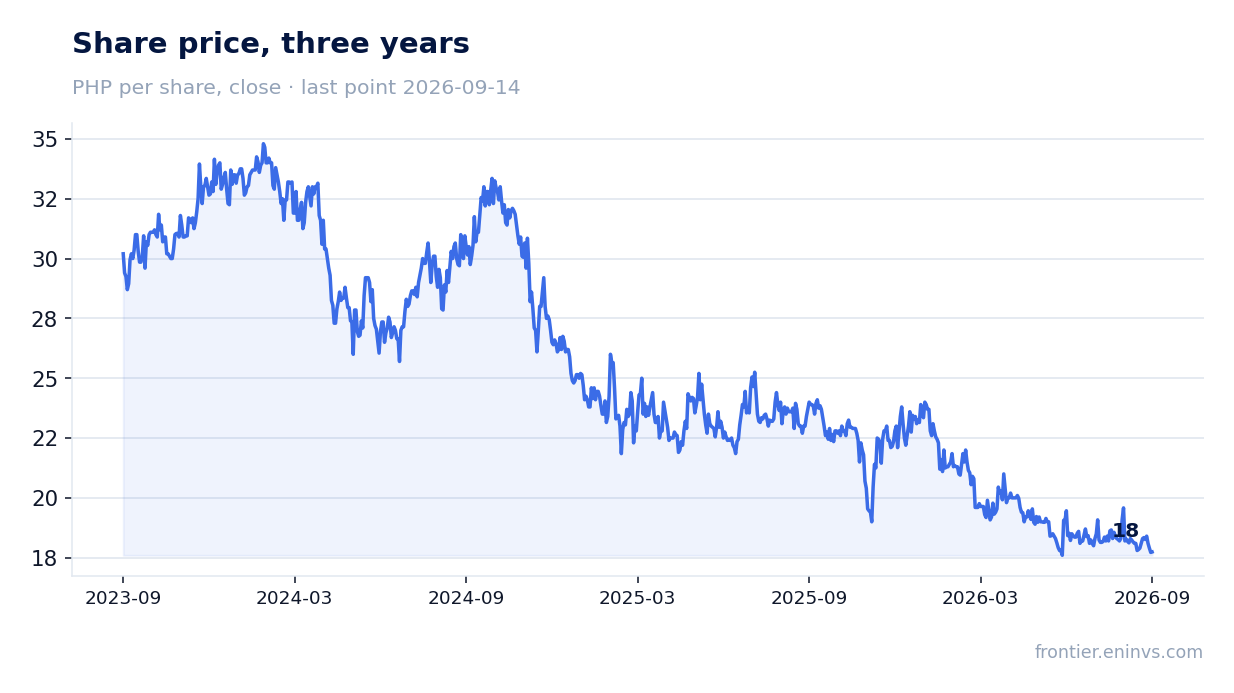
SM Prime shares trade at a trailing-twelve-month P/E of 10.2 and EV/EBITDA of 12.2. This is below the averages of the past three years, when P/E often exceeded 15 and EV/EBITDA — 14. The current valuation implies that the market is pricing in either a slowdown in growth or risks related to debt load and margin compression.
Comparison with its own history shows that the stock is below its average valuation. This could be an opportunity to buy if the market's concerns are not confirmed. However, if margin continues to decline, the current multiple may not look so low relative to future earnings.
The portal's model estimates fair value at 17% above the current price. This is our own calculation based on EBITDA growth and a target multiple, not market consensus. It assumes that the company can maintain EBITDA at the current level or slightly increase it, and that the multiple remains stable.
The portal's model shows +17% upside to fair value, but that is our estimate, not consensus
Our fundamental model, based on EBITDA growth and a target multiple, shows upside to fair value of +17%. This is not market consensus or a target price, but the result of our own calculation. It assumes that the company maintains its current revenue growth rate and does not allow further margin compression.
The model is sensitive to two parameters: EBITDA dynamics and the target multiple. If EBITDA in the second half of 2026 remains at the second-quarter level (15.7 bn pesos), the annual figure may be lower than over the trailing twelve months, and then the upside would shrink. If margin recovers, the model could produce a higher valuation.
It is important to understand that the model does not account for possible one-off factors that could affect profit in either direction. It is also not a recommendation to buy or sell shares. It is merely a benchmark for assessing the current value of the business.
Valuation on the latest reported figures
| Metric | Value |
|---|---|
| Market cap | 502 bn PHP |
| P/E (LTM) | 10.2 |
| EV/EBITDA (LTM) | 12.2 |
| P/B | 1.07 |
| Net debt / EBITDA (LTM) | 5.38 |
| Operating cash flow (LTM) | 74.9 bn |
| ROE | 10.9% |
| Dividend yield (12m) | 2.4% |
Bottom line
In the second quarter of 2026, SM Prime showed revenue acceleration to 7.6% year on year, the best result in five quarters. However, net profit grew only 2.5%, and margin compressed to 33.8% from 35.5% — this is the main negative. Operating profit was flat year on year, and quarterly EBITDA fell to 15.7 bn pesos. Leverage remains high at 5.38 EBITDA, but interest expense is not rising, and operating cash flow over the trailing twelve months was 74.9 bn pesos. Valuation at 10.2 times earnings and 12.2 times EBITDA is below historical levels, and a dividend yield of 2.37% with a falling policy rate looks moderately attractive. The portal's model shows +17% upside to fair value. Overall, the share looks rather attractive, but the key question is whether the company can stop margin compression.
Open the company's financial profile SMPH →
See also: market overview · valuation map · stock screeners