IDGC Ural: profit up 2.5x, but revenue growth is slower than a quarter ago
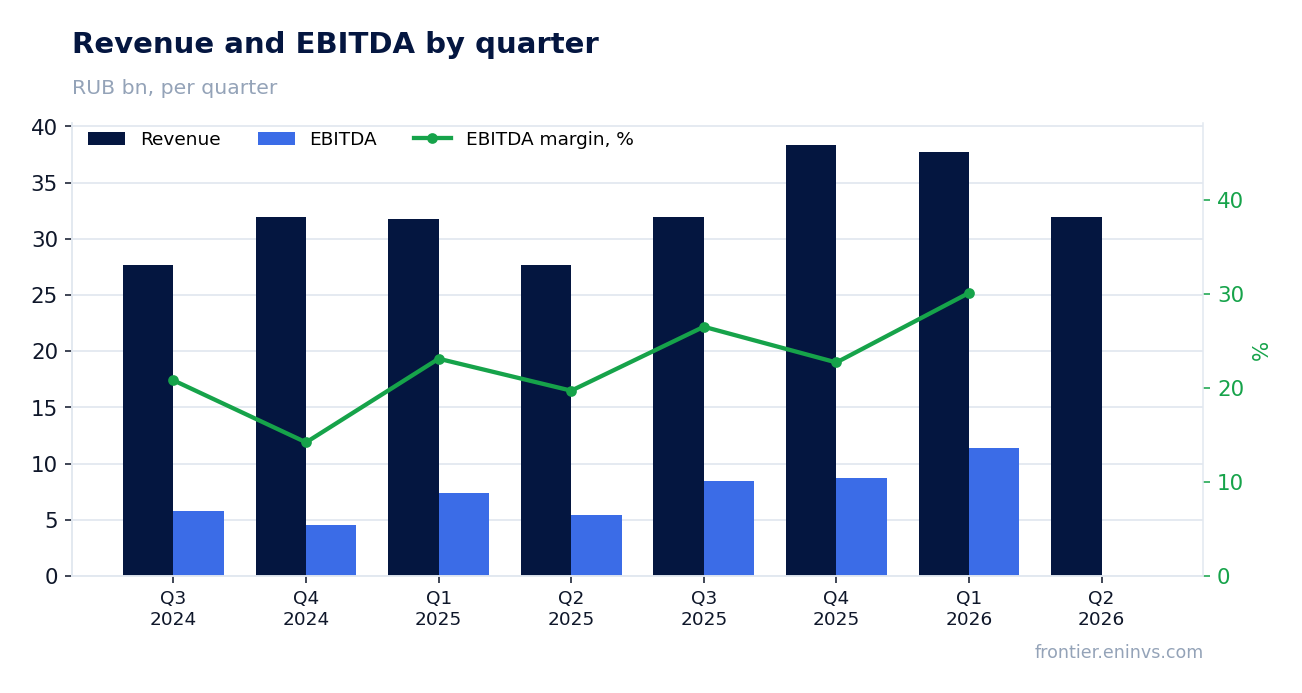
On 29 July, IDGC Ural published its accounting statements for January–June 2026. Second-quarter revenue reached RUB 31.9 bn, up 15.2% year on year, net profit rose 2.5x to RUB 5.4 bn, and the net margin climbed from 7.8% to 17.0%. Revenue growth slowed from 18.7% in the first quarter, while profit was supported by other income and lower interest expenses. At a share price of RUB 0.563 and a dividend yield of about 9.8%, the stock looks attractive for an income-oriented holder – with EV/EBITDA at 1.99 against its own three-year average of 2.12 and the portal model's upside at +106%.
Key takeaways
— Revenue grew 15.2%, but that is slower than 18.7% a quarter earlier
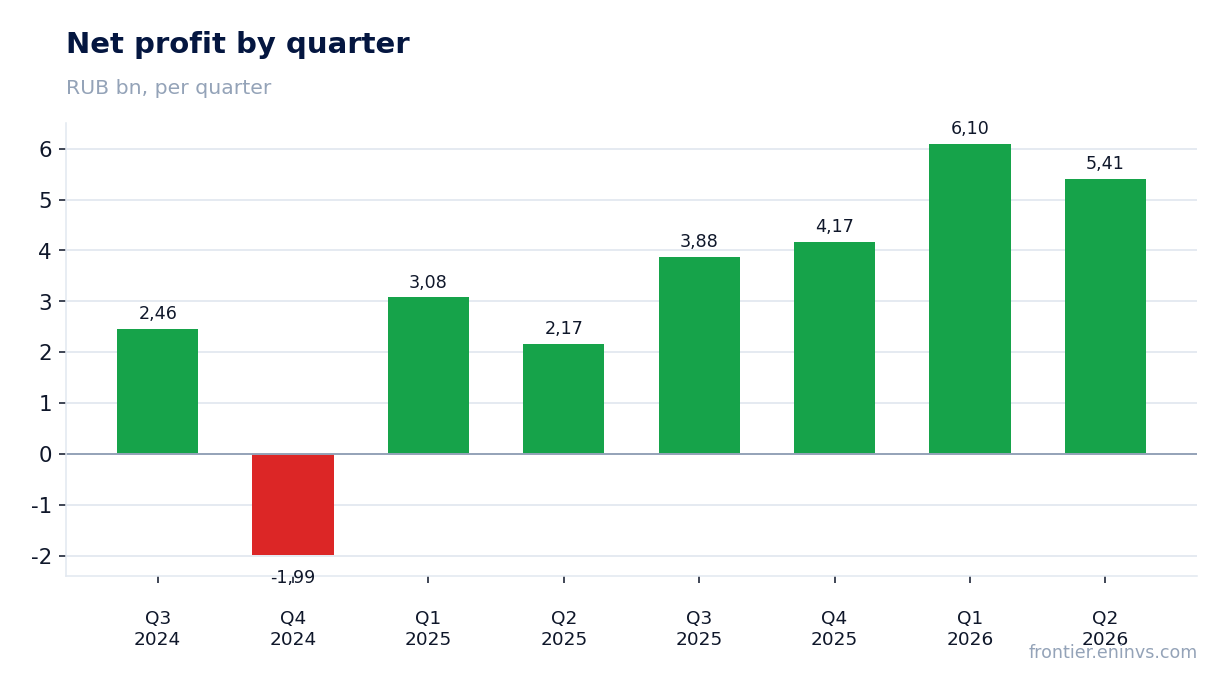
— Net profit rose 2.5x to RUB 5.4 bn, with a 17.0% net margin
— Profit was supported by other income and lower interest expenses
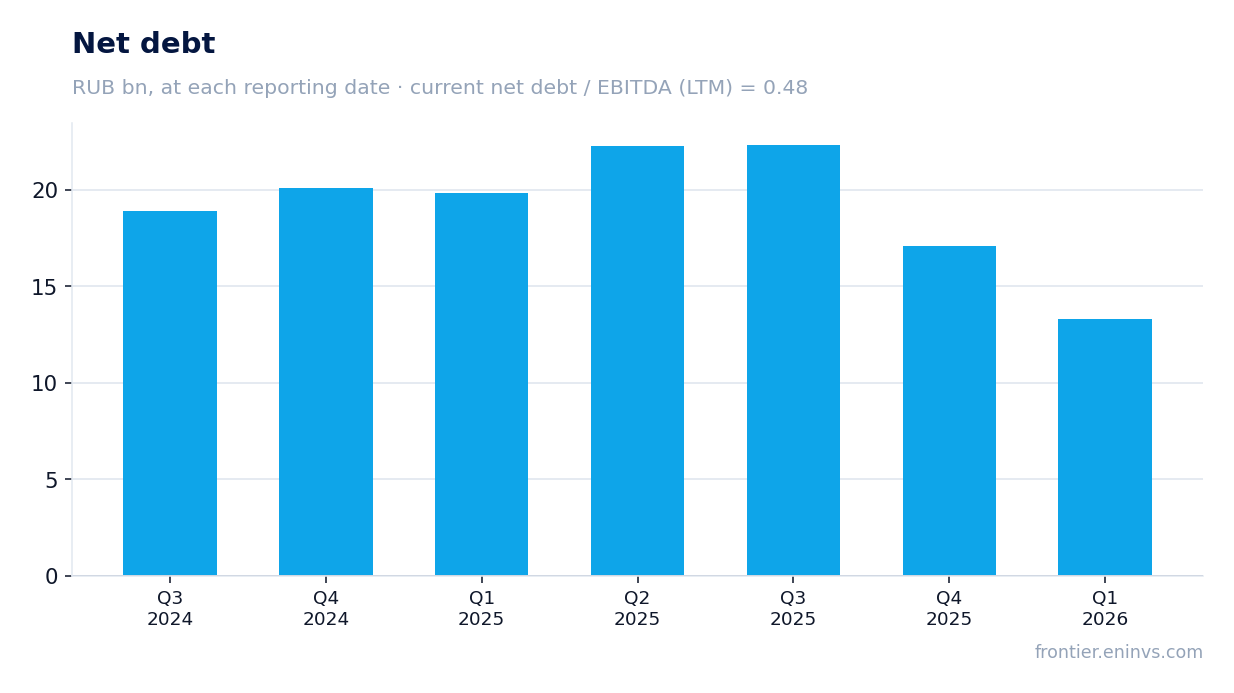
— Debt load at 0.48 EBITDA LTM is low for a grid company
— The dividend for 2026 could be RUB 0.09 per share – this is our estimate
— EV/EBITDA at 1.99 is below its own three-year average of 2.12
— The portal model estimates the share's upside at +106%
Attractiveness
Key figures, RUB bn
| Metric | Q2 2025 | Q2 2026 | Change |
|---|---|---|---|
| Revenue | 27.7 | 31.9 | +15.2% |
| EBITDA | 5.45 | — | — |
| Operating profit | 3.14 | 6.65 | +111.9% |
| Net profit | 2.17 | 5.41 | +149.5% |
| Operating cash flow | 6.75 | — | — |
| Capex | 3.54 | — | — |
| EBITDA margin | 19.7% | — | — |
| Net margin | 7.8% | 17.0% | +9.2 pp |
Revenue grew 15.2%, but that is slower than 18.7% a quarter earlier
In the second quarter of 2026, IDGC Ural's revenue reached RUB 31.9 bn, up 15.2% year on year. This is a notable deceleration from the first quarter, when growth reached 18.7%. For the first half, revenue amounted to RUB 68.6 bn against RUB 58.8 bn a year earlier.
The slowdown in quarterly growth does not mean the business is weakening: second-quarter revenue is traditionally lower than the first due to consumption seasonality. In absolute terms, RUB 31.9 bn is the second-highest quarterly result over the past two years after the fourth quarter of 2025.
Revenue dynamics rest on the growth of electricity transmission tariffs and the connection of new consumers. The statements do not disclose a segment breakdown, so it is impossible to say precisely which factor contributed more. However, the persistence of double-digit growth rates for four consecutive quarters points to the sustainable nature of this process.
Net profit rose 2.5x to RUB 5.4 bn, with a 17.0% net margin
Net profit in the second quarter of 2026 reached RUB 5.4 bn, 2.5 times more than RUB 2.2 bn a year earlier. The net margin rose to 17.0% from 7.8% in the second quarter of 2025. For the first half, profit amounted to RUB 11.3 bn against RUB 5.4 bn a year earlier.
Such profit growth with revenue up only 15.2% is explained by an outpacing decline in expenses. In the income statement for the first half, other income amounted to RUB 2.7 bn against RUB 1.8 bn a year earlier, while interest payable fell to RUB 1.8 bn from RUB 2.3 bn. This provided an additional contribution to profit.
Operating profit in the second quarter amounted to RUB 6.7 bn, also above last year's level. However, the main increase in net profit came not from operating metrics but from financial items – lower debt load and higher income from participation in other organisations.
Profit was supported by other income and lower interest expenses
In the first half of 2026, other income rose to RUB 2.7 bn from RUB 1.8 bn a year earlier. Part of this increase is related to the revaluation of financial investments: according to the notes, revaluation income amounted to RUB 856.5 mn, while expenses were RUB 223.1 mn, giving a net effect of RUB 633.5 mn against RUB 357.9 mn a year earlier.
Interest payable fell to RUB 1.8 bn from RUB 2.3 bn a year earlier. This reflects both an overall reduction in debt load and a lower cost of debt servicing. Net debt at the end of 2025 stood at RUB 17.1 bn, and at the end of the first quarter of 2026 – RUB 13.3 bn, confirming a consistent reduction in liabilities.
These two items – other income and interest expenses – together provided about RUB 1.4 bn of additional profit for the half-year. Without them, net profit growth would have been less impressive, although still significant. It is important to understand that part of other income is one-off in nature and may not recur in the next quarter.
Debt load at 0.48 EBITDA LTM is low for a grid company
IDGC Ural's net debt at the end of 2025 stood at RUB 17.1 bn, and the ratio of net debt to EBITDA for the trailing twelve months was 0.48. This is a low level for a grid company, where a load of 1.5–2.0 EBITDA is considered normal. Such a margin of safety allows financing the investment programme without a significant increase in debt.
In the first half of 2026, the company raised loans of RUB 15.3 bn and repaid RUB 15.8 bn, meaning the net inflow from loans was negative. This is consistent with the balance sheet data: cash increased to RUB 14.7 bn from RUB 10.4 bn at the end of 2025.
Operating cash flow for the first half amounted to RUB 15.2 bn, significantly higher than last year's RUB 6.8 bn. This allows covering capital expenditures, which for the same period amounted to RUB 9.7 bn, and maintaining positive free cash flow. However, we cannot claim that debt load decreased, since an earlier value of the ratio is not available in the facts.
The dividend for 2026 could be RUB 0.09 per share – this is our estimate
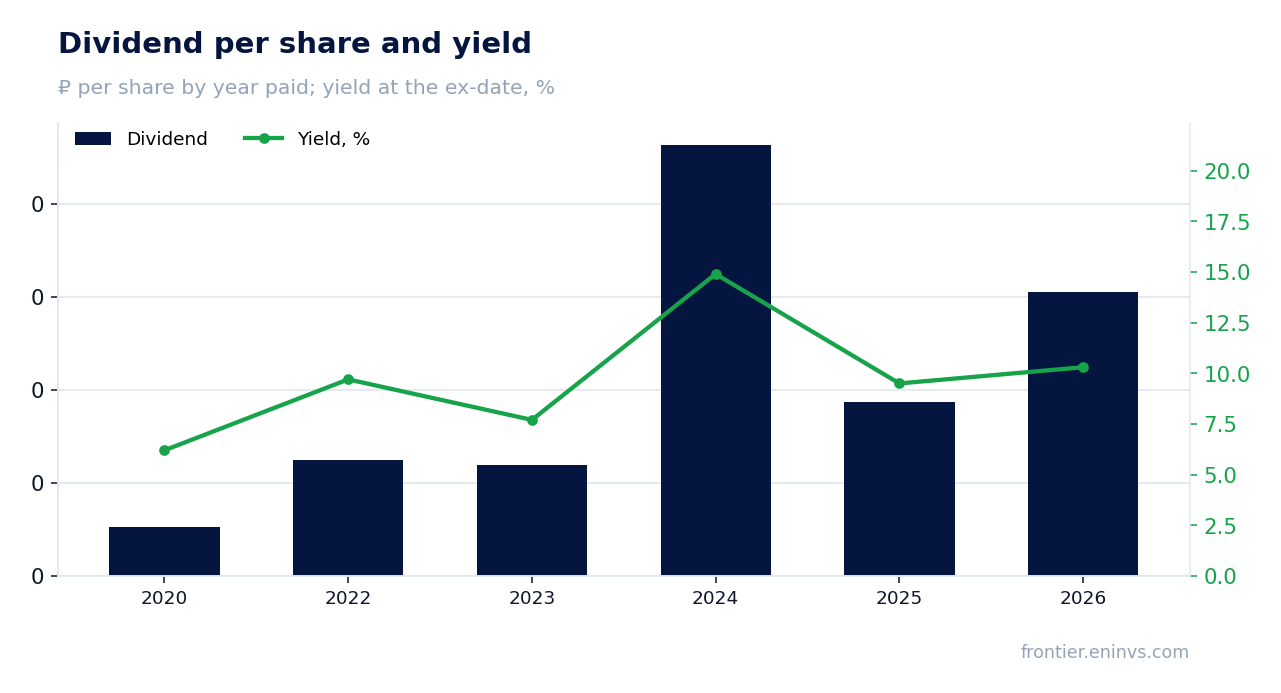
Over the last 12 months, IDGC Ural paid dividends of RUB 0.0612 per share, which at the current price of RUB 0.563 gives a yield of 9.8%. This is below the key rate of 14.0%, but given the potential for share price growth and the low valuation, the stock remains interesting for income-oriented holders.
Our estimate of the dividend for the current financial year (to be paid next year) is RUB 0.09 per share, corresponding to a yield of 14.0% on the current price. This estimate is based on the assumption that the company will allocate 39% of profit to dividends, as last year, and that profit for the year will be about RUB 19.6 bn (LTM). This is our estimate, not a company forecast; the board decides.
The dividend history shows volatility: for 2024, RUB 0.0928 per share was paid (yield 14.9% at the ex-date), for 2025 – RUB 0.0374 (9.5%), for 2026 – RUB 0.0612 (10.3%). The average yield over the last three years is about 11.6%, close to our fair yield estimate of 10.5%.
The risk of a dividend cut is linked to a possible reduction in profit due to growing capital expenditures or one-off write-offs. The company actively invests in fixed assets: in the first half, capital expenditures amounted to RUB 9.7 bn, 34% more than a year earlier. If the investment programme is expanded, free cash flow may decline, limiting dividend payments.
EV/EBITDA at 1.99 is below its own three-year average of 2.12
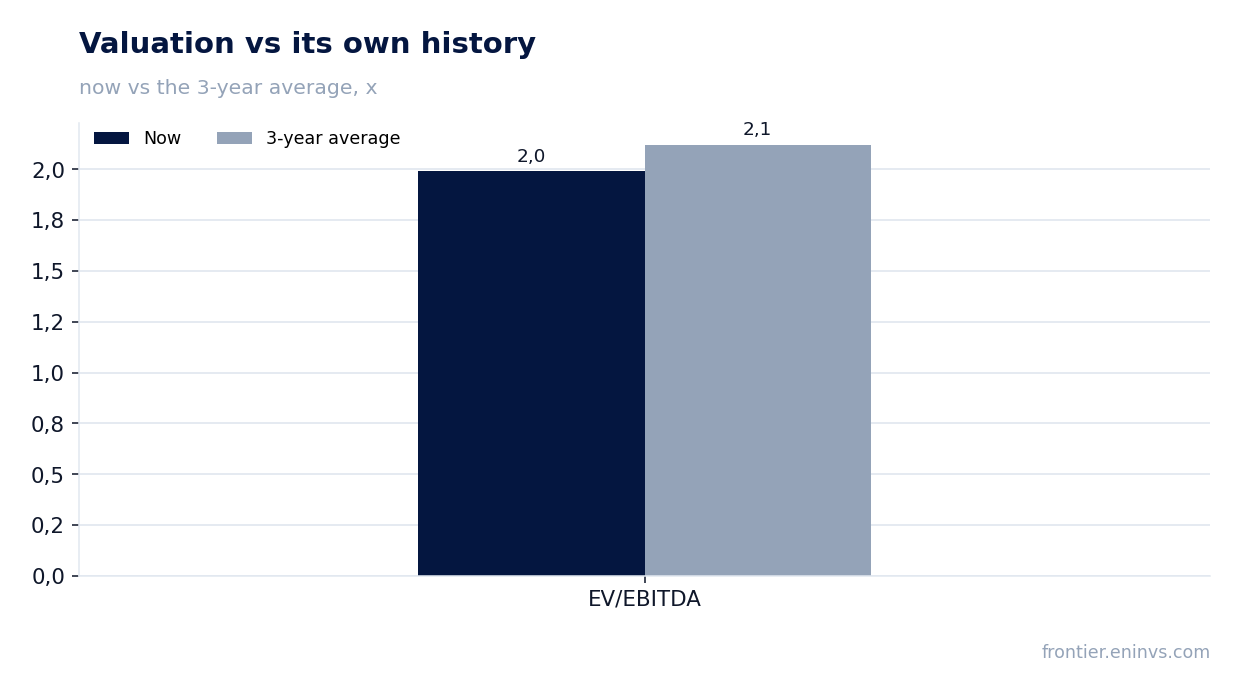
IDGC Ural's current valuation on EV/EBITDA is 1.99, below its own three-year average of 2.12. This means the stock trades at a discount to its historical valuation. For comparison, P/E LTM is 2.78, also indicating a low earnings valuation.
Such low multiples are explained by high net profit over the last 12 months – RUB 19.6 bn – and significant EBITDA – RUB 35.9 bn. Market capitalisation stands at RUB 54.4 bn, less than annual revenue. This valuation is typical for companies with regulated tariffs and low growth rates, but in IDGC Ural's case it is complemented by a high dividend yield.
The portal model estimates the share's upside to fair value at +106%. This is our own model, based on EBITDA growth and a target multiple; it is not a market consensus or a target price. If the company maintains current profit growth and dividend payments, the discount to historical valuation may narrow.
The portal model estimates the share's upside at +106%
Our fundamental valuation model, based on EBITDA growth and a target multiple, shows an upside for IDGC Ural shares to fair value of +106%. This is a substantial upside, reflecting both the low current valuation and expectations for growth in financial metrics.
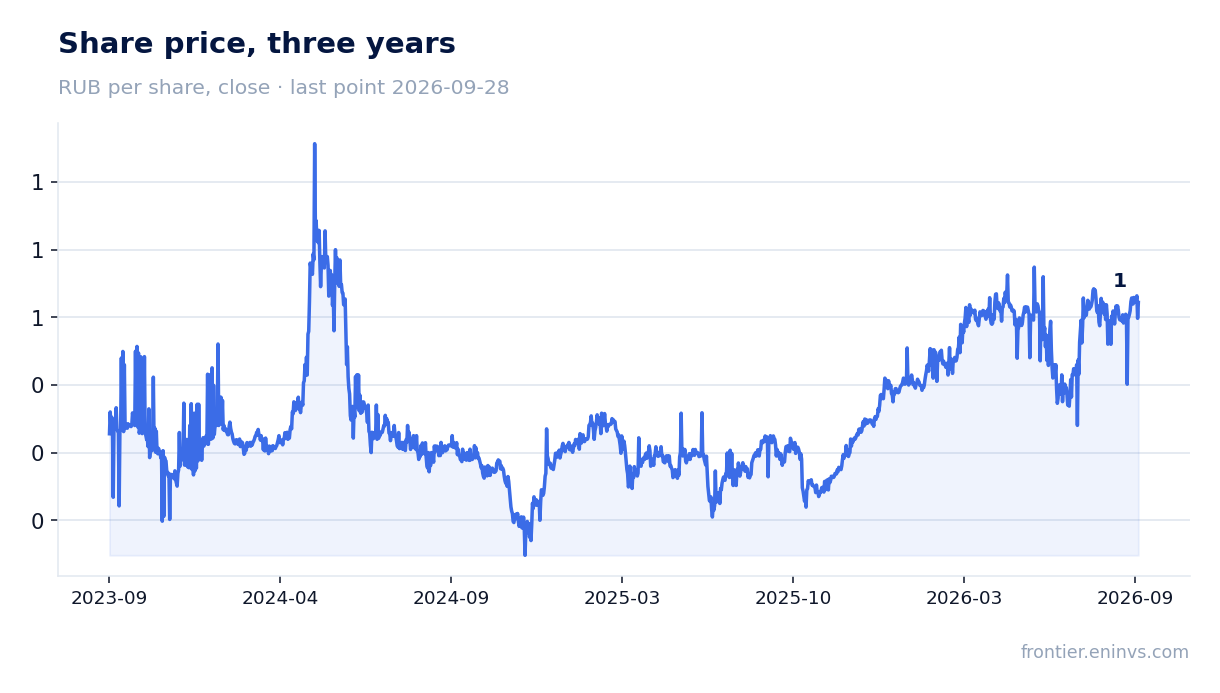
Since the release of the statements on 29 July, the share has gained 10.4% (as of 28 September 2026), with a 2.9% rise on the release day. The market reacted positively to the strong financial results, but the model's upside remains significant. The stock is held in our live model strategies on the portal (RU AI conviction), but this is a fact, not an argument for the valuation.
It is worth noting that the model is based on assumptions about future EBITDA growth and may not account for risks related to tariff regulation or the investment programme. Nevertheless, the current discount to historical valuation and high dividend yield make the stock attractive for a long-term holder.
Valuation on the latest reported figures
| Metric | Value |
|---|---|
| Market cap | 54.4 bn ₽ |
| P/E (LTM) | 2.8 |
| EV/EBITDA (LTM) | 2.0 |
| P/B | 0.66 |
| Net debt / EBITDA (LTM) | 0.48 |
| ROE | 24.2% |
| Dividend yield (12m) | 9.8% |
| EV/EBITDA, 3-year average | 2.1 |
Dividend per share, ₽, and yield at the ex-date
| Year paid | Dividend | Yield |
|---|---|---|
| 2020 | 0.01 | 6.2% |
| 2022 | 0.02 | 9.7% |
| 2023 | 0.02 | 7.7% |
| 2024 | 0.09 | 14.9% |
| 2025 | 0.04 | 9.5% |
| 2026 | 0.06 | 10.3% |
| Our estimate, current year | 0.09 | 14.0% on the current price |
Bottom line
IDGC Ural delivered strong results for the second quarter of 2026: net profit rose 2.5x to RUB 5.4 bn, the net margin climbed to 17.0%, and debt load remains low at 0.48 EBITDA LTM. However, revenue growth slowed to 15.2% from 18.7% in the first quarter, and a significant part of profit came from one-off other income and lower interest expenses. For a dividend-oriented holder, the key question is whether the company can pay the expected RUB 0.09 per share (14.0% yield on the current price) while maintaining its investment programme. EV/EBITDA at 1.99 is below its own three-year average of 2.12, and the portal model points to +106% upside, making the stock attractive at the current price.
Open the company's financial profile MRKU →
See also: market overview · valuation map · stock screeners