UZ_UNIVERSAL: revenue up 26.6% but profit down 15.2% – margin compressed from 40.9% to 27.4%

UZ_UNIVERSAL reported results for the second quarter of 2026. Revenue rose 26.6% year-on-year to UZS 223,470.2 mn, operating profit came in at UZS 75,750.9 mn, and net profit was UZS 61,180.9 mn, down 15.2% from a year earlier. Net margin fell to 27.4% from 40.9% a year ago. At the current price the share looks attractive: forward P/E of 5.4, ROE of 27.5% and dividend yield of 4.4%, with 19% upside to fair value on the portal's model.
Key takeaways
— Revenue grew 26.6% year-on-year but slowed from 30.9% a quarter earlier
— Net profit fell 15.2% year-on-year even as operating profit remained high
— Net margin compressed to 27.4% from 40.9% a year earlier
— Dividend yield of 4.4% with a payout ratio yet to be clarified
— P/E of 5.4 and ROE of 27.5% – valuation below its own history, but profit under pressure
— Upside to fair value on the portal's model is 19%
Attractiveness
Key figures, UZS bn
| Metric | Q2 2025 | Q2 2026 | Change |
|---|---|---|---|
| Revenue | 176 | 223 | +26.6% |
| Operating profit | — | 75.8 | — |
| Net profit | 72.2 | 61.2 | -15.2% |
| Net margin | 40.9% | 27.4% | -13.5 pp |
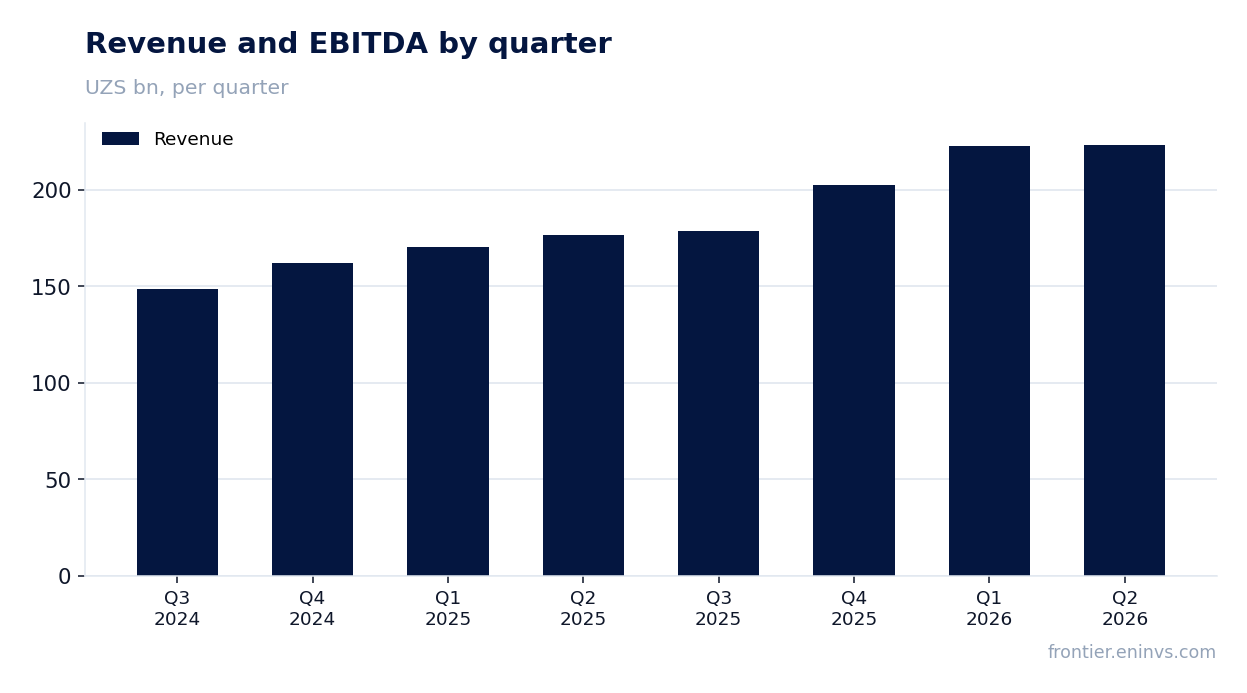
Revenue grew 26.6% year-on-year but slowed from 30.9% a quarter earlier
In the second quarter of 2026, revenue reached UZS 223,470.2 mn, up 26.6% year-on-year. This extends the growth streak, but the pace slowed: in the first quarter of 2026, revenue rose 30.9% year-on-year. The deceleration of 4.3 percentage points is the first signal that the high base of last year is beginning to bite.
Quarterly dynamics show a consistent slowdown: in Q3 2025 revenue grew 20.3% year-on-year, in Q4 2025 – 24.8%, in Q1 2026 – 30.9%, and in Q2 2026 – 26.6%. This is not a collapse, but there is no sustained acceleration. The company is still growing faster than most markets, but the peak pace appears to be behind it.
For an investor, it matters that even with the slowdown, the absolute revenue level remains high: UZS 223,470.2 mn per quarter is a historical high. The question is whether the company can maintain double-digit growth once the low-base effect finally fades.
Net profit fell 15.2% year-on-year even as operating profit remained high
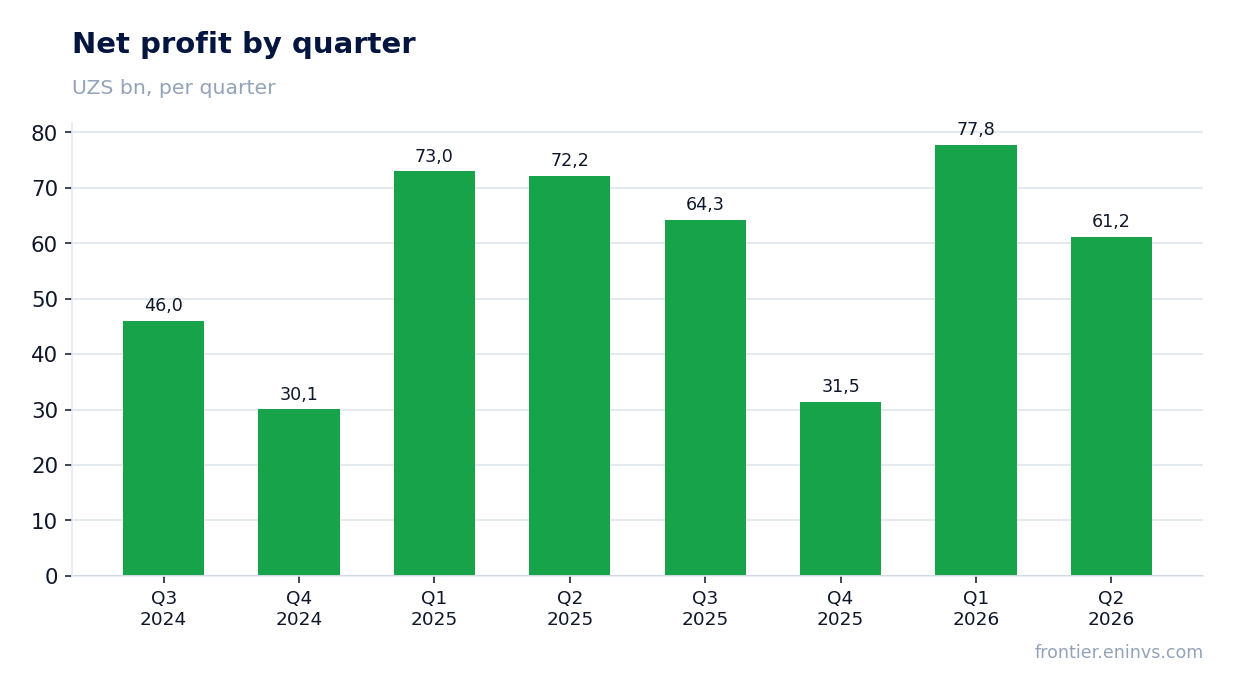
Net profit in the second quarter of 2026 was UZS 61,180.9 mn, down 15.2% from a year earlier. Operating profit stood at UZS 75,750.9 mn – a high level, but it did not translate into net profit growth. The gap between operating and net profit indicates that additional expenses or losses arose below the operating line.
A year earlier, net profit for the second quarter of 2025 was UZS 72,170.0 mn. A 15.2% decline alongside 26.6% revenue growth means that each additional unit of revenue does not bring a proportional increase in profit. This could be due to higher interest expenses, taxes, or one-off write-offs, but the provided data lacks detail.
Operating profit of UZS 75,750.9 mn corresponds to an operating margin of about 33.9% – still a very high figure. However, net margin fell to 27.4%, indicating that pressure on profit emerged below the operating line. Without additional data on the cost structure, the exact cause remains unclear.
Net margin compressed to 27.4% from 40.9% a year earlier
Net margin in the second quarter of 2026 was 27.4%, compared with 40.9% a year earlier. A drop of 13.5 percentage points is a significant deterioration that outweighs the positive effect of revenue growth. This is the key negative of the report.
The margin decline means the company has become less efficient in converting revenue into profit. With revenue of UZS 223,470.2 mn and net profit of UZS 61,180.9 mn, each percentage point of margin is worth about UZS 2,234.7 mn in profit. Losing 13.5 p.p. of margin represents a substantial amount that could have gone to profit.
The reasons for the margin compression could vary: higher operating expenses, increased interest payments, changes in tax burden, or one-off factors. The provided data lacks detail, so it is impossible to pinpoint the driver. However, the fact that margin fell by 13.5 p.p. demands attention – this is not a seasonal fluctuation but a structural shift.
Dividend yield of 4.4% with a payout ratio yet to be clarified
The dividend yield over the trailing twelve months is 4.4%. This is a moderate level that may appeal to income-oriented investors. However, without data on the payout ratio and company policy, it is difficult to assess the sustainability of the dividend.
Net profit over the last twelve months was UZS 234,683.9 mn. If the company directs a significant portion of this profit to dividends, then at the current market capitalisation of UZS 1,270,099.0 mn, a yield of 4.4% looks balanced. But if payments are financed from debt or one-off sources, the risk of a dividend cut increases.
For an investor, it matters that the 4.4% dividend yield exceeds many risk-free rates but is not extraordinary. Combined with a P/E of 5.4 and ROE of 27.5%, the share may be attractive for both growth and income. However, the 15.2% year-on-year decline in net profit creates a risk that future dividend payments may be revised.
P/E of 5.4 and ROE of 27.5% – valuation below its own history, but profit under pressure
The trailing twelve-month P/E ratio is 5.4, indicating a low valuation relative to historical levels. At the same time, ROE stands at 27.5% – a high figure reflecting efficient use of capital. The combination of a low P/E and high ROE is typically considered attractive for investors.
However, a low P/E may reflect not only undervaluation but also market expectations of future profit declines. The 15.2% year-on-year drop in net profit and margin compression to 27.4% are factors that could keep the multiple low. If profit continues to fall, the P/E may rise even if the share price remains unchanged.
The company's market capitalisation is UZS 1,270,099.0 mn. With LTM net profit of UZS 234,683.9 mn, this gives a P/E of 5.4. For comparison, if profit had remained at last year's level, the P/E would be lower. Thus, the current valuation already prices in some profit decline, but not necessarily all possible deterioration.
Upside to fair value on the portal's model is 19%
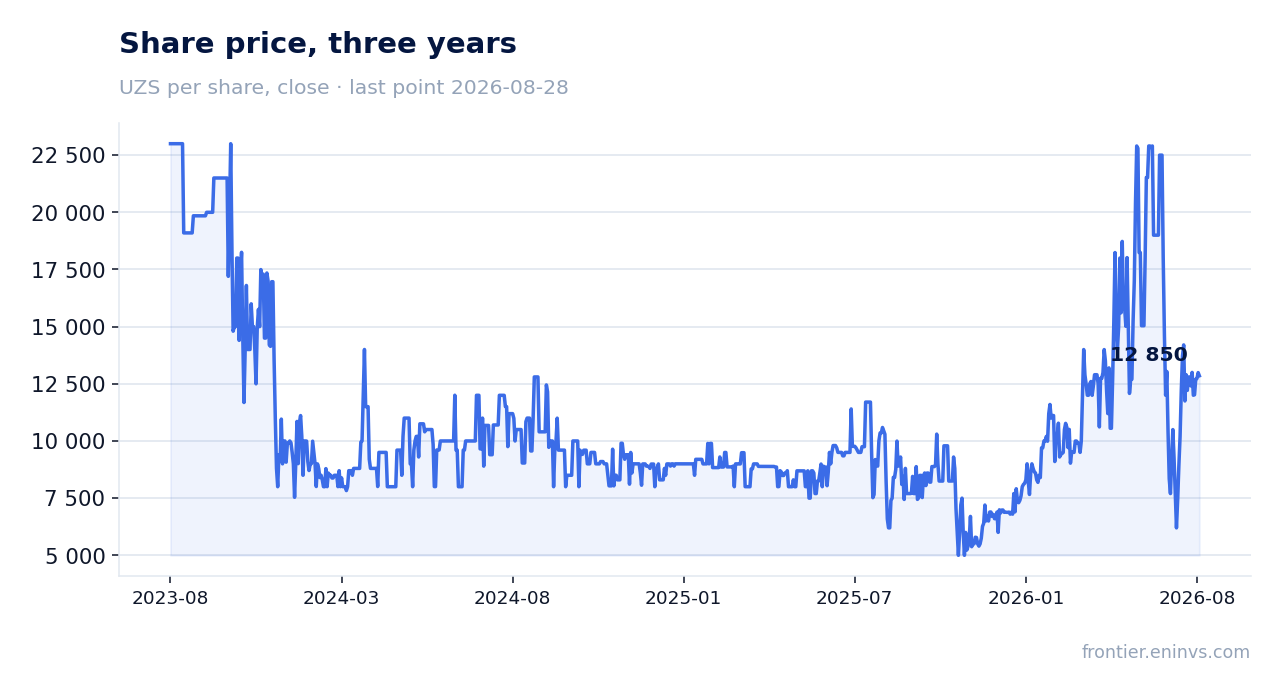
According to the portal's model, the upside to fair value is estimated at 19%. This is the portal's own estimate, based on comparing ROE and P/B, and it is not a market consensus or a target price. The model suggests that at current profitability and valuation levels, the share is undervalued by 19%.
Such upside looks attractive, especially combined with a dividend yield of 4.4%. However, it is important to understand that the model is based on current data and may not account for risks associated with further profit declines. If net profit continues to fall, fair value may also be revised downward.
For an investor, 19% upside is a significant margin, but it is not guaranteed. The market may re-rate the share if it sees a sustained recovery in margin or new growth drivers. Otherwise, the discount may persist for a long time.
Valuation on the latest reported figures
| Metric | Value |
|---|---|
| Market cap | 1 270 bn UZS |
| P/E (LTM) | 5.4 |
| P/B | 2.10 |
| ROE | 27.5% |
| Dividend yield (12m) | 4.4% |
Bottom line
The strong side of the report is revenue growth of 26.6% year-on-year to UZS 223,470.2 mn and high operating profit of UZS 75,750.9 mn. The weak side is the 15.2% decline in net profit and margin compression to 27.4% from 40.9%. Valuation remains low: P/E of 5.4, ROE of 27.5%, dividend yield of 4.4%, and the portal's model shows 19% upside. The key question for a holder is whether the company can restore margin or whether pressure on profit will persist. At the current price the share looks attractive, but with a caveat regarding the risk of further profitability deterioration.
Open the company's financial profile UNIVERSAL →
See also: market overview · valuation map · stock screeners