Russian software in 2027: customers cut contractors, product leaders win. A review of six listed companies
Contents
Bottom line: 2027 will be a year of budget optimisation rather than budget growth for Russian software developers. Of the six listed companies in the sector, Positive Technologies and Arenadata look most attractive, Basis is a buy on dips, Astra is a hold until its 9M report, Diasoft is a hold and Softline is best avoided.
The 9M 2026 reporting season for Russian IT companies is almost over. Positive Technologies and Basis reported on 10 November, Softline reports on 20 November, Astra around 25 November, and Diasoft and Arenadata before year-end. At the same time, large customers' plans for 2027 and the federal budget parameters have become visible. This review puts the data together. It shows what is happening to software demand, which issuers benefit and how much the market asks for each of them.
Import substitution has run out of steam as the main demand driver. VTB says outright that peak IT spending is behind it, state companies are moving development in-house and the budget of the "Data Economy" national project has been cut.
Customers cut contractors and maintenance first. 57% of large companies are reducing contractor integrator staff and 68% are dropping premium vendor support. Licences for key platforms suffer less.
The 14% key rate pushes large projects back to at least 2H 2027. Arenadata has already cut its guidance because of the rate, and Astra expects the effect of rate cuts only in 2027.
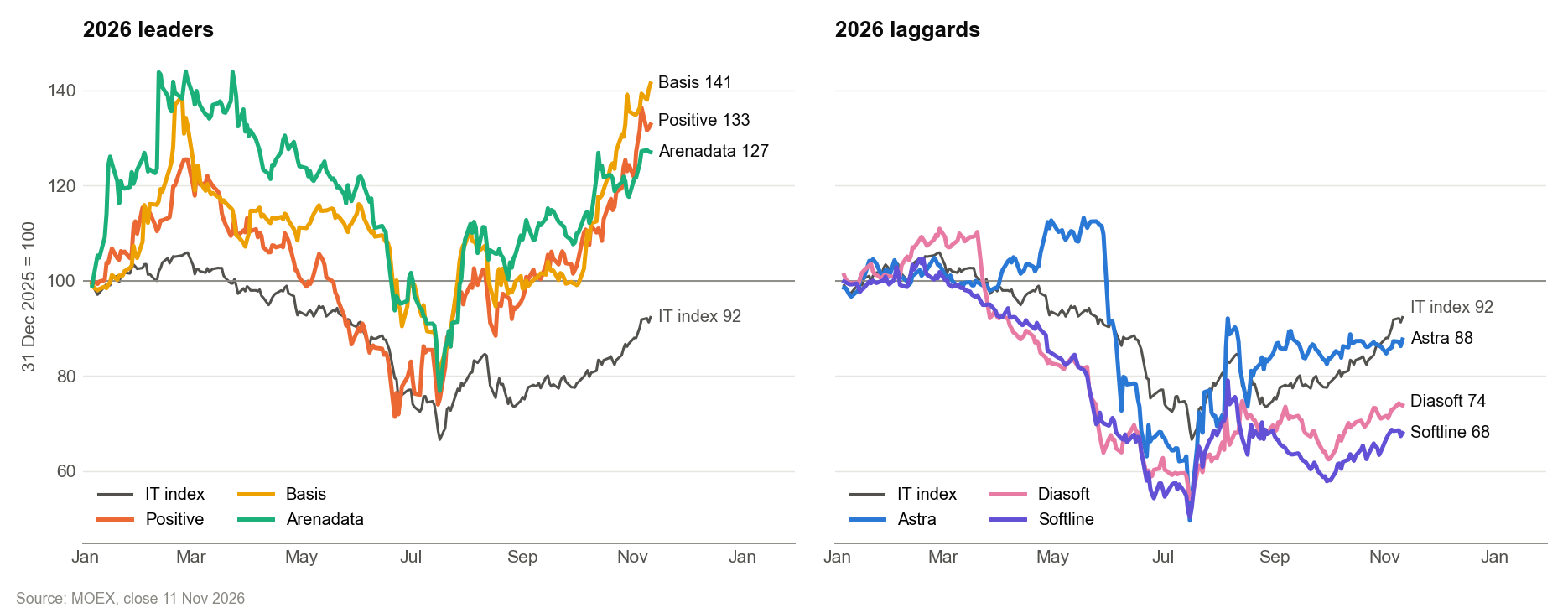
The market has already split the sector. Year to date Basis is up 41%, Positive 33% and Arenadata 27%, while Softline, Diasoft and Astra are down 12–32%.
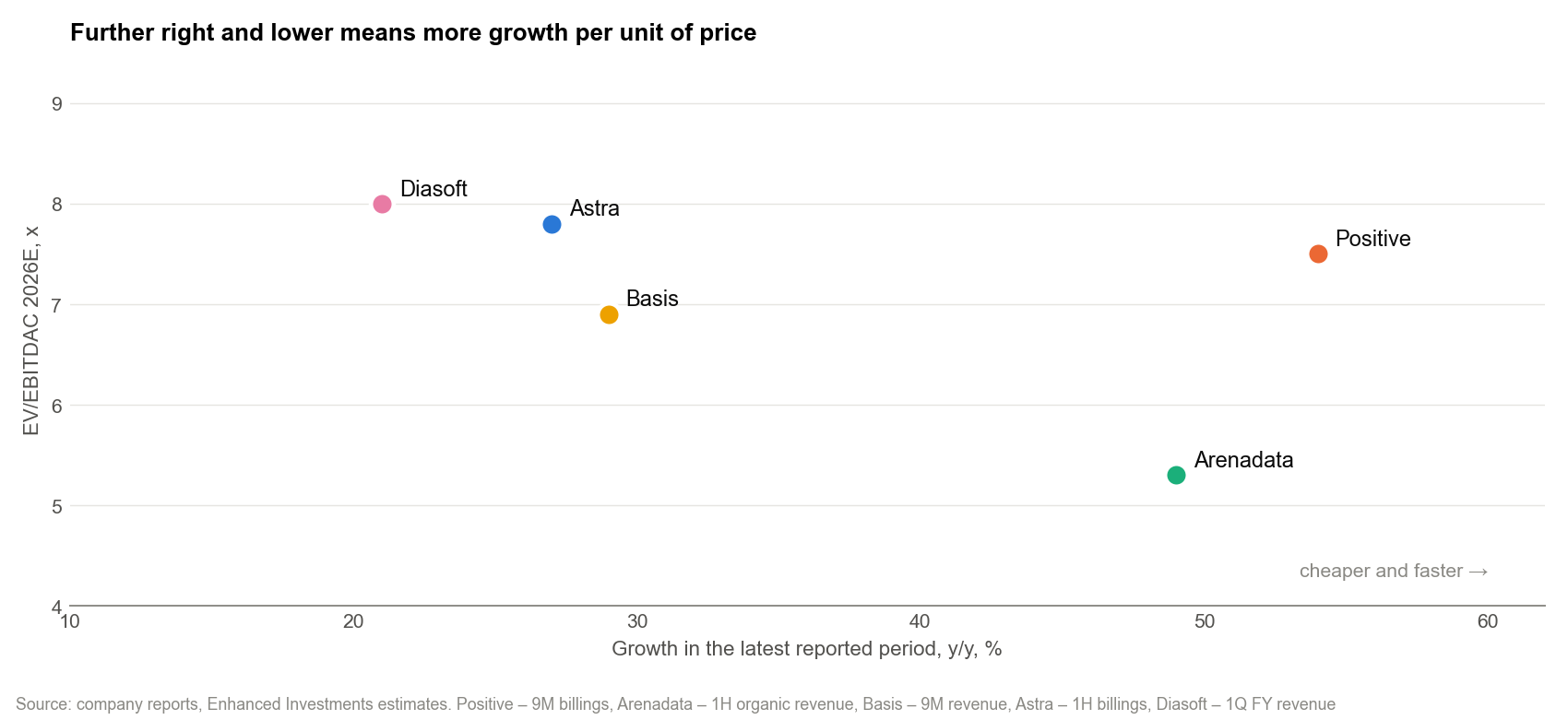
Arenadata and Positive look best on valuation. Arenadata trades at about 5x 2026 EBITDAC with net cash, Positive at about 7.5x with billings up 54%.
The software market grows slower than industry associations promise, and growth goes to a few
Estimates of 2026 market growth differ several times over. In late August T1 estimated growth of the whole IT market at 4% and does not expect double-digit rates before 2028. RUSSOFT calculated that software industry revenue grew 14% in 2025 against a 24% forecast, and expects 17% in 2026. Strategy Partners puts 2026 growth of the enterprise software market at 20%.
Part of the gap comes from measuring different things. But the overall conclusion is the same. Growth is concentrated among a small number of leaders, while revenue at the rest stagnates or falls. Company reports show this. Positive's 9M billings rose 54% and Basis's revenue 29%, while IVA's 1H revenue fell 8.5% and Diasoft's 9M RAS revenue fell 18%.
Large customers cut contractors and maintenance but keep licences for key platforms
In May CROC surveyed 200 CIOs of companies with revenue above RUB 5 bn. Most are optimising spend in 2026, and they cut external people first. 68% are moving support from premium vendor packages to their own service teams, 57% are reducing the number of contractor integrator staff, and 41% are postponing data warehouse and analytics projects to 2027. A separate OCS survey showed that 53% of companies run two platforms of the same class, and 27% are already removing duplicates.
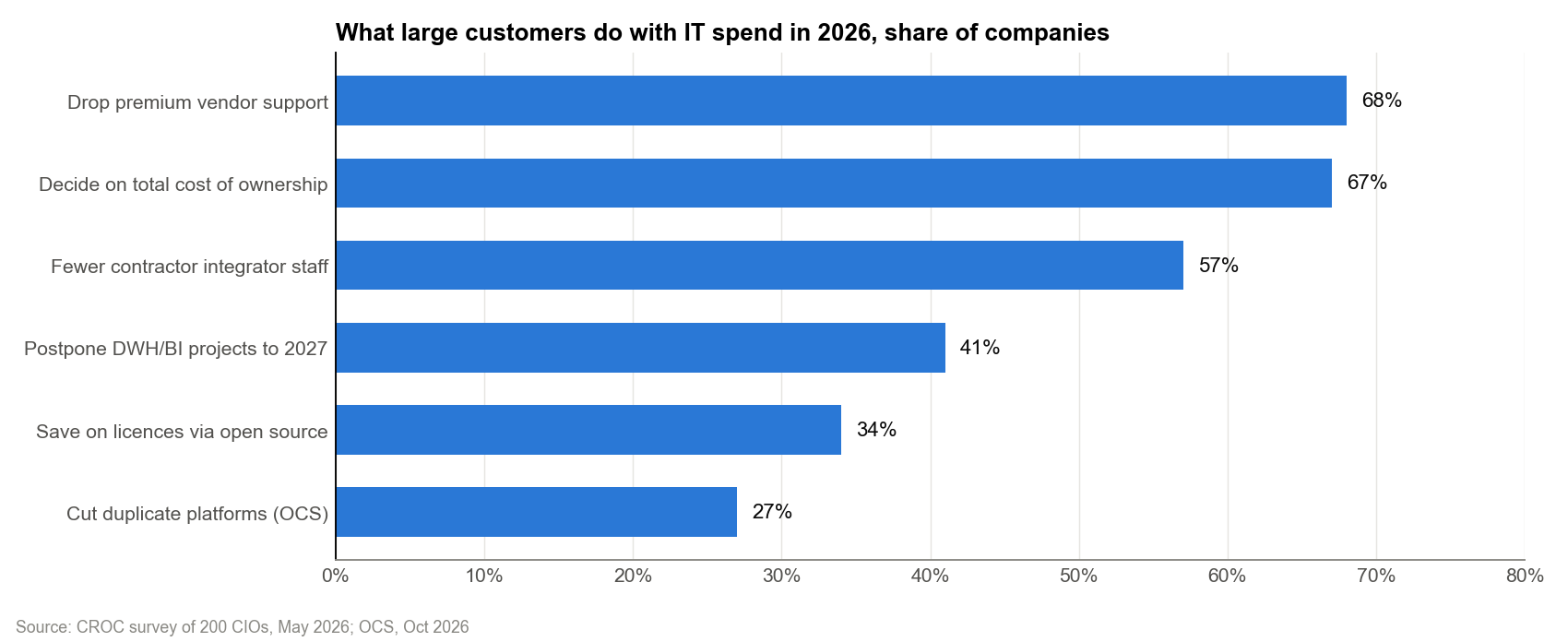
State companies are doing the same. Their software purchases from small tech companies fell from RUB 21 bn to 9.15 bn in 1H. In-house IT subsidiaries take over part of the work. According to TAdviser, state companies' spending on computers and software fell about 10% y/y in 3Q. The labour market confirms it. The share of companies planning to hire IT staff is falling from 30% to 18%, and developer salaries rose only 1% in 1H, below inflation.
So we expect a large customer's IT budget to grow 0–5% in roubles in 2027, which means a decline after inflation. Lines within the budget will behave differently.
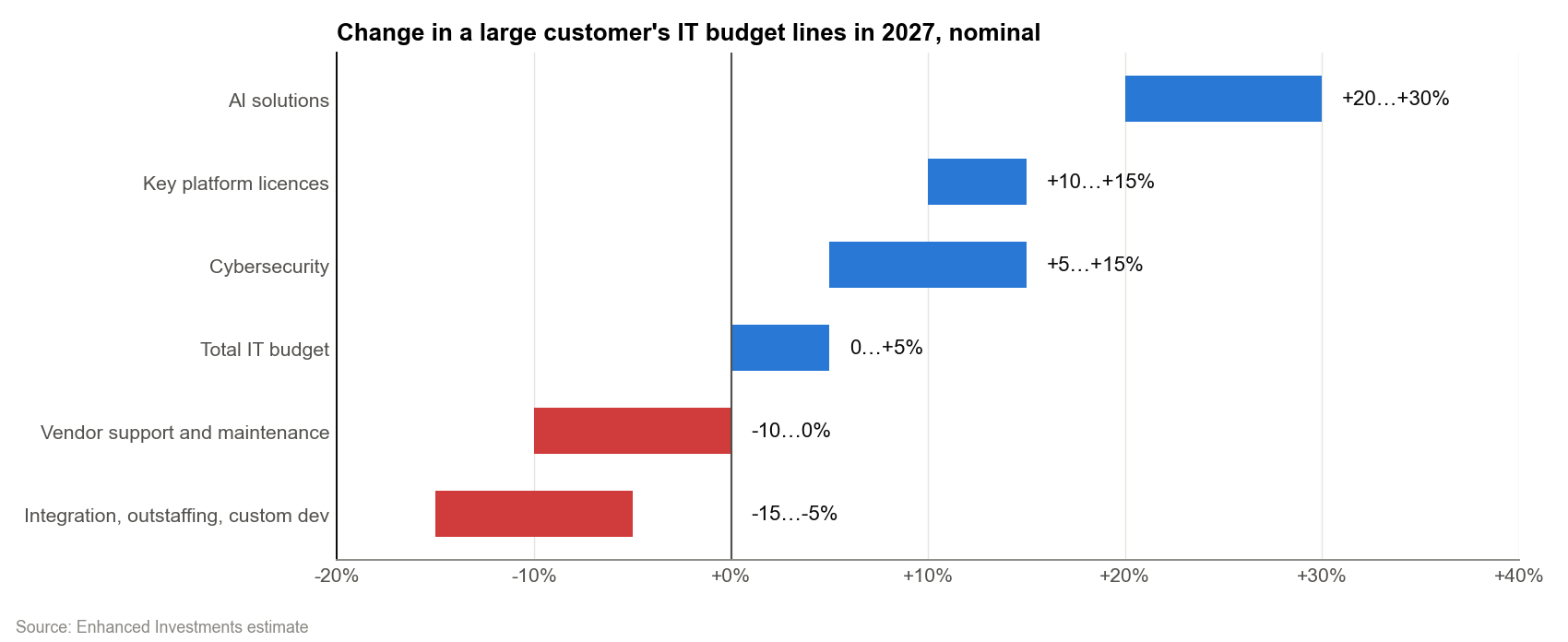
| IT budget line | 2027 vs 2026 | Why | Who is affected |
|---|---|---|---|
| Total IT budget | 0…+5% | Rates, pressure on customers' margins, end of the first import substitution wave | Everyone |
| Licences for key platforms (OS, security, virtualisation, DBMS) | +10…15% for leaders | Customers keep 1–2 vendors per task class, two-OS compatibility requirements | Positive, Basis, Astra, Arenadata |
| Cybersecurity | +5…15% | Attacks and regulation, domestic product prices up 15–30% | Positive |
| Vendor support and maintenance | −10…0% | Shift to in-house service | All vendors |
| Integration, outstaffing, custom development | −15…−5% | In-house teams, 22% VAT on custom development | Softline, services at Arenadata and Diasoft |
| New large projects (data warehouses, ERP, core banking) | pushed to 2H 2027 | Waiting for rate cuts | Diasoft, Arenadata, Softline |
| AI solutions | +20…30% from a low base | Generative AI share of IT spend rises from 3.5% to 4.2% (T1) | Little impact on listed vendors' revenue so far |
The 14% key rate pushes large projects back to at least 2H 2027
On 23 October the Bank of Russia held the key rate at 14%. It was the first pause in the easing cycle. The regulator expects the average rate in 2027 at 12.5–13.5%, and the next meeting is on 18 December. For industrial customers this means expensive money for at least another six months.
Companies say so directly. Arenadata cut its 2026 revenue growth guidance from 20–40% to "at least 20%", citing the high rate and customers' cost of funding. IVA explains its revenue decline by delayed implementations. Astra says industry is postponing large projects and expects the effect of rate cuts from 2027. In our estimate, deferred demand will not start returning before 2H 2027.
Regulation supports OS and virtualisation vendors, while the CII deadline is blurring
From 2026 the standard VAT rate rose to 22%, but the exemption for software in the domestic registry was kept. Product vendors are protected from VAT, custom development is not. For a customer, a registry licence becomes cheaper than a custom project. Social contributions for accredited IT companies rose from 7.6% to 15% within the contribution cap from 2026, which squeezes margins of labour-intensive businesses.
From 1 January 2027, server software and virtualisation platforms must work with at least two trusted operating systems to stay in the registry, and from 1 June 2027 the same rule applies to application software and security tools. This supports Astra as an OS vendor and Basis in virtualisation. Banks must switch to domestic software by early 2028 and connect to the digital rouble, which underpins Diasoft's investment case.
The main deadline for significant critical information infrastructure (CII: energy, telecom, transport and financial systems) remains 1 January 2028. But a draft Ministry of Digital Development resolution allows deferrals to 2031–2036 in certain cases. So no deadline-driven rush in demand should be expected in 2027.
In the 2027–2029 federal budget the "Data Economy" national project gets about RUB 470 bn. "Digital Platforms" (by about RUB 45 bn) and subsidised loans to IT companies were cut. Spending on cybersecurity (+RUB 30.8 bn, largely Roskomnadzor systems), digital public administration (+RUB 17.8 bn) and departmental IT infrastructure (+40%, to RUB 113 bn) grows.
The market has already split the sector: leaders are up 27–41% year to date, laggards down 12–32%
Year to date the Moscow Exchange IT index is down 8% and the MOEX Russia index 10%. Against this, Basis is up 41%, Positive 33% and Arenadata 27%. Astra is down 12%, Diasoft 26% and Softline 32%.
| Stock | 1 month | 3 months | YTD | 12 months | From 52-week high |
|---|---|---|---|---|---|
| Positive | +19% | +30% | +33% | +18% | −3% |
| Basis | +26% | +32% | +41% | +37% vs IPO price | 0% |
| Arenadata | +12% | +14% | +27% | +5% | −12% |
| Astra | +2% | −2% | −12% | −27% | −26% |
| Diasoft | +9% | +9% | −26% | −36% | −37% |
| Softline | +10% | −8% | −32% | −36% | −38% |
| IT index | +15% | +9% | −8% | −5% | −13% |
Basis and Positive trade near their annual highs, so the good news is already priced in. Arenadata is 12% below its February peak. Astra is down 2% over three months while the IT index is up 9%, so its bounce from the summer low is mostly the market's.
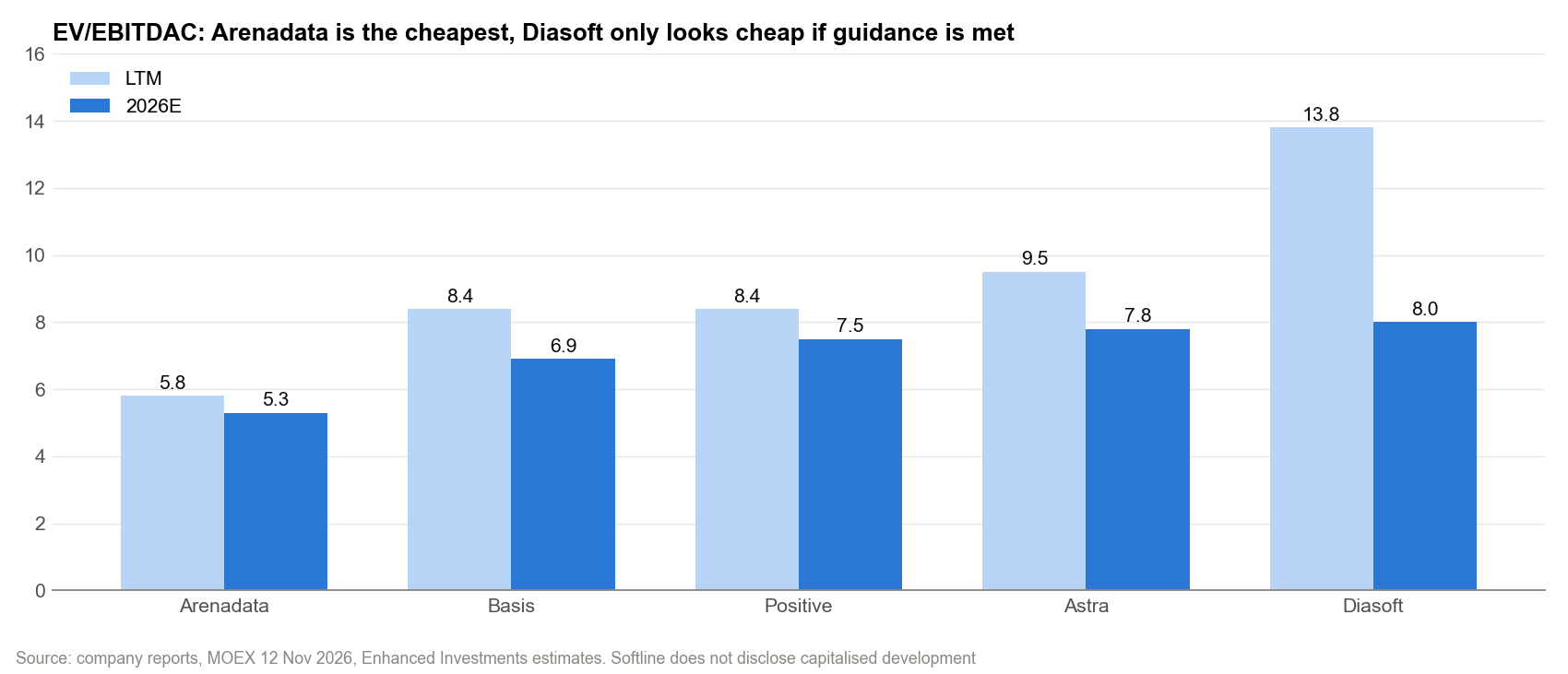
On EBITDAC Arenadata is the cheapest, and Astra costs as much as Positive with half the growth
Software developers capitalise part of their development costs. That money does not go through expenses and does not reduce EBITDA, even though the company spends it. So for software we look at EBITDAC, EBITDA minus capitalised development. The difference can be large. Astra trades at about 5.5x LTM EV/EBITDA but 8–10x EV/EBITDAC, depending on how capitalisation is counted.
| Metric | Positive | Arenadata | Basis | Astra | Diasoft | Softline |
|---|---|---|---|---|---|---|
| Price 12 Nov, RUB | 1300.6 | 99.06 | 150.3 | 219.3 | 1256.5 | 54.74 |
| Market cap, RUB bn | 92.3 | 23.0 | 24.8 | 46.1 | 13.2 | 21.9 |
| Net debt, RUB bn | 12.8 | −1.6 | 0.0 | 3.3 | −0.8 | 31.7 |
| Growth in latest period | 9M billings +54% | 1H revenue +86% (organic ~49%) | 9M revenue +29% | 1H billings +27% | 1Q FY revenue +21% | 1H turnover +15% |
| Company 2026 guidance | billings RUB 40–45 bn | revenue ≥ +20% | revenue +30…40% | net income +40% | FY revenue +28…48% | turnover RUB 145–155 bn |
| LTM P/E | 7.5x | 6.5x | 9.9x | 7.1x | 18x | 17x |
| LTM EV/EBITDAC | 8.4x | 5.8x | 8.4x | 8–10x | 14x | n/a |
| 2026E EV/EBITDAC | 7.5x | 5.3x | 6.9x | 7.8x | 8x | EV/EBITDA 5.8x |
| Net debt / EBITDA | 0.76x | net cash | 0x | 0.38x | net cash | 3.3x |
| Free cash flow | improving | +RUB 0.8 bn in 1H | +RUB 0.8 bn in 3Q | −RUB 1.8 bn in 2Q | +RUB 2.0 bn in FY25 | −RUB 16.4 bn in 1H |
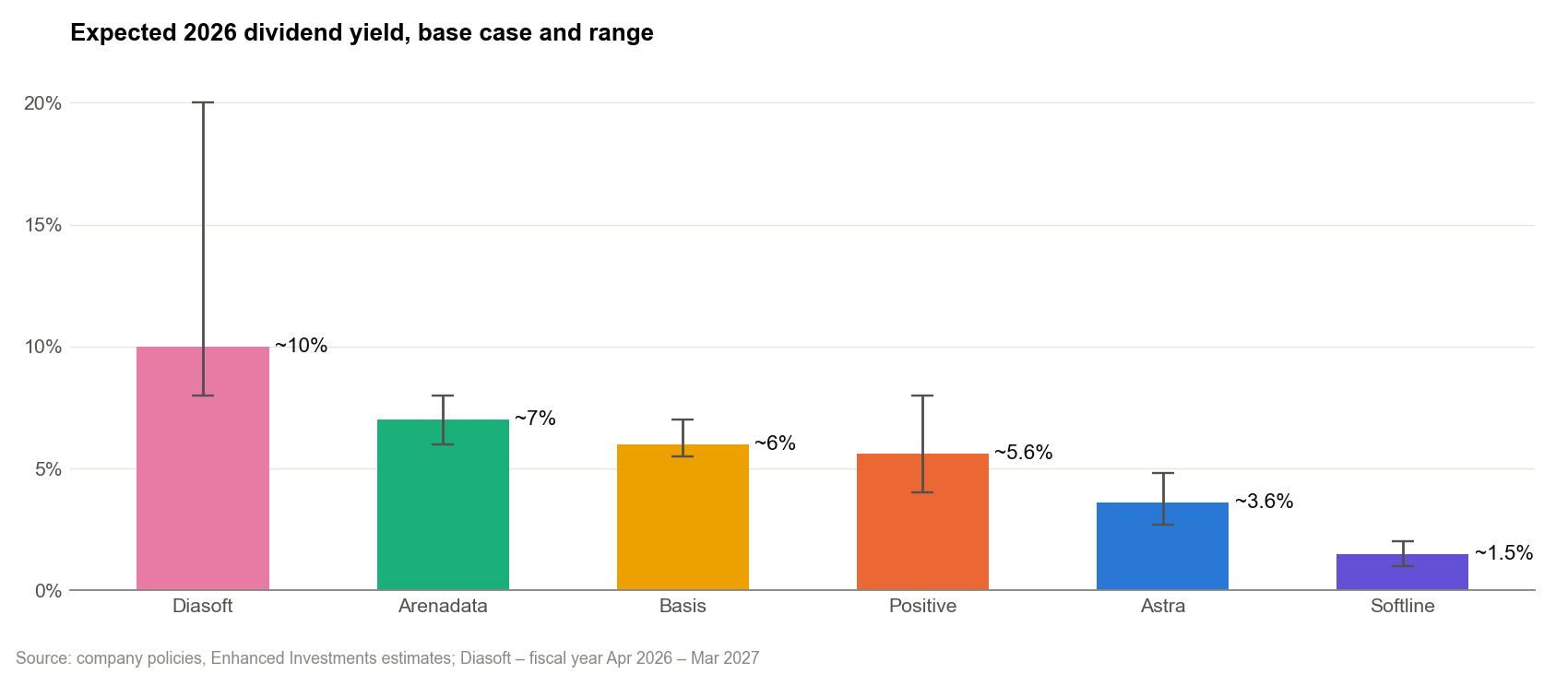
Dividends: Diasoft promises the most, Arenadata and Basis pay most reliably
| Company | Policy | 2026E dividend, RUB per share | Yield | When |
|---|---|---|---|---|
| Diasoft | at least 80% of management EBITDAC | ~130 (100–250) | ~10% (8–20%) | quarterly, RUB 16 with 22 Dec record date |
| Arenadata | at least 50% of adjusted net income | ~7 (6–8) | ~7% | quarterly |
| Basis | at least 50% of NIC while debt is below OIBDAC | ~9 (8–10.5) | ~6% | 2027, possibly two payments |
| Positive | 50–100% of NIC | ~73 (55–105) | ~5.6% | spring-summer 2027 |
| Astra | 15–25% of adjusted net income | ~7.9 (6–10.5) | ~3.6% | June 2027 |
| Softline | 25% of net income | ~0.6–1.2 | ~1–2% | summer 2027 |
Diasoft offers the highest yield, but also the least reliable one. The company has missed its guidance for years, and last fiscal year's dividends exceeded its profit. Arenadata's and Basis's payouts are backed by cash on the balance sheet and positive cash flow. Positive's payout depends on the fourth quarter, and it cancelled the final dividend for 2024.
Positive: the best growth for its price, but the fourth quarter decides everything
Cybersecurity remains the most resilient demand segment. Positive's 9M billings rose 54% to RUB 18.3 bn, and about 68% in 3Q. IFRS revenue grew 48%, and EBITDA turned positive at RUB 2.7 bn versus minus RUB 1.9 bn a year earlier. Costs fell 4%, headcount 4%, and leverage dropped from 2.56x to 0.76x EBITDA.
Full-year billings guidance of RUB 40–45 bn requires the fourth quarter to match last year's or grow up to 20%. That is achievable. The risk is that the fourth quarter brings 55–60% of annual billings, and the stock is already at its annual high. Sovcombank reiterated "buy" and expects RUB 53 bn of billings in 2027. Our view: buy, preferably on dips, target RUB 1,600–1,900.
Arenadata: the cheapest stock in the sector, with cash on the balance sheet
Arenadata makes database management systems and big data platforms. In 2025 revenue grew 46% to RUB 8.75 bn and net income 52% to RUB 2.96 bn. In 1H 2026 revenue rose 86%, but about 20% of revenue came from the acquired UBIC, so organic growth was about 49%. The first half is seasonally loss-making for the company, yet free cash flow was positive at RUB 0.8 bn, with RUB 1.6 bn of net cash.
There are drawbacks. Guidance of "at least 20%" for the year implies an almost flat second half. Gross margin fell from 87% to 78% because services grow fastest and carry lower margins than licences. Euler named Arenadata its November favourite. Our view: buy, target RUB 110–125 plus about 7% in dividends. The next check is the 9M report, where 3Q organic growth should exceed 20%.
Basis: high-quality growth, but the stock is already at an all-time high
Basis is the leader of the Russian virtualisation market, 50.3% owned by RTK-DPC of the Rostelecom group. It listed on 10 December 2025 at RUB 109. 9M revenue grew 29% to RUB 4.46 bn, flagship products 39%, OIBDA margin was 55% and adjusted net income (NIC) grew 52%. Full-year guidance of 30–40% revenue growth was confirmed on 10 November.
The company benefits from the two-OS compatibility rule and growing state spending on IT infrastructure. Risks are dependence on the fourth quarter (about 45% of annual revenue), volatile cash flow and falling sales of complementary solutions. The stock is up 75% from the summer low. Sovcombank is neutral, Euler targets RUB 240. Our view: hold, buy on dips to RUB 130–135, target RUB 165–190.
Astra: profit grows on paper, while cash goes into receivables and development
Astra is Russia's largest operating system developer. In 1H billings rose 27%, revenue 17% and adjusted net income almost doubled to RUB 1.2 bn. But free cash flow in 2Q was minus RUB 1.8 bn, receivables rose 54% to RUB 6.3 bn and net debt went from RUB 0.4 bn to 3.3 bn. In the half year the company capitalised RUB 1.7 bn of development costs and raised money through digital financial assets at 15% a year.
The 2026 target of 40% net income growth is tied to management's incentive programme. If it is met, Astra trades at about 7.8x 2026 EBITDAC, the same as Positive with half the growth. If not, at 10–11x. Our view: hold until the 9M report, target RUB 210–250. We will revisit if billings grow at least 25% and 3Q operating cash flow is positive.
Diasoft: high dividends with guidance missed again and again
Diasoft makes software for banks, and its fiscal year runs April to March. Last fiscal year revenue fell 3% to RUB 9.8 bn, EBITDA 35% and net income 78% due to a provision on a related company's debt. In the first quarter of the new year revenue grew 21% and EBITDA 72%. Guidance for the year is 28–48% revenue growth, but last year the company fell short even of its reduced guidance. Under RAS the parent company's 9M revenue fell 18%.
Support comes from the requirement for banks to move to domestic software by 2028 and from the digital rouble rollout. 16 of the roughly 150 banks that must connect have chosen Diasoft. The dividend policy is generous at no less than 80% of EBITDAC. But disclosure is thin, with no data on cash flow or receivables. Our view: hold, target RUB 1,200–1,400, the stock suits only a dividend case.
Softline: a cheap multiple does not offset the leverage borne by shareholders
Softline is a software integrator and distributor, with its own solutions making up about a third of turnover. In 1H turnover grew 15% to RUB 53.1 bn, own solutions only 6%, adjusted EBITDA 27%. Net income of RUB 0.89 bn rests on about RUB 2.6 bn of other income. Free cash flow for the half year was minus RUB 16.4 bn, and net debt on 30 June was RUB 31.7 bn, or 3.3x EBITDA.
Part of this debt is seasonal, the company usually reduces it by year-end and promises to reach 2x. The group's credit ratings are at A-, and there are no near-term bond put dates. But for shareholders the picture is worse. Interest expense of about RUB 3 bn per half year eats most of EBITDA, and an integrator's business is the first to suffer from cuts in contractor budgets. Our view on the shares: avoid, target RUB 45–60. The next check is the 9M report on 20 November.
Three scenarios for 2027: in the base case product leaders win
| Scenario | Conditions | IT budgets | What happens to the stocks |
|---|---|---|---|
| Base (55%) | Rate at 13–14% until spring, cut to about 12% in 2H, no CII deferrals for software classes with domestic substitutes | 0…+5% in roubles, software leaders +15–25%, services and integration down | Positive, Arenadata and Basis win; Astra depends on 4Q results; Diasoft and Softline move sideways |
| Negative (25%) | Rate at 14% through 1H 2027, 4Q26 deals slip into next year, receivables grow, mass CII deferrals | −5…0%, new projects frozen | Worst for stocks with debt and weak cash flow (Softline, Astra) and those dependent on 4Q (Positive, Basis); Arenadata with cash and dividends holds up best |
| Positive (20%) | Rate at 11–12% by mid-2027, deferred demand returns | +8…12%, large projects return | Astra, Softline and Diasoft gain the most; leaders re-rate to 9–10x EBITDAC |
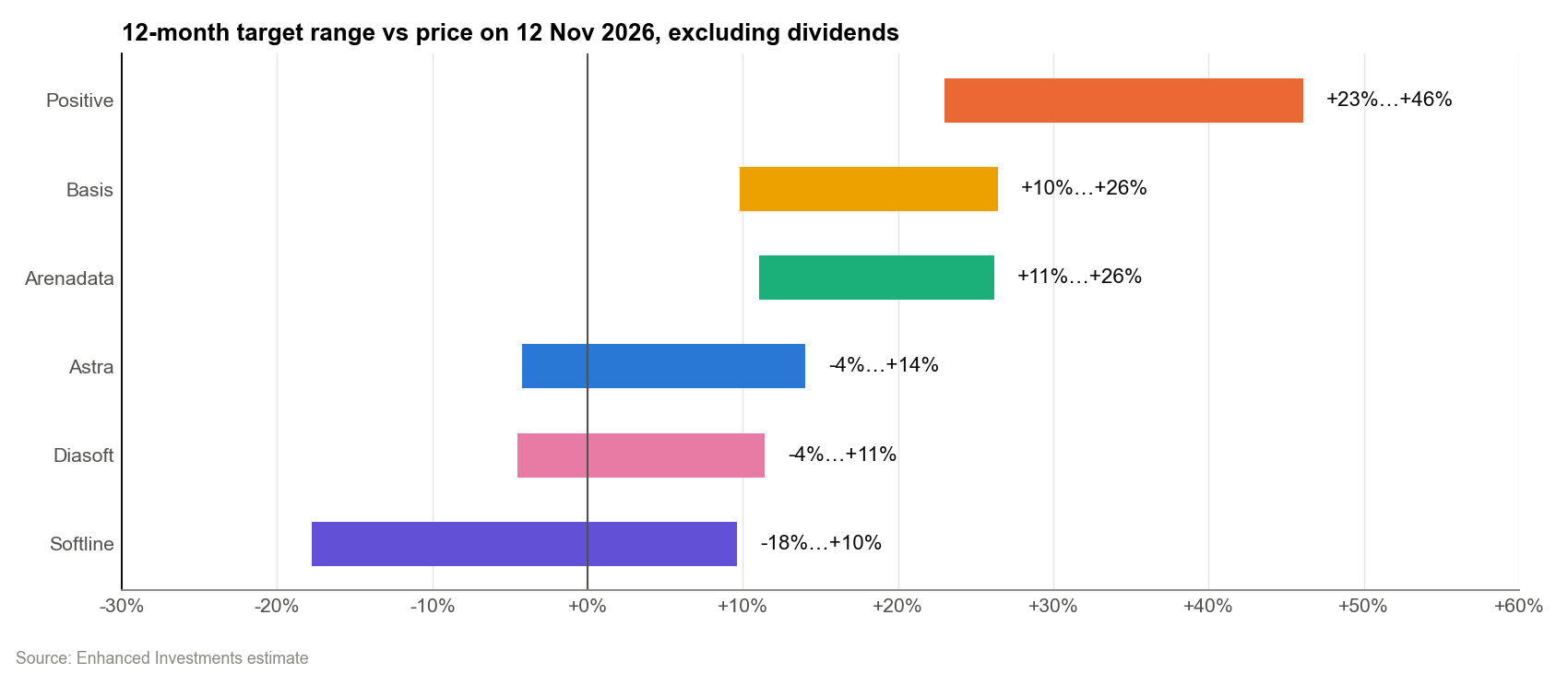
Targets: notable upside for Positive, Arenadata and Basis, downside risk for Softline
| Company | View | 12-month target, RUB | Main risk | Next event |
|---|---|---|---|---|
| Positive | Buy on dips | 1600–1900 | 55–60% of billings in 4Q | preliminary 2026 billings, January-February |
| Arenadata | Buy | 110–125 | flat 2H, falling gross margin | 9M26 IFRS |
| Basis | Hold, buy on dips to 130–135 | 165–190 | stock at its high, 4Q ~45% of the year | FY2026 results, late February |
| Astra | Hold until the report | 210–250 | negative cash flow, rising debt | 9M26 IFRS, around 25 Nov |
| Diasoft | Hold | 1200–1400 | missed guidance | 1H FY IFRS, late November |
| Softline | Avoid | 45–60 | 3.3x leverage, profit from other income | 9M26 IFRS, 20 Nov |
Upcoming events:
- 20 November – Softline 9M report: cash flow, debt, own-solutions margin.
- Around 25 November – Astra 9M report: billings growth, operating cash flow, receivables.
- Late November – Diasoft fiscal 1H report.
- November-December – Arenadata 9M report.
- 18 December – Bank of Russia rate meeting.
- January-February 2027 – preliminary full-year results from Positive, Astra and Basis.
Sources: company reports and press releases; Bank of Russia (rate decision of 23 Oct 2026); CNews (CROC survey 15 May 2026, RUSSOFT 5 Oct 2026, budget 15 Oct 2026); ComNews (T1, 31 Aug 2026); Kommersant (Strategy Partners 19 Jun 2026, budget 7 Oct 2026); Interfax (VTB 11 Sep 2026); TAdviser; Open Systems (OCS, 5 Oct 2026); D-Russia (resolution 1937); Anti-Malware (CII); Finmarket (Sovcombank, Euler); Market Power; Smart-Lab.
If you find this useful, please support us with a like and a subscription! You can discuss the review in the Telegram channel Enhanced Investments, and live multiples for each company are on its card on the portal.