Bayan Resources: coal rose 7.9% but nine-month revenue stood still – profit rests on costs, not on price
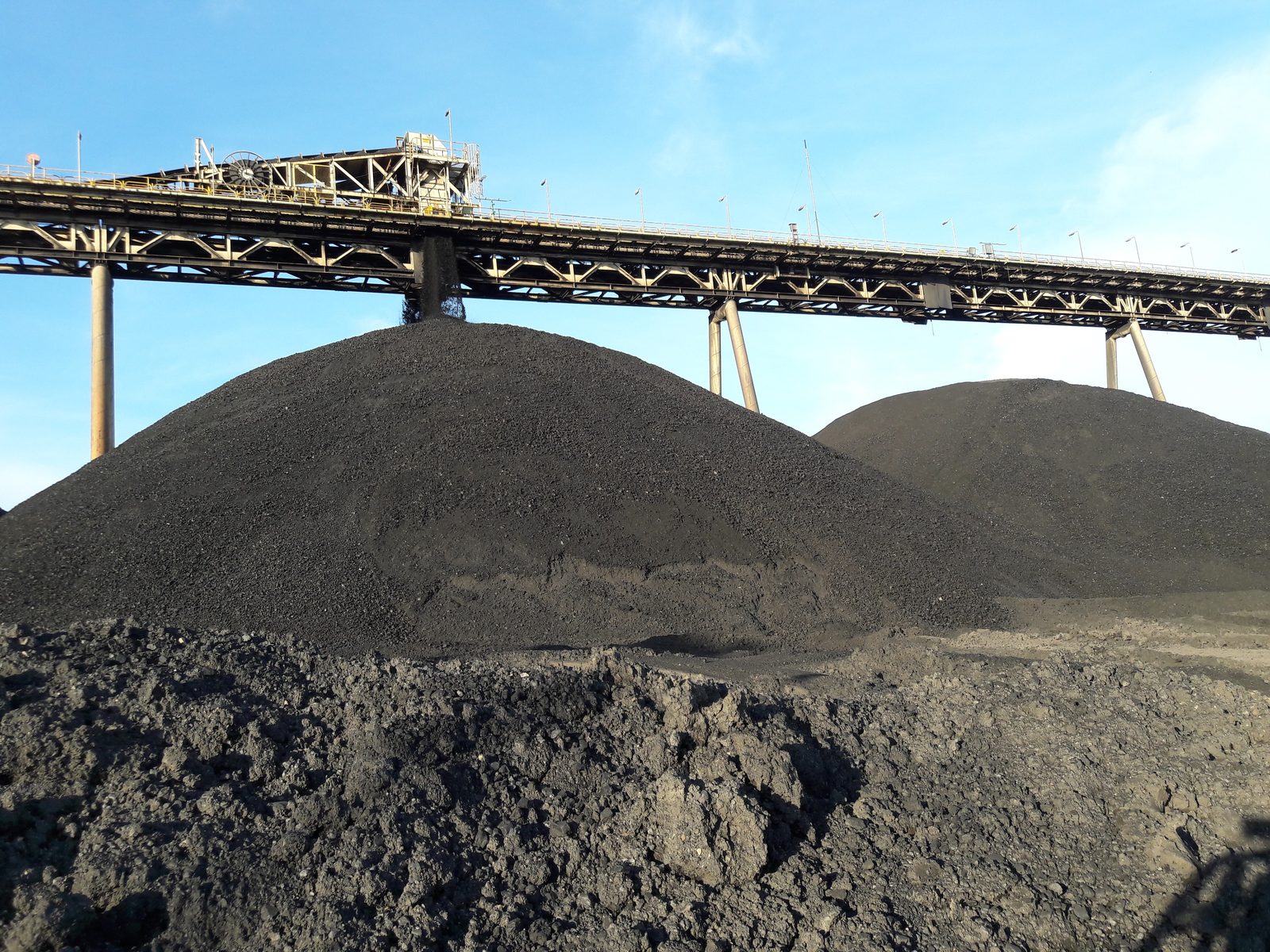
On 30 October Bayan Resources released its interim accounts for the nine months ended 30 September 2026. The average Australian thermal coal price in the period was USD 125.7 versus USD 116.5 a year earlier (+7.9%), and spot on 6 November is already USD 144.7. Nine-month revenue was USD 2,434.2 m against USD 2,439.9 m, essentially flat, while profit rose to USD 599.1 m from USD 533.7 m and net cash on 30 September stood at USD 620.4 m. On our calculation, at last year's volumes and costs the price alone should have produced revenue of USD 3,667 m and EBITDA of USD 1,243.7 m; actual revenue came in USD 3,667 m below that – the gap is explained by volumes and sales mix, not by price. The share looks rather attractive: the portal's spot model implies +17% upside to fair value, EV/EBITDA at current prices is 7.2, and the dividend yield is 3.2%.
Key takeaways
— Thermal coal averaged 7.9% higher at USD 125.7 over nine months, and spot is already USD 144.7
— On our calculation price alone should have produced USD 3,667 m of revenue, yet reported revenue came in USD 3,667 m below that – the gap is not price
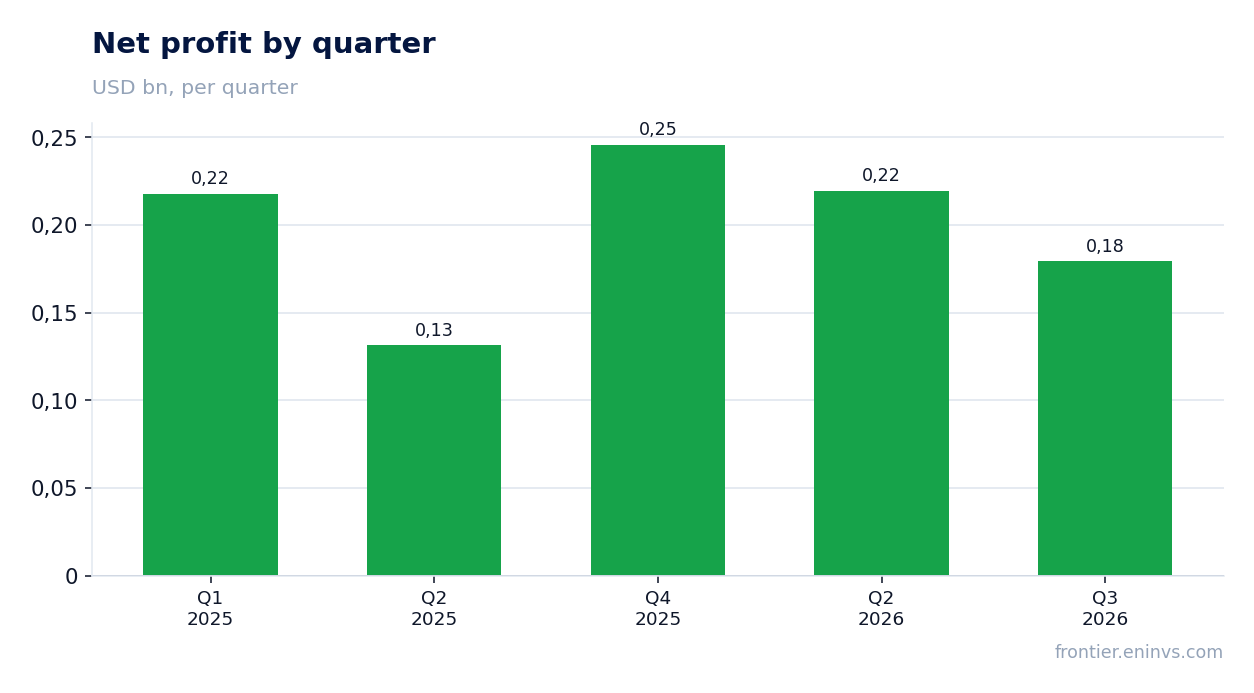
— Profit rose to USD 599.1 m on almost flat revenue – cost of revenue helped, not the market
— The company sits on net cash of USD 620.4 m and negative net debt to EBITDA
— Dividends of USD 500.0 m over nine months at a 3.2% yield, funded by profit rather than debt
— On the portal's spot model EBITDA at current prices is USD 2,110.7 m against USD 1,002 m LTM, and EV/EBITDA is 7.2
Attractiveness
Key figures, USD bn
| Metric | FY 2025 | FY 2026 | Change |
|---|---|---|---|
| Revenue | 3.43 | 0.00 | -100.0% |
| EBITDA | 1.00 | — | — |
| Operating profit | 1.00 | — | — |
| Net profit | 0.77 | — | — |
| Operating cash flow | 0.98 | 0.00 | -100.0% |
| Capex | 0.17 | — | — |
| EBITDA margin | 29.3% | — | — |
| Net margin | 22.4% | — | — |
Thermal coal averaged 7.9% higher at USD 125.7 over nine months, and spot is already USD 144.7
The average Australian thermal coal price over the nine months ended 30 September 2026 was USD 125.7 against USD 116.5 a year earlier – up 7.9%. Spot on 6 November is already USD 144.7, or 15.1% above the reported-period average. Coal accounts for 88% of the company's revenue in the portal model, so this price sets the ceiling for revenue and EBITDA.
For a producer this means the market in the reported period was better than a year earlier and noticeably better than the average of the past 12 months. Yet nine-month revenue stayed at last year's level – USD 2,434.2 m against USD 2,439.9 m. The price rose but the money for coal sold did not, which means the company sold less coal or sold it below the benchmark.
Commodity prices: period average and now
| Benchmark | Year ago | FY 2026 | YoY | Spot 2026-11-06 |
|---|---|---|---|---|
| Steam coal AU, USD | 116,5 | 125,7 | +7,9% | 144,7 |
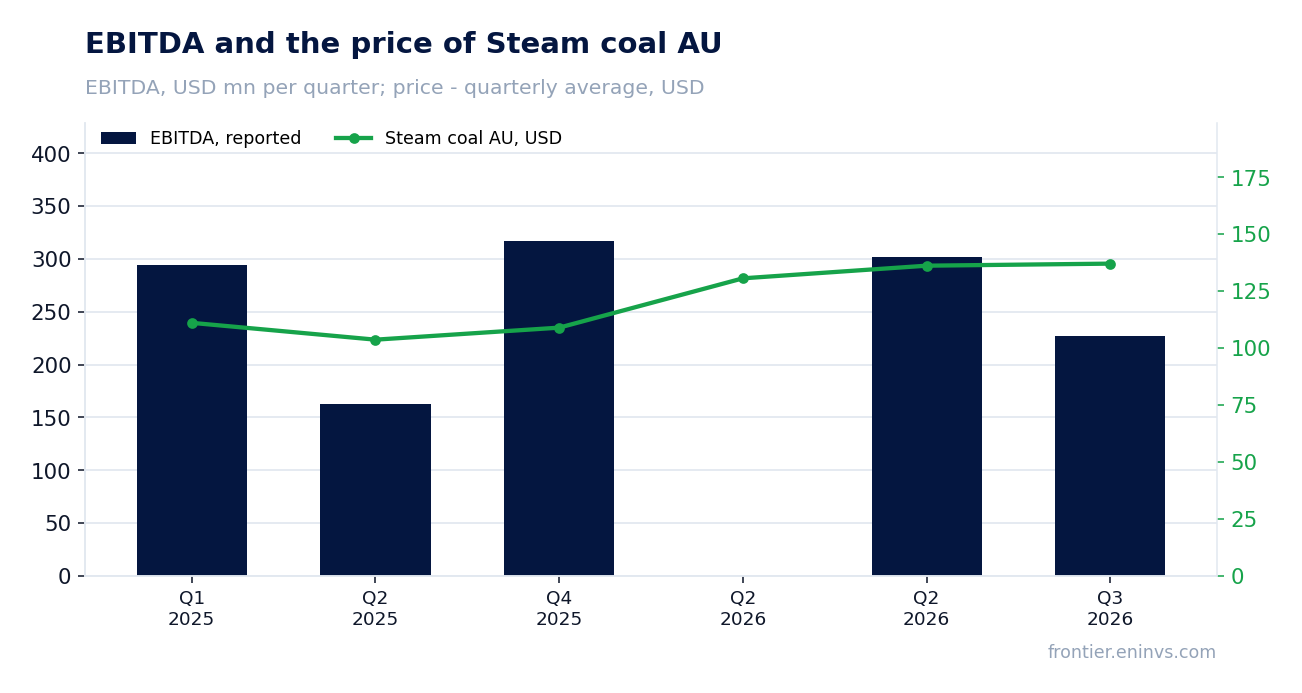
On our calculation price alone should have produced USD 3,667 m of revenue, yet reported revenue came in USD 3,667 m below that – the gap is not price
On our calculation, at last year's volumes and non-commodity costs and moving only the price, nine-month revenue should have been USD 3,667 m and EBITDA USD 1,243.7 m. We estimate the price effect at USD 239.4 m, or +7.0% to the base. Actual revenue was USD 2,434.2 m, i.e. USD 3,667 m below the calculated figure, and none of that gap is price.
The accounts give no split between volumes and realised price, so the exact cause of the gap cannot be named. All that is visible is that with a higher benchmark price the company booked the same revenue as a year earlier – so either volumes sold were lower or the realised price lagged the benchmark. Until that gap closes, a higher coal price will not translate into revenue automatically.
What the prices implied and what the company earned
| Base (FY 2025) | Implied at period prices | Reported | Reported vs implied | |
|---|---|---|---|---|
| Revenue, USD mn | 3 428 | 3 667 | 0,00 | -100,0% |
| EBITDA, USD mn | 1 004 | 1 244 | — | — |
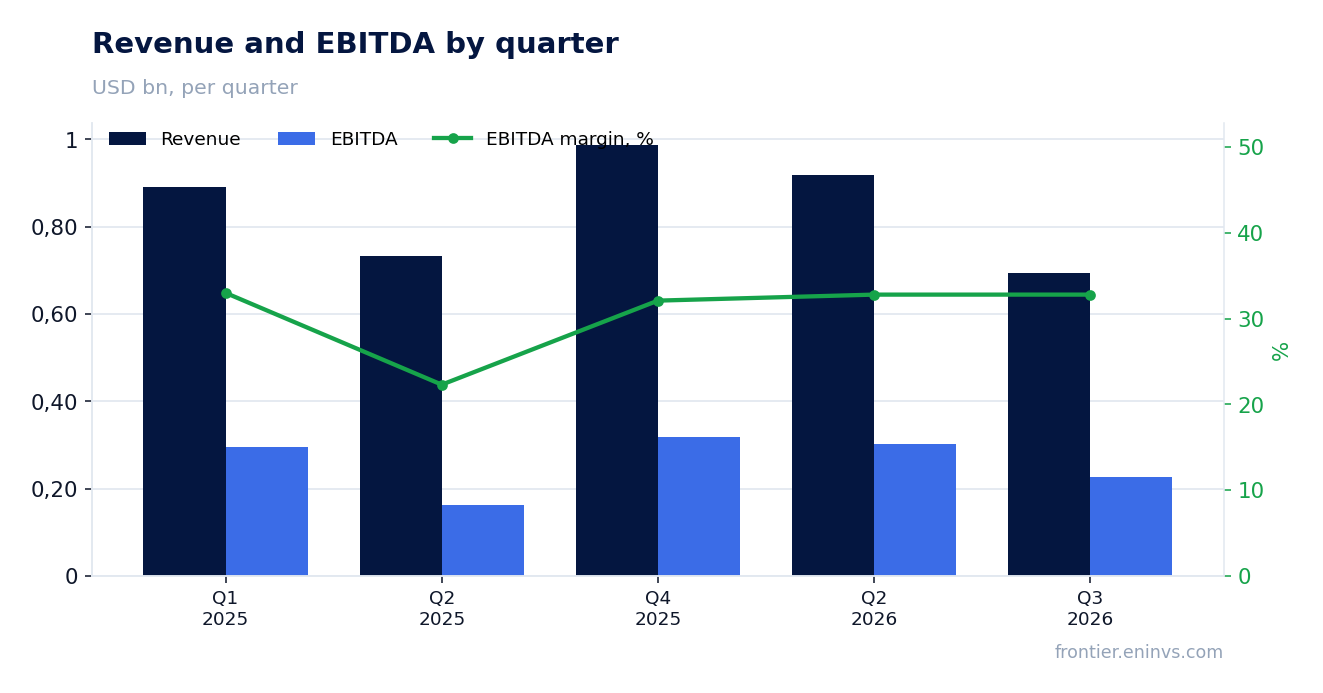
Profit rose to USD 599.1 m on almost flat revenue – cost of revenue helped, not the market
On revenue of USD 2,434.2 m, cost of revenue was USD 1,570.2 m against USD 1,666.6 m a year earlier – a fall of USD 96.4 m. That, not price, drove gross profit up to USD 864.0 m from USD 773.4 m. Gross margin rose to 35.5% from 31.7%.
Operating expenses were almost flat: selling costs rose to USD 31.2 m from USD 25.0 m, while general and administrative costs fell to USD 60.0 m from USD 62.9 m. Finance expenses dropped to USD 4.4 m from USD 7.5 m, while other expenses rose to USD 24.8 m from USD 8.9 m. As a result nine-month profit was USD 599.1 m against USD 533.7 m, and the entire increase came from cost of revenue.
For a coal producer this is an important signal: the company is earning on cost control, not on price. If the price stays at the spot level of USD 144.7 and the cost base holds, the effect will be doubled. If the cost reduction was one-off – say, through lower-cost mining at certain pits – profit will return to its previous base.
The company sits on net cash of USD 620.4 m and negative net debt to EBITDA
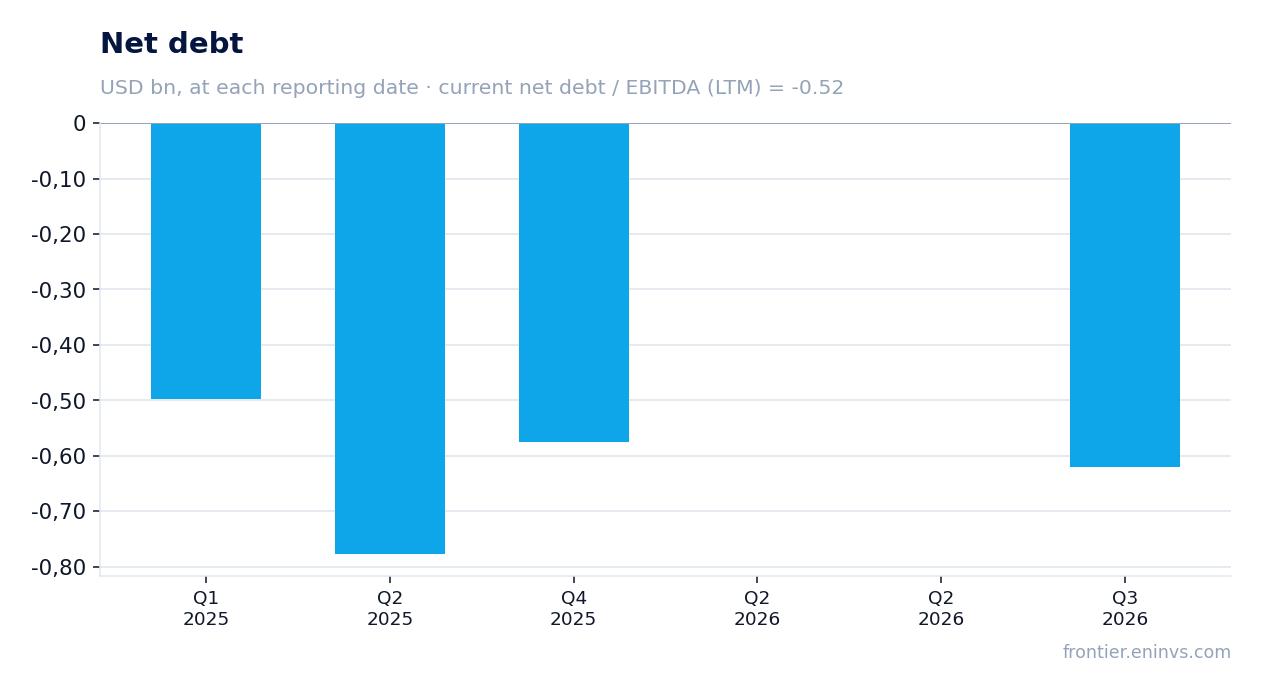
On 30 September 2026 cash and cash equivalents were USD 769.0 m against USD 574.6 m at the end of 2025. Bank loans were USD 148.6 m, all short-term; over nine months the company drew USD 280.0 m and repaid USD 130.0 m. Net cash on 30 September was USD 620.4 m.
Net debt to LTM EBITDA is minus 0.52, meaning cash exceeds debt. Operating cash flow over nine months was USD 695.5 m against USD 804.3 m a year earlier; the decline is driven mainly by dividends and taxes rather than by a deterioration in the business itself. Such a balance sheet provides a cushion even if the coal price falls.
Dividends of USD 500.0 m over nine months at a 3.2% yield, funded by profit rather than debt
Over nine months the company declared USD 500.0 m of dividends and paid them in cash; a further USD 26.9 m went to non-controlling shareholders. The trailing 12-month dividend yield is 3.2% on the current market capitalisation of USD 15,819.0 m. The payout is covered by profit: USD 500.0 m is 83% of nine-month profit, while net cash remains positive.
Our estimate for the current year's dividend is around USD 600–650 m if current profit and the payout ratio hold; the figure depends on whether the cost base holds and whether the company needs more cash for investment. At the share price implied by the market capitalisation this gives a yield of roughly 3.8–4.1% – above the current 3.2% but below the years of high coal prices. A fall in the coal price or a rise in capex could reduce the payout.
On the portal's spot model EBITDA at current prices is USD 2,110.7 m against USD 1,002 m LTM, and EV/EBITDA is 7.2
On the portal's spot model, at current coal prices annual EBITDA would be USD 2,110.7 m against USD 1,002 m LTM – more than double. EV/EBITDA at current prices is 7.2, and net debt to EBITDA is minus 0.29. LTM multiples reflect past prices: LTM EV/EBITDA is 12.7 and LTM P/E is 16.5, well above the current valuation on the spot model.
On the portal's model the share's fair value is 17% above the current market price. This is our own estimate, not a market consensus. Reserve life is 16.4 years at the current production rate, which removes the question of a long-term base. For a coal producer valuation should start from EBITDA at current prices, and on that basis the share looks cheaper than on LTM.
Valuation on the latest reported figures
| Metric | Value |
|---|---|
| Market cap | 15.8 bn USD |
| P/E (LTM) | 16.5 |
| EV/EBITDA (LTM) | 12.7 |
| P/B | 5.87 |
| Net debt / EBITDA (LTM) | -0.52 |
| ROE | 27.4% |
| Dividend yield (12m) | 3.2% |
Bottom line
The strong side of the report was cost: cost of revenue fell by USD 96.4 m and, on almost flat revenue, lifted profit to USD 599.1 m. The balance sheet is solid too – net cash of USD 620.4 m and negative net debt to EBITDA. But the 7.9% rise in the coal price did not reach revenue: on our calculation price alone should have produced USD 3,667 m, while the company booked USD 2,434.2 m. The question for a holder now is whether the cost reduction is sustainable and whether sales volumes recover. The portal's spot model implies +17% upside, EV/EBITDA at current prices is 7.2 and the dividend yield is 3.2% – enough for a 'rather attractive' verdict.
Open the company's financial profile BYAN →
See also: market overview · valuation map · stock screeners