APRI: the next year is covered by cash, but debt is growing faster than EBITDA – 6.3x LTM and a RUB 2.6 bn wall in August 2028
The Chelyabinsk developer APRI (PJSC, 14 bond issues totalling RUB 15.4 bn, rated BBB-|ru| by NRA and BBB-.ru by NKR) is the most discussed bond in the comments to our summary of the BCS broadcast. Short verdict: the company clears the next 12 months – bond payments of RUB 5.1 bn against cash of RUB 6.0 bn, with up to RUB 1.8 bn more in puts – but the structural risk has moved to 2027-2028: net debt has grown to RUB 53 bn, leverage is 6.3x EBITDA and interest cover is 1.4x. This is a bond for a small allocation, as Anton Kulikov says in the broadcast: no more than 1% of a portfolio per issue and 10% per issuer.
The issuer card on the portal, with financials by period, our credit analysis and all issues: APRI. Below are the calculations of Enhanced Investments based on the issuer's IFRS and RAS accounts, the MOEX payment schedule and disclosures; where a figure is the authors' estimate, it is marked as such.
The holder's main question: what pays the next 12 months – the answer is "there is enough", with a caveat on puts
Fact. According to the MOEX schedule, from September 2026 to August 2027 APRI must pay about RUB 3.6 bn of coupons and RUB 1.6 bn of amortization, RUB 5.1 bn in total. Coupons run evenly at RUB 0.27-0.33 bn a month, and amortization of RUB 0.25 bn falls in almost every month until June 2027. Puts stand apart: on 29.09.2026 for issue 2R3 for RUB 750 mn, on 24.02.2027 for 2R5 for RUB 142 mn, and in August-September 2027 for 2R10 and 2R9 for RUB 1.5 bn. A put is an upper bound: the issuer sets the new coupon itself and usually retains most of the issue.
Fact. Cash in the parent company's accounts at 31.12.2025 under RAS was RUB 6.0 bn, covering annual payments 1.18x. According to Kulikov, at mid-year cash was about RUB 1 bn plus RUB 1.5 bn owed to the company by shareholders, and this is the same RUB 2.5 bn from the April placement that caused the bonds to fall at the time. Two puts for RUB 800 mn took place in August; only 6%, about RUB 50 mn, was tendered for repurchase, and the coupon on the latest one was cut from 30.5% to 25.5%.
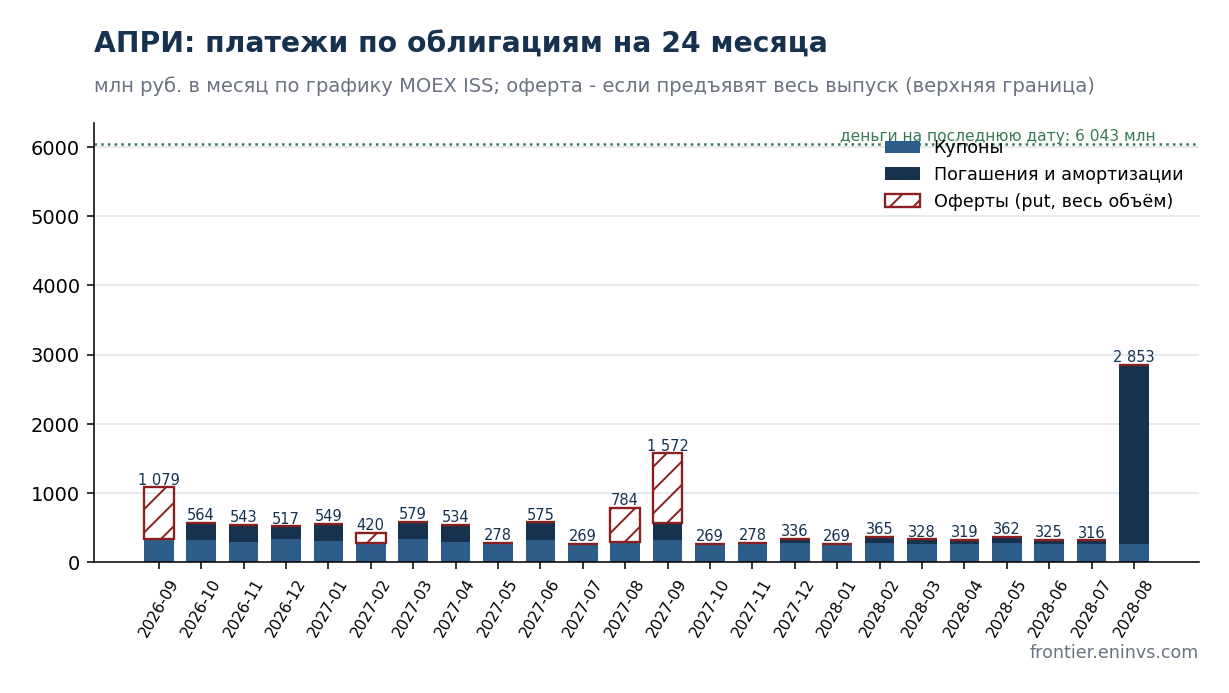
Authors' estimate. Even if the 2R3 put is tendered in full in September, the annual requirement rises to RUB 5.9 bn against RUB 6.0 bn of year-end cash, that is, the cushion disappears, and everything then rests on the release of escrow accounts for houses commissioned in the second half. The company itself has announced a material inflow of liquidity from commissioning, but this is a management forecast, not a fact.
Debt is growing faster than the business: net debt up from RUB 17 bn to RUB 53 bn in two and a half years, leverage 6.3x
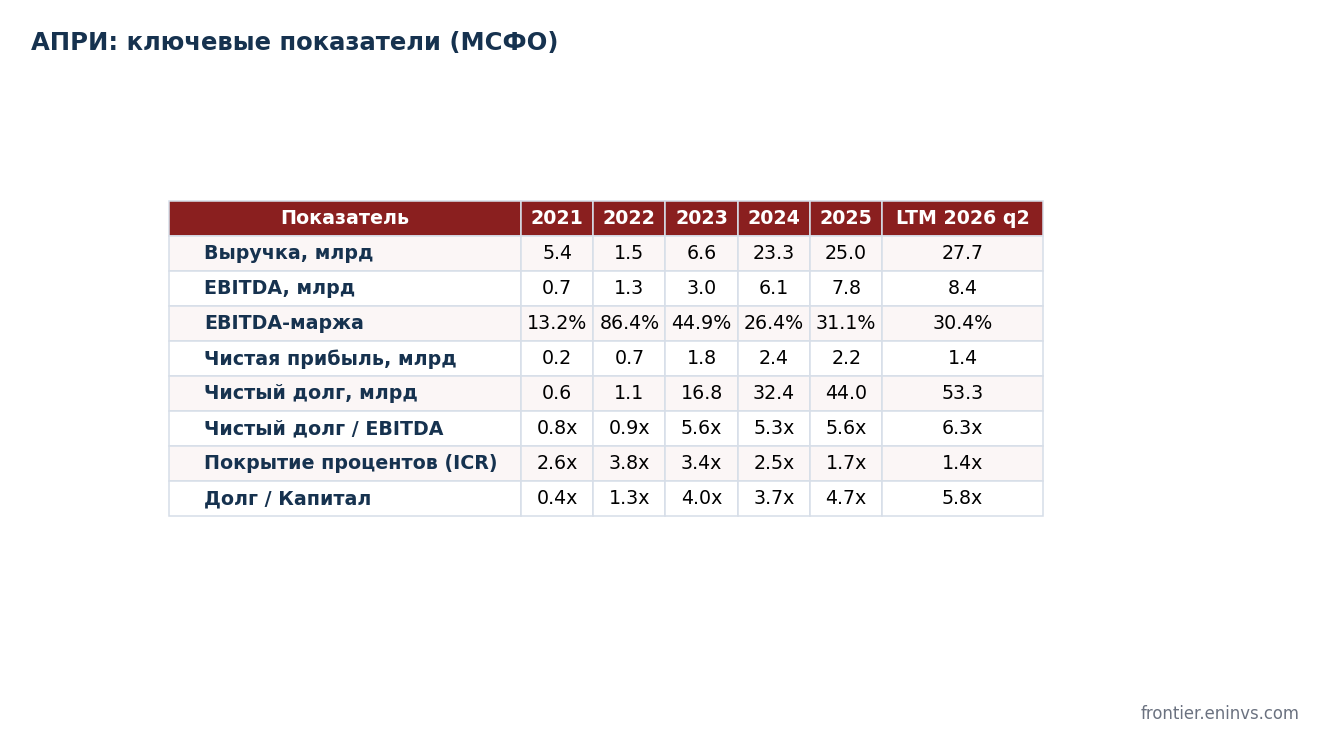
Fact. IFRS net debt: RUB 16.8 bn at end-2023, RUB 32.4 bn at end-2024, RUB 44.0 bn at end-2025 and RUB 53.3 bn at 30.06.2026. LTM EBITDA over the same period grew from RUB 3.0 bn to RUB 8.4 bn, so the ratio has stayed in a 5.3-6.3x range. Debt to equity is 5.8x. EBIT interest cover shrank from 3.4x in 2023 to 1.4x LTM, and in the second quarter of 2026 the company posted a net loss of RUB 0.5 bn on revenue of RUB 5.4 bn.
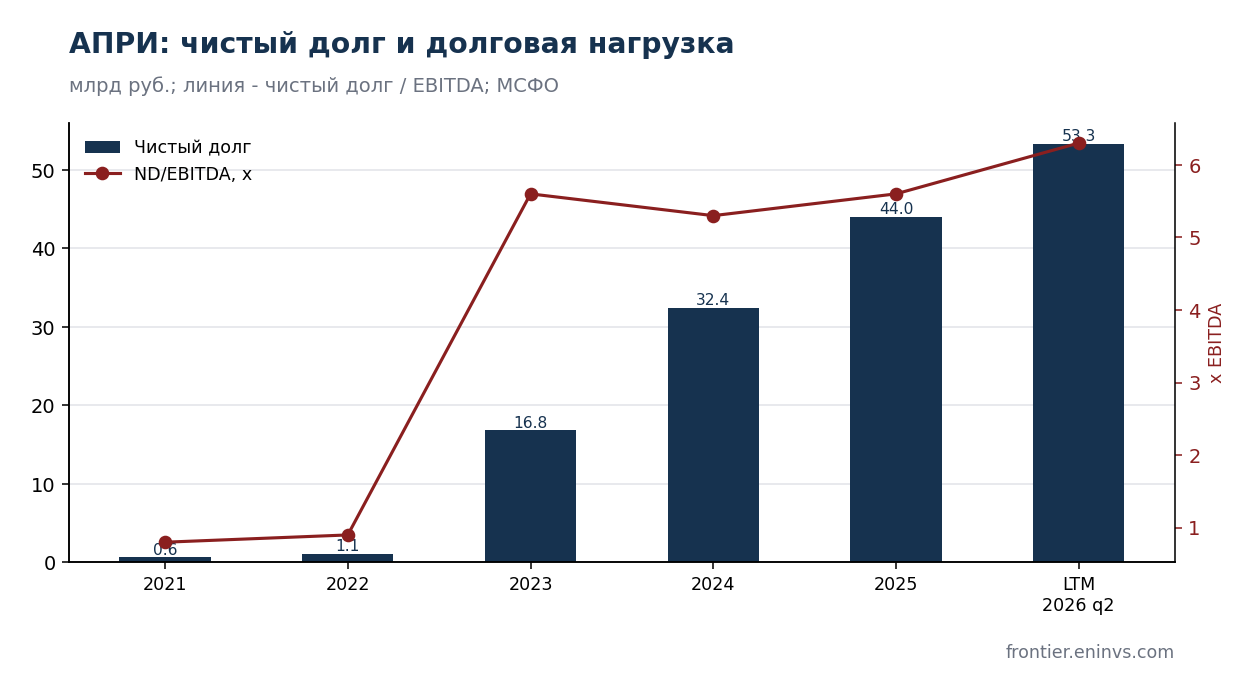
Caveat. For a developer, gross net debt overstates the picture: part of the loans is project finance backed by escrow that is repaid when the accounts are released. At Samolet and Brusnika leverage halves after deducting escrow. We do not show such a calculation for APRI because the company's accounts are posted as scans and the escrow balances have not been extracted from them. Free cash flow has been negative for six quarters in a row, minus RUB 5.1 bn in the second quarter of 2026, that is, construction is funded with borrowed money.
The business is growing and holds a 30% margin; the problem is not operations but the price of money
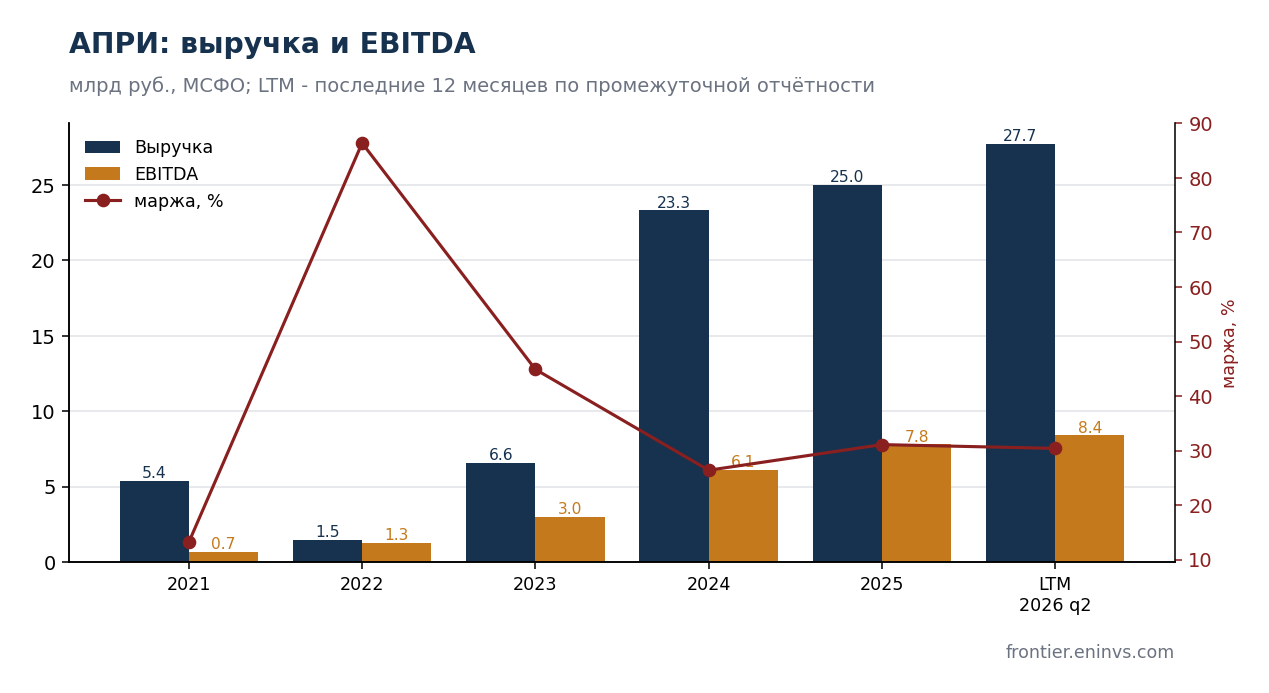
Fact. LTM revenue is RUB 27.7 bn (+23% year on year in the second quarter), EBITDA is RUB 8.4 bn, margin 30%. By quarter the business is uneven: RUB 2.3 bn of EBITDA in the first quarter of 2026 and RUB 1.2 bn in the second. According to Kulikov, the half-year accounts are neutral with positive touches: the auditor removed one-off income items and the company still returned to profit, while Samolet, LSR and Etalon posted losses; second-quarter sales were better than he expected. The expensive 2025 loans from microfinance companies at 40% and above have been repaid, completed property on the balance sheet fell from just over RUB 8 bn to just over RUB 7 bn, and VTB opened a limit for the fan park project.
The market already prices the risk: yields of 33-41% and a spread to OFZ of 1,600-2,300 bp on long issues
Fact. The short 2R1, maturing on 03.11.2026, trades at par with a yield of 24%. Everything longer than 2027 trades at 88-93% of face value: 2R8 yields 37.6% to its January 2029 maturity, 2R14 for RUB 5 bn yields 33.5% to March 2031, and 2R9 and 2R10 yield 39-41% to their 2027 puts. The spread to OFZ on fixed-coupon issues is 1,600-2,300 basis points – a level at which the market is pricing in a noticeable probability of restructuring, not a BBB- credit.
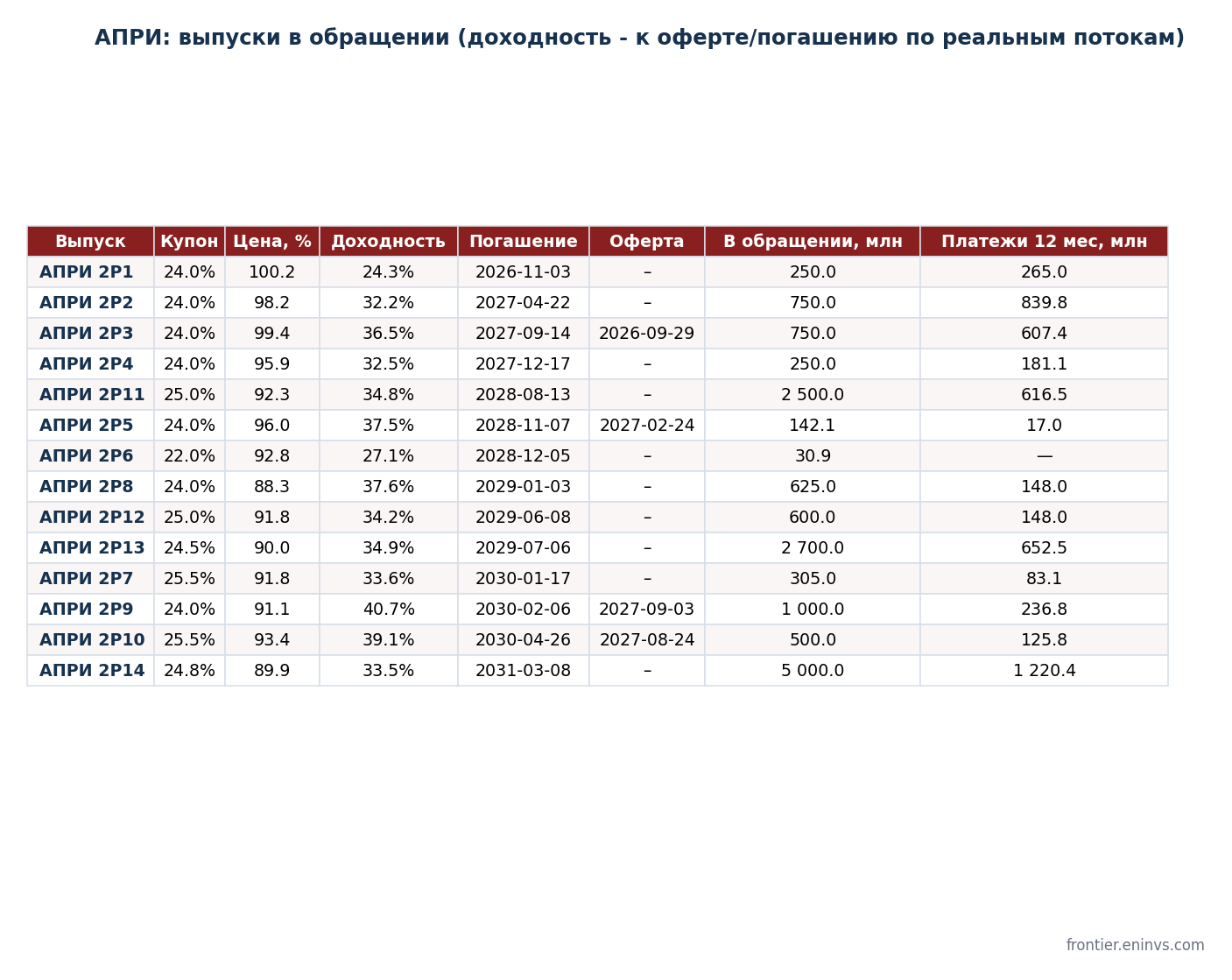
Authors' estimate. Of the RUB 15.4 bn of bond debt, RUB 2.6 bn falls in a single month – August 2028, when 2R11 for RUB 2.5 bn is redeemed. By then the company has to either accumulate cash from the release of escrow or refinance, and at the current 34% secondary-market yield a new issue will cost more than the existing coupons of 24-25.5%.
What could go wrong and what to watch in the coming months
- The 29.09.2026 put on 2R3 for RUB 750 mn – the first test after the coupon cut to 25.5%. If significantly more than 6% is tendered, as in August, the liquidity cushion will be used up.
- Release of escrow in the second half – the only source that can reverse the negative cash flow. Check it against the nine-month report and the commissioning of houses in Chelyabinsk, Yekaterinburg and on Russky Island.
- Formal signals – a tax arrear of RUB 9.7 mn according to the FTS and three unresolved disclosure violations on the Moscow Exchange index. The amounts are small, but for an issuer with RUB 15 bn of debt this is a sign of manual liquidity management.
- The 2028 refinancing – RUB 2.6 bn in August 2028 with secondary-market yields of 34%.
Summary: it can be held only as a small position and only in short issues
APRI covers the next year: cash and puts with low tender rates provide a cushion, the business is profitable, and the auditor cleaned up the accounts. But a growth model funded with borrowed money at a 14% key rate, with sales dependent on mortgages, leaves leverage of 6x and cover of 1.4x, and the market sees this in yields of 33-41%. A sensible position is the same one Kulikov voiced: no more than 1% per issue, with a preference for bonds with maturity or a put before the end of 2027, where the risk is bounded by the calendar and not by the developer's forecasts. The long 2029-2031 issues are a bet on successful refinancing, for which investors are paid 34-38% a year.
Sources and caveats
- Consolidated IFRS accounts of PJSC APRI for 2021-2025 and 1H2026 (e-disclosure), parent company RAS accounts from the FTS GIR BO.
- Schedule of coupons, amortization and puts – MOEX ISS (bondization), quotes – MOEX close on 03.09.2026.
- BCS broadcast with Anton Kulikov of 01.09.2026 – the speaker's position is given with attribution.
- FTS open data on tax arrears, the Moscow Exchange disclosure violations index.
Reviews of other issuers and weekly analytics are in the Telegram channel Enhanced Investments @eninv, and extended cards of all issuers are on the portal.
See also: market overview · valuation map · stock screeners