APRI: 40-50% a year on bonds – a bet on sales growth with escrow covering 14% of project debt
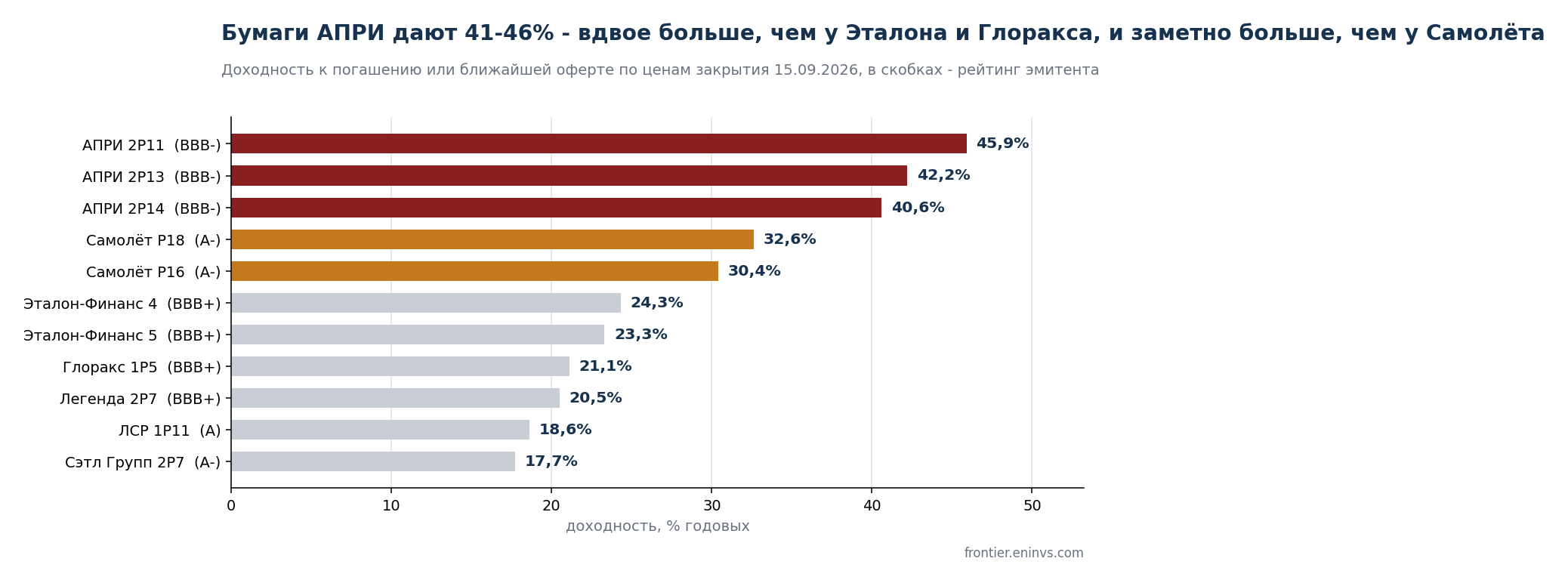
The Chelyabinsk developer APRI (PJSC, ticker APRI on the Moscow Exchange) has become one of the most discussed issuers in the bond market. The company has 14 issues totalling RUB 15.4 bn at face value, coupons of 22% to 25.5% a year, and all the bonds are available to investors without qualified status. Over the month the long issues fell from 94 to 78-82% of face value, and their yield to maturity reached 41-49% a year. That is twice Glorax's and 1.5-2 times Etalon's. Among developers only Samolet yields more.
Short verdict. The company depends on refinancing. Operating cash flow has been negative for the third year in a row, interest on debt is effectively paid with new loans and bond issues, and buyers' money in escrow accounts covers only 14% of project loans against about two thirds on average across the country. The company clears the next twelve months. It needs RUB 5.2 bn for its bonds, and in the second half it commissions projects and gains access to escrow. After that, every year requires three conditions at once. Banks must keep extending project limits, apartment buyers must not slow down, and the market must keep buying new issues at rates from 25%. A yield of 40-50% a year is the price of this set of conditions and of the current situation in the high-yield segment. On our traffic-light scale this is the yellow zone (details at the end of the review).
The company's position. APRI is growing and expanding. This is visible in the volume of current construction and the number of new projects in the operating report, and in the financial one: developers record part of their capital expenditure in operating activities and inventories. In the first half revenue grew 29.5%, and sales rose 48% in square metres and 54% in money. Taken together, the indicators show the company seeing asset growth and business development, not just refinancing.
Update of September 22. The review has been updated for trading on September 21, the presentation from Investor Day (September 19-20) and the company's comments that we received on September 22. The company's comments are given in the text labelled "Company comment" or "Company position". There were no material facts, rating actions or put results in this period, and coupons are paid on time.
The issuer card on the portal, with financials by period, credit metrics and all issues, is here. Below are the calculations of Enhanced Investments based on IFRS and RAS accounts, e-disclosure filings and the Moscow Exchange payment schedule. Where a figure is our estimate, it is marked as such.
The nearest test is September 29, when the company buys back the bonds tendered last week
Fact. For issue BO-002R-03 of RUB 750 mn, the put date falls on September 29, 2026. A put means an obligation of the issuer to buy back bonds at face value from those who applied within the set window. The window has already closed; applications were accepted from September 9 to 15. The company left the rate for the next coupon periods unchanged at 24% a year.
Why it matters. The previous two times, holders hardly tendered any bonds. For issue BO-002R-07 on August 20, 12,506 bonds out of 305 thousand were tendered, that is 4.1% of the issue. For issue BO-002R-10 on August 28, 37,142 out of 500 thousand were tendered, 7.4%. At that time the bonds traded at 95-100% of face value, and holding them was more profitable than tendering. Now the same issues trade at 80-88%, and a 24% rate for a year ahead against a market yield of about 40% makes tendering arithmetically attractive. Authors' estimate. If half the issue is tendered, the company has to find RUB 375 mn in cash within two weeks, and RUB 750 mn if the whole issue is tendered. The result will be disclosed at the end of September, and it is the first clear liquidity test.
What the company says. On September 16 and 21, APRI's IR director Igor Fainman wrote in his Telegram channel APRInomics that the put would be executed in full regardless of how many bonds are tendered, that the money is there and the buyback will go through without delay. According to him, the shareholders are confident in the company's credit quality, APRI's own resources are sufficient to service its obligations, and the shareholders are ready to support the company if necessary. He called the price decline speculative and amplified by thin liquidity, and added that the company does not know the seller. This is a public promise, not a material fact on e-disclosure, and the test of it will be the disclosure of the buyback results. BO-002R-03 now trades at about 95% of face value. The tender window is closed, and bonds bought now can no longer be tendered under the put. For a new buyer this is an issue maturing in September 2027, with 25% amortization from December 2026, a 24% coupon and a yield of about 38% (authors' estimate).
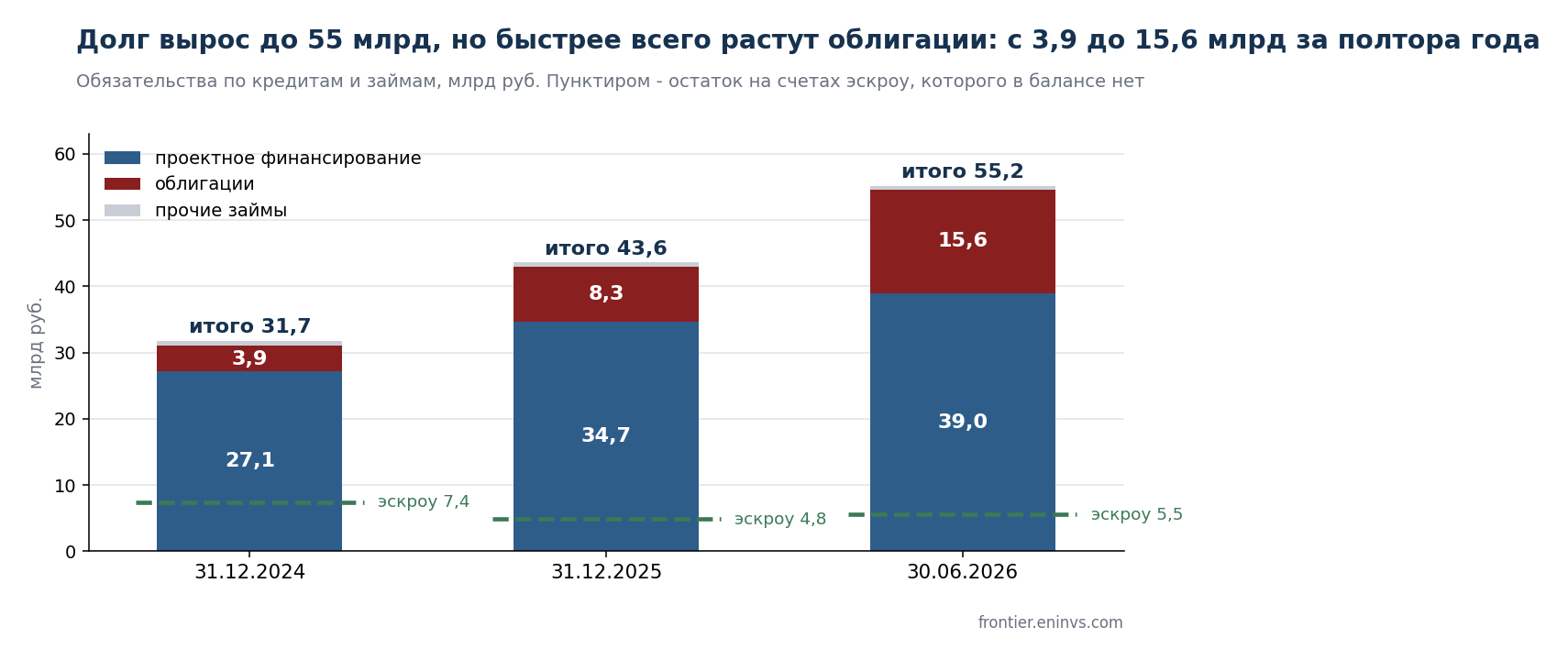
Fact. The group's cash at June 30, 2026 was RUB 975 mn. Separately, off balance sheet, RUB 5.5 bn lies in escrow accounts, but the company cannot dispose of it until the building is commissioned and the first buyer's title is registered.
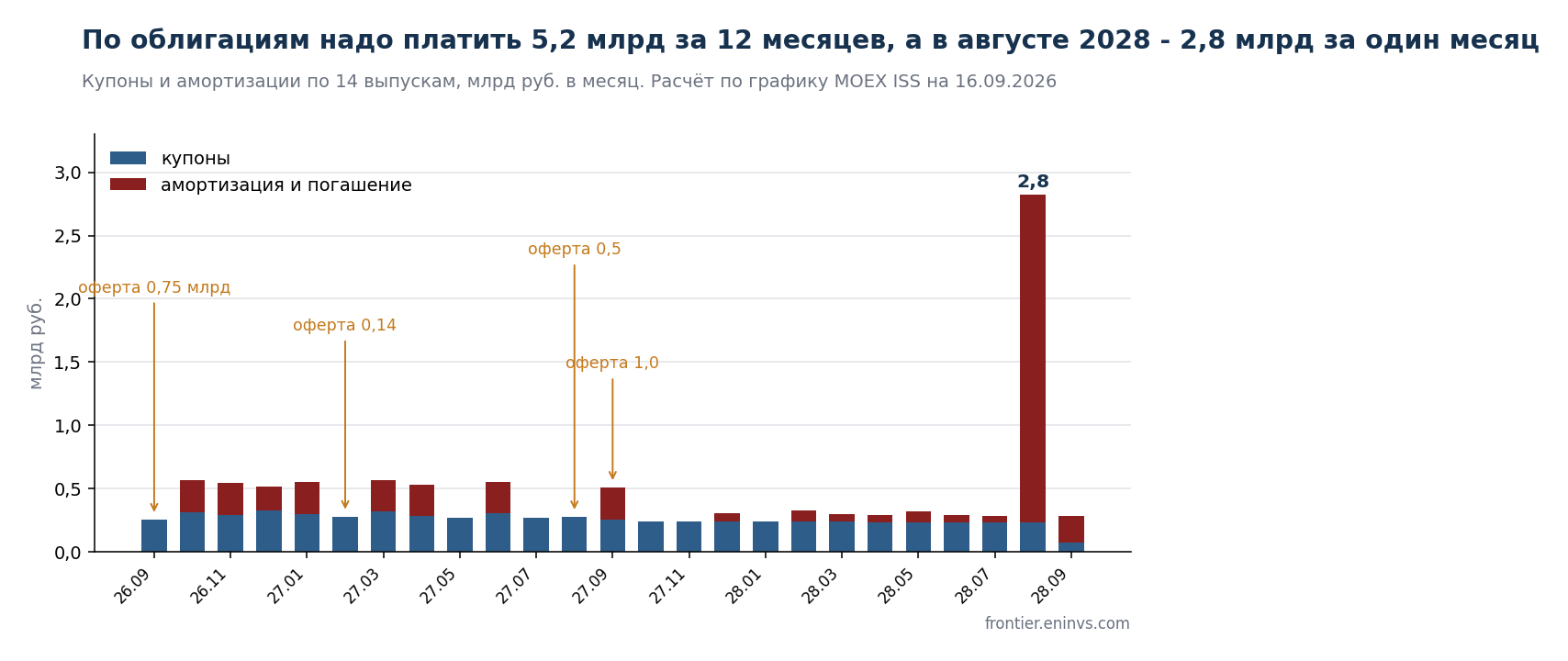
Authors' estimate. From September 2026 to August 2027 the bonds require RUB 3.5 bn of coupons and RUB 1.7 bn of amortization, RUB 5.2 bn in total. Puts come on top. In September 2026 it is RUB 750 mn, in February 2027 RUB 142 mn, and in August and September 2027 another RUB 1.5 bn. August 2028 stands apart, when issue BO-002R-11 of RUB 2.5 bn is redeemed in a single payment.
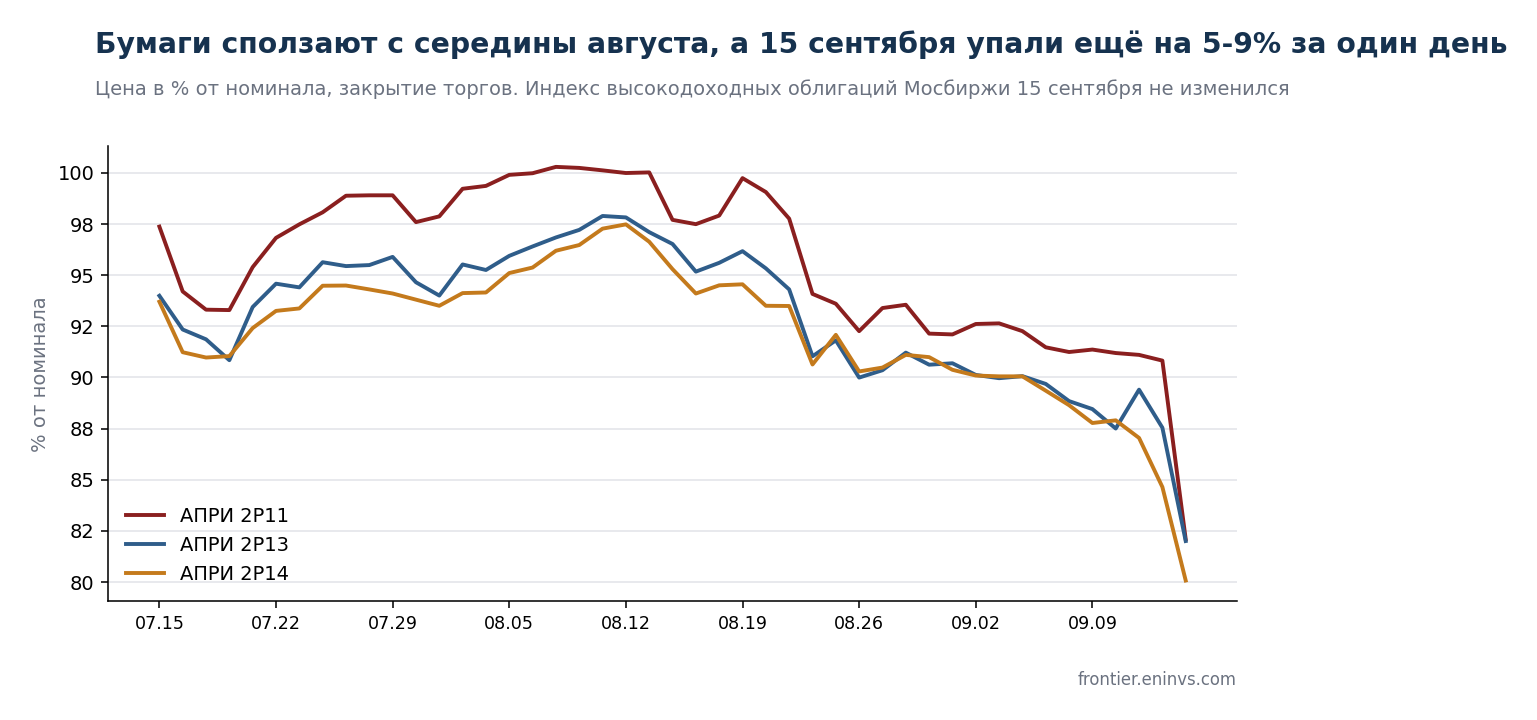
The market repriced the bonds from 94 to 80% of face value in a month, and on September 15 with no news at all
Fact. In mid-August APRI's long issues traded at 93-99% of face value. By September 11 prices had slipped to 87-91%, and on September 14 and 15 the decline accelerated. Issue BO-002R-11 lost 8.7 percentage points in a day and fell from 90.8 to 82.1% of face value, BO-002R-13 lost 5.5 points, and BO-002R-14 another 4.6 points. Turnover tripled; BO-002R-14 traded RUB 104 mn in a day against the usual RUB 25-30 mn.
What is known about the causes. There were no disclosures from the company on those days apart from routine coupon payment notices. There were no rating actions either; the last one dates from August 3, when NKR affirmed BBB-.ru. The Moscow Exchange high-yield bond index was almost unchanged on September 15, so the fall was not a market move but specific to APRI's bonds. The only event of that day was the last day for accepting applications for the BO-002R-03 put. There is no convincing explanation in public sources, so we record the fact and do not speculate about a particular seller. The company explains the fall by speculation and a thin order book (see the section on the put above).
Fact. At the September 15 closing prices, the yield to maturity was 45.9% for BO-002R-11, 44.7% for BO-002R-08, 42.6% for BO-002R-12, 42.9% for BO-002R-13, 40.7% for BO-002R-14 and 40.4% for BO-002R-07. The short BO-002R-01, maturing on November 3, 2026, trades near face value and yields 29%.
What happened next. On September 18, between 10 and 12 Moscow time, a second slump took place: BO-002R-11 briefly traded at 67.6% of face value and BO-002R-14 at 71.7%, and by the close the bonds returned to 77-80%. The Moscow Exchange high-yield bond index lost 1.8% over September 17-18, so the second slump coincided with a general sell-off in the segment. On September 21, BO-002R-11 stood at 81.8% of face value (yield 46.4%), BO-002R-08 at 79.1% (48.9%), BO-002R-13 at 78.8% (45.6%) and BO-002R-14 at 79.1% (41.4%); prices were cross-checked against the Moscow Exchange and Smart-Lab.
The spread to OFZ of the same maturity on the long issues was 2,400-3,100 basis points on September 15, and by September 21 it was 3,300-3,400 for the highest-yielding issue.
Two readings of the same accounts: the company has debt of 4.2x EBITDA, a strict count gives 6.4x
Fact. In the release for the first-half accounts the company reported that EBITDA for the last 12 months reached RUB 11.54 bn, up 68% year on year, the margin was 41.6% and net debt to EBITDA fell to 4.2. The figures are correct, but it is worth understanding how they were obtained. The company adds back to profit all finance costs, including RUB 3.12 bn of interest that under the accounting rules settled in the cost of the houses built. And it subtracts from debt RUB 5.5 bn in escrow accounts that are not on the balance sheet.
Company comment. Interest capitalized into inventory and written off through cost of sales is added back to EBITDA; many public developers that disclose adjusted EBITDA do the same.
Authors' estimate. Both operations are defensible on their own, but then the other side must be counted the same way. Since EBITDA includes capitalized interest, the whole interest burden is needed for comparison. To the RUB 6.41 bn of finance costs from the income statement we must add the same RUB 3.12 bn of interest in cost of sales, RUB 9.53 bn in total. Cover then comes to 1.2 instead of 1.8. If we take only interest accrued over 12 months per note 20 (RUB 8.91 bn), cover is 1.3. If instead we count EBITDA without interest in cost of sales, it is RUB 8.42 bn, net debt without deducting the inaccessible escrow is RUB 54.2 bn, and the debt to EBITDA ratio rises to 6.4.
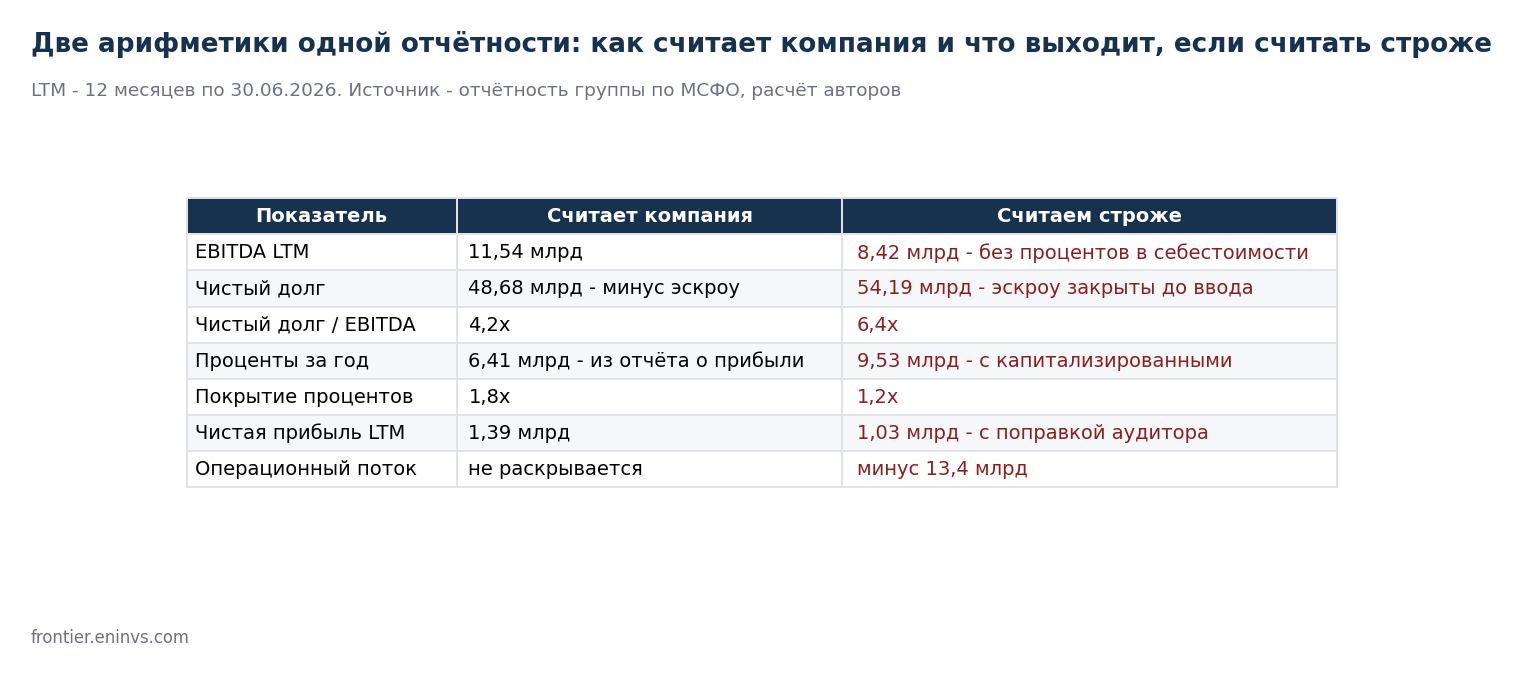
What this means for a bondholder. The difference between 4.2 and 6.4 is not a dispute about methodology for its own sake. With debt of RUB 55 bn the company pays about RUB 8.6 bn of interest a year in cash, at the first-half pace. EBITDA before all interest (RUB 11.5 bn) covers it about 1.3 times, a small margin. But EBITDA is not yet turning into cash: operating cash flow is negative even before interest (minus RUB 3.3 bn for the half-year), so interest is effectively paid with new loans.
Buyers' money covers 14% of project loans against 66% in the market: the price of a bet on sales of finished housing
How it works. Buyers' money under equity participation agreements sits in escrow at a bank until the building is commissioned, and the more of it there is, the lower the rate on the project loan. With empty accounts the rate approaches the market rate.
Fact. At June 30, 2026 APRI had project loans of RUB 38.96 bn, and RUB 5.51 bn lay in escrow. Coverage is 14%. At the end of 2024 it was 27%, and at the end of 2025 already 14%. On average across the Russian market, according to DOM.RF, coverage in June 2026 was 66%.
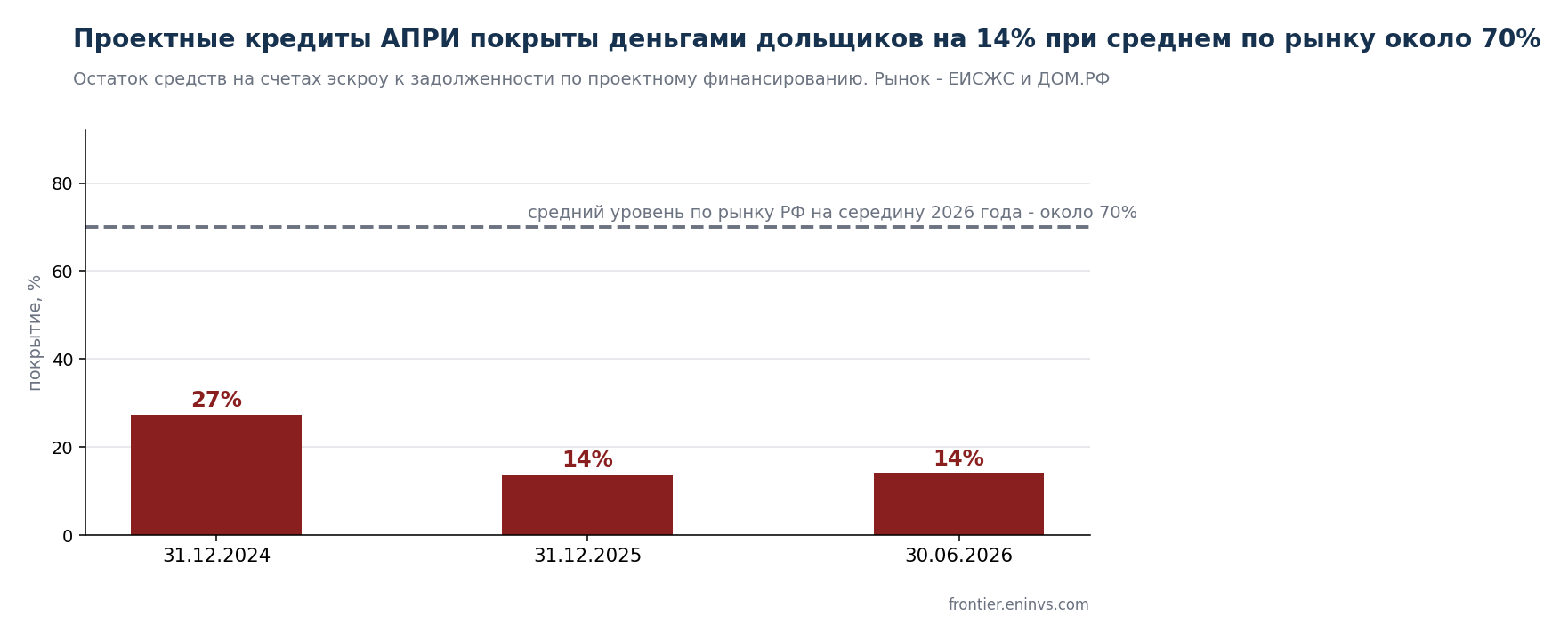
Authors' estimate. Low coverage also shows in the price of money. In the first half the company accrued RUB 2.85 bn of interest on loans on an average project finance portfolio of RUB 36.8 bn, which gives about 15.5% a year. The saving on the rate thanks to escrow, which the company shows in revenue, was RUB 346 mn for the half-year, which is less than 2 percentage points a year on the portfolio. A developer with full accounts pays noticeably less for a project loan; the average market rate, by DOM.RF's estimate, has fallen below 10%.
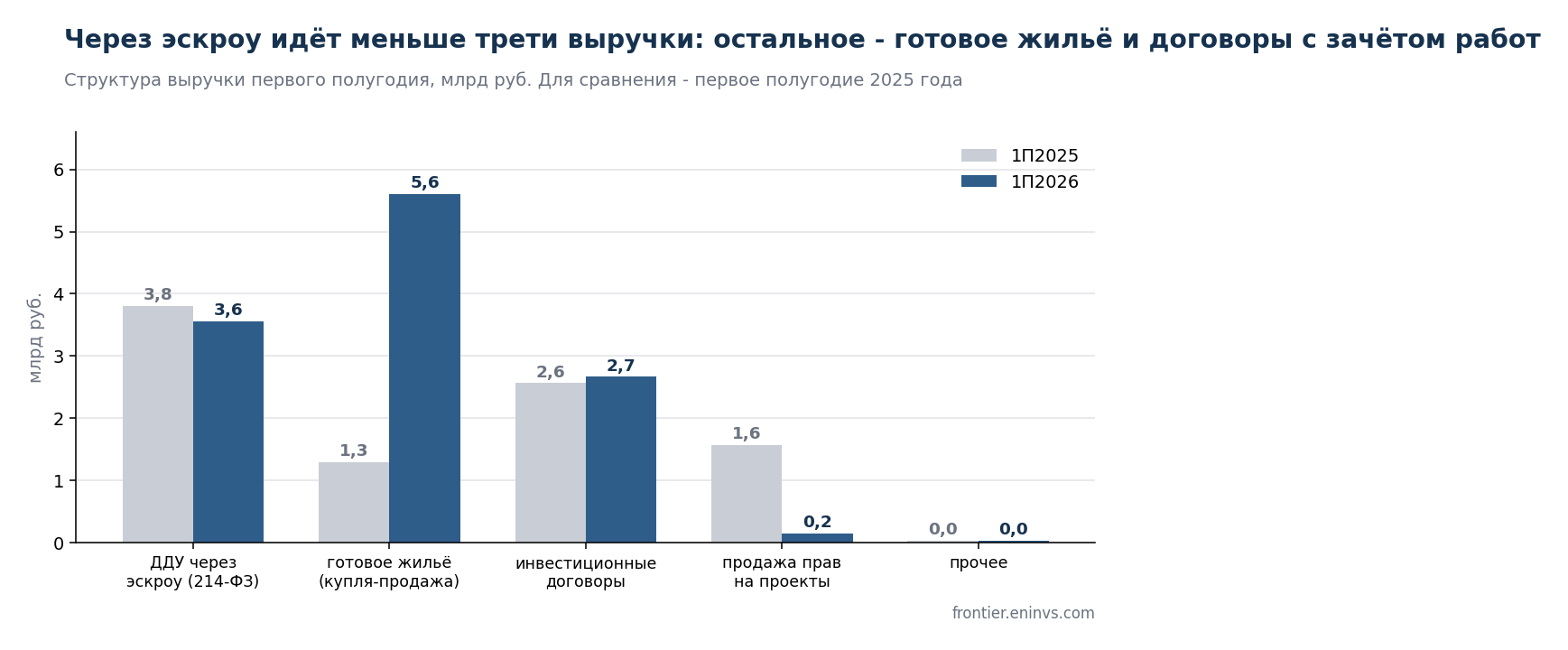
Why it turned out this way at APRI. Less than a third of revenue passes through equity participation agreements, and so through escrow. Another 47% came from finished housing under sale and purchase agreements, where the buyer pays directly. The remaining 22% came from investment activity agreements, under which escrow accounts are not used and obligations are often settled by offsetting counterclaims for contracting work. On top of that there are many projects at an early stage, among them the Fanpark resort near Chelyabinsk, Vladivostok, the Caucasian Mineral Waters and the Leningrad region. There the loan is already being drawn and sales have not started yet.
Company comment. Prioritizing sales of houses at a high stage of completion is a conscious strategy that supports the margin and offsets interest costs. APRI is now revising its approach and plans to fill escrow accounts more actively.
What the RUB 55 bn of debt will be repaid from: quick money covers a quarter
For a typical developer the answer is simple. Project loans are repaid with buyers' money already in escrow, and corporate debt is small. At APRI escrow covers 14% of project loans, so it is worth going through the whole balance sheet and looking at what the company will use to repay RUB 55.2 bn of debt.
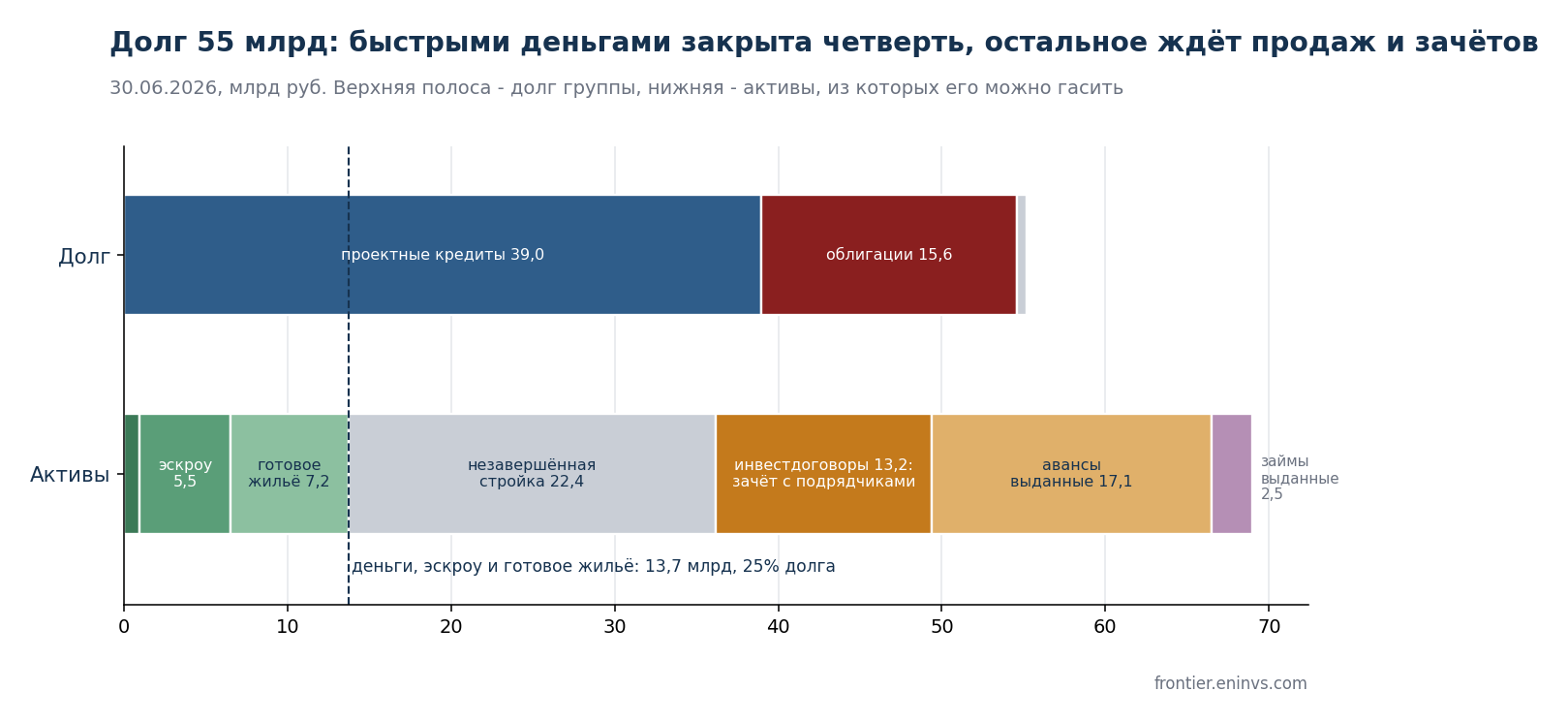
Fact. At June 30, 2026 the group's assets (per the notes to the IFRS accounts) were:
- cash RUB 0.98 bn and RUB 5.51 bn in escrow off balance sheet;
- finished housing for sale RUB 7.23 bn at cost;
- costs of houses under construction RUB 22.44 bn;
- assets under investment agreements RUB 13.22 bn;
- advances issued RUB 17.10 bn, of which RUB 14.13 bn to contractors and suppliers for housing construction;
- loans issued RUB 2.48 bn, of which RUB 1.56 bn to the parent company;
- land plots for construction only RUB 0.59 bn in total, another RUB 0.19 bn of investment property and RUB 0.17 bn of lease rights.
Authors' estimate. Only cash, escrow and finished apartments turn into money quickly, RUB 13.7 bn together, or 25% of debt. Another RUB 22.4 bn is invested in unfinished construction and will come back only when the apartments are sold and the houses delivered. The remaining RUB 30 bn are investment agreements and advances issued, that is, mostly settlements with construction companies. There is also no separate reserve in the form of land. Land on the balance sheet is worth less than RUB 1 bn, and in its Investor Day presentation the company itself calls the absence of long-term investment in a land bank its advantage. It leases sites or obtains them under agreements on comprehensive development of territories.
What investment agreements are and who pays under them. Under these agreements the buyer (called an investor in the accounts) acquires housing or commercial premises without escrow and without the protection of Law 214-FZ. The money goes directly to the developer, but it may also not come. In note 22 to the half-year accounts the company disclosed who these investors are. At June 30 there were 127 agreements with 57 counterparties for RUB 9.94 bn; the three largest account for 37.5% of the amount and the ten largest for 83.4%. The main point is next: most of the counterparties are at the same time contractors of the group, and settlement is expected by offsetting counterclaims under contracting agreements. A contractor builds a house and receives payment for the work not in money but in apartments and premises in that house. The offset deadline is set for the first half of 2027.
What this means for a creditor. Revenue under these agreements (RUB 2.67 bn for the half-year, 43% of revenue recognized as construction proceeds, and 22% of all real estate revenue) is accrued as construction progresses. According to the accounts, settlement under them is in cash or by offset, and since most counterparties are contractors, it is mainly offset. An offset repays the group's debt to a contractor with square metres, and these metres can no longer be sold to a buyer for cash. For the company this is a way to save liquidity. For a bondholder it means that the RUB 13.2 bn of assets under investment agreements will mostly not become a source of debt repayment. When the company on September 16 referred to RUB 16.9 bn of assets under agreements that will be settled within a year, that amount included the part that will be closed by offset.
Two details the company should explain. First, assets under investment agreements (RUB 13.22 bn) are larger than the whole price of the agreements in force (RUB 9.94 bn). Normally an asset under an agreement cannot exceed the unpaid part of its price. Part of the difference may be explained by the fact that advances under the same agreements are shown separately, in liabilities: RUB 7.07 bn of advances received under investment agreements. But the accounts do not allow one to be reconciled with the other. Second, the group at the same time holds RUB 14.1 bn of advances to contractors for housing construction, which grew by RUB 3.9 bn over six months. It turns out that contractors are paid in cash in advance while at the same time they owe the group for apartments. How far these are the same companies and why the counter-settlements are not netted is not disclosed in the accounts. This does not point to an error in the accounts, but it requires an explanation.
Company comment. Assets under agreements are an accumulated amount and cannot be compared directly with revenue or sales of the period. The growth in advances to contractors is related to the acceleration of construction and stricter acceptance of work, and new projects require large prepayments, including for utility connections, which are closed with documents closer to the end of the work.
What happened after the reporting date. In August two projects refinanced project loans with new loans secured by finished housing, in one case with additional money received. Finished apartments in Privilegiya, Prityazhenie and Parkovy were already pledged to banks before, and now new loans have been taken against them. The quickest source of money from the list above is working for bank debt. For the Privilegiya Partners-3 project, supplementary agreements extending loan terms were signed, which the company calls a planned restructuring. In July a subsidiary in Yessentuki concluded land lease assignment agreements with the purchase of assets for RUB 5.0 bn for a chain of hotel-sanatoriums. Who pays under this deal and from what money is not stated directly in the accounts.
Negative operating cash flow: an investment phase and dependence on refinancing
Fact. The group's operating cash flow was minus RUB 6.49 bn in 2024, minus RUB 9.01 bn in 2025 and minus RUB 8.38 bn in the first half of 2026. Even before interest and taxes the flow is negative, at minus RUB 3.76 bn, minus RUB 3.50 bn and minus RUB 3.29 bn respectively. The gap is closed with loans. In the first half the company raised RUB 20.6 bn of loans and bonds and repaid RUB 9.3 bn.
Caveat. For a growing developer negative flow during the construction stage is normal; the money returns when houses are commissioned. The question is the size of interest. Over 12 months RUB 6.53 bn was paid in cash, and RUB 4.32 bn in the first half alone, which is comparable to strict EBITDA for a year.
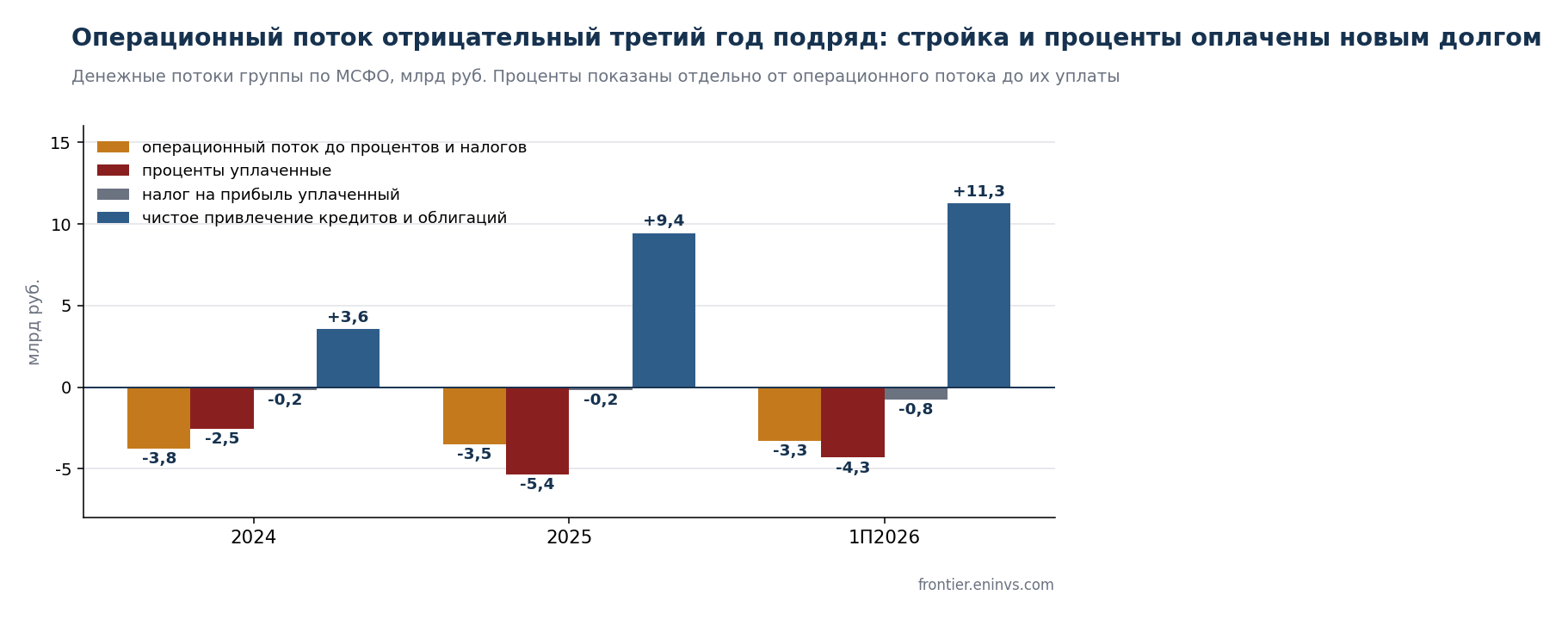
Authors' estimate. Over two and a half years operating activity took about RUB 24 bn of cash, and exactly the same amount came in as net debt raised. The model works as long as banks extend project limits and the market buys new issues. A yield above 40% prices exactly this dependence.
The company borrows at 25% and lends to its owner at 16%, and another RUB 5.5 bn went into advances to contractors
Fact. In the first half of 2026 the group issued loans of RUB 1.79 bn. Of this, RUB 1.56 bn went to the parent company OK-Finance LLC at the key rate plus 2%, with repayment due on December 31, 2026. At the end of 2025 there was no such loan at all. Total balances with the parent company rose from RUB 0.69 bn to RUB 2.96 bn. Besides the loan, OK-Finance owes RUB 1.10 bn under a preliminary agreement for the purchase and sale of securities (RUB 0.71 bn at the end of 2025), although the line for transactions during the half-year is empty. What securities these are is not stated in the accounts. Another RUB 0.65 bn relates to assignment agreements.
Fact. Advances issued to contractors and suppliers grew from RUB 11.57 bn to RUB 17.10 bn, that is, by RUB 5.53 bn over the half-year. Of this, RUB 14.13 bn relates to housing construction. Assets under agreements grew in parallel, from RUB 17.89 bn to RUB 22.41 bn. A part of RUB 8.61 bn relates to agreements with escrow and will be closed when houses are commissioned. The other part, RUB 13.22 bn, relates to investment agreements, settlement under which, according to the accounts, falls in the first half of 2027 and may take place by offsetting counterclaims under contracting.
What matters here. The company borrows from the market at 25% a year and more, and gives its owner money at 16%. On the RUB 1.56 bn loan the group loses about 9 percentage points, that is, about RUB 0.14 bn a year. If we count all the RUB 2.96 bn now recorded against the parent company at the cost of bond debt, they cost the group about RUB 0.7 bn a year. Interest is accrued only on the loan, about RUB 0.25 bn. The forgone RUB 0.4-0.5 bn a year is almost half of adjusted profit for the last 12 months (authors' estimate). The signal itself is more important. A company with negative operating cash flow, RUB 975 mn in its accounts and a RUB 750 mn put in September moves money to its owner, and this money ends up outside the group from which the bonds are paid. The loan did not exist at the end of 2025, and it must be repaid by December 31, 2026. Repayment on time will be a test; if the loan is extended, this should be treated as a negative signal. Growing advances and assets under agreements add a problem from the other side. This is revenue and assets that have not yet turned into cash.
The auditor has qualified the second report in a row: RUB 1.9 bn from sales of stakes is shown in revenue, not in equity
Fact. The group's auditor, International Consulting and Legal Centre LLC, expressed a qualified opinion in its report on the 2025 accounts. Revenue includes income from sales of stakes in subsidiaries without loss of control of RUB 1.89 bn, which contradicts IFRS 10. Under the rules such transactions are recorded in equity, not in revenue and profit. With the correction, 2025 revenue would have fallen from RUB 25.0 bn to RUB 23.1 bn, and net income from RUB 2.25 bn to RUB 0.38 bn.
Fact. In the review report for the first half of 2026 the same qualification is repeated for the comparative data for the first half of 2025 in the amount of RUB 1.53 bn. Taking it into account, the first-half 2025 profit turns into a loss of about RUB 0.53 bn. In the accounts for the first half of 2026 a similar transaction of RUB 130 mn is already correctly recorded, in financing activities.
Sales of stakes continue. In the presentation from Investor Day the company calls the sale of stakes in its developers while retaining control (financial development) a regular financing tool; in 2025 stakes in Cosmos Hotel in Zheleznovodsk and Apri Peterhof were sold this way. For the disputed 2025 transactions the money mostly came in, RUB 1.63 bn. But the buyers of stakes still owe RUB 1.0 bn of interest-free debt due on June 30, 2027, and in the first half of 2026 a balance of RUB 1.12 bn appeared for sales of stakes to entities that the company classifies as related parties.
Authors' estimate. Adjusted for the qualification, net income for the last 12 months is about RUB 1.03 bn instead of the reported RUB 1.39 bn. The amount is small, but a repeated qualification on the same issue means that the company and the auditor have disagreed on the treatment of transactions in subsidiaries' stakes for the second reporting period.
The bonds are issued by a holding with equity of RUB 2.3 bn that guaranteed its developers' project loans of RUB 37 bn
Fact. The bond issuer, PJSC APRI, is engaged in holding company activities according to the Unified State Register of Legal Entities. Construction is carried out by separate special-purpose developers, and project loans are registered to them. According to its own RAS accounts for the first half of 2026, the PJSC showed a loss of RUB 1.35 bn against a profit of RUB 0.45 bn a year earlier. Equity fell from RUB 3.70 bn at the end of 2025 to RUB 2.35 bn at June 30. The PJSC's guarantees and pledges to banks total RUB 36.76 bn, all issued for the group's special-purpose developers. The PJSC's own borrowings are RUB 19.65 bn.
Fact. Project finance is secured by pledges of land plots with an area of 104.85 ha, stakes in twelve subsidiary developers, finished apartments in delivered houses, and a pledge of 225 mn shares of PJSC APRI owned by the parent company OK-Finance LLC. Separately, guarantees were given by PJSC APRI itself and by individuals from among the group's beneficiaries and managers.
What this means. The bonds are unsecured and rank behind banks, which hold pledges and the issuer's guarantee. A bondholder receives what is left after settlements with the banks.
Operationally the company is strong and sales are up one and a half times, but the region is oversupplied
Fact. In the first half of 2026 APRI sold 72.62 thousand sq. m, 48% more than a year earlier, for RUB 11.10 bn, with growth in money of 54%. The average sale price rose 4.2% to RUB 152.8 thousand per sq. m. The share of deals with mortgages reached 83%, being 88% in the first quarter and 74% in the second. 37.46 thousand sq. m were commissioned, and current construction totals 370.61 thousand sq. m. The main growth came from the Prityazhenie projects and the second phase of TvoyaPrivilegia in Chelyabinsk.
Industry context. The Bank of Russia key rate is now 14% against 14.25% at the end of June. Mortgages remain expensive, and the conditions of the family programme were tightened from February 2026. In the Chelyabinsk region the volume of unsold housing grew by about 20% over the year to 24.9 thousand units, over 1.43 mn sq. m. For a developer with most of its construction in one region, oversupply means pressure on the price and on the pace of sales, and so on the pace at which escrow is filled.
A separate detail. Bondholders can voluntarily direct coupons towards a mortgage or exchange a block of bonds for an apartment at a 7% discount; the company pays its obligations on the issues in cash.
The agencies hold BBB-: NKR expects debt to rise to 7.2x EBITDA, but also improved interest cover
Fact. On August 3, 2026 NKR affirmed the credit rating at BBB-.ru with a stable outlook. The rationale states that the ratio of total debt to OIBDA, adjusted for escrow, was 5.3 for 2025, and in 2026 the agency expects it to rise to 7.2 owing to the growth in debt. Interest cover fell from 2.9 in 2024 to 1.9 in 2025. The share of equity in assets is 12%. The agency explicitly notes the weak quality of debt servicing and the high share of borrowed funds. At the same time NKR expects interest cover to improve to 2.2 in 2026 and notes an even repayment schedule without peaks.
Fact. NRA affirmed the rating at BBB-|ru| with a stable outlook on October 24, 2025 and noted negative free cash flow in 2023-2024 and for the 12 months to June 30, 2025, together with the geographic concentration of the business. The next review is expected in autumn 2026.
How to read this. In liquidity NKR includes not only cash but also unused bank limits and housing inventory. Finished housing (RUB 7.23 bn) is being sold, but it is a one-off resource, and it is pledged to banks.
Taxes and courts: an arrear of RUB 9.7 mn, the case file could not be checked
Fact. According to open FTS data as of August 1, 2026, PJSC APRI has a tax arrear of RUB 9.72 mn. The main part is VAT of RUB 8.72 mn, another RUB 0.54 mn is insurance contributions, RUB 0.39 mn is property tax, and the rest is transport and land taxes. For a company with RUB 55 bn of debt the amount is small. The company explains the arrear by a technical error in allocating a payment. But arrears recur: in April 2026 the company had RUB 140 mn of income tax arrears, and in May 2025 RUB 60 mn.
Caveat. We could not check the arbitration case file because it blocked automated requests. The company does not see any proceedings in its accounts that are material for its financial position.
What to watch next
- Put results on September 29. How many BO-002R-03 bonds out of RUB 750 mn were tendered and whether the company kept its promise to buy back everything. Disclosure will come at the end of September. A share noticeably above the 4-7% of August will mean that holders are leaving at the first opportunity.
- Offsets under investment agreements. The settlement deadline for RUB 13.2 bn is set for the first half of 2027. If these assets keep growing faster than revenue, it means the company is paying for a growing share of construction with apartments rather than money.
- Nine-month accounts. The key lines here are the escrow balance, cash, operating cash flow before interest and the amount of advances issued. Commissioning in the second half should reverse these figures, otherwise the picture will worsen.
- New placements. In the half-year the company borrowed RUB 7.85 bn through bonds. A new issue at a market yield above 40% will raise the cost of debt further, and without placements the bonds will have to be repaid from operating cash.
- Fanpark. Drawdown of the RUB 7.2 bn of concessional VTB loan announced at SPIEF, for the group's most capital-intensive project.
- Repayment of the parent company's loan. OK-Finance LLC must repay RUB 1.56 bn by December 31, 2026. The 2026 accounts will show whether the money returned to the group or the loan was extended.
- NRA rating in autumn. NRA must review the rating by the end of October, and the outcome will depend on the dynamics of debt load and on how the September 29 put goes.
Traffic light: yellow
On our scale APRI is in the yellow zone. Interest is covered by EBITDA only 1.2-1.4x, debt to EBITDA is 4.7 on the company's EBITDA without deducting escrow and 6.4 without capitalized interest, operating cash flow has been negative for the third year, and escrow covers 14% of project loans. The company falls short of red. All payments are on time, the auditor has a qualification on one issue rather than a disclaimer of opinion, ratings are BBB- with no downgrades, and the RUB 5.2 bn of bond payments over the next 12 months are covered by commissioning in the second half and market access.
- Would move it to red: an incomplete buyback at the September 29 put; a rating downgrade; an extension of the parent company's loan instead of repayment by December 31; growth in offsets and advances without growth in cash from sales; redemptions without new placements.
- Would return it to green: escrow coverage closer to the market's 66%, positive operating cash flow before interest, repayment of the loan to the owner.
Summary: a bond for those who weigh the probability of refinancing, not the coupon
APRI does not look like a company on the brink. It is growing faster than the market, holds a place among the top three in the Chelyabinsk region, sells more metres at higher prices, pays coupons on time and has not missed a single payment. There are no signs of preparation for a default either in the accounts or in the disclosures.
The financing structure remains tough. Debt of RUB 55 bn against equity of RUB 9.1 bn, buyers' money covering 14% of project loans, interest of about RUB 8.6 bn a year paid with new loans, and a market cost of new debt for the company starting from 25%. The model is sustainable as long as sales grow, banks provide financing and the bond market is open. If one of these conditions worsens, the company may need to adjust its financial strategy, for example by selling part of its assets or agreeing with holders a change to the payment schedule.
That is why a yield of 40-50% a year looks like an honest price, not a gift. The long 2029-2031 issues remain a bet that in two or three years the company will be able to borrow more cheaply than today, and that the housing market in the Chelyabinsk region will digest the current oversupply. The nearest data for this assessment will come from the September put results and the nine-month accounts.
Sources and caveats
- IFRS accounts of PJSC APRI for 2025 and 1H2026 with MKPTs's reports, RAS accounts of the PJSC for 1H2026, issuer announcements on e-disclosure.ru for July-September 2026.
- Prices, turnover and payment schedules from the Moscow Exchange (ISS) at 15.09 and 21.09.2026, cross-checked against Smart-Lab.
- Presentation of PJSC APRI from Investor Day 19-20.09.2026 ([ir.apri-group.ru](https://ir.apri-group.ru/media/296f751dcf0647f9a99f6bc05985c273.pdf)).
- Posts by APRI's IR director in his Telegram channel [APRInomics](https://t.me/APRInomics/2444) of 16, 17, 18 and 21.09.2026.
- Company press releases of 17.07 and 28.08.2026, NKR releases of 03.08.2026 and NRA of 24.10.2025, data from the FTS, DOM.RF and EISZhS.
Reviews of other issuers and weekly analytics are in the Telegram channel Enhanced Investments @eninv, and extended cards of all issuers are on the portal.
See also: market overview · valuation map · stock screeners