Inarctica: the fish is back, but without a weak ruble there is little upside
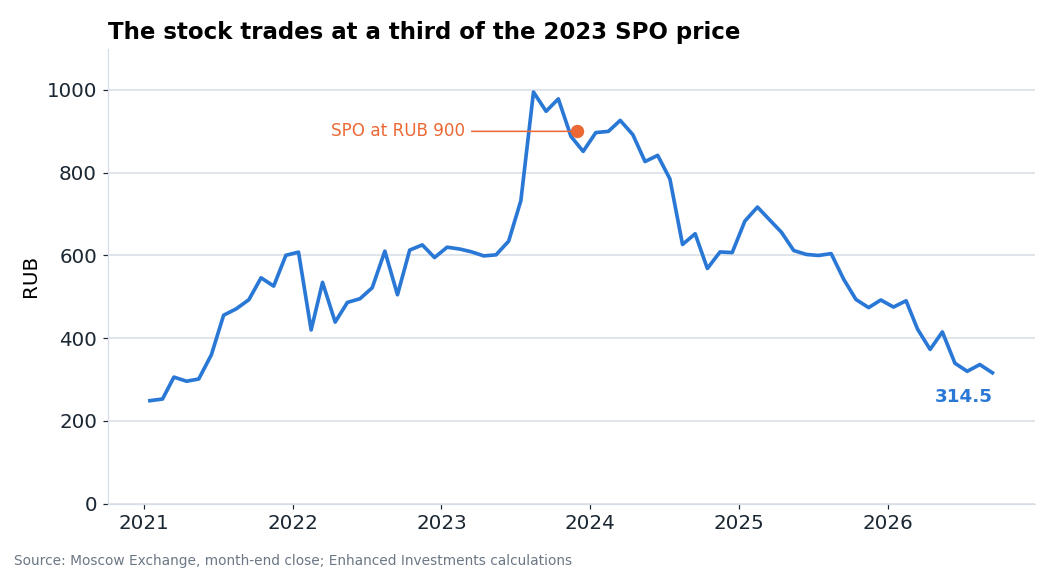
Inarctica is Russia's largest producer of farmed salmon and trout. In 2024 the company lost about a third of the fish in its pens to cold water and parasites. Sales and profit fell, and the share price dropped from RUB 900 in the SPO in November 2023 to RUB 314.5 today. In 2026 production is recovering. Below we look at whether the stock has upside at current fish prices.
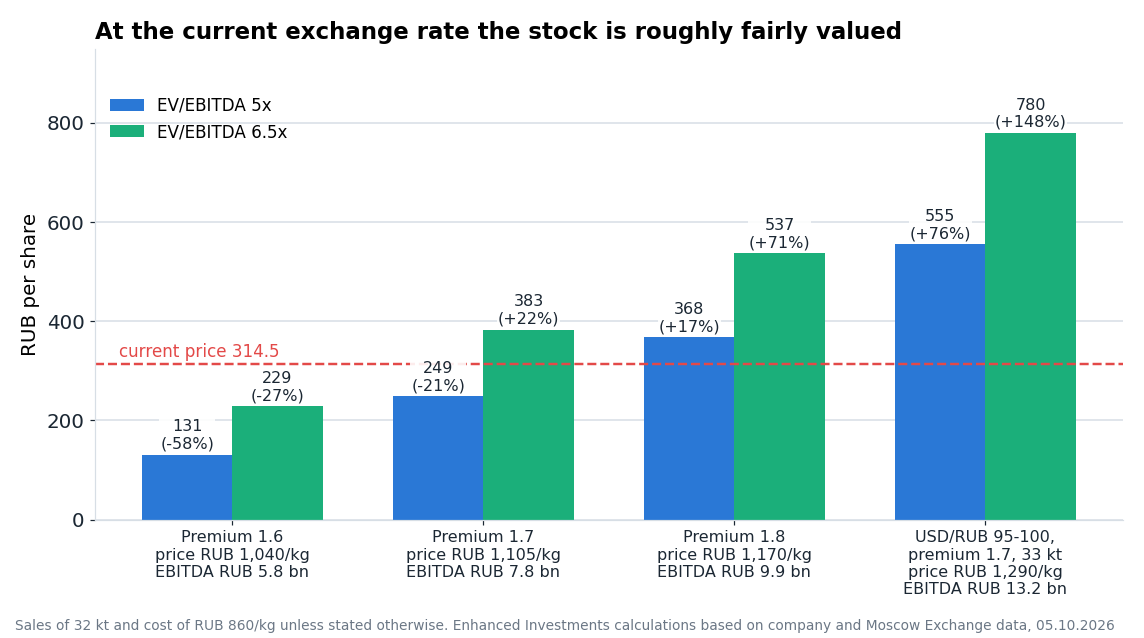
At the current exchange rate the stock is roughly fairly valued; upside appears with a weak ruble or expensive fish on the world market. If the company sells 32 thousand tonnes in 2027 and fish prices stay where they are, the fair value of the stock is RUB 250-380, from -21% to +22% versus the current price. With the dollar at RUB 95-100, it rises to RUB 555-780.
- 2027 sales could rise to 30-34 thousand tonnes; the 2023 record was 28.2 thousand tonnes.
- The company earns half as much per kilogram as it did in 2024.
- Fish prices in Russia follow the exchange rate, while the premium to the world price fluctuates.
- A strong El Niño could lift world salmon prices but would make feed more expensive.
- The 6.4% dividend is below the 14% key rate and is currently paid with borrowed money.
- The main risk is biological, and it has already materialised.
Inarctica covers the whole chain from smolt to chilled fish on the shelf
The company (called Russian Aquaculture until 2023) farms Atlantic salmon and sea trout in the Barents Sea off the coast of the Murmansk region and trout in the lakes of Karelia. It has 32 fish farming sites, five hatcheries in the Karelia, Kaluga, Nizhny Novgorod and Arkhangelsk regions, processing facilities and its own fleet. Some sites are always left fallow to reduce the risk of disease and parasites.
The cycle takes one and a half to two years. The smolt first grows in fresh water at a hatchery, in summer it is released into sea pens, and there the fish spends more than a year reaching market weight. It is then harvested, processed and shipped chilled to retail chains and restaurants across Russia. In 2025 revenue, salmon accounted for 66%, sea trout for 27%, lake trout for 2%, and the rest came from caviar and seaweed.
Imports account for a significant share of the market. According to the company, the Russian market for farmed salmon and sea trout was 138.5 thousand tonnes in 2025, and Inarctica, with sales of 22.2 thousand tonnes, holds about 16%. Most imports come from Turkey (trout) and Chile (salmon).
The long cycle has two consequences for the financial statements. Next year's sales are determined by biomass, that is, the live weight of fish in the pens. Under IFRS, fish in the water is revalued at market prices, so IFRS profit swings with prices. Operating performance is better tracked through adjusted EBITDA and profit before revaluation. As an agricultural producer, the company pays a zero rate of income tax, so almost all operating profit after interest goes to shareholders.
The company still imports part of its smolt from Norway, and already buys about 80% of its feed in Russia. In the Novgorod region it is building its own feed mill with a capacity of 70 thousand tonnes a year, which takes most of the 2026 capital expenditure. According to management, the period of high capex will end in late 2026, and the company plans to be fully self-sufficient in smolt and feed from 2028.
2027 sales could rise to 30-34 thousand tonnes
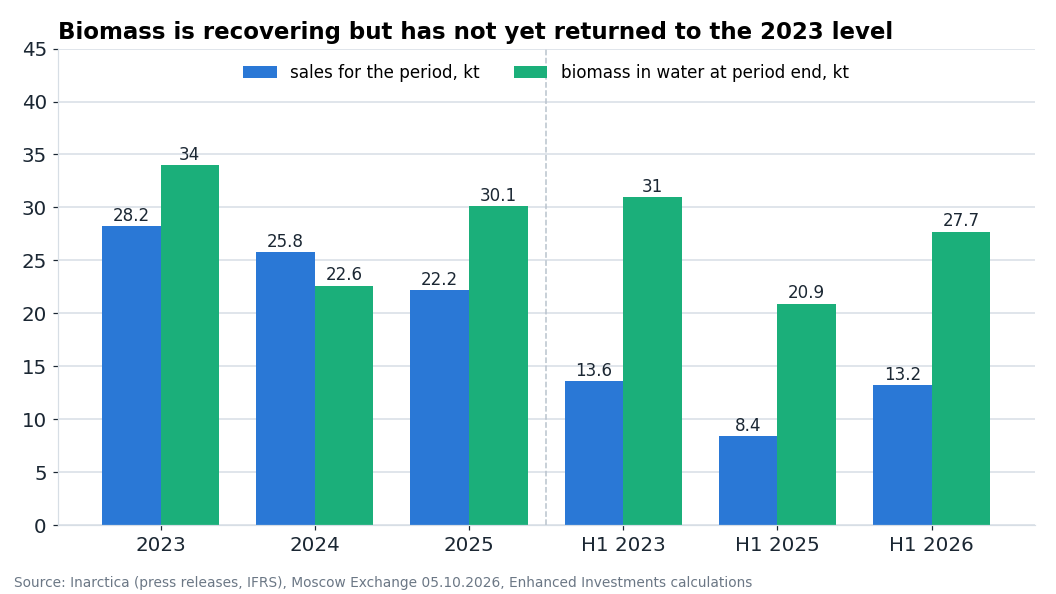
In 2023 the company sold a record 28.2 thousand tonnes. In 2024 part of the fish died, year-end biomass fell from 34 to 22.6 thousand tonnes, and in 2025 sales dropped to 22.2 thousand tonnes. In 2025 the company carried out record stocking, and biomass grew by 33% to 30.1 thousand tonnes. In the first half of 2026 this fed through to sales: 13.2 thousand tonnes versus 8.4 thousand tonnes a year earlier.
Biomass should be compared within the same season. It is at its lowest in summer: the large fish have already been harvested, and the juveniles have only just been released into the pens. Fish grow fastest from July to October, so biomass is noticeably higher by December. In 2025 it rose from 20.9 thousand tonnes at the end of June to 30.1 thousand tonnes at the end of December. At the end of June 2026 there were 27.7 thousand tonnes in the water, still below the 31 thousand tonnes of June 2023, but a third more than a year earlier.
If the second half repeats last year's growth, there will be 37-40 thousand tonnes in the water by the end of 2026. In that case the company could sell 30-34 thousand tonnes in 2027. Our base case assumes 32 thousand tonnes, with 28 thousand tonnes as the lower bound. The company's strategic target is 60 thousand tonnes a year, but the timing and cost of this programme have not been disclosed.
Revenue grew by 38%, but the company earns half as much per kilogram as in 2024
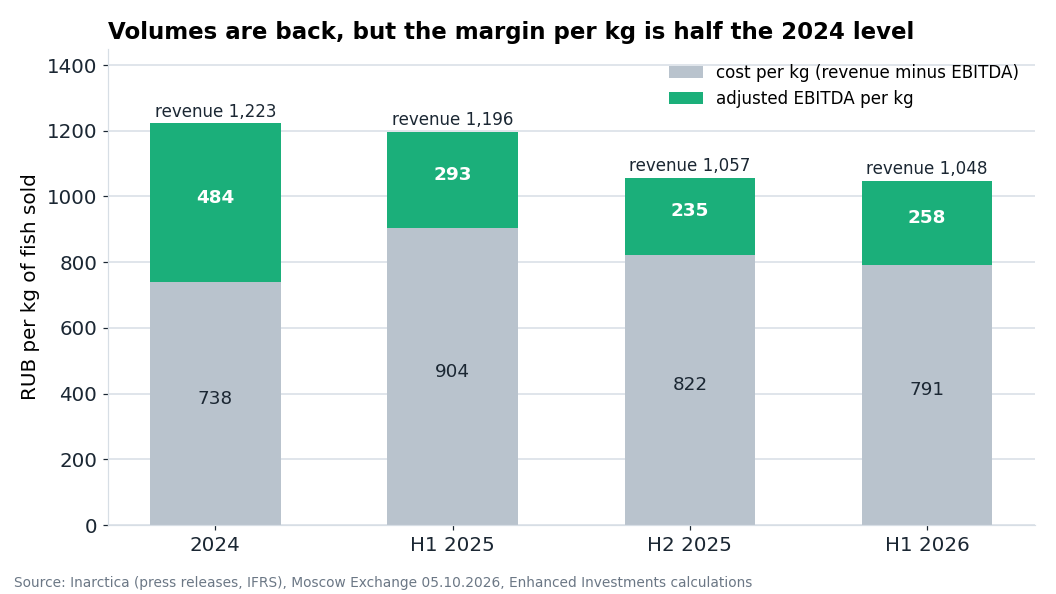
In the first half of 2026 revenue grew by 38% to RUB 13.8 bn, and adjusted EBITDA also rose by 38% to RUB 3.4 bn, a 25% margin. Adjusted net profit doubled to RUB 1.6 bn. Under IFRS the company reported a loss of RUB 0.4 bn due to the revaluation of cheaper fish in the water.
Per kilogram of fish sold, the picture is worse. In 2024 the company earned RUB 1,223 of revenue and RUB 484 of EBITDA per kilogram; in the first half of 2026, RUB 1,048 and RUB 258. The company itself cites an average salmon price of RUB 1,008/kg, 12% below 2025. With volumes back, cost per kilogram fell from RUB 904 in the first half of 2025 to RUB 791, because fixed costs are spread over more tonnes. But that is still far from RUB 738 in 2024. For 2027 we assume RUB 860: inflation will continue, and it is too early to factor in the effect of the company's own feed mill.
Fish prices in Russia follow the exchange rate, while the premium to the world price fluctuates
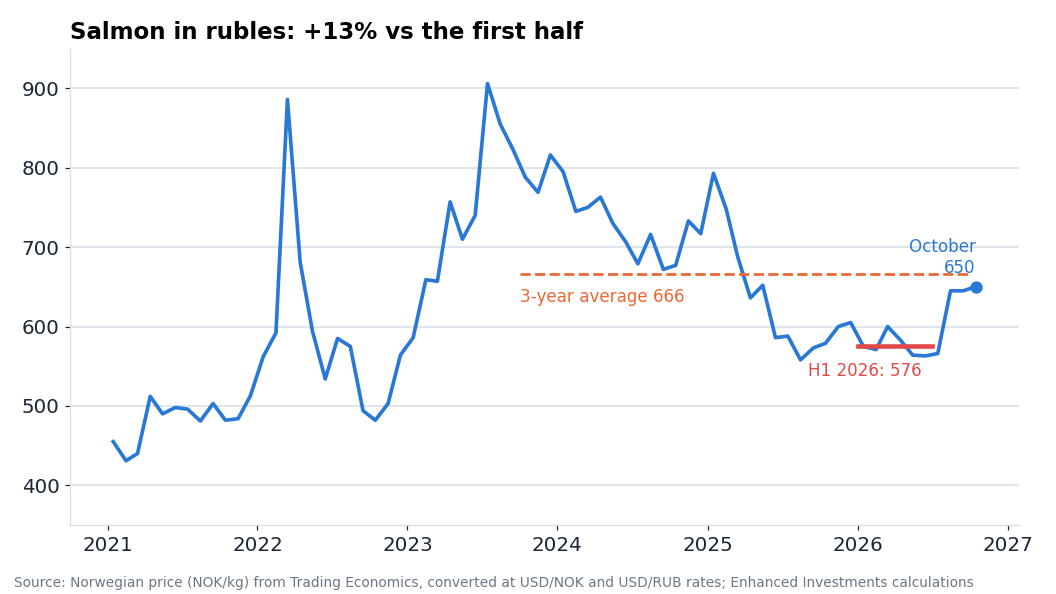
Imports are paid for in foreign currency, so domestic prices follow the exchange rate. The rating agency [NKR](https://ratings.ru/ratings/press-releases/Inarctica-080726/) explicitly links the 2025 price decline to competition from imports amid a strong ruble. In kroner, Norwegian salmon has cost NOK 71-75 per kilogram throughout the past year, and its ruble price is driven almost entirely by the exchange rate. Since June the dollar has risen from RUB 74 to RUB 84, and salmon in rubles has become 13% more expensive, from RUB 576 to RUB 650/kg.
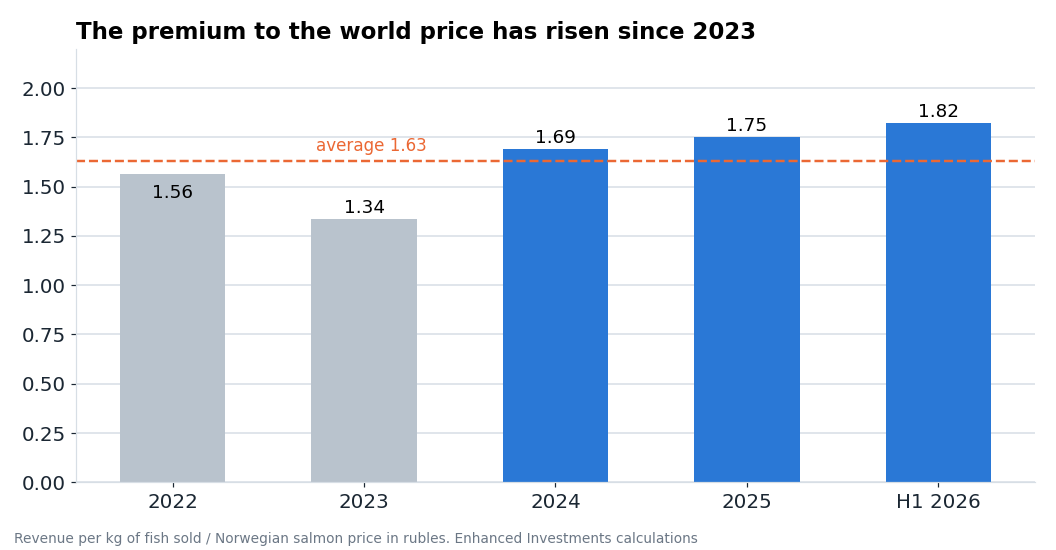
Inarctica sells fish above the Norwegian exchange price in rubles, but the premium varies. In 2023 revenue per kilogram exceeded the world price by a factor of 1.34, in 2025 by 1.75, and in the first half of 2026 by 1.82. The 2022-2026 average is 1.63. The current level is close to the maximum, so our base case uses 1.7. At a world price of RUB 650/kg this means RUB 1,105/kg for Inarctica.
A strong El Niño could lift world salmon prices but would make feed more expensive
El Niño is a warming of surface waters in the eastern Pacific that recurs every few years. According to a forecast by the US agency [NOAA](https://www.cpc.ncep.noaa.gov/products/analysis_monitoring/enso_advisory/ensodisc.shtml) dated 10 September 2026, there is a more than 90% probability that the current episode will be very strong. With a 75% probability, in October-December it will become stronger than any episode since 1950.
This matters for the salmon market because of Chile, the world's second-largest producer after Norway. Warm water off the Chilean coast leads to more frequent harmful algal blooms, which damage fish gills and reduce oxygen in the pens. In February-March 2016, after the previous strong El Niño, algae killed about 25 million fish in Chile, roughly 40 thousand tonnes. In the same year the average price of Norwegian salmon rose by 51.5%, although Norway's own problems also played a role. The bloom season falls in the southern summer, so any impact would come in early 2027. Even a very strong El Niño does not guarantee consequences in any particular region.
For Inarctica the effect cuts both ways. If world prices rise, imported fish in Russia will become more expensive, and the company will have room to raise prices. The flip side is feed. El Niño undermines the anchovy catch in Peru, which is used to make fishmeal and fish oil. According to [IFFO](https://www.iffo.com/amid-coastal-el-nino-fishmeal-and-fish-oil-output-remains-weak), in the first seven months of 2026 global fishmeal production fell by 49% and fish oil by 30%. These ingredients go into salmon feed, and the company's own feed mill does not protect it from their price.
Authors' estimate. Suppose the Norwegian price in kroner rises by 15% and half of the increase passes through to Inarctica's price. At 32 thousand tonnes, EBITDA would gain about RUB 2.6 bn. If the marine ingredients of feed become a third more expensive, costs would rise by about RUB 35/kg, minus RUB 1.1 bn. In total, about RUB 1.5 bn, or roughly RUB 85 per share at a 5x multiple. This is a scenario, not a forecast, and it is not included in our main estimate.
At the current exchange rate fair value is RUB 250-380; with the dollar at RUB 95-100 it is RUB 555-780
We calculate 2027 EBITDA simply: sales volume multiplied by the difference between price and cost per kilogram. Sales of 32 thousand tonnes, cost of RUB 860/kg. Net debt at the end of June was RUB 16.8 bn, or RUB 17.3 bn including leases. We value the company at two EV/EBITDA multiples: 5x, with a discount for biological risk and the 14% key rate, and 6.5x, closer to the company's history, which is the upper bound.
- Premium of 1.6, the five-year average. Price RUB 1,040/kg, EBITDA RUB 5.8 bn, the stock is worth RUB 131-229.
- Premium of 1.7, base case. Price RUB 1,105/kg, EBITDA RUB 7.8 bn, the stock is worth RUB 249-383, from -21% to +22% versus the current price.
- Premium of 1.8, as in the first half. Price RUB 1,170/kg, EBITDA RUB 9.9 bn, the stock is worth RUB 368-537.
- Dollar at RUB 95-100 by the end of 2027. This is the exchange rate we expect. At a premium of 1.7 the price would be about RUB 1,290/kg. We assume sales of 33 thousand tonnes and cost of RUB 890, because smolt and part of the feed are bought in foreign currency. EBITDA RUB 13.2 bn, the stock is worth RUB 555-780.
The current market capitalisation of RUB 27.6 bn at a 5x multiple corresponds to EBITDA of RUB 9 bn. At 32 thousand tonnes this requires a premium to the world price of about 1.76, almost the current level. The market already prices in the recovery of volumes and a sustained current premium, but not a weaker ruble. Sensitivity is high. Every 0.1 of premium changes EBITDA by RUB 2.1 bn, or about RUB 120 per share at 5x. With sales of 28 thousand tonnes instead of 32, the base-case valuation falls to RUB 193-311.
The 6.4% dividend is below the key rate and is currently paid with borrowed money
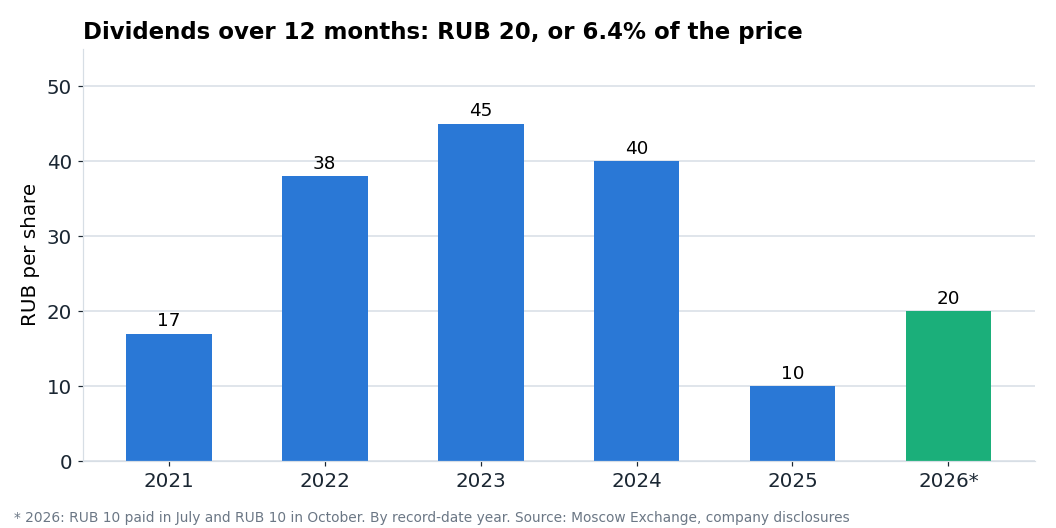
Over the past 12 months the company has paid RUB 20 per share: RUB 10 in July and RUB 10 for the first half of 2026, for which the last day to buy was 1 October. At a price of RUB 314.5 this is a 6.4% annual yield versus a 14% key rate. Under its dividend policy, Inarctica pays if it has profit under Russian accounting standards (RAS) and net debt does not exceed 3.5x annual EBITDA. Debt is currently 2.5x EBITDA, so there is headroom.
The business is not yet earning the cash for these payouts. Free cash flow for the first half was negative at minus RUB 2.6 bn. The money goes into growing fish that will be sold later and into the feed mill. Net debt rose from RUB 13.8 bn to RUB 16.8 bn over six months, and in June the company placed RUB 3 bn of bonds. In the base case 2027 profit will be about RUB 3.7 bn, and with a payout ratio of 35-50% the dividend would be RUB 15-21, or 5-7% of the price. The stock is not worth buying for the dividend.
The main risk is biological, and it has already materialised
Fish in the open sea depend on water temperature, disease and parasites. In 2024 this cost the company about a third of its biomass; in 2015 it lost 4.3 thousand tonnes. For protection the company has four wellboats for delousing fish (the fourth was bought in 2025), its farms are spread along the coast, and the fish is insured.
Credit quality is nonetheless high. In July 2026 NKR affirmed the A+.ru rating with a positive outlook. The second risk relates to the revaluation of fish in the water. It makes IFRS profit very volatile: when prices fall the company reports a loss even if it sells fish at a profit.
The stock is a third of the SPO price, but it is not cheap on current EBITDA
Market capitalisation is RUB 27.6 bn against equity of RUB 38.3 bn, or 0.72x book value. Including debt, the company is valued at RUB 45 bn, or 6.8x LTM adjusted EBITDA (RUB 6.6 bn). For a company with biological risk and debt, this is not cheap. The stock becomes cheap only if EBITDA rises to at least RUB 9-10 bn.
Inarctica is a bet on a weak ruble and expensive fish, with biological risk
The production recovery is already in the price, as is the current high premium to the world price. Further upside for the stock depends on the price of fish in rubles. At the current RUB 84 per dollar the stock is roughly fairly valued. We expect the exchange rate at about RUB 90 by the end of 2026 and RUB 95-100 by the end of 2027, and in that scenario the upside is 75-150%. El Niño offers an additional chance if it hits Chilean salmon. If the ruble strengthens again to RUB 75-77, as in the first half, or the premium reverts to the average, the stock is more likely to fall.
What to track next:
- year-end 2026 biomass, which determines 2027 sales;
- the realised price for the second half and the ruble exchange rate;
- algal blooms in Chile in January-March 2027 and fishmeal prices;
- reports of fish mortality and the revaluation of biological assets;
- free cash flow: without it, dividends rest on debt.
Financial statements, multiples and the company's dividend history are available on the Inarctica card on the Enhanced Investments portal.
Artificial intelligence was used in preparing this material. We have checked the information, but inaccuracies and errors are still possible. If you find one, please write to us at Enhanced Investments and we will promptly correct it.
Prepared by Enhanced Investments based on Inarctica's press releases and IFRS statements, the NKR press release of 8 July 2026, NOAA, IFFO, the Moscow Exchange and Trading Economics. Prices as of 5 October 2026. This is not an individual investment recommendation.
Open the company's financial profile AQUA →
See also: market overview · valuation map · stock screeners