ASV is placing RUB 600 mn at 24%: the collector is growing, but interest eats the profit
The new BO-06 issue, with a coupon indication of 24% a year, looks interesting. With monthly payments the effective yield is about 26.8%. That is 0.4-0.7 pp above ASV's bonds already trading with 1.5-2 years to maturity. For comparison, ID Collect, rated one notch higher, trades at 22.5-23.5%, and Intel Collect, rated two notches lower, at 25%. The premium to the issuer's own curve is small, but it is there. If the coupon is cut to 23% after the book is built, the premium disappears, and it makes more sense to buy the older issues on the exchange.
ASV's business is growing and it services its debt without disruption. Revenue grew 2.3x in three years, and the first bond issue was redeemed on time in August 2026.
ASV's weak spot is its debt load. Over the last 12 months operating profit covered interest about 1.5-1.6x, and equity is 17% of assets (assets are 5.8x equity).
The accounts are audited by a top-five auditor. The 2025 accounts were audited by FinExpertiza. In the Expert RA ranking it is the fourth-largest auditor in Russia by revenue, and it also audits the Bank of Russia.
Dealings with the owner look negative, but they are moderate in scale. The parent company received an interest-free loan of RUB 109.5 mn, and the beneficiary owns an IT contractor of the company.
We like the collection sector as a whole. Debts are bought at 7-18% of face value, the market is consolidating, and, according to Expert RA, professional collectors have had no defaults on public debt.
What is happening: the order book opens on September 25
ASV Debt Collection Agency LLC (ASV) is a collector from St. Petersburg that has operated since 2015. It buys overdue debts from banks and microfinance companies and collects them, mainly through the courts, notaries' electronic writs of execution and bailiffs. At the end of 2025 the company owned debts with a face value of RUB 28.5 bn. The largest seller accounts for about a quarter of the portfolio, and the company works in all federal districts. The company is owned and managed by Maxim Bogomolov (99% through ASV.Upravlenie LLC).
On September 25 at 11:00 Moscow time the order book opens for the BO-06-001R issue of RUB 600 mn. The issue is included in level 3 of the Moscow Exchange listing and, like the previous ones, is intended for qualified investors. According to media reports, the maturity is three years. The preliminary indication puts the coupon at 24% a year. The issuer will disclose the official guidance and the final rate after the book closes.
NRA affirmed the credit rating at BB+|ru| with a stable outlook on May 7, 2026. This is the top of the high-yield bond zone.
Collectors are among the few high-yield sectors where the business works against the cycle
A collector buys debt that a bank or microfinance company has already written off as bad and pays a small fraction of face value for it. According to Expert RA, in 2025 bank debts were sold on average for 7% of the principal and microfinance debts for 18%. If even a third of the debt is collected, the deal pays back many times over.
This kind of business has two features that help a creditor. The first is called countercyclicality. When the economy slows, there are more delinquencies, portfolios get cheaper, and collectors have more work. The second is that the portfolio turns into cash on its own. If the company stops buying new portfolios, the cash from those already bought goes to repay debt. ASV's annual revenue, more than 90% of which, according to NRA, is collections on purchased debts, is RUB 2.8 bn. That is comparable to the company's entire debt of RUB 3.4 bn.
The market is consolidating quickly. According to Expert RA, the six largest players bought more than 80% of portfolios in 2025 and accounted for about 88% of investment. By 2027-2028 their share may exceed 90%. ASV is not in this group, but its portfolio is noticeably larger than that of most regional collectors.
The main industry risk is regulation. In 2024-2025 court fees rose 10-15 times, and replacing a claimant in a case now costs RUB 15 thousand. For collectors that work through the courts this directly raises costs. ASV responds by shifting part of its collection to notaries' electronic writs of execution and notifications through Gosuslugi. According to NRA, the share of electronic document flow rose from 18% to 30% in 2025.
Revenue grew 2.3x in three years, and growth slowed in 2026
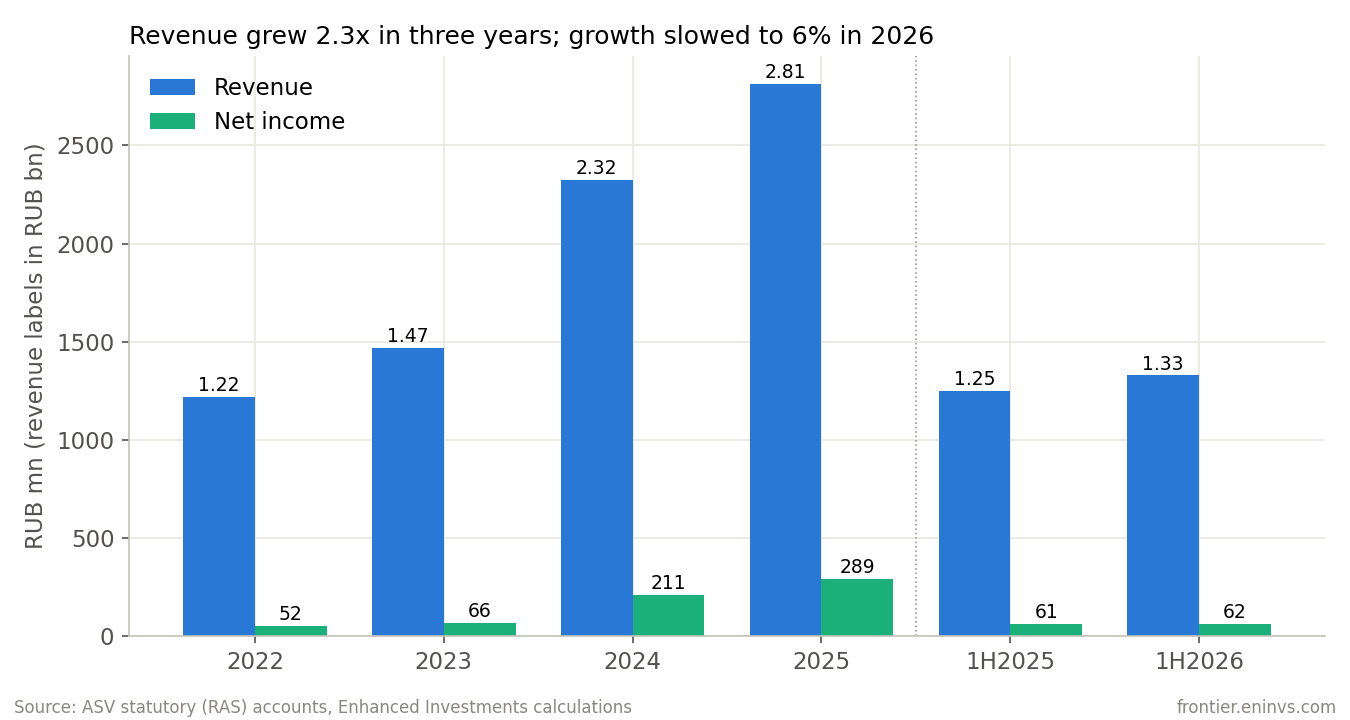
In 2025 the company earned revenue of RUB 2.81 bn (+21%) and net income of RUB 289 mn (+37%). No dividends were paid, all the profit stayed in equity, and equity grew 68% to RUB 718 mn. NRA estimates the return on equity at about 40%.
The picture is calmer in 1H2026. Revenue rose 6% to RUB 1.33 bn and operating profit rose 40% to RUB 486 mn. Net income barely changed (RUB 62 mn against RUB 61 mn a year earlier), because the growth in operating profit was eaten by interest.
ASV's profit is heavily concentrated in the fourth quarter. In 2025 it accounted for 53% of full-year pre-tax profit. The first half therefore understates the annual result, but extrapolating the half-year is also not an option. The issuer should disclose the reason for this seasonality separately.
Interest is growing faster than profit, and the 12-month cover is about 1.5-1.6x
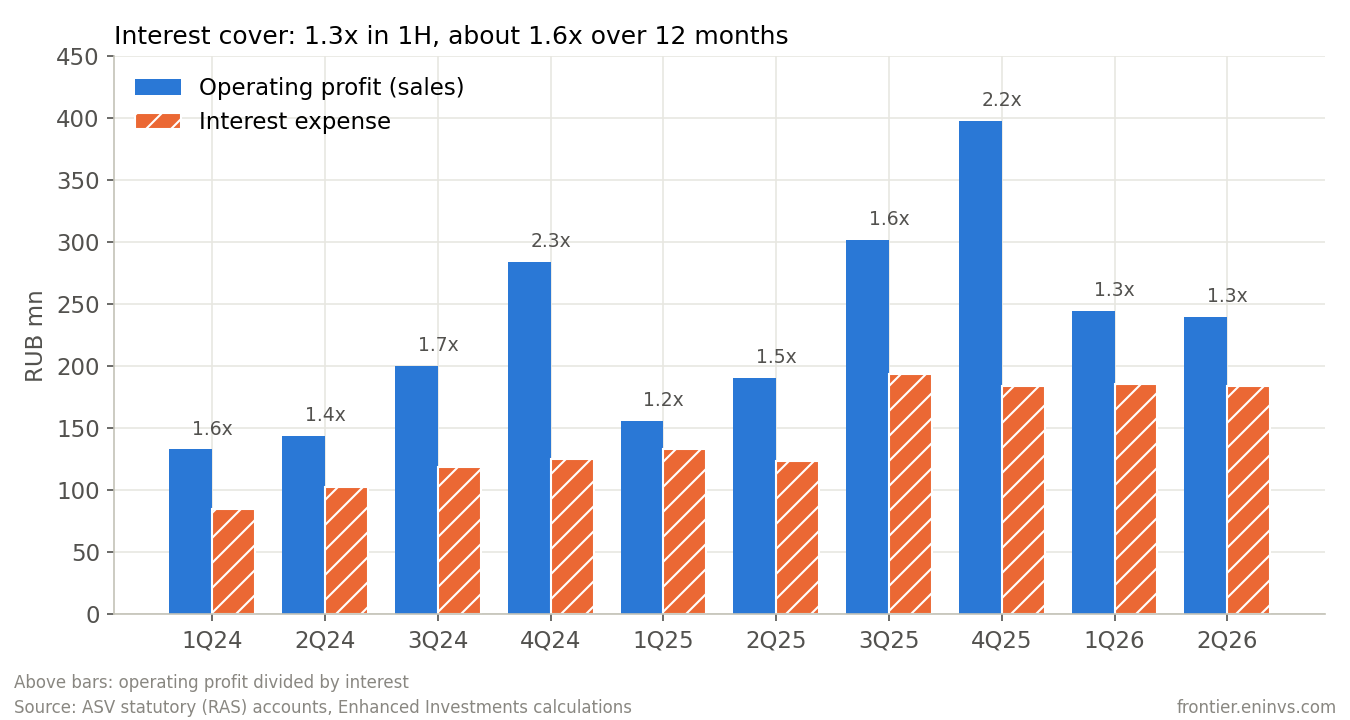
For a creditor the key metric here is interest cover, that is, how many times operating profit exceeds interest payments. For ASV it was 1.65x in 2025 and 1.31x in 1H2026. The half-year figure understates the picture because of seasonality, so it is more correct to look at the last 12 months (3Q2025-2Q2026). On our RAS-based calculation cover for that period is 1.59x (operating profit of RUB 1.19 bn against interest of RUB 0.75 bn), and 1.52-1.55x on the issuer's estimate. Interest expense rose 44% year on year to RUB 370 mn for the half-year.
The company is actively buying new portfolios with borrowed money. According to NRA, investment in claims rose from RUB 1.0 bn to RUB 1.5 bn in 2025. Negative operating cash flow is not in itself an alarming signal for a collector: portfolio purchases are recorded as an operating expense, which is the equivalent of loan issuance at a bank. But with cover of about 1.5x the safety margin is thin. If collections on new portfolios fall short of plan, profit may fail to cover interest.
Debt is about 2.9x annual operating profit (last 12 months). NRA states that the rating may be downgraded if net debt exceeds 4x annual EBIT. There is headroom to that threshold, but with the new issue it will shrink.
Debt of RUB 3.4 bn, more than half of it short-term
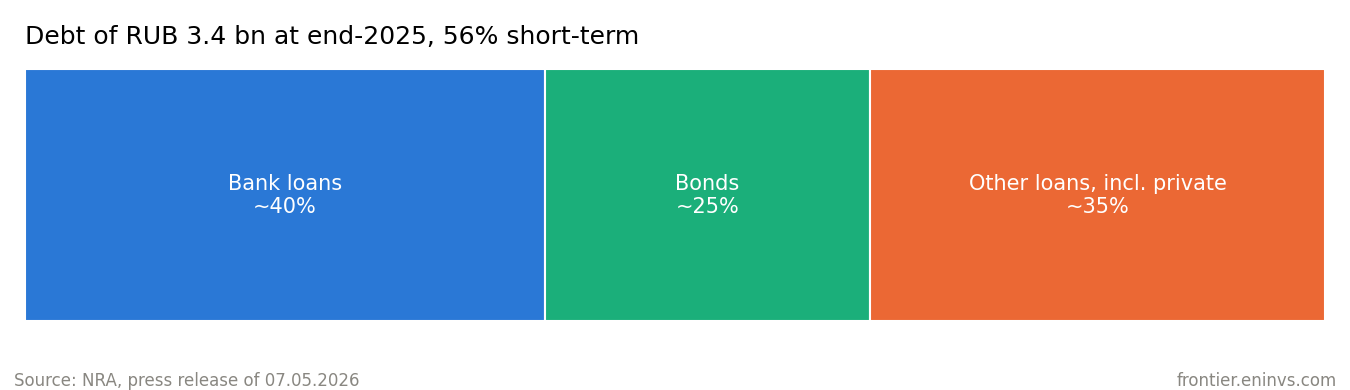
At the end of 2025 debt was RUB 3.4 bn. About 40% is bank loans, about 25% bonds, and the rest other loans, including from private individuals. 56% of the debt must be repaid or refinanced within a year.
The least transparent part of the debt is loans from private individuals. It is unclear who the creditors are, for what term and at what rate they lend, and whether they are related to the owner. NRA explicitly points to the refinancing risk of these loans.
On June 30, 2026 equity was RUB 781 mn against assets of RUB 4.52 bn, that is 17%. In other words, assets are 5.8x equity. 92% of assets are current, mainly purchased portfolios. Their book value depends on the estimate of future collections. If the portfolio on the balance sheet is overvalued by 15-20%, that is enough to wipe out equity.
Bonds outstanding total RUB 1.1 bn, and the payments on them are manageable
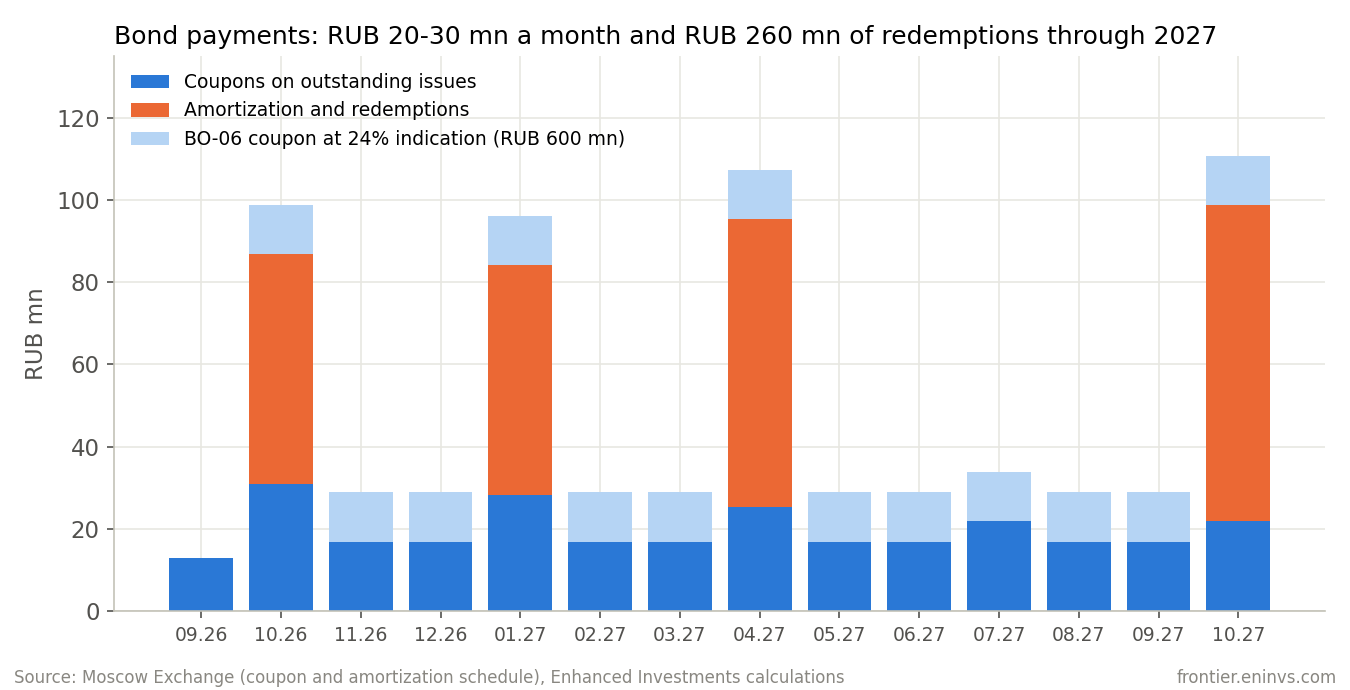
Four issues with a combined face value of about RUB 1.1 bn are currently outstanding: 1R02 (RUB 182 mn, amortizing until April 2027), 1R03 (RUB 77 mn, maturing in October 2027), 1R04 (RUB 200 mn, until November 2028) and 1R05 (RUB 650 mn, until June 2029). The first issue, BO-01 of RUB 200 mn, was redeemed on August 14, 2026.
Coupons on outstanding issues are RUB 17-31 mn a month, and redemptions through the end of 2027 are about RUB 260 mn. With BO-06 the bond debt will rise to about RUB 1.7 bn (+55%), and coupon payments by another RUB 12 mn a month. Against quarterly operating profit of RUB 240 mn these amounts are manageable. The main burden lies in bank loans and private loans, not in bonds.
An interest-free loan to the owner looks negative, although the amount is small
The parent company ASV.Upravlenie LLC received an interest-free loan of RUB 109.5 mn. It has been on the balance sheet since at least 2024. ASV itself borrows at an average of about 20-23% a year (calculated as interest to debt). This means the company forgoes RUB 20-25 mn a year on this loan, or 7-9% of 2025 net income. Money has been moved out from under the bonds to the owner, and this is unfavourable for bondholders.
The beneficiary also owns Ligres JSC, which provides IT services to ASV. In addition, the business in Kazakhstan is run through the parent company, that is, outside the issuer's perimeter, and in Kyrgyzstan ASV has a subsidiary with a 75% stake. The volumes of these operations are not disclosed. The company has no IFRS reporting and no board of directors. NRA names their introduction as a condition for an upgrade.
No problems are visible with taxes and courts
According to open FTS data as of August 25, 2026, ASV has an arrear of RUB 2,700 in state duty. There are no arrears in taxes and contributions. According to the Checko aggregator, the company is a defendant in 12 arbitration cases totalling RUB 1.2 mn and has 5 enforcement proceedings totalling RUB 22.7 thousand. For a collector with millions of debtors this is a background level. Of 46 inspections, violations were found in two. No information on major FSSP fines or exclusion from the register was found, but we could not check the FSSP database directly.
The accounts are audited by the country's fourth-largest auditor
ASV's 2025 accounting statements were audited by FinExpertiza LLC (INN 7708096662). In the Expert RA ranking of audit firms for 2025 it is fourth by revenue (RUB 955 mn) after Kept, FBK and Unicon. FinExpertiza has audited the Bank of Russia since 2017. For a high-yield issuer with issues of a few hundred million rubles this is noticeably stronger than average. A strong auditor does not remove questions about portfolio valuation, but it makes the RAS figures more reliable.
Among six collectors with bonds, ASV offers the second-highest yield
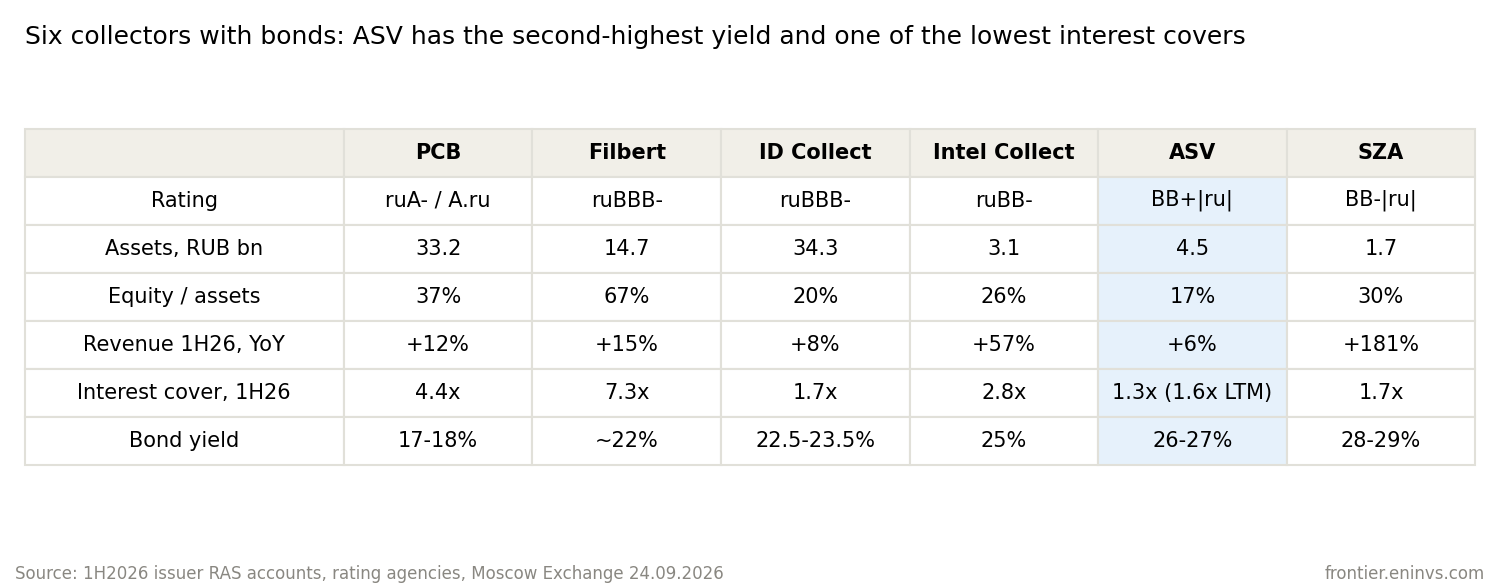
The bonds of five other professional collectors trade on the Moscow Exchange, and they set the frame for valuing ASV.
PCB is the largest player in the market, rated ruA- by Expert RA and A.ru by NKR. It has RUB 33.2 bn of assets, equity of 37% of assets, and operating profit covers interest 4.4x. Its fixed-coupon bonds yield 17-18%.
Filbert (rated ruBBB-) hardly uses debt: equity is 67% of assets and interest cover is 7.3x. On the exchange it has one issue of RUB 500 mn with a yield of about 22% to the offer.
ID Collect (ruBBB-, one notch above ASV) is closest to ASV in balance sheet structure: equity is 20% of assets and interest cover is 1.7x. But the company is seven times larger, has almost RUB 8 bn of bonds outstanding, and most of its issues are available to non-qualified investors. The yield is 22.5-23.5%.
Intel Collect (ruBB-, two notches below ASV) is comparable to ASV in size (assets of RUB 3.1 bn), is growing fast and covers interest better (2.8x). Its bonds trade at 25%.
SZA (Asset Protection Service, BB-|ru| from NRA) is the smallest (assets of RUB 1.7 bn) and offers the highest yield, 27.7-29.0%.
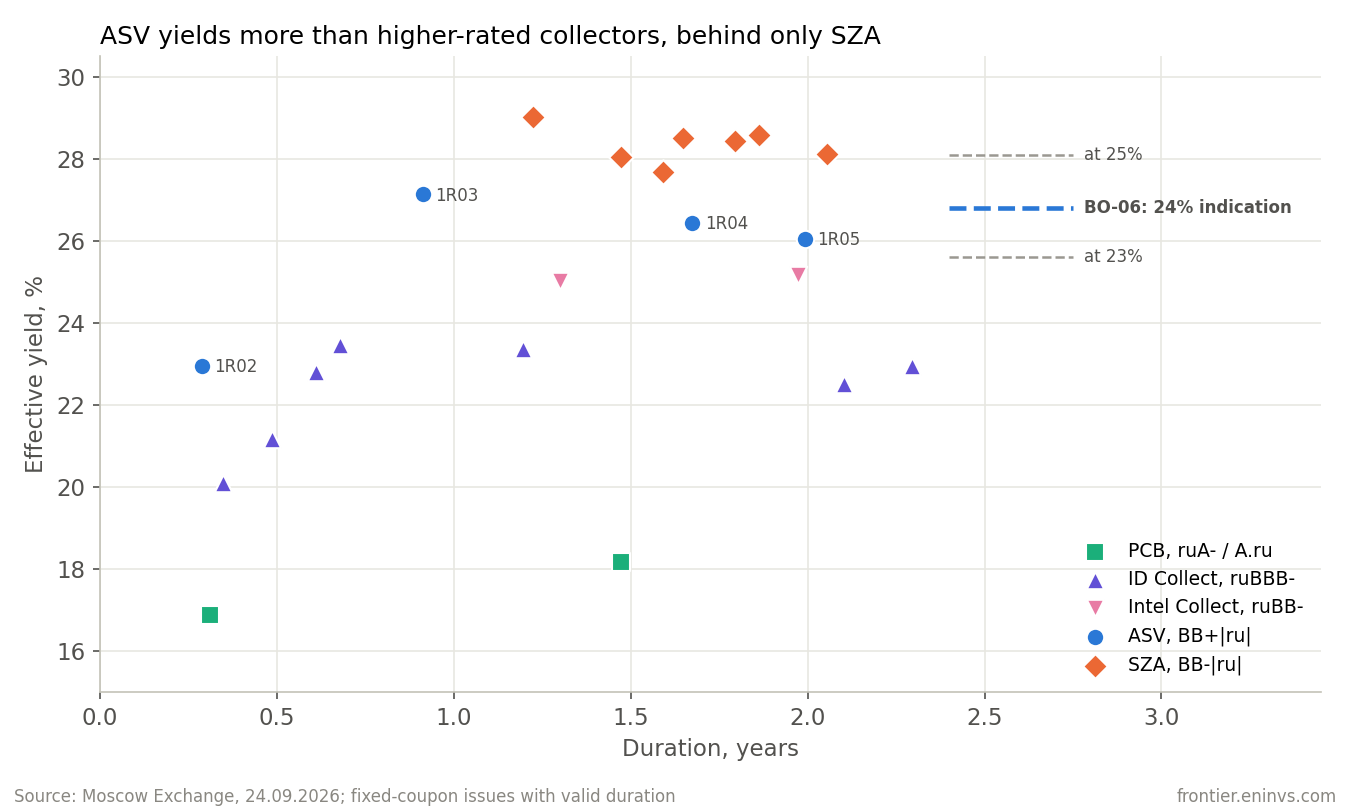
ASV's curve sits at 26-27% for 1-2 years. That is above all collectors with a higher rating and above Intel Collect with a lower one. Only SZA yields more than ASV. Ratings from different agencies are only roughly comparable, but the picture is still clear. The market demands a premium from ASV for one of the lowest interest covers in the group and the thinnest equity. For a buyer who accepts this risk, ASV offers one of the highest yields among collectors rated BB or above.
This gives the valuation of BO-06. The 24% indication with monthly payments gives an effective yield of 26.8%. That is 0.7 pp above the latest issue 1R05 (26.1%) and 0.4 pp above 1R04 (26.4%). It is 1-2 pp short of SZA's level (27.7-29.0%), and the rating explains this gap. If the final coupon is cut to 23%, the effective yield will be 25.6%. That is below the issuer's own curve and almost at Intel Collect's level, and in that case it is better to buy the older issues on the secondary market.
Summary: at a 24% coupon the issue offers a moderate premium to the curve of a normal BB+ collector
ASV is a growing collector that has operated since 2015 and has serviced its bonds without disruption since 2023. Its accounts are audited by a top-five auditor, and by yield ASV's bonds stand above those of higher-rated collectors. In numbers: revenue of RUB 2.8 bn, profit of RUB 289 mn, and the first issue redeemed on time. According to the rating agencies, the industry has so far seen no defaults on public debt, and the market for distressed debt continues to grow.
At the same time, ASV has thin equity and low interest cover, and related parties receive interest-free money. The new issue therefore makes sense only with a premium to the bonds already trading. The 24% monthly indication provides such a premium, although a small one. A coupon cut after the book is built would consume it. What to track next: interest cover for 2026, repayment of the parent company's loan, disclosure of the structure of private loans, and the appearance of IFRS reporting.
Quarterly reporting, ratings, issues and payment calendars for all six collectors are collected on their issuer cards on Frontier.
Sources: RAS accounts of ASV Debt Collection Agency LLC (GIR BO, e-disclosure), NRA press releases of 16.05.2025 and 07.05.2026, Moscow Exchange data as of 24.09.2026, FTS open data, Checko, Expert RA study and audit ranking for 2025, audit-it.ru (auditor information), Kommersant on the secondary debt market, Cbonds.
See also: market overview · valuation map · stock screeners