A $50 oil price in the budget rule: more FX purchases, a weaker rouble and a slower pace of rate cuts
On 24 September the Ministry of Finance submitted the 2027-2029 budget and amendments to the Tax Code to the government ([Ministry of Finance press release](https://minfin.gov.ru/ru/press-center/?id_4=40635-minfin_rossii_vnes_v_pravitelstvo_rf_byudzhetnyi_paket)). Besides taxes, the package contains a new oil cutoff price: $50 per barrel for 2027-2029 instead of $58, $57 and $56 under current law. Below we look at what this means for FX purchases, the rouble, inflation and the key rate. The text of the bill is not yet available, so the amounts are our estimates with ranges, and the assumptions are stated next to the figures.
A $50 cutoff price will add about RUB 60 bn of FX purchases per month at any oil price, or RUB 0.7-0.8 tn a year. This is a factor for a weaker rouble by several roubles. Together with higher taxes, it accelerates prices over the next year and makes the Bank of Russia more cautious about cutting the rate.
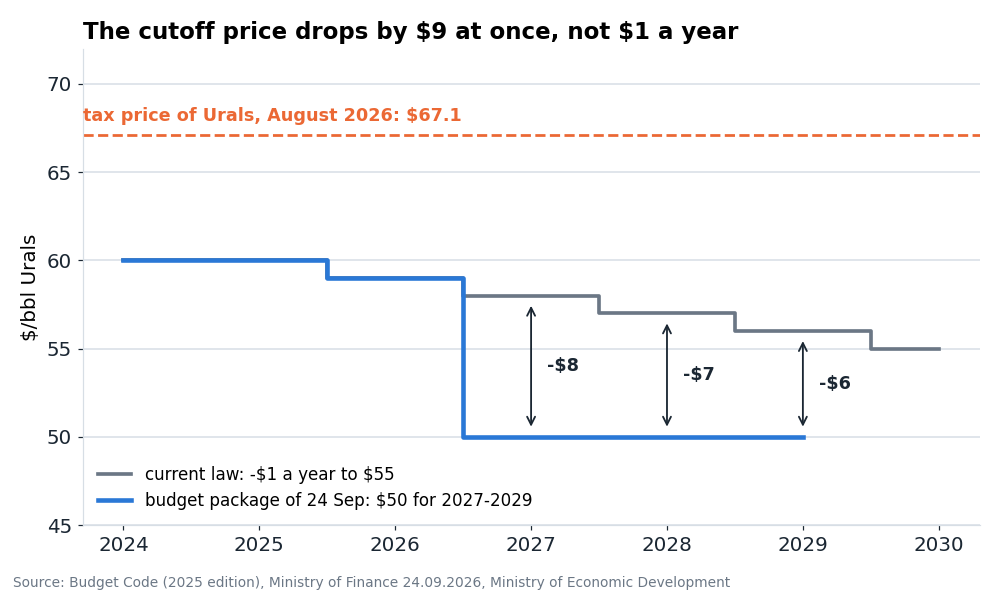
- The cutoff falls in one step of $8-9, not by $1 a year. Oil companies' taxes do not change as a result; what changes is how much oil and gas revenue the budget spends and how much it sets aside in the National Wealth Fund (NWF).
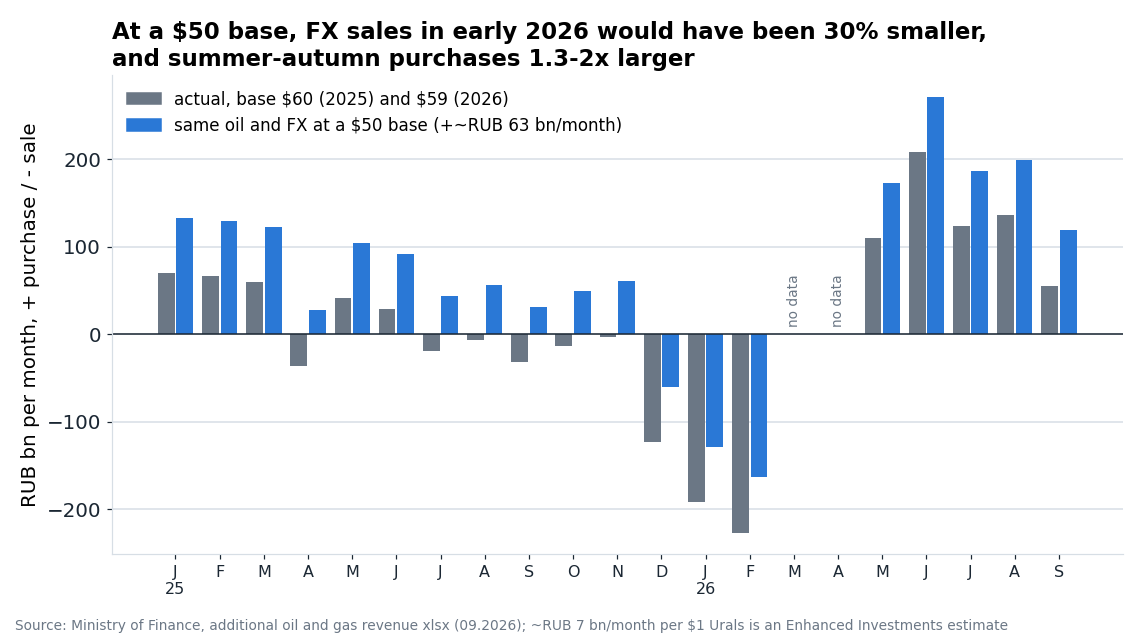
- At 2026 prices, FX purchases under the rule would have been 1.3-2x higher. Sales in low-price months would have been 30% smaller.
- Higher taxes and a weaker rouble accelerate prices in 1H2027. Rate cuts will most likely continue, but more slowly.
- The tax package will give the budget RUB 0.57-0.77 tn in 2027, but will not close the deficit of about 2% of GDP. It is still financed by OFZ issuance.
The cutoff price falls to $50 at once, not by $1 a year until 2030
The budget rule splits oil and gas revenue into two parts. Everything the budget receives at a Urals price up to the cutoff goes to spending. Everything above it is directed by the Ministry of Finance to buying FX and gold for the NWF. If oil is below the cutoff, the Ministry sells FX instead and covers the shortfall. Under the current Budget Code the cutoff falls by $1 a year, from $59 in 2026 to $55 by 2030. The package sets [$50 for all three years](https://www.interfax.ru/business/1117514). The Ministry's logic is that at such a base, oil price swings have the least effect on the balance of the budget.
A $50 cutoff price will add about RUB 60 bn of FX purchases per month and puts pressure on the rouble
The budget rule splits oil and gas revenue into two parts. Everything the budget receives at a Urals price up to the cutoff goes to spending; everything above it goes to FX purchases for the NWF. Under the law, the 2027 cutoff would be $58. The package sets [$50 for all three years](https://www.interfax.ru/business/1117514). At the same oil price, the Ministry of Finance will buy about RUB 60 bn more FX per month, which is RUB 0.7-0.8 tn a year, or about RUB 3 bn per trading day.
The official rate on 24 September is RUB 84.40 per dollar, against an average of 72.8 in May. The new base pushes the rouble toward weakening. Third-party analysts estimate the effect at several roubles on the 2027 average rate; we expect noticeably more weakening. The counterweights are high rouble rates against a large deficit and FX sales by the Bank of Russia, whose parameters for 2027 have not yet been announced. For the FX part of a portfolio and for FX-replacement bonds this is an additional argument. A weaker rouble tends to help oil companies: their taxes do not change, while their rouble revenue rises.
History shows that purchase volumes themselves have little effect on the rouble, while sharp policy reversals matter more
Ministry of Finance and Bank of Russia FX operations since 2018 offer a good test. In 2019 the state bought RUB 3.6 tn of FX, and the rouble strengthened over the year from 66.5 to 61.9 per dollar. In 2024 it sold RUB 1.7 tn of FX, and the dollar still rose from 89 to 102. In 2025, sales of RUB 2.3 tn coincided with a rouble rally from 100 to 78. The volumes themselves are swamped by the trade balance, sanctions and the Bank of Russia's rate.
Sharp reversals had a stronger effect. After four of the five pauses in purchases, the rouble strengthened within two to three months: by 2% in 2018, 10% in 2020, 7% in 2023 and 19% in late 2024. The exception is January 2022, when everything was overridden by the events of February. The closest precedent to the current decision is the launch of the rule with a low $40 base in 2018. The state then bought RUB 2.3 tn of FX over the year, and the dollar rose from 56 to 69, although the April sanctions also played a part.
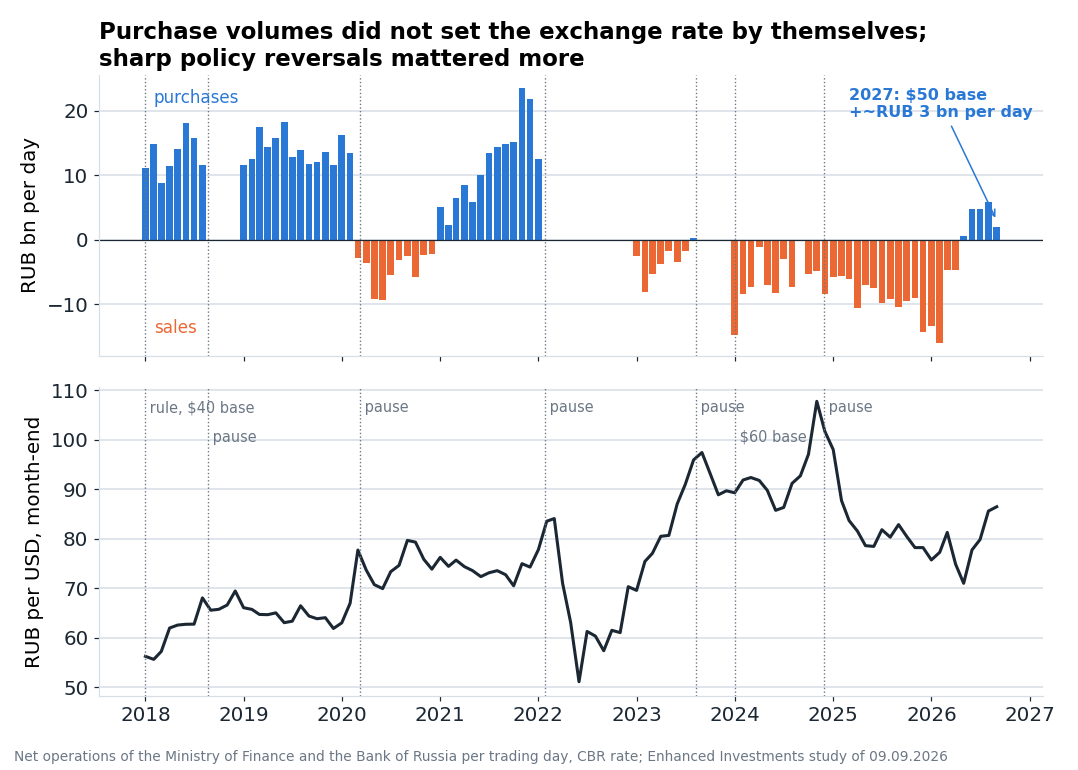
What this means for 2027. Simple statistical estimates link an additional RUB 3 bn of purchases per day to only a few percent of annual rouble weakening, and the relationship is weak. But that is the effect of the purchases alone. We expect the rouble to weaken noticeably more: FX purchases will be joined by a cut in the key rate, which makes rouble assets less attractive. The benchmark is the launch of the rule with a low $40 base in 2018, when the dollar rose by almost a quarter over the year. The current decision differs from 2018 in that it was announced in advance and takes effect only in January, so the market may price part of the effect into the rate as early as this autumn. If the rouble starts to weaken too sharply, the regulator has a proven tool: a pause in purchases. Over eight years it has been used five times.
Higher taxes accelerate prices over the next year and push back rate cuts
On 11 September the Bank of Russia held the key rate at 14%, with annual inflation of 6.3% and a forecast of a return to 4% in 2027 ([Bank of Russia](https://www.cbr.ru/press/keypr/)). The regulator states directly that pro-inflationary risks prevail. The tax package adds several new ones.
- Part of the taxes passes straight into prices. The Ministry of Finance itself estimated the VAT increase to 22% in 2026 at 0.6-0.7 pp of inflation. In 2027 it will be joined by VAT on foreign purchases and the parcel fee, which immediately make imports more expensive.
- The $50 base weakens the rouble, and a weaker rouble means more expensive imports. The additional RUB 0.7-0.8 tn of FX purchases a year weigh on the rate, and through imports this reaches prices.
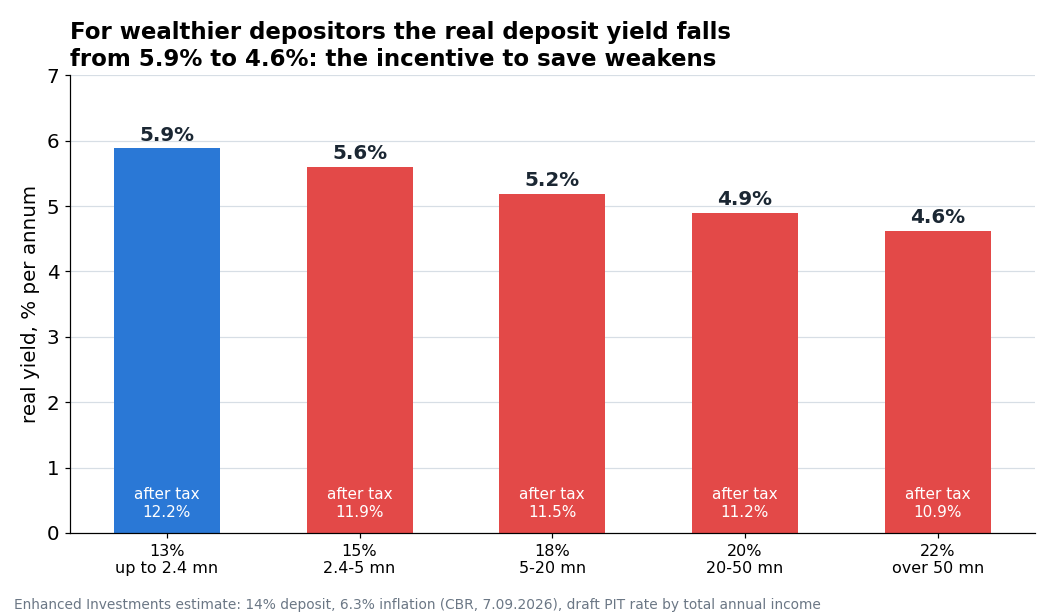
- A tax on interest weakens the incentive to save. The Bank of Russia's logic rests on the idea that a high rate makes people keep money on deposits rather than spend it. After the reform, a 14% deposit for a depositor earning more than RUB 50 mn a year yields 10.9% after tax instead of 12.2%, and the real yield falls from 5.9% to 4.6%. To preserve the same incentive to save, the Bank of Russia will have to keep the nominal rate higher.
- Household and business expectations. The Bank of Russia looks through one-off price jumps from taxes only if inflation expectations are calm. Each new tax increase pushes those expectations up.
There is also an offsetting effect. The $50 base means less oil money goes into budget spending, and a tighter budget, in the Bank of Russia's logic, helps bring inflation down. But this is an effect on a horizon of several years, whereas more expensive imports and the tax amendments will show up in prices in the first months of 2027. In our estimate, this makes the Bank of Russia more cautious specifically in 1H2027. Rate cuts will most likely continue, but more slowly than the market prices in without the package. For bets on a rapid rate cut, such as long OFZs and highly indebted equities, this is an argument against haste. The package is more likely to benefit floaters.
Seven measures will give the budget RUB 0.57-0.77 tn in 2027, and the miners' tax is temporary
What the Ministry of Finance proposes, point by point:
- Personal income tax (PIT). Dividends, deposit interest, income from securities and digital rights, and from the sale of property, insurance and gifts will be taxed together with salary on a 13-15-18-20-22% scale. At present they have a separate base with rates of 13% and 15%. The tax-free threshold for small deposits is retained, and the changes do not affect income of participants in the special military operation. According to the Ministry of Finance, about 4 mn people are affected.
- Mutual funds. The fund pays 15% profit tax on passive income, and this tax is credited to the unit holder.
- Type-C accounts. Tax on dividends to non-residents on type-C accounts is 35% instead of 15%.
- Foreign online purchases. 22% VAT, paid by marketplaces as tax agents. Plus a customs fee of RUB 100 per parcel up to EUR 200.
- Mining and metals sector. A separate law "On the windfall profit tax": 30% (20% for gold) of the increase in world prices in roubles relative to 2025, if the increase is at least 10%. Subsoil users pay three times, in 2027-2029. Metal ores, apatite, phosphorites, potash salts and precious metals are covered; coal and nitrogen fertilisers are not.
Some retellings give 2024 as the base year for miners and place the sharp price rise in 2025. On the Ministry of Finance website and in the [Interfax report](https://www.interfax.ru/business/1118178) the base is 2025 and the rise is 2026. The calculations below are made using the text of the draft law "On the windfall profit tax" in the 23 September version.
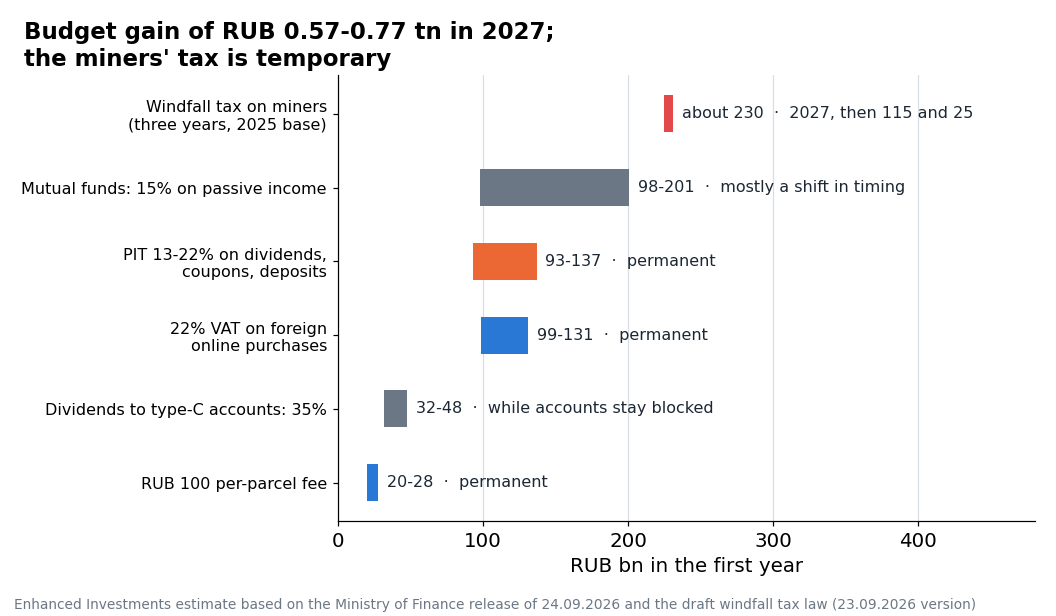
Year after year, the permanent contributors will be PIT, VAT on foreign purchases, the parcel fee and the tax on type-C accounts: RUB 245-345 bn a year, about 0.5-0.8% of budget revenue. The miners' tax is temporary: at current prices RUB 230 bn in 2027, RUB 115 bn in 2028 and RUB 25 bn in 2029. The package does not close the deficit of about 2% of GDP a year; it is still financed by borrowing, that is, large OFZ placements.
This is one of three articles on the 2027 budget package:
- [Taxes for companies](https://telegra.ph/Corporate-Taxes-2027-Miners-09-24)
- [Taxes for private investors](https://telegra.ph/Investor-Tax-15-to-22-09-24)
- Budget rule, rouble and rate
The text of the bill will decide the key points
What to check in it:
- parameters of the Bank of Russia's FX operations for 2027;
- final budget parameters and the volume of borrowing;
- the entry into force of the tax amendments: it determines in which months their effect on prices will fall.
The package still has to be approved by the government and the State Duma. In 2024 the parameters of the tax reform were revised before the second reading, so the figures may change.
See also: market overview · valuation map · stock screeners