Draft Monetary Policy Guidelines for 2027-2029: the 2027 rate path was raised by 3 pp, while the OFZ market lives in a different scenario
On 31 August the Bank of Russia published the draft Guidelines for the Single State Monetary Policy for 2027 and the Period of 2028 and 2029, 225 pages long, approved by the Board of Directors on 28 August. At the same time the regulator's channel released [a video presentation by Deputy Governor Alexey Zabotkin](https://www.youtube.com/watch?v=Nu3hmGwt-S0). Enhanced Investments went through the primary source and compiled the practical conclusions.
[Document on the Bank of Russia website](https://www.cbr.ru/about_br/publ/ondkp/on_2027_2029/) · [PDF, 225 pages](https://www.cbr.ru/Content/Document/File/197907/on_2027(2028-2029).pdf)
The document is new, but the forecast in it is old
One thing should be established before reading. The document contains no new macro forecast. The data cut-off for the forecast calculations was 23 July, the baseline scenario was approved by the Board of Directors on 24 July, and statistics are as of 21 August. This is the July forecast in a new cover, and August data did not make it in.
The value of the document lies not in how fresh the figures are but in the logic laid out around them. It shows the budget and external assumptions, the alternative scenarios and the estimates of one-off factors that the quarterly forecast does not contain.
The 2027 rate path was raised by 3 percentage points at once
The main change is visible when compared with last year's edition of the Guidelines. Over the year the Bank of Russia radically revised not the target but the price of reaching it.
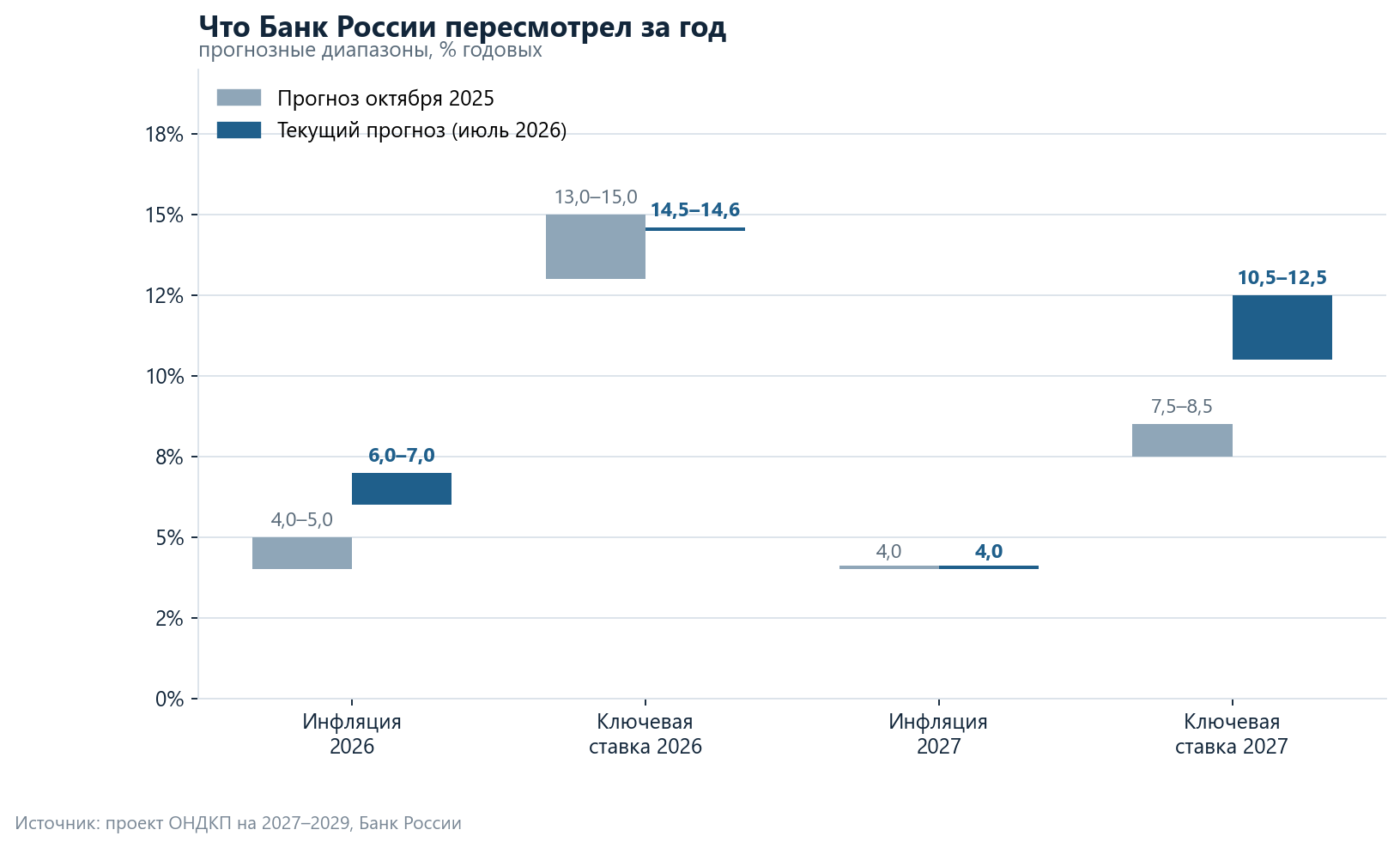
- 2026 inflation, December to December: was 4.0–5.0%, now 6.0–7.0%
- 2027 average key rate: was 7.5–8.5%, now 10.5–12.5%
- 2026 GDP: was 0.5–1.5%, now 0.0–1.0%
- 2027 inflation stayed at 4.0% – the target was not moved
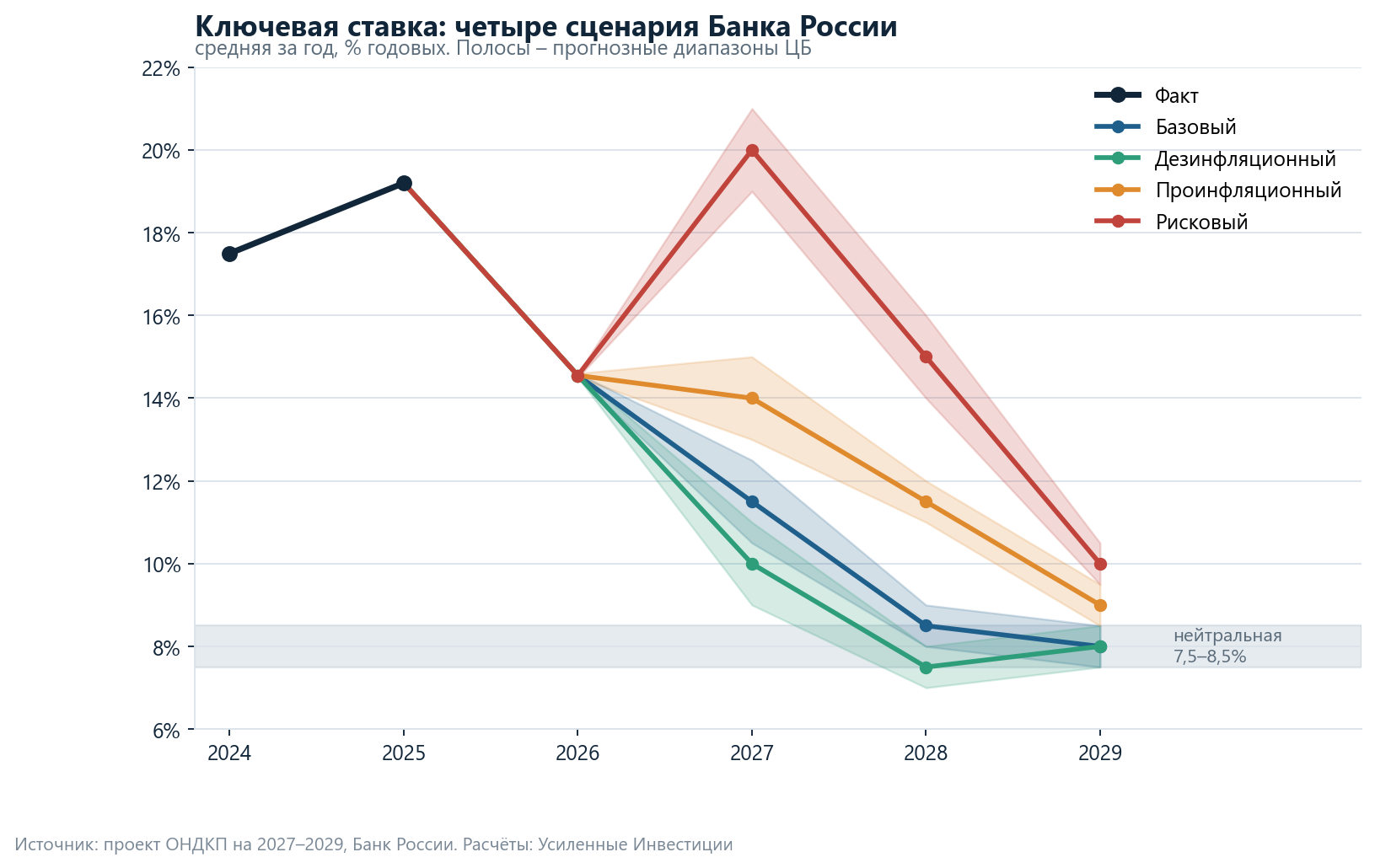
The full trajectory of the average key rate in the baseline scenario is 14.5–14.6% in 2026, 10.5–12.5% in 2027, 8.0–9.0% in 2028 and 7.5–8.5% in 2029. The last range is the neutral rate, whose estimate was not changed. The real neutral rate remains 3.5–4.5% and the nominal one 7.5–8.5%. The Bank of Russia plans to return to the neutral level only in 2029.
Until the end of 2026 the room for cuts is at most about 75 basis points
This follows not from the text but from a footnote to the forecast table. The Bank of Russia discloses that from 1 January to 26 July 2026 the average key rate was 15.0%, and from 27 July to the end of the year it is expected in the range of 13.7–14.0%.
The rate is now 14.00%, with three meetings left: 11 September, 23 October and 18 December. The upper bound of 14.0% corresponds to a scenario with no cuts at all. By our calculation, the lower bound of 13.7% is reached by exactly three steps of 25 basis points. In other words, the Bank of Russia's baseline scenario puts the end of 2026 in a corridor of 13.25–14.00%.
The rate will go below 10% no earlier than the second half of 2027
To get an average of 10.5–12.5% in 2027 when starting from 13.25–14.00%, the rate must reach roughly 9–11% a year by December 2027. A double-digit rate persists almost the entire year. A scenario of a quick return to single-digit rates is absent from the baseline forecast.
For those planning a company budget or a savings structure for 2027, the implication is simple. Under the regulator's baseline scenario, the cost of rouble funding stays above 10% until the end of next year.
The OFZ market lives in a different scenario, and the gap is huge
The most striking conclusion comes from overlaying the Bank of Russia's path on the government bond curve. At the 31 August close the curve slopes upward. Issue 26232, maturing in autumn 2027, traded at 13.4–13.5% a year, 26218 maturing in 2031 at 15.3%, 26250 (2037) at 16.0% and 26238 (2041) at 15.7%.
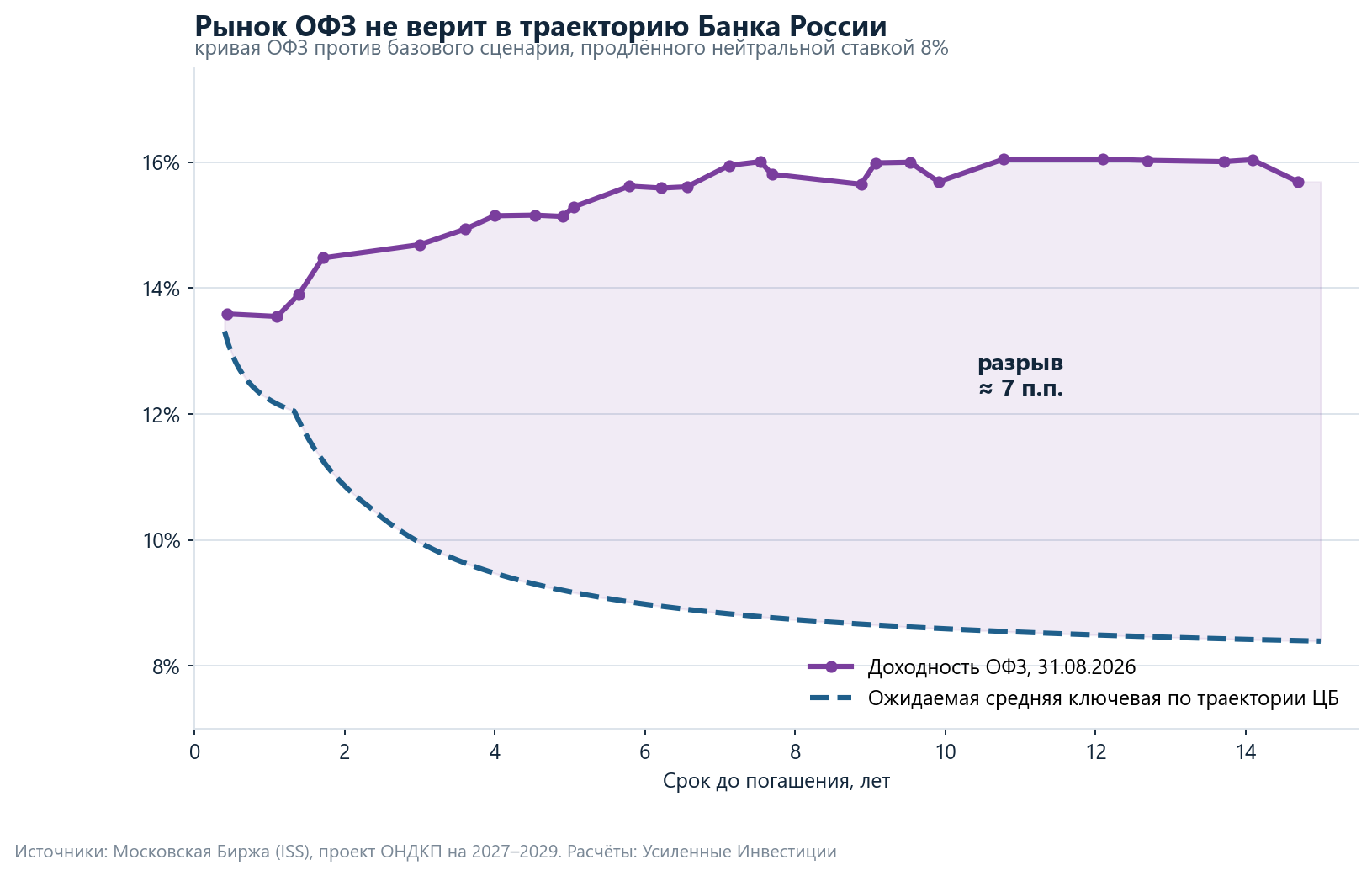
If we combine the regulator's baseline path and extend it with a neutral rate of 8%, the expected average key rate over the horizon to 2037 comes out at about 8.5% a year. Even if the scenarios are weighted 60/25/15 in favour of the baseline, pro-inflationary and risk scenarios, the result is about 9%. The difference from the market's 16% is about 7 percentage points.
Such a magnitude cannot be explained by a forecast error; it is a risk premium. The Bank of Russia says this directly. Short OFZ yields fell following the key rate, while long-term ones reacted weakly and in some periods even rose, because participants priced in concerns about the parameters of future fiscal policy.
From here the framework for the decision is simple. Long OFZs are cheap exactly to the extent that an investor believes in fiscal consolidation. Buying the long end of the curve is a bet not on how fast the key rate falls but on the Ministry of Finance reaching the announced trajectory.
The main fork is not the rate but the budget
The Bank of Russia has no approved trajectory of the structural primary deficit; the Government has not yet defined it. The forecast calculations assume a trajectory that Ministry of Finance officials have discussed publicly. The structural primary deficit is 2% of GDP in 2026, 1% in 2027, 0.5% in 2028 and zero in 2029. It is additionally assumed that the current base oil price in the fiscal rule is kept.
The regulator expressly stipulates that these assumptions will be refined after the new budget projections are published in autumn 2026, and that a change in fiscal policy parameters may require an adjustment of monetary policy. Separately, the document records that the suspension of fiscal rule operations in March–April 2026 increased short-term volatility of the rouble exchange rate.
Four scenarios: from a 9% rate to a 21% rate
The Bank of Russia considers a baseline and three alternative scenarios. The baseline is assessed as the most likely; among the others, the pro-inflationary one is considered more likely than the disinflationary one, and the probability of the risk scenario is low.
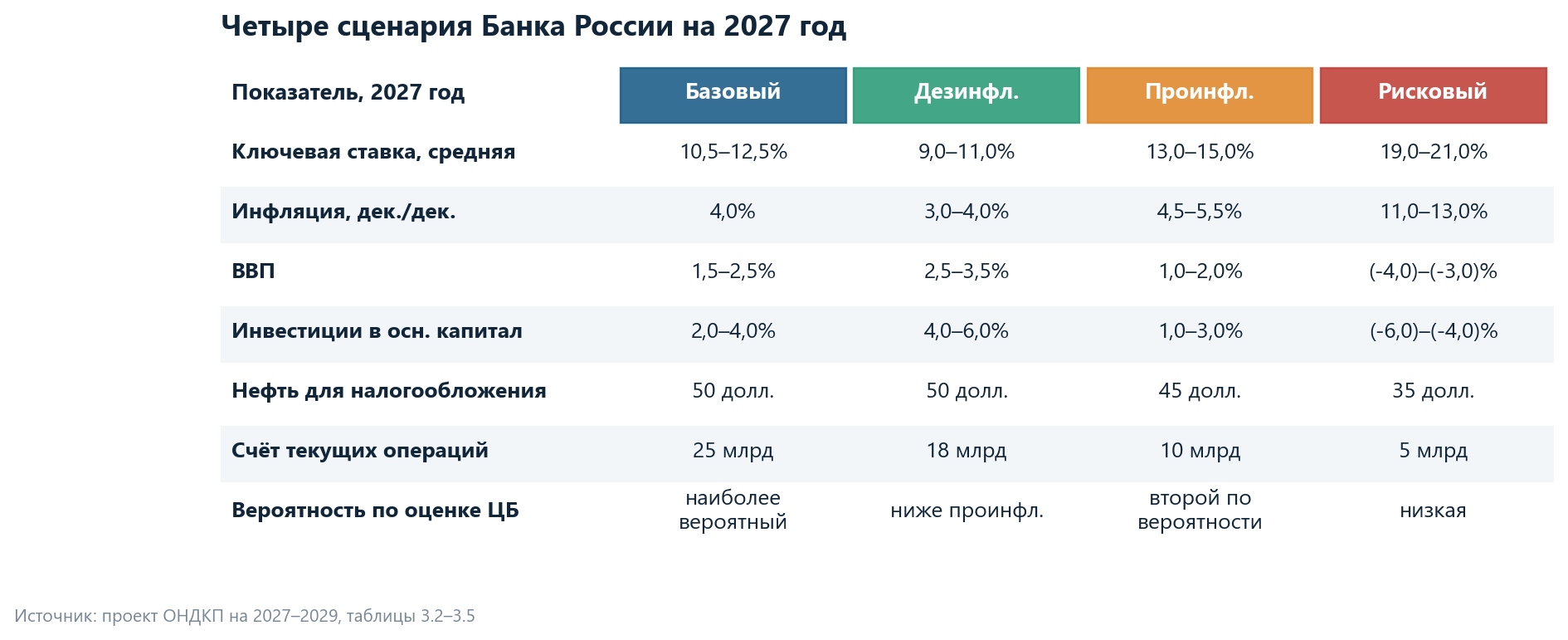
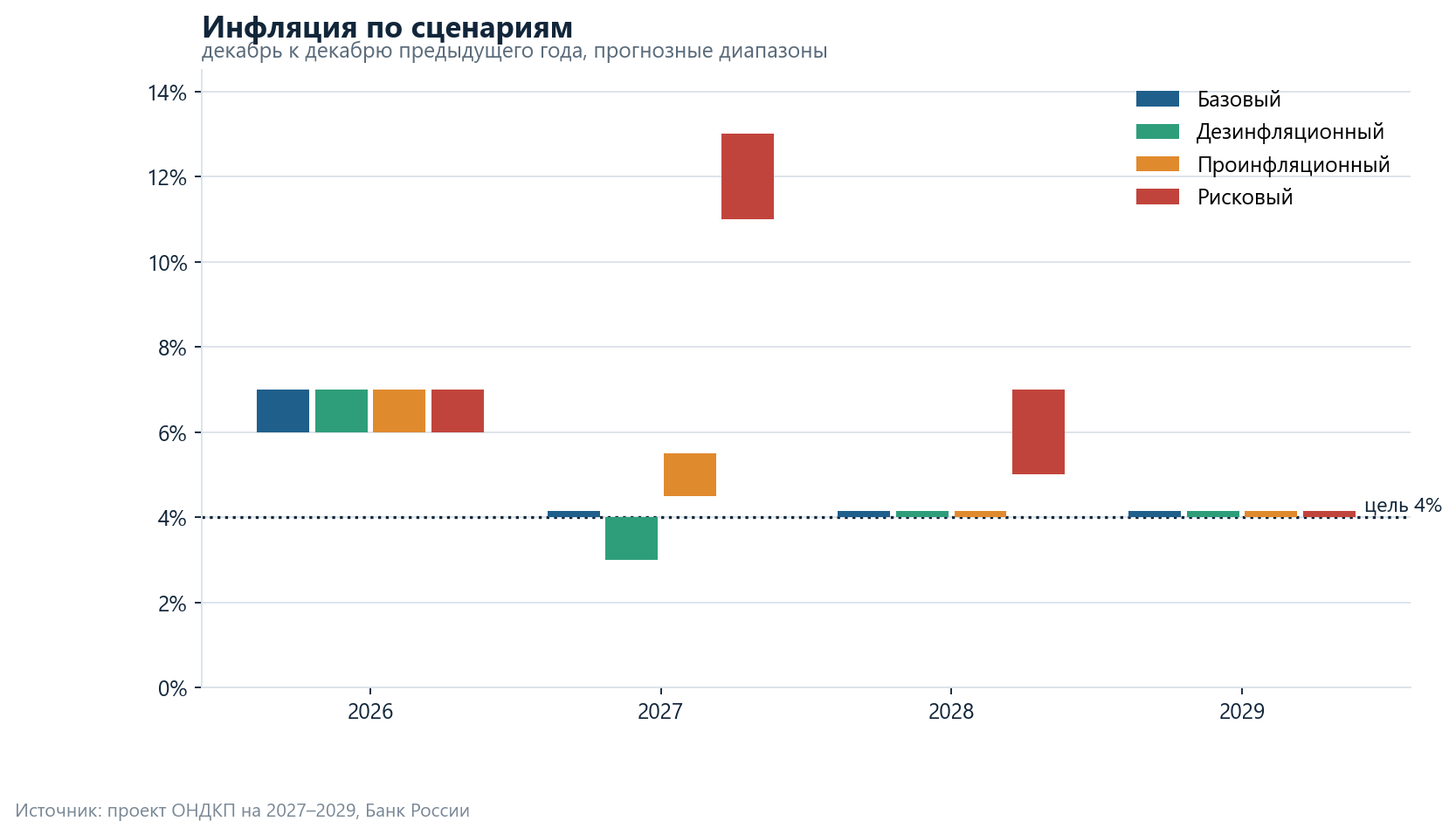
The risk scenario models a global financial crisis comparable in scale to the crisis of 2007–2008. The trigger named in it is a sharp repricing of technology company assets amid inflated expectations about the economic effects of artificial intelligence development. The average key rate in 2027 in this scenario is 19.0–21.0%, inflation rises to 11.0–13.0%, GDP falls by 3–4% in 2027 and by another 1.5–2.5% in 2028, and the oil price drops to USD 35 in 2027 and USD 25 in 2028.
External assumptions: the Strait of Hormuz and oil at USD 50
In the baseline scenario, the escalation in the Middle East and shipping restrictions in the Strait of Hormuz are treated as a temporary factor, normalising by early 2027. The Russian oil price used for tax purposes is set at about USD 60 per barrel in 2026 and USD 50 in 2027–2029. This is below the levels of 2025 and 2019–2021 and is explained by the oil market returning to a surplus as OPEC+ output grows.
Sanctions restrictions in the baseline scenario remain over the entire forecast horizon and continue to constrain export and import growth at elevated transaction costs.
The balance of payments shrinks fivefold
The Bank of Russia fundamentally does not publish an exchange rate forecast – a floating rate regime does not imply target levels. But the document contains an indicator that comes closest to the exchange rate.
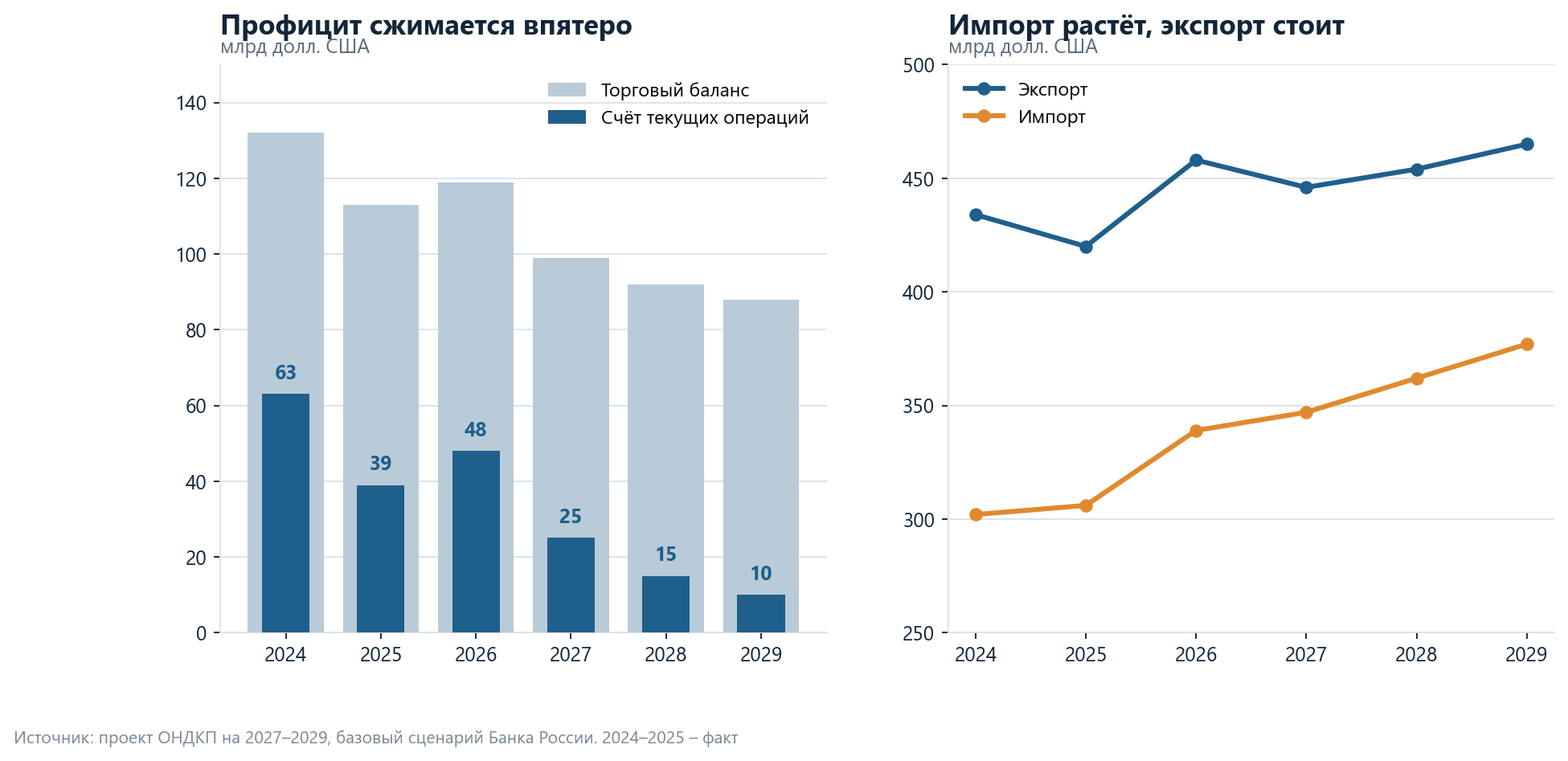
The current account surplus in the baseline scenario falls from USD 48 bn in 2026 to USD 25 bn in 2027, USD 15 bn in 2028 and USD 10 bn in 2029. Exports barely grow (USD 458 bn in 2026 versus USD 465 bn in 2029), while imports rise from USD 339 bn to USD 377 bn. The trade balance shrinks from USD 119 bn to USD 88 bn.
In a separate box the regulator breaks down exchange rate factors since 2022 into structural, one-off and cyclical ones. The key observation: the import-to-GDP ratio fell from just over 20% to about 15% by early 2026, and this, along with high rouble rates, supported the strong rouble. Both factors weaken in the forecast.
One-off factors: VAT is already counted, tariffs are still ahead
For the first time a quantitative estimate is given of the contribution of the tax reform. The VAT increase from 20% to 22% from January 2026 added about 0.8–1.0 percentage points to prices, and this effect has already played out:
- the anticipatory effect – about 0.2 pp in 4Q2025, when purchases were brought forward
- the main effect – 0.6–0.7 pp in January–April 2026, practically exhausted by April
- the Bank of Russia recorded no significant secondary or indirect effects: retail companies' inflation expectations fell from the January peak of 12.7% to 8.0% in April
The tariff factor, however, has not yet played out. Utility tariff indexation in 2026 takes place in two stages: in January by 1.7% and in October by 15.0% on average. In addition, the recycling fee on passenger cars was indexed by 20% from January. The autumn spike in the consumer price index is already in the 6.0–7.0% forecast, and the regulator will not respond to it with the rate. Only the reaction of inflation expectations matters.
Transmission works through two different pipes
Two numbers from the document explain why the same key rate move affects the economy unevenly.
- 67% of the corporate loan portfolio as of 1 July 2026 consisted of floating-rate loans. For this part, key rate decisions are transmitted immediately
- About a third of fixed-rate rouble corporate loans in 1H2026 were issued below 12% a year – at an average key rate of 15.0%. Direct subsidy programmes accounted for less than 3% of issuance
The gap is explained by mechanisms not visible in subsidy statistics: state guarantees, concessional funding for lending banks, direct financing through development institutions and National Wealth Fund money, project financing of developers, and lending to affiliated borrowers. The regulator's conclusion is direct. The actual pro-inflationary pressure from concessional lending in the broad sense is higher than the statistics suggest.
The regulator's assessment of subsidised mortgages is harsh
Subsidised mortgages remain the largest segment: they account for over 70% of all concessional lending in the economy and still more than half of mortgage loans issued. Over the entire period of the programmes, 3.8 mn loans worth RUB 18.1 tn were issued, which allowed the purchase of over 170 mn sq. m of housing.
The assessment of the result in the document is unambiguous. The inability to build at a pace commensurate with the growth of the mortgage portfolio led to an almost twofold rise in primary market prices. The price growth completely offset the benefits of the low rate and made housing less affordable for future buyers.
For banks: the structural liquidity deficit will grow several times over
The section on the money programme is usually skipped, but it contains a figure important for assessing competition for funding.
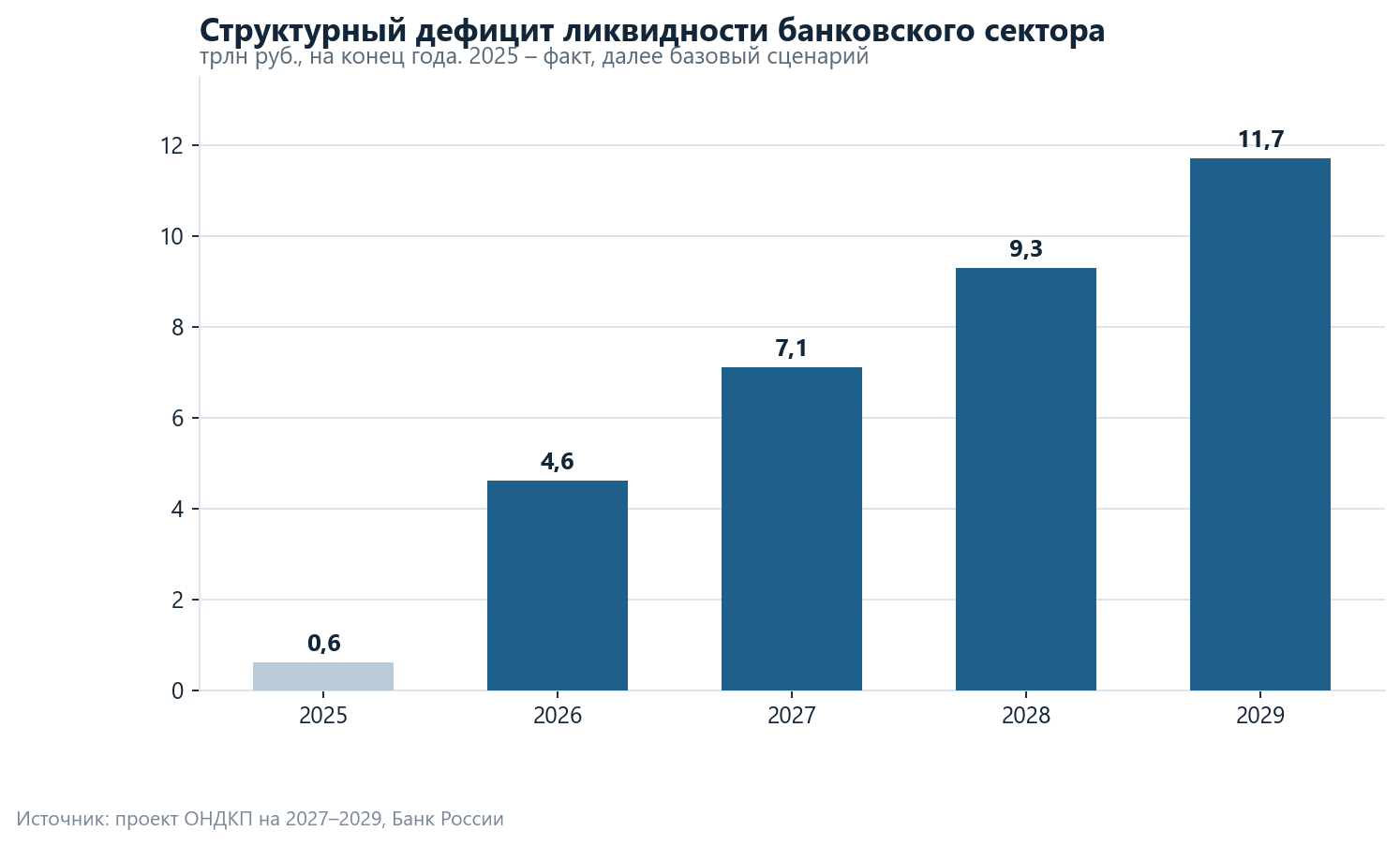
The structural liquidity deficit grows from RUB 0.6 tn at the end of 2025 to RUB 4.6 tn at the end of 2026 and further to RUB 11.7 tn by 2029. It grows mainly because of cash in circulation, which absorbs RUB 3.7 tn in 2026 versus RUB 1.0 tn in 2025. The volume of liquidity provided by the Bank of Russia in the baseline scenario rises from RUB 5.9 tn to RUB 15.7 tn.
The inflation target may become lower than 4%
The monetary policy review began in 2026 and is to be completed in 2028. Within it the Bank of Russia analyses when the preconditions for lowering the target level may emerge and what the new level might be.
The wording in the box on the target level is noticeably more definite than one would expect from a purely research text. The regulator writes that the preconditions for lowering the target had formed by the end of 2021, and lists the arguments: professional participants' expectations have been anchored to the target since 2017, inflation of 4% and below corresponds to a comfortable level for the vast majority of citizens and businesses, the problem of the effective lower bound of the rate is not significant for Russia, and the targets of trading partner countries are lower on average.
If a decision is taken, it will be announced several years before the change. For long rouble assets this is a structurally downward factor for rates, but on a horizon of 2028 and later.
What to watch next
- 11 September – the next Board of Directors meeting on the key rate. Then 23 October and 18 December
- Autumn 2026 – new budget projections. They, rather than the September rate step, will determine the 2027 path
- By 1 December – the final version of the Guidelines goes to the State Duma (Article 45 of the Bank of Russia law). Budget assumptions will already be refined in it, and comparing the two versions will show how far the path has shifted
What this means for positions
Everything above is the content of the document and arithmetic on the published ranges. What follows is the authors' interpretation by Enhanced Investments. It rests on the same figures but remains an opinion, not a conclusion from the document.
The long end of OFZs is bought not for the rate but for the budget, and this bet has a date. The 7-percentage-point premium over the expected average key rate does not persist because of a dispute about the pace of easing. The Bank of Russia itself names the source: uncertainty about the parameters of future fiscal policy. So it will be resolved not at a rate meeting but in autumn, when the budget projections come out, and by 1 December, when the final version of the Guidelines appears. Until this fork, duration is interesting not because the rate will fall quickly but because the wait is paid at 16% with a key rate of 14%. A cautious structure means splitting the entry into two parts and leaving the second for the market's reaction after the budget.
Locking in yield is worthwhile, but not all of it. In the baseline scenario the average key rate in 2027 is 10.5–12.5%, and a fixed yield of 15–16% outperforms it. The pro-inflationary scenario gives 13.0–15.0% and the risk scenario 19.0–21.0%, and there a floating coupon wins. The regulator puts the pro-inflationary scenario second in likelihood, so it is sensible to keep floaters as insurance against the upper branch. A deposit, however, loses to duration by construction, and this follows from the Bank of Russia's own observation. Deposit rates reacted quickly to the actual and expected key rate cuts, while long-term OFZ yields reacted weakly. A deposit is repriced downward every few months, while a long bond fixes the rate for years ahead.
All three supports of the strong rouble are weakening. The current account surplus shrinks from USD 48 bn to USD 10 bn by 2029. Imports, whose share in GDP fell from just over 20% to about 15%, grow again in the forecast from USD 339 bn to USD 377 bn. The interest rate differential, which the regulator names among the reasons for the rouble's strength in 2025, narrows as the key rate falls. The Bank of Russia does not publish an exchange rate forecast, but all three factors in its own baseline scenario work in the same direction.
Oil producers have a USD 50 price built into the baseline scenario. The Russian oil price for tax purposes is assumed at about USD 60 in 2026 and USD 50 in 2027–2029. At the same time the 2027 current account stays positive at USD 25 bn, that is, in this scenario there is no sharp rouble weakening to help exporters. Calculating oil and gas companies' EBITDA at current prices under such assumptions means assuming a more favourable world than the Bank of Russia's.
The mortgage recovery in the baseline scenario turns out to be a 2028 story. The mortgage portfolio grows by 6–10% in 2026 and 7–12% in 2027, and reaches 10–15% only in 2028–2029. For developers this means double-digit growth returns in two years, not on a rate cut in 2027. To this one should add the regulator's own assessment, under which primary market price growth has already offset the benefit of subsidised programmes. In this logic one should not expect an expansion of non-targeted programmes.
The October inflation spike will be noise, not a signal. Utility tariff indexation of 15% on average in October is already in the 6.0–7.0% forecast and, in the regulator's logic, belongs to one-off supply factors that are not answered with the rate. If the market reacts to the headline figure with a sell-off, it is more an opportunity than a reason to worry. The signal will be not the print itself but the behaviour of inflation expectations after it.
What would break this framework. The main risk to the whole construction comes from the autumn budget projections. If the trajectory of the structural primary deficit turns out higher than the 1% of GDP in 2027 assumed by the Bank of Russia, the entire baseline rate path will shift upward, and the premium in long OFZs will turn out to be justified rather than excessive.
Extended analytics on Russian issuers is on the portal frontier.eninvs.com. Weekly reviews are in the Telegram channel Enhanced Investments @eninv.
See also: market overview · valuation map · stock screeners