Cian 2Q2026: 31% margin, a dividend of at least RUB 83, and the question of where the next growth will come from
On August 19, MKPAO Cian reported results for the second quarter and the first half of 2026. The report is strong: revenue accelerated, margin rose by 7 percentage points, the company confirmed its full-year guidance and continues to buy back shares. We break down what the result consisted of, what is missing from it and how interesting the stock is at a price of RUB 660.
All figures below are taken from the [company's press release](https://ir.ciangroup.ru/ru/press-center/press-releases/vyruchka-tsiana-vyrosla-na-23-a-rentabelnost-prevysila-31-vo-2-kv-2026-goda/) and the IFRS statements for 6 months of 2026; market data is from the Moscow Exchange as of August 19. The issuer's card with the history of its metrics – Cian on our portal.
In brief
- Quarterly revenue was RUB 4,425 mn, up 22.8% year on year. In the first quarter growth was 18%, so the pace accelerated.
- Operating expenses grew only 7.2%. The gap between revenue and expenses produced adjusted EBITDA of RUB 1,383 mn versus RUB 864 mn a year earlier.
- Adjusted EBITDA margin was 31.3% versus 24.0% a year earlier. Management's full-year guidance of "at least 30%" is so far being met with room to spare.
- Net profit was RUB 1,040 mn, up 31.6%. That is half the pace of EBITDA, and the reason is important: interest income from the cash cushion is shrinking.
- There is no debt, and cash in accounts is RUB 4.1 bn. For 2026 the company has promised dividends of at least RUB 83 per share, which is at least 12.6% of the current price, and a RUB 4 bn share buyback is under way.
- Valuation: 10.1x EV/EBITDA for the last 12 months and about 8.6x on our 2026 estimate.
- The main risk of the coming months is the revision of family mortgages from October 1. Part of the spring demand was pulled forward precisely by the expectation of tightening.
Revenue grew 22.8%, expenses 7.2%, and the whole difference settled in profit
The main figure in the report is not revenue but the gap between growth rates. Revenue added 22.8%, operating expenses 7.2%. In a business with a high share of fixed costs, such a gap works as an amplifier: each additional ruble of revenue turns almost entirely into profit, because the platform, developers and servers have already been paid for. This is what is called operating leverage.
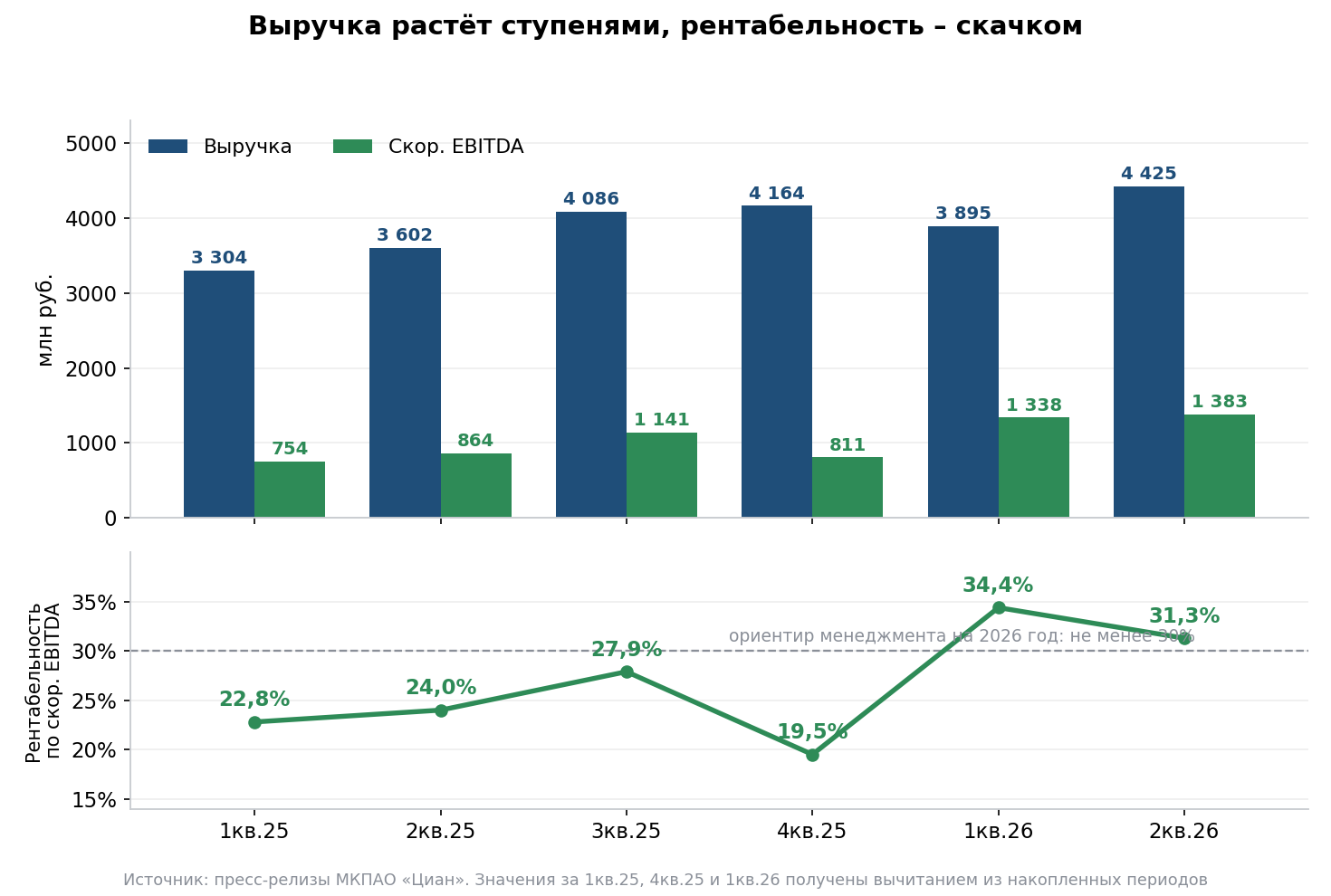
Adjusted EBITDA is profit before interest, taxes and depreciation, as well as before share-based employee compensation and one-off restructuring costs. The company calculates it itself and the measure is not part of IFRS, but the release includes a reconciliation to net profit, and the adjustments in the second quarter are modest: RUB 88 mn of depreciation, RUB 57 mn of share-based payments, RUB 15 mn of restructuring.
The margin dip in the fourth quarter of 2025 to 19.5% is explained by the company sharply increasing marketing at that time. In the first half of 2026, by contrast, marketing expenses fell 2.7% year on year and amounted to 22.2% of revenue versus 27.6% a year earlier. Management explicitly warns that expenses were redistributed within the year in favour of the higher season, so margin in the second half will be lower than in the first.
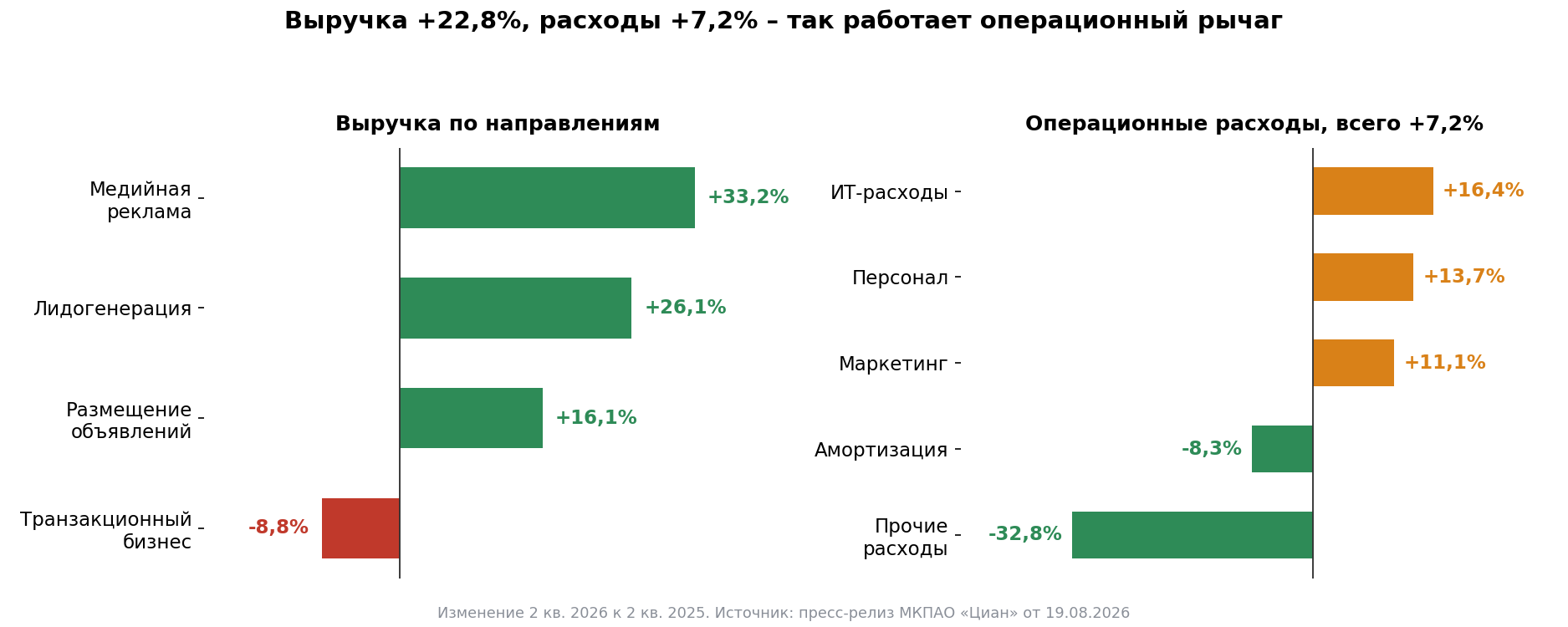
By cost line, the fastest growth is in IT (plus 16.4%; the company cites spending on artificial intelligence and more expensive hosting) and personnel (plus 13.7% due to a market-based salary review). Other expenses, however, fell by a third, and they are what pulled total growth down to 7.2%.
The acceleration happened on a falling new-build market, not because of it
Context matters because it explains what is missing from these figures. In the second quarter the number of new-build transactions in the capital regions fell 21% year on year. Cian nonetheless grew core-business revenue by 24.1%. So the growth is provided not by the market but by its own monetisation.
Signs of a turn have appeared, though. The Central Bank key rate was 14.25% at the end of the quarter and fell to 14.0% in July. The average mortgage rate in June is about 19%, 2 percentage points lower than in January. Mortgage issuance in the second quarter rose 32% year on year both by number of loans and in money terms. The number of secondary-market transactions in Moscow added 19%, and in June new-build transactions in the capitals grew 22% on May – though on expectations of tighter family mortgages, i.e. demand was partly pulled forward from the future.
The share of subsidised programmes in issuance in money terms declined to 60%, down 15 percentage points over the year. For Cian this is rather good: the less the market depends on a single state programme, the more stable developers' demand for leads.
Growth is almost entirely price-driven: listings are up 0.7%, while the average ticket is up 12.5%
This is the report's main weakness. The company discloses operating metrics for the half-year, and they show that physical volumes are standing still.
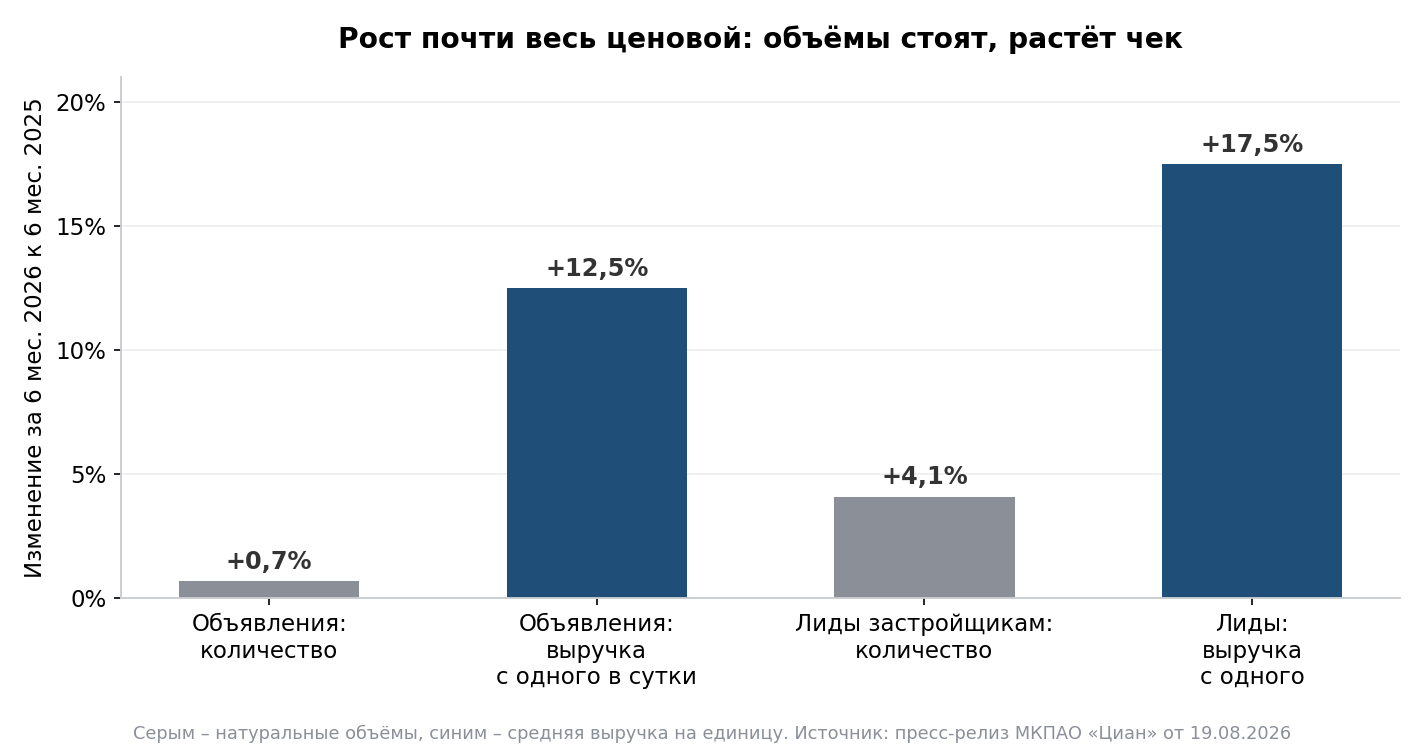
The average daily number of listings on the platform grew 0.7% to 2.09 mn. Revenue from listing placement nonetheless added 13.3% – because average daily revenue per listing rose from RUB 9.7 to RUB 11.0, i.e. by 12.5%. The company names the sources: price indexation in line with media inflation, differentiated pricing and the development of subscriptions.
The same picture holds in lead generation. Lead generation is the sale of targeted calls from potential buyers to developers. The number of such calls grew 4.1% to 112.3 thousand, while average revenue per call grew 17.5%, from RUB 19.3 thousand to RUB 22.6 thousand, partly thanks to the move to an auction model.
Price growth is a normal source of revenue for a platform with network effects, and Cian uses it skilfully. But it has a limit set by the client's economics: agents and developers are willing to pay more only as long as a lead pays off. Until the transactions market revives, further revenue acceleration will have to be extracted from the same pocket. Sustainable growth will appear when volumes – the number of listings and calls – start to grow.
The transactional business remains a promise, not a second engine
The second segment is transactional: the mortgage marketplace and the SmartDeal deal-support service. Its revenue in the second quarter fell 8.8% to RUB 125 mn, and 11.3% for the half-year to RUB 243 mn. The segment's adjusted EBITDA is negative: minus RUB 69 mn for the quarter and minus RUB 198 mn for the half-year, although a year ago the loss was larger.
In the first quarter of 2026 the company closed its financial platform and, in its words, is working on a new product and business model in mortgages. It also mentions that more than 1,000 deals have passed through the "Deal on Cian" service and a title-preservation guarantee has been launched.
The scale is so far symbolic: 3% of group revenue at negative margin. The story of turning a classified (a listings platform) into a participant in the deal itself, with a commission on the apartment's value, is not yet confirmed by the numbers. The good news is that the segment's loss is shrinking and does not prevent the group from showing a 31% margin.
Profit is growing half as fast as EBITDA because interest income is melting
Adjusted EBITDA grew 60.1%, net profit only 31.6%. The gap is explained by one line: financial income fell from RUB 541 mn to RUB 218 mn, i.e. by almost 60%.
The reason is simple. Cian held a large cash position for a long time and earned on deposits at a high rate. At the end of 2024 there was RUB 9.2 bn in accounts, at the end of 2025 RUB 6.1 bn, and on June 30, 2026 RUB 4.1 bn. The money went to dividends, while the rate is falling. Over the half-year financial income declined from RUB 935 mn to RUB 416 mn.
The practical takeaway for the investor: a significant part of Cian's past profit was interest-based, not operating, and this prop is going away. In 2027 the operating business will have to grow faster just so that net profit does not decline. At the same time the effective income tax rate remains high – 27.6% for the quarter and 27.2% for the half-year, although that is already better than last year's 31.4% and 34.2%, when restructuring weighed on the result.
There is no debt, but the cushion has shrunk to RUB 4.1 bn and is almost entirely allocated
The company's balance sheet is simple and clean. There are no loans or borrowings at all; the only financial liability is a lease of RUB 39 mn. Assets are RUB 8.1 bn, of which RUB 4.1 bn is cash, RUB 0.9 bn goodwill and RUB 1.1 bn intangible assets. Classic credit metrics such as net debt to EBITDA or interest coverage are uninformative here: net debt is negative and there are practically no interest payments.
It is more interesting to see whether the money is enough for the announced commitments. Over the half-year the company generated RUB 2,446 mn of operating cash flow (plus 3.5% year on year – modest growth because of last year's high working-capital base) and paid RUB 4,333 mn in dividends. The cash balance fell by RUB 2,035 mn.
Before year-end the company still has to pay at least RUB 30 per share, about RUB 2.3 bn, and to continue the buyback. By our estimate, with second-half operating cash flow of roughly RUB 2.2–2.6 bn and the current buyback pace, the cash position at year-end will be about RUB 2.5–3 bn. There will be no shortfall, but the safety margin is noticeably thinner than a year ago, and with it future interest income is thinner too.
Return of capital: at least RUB 83 of dividends for the year and a RUB 4 bn buyback
In June the company paid RUB 53 per share for the first quarter of 2026, including a RUB 23.7 special dividend, with the record date of June 22. At least RUB 30 more is promised before year-end. In total for 2026 that is at least RUB 83 per share, or 12.6% of the RUB 660 price. For comparison: the key rate is now 14.0%, and short OFZ yield about 13.7–14.0% a year.
An important caveat. The dividend policy provides for paying 60–100% of adjusted IFRS net profit. By our estimate, 2026 net profit will be about RUB 4 bn, i.e. roughly RUB 51 per share. The promised RUB 83 is noticeably higher, and the difference is a distribution of the accumulated cash cushion, not a sustainable level. When the cushion runs out, the dividend will have to be calculated from profit.
In parallel, since July 15 a buyback of shares from the market of up to RUB 4 bn over 12 months has been under way, conducted by the subsidiary AO Ts-Resheniya. As of August 17, 1,076,520 shares have been bought for RUB 649.9 mn, which is 1.39% of the share capital at an average price of about RUB 604 per share. For a market capitalisation of RUB 51 bn, the full programme is about 7.8% of all shares.
Liquidity has indeed increased. According to the Moscow Exchange, from the start of 2026 until the buyback began, CNRU's average daily turnover was RUB 126 mn (215 thousand shares a day), and after July 15 it was RUB 226 mn (377 thousand shares). The 80% increase matches the company's estimate. At the same time the buyback itself is about 45 thousand shares a day, around 12% of turnover, so the jump in liquidity is explained not only by it but also by increased interest in the stock.
10.1x EV/EBITDA for the last 12 months and about 8.6x on the 2026 forecast
Let us put the valuation together. For the last 12 months (from the third quarter of 2025 through the second quarter of 2026), revenue was RUB 16,570 mn, adjusted EBITDA RUB 4,673 mn and net profit RUB 3,900 mn.
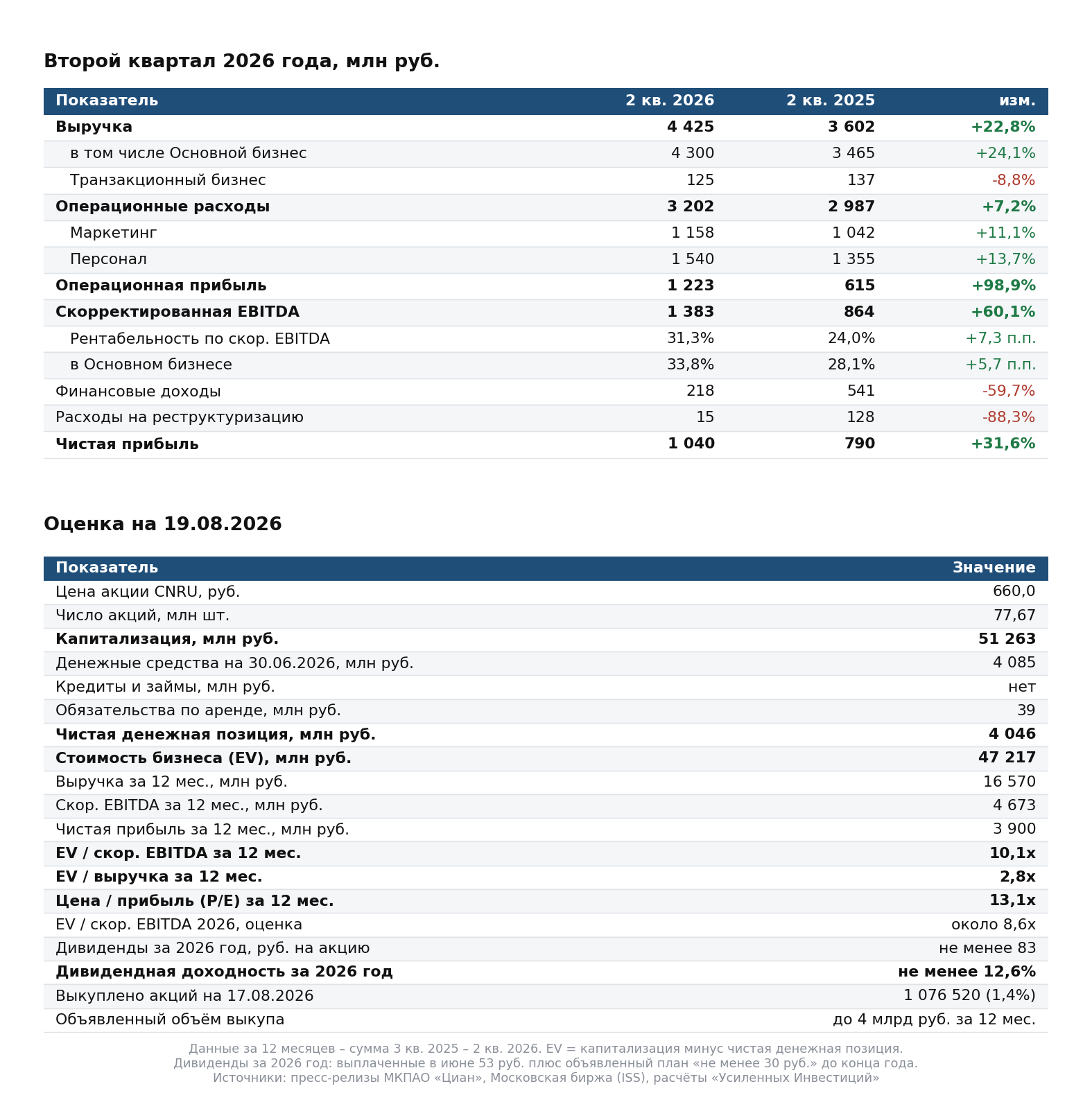
Enterprise value (EV) is market capitalisation less net cash, i.e. the amount for which a buyer actually acquires the operations. For Cian this is RUB 47.2 bn at a capitalisation of RUB 51.3 bn.
The company's 2026 guidance is revenue growth of 17–22% and a margin of at least 30%. That implies revenue of RUB 17.7–18.5 bn and adjusted EBITDA of roughly RUB 5.4–5.6 bn, i.e. about 8.6x EV/EBITDA. For a growing platform with no debt, a margin above 30% and a double-digit dividend yield, this is a reasonable but not cheap price.
It is worth noting separately that RUB 2,721 mn of adjusted EBITDA has already been earned in the first half. For the annual margin to come out "at least 30%", the second half needs only 26–28%. That means a cushion is built into management's guidance, and exceeding the guidance looks more likely than missing it.
The stock has already priced in the decline: up 18% year to date versus down 22% for the index
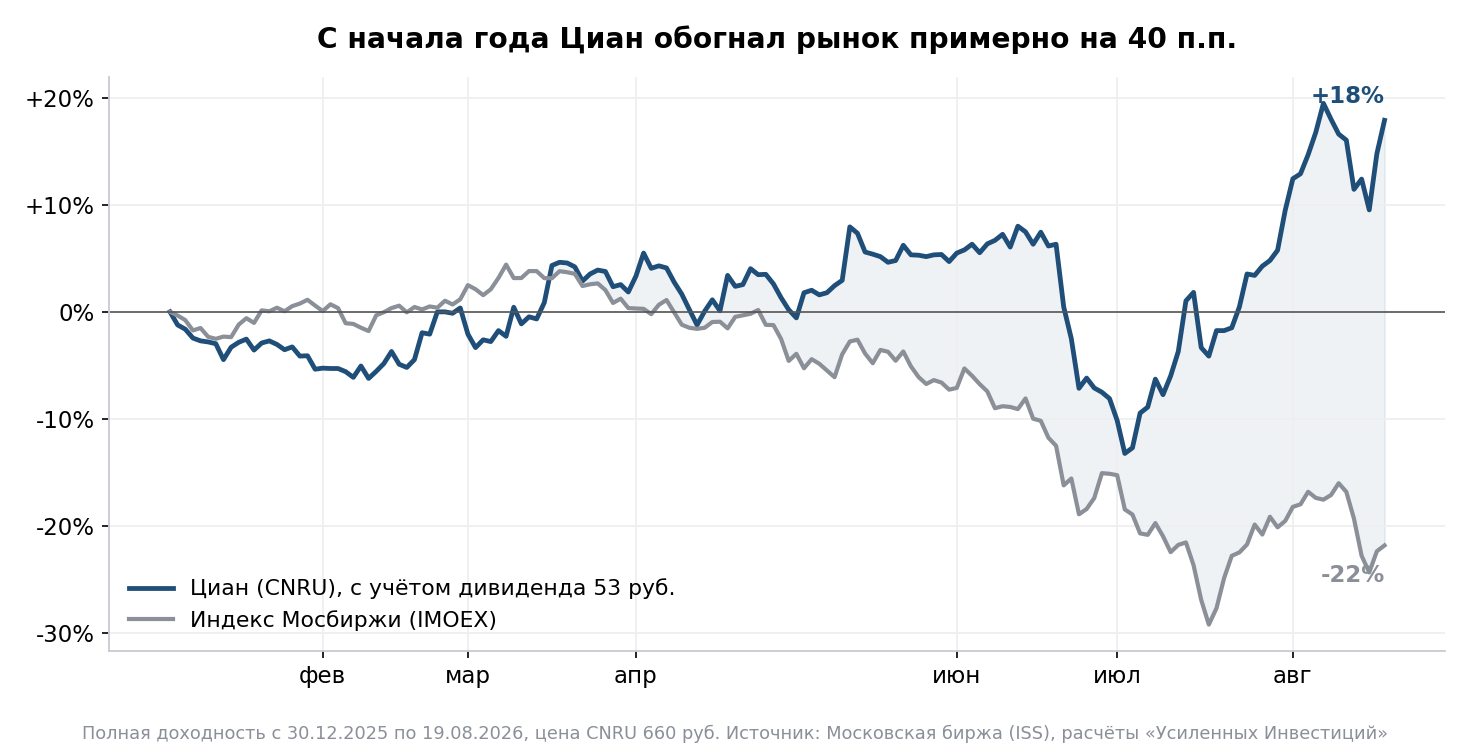
Since the start of the year the stock has returned about 18% including dividends, while the MOEX index lost 22%. The outperformance is about 40 percentage points. From the low of RUB 471.8 set on July 2, the stock gained almost 40% in a month and a half: first on the buyback announcement on July 6, then on the report. CNRU's weight in the MOEX index is 0.36%.
This is significant for assessing the idea. Most of the re-rating has already happened, and the buyer today is paying not for a turn in sentiment but for the business's future growth.
The main risk of autumn is the revision of family mortgages from October 1
This is a risk that is visible in the report only between the lines but is capable of overturning the whole picture. Family mortgages are currently issued at 6% a year. Since February 1, 2026 a restriction has already been in force: one subsidised loan per family. From October 1 the programme is due to be reviewed again.
There are no final parameters, and the Ministry of Finance has postponed the decision. A differentiation of the rate by number of children is under discussion: about 10–12% for a family with one child, 8–10% with two, 4–6% with three or more, plus different loan limits for the capitals and the regions and a cap on the subsidised period of 15 years. None of these figures has been approved, and a soft scenario is also possible.
Why this is critical for Cian. The share of subsidised programmes in mortgage issuance in money terms in the second quarter was 60%. Lead generation is RUB 1,334 mn, or 30% of quarterly revenue, and almost all of it comes from new builds. Add developers' advertising budgets in listing placement and display advertising, and roughly a third of group revenue depends directly on how many apartments in new builds are sold at a subsidised rate.
The arithmetic for the buyer is plain. On a RUB 6 mn loan for 20 years, the payment at a 6% rate is about RUB 43 thousand a month. At 10% it rises to RUB 58 thousand, at 12% to RUB 66 thousand. That is an increase of 35–54%, and for a family with one child it means not a more expensive purchase but its cancellation.
From there the chain goes straight into the reporting. Fewer transactions means fewer calls to developers, and so both the number of leads and their price fall, since the auction model works both ways. The price part of growth, which gave plus 17.5% of revenue per lead, is the most vulnerable.
It should also be kept in mind that part of the spring result has been borrowed from the future. The company itself writes that June's 22% month-on-month growth in capital-region transactions and the 32% year-on-year surge in mortgage issuance were largely caused by the expectation of tighter family mortgage terms. If so, the fourth quarter of 2026 and the first half of 2027 may turn out noticeably weaker than the current trajectory implies, and the high base of the second and third quarters will make year-on-year comparisons unpleasant.
How attractive is the idea: moderately, and it is a bet on a recovery in volumes
What speaks in favour of buying. Operating leverage works and has been confirmed by two quarters in a row, not by a single burst. The company is growing faster than its market, has no debt, a double-digit dividend yield and a buyback of 7.8% of capital that supports the quote. The rate-cutting cycle has only begun, and if it continues, transaction volumes and developers' advertising budgets will go up – and with the current cost structure this translates into profit with a large multiplier.
What speaks against. Growth rests on price increases with stagnant volumes, and this is a finite resource. The interest income that made profit look good is shrinking and will continue to shrink. The transactional segment is still loss-making and small. The dividend is above profit, i.e. partly it is a return of accumulated cash, and after 2026 its base should decline. The stock has already risen 40% from its July low. And most importantly, the revision of family mortgages hangs over the fourth quarter, and it could wipe out the entire effect of the key rate cut for the primary market.
Our fair value estimate. If in 2027 revenue grows by about 15% to RUB 20–21 bn and the margin holds around 32%, adjusted EBITDA will be roughly RUB 6.5–6.7 bn. At a multiple of 8x this gives a business value of about RUB 53 bn, plus the cash balance – a capitalisation of about RUB 55–56 bn, or roughly RUB 710–720 per share. Including dividends, the one-year horizon gives a total return of about 15–18% versus 14% on short OFZ.
Conclusion: there is a premium to the risk-free rate, but it is small, and it does not pay for the October risk on family mortgages. Cian looks like a solid, quality asset that is appropriate in a portfolio as a bet on a recovery of the real estate market as the key rate falls. As an idea with large re-rating potential at current levels, the stock no longer looks like one – the market has priced in most of this move in July and August. A reasonable tactic looks to be to wait for the approved parameters of the subsidised programme: in a soft scenario the stock will remain cheap relative to its trajectory, in a hard one there will be an opportunity to buy cheaper.
What to watch next
- The number of listings and leads in the third-quarter report. If volumes move off zero growth, that would confirm a turn and make the story much more interesting.
- Second-half margin. Management warned in advance about the shift of marketing, and a fall below 26–28% would be an alarm signal.
- The size of the second dividend. At least RUB 30 is promised, and the actual figure will show how willing the company is to spend the cash remainder.
- The buyback pace. In the first month RUB 650 mn out of RUB 4 bn was used. At this pace the programme will end earlier than in 12 months, and support for the quote will disappear.
- Approved parameters of family mortgages. The key event of autumn. The rate for families with one child and the loan limits will determine whether the fourth quarter is a failure for the primary market.
- The key rate and mortgage issuance. The main external driver of volumes, and therefore of the next phase of revenue growth.
Tickers
Cian (CNRU). Extended cards of Russian issuers with the history of financial metrics – on our portal.
More reviews of Russian companies – in the Telegram channel Enhanced Investments @eninv.
See also: market overview · valuation map · stock screeners