Corporate taxes from 2027: which miners pay the most and how much the market has already priced in
*Updated 25 September. The estimates have been redone using the text of the draft law "On the windfall tax" (23 September version). In the first version we treated the tax as permanent and included nitrogen fertilisers and aluminium. The text makes the tax temporary, with three payments; nitrogen and coal are not covered, and aluminium is taxed as ore. The conclusion that the market had underpriced the tax for Nornickel did not hold up.*
On 24 September the Ministry of Finance submitted the 2027-2029 budget and amendments to the Tax Code to the government ([Ministry of Finance press release](https://minfin.gov.ru/ru/press-center/?id_4=40635-minfin_rossii_vnes_v_pravitelstvo_rf_byudzhetnyi_paket)). For companies the main news is the windfall tax on the mining and metals sector. Below: who pays how much, how much of it the market has already priced in, and what this means for bonds. The amounts are our estimates based on the text of the draft law, with assumptions stated next to the figures.
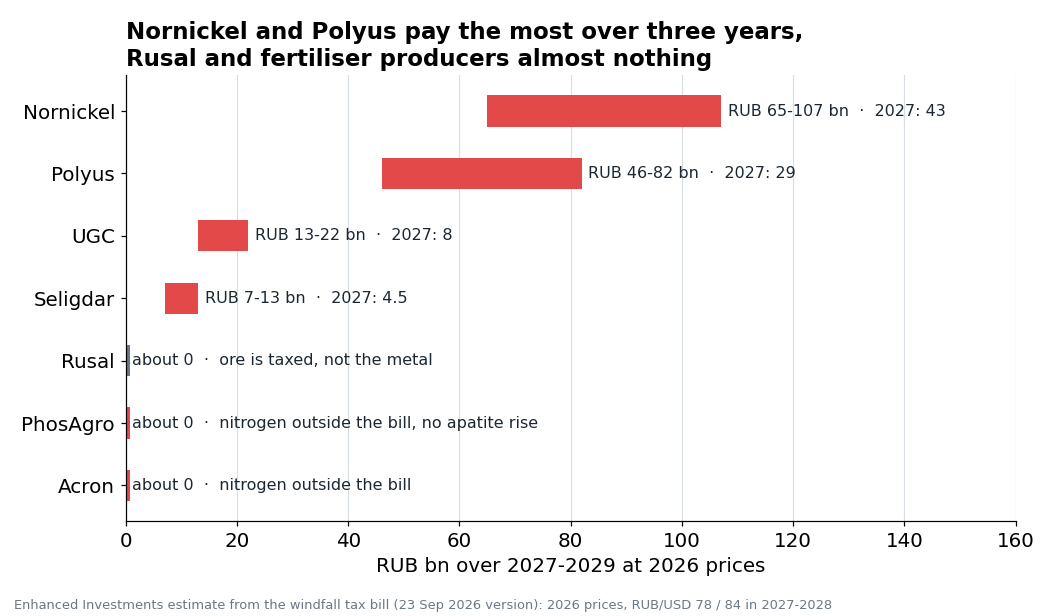
The new tax takes 30% of the rise in rouble prices versus 2025 from miners and 20% from gold producers, if the rise is at least 10%. It is paid three times, in 2027-2029, and the base is raised by 10% each year. At current prices that is about RUB 230 bn in 2027 and RUB 365 bn over three years. Nornickel and Polyus pay the most, Rusal and fertiliser producers almost nothing, and the market has priced in Nornickel's tax with room to spare.
- Nornickel pays RUB 65 bn over three years, Polyus RUB 46 bn. At RUB/USD 84 in 2027-2028 the figures rise to RUB 107 bn and RUB 82 bn. More than half falls on the first payment in April 2027.
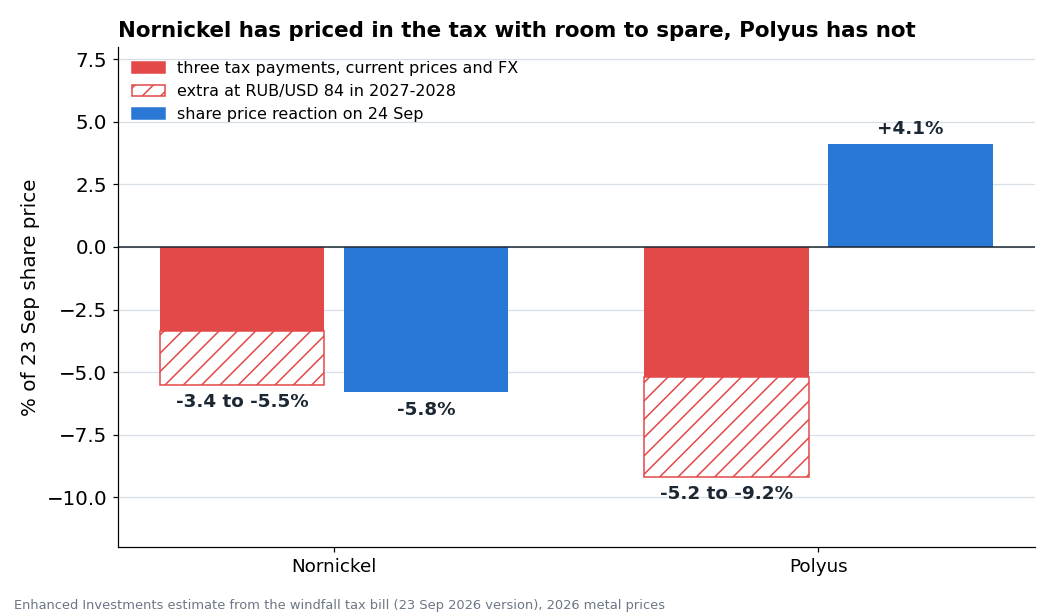
- Nornickel has priced in the tax with room to spare, Polyus has not. The tax costs Nornickel 3.4-5.5% of its market capitalisation, while the shares fell 5.8% on 24 September. For Polyus it is 5-9%, yet the shares rose, and the upside to fair value after the tax is still above 50%.
- Rusal and fertilisers pay almost nothing. Ores are taxed, not aluminium; nitrogen and coal are not on the list, and apatite and potash rose by less than the threshold. Rusal loses through its 26% stake in Nornickel, RUB 17-28 bn, roughly what it lost in market value on 24 September.
- In bonds, the tax matters most for Seligdar. About 10% of EBITDA in 2027 with debt at 3.4x EBITDA, but the burden is temporary.
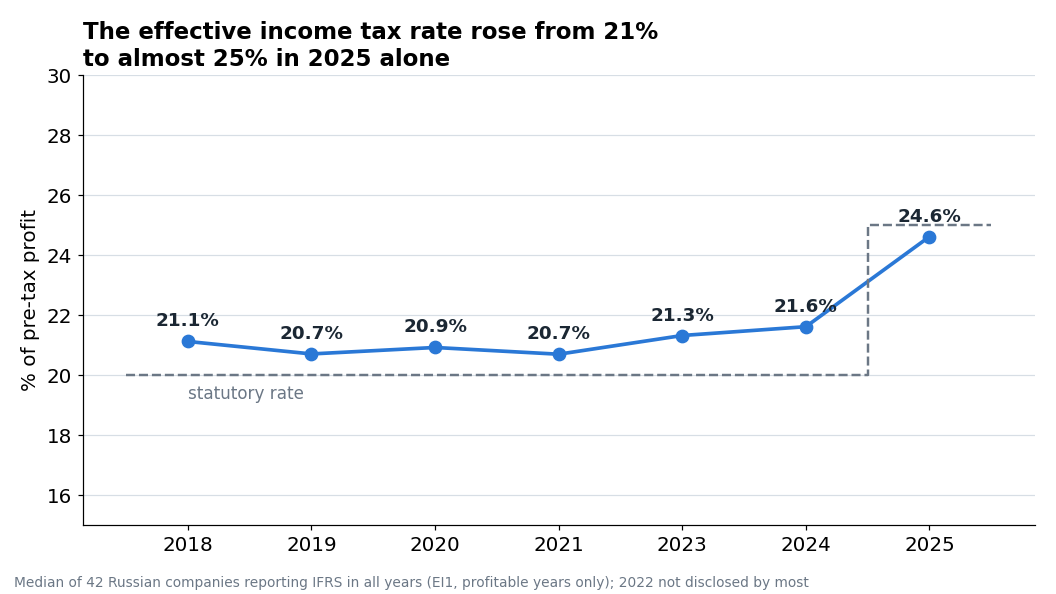
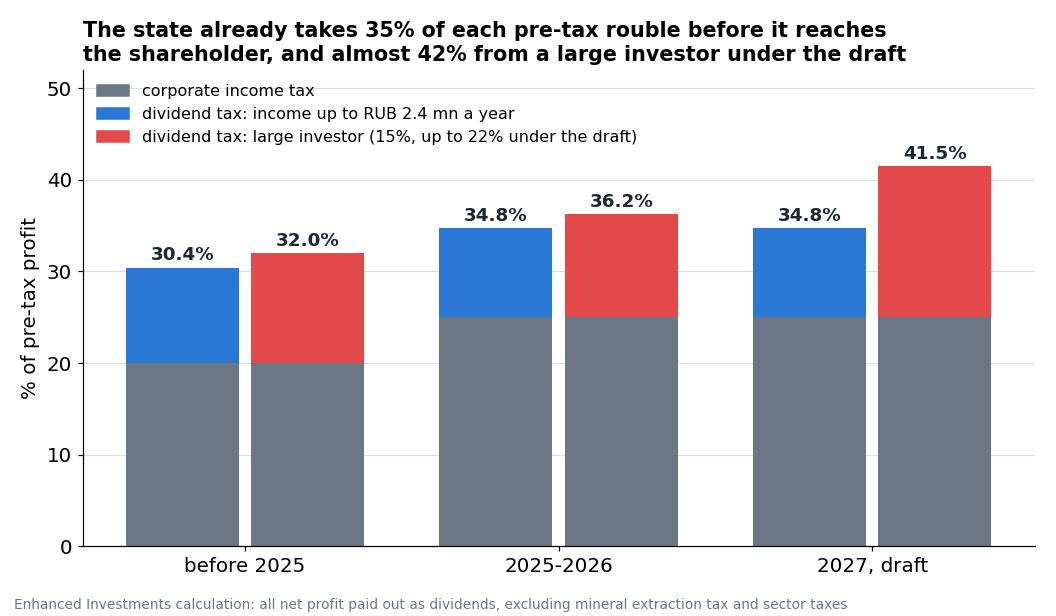
- Taxes on business have been raised almost every year since 2023. The effective income tax rate rose from 21% to almost 25%, and less than two thirds of a pre-tax rouble of profit reaches the shareholder.
Miners pay about RUB 230 bn in 2027, and by 2029 the tax almost disappears
The tax is set out in a separate draft law, "On the windfall tax" (23 September version). It is levied not on profit but on the revenue gain from price: the volume produced per mineral extraction tax (MET) returns, multiplied by the amount by which the average world price in roubles exceeds the 2025 average. The rate is 30%, and 20% for gold. If the rise is below 10%, there is no tax on that commodity. For Nornickel, each ore metal is calculated separately. The tax is paid three times, by 28 April 2027, 2028 and 2029, and the base price is raised each time: multiplied by 1.1 for 2027 and by 1.21 for 2028. There is also a cap: the tax on each type of raw material cannot exceed 15% of its estimated revenue net of MET.
In roubles, almost all metals have risen versus 2025: silver by 69%, platinum by 40%, gold by 24%, copper and palladium by 18%. Nickel rose by only 7% and falls below the threshold. At the same prices in 2027, the 10% threshold above the 1.1x base is passed only by metals that rose by more than 21%: gold, silver, platinum, rhodium and cobalt. Copper and palladium drop out. The amounts below are calculated at current prices and an exchange rate of about RUB 78 per dollar; the second figure in each range assumes RUB 84 in 2027-2028. The base is in roubles, so a weaker rouble raises the tax: over three years the sector would pay about RUB 365 bn, and about RUB 600 bn at RUB 84.
Who pays:
- Gold. The whole industry, at output of about 330 tonnes, pays about RUB 145 bn in 2027 and RUB 85 bn in 2028, and nothing in 2029 at current prices. Polyus pays RUB 29 bn in 2027 and RUB 46-82 bn over three years, UGC RUB 13-22 bn, and Seligdar RUB 7-13 bn over three years. Large private gold miners pay too: Nordgold RUB 22-38 bn, Areal (formerly Highland Gold) RUB 11-20 bn over three years.
- Platinum group metals, copper and nickel. Nornickel pays RUB 43 bn in 2027, RUB 14 bn in 2028 and RUB 9 bn in 2029, RUB 65 bn in total, and up to RUB 107 bn at RUB/USD 84. Nickel is outside the tax, copper and palladium are taxed only in the first year, and after that platinum, rhodium and cobalt pay. We assumed Nornickel's MET at about 7% of revenue; this is our assumption, and it determines whether platinum hits the cap.
- Aluminium. Rusal pays about zero. The draft law taxes commercial ores of non-ferrous metals, that is bauxite and nepheline, not aluminium itself. Rusal's bauxite output in Russia is small, and even if the price rises the tax amounts to a few billion roubles.
- Fertilisers are missed. In the first version of the article we calculated RUB 5-10 bn for Acron and RUB 5-14 bn for PhosAgro, including nitrogen fertilisers. From this sector the draft law covers only apatite and phosphorite ores and potash salts. Nitrogen, made from gas, is not taxed, apatite did not rise in roubles versus 2025, and potash rose by 6%, below the threshold. At current prices PhosAgro, Acron and Uralkali do not pay the tax.
- Who does not pay. Diamonds are not on the list. Iron ore is, but it fell by 6% in roubles. ALROSA, Severstal, MMK and NLMK do not pay the tax.
- Coal is not in the draft law. Thermal coal rose by 13% in roubles and coking coal by 16%, but the tax does not apply to them. For Mechel, Raspadskaya and SUEK this removes the main risk.
Nornickel has priced in the tax with room to spare, Polyus has not
In the first version of the article we treated the tax as permanent and multiplied it by the target EV/EBITDA multiple. Under the text of the draft law the tax is paid three times and shrinks quickly, so it reduces the value of a company by roughly the sum of the three payments. That is what we compare with how the shares moved on 24 September. The MOEX Index barely changed over the day, +0.1%. The text does not say whether the new tax reduces income tax; we assume it does not.
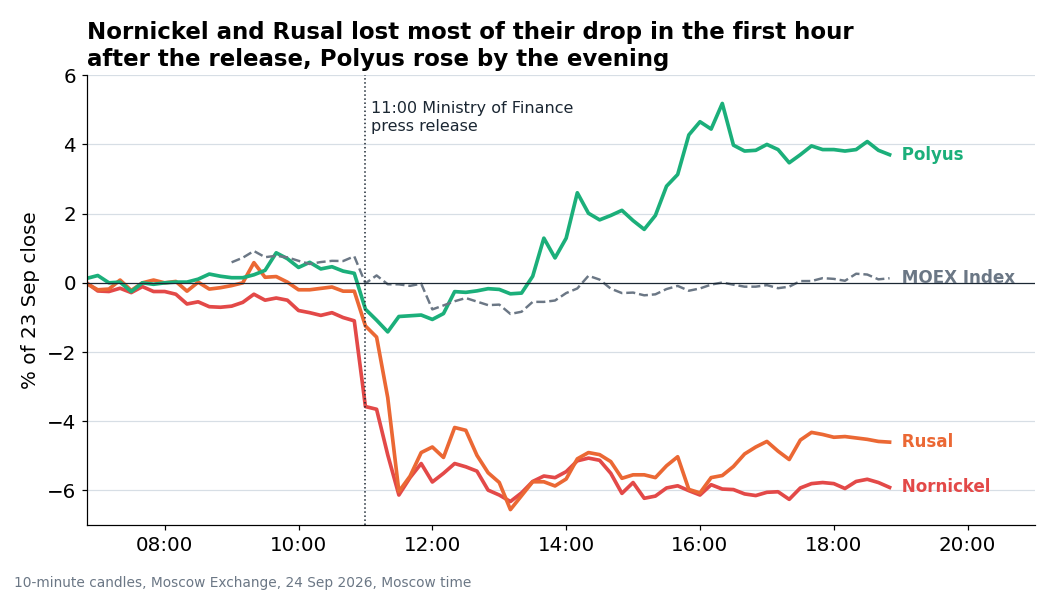
- Nornickel has priced it in with room to spare. Three payments of RUB 65 bn, up to RUB 107 bn with a weak rouble, are RUB 4.3-7 per share, or 3.4-5.5% of the 23 September closing price. The shares fell 5.8%, almost entirely in the hour of publication. Our earlier conclusion that the market had underpriced the tax is not confirmed by the text of the draft law. The dividend is tied to free cash flow: in 2027 the tax will reduce the payout base by about RUB 2.8 per share, and in later years by less than one rouble.
- Polyus has not priced it in, but the conclusion does not change. Three payments of RUB 46-82 bn, RUB 49-87 per share, 5-9% of the price. After the publication the shares lost 1.2% and by the close had risen 4.1%. Fair value in the portal model falls from RUB 1,620 to RUB 1,530-1,570 and stays more than 50% above the market. On 8 July management recommended suspending dividends until 2030, so the tax hits the cash for the Sukhoi Log project, not payouts.
- Rusal loses through Nornickel, not through aluminium. Rusal itself pays almost nothing under the draft law: ore is taxed, not the metal. But it owns about 26% of Nornickel, and RUB 17-28 bn of Nornickel's tax falls to its share. Rusal's shares fell 4.6% on 24 September, about RUB 17 bn of market value, that is, roughly that amount.
- Seligdar. There is no model valuation. The three-year tax of RUB 7-13 bn against a market capitalisation of about RUB 38 bn is 19-33%: with debt four times its market capitalisation, even a temporary tax is noticeable for shareholders. In 2027 it is about 10% of EBITDA.
- PhosAgro and Acron do not pay the tax under the current draft law, and dividends are not at risk. If nitrogen were taxed, PhosAgro would lose RUB 19-28 per share a year (4-6% of its 2025 dividends) and Acron about RUB 88 (16%). This is a risk of amendments at the second reading, not the base case.
All estimates assume that the law is adopted in the 23 September version and that metal prices stay at 2026 levels. If metals rise further, the tax will grow: the threshold and the base are calculated from each year's average prices. If they return to 2025 levels, there will be no tax.
The market reacted within an hour and then barely moved. Nornickel and Rusal took almost all of their loss in the first hour after the 11:00 press release, then traded in a narrow range until the evening. Polyus first lost 1.2% and after 14:00 rose by 5%. We found no news that would explain this rise. The MOEX Index stayed near zero all day, so the fall in Nornickel and Rusal is a reaction to the tax itself.
In bonds, the tax matters most for Seligdar
- Rusal. The direct tax is about zero, and for holders of Rusal's yuan bonds the main question of the previous version, whether aluminium is taxed, is removed by the draft law: ore is taxed. The debt burden stays high regardless of the tax.
- Seligdar. Net debt is already 3.4x EBITDA against a threshold of 3.0x, above which the burden is considered high. A tax of about 10% of EBITDA in 2027 and 6% in 2028 pushes leverage further up, but temporarily.
- Uralkali. Potash rose only 6% versus 2025, below the 10% threshold, so at current prices there is no tax.
- Nordgold and Areal. The tax is RUB 7-14 bn in 2027 and RUB 11-38 bn over three years, but they do not disclose financials, so the effect on their debt cannot be assessed.
- Mechel and coal producers. Coal is not in the draft law, so for holders of their bonds the tax changes nothing.
Since 2023 business taxes have been raised almost every year, and less than two thirds of a pre-tax rouble now reaches the shareholder
The 2027 package is not the first increase. Over the past four years, taxes on companies and their owners have risen almost every year:
- 2023. The one-off windfall profit tax on large business raised [RUB 318.8 bn](https://minfin.gov.ru/ru/press-center/?id_4=38838-byudzhet_poluchil_3188_mlrd_rublei_ot_naloga_na_sverkhpribyl). From 2023 to 2025 Gazprom additionally paid MET of RUB 50 bn a month.
- 2025. Income tax rose from 20% to 25%. The Ministry of Finance estimated the effect at RUB 1.6 trn a year.
- 2026. VAT rose from 20% to 22%. The Ministry of Finance estimates this at RUB 1.19 trn a year, and for 1H2026 the Federal Tax Service counted [RUB 426 bn](https://www.vedomosti.ru/economics/news/2026/07/29/1217244-fns-povishenie). This tax is mostly paid by buyers, but part of it falls on company margins.
- 2027, draft. The windfall tax on miners, about RUB 230 bn in 2027 and less afterwards, and a higher personal income tax on dividends and coupons for large investors.
This is clearly visible in the reporting. The median effective income tax rate of 42 Russian companies that disclose IFRS in all years stayed at about 21% from 2018 to 2024 and rose to 24.6% in 2025. For oil and mining companies the main tax is MET, and it is not visible in income tax. The windfall tax will be added on top of it.
If we add up corporate income tax and dividend tax, of a rouble of pre-tax profit the shareholder received 68-70 kopecks until 2025. Now it is 64-65 kopecks. Under the draft a large investor will receive 58 kopecks: the state takes almost 42%. For commodity companies, MET and the windfall tax come on top.
Marketplaces and companies with type C accounts will barely be hurt by the changes
For the marketplaces themselves the hit is small. Cross-border trade in 2025 was about RUB 450 bn, roughly 4% of all online retail in Russia (RUB 11.5 trn, according to AKIT). If it shrinks by 15-25%, that is less than 1% of the platforms' turnover, and part of the demand will go to Russian sellers on the same Ozon and Wildberries. The downside is an additional burden: the platforms will become tax agents and will calculate and remit VAT on behalf of foreign sellers.
The issuer pays the same dividend, but more of it goes to the budget. This does not affect company profit or the exchange rate: money from type C accounts does not reach the currency market anyway. A foreigner with a type C account will receive 23.5% less.
This is one of three articles on the 2027 budget package:
- Taxes for companies
- [Taxes for private investors](https://telegra.ph/Investor-Tax-15-to-22-09-24)
- [Budget rule, the rouble and the key rate](https://telegra.ph/Budget-2027-Cutoff-50-Taxes-09-24)
The text of the draft law will decide the outcome
What to check in it:
- whether the windfall tax reduces income tax and whether the 10% threshold and the 1.1 and 1.21 escalating base are kept;
- whether the list is expanded by the second reading, to nitrogen fertilisers, coal, or aluminium as a metal rather than ore;
- when VAT on foreign purchases takes effect and whether it will be phased in.
The package still has to be approved by the government and the State Duma. In 2024 the parameters of the tax reform were amended before the second reading, so the figures may change.
See also: market overview · valuation map · stock screeners