Food prices are rising 13% annualised after the election: what it means for X5 and the key rate
There is a suspicion that retail chains held prices back before the State Duma election on 18–20 September and raised them straight afterwards. Below is a check against weekly data from Rosstat and the Ministry of Economic Development: what the numbers show, where they give no clear answer, and what follows for X5 shares and for the key rate.
After the election, food excluding fruit and vegetables is rising at about 13% annualised. That is two to three times faster than in the two weeks before the election.
- All food including fruit and vegetables has also accelerated: from −2% annualised in the two weeks before the election to +5% in the two weeks after. It is held back from speeding up further by the cheap harvest, which offsets about half of the price growth in other foods.
- The statistics cannot tie the increase specifically to the election. Food producer prices rose 1.9% as early as August, and the chains could have been passing them through to the shelf with the usual lag.
- For X5, faster prices mean LFL turning up for the first time in more than a year. Over 11 years X5's like-for-like sales have almost tracked food inflation, while the margin has not depended on it.
- Faster LFL alone does not move the share, but together with the December dividend and a low price it adds one more argument in favour of X5. Over 30 reports, the share's reaction to changes in LFL was at noise level.
- For the key rate this is an argument for a pause at the 23 October meeting. A cut in October becomes less likely.
Food excluding fruit and vegetables is rising 13% annualised after the election against 4–7% before it
Rosstat records weekly prices on Mondays. The week of 15–21 September ends on Monday 21 September, the first day after the election. In exactly that week price growth for food excluding fruit and vegetables jumped to 0.24% per week, after 0.07% and 0.11% in the first two weeks of September. The following week, 22–28 September, showed the same 0.24%.
Weekly figures are easier to compare when annualised. 0.24% a week is equivalent to about 13% annualised. In August the pace was 7–7.5% annualised, and in the first half of September 4–6%. A year ago, in the same weeks, food excluding fruit and vegetables was rising 5–8% annualised.
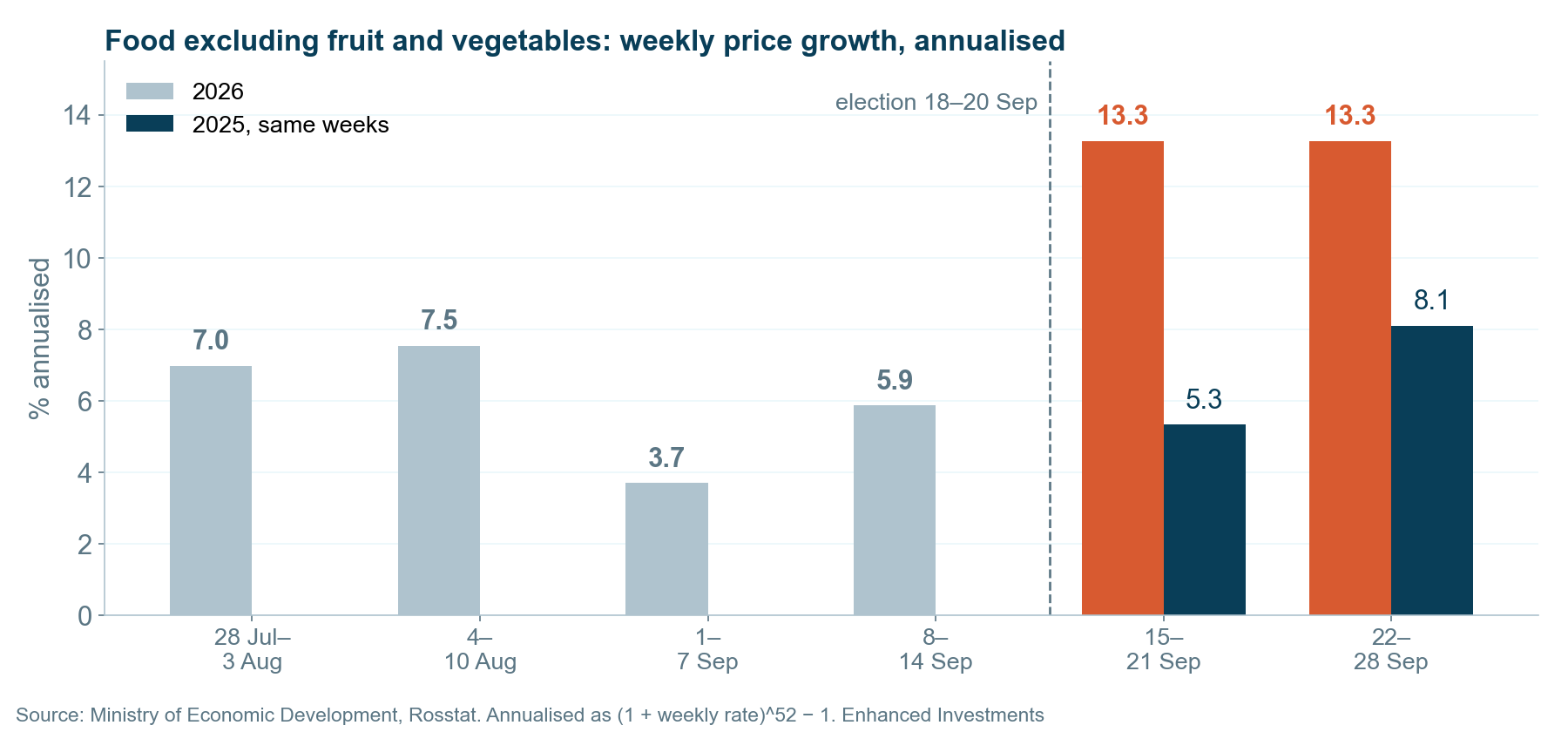
Eggs are rising fastest: +2.4% and +1.9% in the two weeks after the election. Buckwheat and millet add 0.4–0.8% a week, frozen fish 0.6–0.7%, pork and chicken 0.4–0.5%, rice 0.5%. Eggs and buckwheat have their own reasons. Eggs have been rising since mid-August, and this year's buckwheat sowing is the smallest in recent history. But the increase is across many groups at once, including meat, fish, butter and cottage cheese.
All food has also accelerated: from −2% to +5% annualised in two weeks
Including fruit and vegetables the acceleration is more modest, but it is there too. In the first week of September food prices fell (−0.09% for the week), and in the second they were almost unchanged (+0.01%). Over those two weeks together that is −2.1% annualised. After the election growth was +0.08% and +0.12% a week, +5.3% annualised over the two weeks together. The annualised pace rose by more than 7 pp in two weeks.
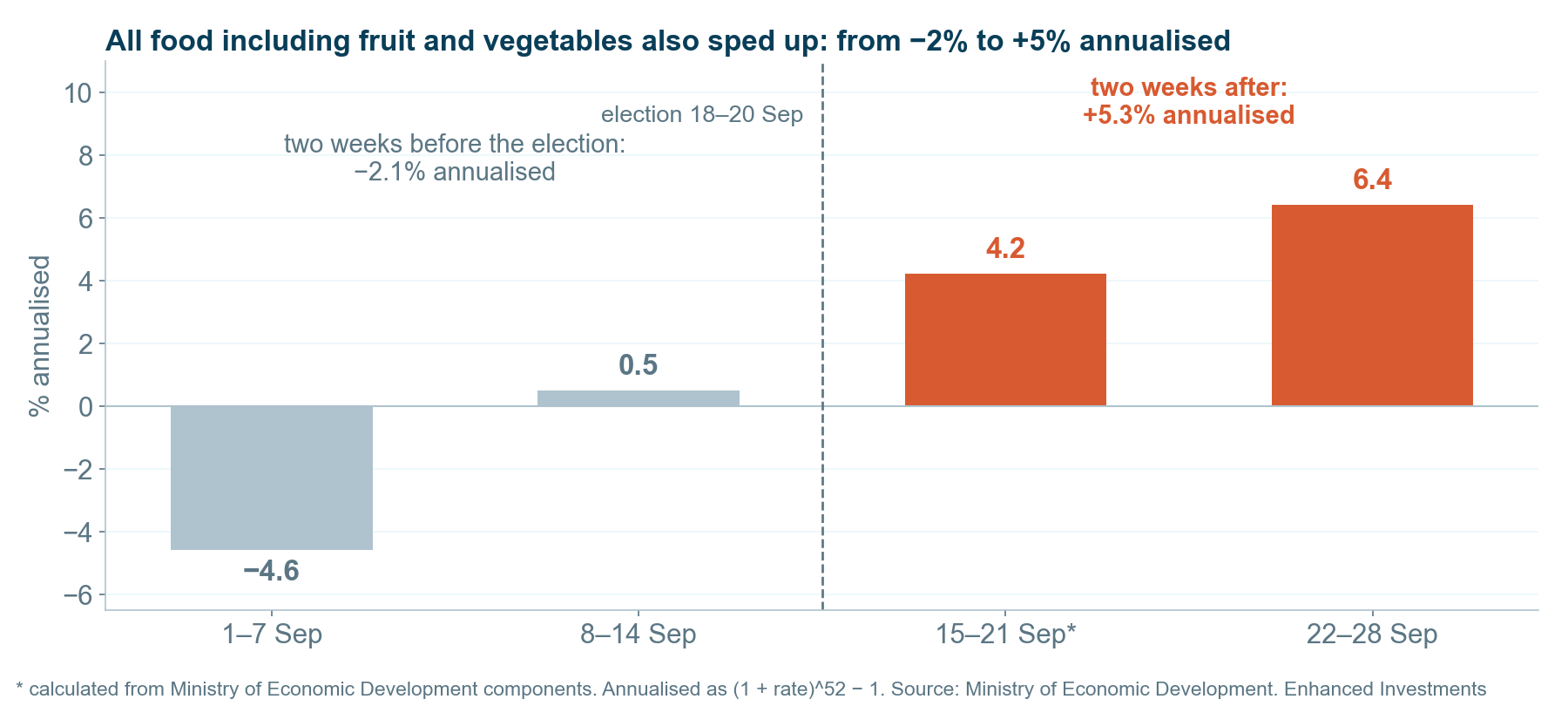
That is why overall weekly inflation also looks modest: 0.06% and 0.12% in the two weeks after the election. Annual inflation is holding at about 6.25%. Since the start of the year prices have risen 4.93%, against 4.29% a year earlier.
Cheap vegetables offset half of the price growth, but by November this cushion usually disappears
Throughout September fruit and vegetables fell 1–1.8% a week. Potatoes, cabbage, carrots, onions and apples fell the most. Their share of the weekly food basket is about 8–9% (an estimate from Ministry of Economic Development data). That is enough to offset between a third and a half of the price increase in other foods.
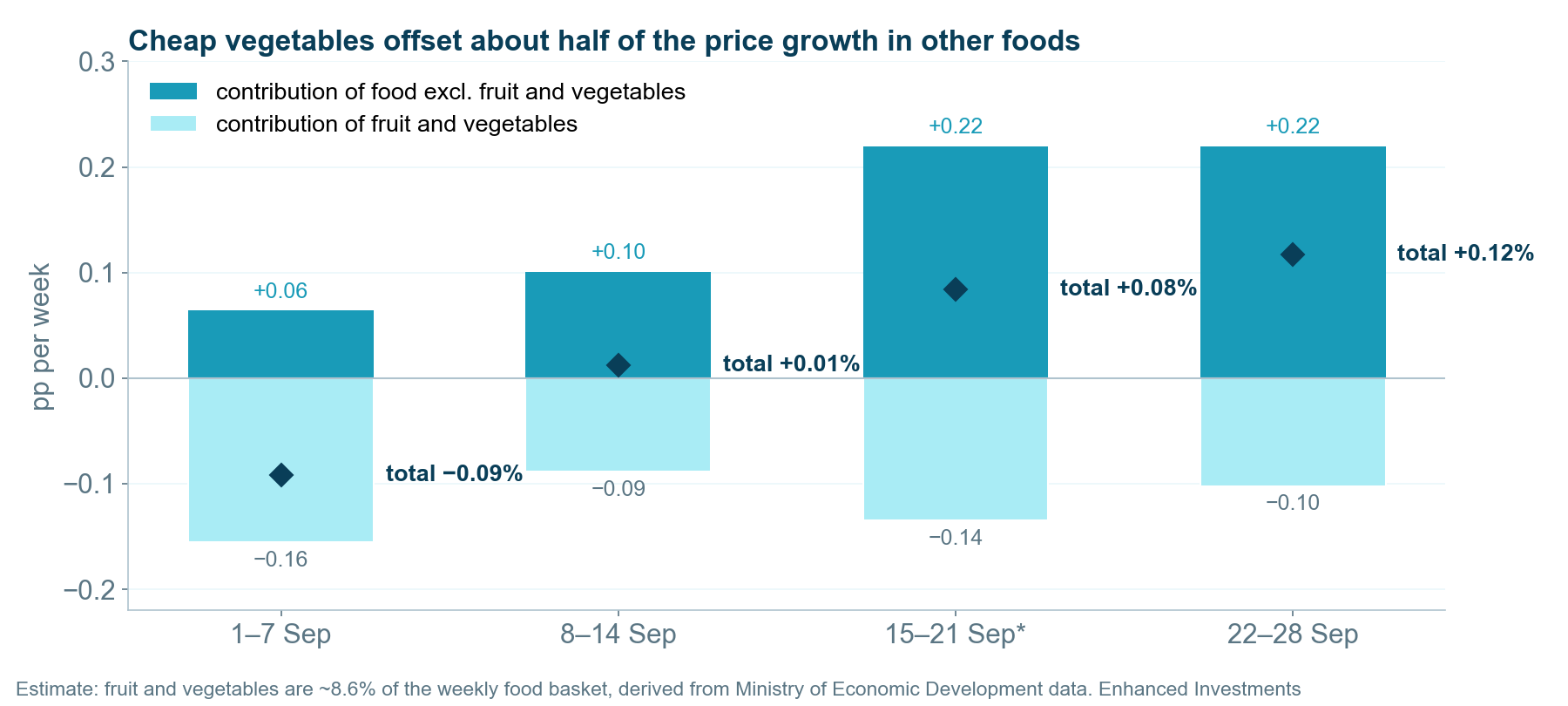
The seasonal fall in harvest prices usually ends by October or November. If other foods keep rising at the current pace, overall food price growth in weekly data will rise to 10–13% annualised. For now this is a scenario: only two weeks of observations have passed since the election.
The link to the election cannot be proven from the data: producers raised prices as early as August
The coincidence in timing is obvious, and on social media store employees write about mass repricing right after the election. There is another explanation for the increase. Food producer prices, according to Rosstat, rose 1.9% month on month in August. Chains usually pass purchase prices through to the shelf with a lag of one to two months, and that lag falls at the end of September.
The statistics cannot separate the two versions. For an investor something else matters more: whether growth continues in October. The answer will come from Rosstat's weekly data, which is published on Wednesdays.
For X5, faster prices offer a chance to catch up with the revenue guidance, but do not guarantee margin growth
X5 guides for 2026 revenue growth of 12–16%. In 1Q revenue grew 11.3% and in 2Q 9.9%. Like-for-like sales (LFL, revenue of stores open for more than a year) grew 6.1% and 4.2%. Basket inflation at X5 in 2Q was only 3.4%, and management tied the slowdown in growth precisely to the sharp fall in food inflation.
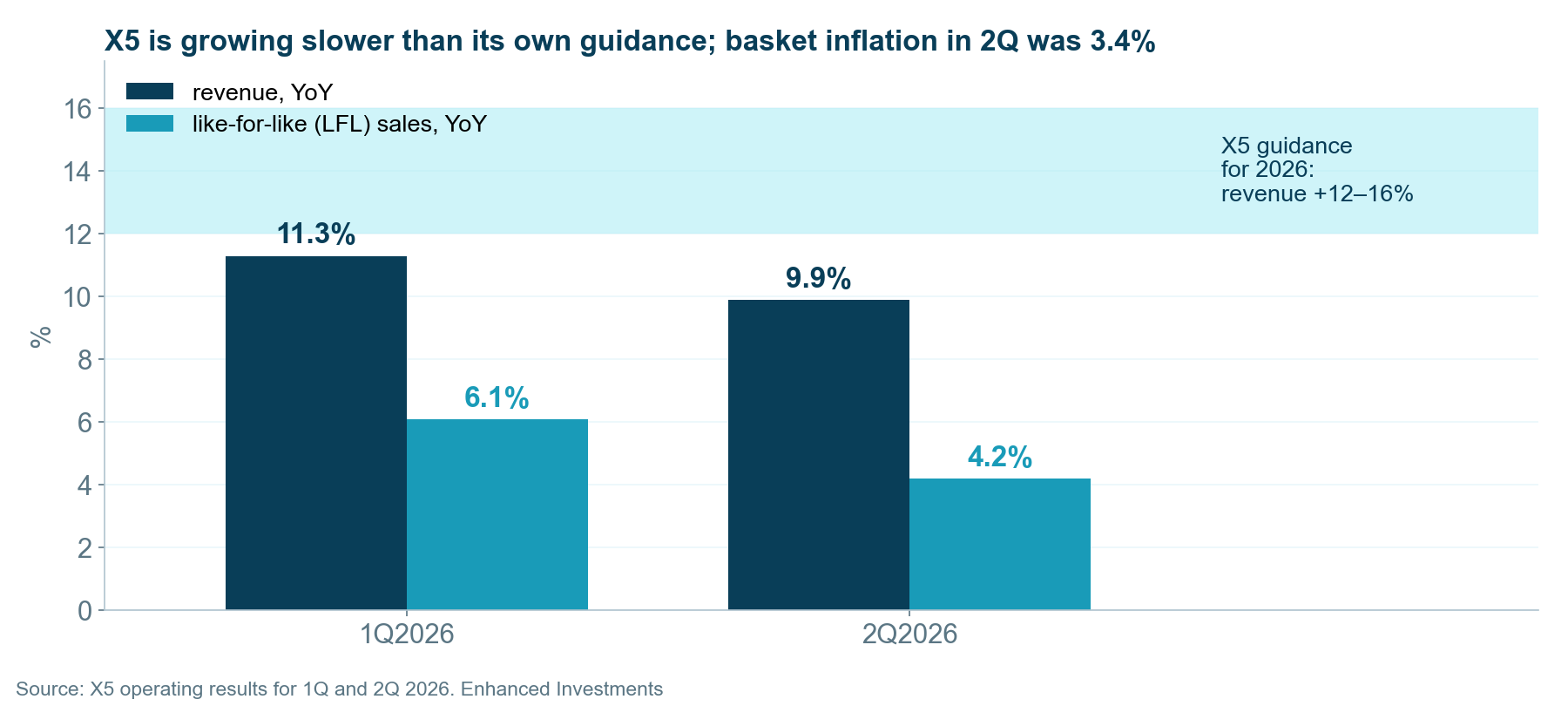
X5's LFL has a very stable link to food prices. Over 46 quarters since 2015 the correlation between like-for-like sales and Rosstat food inflation was 0.77. Since 2018 each percentage point of food inflation has added about 0.7 pp to LFL. Deviations arise from the company's own factors. In 2023–2024 LFL ran ahead of inflation by 4–7 pp thanks to the growth of Chizhik and market share, and since the end of 2025 it has again almost matched it.
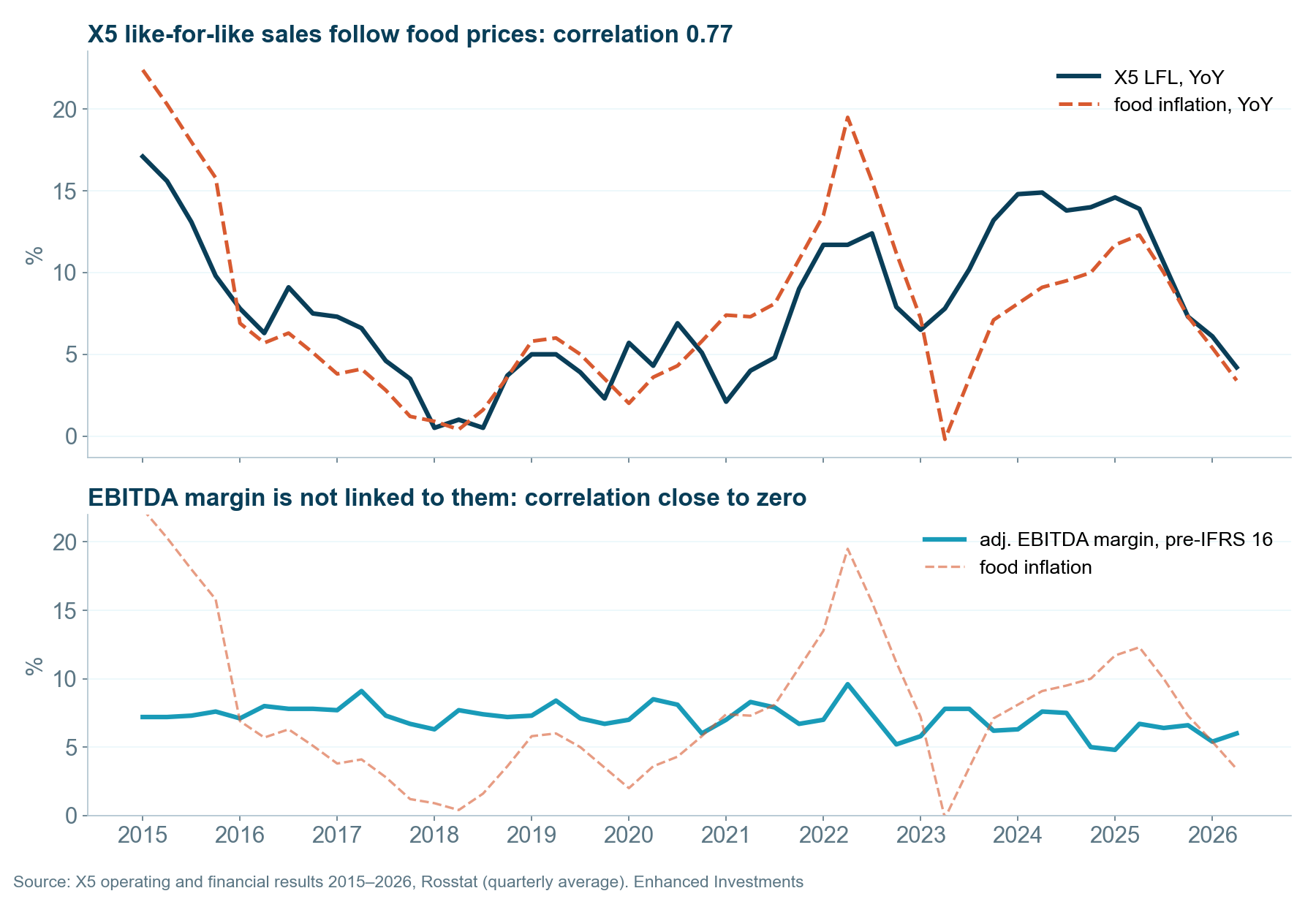
There is no such link with the EBITDA margin: the correlation is close to zero. In 2024–2025 food prices rose 9–12% while the margin fell to 4.8–6.7%. It was eaten up by wage growth, delivery costs and a rising share of the discounter.
To reach at least the lower bound of the guidance, revenue in 2H must grow by about 13% (an estimate). Without faster shelf prices this is hard to achieve. If food excluding vegetables keeps rising at the current pace, LFL in 4Q on the historical relationship could be about 4.5–6.5% against 4.2% in 2Q. That would be the first acceleration after five consecutive quarters of slowdown.
There are limits as well.
- The price growth comes from suppliers. The chain passes it on to the shelf, but gross margin does not rise by itself as a result.
- The state is watching prices of basic foods. The government has approved a list of 24 products for price monitoring along the whole chain from 2027. A sharp price rise right after the election gives a reason to return to the conversation about mark-ups.
- Shoppers are moving to cheaper formats. Chizhik revenue grew 29.8% in 2Q and Pyaterochka 7.6%. The discounter has a lower margin.
- Two weeks of data is too little. This could be a one-off repricing after a pause, not a new trend.
The first test is X5's 3Q operating results, expected in mid-October. Only the last days of September fall into that quarter, so management's comments on October prices will matter more. A full test is the 4Q results in January.
Repricing alone does not move the X5 share, but together with the dividend and a low price it adds one more argument
The share's reaction to operating reports was tested on 30 releases since 2018, using Moscow Exchange trading. Over the two days around a release, the stock's return in excess of the Moscow Exchange index is unrelated to the change in LFL versus the previous quarter: the correlation is 0.02. The average move on those days is ±2.7%, and an LFL acceleration of 1 pp or more gave on average only half a percentage point better result than a slowdown. One reason is that the whole market sees Rosstat's weekly data, so the approximate LFL is known before the report.
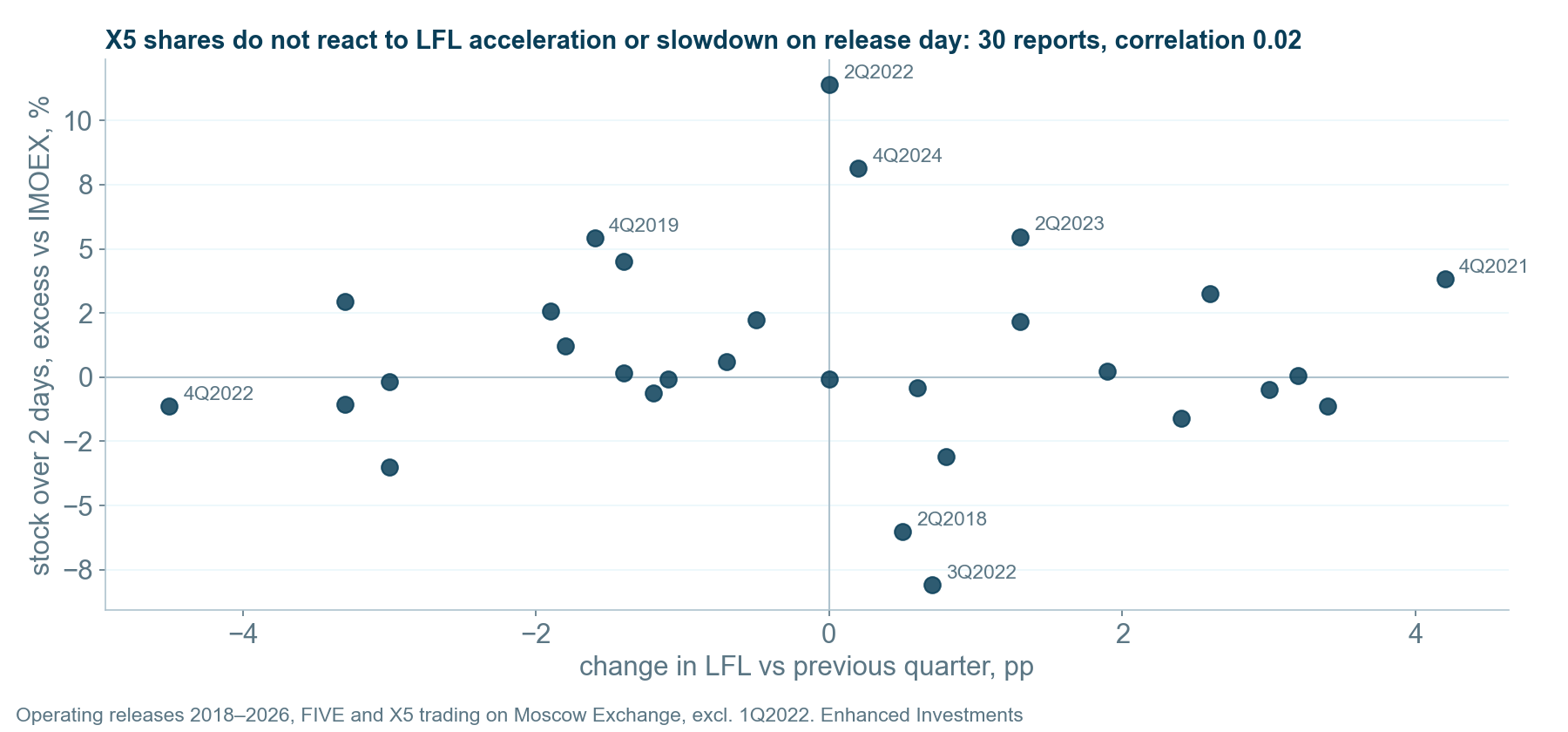
Over a quarter-long horizon the link is weak but positive: X5's excess return over the market correlates with the LFL level at 0.38. Years with LFL of 10–14% (2022 and 2024) were strong for the share. So an LFL acceleration works as an additional argument, not as a standalone reason to buy.
The main argument for the coming months is the dividend. The X5 supervisory board recommends the interim payment in mid-November, and the record date falls in early January. The size is calculated from EBITDA and debt: in practice the company keeps net debt together with the year's dividends at about 1.4 times annual EBITDA, and about 60% of the annual amount falls on the December tranche. By this formula the tranche is estimated at RUB 100–170, or 5–9% of the RUB 1,926 price on 1 October. The estimate is rather cautious: in November 2025 the board of directors recommended RUB 368, almost 40% more than the market expected (about RUB 265). The share is also 45% below its March 2025 level (RUB 3,508).
Faster food prices alone do not promise share price growth. But against the background of a 5–9% December dividend and a price 45% below the peak, they add one more argument for X5: for the first time in more than a year LFL stops slowing.
The events line up in time as follows.
- End of October: 3Q financial report; mid-November: dividend recommendation. Faster prices have almost no effect on the size of the payment, which depends on EBITDA and debt.
- November–December: Rosstat's weekly data show in advance an acceleration of LFL in 4Q. In exactly this period faster prices can support the share, and expectations for 2027 revenue stop falling.
- Early January: record date, after which the share usually falls by about the size of the dividend.
- End of January: 4Q operating results. An LFL acceleration may soften the drop after the record date, but history does not promise a strong reaction on the day of the report.
Two risks work against this scenario. If wages and the share of Chizhik again eat up the margin, the dividend will be closer to RUB 100. And the same price growth pushes back a cut in the key rate, which is the main backdrop for the dividend story.
For the key rate this is an argument for a pause on 23 October
On 11 September the Bank of Russia kept the key rate at 14% and noted that sustained inflation had accelerated to 5–6% annualised. The central bank's inflation forecast for 2026 is 6–7%. The next meeting will be on 23 October.
Food excluding fruit and vegetables is the closest to what the central bank calls sustained inflation: it has no seasonal swings from the harvest. A pace of 13% annualised for two weeks in a row sits poorly with a rate cut. SberCIB analysts even before this data considered keeping the rate in October more likely.
There is a flip side too. Annual inflation is about 6.25% and is not rising yet, and cheap vegetables noticeably pull the September index down. If in October the pace for food returns to 0.1% a week, the September surge will turn out to be a one-off repricing, and the question of a rate cut in December will stay open.
What to watch next: weekly prices on Wednesdays, X5 in mid-October, the central bank on 23 October
- Rosstat's weekly inflation on Wednesdays. If food excluding vegetables stays above 0.2% a week, the trend is confirmed.
- Rosstat's monthly inflation for September in mid-October.
- X5's 3Q operating results in mid-October, the dividend recommendation in mid-November.
- The Bank of Russia rate decision on 23 October.
Sources: [Interfax, 22–28 Sep](https://www.interfax.ru/business/1119451), [Interfax, 15–21 Sep](https://www.interfax.ru/business/1118032), [Interfax, 8–14 Sep](https://www.interfax.ru/business/1116480), [PRIME, Ministry of Economic Development data as of 28 Sep](https://1prime.ru/20260930/inflyatsiya-873821120.html), [Rosstat, 1–7 Sep](https://rosstat.gov.ru/storage/mediabank/137_09-09-2026.html), [Bank of Russia, decision of 11 Sep](https://www.cbr.ru/press/keypr/), [X5, 2026 guidance](https://www.x5.ru/ru/news/x5-predstavila-prognozy-i-orientiry-na-2026-god/), [Vedomosti, X5 in 2Q](https://www.vedomosti.ru/investments/news/2026/07/16/1214122-x5-narastila-viruchku), [X5, operating and financial results 2015–2026](https://www.x5.ru/ru/investors/), [Rosstat, quarterly price indices](https://rosstat.gov.ru/storage/mediabank/ipc_kv2_2005-2026.xlsx), FIVE and X5 quotes from the Moscow Exchange.
More analytics in the Telegram channel Enhanced Investments, company cards on the portal.
See also: market overview · valuation map · stock screeners